
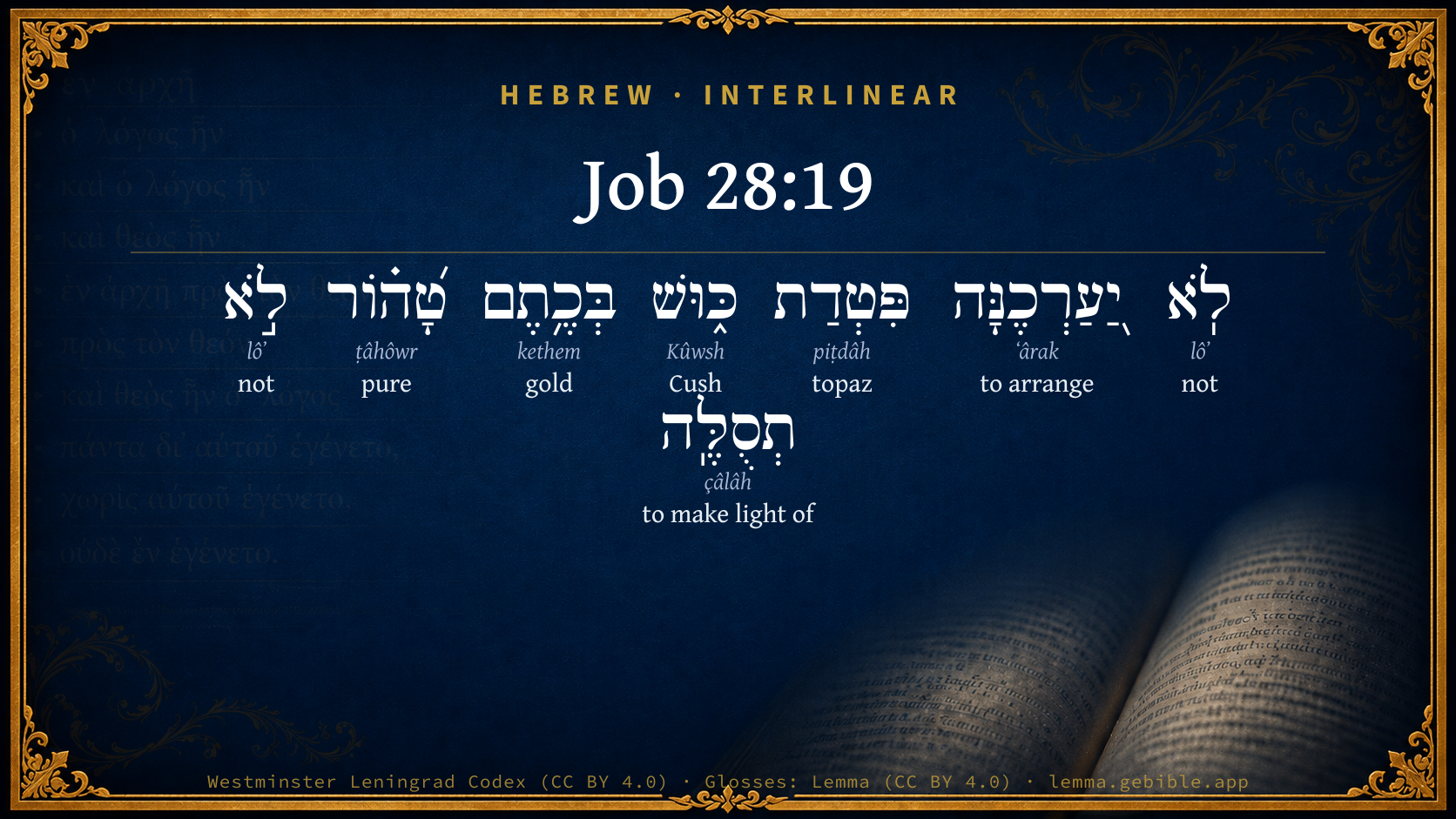
Job 28:19

Hebrew (Westminster Leningrad Codex) Job 28:19 appears in the Hebrew Old Testament. The text above is from the Westminster Leningrad Codex. Each word links to its Strong’s number, a concise gloss, and parsing drawn from the Open Scriptures Hebrew Bible morphology. Click any word for its full Brown-Driver-Briggs (BDB) entry.
Download image
Cite this verse

Job 28:19 (World English Bible). Public Domain. Lemma interlinear Bible study tool, https://lemma.gebible.app/v/job/28/19.

Show BibTeX & RIS
BibTeX
RIS
English Translation
The topaz of Ethiopia shall not equal it, Neither shall it be valued with pure gold.
World English Bible · Public Domain
Download a study sheet

One document with this verse’s original text, its word-by-word gloss line, the meaning frame, cross-references with their text, attributed commentary, and full source and license credits — printable, and it pastes into notes with its structure intact.

This verse Autodidact and up

Study sheet (.html) Plain text (.txt)

A passage Seminary Student

Up to 50 verses in one chapter. A passage sheet keeps up to 6 commentary sources and 12 cross-references per verse, in the order this page ranks them, and says so on the sheet whenever that leaves anything out. Ask for a single verse and you get the Autodidact verse sheet above.

Everything on this page stays free to read, with no account — the sheet is a download of what is already on screen, not access to it.

Want to remove ads? Support Godless Engineer
Compare translations 3

The same verse in 3 English versions, stacked beneath the original-language interlinear above. Click any original word for its lexicon entry.

Each is an independent rendering of the whole verse — the interlinear is not word-aligned to these translations.

Highlighted words mark where these versions differ — a whole-verse word diff, not a word-by-word alignment.

  • World English Bible Public Domain
    The topaz of Ethiopia shall not equal it, Neither shall it be valued with pure gold.
  • King James Version Public Domain
    The topaz of Ethiopia shall not equal it, neither shall it be valued with pure gold.
  • unfoldingWord Literal Text CC BY-SA 4.0
    The topaz of Cush does not equal it; it is not valued in pure gold.

unfoldingWord Literal Text — © unfoldingWord, licensed CC BY-SA 4.0. Word-aligned USFM3 via Door43 (git.door43.org/unfoldingWord/en_ult).

Versions to compare (up to 4)

3 of 4 selected

Show all 18 translations

Every available English version of this verse, each an independent rendering of the whole verse.

  • World English Bible Public Domain
    The topaz of Ethiopia shall not equal it, Neither shall it be valued with pure gold.
  • Berean Standard Bible Public Domain
    Topaz from Cush cannot compare to it, nor can it be valued in pure gold.
  • Majority Standard Bible Public Domain
    Topaz from Cush cannot compare to it, nor can it be valued in pure gold.
  • King James Version Public Domain
    The topaz of Ethiopia shall not equal it, neither shall it be valued with pure gold.
  • American Standard Version (1901) Public Domain
    The topaz of Ethiopia shall not equal it, Neither shall it be valued with pure gold.
  • Revised Version (1885) Public Domain
    The topaz of Ethiopia shall not equal it, neither shall it be valued with pure gold.
  • Geneva Bible (1599) Public Domain
    The Topaz of Ethiopia shall not be equall vnto it, neither shall it be valued with the wedge of pure gold.
  • Douay-Rheims (1899) Public Domain
    The topaz of Ethiopia shall not be equal to it, neither shall it be compared to the cleanest dyeing.
  • Young's Literal Translation Public Domain
    Not equal it doth the topaz of Cush, With pure gold it is not valued.
  • Literal Standard Version CC BY-SA 4.0
    The topaz of Cush does not equal it, || It is not valued with pure gold.
  • Unlocked Literal Bible CC BY-SA 4.0
    The topaz of Cush does not equal it; neither can it be valued in terms of pure gold.
  • unfoldingWord Literal Text CC BY-SA 4.0
    The topaz of Cush does not equal it; it is not valued in pure gold.
  • Darby Bible Public Domain
    The topaz of Ethiopia shall not be compared to it, neither shall it be set in the balance with pure gold.
  • World Messianic Bible Public Domain
    The topaz of Ethiopia will not equal it. It won’t be valued with pure gold.
  • Webster's Bible Public Domain
    The topaz of Cush shall not equal it, neither shall it be valued with pure gold.
  • Free Bible Version CC BY-SA 4.0
    Topaz from Ethiopia can't compare with it; it cannot be bought with the purest gold.
  • Bible in Basic English Public Domain
    The topaz of Ethiopia is not equal to it, and it may not be valued with the best gold.
  • JPS Tanakh (1917) Public Domain
    The topaz of Ethiopia shall not equal it, neither shall it be valued with pure gold.

Literal Standard Version (2020), Covenant Press — licensed CC BY-SA 4.0. Text via the HelloAO Bible API (eBible.org). Unlocked Literal Bible (unfoldingWord) — licensed CC BY-SA 4.0. Text via the HelloAO Bible API (eBible.org). unfoldingWord Literal Text — © unfoldingWord, licensed CC BY-SA 4.0. Word-aligned USFM3 via Door43 (git.door43.org/unfoldingWord/en_ult). Free Bible Version, Dr. Jonathan Gallagher — licensed CC BY-SA 4.0. Text via the HelloAO Bible API (eBible.org).

Word by word

More ways to search: Search by grammar → Find every occurrence → Compare this word →

Practice this passage: Drill this verse → Learn its vocabulary →

About this verse

These counts appear in no published source. They are computed here, from the morphology-tagged text and Lemma’s own curated glosses. What Lemma adds →

8
words
7
distinct lemmas
Wisdom
section

Notable vocabulary

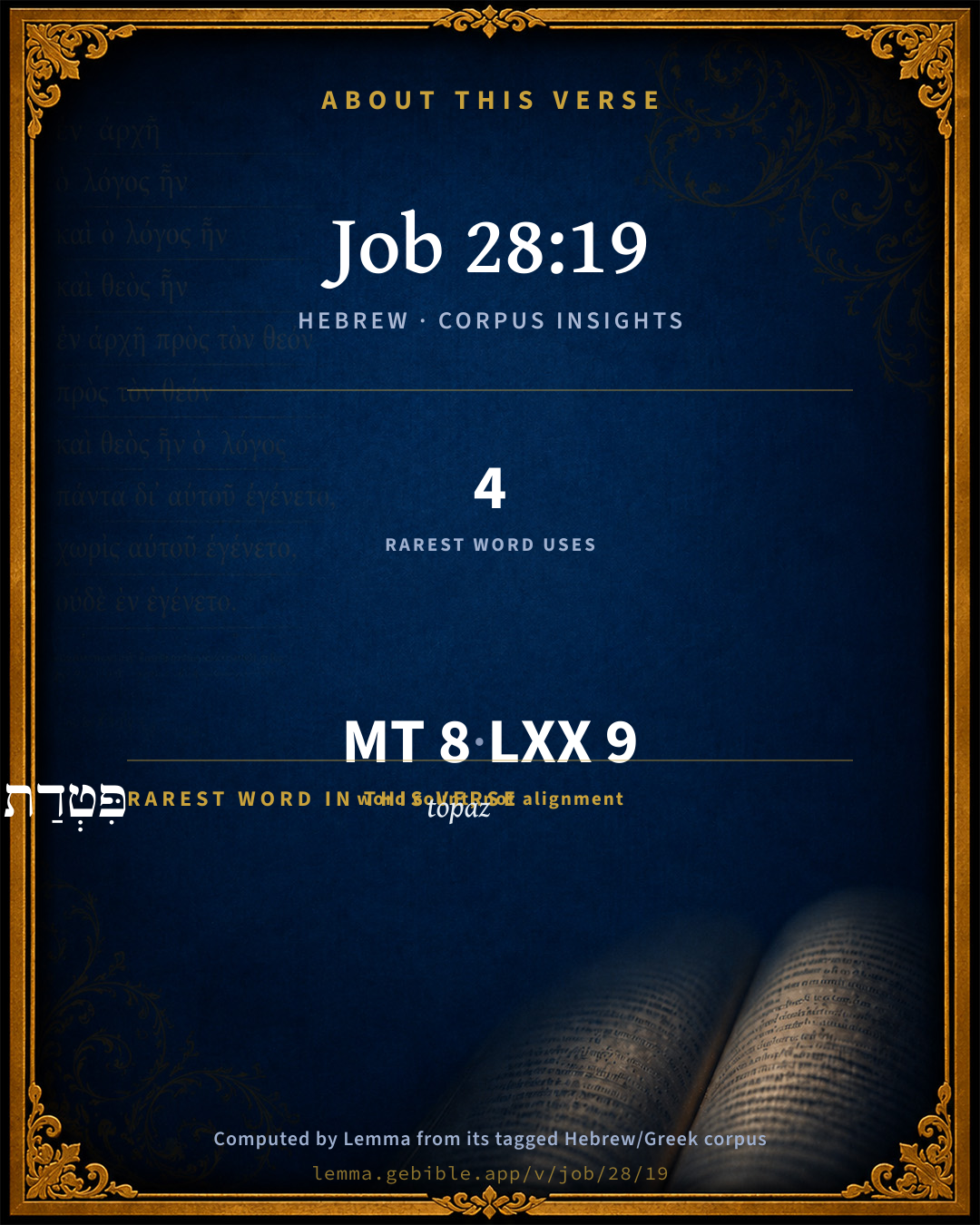
The rarest word here is פִּטְדַת topaz H6357 — appearing just 4 times in the whole Hebrew Bible.

Shared distinctive vocabulary

פִּטְדַת topaz H6357 occurs in 4 verses of the Hebrew Bible. Also found in:

Grammatical profile

  • 2 verbs
  • 3 nouns
  • 1 adjective
  • 2 particles

Verb forms

  • יַ֭עַרְכֶנָּה Qal · Imperfect
  • תְסֻלֶּֽה Pual · Imperfect

Repetition

A word recurs within this verse — often emphatic in Hebrew:

Hebrew & Septuagint length

In English translation the verse runs 16 words from the Hebrew and 18 from the Septuagint (LXX English) — closely comparable.

A rough comparison of the two English renderings, which tokenize alike — not a word-level alignment.

Word counts can differ between the Hebrew and the Greek without any difference in meaning — e.g. the Hebrew direct-object marker אֵת has no separate Greek word, and Greek often adds the article ὁ.

In the original languages it is 8 Hebrew tokens and 9 Greek tokens — but the two are counted differently (Hebrew bundles its prefixes and suffixes into one token; the Greek is in lemma form), so that isn’t a like-for-like length.

Cross-references

5

Topical passages linked to Job 28:19 in the Treasury of Scripture Knowledge — connected by theme and wording, ordered by reader-vote popularity; previews shown in the World English Bible.

  • Exodus 28:17 You shall set in it settings of stones, four rows of stones: a row of ruby, topaz, and beryl shall be the first row;
  • Exodus 39:10 They set in it four rows of stones. A row of ruby, topaz, and beryl was the first row;
  • Proverbs 8:19 My fruit is better than gold, yes, than fine gold; My yield than choice silver.
  • Ezekiel 28:13 You were in Eden, the garden of God; every precious stone adorned you: ruby, topaz, emerald, chrysolite, onx, jasper, sapphire, turquoise, and beryl. Gold work of tambourines and of pipes was in you. In the day that you were created they were prepared.
  • Revelation 21:20 the fifth, sardonyx; the sixth, sardius; the seventh, chrysolite; the eighth, beryl; the ninth, topaz; the tenth, chrysoprasus; the eleventh, jacinth; and the twelfth, amethyst.

Cross-references courtesy of OpenBible.info (CC BY 4.0).

Hebrew and Greek witnesses Masoretic Hebrew ↔ Greek Septuagint

The same verse in the two great witnesses to the Old Testament, shown verse-for-verse.

These are two independent witnesses, not word-aligned to each other, and the Septuagint is shown in lemma (dictionary) form.

Hebrew Job 28:19 Masoretic · Westminster Leningrad Codex

לֹֽא יַ֭עַרְכֶנָּה פִּטְדַת כּ֑וּשׁ בְּכֶ֥תֶם טָ֝ה֗וֹר לֹ֣א תְסֻלֶּֽה

The topaz of Ethiopia shall not equal it, Neither shall it be valued with pure gold.

World English Bible · Public Domain

Greek LXX Job 28:19 Septuagint · lemma form

οὐ ἰσόω αὐτός τοπάζιον αἰθιοπία χρυσίον καθαρός οὐ συνβαστάζω

The topaz of Ethiopia shall not be equalled to it; it shall not be compared with pure gold.

LXX2012 (modern English Septuagint) · Public Domain

On this verse, Albert Barnes' Notes on the Bible discusses the Septuagint’s reading. Read the note in Commentary ↓

Hebrew: Westminster Leningrad Codex (CC BY 4.0). Greek: Septuagint (public domain); English from LXX2012 (modern English Septuagint) (Public Domain). How the Septuagint differs from the Hebrew →

Commentary

Notes on Job 28:19 from classic Christian and Jewish commentators (each source and its license shown beneath its notes). The classic Christian expositions comment on the surrounding passage and are grouped to its opening verse, so a note may address several verses; the Jewish commentaries on the Tanakh (Rashi and others) are per-verse, so they appear only where the commentator wrote on this verse.

Lemma curates 59 commentaries, every one of them public domain or Creative Commons licensed, each selected and text-cleaned for this edition rather than reprinted as found. About our sources →

Trapp's Complete Commentary

John Trapp

Job 28:19 The topaz of Ethiopia shall not equal it, neither shall it be valued with pure gold.

Ver. 19. The topaz of Ethiopia shall not equal it] Of the Topaz, see Plin. lib. 86, cap. 8. It seemeth to have the lustre of gold and purity of crystal, and those agreeable mixtures of colours which make the purple of kings. The operations of this stone are many and rare, as Rueus sets them forth, lib. 2, cap. 3.

Neither shall it be valued with pure gold] Plato saith as much of moral wisdom, Oυτε χρυσυς, ουτε αδαμας, ουτως αστραπτει, No gold or gem so glistereth. And elsewhere he saith, that if moral virtue could be beheld with mortal eyes, mirificos sui amores excitaret, it would wonderfully enamour men. Aurelius the emperor would say, that he would not leave the knowledge he might learn in one hour for all the gold that he possessed. Alphonsus, king of Arragon, professed that he would rather choose to lose his jewels than his books, his kingdoms (whereof he had many), quam litteras, quas permodicas scire dicebat, than that little learning he had attained unto (Val. Max. Christian. 118,237). Many have been so taken with the study of the mathematics, that they could have lived and died in it. Vae igitur stupori nostro, woe then to the world because of wisdom! this incomparable wisdom of God in a mystery, as the apostle calleth it.

Haec quia pro vili, sub pedibusque iacet (Ovid).

Money is most men’s study, not without a horrible neglect of piety, which yet is the principal thing, Pro 4:7, and profitable to all things, 1Ti 4:8, as that which hath the promise of both lives, Ibid. Now the promises are exceeding great and precious things, 2Pe 1:4, even the unsearchable riches of Christ, Eph 3:8. Such gold as cannot be too dearly bought, Mat 13:44; Mat 13:46, nor too far set, no, though so far as the queen of Sheba came to hear the wisdom of Solomon, and could have been content to have changed her throne for his footstool. Sure it is she was no niggard, but parted with abundance of precious things and sweet odours for that wisdom which she held, and worthily, far more sweet and precious than all her annual revenue. Sure it is, that if the mountains were pearl, the huge rock rubies, and the whole globe a shining chrysolyte, yet all this were nothing to the worth of the wisdom here commended. How greatly bound then are God’s people to bless his name for communicating unto us this invaluable treasure by his word and Spirit, 1Co 2:13 Hath he not written for us excellent things in counsels and knowledge? Pro 22:20; hath he not made his Son, that essential wisdom of his, to become unto us wisdom, righteousness, sanctification, and redemption? 1Co 1:30. Should some earthly prince give us a rich ring off his finger, wherein there were a chrysolyte, a sapphire, a topaz, or some other precious stone, how highly would we honour him, and what would we not be ready to do or suffer for him? And shall we not much more do so for God, rich in mercy, plenteous in goodness, abundant in kindness and in truth, who giveth us all things richly to enjoy? O pray for that blessed sight, Eph 1:18; Eph 3:18, and reckon one grain of grace more worth than all the gold of Ophir, one remnant of faith beyond all the gorgeous and gay attire in the world.

John Trapp, A Commentary or Exposition upon All the Books of the Old and New Testament (1647–1656) — public domain. Text from a community e-Sword module.

Jamieson, Fausset & Brown

Robert Jamieson, A. R. Fausset & David Brown

Ethiopia--Cush in the Hebrew. Either Ethiopia, or the south of Arabia, near the Tigris.

Jamieson, Fausset & Brown — Commentary Critical and Explanatory on the Whole Bible (1871) — public domain (CC PDM 1.0). Text via the HelloAO Bible API.

Adam Clarke's Commentary

Verse 19. The topaz of Ethiopia] The country called Cush, which we call Ethiopia, is supposed to be that which extends from the eastern coast of the Red Sea, and stretches towards Lower Egypt. Diodorus Siculus says that the topaz was found in great abundance, as his description intimates, in an island in the Red Sea called Ophiodes, or the isle of serpents, Hist. lib. iii., p. 121. His account is curious, but I greatly doubt its correctness; it seems too much in the form of a legend: yet the reader may consult the place.

See also Clarke on "Job 28:16".

Adam Clarke's Commentary on the Bible (1810–1826) — public domain. Text from a community e-Sword/MySword module.

The Cambridge Bible for Schools and Colleges

gen. ed. J. J. S. Perowne

19. equal it] See on Job_28:17.

be valued] See on Job_28:16.

The Cambridge Bible for Schools and Colleges (gen. ed. J. J. S. Perowne; Cambridge University Press, 1878–1918) — public domain. Text from a community e-Sword module.

John Gill's Exposition

The topaz of Ethiopia shall not equal it,.... Not Ethiopia Abyssinia, or that which lies beyond Egypt in Africa; for, as Ludolphus (x) says, there are no gems found there, or very rarely; but Cush, as the word is, or Arabia Chusaea, the same with the country of Midian, and the parts adjacent; see Hab 3:7; hence Zipporah, the wife of Moses, who was of that country, is called an Ethiopian woman, Num 12:1; and this was near Job's country, who knew the produce of it; and here the topaz is found, as many writers observe. Diodorus Siculus says (y), in Ophiodes, an island in the Arabian gulf, belonging to the Troglodytes, the topaz is found, which is a very clear stone, pleasant to the sight, like to glass, and affording a wonderful golden colour; and with him Strabo (z) agrees, who relates there is an island called Ophiodes, from its being freed from serpents by the king's orders, which killed men that came there for topazes; which, he says, is a clear stone of a golden colour, and so refulgent, that it is not easy to see it in the daytime, being so surrounded with light; but at night it is seen by those that gather it, who set a vessel for a sign, and then dig for it in the daytime; and, he adds, a multitude of men are hired by the kings of Egypt, to gather and keep these stones, and men from stealing them; and, according to Archelaus (a), the topaz is found in Chitis, an island in Arabia, where the Troglodytes digging for herbs and roots find it; and, as Juba relates (b), there is an island called Topazion, in the Red sea, three hundred furlongs (about 73 miles) from the continent, which is cloudy, and is therefore often sought for by navigators; whence he says it had its name Topazion, which in the language of the Troglodytes signifies to seek, and the topaz itself in their language so signifies; in the Samaritan version of Exo 39:10; it is called Dachetah, from the Arabic word (c) "Dachatz", the language of the Troglodytes, which signifies to seek and search by removing the earth with the foot. This island seems to be the same with Topazos, which Pliny (d) says is an island of the Arabians, and gave name to a gem, meaning the topaz; but the truth rather is, that the gem gave name to the island: upon the whole, it is no wonder, as Braunius (e) observes, that this gem should be called by Job the Arabian topaz. The Targum here calls it a green pearl; and some have thought the emerald is meant, which is of that colour; and the emeralds of Ethiopia are praised by some, according to Juba (f); and in Egypt were emerald mines the Ethiopians laid a claim to (g); and there were emeralds also in Arabia, as the above Juba relates; however, be this what it may, as it is most likely to be the topaz, it is not equal in value to wisdom, no, not the largest topaz ever known; not even that of the great Mogul, which weighs more than an hundred fifty seven carats, valued at 271,500 French pounds (h); and according to Tavernier (i) it weighs almost an hundred fifty eight carats, and was bought at Goa for almost 272,000 florins:

neither shall it be valued with pure gold; that is most refined and freed from dross; they are not to be laid together as of equal value; See Gill on Job 28:16, where the same word is used.

(x) Hist. Ethiop. l. 1. c. 7. (y) Bibliothec. l. 3. p. 172. (z) Geograph. l. 16. p. 529. (a) Apud Plin. Nat. Hist. l. 37. c. 8. (b) Apud ib. (c) Vid. Castel. Lex. Heptaglott. col. 686, 693. (d) Nat. Hist. l. 6. c. 29. (e) De Vest. Sacerdot. Heb. p. 649. (f) Apud Plin. Nat. Hist. l. 37. c. 5. (g) Heliodor. Ethiop. l. 8. 1. & 9. 6. (h) Scheuchzer. Physic. Sacr p. 747. (i) Apud Braunium de Vest. Sacerdot. Heb. p. 649, 650.

John Gill's Exposition of the Whole Bible (1746–1763) — public domain (CC PDM 1.0). Text via the HelloAO Bible API.

Albert Barnes' Notes on the Bible

The topaz - The topaz is a precious stone, whose colors are yellow, green, blue, and red. Its natural place is in various primitive rocks, such as the topaz-rock, gneiss, and clay-slate. It is found in the granite and gneiss districts of Mar and Cairnaorta, in Cornwall, in Brazil, and in various other places. The most valuable stones of this kind now known are those which are found in Brazil. This gem is much prized by jewelers, and is considered as one of the more beautiful ornamental stones. The Hebrew word פטדה pı̂ṭdâh, occurs in Exo 28:17; Exo 39:10; Eze 28:13. and in this place only. It is uniformly rendered topaz. It is not improbable that the English word “topaz,” and the Greek τοπάζιον topazion, are derived from this, by a slight transposition of the letters - טפדה. The Vulgate and the Septuagint render this “topaz.”

Of Ethiopia - Hebrew כוּשׁ kûsh - “Cush.” Coverdale here renders it, “India.” On the meaning of this word, and the region denoted by it, see the notes at Isa 11:11. It may mean either the part of Africa now known as Ethiopia, or Abyssinia and Nubia; the southern part of Arabia, or the Oriental Cush in the vicinity of the Tigris. It is better, since the word has such ambiguity, to retain the original, and to translate it “Cush.” For anything that appears, this may have denoted, in the time of Job, the southern part of Arabia. It is known that the topaz was found there. Thus, Pliny says, Lib. xxxvii. 32, Reperta est - in Arabiae insula, quae Citis vocatur; in qua Troglodytae praedones, diutius fame - prossi cum herbas radicesque effoderant, eruerunt topazion.

Albert Barnes' Notes on the Bible (1834–1885) — public domain. Text from a community e-Sword/MySword module.

Haydock's Catholic Bible Commentary

Ethiopia, on the east of the Red Sea. Pliny ([Natural History?] vi. 29.) mentions the isle of Chuthis, which was also famous for the topaz. --- Dying. Hebrew cethem, (Haydock) which we have observed relates to gold, ver. 16.

George Leo Haydock (1774–1849), Haydock's Catholic Family Bible and Commentary, 1859 edition — public domain. Excludes Psalms (Douay-Rheims chapter numbering differs from Protestant) and Deuterocanonical books (Catholic canon only).

Matthew Poole's English Annotations

The topaz; of which see Exo 28:17; 39:10.

Of Ethiopia, or, of Arabia; for Cush signifies both Ethiopia and Arabia; and the topaz was found in the Red Sea, which lay between both, and so might be ascribed to either.

Matthew Poole's English Annotations on the Holy Bible (1683–1685) — public domain. Text from a community e-Sword/MySword module.

Whedon's Commentary on the Bible

Daniel D. Whedon

19. Topaz — A most precious gem, whose prevailing colour was wine-yellow, passing over into carnation red, lilac, or a pale green. Professor Eadie states that a single topaz has sold for more than a million dollars. See Pliny, xxxvii, sec. 32. All Semitic nations displayed an absorbing passion for jewels and precious stones. Jdg_8:24; Eze_28:13, etc. As with the King of Tyre, their aspiration was to be covered with precious stones. Before the imagination, kindled with the contemplation of earth’s treasures, celestial wisdom urges her own incomparable worth.

Ethiopia — Hebrew, Cush. “Where the south declines,” says Herodotus, (iii, 114,) “toward the setting sun, lies the country called Ethiopia, the last inhabited land in that direction.”

Daniel D. Whedon (gen. ed.), Commentary on the Old and New Testaments (1874–1909) — public domain. Text from a community e-Sword module.

The Pulpit Commentary

The topaz of Ethiopia shall not equal it. It is generally allowed that the pithdath (tdfpi) is either the "topaz" or the "chrysolite." In favour of its being the chrysolite is the passage of Pliny which mentions its being esteemed for its green tints ("Hist. Nat.," 37:8). Otherwise "topaz" might have appeared to be the best rendering. By "Cush," here translated "Ethiopia," is probably meant Cushite Arabia, or the southern and south-eastern regions (see the author"s "Origin of Nations," pp. 206-209). Neither shall it be valued with pare gold. Of the four words used for "gold" in this passage (vers. 15-17), one (bhz) seems to be the common name, and to designate the metal by its coleus, "yellow," since bhx means "to be yellow" Another (rWgs) means properly "what is treasured," or "shut up," from rgs, "to shut." The third (zp) seems to be the name for "native gold," or that found in river-washings and nuggets, which was regarded as the purest. The fourth ( is a poetical name only, and designates gold of extreme purity, (Son_5:11) whether highly refined or native. Job uses them all, to show that there was no gold of any kind wherewith it was possible to purchase wisdom.

The Pulpit Commentary (1880–1919), ed. H.D.M. Spence-Jones & Joseph S. Exell — public domain. Text from a community e-Sword module.

Rashi

Rabbi Shlomo Yitzchaki (Rashi)

The topaz of Kush It is a precious stone, as in (Exod. 28:17), “ruby, topaz (פטדה).” with...jewelry Heb. בכתם. That is a collection of jewelry for women’s adornments, and this collection is called כֶּתֶם in Hebrew, and “al halls” in Arabic. That is (Prov. 25:12) “Like a golden earring and jewelry of the finest gold (וחלי כתם),” and similarly (Hosea 2:15), “and adorned herself with her earrings and her jewelry (וחליתה).” Others interpret כֶּתֶם like כֶּתֶר, a crown, but it is incorrect because we do not find a verb with this root, as we find with כֶּתֶר. מַכְתִּיר, to crown or surround, כותרות capitals.

Rashi on the Tanakh — English translations: “The Judaica Press complete Tanach with Rashi, translated by A. J. Rosenberg” (CC BY 4.0); “Pentateuch with Rashi's commentary by M. Rosenbaum and A.M. Silbermann, 1929-1934” (public domain); “The Metsudah Tanach series, Lakewood, N.J” (CC BY 4.0); and “The Book of Joshua, Metsudah Publications, 1997” (CC BY 4.0). Text via Sefaria.

Lesson kit

Teaching starters — assembled from the data on this page, not authored interpretation. Every prompt links to the verse data it draws on. Edit before teaching.

Job, in the Wisdom, opens this verse with 8 words (7 distinct Hebrew lemmas). Its most distinctive word is piṭdâh (“topaz”). A historical commentator’s framing appears above. Read the whole chapter for the surrounding context.

Discussion questions

  1. How does “topaz” (piṭdâh) shape what this verse is saying?
  2. How does Exodus 28:17, which shares the word «topaz», read alongside this verse?
  3. What does the repetition of “not” (2× in this one verse) do in this verse?
  4. These translations render this verse differently. What is at stake in choosing one wording over another?
  5. «יַ֭עַרְכֶנָּה» is a Qal Imperfect verb. How does that grammatical form shape the action described?
  6. Compare how Trapp's Complete Commentary and Jamieson, Fausset & Brown read this verse. Where do they agree or differ?

Things to notice

Reading settings

Reading text

Shown beneath each verse's original-language words.

Old Testament
Old Testament edition

Read the OT as the Masoretic Hebrew (MT) or the Greek Septuagint (LXX).

English shown for the Greek Septuagint (in the Hebrew ↔ Greek comparison).

Comparing translations? Open the Compare panel on any verse page to stack up to four side by side.