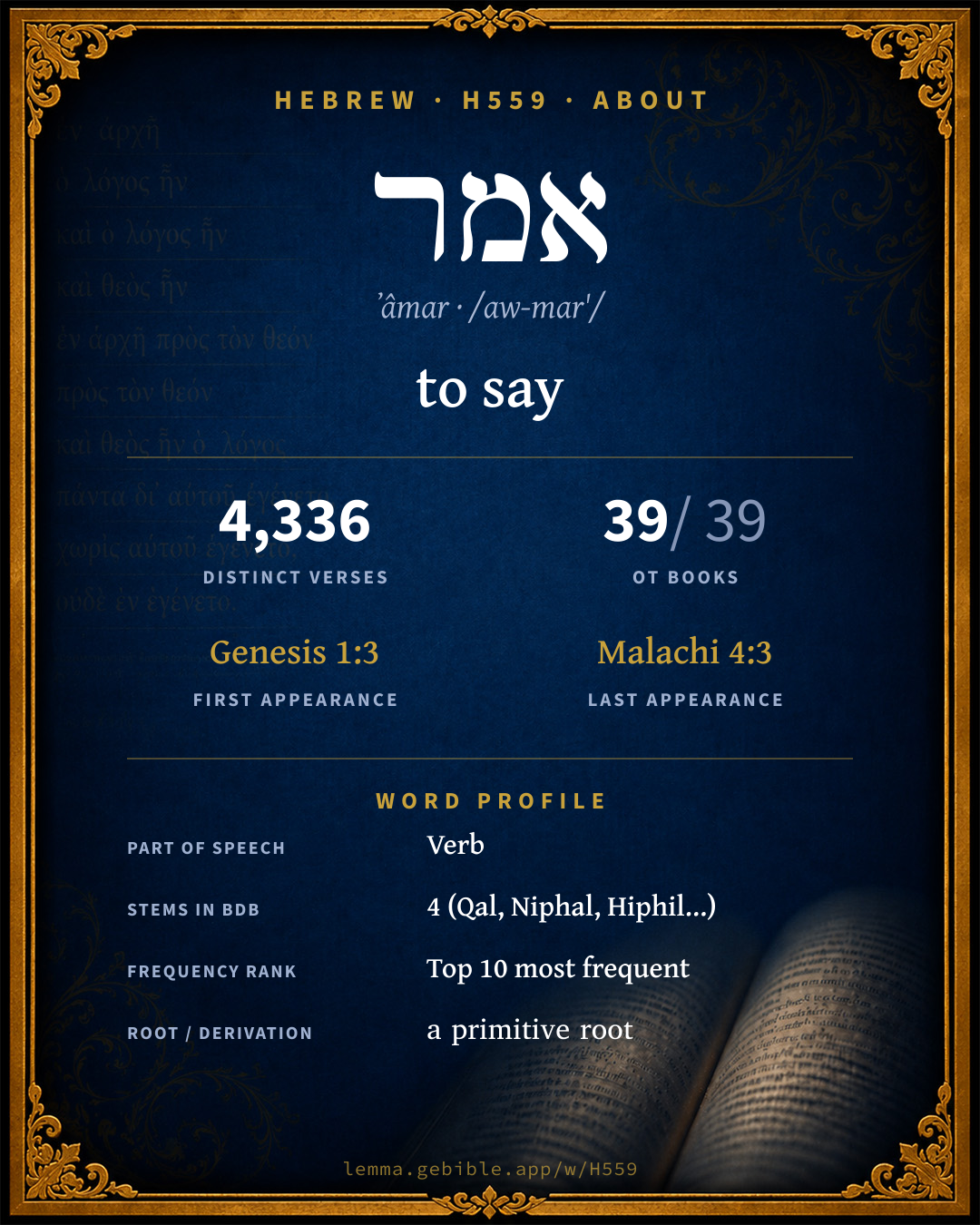
אָמַר
to say
also: speak, utter fuller range ↓
Full lexicon entry — Brown-Driver-Briggs (BDB)
From Brown-Driver-Briggs (BDB)
Where this word appears
See every Qal verb in the Hebrew Bible →
Grammar key — what these labels mean
Part of speech
- Verb
- An action or state-of-being word.
Stem
- Qal
- The basic, simple active stem — the plain form of the verb (“he wrote”).
- Niphal
- Usually the simple passive or reflexive of the Qal (“he was written”).
- Hiphil
- The causative active stem (“he caused / brought about”). Here: ‘avow’
- Hithpael
- The reflexive or reciprocal stem (the subject acts on itself).
Form
- Sequential Imperfect
- An imperfect with prefixed waw — the standard past-narrative form (waw-consecutive imperfect).
- Infinitive Construct
- A bound verbal noun, frequently with prepositions (“to write / in writing”).
- Perfect
- A completed action or state — Hebrew marks aspect (completeness) more than strict tense (“he wrote”).
- Sequential Perfect
- A perfect with prefixed waw continuing a preceding imperfect or command (waw-consecutive perfect).
- Imperative
- A direct command (“write!”).
- Imperfect
- An incomplete, ongoing, or future action (“he will / would write”).
- Participle Active
- A verbal adjective expressing ongoing or characteristic action (“writing / one who writes”).
- Jussive
- A third- or second-person volitional form expressing wish or command (“let him write”).
- Infinitive Absolute
- An unbound verbal noun, often intensifying or standing in for a finite verb.
- Cohortative
- A first-person volitional form expressing wish or resolve (“let me / let us write”).
- Participle Passive
- A verbal adjective expressing action received (“written”).
State
- Absolute
- The independent form of a noun, not bound to a following word.
Person
- 3rd Person
- The one spoken about (“he / she / it / they”).
- 2nd Person
- The one addressed (“you”).
- 1st Person
- The speaker (“I / we”).
Gender
- Masculine
- Grammatically masculine.
- Feminine
- Grammatically feminine.
- Common
- Either gender — not distinguished for this form.
Number
- Singular
- One.
- Plural
- More than one (in Hebrew, generally three or more).
21 verses where H559 appears in the Qal stem in the Book of Daniel. Filtered view — show all forms. Click any verse to open its interlinear word-by-word view. Verse text shown in the World English Bible for context — . Each verse’s Hebrew form is shown with its reference; the English is not keyword-highlighted, since the data carries no word-level English alignment. Use “Compare translations” on any verse to read it across multiple English versions. This concordance covers the Hebrew Bible; Septuagint (Greek Old Testament) occurrences are not indexed here.
Daniel
- Daniel 1:3 וַ/יֹּ֣אמֶר conj + Qal wimpf 3ms The king spoke to Ashpenaz the master of his eunuchs, that he should bring in [certain] of the children of Israel, even of the seed royal and of the nobles;
- Daniel 1:10 וַ/יֹּ֜אמֶר conj + Qal wimpf 3ms The prince of the eunuchs said to Daniel, I fear my lord the king, who has appointed your food and your drink: for why should he see your faces worse looking than the youths who are of your own age? so would you endanger my head with the king.
- Daniel 1:11 וַ/יֹּ֥אמֶר conj + Qal wimpf 3ms Then said Daniel to the steward whom the prince of the eunuchs had appointed over Daniel, Hananiah, Mishael, and Azariah:
- Daniel 1:18 אָמַ֥ר Qal pf 3ms At the end of the days which the king had appointed for bringing them in, the prince of the eunuchs brought them in before Nebuchadnezzar.
- Daniel 2:2 וַ/יֹּ֣אמֶר conj + Qal wimpf 3ms Then the king commanded to call the magicians, and the enchanters, and the sorcerers, and the Chaldeans, to tell the king his dreams. So they came in and stood before the king.
- Daniel 2:3 וַ/יֹּ֧אמֶר conj + Qal wimpf 3ms The king said to them, I have dreamed a dream, and my spirit is troubled to know the dream.
- Daniel 8:13 וַ/יֹּאמֶר֩ conj + Qal wimpf 3ms Then I heard a holy one speaking; and another holy one said to that certain one who spoke, How long shall be the vision [concerning] the continual [burnt-offering], and the disobedience that makes desolate, to give both the sanctuary and the host to be trodden under foot?
- Daniel 8:14 וַ/יֹּ֣אמֶר conj + Qal wimpf 3ms He said to me, To two thousand and three hundred evenings [and] mornings; then shall the sanctuary be cleansed.
- Daniel 8:16 וַ/יֹּאמַ֔ר conj + Qal wimpf 3ms I heard a man's voice between [the banks of] the Ulai, which called, and said, Gabriel, make this man to understand the vision.
- Daniel 8:17 וַ/יֹּ֤אמֶר conj + Qal wimpf 3ms So he came near where I stood; and when he came, I was frightened, and fell on my face: but he said to me, Understand, son of man; for the vision belongs to the time of the end.
- Daniel 8:19 וַ/יֹּ֨אמֶר֙ conj + Qal wimpf 3ms He said, Behold, I will make you know what shall be in the latter time of the indignation; for it belongs to the appointed time of the end.
- Daniel 9:4 וָ/אֹֽמְרָ֗/ה conj + Qal wimpf 1cs + sfx h I prayed to Yahweh my God, and made confession, and said, Oh, Lord, the great and dreadful God, who keeps covenant and loving kindness with those who love him and keep his commandments,
- Daniel 9:22 וַ/יֹּאמַ֕ר conj + Qal wimpf 3ms He instructed me, and talked with me, and said, Daniel, I am now come forth to give you wisdom and understanding.
- Daniel 10:11 וַ/יֹּ֣אמֶר conj + Qal wimpf 3ms He said to me, Daniel, you man greatly beloved, understand the words that I speak to you, and stand upright; for to you am I now sent. When he had spoken this word to me, I stood trembling.
- Daniel 10:12 וַ/יֹּ֣אמֶר conj + Qal wimpf 3ms Then said he to me, Don't be afraid, Daniel; for from the first day that you did set your heart to understand, and to humble yourself before your God, your words were heard: and I am come for your words' sake.
- Daniel 10:16 וָ/אֹֽמְרָ/ה֙ conj + Qal wimpf 1cs + sfx h Behold, one in the likeness of the sons of men touched my lips: then I opened my mouth, and spoke and said to him who stood before me, my lord, by reason of the vision my sorrows are turned on me, and I retain no strength.
- Daniel 10:19 וַ/יֹּ֜אמֶר וָ/אֹֽמְרָ֛/ה conj + Qal wimpf 3ms conj + Qal wimpf 1cs + sfx h He said, "Greatly beloved man, don't be afraid: peace be to you, be strong, yes, be strong." When he spoke to me, I was strengthened, and said, "Let my lord speak; for you have strengthened me."
- Daniel 10:20 וַ/יֹּ֗אמֶר conj + Qal wimpf 3ms Then he said, "Do you know why I have come to you? Now I will return to fight with the prince of Persia. When I go forth, behold, the prince of Greece shall come.
- Daniel 12:6 וַ/יֹּ֗אמֶר conj + Qal wimpf 3ms One said to the man clothed in linen, who was above the waters of the river, How long shall it be to the end of these wonders?
- Daniel 12:8 וָ/אֹ֣מְרָ֔/ה conj + Qal wimpf 1cs + sfx h I heard, but I didn't understand: then said I, my lord, what shall be the issue of these things?
- Daniel 12:9 וַ/יֹּ֖אמֶר conj + Qal wimpf 3ms He said, Go your way, Daniel; for the words are shut up and sealed until the time of the end.
About this entry
At a glance — auto-summarized from this page’s data, not written by a person. Every figure links to its source below. This summary describes the numbers; it doesn’t interpret them.
The Hebrew verb אמר centers on the idea of “to say.” One archaism survives in the King James Version — “saith” — where modern Bibles read “said”; see the renderings breakdown. Spanning 4,336 verses in 39 books, it ranks among the most common words of the Hebrew Bible. Its earliest occurrence is Genesis 1:3. Different stems carry different senses — BDB groups them under 4 stems, among them Qal and Niphal. Dig into 4,336-verse concordance and the renderings breakdown below.
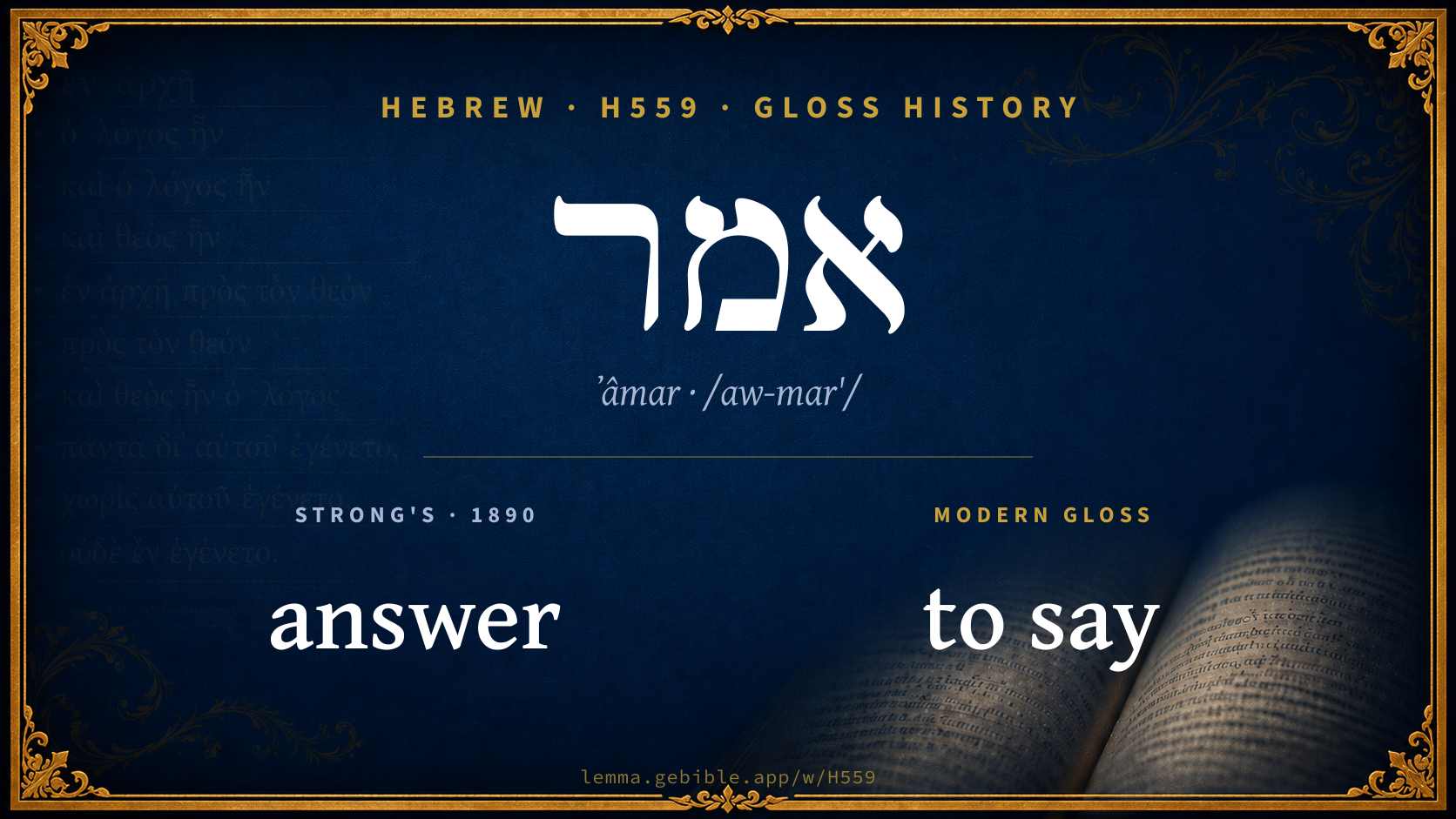
Gloss history
Strong's 1890 vs modern scholarship
About this word
Strong's H559 catalogs a Hebrew word from the Hebrew Old Testament.
These counts are not copied from any lexicon or concordance. They are computed here, from the morphology-tagged Hebrew Old Testament. What Lemma adds →
- 4,336
- distinct verses
- The word appears in 4,336 distinct verses.
- 39 / 39
- OT books
- The word appears in 39 of 39 Old Testament books.
- #7
- by frequency
- Top 10 most frequent Hebrew words (rank 7 of 8,640 Hebrew words by occurrence).
View all 4,336 occurrences in the concordance →
By section of the Old Testament
By traditional corpus
Conventional, traditional groupings — biblical authorship is debated, so this is a traditional corpus grouping, not an authorship claim. Each share is this word’s portion of its verses in that division of the Hebrew canon. Each figure is a share of the word’s 4,336 distinct verses.
- Prophets (Nevi'im) 2,521 verses · 58%
- Torah (Pentateuch) 1,175 verses · 27%
- Writings (Ketuvim) 640 verses · 15%
How translations render this word
Counts come from each version’s own published word-to-Strong’s tagging or interlinear alignment — an approximate guide to how each version renders this word, not a word-level alignment the data otherwise carries. Because each total is that version’s own tagged count, the per-version totals vary from one another and need not match the appearance or distinct-verse counts above. These counts may also differ from a printed concordance because Lemma counts each distinctly tagged rendering and does not collapse phrase taggings into a single head-word total. This is a fixed set of word-tagged versions (KJV, ASV, BSB, ULT) and does not change with the reading translation you choose elsewhere. Each version’s license is shown beside its name below (and on Sources).
- King James Version: Said 1,837×, Saying 793×, Saith 467×
- American Standard Version: Said 1,687×, Saying 689×, He said 416×
- Berean Standard Bible: Said 1,107×, Says 559×, Saying 313×
- unfoldingWord Literal Text: Said 1,617×, And 929×, Saying 867×
King James Version Public Domain
Renders H559 across 5,308 tagged occurrences — most commonly:
Plus other, less common renderings. Plus 365 renderings that appear only once — usually multi-word phrases or single function words the recovered tagging swept in, not distinct renderings.
American Standard Version Public Domain
Renders H559 across 5,297 tagged occurrences — most commonly:
Plus other, less common renderings. Plus 419 renderings that appear only once — usually multi-word phrases or single function words the recovered tagging swept in, not distinct renderings.
Berean Standard Bible Public Domain
Renders H559 across 4,549 tagged occurrences — most commonly:
Plus other, less common renderings. Plus 401 renderings that appear only once — usually multi-word phrases or single function words the recovered tagging swept in, not distinct renderings. Not rendered by a distinct English word in 754 further occurrences.
unfoldingWord Literal Text CC BY-SA 4.0
Renders H559 across 6,405 tagged occurrences — most commonly:
Plus other, less common renderings. Plus 130 renderings that appear only once — usually multi-word phrases or single function words the recovered tagging swept in, not distinct renderings.
8 senses and sub-senses in the full BDB
Hebrew verbs can shift meaning by stem (binyan): Qal is the basic action, Niphal is often passive or reflexive, Piel often intensifies or makes it factitive, and Hiphil is typically causative. The senses below are grouped under the stem BDB assigns to each. This entry also uses Hithpael (reflexive or reciprocal).
What do BDB’s symbols mean?
BDB uses these scholarly abbreviations:
| Symbol | Meaning |
|---|---|
| 𝔊 | the Septuagint (the ancient Greek translation, LXX) |
| 𝔙 | the Vulgate (the Latin translation) |
| 𝔖 | the Syriac version (the Peshitta) |
| 𝔗 | the Targum (the Aramaic translation) |
| ψ | the Psalms |
| √ | root (the underlying root or stem) |
| ‖ | parallel passage (a synonymous or contrasted parallel) |
| † | the dagger: every passage where the word occurs is cited |
The 8 senses and sub-senses the full Brown-Driver-Briggs lexicon distinguishes for this word, in lexicon order (not ranked by frequency), with BDB’s own verbatim wording and sub-sense lettering. Shown in Hebrew script with BDB’s own scholarly abbreviations. The condensed entry is in the Lexicon Entry tab. See also the Forms in the corpus table below.
Qal
- Pf. א׳ Gn 3:1 +, etc.; Impf. יֹאמַר Gn 31:8 +; וַיֹּא֫מֶר Gn 1:3 +; וַיֹּאמַ֑ר Gn 14:19 +; in Jb always וַיֹּא֑מַר Jb 3:2 +; 3 fs. תֹּאמַר Gn 21:12 +; תֹּאמֵ֑ר Pr 1:21; 1 s. אֹמַר Gn 22:2 +; אוֹמְרָה ψ 42:10; וָאֹמַר Gn 20:13 +; וָאוֹמַר Ne 2:7, 17, 20; 3 m. pl. יֹאמְרוּ Ex 4:1 + etc.; sf. יֹמְרוּךָ ψ 139:20; 2 mpl. תֹּמְרוּ 2 S 19:14 (cf. Köi. p. 385); Imv. אֱמֹר (אֱמָר־) Gn 45:17 +, etc.; Inf. abs. אָמוֹר Ex 21:5 +; cstr. אֱמֹר Ez 25:8 +; (הַ)אֲמֹר Jb 34:18 but read הָאֹמֵר 𝔊 𝔙 Di, or better הֶאָמֹר Inf. abs. c. ה interrog. cf. Ew§ 328 d; sf. אָמְרִי Jos 6:10 +; אֲמָרְכֶם Je 23:38; אֱמָרְכֶם Mal 1:7 +; לֵאמֹר Gn 1:22 +, etc.; Pt; act. אֹמֵר Gn 32:10 +, etc.; pass. הֶאָמוּר Mi 2:7, but this grammatically indefensible, read הֶאָמוֹר, Inf. abs. c. ה interrog., v. DrExpositor, April, 1887, 263. e.g. Genesis 3:1
- 1. Say (subj. God Gn 3:1 + or man 32:5, serpent 3:1, ass Nu 22:28, horse יֹאמַר הֶאָח Jb 39:25 etc.; inanimate things, personif. Jb 28:14 cf. v 22 etc.; so in allegory or fable Ju 9:8 2 K 14:9 etc.; especially in narrat., וַיֹּאמֶר etc., Gn 4:6 + very often): mostly sq. thing said, either subst. Je 14:17 (c. cl. app.) Dt 27:16 f. Ju 12:6; pronoun Gn 44:16 2 K 20:14 +; or (usually) clause Gn 1:3; 3:1; 37:20 + often (orat. recta); with adv. thus, so Gn 32:5 Nu 20:14 1 K 20:3, 5 +; especially כֹּה אָמַר י׳ Ex 5:1; 7:17, 26; 8:16; 1 Ch 17:4 + often; the person addressed usually introduced by אֶל Gn 3:1; 15:7; 22:7; Lv 21:1; 2 S 3:7; 1 K 12:5, 23, or לְ Gn 3:13; 4:15; 1 S 20:2; 2 S 2:21; 1 K 14:2 + often; rarer combinations are, א׳ בְּאָזְנֵי Is 49:20 (cf. 5:9 & vid. דבר); א׳ לִפְנֵי Ez 28:9; א׳ לְעֵינֵי Dt 31:7; Jos 10:12; Je 28:11; א׳ בְּ Jo 2:17 ψ 126:2, where בְּ local; in all cases usually sq. dir. obj. of words said, Ex 19:25; Ju 17:2 being singular; Gn 4:8 the object-clause has probably fallen out, cf. Vrss Di; = mention, name, designate Gn 22:2, 3; 43:27, 29 Ex 32:13; Nu 14:40; 1 S 10:16; 16:3; 2 S 6:22 Ne 6:19; cf. ψ 139:20 יֹמְרוּךָ לִמְזִמָּה speak of thee for falsehood (but many, as Hup Pe Dy Che, read יַמְרוּךָ); = tell, declare, proclaim (sq. dir. obj. only) ψ 40:11; Ez 13:7; in reply to question = answer Ex 12:27; Jos 4:7; 1 K 9:9; Je 5:19; 22:9. The obj. spoken of may be referred to by אֶל 2 K 19:32; Je 22:18; 27:19, or לְ Gn 20:13 אִמְרִי לִי say of me, etc. Dt 33:9; Ju 9:54; Is 5:20 ψ 3:3; 71:10, very rarely by a simple accus. Is 3:10 (where read prob. for אִמְרוּ, אַשְׁרֵי), except after אֲשֶׁר where the words used follow (cf. אֲשֶׁר 4 d) Gn 3:17; Nu 10:29; 14:31 Dt 28:68; Ju 7:4; 1 S 9:17, 23b; 1 K 8:29; La 4:20; cf. Nu 21:16; 2 K 17:12; 21:4, & (two extreme cases) Is 8:12; La 2:15 (v. DrSm i. 25, 5); הֶֽאָמוּר Mi 2:7 read inf. abs. c. ה interrog. הֶאָמוֹר (v. supr.) shall one say? shall it be said? After another vb. of saying, introducing thing said: Dt 21:7; 25:9; 27:15; Ct 2:10 +, even after אמר Gn 22:7; Lv 21:1; Je 34:2; Est 7:5 +; especially inf. לֵאמֹר, after דבר Gn 8:15, צוה 2:16; 3:17, ענה 41:16, ברך 1:22, נשׁבע 24:7, נדר 28:20, etc.; after אמר 2 S 3:18; 1 K 12:23; 1 Ch 21:18 +; after שׁלח 2 Ch 35:21 שׁוּב Gn 32:7; cf. also Gn 28:6 Ex 5:13; 9:5; 13:8; 17:4; Nu 11:20; Dt 1:28; 13:7; Ju 8:15; 1 S 23:2; 1 K 13:3; Je 32:3; 37:9; Ru 4:4 +; when subj. of לֵאמֹר differs from that of preceding clause Gn 31:1; 38:13, 24 etc.; after שׁמע Is 37:9 = 2 K 19:9. e.g. Genesis 3:1
- 2. Say in the heart (= think) א׳ בלבב Dt 8:17 cf. 1 K 12:26 ψ 10:6, 11, 13; 14:1; 35:25; Is 14:13; 47:8, 10; 49:21; Ec 2:1, 15; 3:17, 18; א׳ לִלְבָבָם Ho 7:2; א׳ אֶל־לִבּוֹ Gn 8:21 said unto his heart (to himself), subj. י׳, cf. 1 S 27:1; אָֽמְרָה נַפְשִׁי La 3:24; thence א׳ alone Gn 20:11; 26:9 Nu 24:11; Ru 4:4; 1 S 20:26; 2 S 5:6; 12:22; 2 K 5:11; Mal 1:7; with כִּי Ju 15:2; in particular = desire מַה־תֹּאמַר נַפְשְׁךָ 1 S 20:4 cf. Est 2:13; sq. inf. = purpose, Ex 2:14 thinkest thou to kill me, as thou killedst the Egyptian? Jos 22:33; 1 S 30:6; 1 K 5:19; 2 Ch 28:10, 13; expect 2 S 21:16 he expected to slay David 2 Ch 13:8; 32:1. e.g. Deuteronomy 8:17
- 3. Promise (sq. inf.) 1 Ch 27:23; 2 Ch 21:7; Est 4:7; (id. + ל of pers.) 2 K 8:19; Ne 9:15; (sq. acc. of dir. obj. + ל of pers. + inf. of purpose) Ne 9:23. e.g. 1 Chronicles 27:23
- 4. Command (especially late) sq. אֶל־ of person addressed, Nu 15:28; 1 Ch 21:18; sq. ל Jos 11:9; 2 S 16:11 2 K 4:24; Jb 9:7 ψ 106:24 (v. sub אֲשֶׁר 8 e); sq. inf. 1 S 24:11 1 Ch 21:17; 2 Ch 1:18; 29:27, 36; 31:11; 35:21 Est 1:17; 4:13, 15; 6:1; 9:14; inf. + ל of pers. 2 Ch 14:3; 29:21; 31:4; Ne 9:15; Est 1:10; sq. acc. dir. obj. 2 Ch 29:24 the king commanded the burnt-offering and the sin-offering, cf. 1 K 5:20; Est 2:15; sq. cl. with אשׁר = that Ne 13:19; id. + ל of pers. v 22; sq. cl. with כִּי Jb 36:10; abs. 1 S 16:16 (read however prob. יאמרו for יאמר, cf. Dr); also ψ 105:31, 34; 107:25; 1 Ch 14:12; 2 Ch 24:8; Ne 13:9, 19 (all sq. vb. consec.); command by leter א׳ עִם־הַסֵּפֶר Est 9:25 (sq. impf.); appoint, assign לֶחֶם א׳ לוֹ 1 K 11:18 = threaten sq. inf. Dt 9:25 ψ 106:23. e.g. Numbers 15:28
Niphal
- Pf. נֶאֱמַר Dn 8:26; Impf. יֵאָמֵר Gn 22:14 +; יֵאָ֫מֶר לוֹ Is 4:3; יֵאָמַ֑ר Gn 10:9 +; וַיֵּאָמַ֑ר Jos 2:2; be said, told Gn 10:9; 22:14 ψ 87:5; Je 4:11; 16:14 (all abs., indef. subj., of current saying); so said in a book Nu 21:14; be related, told, of vision Dn 8:26; said, told to (sq. ל ind. obj.) Jos 2:2; Ho 2:1(×2) Zp 3:16; either so, or told concerning Nu 23:23; Ez 13:12 (אֶל־); יֵאָמֵר לָכֶם = ye shall be called (it shall be said to you) Is 61:6 (‖ תִּקָּרֵ֔אוּ), cf. 4:3; 19:18; 32:5 (‖ יִקָּרֵא ל) 62:4(×2); hence be called, of Tophet לֹא־יֵאָמֵר עוֹד הַתֹּפֶת Je 7:32; subj. שֵׁם Gn 32:29; Jb 34:31 כִּי אֶל־אֵל חֶאָמַר, Rabb. (cf. AV) treat הֵאָמַר as Niph. Inf. for לְהֵאָמֵר, but against grammar; the form as it stands is Qal Pf., אֶל־אֵל being prefixed to the interrog. for emphasis (cf. Je 22:15; 23:26 Ne 13:27), v. Dr§ 9 Di al.; Hoffm., however, reads הֵאָמֵר inf. abs. = imv. ‘so must one speak (it be spoken) to God.’ e.g. Daniel 8:26
Hiphil
- Pf. avow, avouch Dt 26:17 אֶת־י׳ הֶאֱמַרְתָּ הַיּוֹם לִהְיוֹת לְךָ לֵאלֹהִים; v 18 וי׳ הֶאֱמִירְךָ היום להיות לוֹ לְעַם (lit. cause to declare, i.e. through agency of Moses; on this & other interpr. vid. Di). e.g. Deuteronomy 26:17
Hithpael
- Impf. יִתְאַמְּרוּ ψ 94:4 subj. כָּל־פֹּעֲלֵי אָ֑וֶן act proudly, boast (‖ יַבִּיעוּ יְדַבְּרוּ עָתָק); prob. also 2 mpl. תִּתְיַמָּ֑רוּ Is 61:6 (in good sense, sq. בְּ of thing gloried in) 𝔖 𝔙 𝔗 & cf. 𝔊; GesComm. so De Che Köi. 457 f. (from [ימר] exchange Thes Hi Kn Ew Di; but vid. ימר). e.g. Psalms 94:4
Senses from the full Brown-Driver-Briggs lexicon (Brown, Driver, Briggs; Oxford 1906 — public domain), digitized via Sefaria, supplemented by the OpenScriptures HebrewLexicon (CC BY 4.0). Full attribution on Sources.
Word origin
vb. utter, say (MI Ph. אמר, Aramaic אֲמַר, Ethiopic አመረ I. 2 shew, declare, Arabic أَمَرَ command; perhaps √ אמר orig. = be or make prominent, hence Hithp. infr., אָמִיר; Sab. אמר lofty, epith. of king JHMordtmZMG 1876, 37; cf. DlPr 28 who thinks orig. meaning hell, sichtbar sein, whence Assyrian amâru, see & shew, declare, say)—
— Brown-Driver-Briggs (Oxford 1906, public domain), digitized via Sefaria, supplemented by the OpenScriptures HebrewLexicon (CC BY 4.0). See Sources.
Origin: a primitive root
Jastrow Dictionary
A second Hebrew/Aramaic lexicon for comparison, covering Aramaic and post-biblical (Talmudic, Targumic, Midrashic) usage that the biblical-Hebrew BDB does not. Matched by lemma rather than by Strong’s number, so a lemma may carry more than one Jastrow headword (shown separately below), and the entries cover usage well beyond the Bible.
אָמַר I
- (a) to join, knot; to be knotted, thick; b) to heap up; c) transf. to join words, compose, cmp. דבר; d) to contract, bargain, exchange. [As to Assyr. to see, cmp. חמא.])
- 1. to speak, think, say, relate &c. … א׳ ר׳ … א׳ ר׳ Rabbi … related in the name of R. … Ber. 3ᵇ; a. v. fr.—Part. pass. אָמוּר expression. Yoma 70ᵇ, a. fr. הוא הא׳ וכ׳ it is the same expression (‘one ram’) used here and in the Book of Numbers. Sifré Deut. s. 334, a. fr. אֱמוֹר מעתה say from now, i.e. from this draw the conclusion. Gen. R. s. 39 תאמר שהבירה וכ׳ (usu. שמא תאמר) will you say (is it possible), this castle has no commander?—אֲמוּרִים דברים במה (abbr. בד׳'א) in what case are these words said? i.e. this applies only. Ḥull. 3ᵃ; a. fr.—זאת אוֹמֶרֶת this tells, i.e. this proves. Ber. 11ᵇ; a. fr.—אָמְרוּ it is said, told &c.; v. next w.—Inf. לוֹמַר = לֵאמֹר. Ḥag. 14ᵇ; a. fr.
- 2. to vow, devote. אָמוּר (לגבוה) devoted to the Lord. Succ. 55ᵇ; v. אֲמִירָה I, 3, a. אֵימוּרִים.
- (b. h.) to be said, to read … נא׳ כאן … ונ׳ להלן we read here … and we read there … (the same expression is used here and there in the Scriptural text). Ber. 9ᵃ; a. v. fr.—שֶׁנֶּאֱמַר (abbr. שנ׳, שנא׳) for it is said in the Scriptures (as evidence in favor of an opinion). Snh. X, 1; a. v. fr.; also כמה שנ׳ (כמו) as it is said.—מִשּׁוּם שנ׳ because it is said in the Scriptures, i.e. you may possibly be misled by a certain expression to think …, therefore another term is used in its stead in an analogous case, or added to the ambiguous word; v. שׁוּם.
אֲמַר
- 1) as preced. 1). Targ. Gen. I, 3; a. v. fr.—א׳ מר above you quoted an authority, or, it has been stated. Ber. 2ᵃ; a. fr.—א׳ קרא the Scripture says. Ib. 13ᵃ; a. fr.—Y. Orl. III, end, 63ᵇ, a. fr. אמרונה בשם … (in Bab. heb. אֲמָרוּהָ) they said it in behalf of … i.e. as a tradition.—Y. Ber. I, 2ᵈ מילתיה אמרה his word (statement, opinion &c.) proves.—הדא אמרה = זאת אומרת; v. preced.—אַמְרֵי (h. אָמְרוּ) they say, it is said. Sabb. 19ᵃ אמרו עליו על … ואמרי לה וכ׳ it is told about R. …, and another relation refers this to R.—; a. fr.—קאמר, קאמרי &c. = קא אמר &c. Ḥull. 85ᵃ; a. fr.—מנא תימרא whence dost thou prove? Sabb. 23ᵃ; a. fr.—Inf. מֵימַר, מֵימְרָא. סבר מ׳, סבר למ׳ originally he was of the opinion. Y. Sabb. VI, 8ᶜ top; Keth. 87ᵇ; a. v. fr.—לְמֵימְרָא does this mean to say? Sabb. 15ᵇ; a. fr. לא אמרן אלא … אבל … this has been said, i.e. this applies only to a case … but if … Ber. 43ᵇ; a. fr.—כְּלוֹמַר as if saying, meaning to say, viz; v. כִּילּוּ.—Y. Kil. IV, 32ᶜ bot. אימורין לבני וכ׳ say ye to &c.—מאי איכא למימר, v. אִיכָּא; Answ. אֵימוּר say … Sabb. 6ᵃ; a. fr.—Hor. 13ᵃ א׳ כולה who orders every thing (as an etymol. of אֲמַרְכָּל).—2) to praise, proclaim. Targ. Is. VIII, 13; a. fr.—Part. pass. אָמִיר q. v.
- , contr. אִתְּמַר, אִיתְּ׳ it is said, taught. Targ. Job XXXIV, 31.—Y. Yoma V, end, 43ᵃ אתאמרת, contr. אִתַּמְרַת it has been said with refer. to the opinion of …—אִתְּ׳, אִיתְּ׳ it has been said (above);we have been taught. Succ. 15ᵃ; a. fr.
- same. Targ. Gen. XXII, 14; a. e.
אָמַר II
- , v. אָמַר I, a) to be thick, strong.
- 1. to thrive; to boast, vaunt, be oppressive (cmp. Ps. XCIV, 4). Sot. IX, 15 (49ᵇ) יוקר יַאֲמִיר the nobility shall be oppressive (Snh. 97ᵃ יְעַוֵּת; Der. Er. Zut. X יעוות; Cant. R. to II, 13 הווה).—*[ e.g. Psalms 94:4
- 2. (denom. of מריא to fatten. Sabb. XXIV, 3 (155ᵇ) Bab. מַאֲמִירִין, Ms. Oxf., Mish. a. Y. מַמְרִים, מַמְרִין, v. מרי.]
אֵמֶר
- , v. אֵימַר a. אִמְרָה.
אִמַּר
- lamb, v. אִימַּר.
מְרַר
- same, to be bitter; to grieve, mourn. Perf. מַר, imperf. יֵימַר, יֵמַר. Targ. Is. XXIV, 9. Targ. I Sam. XXX, 6; a. fr.—Targ. Zech. XII, 10 ויֵימְרוּן, v. infra.
- to embitter, aggrieve. Targ. Ruth I, 13 תְמָרְרוּן (ed. Amst. תִמְרְ׳). Targ. Y. I Deut. XXXII, 32 מְמַרְרִין (some ed. מְמַרְרַן; Y. II מַרְרַן).
- 1. same. Targ. Ruth I, 20 (not same. Targ. Ruth I, 20 (not אֲמַרִ׳). Targ. Ex. I, 14; a. e.
- 2. to arrange mourning. Targ. Zech. XII, 10 ויימרון … כמא דמַמְרִין וכ׳ they shall arrange mourning for him, as is arranged for &c. (v. infra).—[אָמְרָרוּ, v. Ithpa.]
- to aggrieve. Targ. Prov. XVII, 25. Targ. Y. I Gen. XLIX, 23 ממרירו, read: מַרְמִירוּ; (Y. II אֲמָרוּ, read: אַמָּ׳ Af.).
- 1. to be enraged, fight. Targ. O. Gen. l. c. (Var. אָמְרָרוּ, v. Berl. Targ. O. II, p. 18; oth. ed. אַמְרָרוּ Af.).
- 2. to mourn. Targ. Zech. l. c. Var. (v. Lag. Proph. I, p. XLII).
A Dictionary of the Targumim, the Talmud Babli and Yerushalmi, and the Midrashic Literature (Marcus Jastrow; London, Luzac, 1903) — Public Domain. Digitized via Sefaria. Digitized via Sefaria. Full attribution on Sources.
Forms in the corpus
The 578 distinct written forms H559 takes in the Hebrew Bible, most frequent first — each parse links to that stem’s occurrences in the concordance. Hebrew forms include their vowel points and cantillation, so a single lemma takes many written forms.
The 60 most common forms are shown; 518 rarer forms follow in the full concordance.
Same root — word family
Other BDB entries built from the same root as H559, grouped by Strong’s listed origin. These share a root / origin per the lexicon — not necessarily a shared meaning. Each links to that word’s own entry.
Derived from this word
Proper names from this root
People and places named from this root — a name, not an additional meaning of the word.
Compare all same-root words → Showing 4 of 9 — not the complete family. 4 of the same-root words are proper names (people or places). They share a root, not necessarily a meaning.
Septuagint verse parallels
Most of the 4,336 Hebrew verses this word occurs in also exist in the Greek Old Testament (Septuagint), so the same passages can be read in Greek by switching the Old Testament edition to the Septuagint.
Read these verses in the Septuagint
- Genesis 1:3
- Exodus 1:9
- Leviticus 1:1
- Numbers 1:1
- Deuteronomy 1:5
- Joshua 1:1
- Judges 1:1
- Ruth 1:8
- 1 Samuel 1:8
- 2 Samuel 1:3
- 1 Kings 1:2
- 2 Kings 1:2
This is a verse-level parallel only — the same verses exist in both the Hebrew and Greek Old Testaments. No word-level Hebrew↔Greek correspondence is claimed: the data carries no such alignment, so no Greek word is shown as this Hebrew word’s translation. Coverage is not total — the Septuagint omits the deuterocanon and renumbers the Psalms, so some Hebrew verses have no direct Greek parallel.