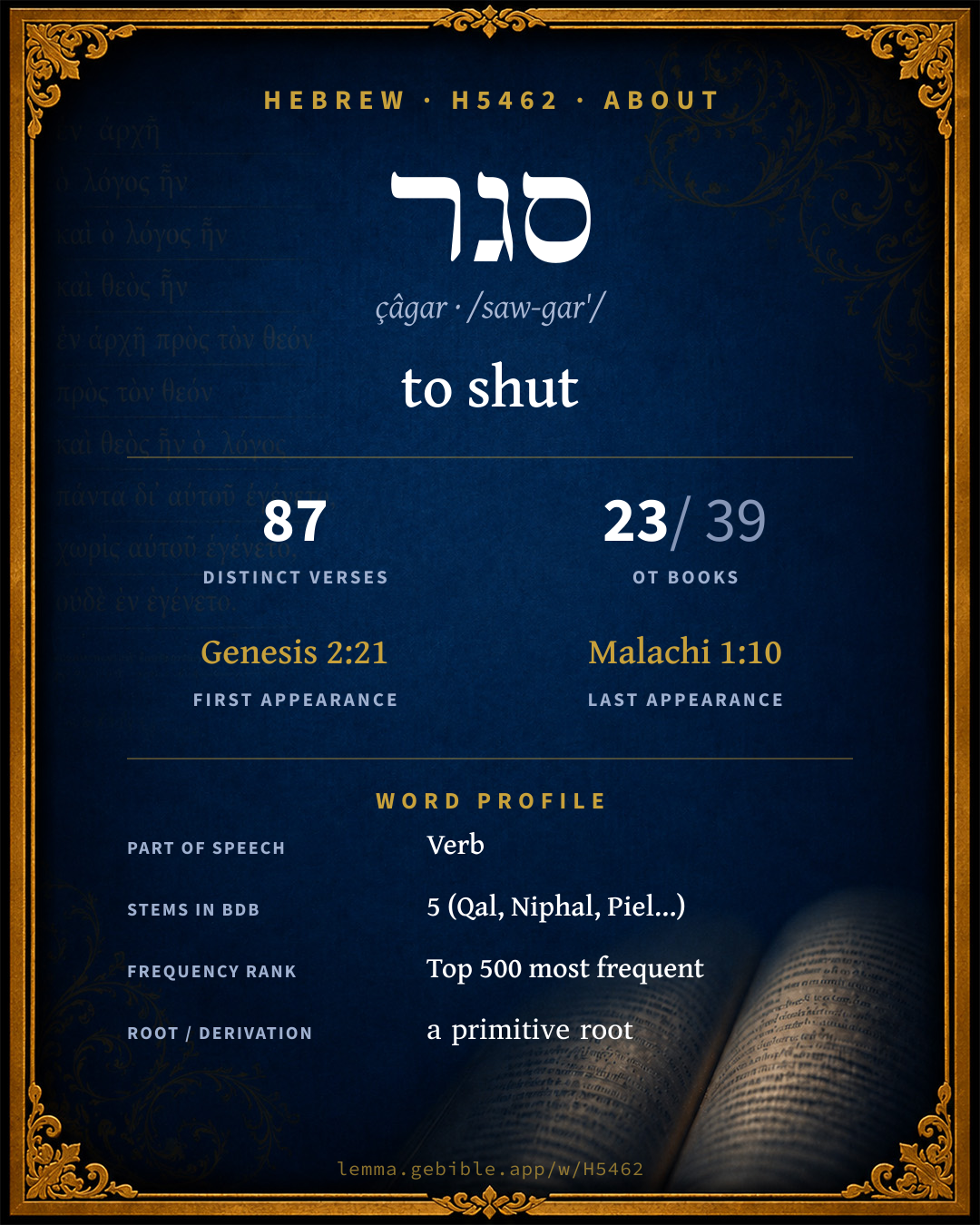
סָגַר
to shut
‘to shut’ is one of 3 main senses fuller range ↓
Full lexicon entry — Brown-Driver-Briggs (BDB)
From Brown-Driver-Briggs (BDB)
Where this word appears
See every Qal verb in the Hebrew Bible →
Grammar key — what these labels mean
Part of speech
- Noun
- A naming word — a person, place, thing, or idea.
- Verb
- An action or state-of-being word.
Noun type
- Common
- A common noun — a general class of person, place, or thing (“king,” “city,” “water”), not a specific name.
Stem
- Qal
- The basic, simple active stem — the plain form of the verb (“he wrote”). Here: ‘shut door’
- Hiphil
- The causative active stem (“he caused / brought about”). Here: ‘deliver up to’
- Pual
- The passive counterpart of the Piel. Here: ‘of cities Je 13’
- Niphal
- Usually the simple passive or reflexive of the Qal (“he was written”). Here: ‘subj. pers. be shut up [in city] 1 S 23’
- Piel
- An intensive or resultative active stem.
Form
- Sequential Imperfect
- An imperfect with prefixed waw — the standard past-narrative form (waw-consecutive imperfect).
- Perfect
- A completed action or state — Hebrew marks aspect (completeness) more than strict tense (“he wrote”).
- Sequential Perfect
- A perfect with prefixed waw continuing a preceding imperfect or command (waw-consecutive perfect).
- Participle Passive
- A verbal adjective expressing action received (“written”).
- Imperative
- A direct command (“write!”).
- Imperfect
- An incomplete, ongoing, or future action (“he will / would write”).
- Cohortative
- A first-person volitional form expressing wish or resolve (“let me / let us write”).
- Jussive
- A third- or second-person volitional form expressing wish or command (“let him write”).
- Infinitive Construct
- A bound verbal noun, frequently with prepositions (“to write / in writing”).
- Participle Active
- A verbal adjective expressing ongoing or characteristic action (“writing / one who writes”).
State
- Absolute
- The independent form of a noun, not bound to a following word.
Person
- 3rd Person
- The one spoken about (“he / she / it / they”).
- 2nd Person
- The one addressed (“you”).
- 1st Person
- The speaker (“I / we”).
Gender
- Masculine
- Grammatically masculine.
- Common
- Either gender — not distinguished for this form.
- Feminine
- Grammatically feminine.
Number
- Singular
- One.
- Plural
- More than one (in Hebrew, generally three or more).
3 verses where H5462 appears in the Qal stem in the Book of Joshua. Filtered view — show all forms. Click any verse to open its interlinear word-by-word view. Verse text shown in the World English Bible for context — . Each verse’s Hebrew form is shown with its reference; the English is not keyword-highlighted, since the data carries no word-level English alignment. Use “Compare translations” on any verse to read it across multiple English versions. This concordance covers the Hebrew Bible; Septuagint (Greek Old Testament) occurrences are not indexed here.
Joshua
- Joshua 2:5 לִ/סְגּ֗וֹר prep + Qal inf.cs and it happened about the time of the shutting of the gate, when it was dark, that the men went out; where the men went I don't know: pursue after them quickly; for you will overtake them.
- Joshua 2:7 סָגָ֔רוּ Qal pf 3cp The men pursued after them the way to the Jordan to the fords: and as soon as those who pursued after them were gone out, they shut the gate.
- Joshua 6:1 סֹגֶ֣רֶת וּ/מְסֻגֶּ֔רֶת Qal ptcp.act fs conj + Pual ptcp.pass fs Now Jericho was tightly shut up because of the children of Israel: none went out, and none came in.
About this entry
At a glance — auto-summarized from this page’s data, not written by a person. Every figure links to its source below. This summary describes the numbers; it doesn’t interpret them.
The Hebrew verb סגר centers on the idea of “to shut.” Older and newer Bibles part ways — “shut” in the King James Version, “and” (unfoldingWord Literal Text) in modern versions. See the renderings breakdown. It appears 87 verses across 23 books of the Hebrew Bible, among its moderately common vocabulary. Its earliest occurrence is Genesis 2:21. Read the stem: it spans 5 stems, including Qal and Niphal. For the data behind this summary, explore the sense tree and the renderings breakdown below.
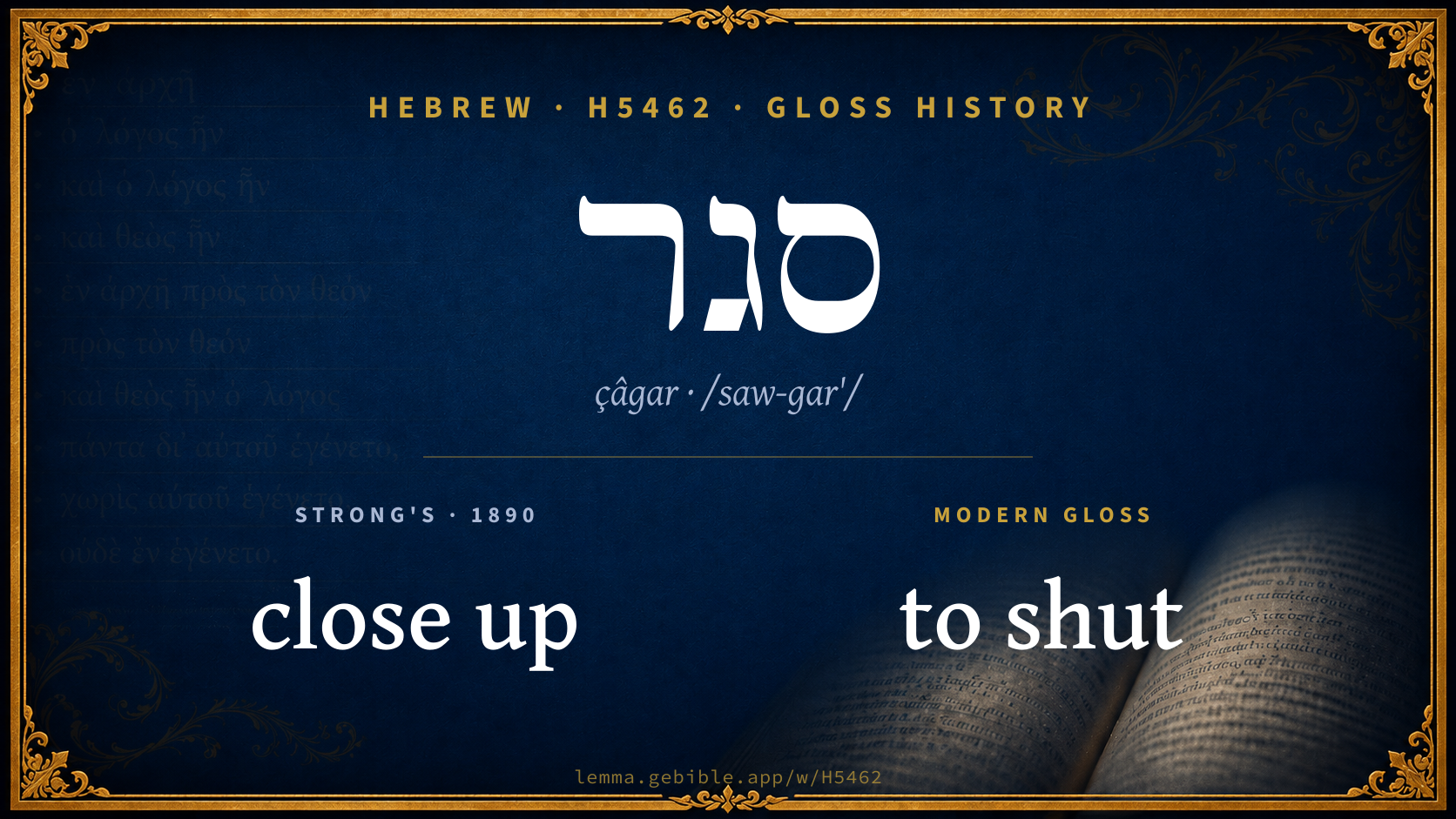
Gloss history
Strong's 1890 vs modern scholarship
About this word
Strong's H5462 catalogs a Hebrew word from the Hebrew Old Testament.
These counts are not copied from any lexicon or concordance. They are computed here, from the morphology-tagged Hebrew Old Testament. What Lemma adds →
- 87
- distinct verses
- The word appears in 87 distinct verses.
- 23 / 39
- OT books
- The word appears in 23 of 39 Old Testament books.
- #455
- by frequency
- Top 500 most frequent Hebrew words (rank 455 of 8,640 Hebrew words by occurrence).
View all 87 occurrences in the concordance →
By section of the Old Testament
By traditional corpus
Conventional, traditional groupings — biblical authorship is debated, so this is a traditional corpus grouping, not an authorship claim. Each share is this word’s portion of its verses in that division of the Hebrew canon. Each figure is a share of the word’s 87 distinct verses.
- Prophets (Nevi'im) 47 verses · 54%
- Torah (Pentateuch) 20 verses · 23%
- Writings (Ketuvim) 20 verses · 23%
How translations render this word
Counts come from each version’s own published word-to-Strong’s tagging or interlinear alignment — an approximate guide to how each version renders this word, not a word-level alignment the data otherwise carries. Because each total is that version’s own tagged count, the per-version totals vary from one another and need not match the appearance or distinct-verse counts above. These counts may also differ from a printed concordance because Lemma counts each distinctly tagged rendering and does not collapse phrase taggings into a single head-word total. This is a fixed set of word-tagged versions (KJV, ASV, BSB, ULT) and does not change with the reading translation you choose elsewhere. Each version’s license is shown beside its name below (and on Sources).
- King James Version: Shut 11×, Pure 6×, Shall shut 6×
- American Standard Version: Shut 9×, Pure 5×, Shall shut 5×
- Berean Standard Bible: Shut 9×, Pure 6×, Be shut 4×
- unfoldingWord Literal Text: And 7×, Shut 7×, Then 6×
King James Version Public Domain
Renders H5462 across 93 tagged occurrences — most commonly:
Plus 49 renderings that appear only once — usually multi-word phrases or single function words the recovered tagging swept in, not distinct renderings.
American Standard Version Public Domain
Renders H5462 across 94 tagged occurrences — most commonly:
Plus 59 renderings that appear only once — usually multi-word phrases or single function words the recovered tagging swept in, not distinct renderings.
Berean Standard Bible Public Domain
Renders H5462 across 90 tagged occurrences — most commonly:
Plus 56 renderings that appear only once — usually multi-word phrases or single function words the recovered tagging swept in, not distinct renderings. Not rendered by a distinct English word in 1 further occurrence.
unfoldingWord Literal Text CC BY-SA 4.0
Renders H5462 across 117 tagged occurrences — most commonly:
Plus other, less common renderings. Plus 61 renderings that appear only once — usually multi-word phrases or single function words the recovered tagging swept in, not distinct renderings.
19 senses and sub-senses in the full BDB
Hebrew verbs can shift meaning by stem (binyan): Qal is the basic action, Niphal is often passive or reflexive, Piel often intensifies or makes it factitive, and Hiphil is typically causative. The senses below are grouped under the stem BDB assigns to each. This entry also uses Pual (the passive of Piel).
What do BDB’s symbols mean?
BDB uses these scholarly abbreviations:
| Symbol | Meaning |
|---|---|
| 𝔊 | the Septuagint (the ancient Greek translation, LXX) |
| 𝔙 | the Vulgate (the Latin translation) |
| 𝔖 | the Syriac version (the Peshitta) |
| 𝔗 | the Targum (the Aramaic translation) |
| ψ | the Psalms |
| √ | root (the underlying root or stem) |
| ‖ | parallel passage (a synonymous or contrasted parallel) |
| † | the dagger: every passage where the word occurs is cited |
The 19 senses and sub-senses the full Brown-Driver-Briggs lexicon distinguishes for this word, in lexicon order (not ranked by frequency), with BDB’s own verbatim wording and sub-sense lettering. Shown in Hebrew script with BDB’s own scholarly abbreviations. The condensed entry is in the Lexicon Entry tab. See also the Forms in the corpus table below.
Qal
- Pf. 3 ms. ס׳ Gn 19:6 +, 3 pl. סָֽגְרוּ 2 Ch 29:7, סָֽגְר֑וּ ψ 17:10 (cf. Baer’s n., Ges§ 29 o Köii. 1, 535 Anm.), סָנָר֑וּ Gn 19:10 Jos 2:7; Impf. יִסְגֹּר Jb 12:14 Mal 1:10, 1 pl. cohort. נִסְגְּרָה Ne 6:10, etc.; Imv. ms. סְגֹר ψ 35:3 Is 26:20 (וּסֲגֹר Baer Ginsb), mpl. סִגְרוּ 2 K 6:32; Inf. cstr. לִסְגּוֹר Jos 2:5; Pt. act. סֹגֵר Is 22:22; f. סֹגֶּרֶת Jos 6:1 (but v. infr.); pass. סָגוּר 1 K 6:20 + 12 times;— e.g. Genesis 19:6
- 1. shut door (דֶּלֶת) Gn 19:10 (J) 2 K 6:32 Mal 1:10 Ne 6:10 2 Ch 28:24; 29:7; gate (שַׁעַר) Jos 2:7 (JE) Ez 46:12, cf. 44:1, 2(×2); 46:1, וַיְהִי הַשּׁ׳ לִסְגֹּר Jos 2:5 (JE), also (שַׁעַר om.) Jos 6:1 (si vera l.; סֹגֶרֶת dittogr. according to Buhl Lex 13); door after one (אַחֲרֵי), on leaving room Gn 19:6 (J); upon, behind, oneself, from within (בְּעַד q.v.) 2 K 4:4, 5, 33 Is 26:20 (fig.), also (דֶּלֶת om.) Ju 9:51 2 K 4:21; c. דֶּלֶת + בְּעַד upon one left inside Ju 3:23, and (דֶּלֶת om.) Gn 7:16 (J); fig. ס׳ דַּלְתֵי בִטְנִי Jb 3:10, cf. ס׳ רַחְמָהּ 1 S 1:5, ס׳ בְּעַד רַחְמָהּ v 6 abs. shut (opp. פָּתַח) Is 22:22(×2); metaph. חֶלְבָּמוֹ ס׳ ψ 17:10 their fat (i.e. gross, unreceptive heart) they have closed. e.g. Genesis 19:10
- 2.
- a. close in upon (בְּעַד) Ju 3:22 (fat upon blade of sword), so poss. also וַיִּסְגֹּר בָּשָׂר תַּחְתֶּנָּה Gn 2:21 (J) and flesh closed in, in place of it (usually and he closed flesh, i.e. closed the gap with flesh); ס׳ עֲלֵיהֶם הַמִּדְבָּר Ex 14:3 the wilderness hath closed in upon them; obj. om., יִסְגֹּר עַל־אִישׁ Jb 12:14 he closeth in upon a man, fig. of imprisonment. e.g. Judges 3:22
- b. close up breach (פֶּרֶץ) [in wall] of city 1 K 11:27; poss. close up [path] (si vera l.) ψ 35:3 Vrss Ol De Bae; JDMich DeW Ew Hup-Now Che take סְגֹר here as weapon, usually 4 [Gk. σάγαρις] of Massagetae Herod. i. 215 cf. LagGes Abh. 203, also Egyptian sagartá (loan-word) Bondi 55; both improb., text prob. corrupt; SchwallyZAW xi (1891), 258 reads חֲגֹר > HalRev. Sém. iii (1894), 47 עוּרָה (cf. ψ 59:5). e.g. 1 Kings 11:27
- 3. Pt. pass., closed up = closely joined with tight seal, Jb 41:7 (of scales of crocodile). e.g. Job 41:7
- 4. elsewhere only Pt. pass. in זָהָב סָגוּר, only of temple adornment and utensils 1 K 6:20, 21; 7:49, 50; 10:21 = 2 Ch 9:20; 4:20, 22; perhaps read סָגוּר (abbrev. for ז׳ ס׳) Jb 28:15 (for MT סְגוֹר, so Hoffm Bu Du); cf. Assyrian ḫurâṣu sakru, sagiru, DlHWB 499. e.g. 1 Kings 6:20
Niphal
- Pf. 3 ms. נִסְגַּר 1 S 23:7; Impf; 3 ms. יִסָּגֵר Ez 46:2; 3 fs. juss. תִּסָּגֵר Nu 12:14, וַתִּסָּגֵר v 15; 3 mpl. יִסָּנֵר֑וּ Is 45:1; 60:11, וַיִּסָּֽגְרוּ Ne 13:19; Imv. ms. הִסָּגֵר Ez 3:24;— e.g. 1 Samuel 23:7
- 1. subj. pers. be shut up [in city] 1 S 23:7, מִחוּץ לַמַּחֲנֶה Nu 12:14, 15 (E); בְּתוֹךְ בַּיִת Ez 3:24. e.g. 1 Samuel 23:7
- 2. be shut, closed, of city gates Ez 46:2 Is 45:1; 60:11 and (דלתות) Ne 13:19. e.g. Ezekiel 46:2
Piel
- Pf. 3 ms. סִגַּר 1 S 26:8 2 S 18:28; sf. סִגְּרַנִי 1 S 24:19; Impf. 3 ms. sf. יְסַגֶּרְךָ 1 S 17:46;—deliver up to (leave no other opening for one, shut one up to), cf. [מָגַן], מִגֵּן, p. 171 b supr.), only S: c. acc. pers. + בְּיַד 1 S 17:46; 24:19; 26:8; בְּיַד om. 2 S 18:28 (v. also Hiph.). e.g. 1 Samuel 26:8
Pual
- Pf. 3 ms. סֻגַּר Is 24:10; 3 pl. סֻגְּרוּ Je 13:19, וְסֻגְּרוּ consec. Is 24:22; Pt. f. מְסֻגֶּ֫רֶת Jos 6:1;—be shut up: e.g. Isaiah 24:10
- 1. of cities Je 13:19 (opp. פָּתַח), of beleaguered city Jos 6:1 (JE), of houses Is 24:10 (+ מִבּוֹא). e.g. Jeremiah 13:19
- 2. of prisoners עַל־מַסְגֵּר Is 24:22 = down into a dungeon. e.g. Isaiah 24:22
- 3. of doors Ec. 12:4. e.g. Ecclesiastes 12:4
Hiphil
- Pf. 3 ms. הִסְגִּיר Lv 14:46 +; 2 ms. sf. הִסְגַּרְתַּ֫נִי ψ 31:9; 1 s. וְהִסְגַּרְתִּ֫י Am 6:8, etc.; Impf. 3 ms. יַסְגִּיר Jb 11:10, וַיַּסְגֵּר ψ 78:48, 62; 2 ms. תַּסְגִּר Dt 23:16, juss. תַּסְגֵּר Ob 14, etc.; Inf. cstr. הַסְגִּיר Am 1:6, sf. הַסְגִּירוֹ 1 S 23:20, הַסְגִּירָם Am 1:9;— e.g. Leviticus 14:46
- 1. deliver up to (cf. Pi., c. acc. obj. + בְּיַד 1 S 23:11, 12, 20; 30:15 Jos 20:5 (D) ψ 31:9 La 2:7; + לְ Am 1:9 ψ 78:50, 62, and (acc. pers. om.) Am 1:6; + אֶל־ Dt 23:16 Jb 16:11; c. acc. of animal + לְ ψ 78:48; c. acc. pers. alone Dt 32:30 Ob 14, acc. om. 1 S 23:12; c. acc. urb. alone Am 6:8. e.g. 1 Samuel 23:11
- 2. shut up (late; chiefly Lv 13, 14, P):
- a. c. acc. pers. Lv 13:5, 11, 21, 26 cf. v 4, 31, 33, so (abs.) = imprison Jb 11:10; c. acc. rei Lv 13:54 cf. v 50. e.g. Leviticus 13:5
- b. c. acc. הַבַּיִת Lv 14:38 and (indef. subj. v 46. e.g. Leviticus 14:38
Senses from the full Brown-Driver-Briggs lexicon (Brown, Driver, Briggs; Oxford 1906 — public domain), digitized via Sefaria, supplemented by the OpenScriptures HebrewLexicon (CC BY 4.0). Full attribution on Sources.
Word origin
vb. shut, close (NH id., Aramaic סְגַר, ܣܓܰܪ id.; Zinj. מסגרת prison Lzb328; Ph. סגר Pi. or Hiph. deliver over; poss. Ethiopic ሠገራት (prison) guard PräBAS i. 371);—
— Brown-Driver-Briggs (Oxford 1906, public domain), digitized via Sefaria, supplemented by the OpenScriptures HebrewLexicon (CC BY 4.0). See Sources.
Origin: a primitive root
Jastrow Dictionary
A second Hebrew/Aramaic lexicon for comparison, covering Aramaic and post-biblical (Talmudic, Targumic, Midrashic) usage that the biblical-Hebrew BDB does not. Matched by lemma rather than by Strong’s number, so a lemma may carry more than one Jastrow headword (shown separately below), and the entries cover usage well beyond the Bible.
סָגַר
- (b. h.) to bar, bolt; to lock up, close. Snh. 38ᵃ (ref. to מסגר, II Kings XXIV, 16) כיון שסוֹגְרִין הלכה וכ׳ after they had closed the discussion about a law (declared it obscure), there was none to open again; Gitt. 88ᵃ; Sifré Deut. 321 אהר שפותח אין סוֹגֵר after he has opened (explained), none can close (raise objection). Tanḥ. Sh’mini 9 עבר על כל בתי … וס׳ אותם he passed over all synagogues and schools and closed them. Mekh. B’shall., s. 3 הים סוגר ושונא רודף וכ׳ the sea forming a bar, and the enemy pursuing &c.; Ex. R. s. 21 (not סגר). Mekh. Yithro, Amal., s. 1 מתחלה … שהיתה סוֹגֶרֶת ומְסוּגֶּרֶת וכ׳ formerly no slave could flee from Egypt, for it was shut up and barred (Josh. VI, 1); a. fr.—Cant. R. to III, 10 (expl. זהב סָגוּר) שהיה סוֹגר בעד כל וכ׳ it locked up the shops of all workers in gold (ruined their trade); Y. Yoma IV, 41ᵈ top מכסיף (corr. acc.); Num. R. s. 12 (not סגור); Ex. R. s. 35 שהיה סגור כל וכ׳ (corr. acc.). e.g. 2 Kings 24:16
- to be locked up. Yoma 45ᵃ כל החנויות נִסְגָּרוֹת all (gold) shops were closed (their business ruined, v. supra); a. e.
- to lock up; to bind over, hand over, deliver. Sifré Deut. 322 בקשו ישראל לברוח … היו מַסְגִּירִים אותם when the Israelites attempted to flee northward, they blocked their way. Ib. 323 (ref. to Deut. XXXII, 30) איני מַסְגִּיר אתכם ע"י עצמי וכ׳ I shall not deliver you (into the hands of the enemy) directly, but through others (who will betray you). Ib. מוכרני מיד ומַסְגִּירַנִי מיד I sell and immediately deliver you. Tanḥ. Sh’mini l. c. (ref. to המסגר, v. supra) שכל או"ה … שהן מַסְגִּירִין לכל האומות all nations go before them into enclosures and flee, for they cause all nations to lock themselves up; a. fr.—Esp. to lock up the leper pending the priest’s observation (Lev. XIII, 4, a. e.). Neg. V, 1; a. fr.—Part. pass. מוּסְגָּר a leper under trial, opp. מוחלט (v. חָלַט I). Meg. I, 7; a. fr. e.g. Deuteronomy 32:30
- to be closed, locked. Part. מְסוּגָּר, f. מְסוּגֶּרֶת, v. supra.
סְגַר
- Targ. Job XXXVIII, 8 Var. Ms. (ed. אגיף). Targ. Y. Deut. XXI, 5.—Part. pass. סְגִיר, סְגִירָא a) fenced in, barred. Targ. Cant. I, 9.—b) leprous, v. סְגִיר.
- same. Targ. Lev. XIII, 4. Ib. XIV, 38; a. fr.
- 1. to be locked up, closed. Targ. Y. Gen. VIII, 2 (h. text ויסכרו). Targ. O. Num. XII, 14; a. fr.—Trnsf. to be engrossed with; to be bewildered, v. אִסְתַּגַּר.
- 2. (v. סְגִיר) to become leprous. Targ. II Chr. XXVI, 22.
סֶגֶר
- (preced.) lock, bolt. Tanḥ. Ḥayé 3 ונעל הס׳ לפניה and he shut the lock before her [perh. סְגוֹר].
A Dictionary of the Targumim, the Talmud Babli and Yerushalmi, and the Midrashic Literature (Marcus Jastrow; London, Luzac, 1903) — Public Domain. Digitized via Sefaria. Digitized via Sefaria. Full attribution on Sources.
Forms in the corpus
The 73 distinct written forms H5462 takes in the Hebrew Bible, most frequent first — each parse links to that stem’s occurrences in the concordance. Hebrew forms include their vowel points and cantillation, so a single lemma takes many written forms.
The 60 most common forms are shown; 13 rarer forms follow in the full concordance.
Same root — word family
Other BDB entries built from the same root as H5462, grouped by Strong’s listed origin. These share a root / origin per the lexicon — not necessarily a shared meaning. Each links to that word’s own entry.
Derived from this word
- מסגר maçgêr H4525 enclosure
- מסגרת miçgereth H4526 border
- סגור çᵉgôwr H5458 fine gold
- סגר çᵉgar H5463 to shut
- סגריד çagrîyd H5464 steady rain
- סוגר çûwgar H5474 cage
Compare all same-root words → Showing 4 of 7 — not the complete family. They share a root, not necessarily a meaning.
Septuagint verse parallels
This word appears in 80 verses that also exist in the Greek Old Testament (Septuagint), out of the 87 Hebrew verses it occurs in. You can read those verses in Greek by switching the Old Testament edition to the Septuagint.
Read these verses in the Septuagint
- Genesis 2:21
- Exodus 14:3
- Leviticus 13:4
- Numbers 12:14
- Deuteronomy 23:15
- Joshua 2:5
- Judges 3:22
- 1 Samuel 1:5
- 2 Samuel 18:28
- 1 Kings 6:20
- 2 Kings 4:4
- 2 Chronicles 4:20
This is a verse-level parallel only — the same verses exist in both the Hebrew and Greek Old Testaments. No word-level Hebrew↔Greek correspondence is claimed: the data carries no such alignment, so no Greek word is shown as this Hebrew word’s translation. Coverage is not total — the Septuagint omits the deuterocanon and renumbers the Psalms, so some Hebrew verses have no direct Greek parallel.