Ezekiel 3:24

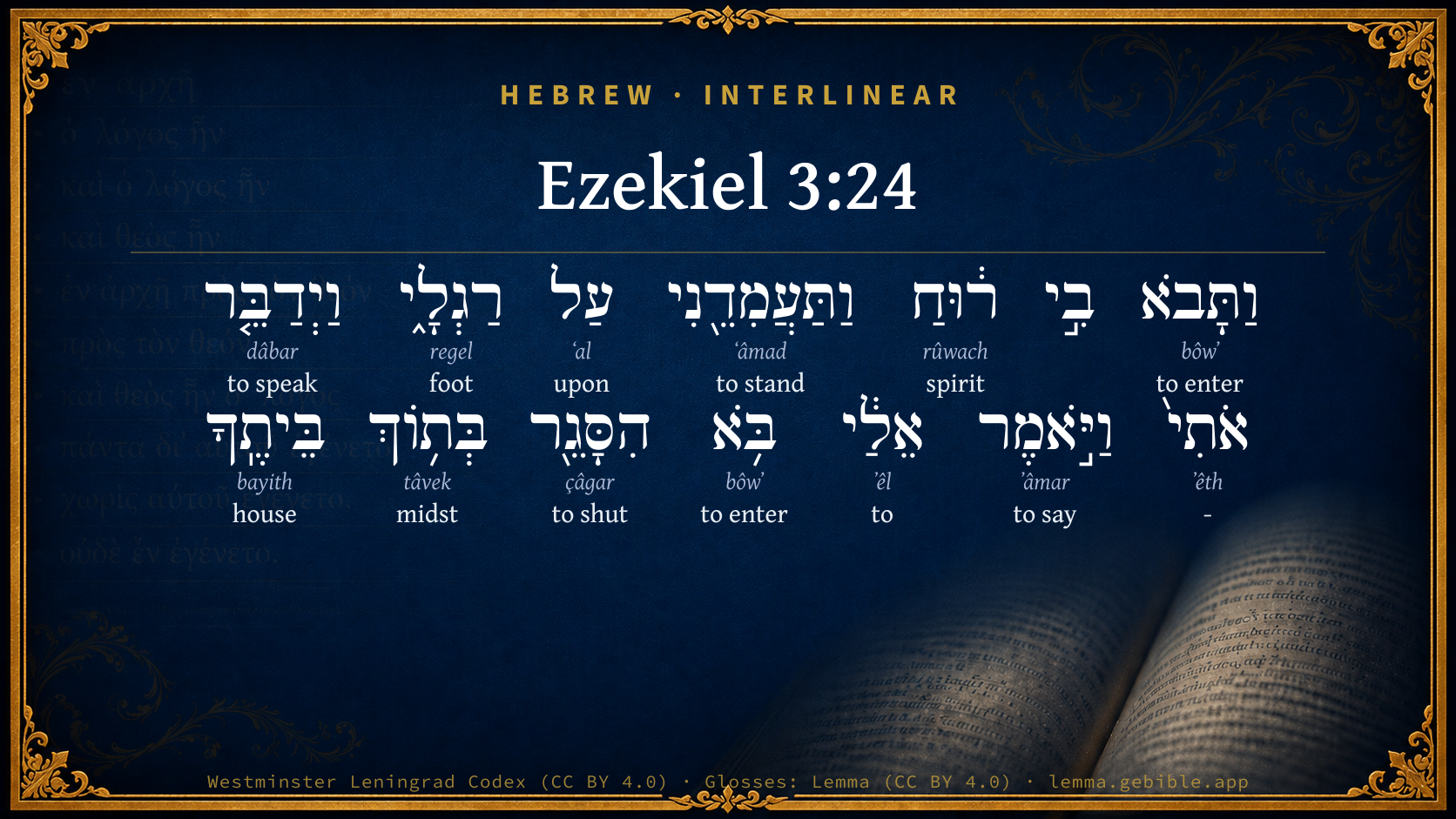
Hebrew (Westminster Leningrad Codex) Ezekiel 3:24 appears in the Hebrew Old Testament. The text above is from the Westminster Leningrad Codex. Each word links to its Strong’s number, a concise gloss, and parsing drawn from the Open Scriptures Hebrew Bible morphology. Click any word for its full Brown-Driver-Briggs (BDB) entry.
Download image
Cite this verse

Ezekiel 3:24 (World English Bible). Public Domain. Lemma interlinear Bible study tool, https://lemma.gebible.app/v/ezekiel/3/24.

Show BibTeX & RIS
BibTeX
RIS
English Translation
Then the Spirit entered into me, and set me on my feet; and he spoke with me, and said to me, Go, shut yourself within your house.
World English Bible · Public Domain
Download a study sheet

One document with this verse’s original text, its word-by-word gloss line, the meaning frame, cross-references with their text, attributed commentary, and full source and license credits — printable, and it pastes into notes with its structure intact.

This verse Autodidact and up

Study sheet (.html) Plain text (.txt)

A passage Seminary Student

Up to 50 verses in one chapter. A passage sheet keeps up to 6 commentary sources and 12 cross-references per verse, in the order this page ranks them, and says so on the sheet whenever that leaves anything out. Ask for a single verse and you get the Autodidact verse sheet above.

Everything on this page stays free to read, with no account — the sheet is a download of what is already on screen, not access to it.

Want to remove ads? Support Godless Engineer
Compare translations 3

The same verse in 3 English versions, stacked beneath the original-language interlinear above. Click any original word for its lexicon entry.

Each is an independent rendering of the whole verse — the interlinear is not word-aligned to these translations.

Highlighted words mark where these versions differ — a whole-verse word diff, not a word-by-word alignment.

  • World English Bible Public Domain
    Then the Spirit entered into me, and set me on my feet; and he spoke with me, and said to me, Go, shut yourself within your house.
  • King James Version Public Domain
    Then the spirit entered into me, and set me upon my feet, and spake with me, and said unto me, Go, shut thyself within thine house.
  • unfoldingWord Literal Text CC BY-SA 4.0
    The Spirit came to me and stood me up on my feet; and he spoke with me, and said to me, “Go and shut yourself up within your house,

unfoldingWord Literal Text — © unfoldingWord, licensed CC BY-SA 4.0. Word-aligned USFM3 via Door43 (git.door43.org/unfoldingWord/en_ult).

Versions to compare (up to 4)

3 of 4 selected

Show all 18 translations

Every available English version of this verse, each an independent rendering of the whole verse.

  • World English Bible Public Domain
    Then the Spirit entered into me, and set me on my feet; and he spoke with me, and said to me, Go, shut yourself within your house.
  • Berean Standard Bible Public Domain
    Then the Spirit entered me and set me on my feet. He spoke with me and said, “Go, shut yourself inside your house.
  • Majority Standard Bible Public Domain
    Then the Spirit entered me and set me on my feet. He spoke with me and said, “Go, shut yourself inside your house.
  • King James Version Public Domain
    Then the spirit entered into me, and set me upon my feet, and spake with me, and said unto me, Go, shut thyself within thine house.
  • American Standard Version (1901) Public Domain
    Then the Spirit entered into me, and set me upon my feet; and he spake with me, and said unto me, Go, shut thyself within thy house.
  • Revised Version (1885) Public Domain
    Then the spirit entered into me, and set me upon my feet; and he spake with me, and said unto me, Go, shut thyself within thine house.
  • Geneva Bible (1599) Public Domain
    Then the Spirit entred into me, which set me vp vpon my feete, and spake vnto me, and said to me, Come, and shut thy selfe within thine house.
  • Douay-Rheims (1899) Public Domain
    And the spirit entered into me, and set me upon my feet: and he spoke to me, and said to me: Go in; and shut thyself up in the midst of thy house.
  • Young's Literal Translation Public Domain
    And come into me doth a spirit, and causeth me to stand on my feet, and He speaketh with me, and saith unto me, `Go in, be shut up in the midst of thy house.
  • Literal Standard Version CC BY-SA 4.0
    And [the] Spirit comes into me, and causes me to stand on my feet, and He speaks with me, and says to me, “Go in, be shut up in the midst of your house.
  • Unlocked Literal Bible CC BY-SA 4.0
    The Spirit came to me and stood me up on my feet; and he spoke with me, and said to me, “Go and shut yourself up within your house,
  • unfoldingWord Literal Text CC BY-SA 4.0
    The Spirit came to me and stood me up on my feet; and he spoke with me, and said to me, “Go and shut yourself up within your house,
  • Darby Bible Public Domain
    And the Spirit entered into me, and set me upon my feet; and he spoke with me, and said unto me, Go, shut thyself within thy house.
  • World Messianic Bible Public Domain
    Then the Spirit entered into me and set me on my feet. He spoke with me, and said to me, “Go, shut yourself inside your house.
  • Webster's Bible Public Domain
    Then the spirit entered into me, and set me upon my feet, and spoke with me, and said to me, Go, shut thyself within thy house.
  • Free Bible Version CC BY-SA 4.0
    Then the Spirit came into me and made me stand upright. He told me, “Go into your house and shut the door.
  • Bible in Basic English Public Domain
    Then the spirit came into me and put me on my feet; and he had talk with me and said to me, Go and keep yourself shut up inside your house.
  • JPS Tanakh (1917) Public Domain
    Then spirit entered into me, and set me upon my feet; and He spoke with me, and said unto me: 'Go, shut thyself within thy house.

Literal Standard Version (2020), Covenant Press — licensed CC BY-SA 4.0. Text via the HelloAO Bible API (eBible.org). Unlocked Literal Bible (unfoldingWord) — licensed CC BY-SA 4.0. Text via the HelloAO Bible API (eBible.org). unfoldingWord Literal Text — © unfoldingWord, licensed CC BY-SA 4.0. Word-aligned USFM3 via Door43 (git.door43.org/unfoldingWord/en_ult). Free Bible Version, Dr. Jonathan Gallagher — licensed CC BY-SA 4.0. Text via the HelloAO Bible API (eBible.org).

Word by word

More ways to search: Search by grammar → Find every occurrence → Compare this word →

Practice this passage: Drill this verse → Learn its vocabulary →

הִסָּגֵ֖ר
çâgar
H5462
“shut”
Verb, Niphal, Imperative, 2nd Person, Masculine, Singular
Part of Speech
Verb
Stem
Niphal
Form
Imperative
Person
2nd Person
Gender
Masculine
Number
Singular
Full BDB Definition

Origin: a primitive root

TWOT: 1462

to shut, close - (Qal) - to shut - to close, close up - closed up, closely joined, shut up - (Niphal) - to be shut up - to be shut or closed - (Piel) to shut up, deliver up - (Pual) to be shut up - (Hiphil) - to deliver up - to shut up, imprison
  1. וַתָּבֹא bôwʼ H935 “and · to enter” Conjunction + Verb, Qal, Sequential Imperfect, 3rd Person, Feminine, Singular
  2. ר֔וּחַ rûwach H7307 “spirit” Noun, Common, Both, Singular, Absolute
  3. וַתַּעֲמִדֵ֖נִי ʻâmad H5975 “and · to stand · me” Conjunction + Verb, Hiphil, Sequential Imperfect, 3rd Person, Feminine, Singular + Suffix, Personal, 1st Person, Common, Singular
  4. עַל ʻal H5921 “upon” Preposition
  5. רַגְלָ֑י regel H7272 “feet · my” Noun, Common, Feminine, Dual, Construct + Suffix, Personal, 1st Person, Common, Singular
  6. וַיְדַבֵּ֤ר dâbar H1696 “and · to speak” Conjunction + Verb, Piel, Sequential Imperfect, 3rd Person, Masculine, Singular
  7. אֹתִי֙ ʼêth H853 “- · me” Particle, Direct Object + Suffix, Personal, 1st Person, Common, Singular
  8. וַיֹּ֣אמֶר ʼâmar H559 “and · to say” Conjunction + Verb, Qal, Sequential Imperfect, 3rd Person, Masculine, Singular
  9. אֵלַ֔י ʼêl H413 “to · me” Preposition + Suffix, Personal, 1st Person, Common, Singular
  10. בֹּ֥א bôwʼ H935 “enter” Verb, Qal, Imperative, 2nd Person, Masculine, Singular
  11. בְּת֥וֹךְ tâvek H8432 “in/at · midst of” Preposition + Noun, Common, Masculine, Singular, Construct
  12. בֵּיתֶֽךָ bayith H1004 “house · your” Noun, Common, Masculine, Singular, Construct + Suffix, Personal, 2nd Person, Masculine, Singular

About this verse

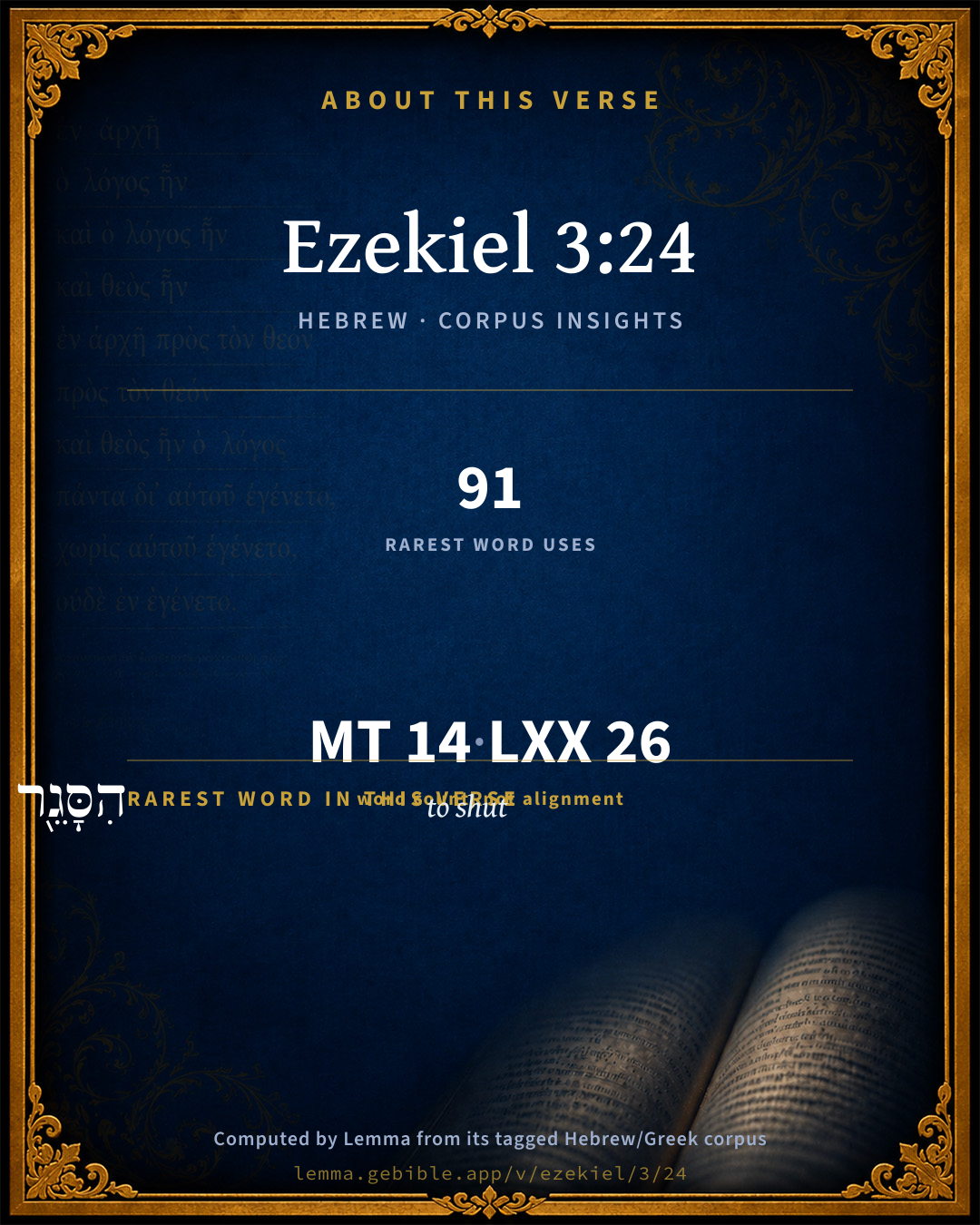
These counts appear in no published source. They are computed here, from the morphology-tagged text and Lemma’s own curated glosses. What Lemma adds →

14
words
12
distinct lemmas
Prophets
section

Grammatical profile

  • 6 verbs
  • 4 nouns
  • 3 prepositions
  • 1 particle

Verb forms

  • וַתָּבֹא Qal · Sequential Imperfect
  • וַתַּעֲמִדֵ֖נִי Hiphil · Sequential Imperfect
  • וַיְדַבֵּ֤ר Piel · Sequential Imperfect
  • וַיֹּ֣אמֶר Qal · Sequential Imperfect
  • בֹּ֥א Qal · Imperative
  • הִסָּגֵ֖ר Niphal · Imperative

Repetition

A word recurs within this verse — often emphatic in Hebrew:

  • וַתָּבֹא to enter H935 ×2

Hebrew & Septuagint length

In English translation the verse runs 27 words from the Hebrew and 32 from the Septuagint (LXX English) — closely comparable.

A rough comparison of the two English renderings, which tokenize alike — not a word-level alignment.

Word counts can differ between the Hebrew and the Greek without any difference in meaning — e.g. the Hebrew direct-object marker אֵת has no separate Greek word, and Greek often adds the article ὁ.

In the original languages it is 14 Hebrew tokens and 26 Greek tokens — but the two are counted differently (Hebrew bundles its prefixes and suffixes into one token; the Greek is in lemma form), so that isn’t a like-for-like length.

Cross-references

5

Topical passages linked to Ezekiel 3:24 in the Treasury of Scripture Knowledge — connected by theme and wording, ordered by reader-vote popularity; previews shown in the World English Bible.

  • Ezekiel 2:2 The Spirit entered into me when he spoke to me, and set me on my feet; and I heard him who spoke to me.
  • Daniel 10:19 He said, "Greatly beloved man, don't be afraid: peace be to you, be strong, yes, be strong." When he spoke to me, I was strengthened, and said, "Let my lord speak; for you have strengthened me."
  • Daniel 10:8–10 So I was left alone, and saw this great vision, and there remained no strength in me; for my comeliness was turned in me into corruption, and I retained no strength.
  • Ezekiel 4:1–4 You also, son of man, take a tile, and lay it before you, and portray on it a city, even Jerusalem:
  • Ezekiel 37:10 So I prophesied as he commanded me, and the breath came into them, and they lived, and stood up on their feet, an exceeding great army.

Cross-references courtesy of OpenBible.info (CC BY 4.0).

Hebrew and Greek witnesses Masoretic Hebrew ↔ Greek Septuagint

The same verse in the two great witnesses to the Old Testament, shown verse-for-verse.

These are two independent witnesses, not word-aligned to each other, and the Septuagint is shown in lemma (dictionary) form.

Hebrew Ezekiel 3:24 Masoretic · Westminster Leningrad Codex

וַתָּבֹא בִ֣י ר֔וּחַ וַתַּעֲמִדֵ֖נִי עַל רַגְלָ֑י וַיְדַבֵּ֤ר אֹתִי֙ וַיֹּ֣אמֶר אֵלַ֔י בֹּ֥א הִסָּגֵ֖ר בְּת֥וֹךְ בֵּיתֶֽךָ

Then the Spirit entered into me, and set me on my feet; and he spoke with me, and said to me, Go, shut yourself within your house.

World English Bible · Public Domain

Greek LXX Ezekiel 3:24 Septuagint · lemma form

καί ἔρχομαι ἐπί ἐγώ πνεῦμα καί ἵστημι ἐγώ ἐπί πούς ἐγώ καί λαλέω πρός ἐγώ καί εἶπον ἐγώ εἰςἔρχομαι καί ἐνκλείω ἐν μέσος ὁ οἶκος σύ

Then the Spirit came upon me, and set me on my feet, and spoke to me, and said to me, Go in, and shut yourself up in the midst of your house.

LXX2012 (modern English Septuagint) · Public Domain

Hebrew: Westminster Leningrad Codex (CC BY 4.0). Greek: Septuagint (public domain); English from LXX2012 (modern English Septuagint) (Public Domain). How the Septuagint differs from the Hebrew →

Targum (Aramaic paraphrase)

1

The Targum is the ancient Jewish Aramaic paraphrase of the Hebrew Scriptures — an interpretive translation, not the Hebrew text itself. Onkelos (literal) and Pseudo-Jonathan (expansive) render the Torah, and Jonathan the Prophets. Coverage is partial: where no permissively-licensed English translation exists for a verse, only the Aramaic is shown. This is verse-level text, not a word-by-word alignment to the Hebrew.

  1. Targum Jonathan Prophets (Joshua–Malachi)
    וַעֲלַת בִּי רוּחָא וַאֲקֵימַתְנִי עַל רִגְלָי וּמַלֵיל עִמִי וַאֲמַר עוּל אִטַמַר בְּגוֹ בֵיתָךְ:

    (no public-domain English translation for this verse)

    Targum Jonathan — Aramaic: “Mikraot Gedolot” (public domain). English: “Sefaria Community Translation” (CC0 1.0 (public-domain dedication)); “London "Chaldee Paraphrase," 1871” (public domain). Text via Sefaria.

Commentary

Notes on Ezekiel 3:24 from classic Christian and Jewish commentators (each source and its license shown beneath its notes). The classic Christian expositions comment on the surrounding passage and are grouped to its opening verse, so a note may address several verses; the Jewish commentaries on the Tanakh (Rashi and others) are per-verse, so they appear only where the commentator wrote on this verse.

Lemma curates 59 commentaries, every one of them public domain or Creative Commons licensed, each selected and text-cleaned for this edition rather than reprinted as found. About our sources →

Trapp's Complete Commentary

John Trapp

Eze 3:24 Then the spirit entered into me, and set me upon my feet, and spake with me, and said unto me, Go, shut thyself within thine house.

Ver. 24. Go shut thyself within thine house,] q.d., Thou hast a mind, I perceive to do so; but it is not thy wisest way to decline thine office, how hard soever it seemeth.

John Trapp, A Commentary or Exposition upon All the Books of the Old and New Testament (1647–1656) — public domain. Text from a community e-Sword module.

Tyndale Open Study Notes

Tyndale Open Resources

3:24-25 Ezekiel was God’s prisoner, shut . . . in his house and tied with ropes. It is not clear whether these were literal ropes used to express the hostility of his fellow exiles toward the prophet, or a vivid image of their opposition and his restricted mobility among them. His complete captivity was striking, including the limitation placed on his speech (3:26-27); it would be a sign to the people.

Tyndale Open Study Notes — © Tyndale Open Resources, licensed CC BY-SA 4.0. Text via the HelloAO Bible API.

Geneva Bible (1599)

Geneva Bible translators

Signifying, that not only he should not profit, but they should grievously trouble and afflict him.

Read Ezek. 2:2.

Geneva Bible (1599) marginal notes — public domain. Text via Bolls.life.

Jamieson, Fausset & Brown

Robert Jamieson, A. R. Fausset & David Brown

set me upon my feet--having been previously prostrate and unable to rise until raised by the divine power.

shut thyself within . . . house--implying that in the work he had to do, he must look for no sympathy from man but must be often alone with God and draw his strength from Him [FAIRBAIRN]. "Do not go out of thy house till I reveal the future to thee by signs and words," which God does in the following chapters, down to the eleventh. Thus a representation was given of the city shut up by siege [GROTIUS]. Thereby God proved the obedience of His servant, and Ezekiel showed the reality of His call by proceeding, not through rash impulse, but by the directions of God [CALVIN].

Jamieson, Fausset & Brown — Commentary Critical and Explanatory on the Whole Bible (1871) — public domain (CC PDM 1.0). Text via the HelloAO Bible API.

Adam Clarke's Commentary

Verse 24. The spirit - said unto me, Go, shut thyself within thine house.] Hide thyself for the present. The reason is immediately subjoined.

Adam Clarke's Commentary on the Bible (1810–1826) — public domain. Text from a community e-Sword/MySword module.

John Calvin's Commentaries

Here Ezekiel confirms what I have said: whenever the faithful are frightened at the sight of God’s glory, they cannot collect their mind unless the Lord prop them up by his strength. But this state was peculiar to the Prophet, because he ought to acknowledge himself, as it were, dead when he felt the Spirit of God living and flourishing in his mind. Therefore this tends to confirm him, because the Spirit restored him from a state of death to life: therefore he says, the Spirit came In fine, as the soul gives life to the man, so the Spirit of God is a supernatural life in man. We live after the manner of men, because a virtue is implanted in our soul which has faculties of its own. For in the soul is the seat of intelligence, and the will, and the sensations, and it diffuses its vigor through all the members. But the life which souls breathe into bodies is only earthly, but the Spirit of God gives life supernaturally. And this distinction must be held, because profane men boast only in outward appearances, as they call it — that is, in outward splendor, which is nothing else but a mask: and so with all their might they celebrate free-will and our natural faculties, because they have never tasted what that supernatural life is which is here mentioned. Ezekiel indeed was filled with the Spirit of God after a peculiar manner, that he might be fit to undertake the prophetic office, but this is common to the faithful for their spiritual life.

He says next, that he was placed upon his feet, because he was lying prostrate, nor could he, as I have said, raise a finger, unless he had been raised by divine power. Afterwards he relates the command of God, which appears to be absurd. For why did God appoint Ezekiel a Prophet unless that he should apply himself to the office of teaching? But now he orders him not only to rest, but even to he concealed at home. He uses the word “concealed” as if he had said, remain at home as a captive. If he had been a private man, he had enjoyed a free passage out, but now since God enjoins upon him the prophetic office, he is held captive. But all this is opposed to his mission. But first, God wished to prove the obedience of his servant; then he wished specially to confirm his calling more and more, for this was no common confirmation, because although the Prophet excelled in singular virtue, yet he did not leap into the midst, but rested at home, and became a voluntary captive, because it so pleased God. Hence the whole people might know that the Prophet did not proceed rashly, or by any sudden impulse, because he was often mute by the command of God. Afterwards it follows —

John Calvin's Commentaries (1540-1563) — public domain. Text from the Calvin Translation Society English edition (1840s-50s) via the Christian Classics Ethereal Library (ccel.org). Calvin's coverage is partial (roughly two-thirds of the Bible); uncommented books and verses are honest gaps, never fabricated. The 19th-century editor's footnotes and remarks are omitted so the notes are faithfully Calvin's own voice.

Ellicott's Commentary for English Readers

(24) Go, shut thyself within thine house.—The prophet’s consecration being now complete, he is to enter upon his actual work; yet, in view of the disposition of the people, he is to begin his prophecies in a private way, shut up in his house. Or it may be that this should be understood of a period of absolute silence and meditation preparatory to entering upon his work. Moreover, fresh warning is given of the reception he must be prepared to meet.

A Bible Commentary for English Readers, edited by Charles John Ellicott (1878–1897) — public domain. Text from a community e-Sword module.

The Cambridge Bible for Schools and Colleges

gen. ed. J. J. S. Perowne

24. shut thyself within thy house] The words are not to be pressed to mean more than abstention from the exercise of his ministry in public. Cf. ch. Eze_8:1, Eze_11:25, Eze_14:1 &c.

The Cambridge Bible for Schools and Colleges (gen. ed. J. J. S. Perowne; Cambridge University Press, 1878–1918) — public domain. Text from a community e-Sword module.

John Gill's Exposition

Then the spirit entered into me,.... Again; the Spirit of God, that was in the wheels and living creatures: see Eze 2:2;

and set me upon my feet; as he had done before, when in the same prostrate condition, Eze 2:2;

and spake with me; either the Spirit that entered into him, and set him upright; or rather the Lord Christ, the glory of the Lord that stood where he was, and appeared to him:

and said unto me, go, shut thyself within thine house: this was not said ironically, but in earnest; and the reason either was, because the people were not fit for reproof and correction, as Jarchi thinks, being a rebellious people; or that the prophet might receive further instructions, and have all the words of his prophecy delivered to him, before he began to prophesy. Some think this shutting up was an emblem of the siege of Jerusalem. It may seem strange that the prophet should be bid to go into the plain, where the Lord promised to talk with him; and this is all that is said to him, to go home, and shut himself up in his house: but it should be observed, that this was not the only thing for which he went into the plain: he was to have, and had, a fresh view of the glory of the Lord, and of the vision he had before, for the further confirmation of him; besides, this moving him from place to place, before he prophesied, might be partly to try his faith, and partly to preserve him from the violence of the people; who, had he delivered his message at once, might have been so provoked, as to have fallen upon him, and destroyed him; as well as to prepare them to receive his prophecies with more respect and reverence, when they saw he did not rashly, and at once, deliver them out to them.

John Gill's Exposition of the Whole Bible (1746–1763) — public domain (CC PDM 1.0). Text via the HelloAO Bible API.

Albert Barnes' Notes on the Bible

“Shut” in the privacy of his own chamber he is to receive a message from Yahweh. This “shutting up,” however, and the “bands” (Eze 3:25, used figuratively) were signs of the manner in which Ezekiel’s countrymen would close their ears, hindering him as far as in them lay from delivering the message of the Lord.

With this verse commences a series of symbolic actions enjoined to the prophet in order to foretell the coming judgments of Jerusalem Ezek. 4; 5. Generally speaking symbolic actions were either literal and public, or figurative and private. In the latter case they impressed upon the prophet’s mind the truth which he was to enforce upon others by the description of the action as by a figure. Difficulties have arisen, because interpreters have not chosen to recognize the figurative as well as the literal mode of prophesying. Hence, some, who would have all literal, have had to accept the most strange and unnecessary actions as real; while others, who would have all figurative, have had arbitrarily to explain away the most plain historical statement. There may be a difference of opinion as to which class one or other figure may belong; but after all, the determination is not important, the whole value of the parabolic figure residing in the lesson which it is intended to convey.

Albert Barnes' Notes on the Bible (1834–1885) — public domain. Text from a community e-Sword/MySword module.

Matthew Poole's English Annotations

The spirit: see Eze 2:2.

Shut thyself within thy house: some say this is to be an interrogation, wilt thou, &c.? others add it is an irony, upbraiding him; but I see no ground for either. It is, as we read it, a plain command, which appears, in that with the command God giveth strength to do what is commanded; and he is to shut up himself, to learn of God what he must foretell, to foresignify the shutting up of Jews in Jerusalem.

Matthew Poole's English Annotations on the Holy Bible (1683–1685) — public domain. Text from a community e-Sword/MySword module.

Whedon's Commentary on the Bible

Daniel D. Whedon

24. Then the spirit entered into me — “A” spirit (Eze_2:2; Eze_3:14) has become “the” spirit now. Ezekiel has become acquainted with the action of this inner spiritual power. It is Jehovah’s spirit, for it “speaks,” and prophesies, and commands, and makes dumb (24-26).

Go, shut thyself within thine house — The object sought by commanding him to come into the “valley” seems already to have been accomplished. The prophet is ready now to obey, implicitly, without protest, any word of the Lord; yet he must shut himself within the house and wait yet a little longer before he delivers his message.

Daniel D. Whedon (gen. ed.), Commentary on the Old and New Testaments (1874–1909) — public domain. Text from a community e-Sword module.

The Pulpit Commentary

Go, shut thyself within thy heroin, etc. The command implied that he was to cease for a time from all public ministrations. There was a time to keep silence, as well as a time to speak, (Ecc_3:7) and for the immediate future silence was the more effective of the two. It would, at least, make them eager to hear what the silence meant.

Vers. 24-27. The temporary suspension of the active ministry of the prophet.

the Spirit entered into me, and set me upon my feet," etc. Seclusion and silence were enjoined upon Ezekiel for a time. Our text teaches that the temporary suspension of his active ministry

I WAS COMMANDED BY THE LORD. "Then the Spirit entered into me, and set me upon my feet, and spake with me, and said unto me, Go, shut thyself within thine house" (cf. Eze_2:2) One would have been inclined to conclude that, when he was revived by the Spirit, the prophet would have been ordered to enter upon active service. But he was commanded to seclude himself within his house. This seclusion was probably intended as:

1. A season of meditation for the prophet. Such seasons are requisite for those whose work for God is public and arduous; and in his providence God so orders their lives that such seasons are attainable by them; e.g. . Moses in the desert of Mitian; (Exo_3:1) St. Paul in Arabia; (Gal_1:17) Martin Luther in the monastery of Erfurt, and in the castle of Wartburg.

2. As a silent admonition to the people. God would instruct them by symbol, that from a rebellious people the prophetic presence and voice may be withdrawn. If men will not heed the reproofs of his servants, the reprover shall be silent towards them (ver. 26).

II WAS OCCASIONED BY THE OBSTINACY OF THE PEOPLE IN WICKEDNESS. "But thou, O son of man, behold, they shall put bands upon thee, and shall bind thee with them, and thou shalt not go out among them." This verse is a difficult one, and we cannot assert dogmatically what it means; but it seems to us that it should be taken metaphorically, and that it symbolizes the truth that the persistent sins of the people occasioned the seclusion and silence of the prophet. Dr. Fairbairn thus paraphrases the verse under consideration: "Their obstinate and wayward disposition shall be felt upon thy spirit like restraining fetters, repressing the energies of thy soul in its spiritual labours, so that thou shalt need to look for thy encouragement elsewhere than in fellowship with them. The imposition of bands must be understood spiritually, of the damping effect to be produced upon his soul by the conduct of the people. It is a marked specimen of the strong idealism of our prophet, which clothes everything it handles with the distinctness of flesh and blood." The persistent rebelliousness of the people occasioned the temporary suspension of the active work of the prophet. The unbelief of our Lord"s own countrymen was as bands upon him, restraining the exercise of his benevolent power. "And he did not many mighty works there, because of their unbelief." Obstinacy in wickedness deprives man of the most precious spiritual possessions.

III WAS TO BE RIGIDLY ENFORCED. "And I will make thy tongue cleave to the roof of thy mouth, that thou shalt be dumb, and shalt not be to them a reprover: for they are a rebellious house." This is to be taken metaphorically. "Because the people would silence the prophet, God, to punish them, will close his mouth." During the time of the suspension of his prophetic activity he would be as silent to them as a dumb man. When the Lord determines to deprive a people of any blessing which they have despised or persistently disregarded, his determination will certainly be enforced.

IV WAS TO BE ONLY TEMPORARY. "But when I speak with thee, I will open thy month, and thou shalt say unto them, Thus saith the Lord God," etc. The withdrawal of the messenger of the Lord was not to be permanent. The prophet would speak again when God willed him to do so. When his seclusion and silence had produced their effect, he must go forth and proclaim the word of the Lord. The following observations are suggested by this verse:

1. The prophet is empowered for his work by the Lord. "When I speak with thee, I will open thy mouth." Ezekiel received his message from the Lord, and was emboldened by him to deliver it.

2. The prophet is authorized in his work by the Lord. "Thou shalt say unto them, Thus saith the Lord God." Both the silence and the speech of Ezekiel were expressly ordered by God. In both he was under the control of his Divine Master, remaining silent when so directed by him, and proclaiming his word whet, commanded and enabled by him to do so. "This represents forcibly the authoritative character and Divine origin of the utterances of the Hebrew prophets.

3. The prophets great concern in his work should be to be faithful to the Lord. "Thus saith the Lord God; He that heareth, let him hear; and he that forbeareth, let him forbear: for they are a rebellious house." Ezekiel was not responsible for the success of his work with the people. But fidelity in executing the commissions which he received from his great Master was required of him. For this he was responsible. And still "it is required in stewards that a man be found faithful". (1Co_4:2)

CONCLUSION. Our subject addresses to us solemn admonition as to our treatment of the Word of the Lord. If we persistently despise or disregard that Word, he may withdraw it from us, or place us beyond the sphere of the ministry thereof. Neglected privileges may justly and reasonably be taken away from those who have neglected them. W.J. (cf. Amo_1:4-12)

The Pulpit Commentary (1880–1919), ed. H.D.M. Spence-Jones & Joseph S. Exell — public domain. Text from a community e-Sword module.

John Wesley's Explanatory Notes

Shut - To foresignify the shutting up of the Jews in Jerusalem.

John Wesley, Explanatory Notes Upon the Whole Bible (1754–1765) — public domain. Text via the GEBible commentary corpus.

unfoldingWord translationNotes

Door43 World Missions Community

he spoke with me

If your language has to identify the one speaking, it would be best to identify the speaker as the "one who looked like a man" (Ezekiel 1:26). It was not "the Spirit."

they will place ropes upon you and tie you so you cannot go out among them

This is best translated literally.

translationWords

Holy Spirit

Son of Man

unfoldingWord translationNotes — © Distant Shores Media and the Door43 World Missions Community, licensed CC BY-SA 4.0. Source: git.door43.org/Door43/en_tn.

Rashi

Rabbi Shlomo Yitzchaki (Rashi)

confine yourself within your house to show them that they are not worthy of reproof.

Rashi on the Tanakh — English translations: “The Judaica Press complete Tanach with Rashi, translated by A. J. Rosenberg” (CC BY 4.0); “Pentateuch with Rashi's commentary by M. Rosenbaum and A.M. Silbermann, 1929-1934” (public domain); “The Metsudah Tanach series, Lakewood, N.J” (CC BY 4.0); and “The Book of Joshua, Metsudah Publications, 1997” (CC BY 4.0). Text via Sefaria.

Lesson kit

Teaching starters — assembled from the data on this page, not authored interpretation. Every prompt links to the verse data it draws on. Edit before teaching.

Ezekiel, in the Prophets, opens this verse with 14 words (12 distinct Hebrew lemmas). Its most distinctive word is çâgar (“to shut”). A historical commentator’s framing appears above. Read the whole chapter for the surrounding context.

Discussion questions

  1. The word çâgar carries the sense “to shut.” How does it shape the verse?
  2. Ezekiel 2:2 shares this passage’s theme. How do the two illuminate each other?
  3. “to enter” occurs 2× in this one verse. What is the effect of the repetition?
  4. These translations render this verse differently; the difference is in the English rendering, not the original. What questions does that raise?
  5. The verb «וַתָּבֹא» is Qal Sequential Imperfect. How does its form color the action?
  6. Reading how Trapp's Complete Commentary and Tyndale Open Study Notes read this verse, where do the two commentators agree and where do they part?

Things to notice

Reading settings

Reading text

Shown beneath each verse's original-language words.

Old Testament
Old Testament edition

Read the OT as the Masoretic Hebrew (MT) or the Greek Septuagint (LXX).

English shown for the Greek Septuagint (in the Hebrew ↔ Greek comparison).

Comparing translations? Open the Compare panel on any verse page to stack up to four side by side.