
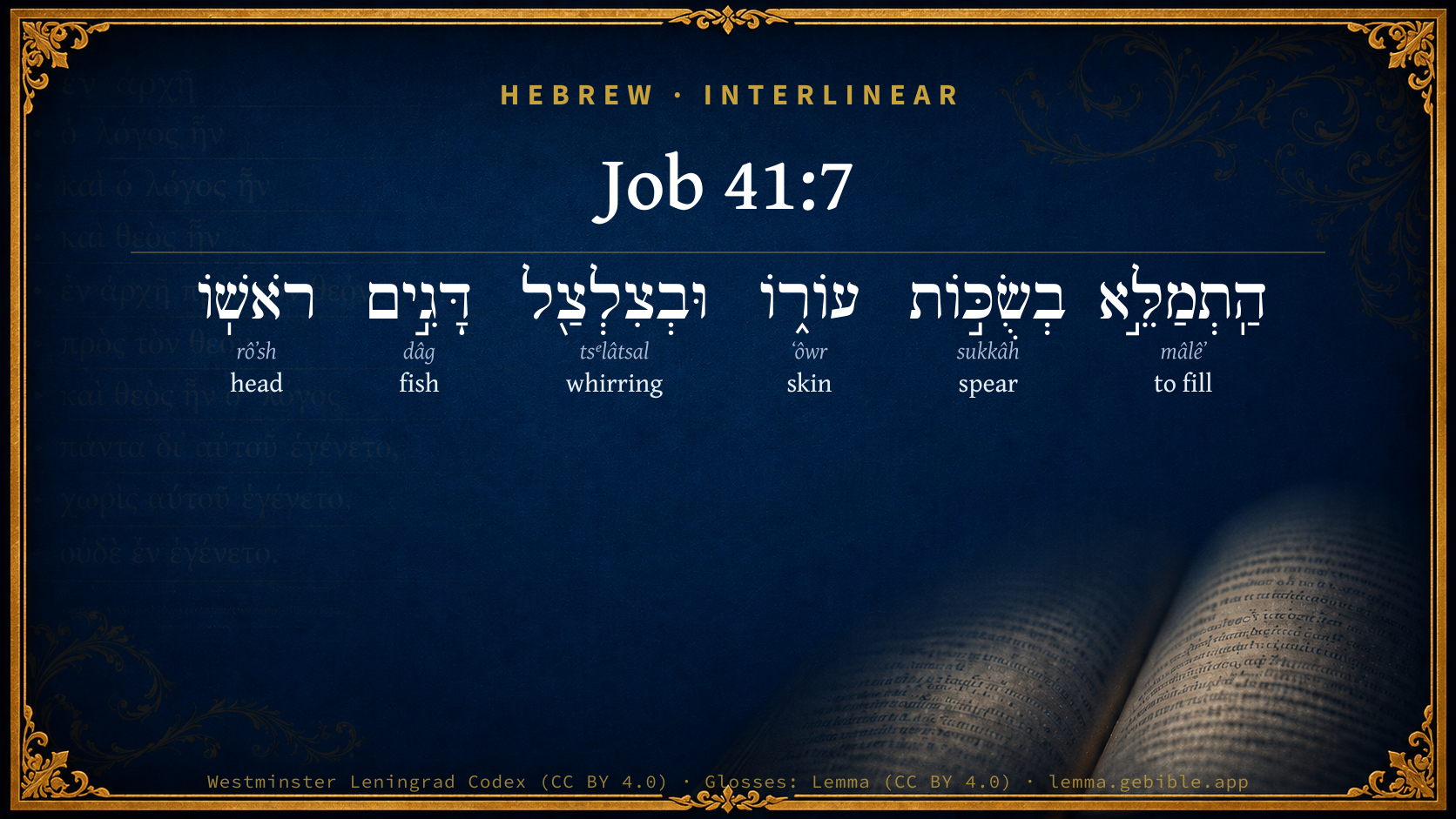
Job 41:7

Hebrew (Westminster Leningrad Codex) Job 41:7 appears in the Hebrew Old Testament. The text above is from the Westminster Leningrad Codex. Each word links to its Strong’s number, a concise gloss, and parsing drawn from the Open Scriptures Hebrew Bible morphology. Click any word for its full Brown-Driver-Briggs (BDB) entry.
Download image
Cite this verse

Job 41:7 (World English Bible). Public Domain. Lemma interlinear Bible study tool, https://lemma.gebible.app/v/job/41/7.

Show BibTeX & RIS
BibTeX
RIS
English Translation
Can you fill his skin with barbed irons, Or his head with fish-spears?
World English Bible · Public Domain
Highlights
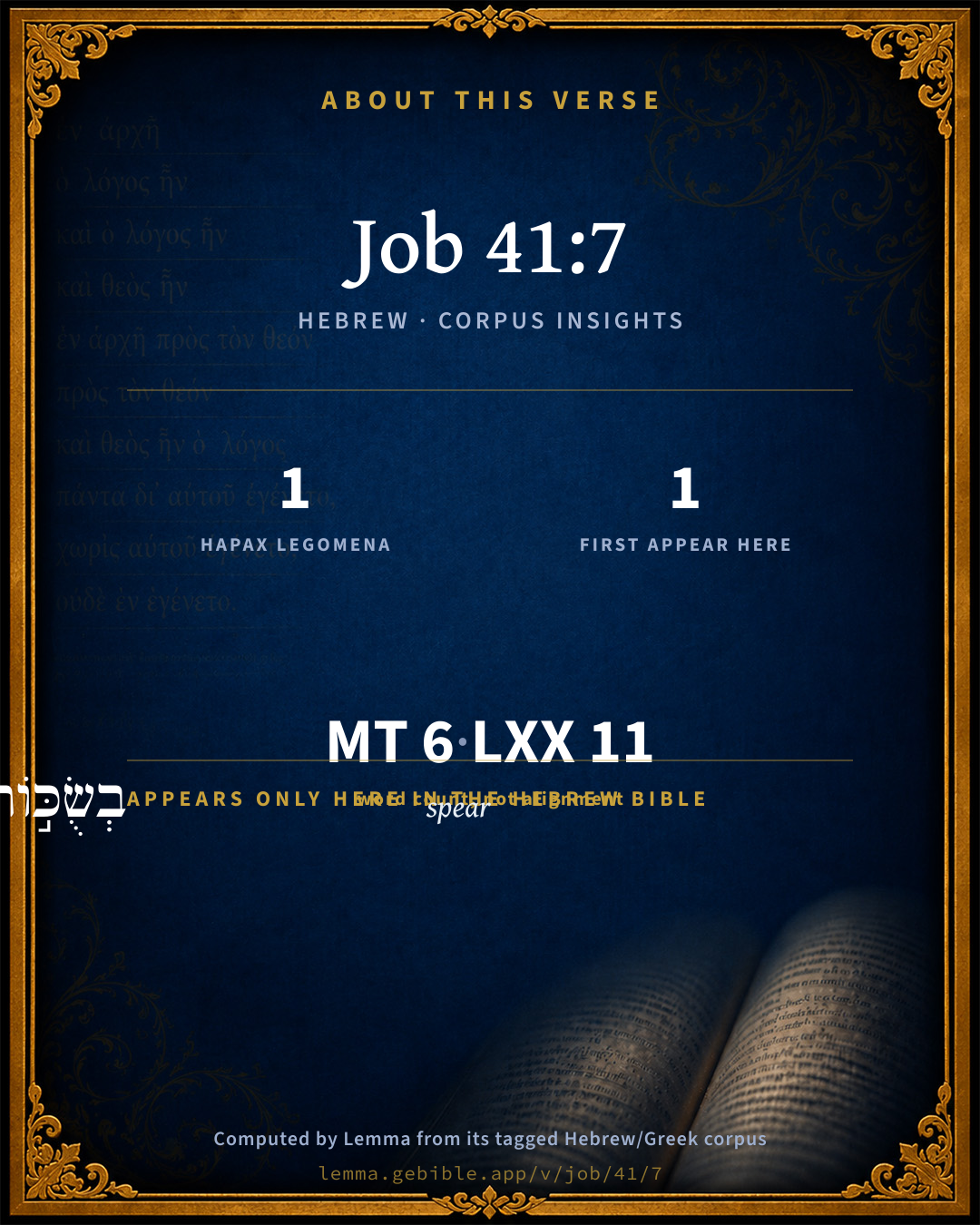
  • 1 hapax legomenon — only here in the Hebrew Bible
  • 1 first appearance in the Hebrew Bible
Full analysis ↓
Download a study sheet

One document with this verse’s original text, its word-by-word gloss line, the meaning frame, cross-references with their text, attributed commentary, and full source and license credits — printable, and it pastes into notes with its structure intact.

This verse Autodidact and up

Study sheet (.html) Plain text (.txt)

A passage Seminary Student

Up to 50 verses in one chapter. A passage sheet keeps up to 6 commentary sources and 12 cross-references per verse, in the order this page ranks them, and says so on the sheet whenever that leaves anything out. Ask for a single verse and you get the Autodidact verse sheet above.

Everything on this page stays free to read, with no account — the sheet is a download of what is already on screen, not access to it.

Want to remove ads? Support Godless Engineer
Compare translations 3

The same verse in 3 English versions, stacked beneath the original-language interlinear above. Click any original word for its lexicon entry.

Each is an independent rendering of the whole verse — the interlinear is not word-aligned to these translations.

Highlighted words mark where these versions differ — a whole-verse word diff, not a word-by-word alignment.

  • World English Bible Public Domain
    Can you fill his skin with barbed irons, Or his head with fish-spears?
  • King James Version Public Domain
    Canst thou fill his skin with barbed irons? or his head with fish spears?
  • unfoldingWord Literal Text CC BY-SA 4.0
    Can you fill its hide with harpoons or its head with spears of fish?

unfoldingWord Literal Text — © unfoldingWord, licensed CC BY-SA 4.0. Word-aligned USFM3 via Door43 (git.door43.org/unfoldingWord/en_ult).

Versions to compare (up to 4)

3 of 4 selected

Show all 18 translations

Every available English version of this verse, each an independent rendering of the whole verse.

  • World English Bible Public Domain
    Can you fill his skin with barbed irons, Or his head with fish-spears?
  • Berean Standard Bible Public Domain
    Can you fill his hide with harpoons or his head with fishing spears?
  • Majority Standard Bible Public Domain
    Can you fill his hide with harpoons or his head with fishing spears?
  • King James Version Public Domain
    Canst thou fill his skin with barbed irons? or his head with fish spears?
  • American Standard Version (1901) Public Domain
    Canst thou fill his skin with barbed irons, Or his head with fish-spears?
  • Revised Version (1885) Public Domain
    Canst thou fill his skin with barbed irons, or his head with fish spears?
  • Geneva Bible (1599) Public Domain
    One is set to another, that no winde can come betweene them.
  • Douay-Rheims (1899) Public Domain
    One is joined to another, and not so much as any air can come between them:
  • Young's Literal Translation Public Domain
    Dost thou fill with barbed irons his skin? And with fish-spears his head?
  • Literal Standard Version CC BY-SA 4.0
    Do you fill his skin with barbed irons? And his head with fish-spears?
  • Unlocked Literal Bible CC BY-SA 4.0
    Can you fill his hide with harpoons or his head with fishing spears?
  • unfoldingWord Literal Text CC BY-SA 4.0
    Can you fill its hide with harpoons or its head with spears of fish?
  • Darby Bible Public Domain
    Wilt thou fill his skin with darts, and his head with fish-spears?
  • World Messianic Bible Public Domain
    Can you fill his skin with barbed irons, or his head with fish spears?
  • Webster's Bible Public Domain
    \\41:16\\One is so near to another, that no air can come between them.
  • Free Bible Version CC BY-SA 4.0
    Can you pierce his skin with many harpoons, its head with fishing spears?
  • Bible in Basic English Public Domain
    One is so near to the other that no air may come between them.
  • JPS Tanakh (1917) Public Domain
    (40-31) Canst thou fill his skin with barbed irons? or his head with fish-spears?

Literal Standard Version (2020), Covenant Press — licensed CC BY-SA 4.0. Text via the HelloAO Bible API (eBible.org). Unlocked Literal Bible (unfoldingWord) — licensed CC BY-SA 4.0. Text via the HelloAO Bible API (eBible.org). unfoldingWord Literal Text — © unfoldingWord, licensed CC BY-SA 4.0. Word-aligned USFM3 via Door43 (git.door43.org/unfoldingWord/en_ult). Free Bible Version, Dr. Jonathan Gallagher — licensed CC BY-SA 4.0. Text via the HelloAO Bible API (eBible.org).

Word by word

More ways to search: Search by grammar → Find every occurrence → Compare this word →

Practice this passage: Drill this verse → Learn its vocabulary →

About this verse

These counts appear in no published source. They are computed here, from the morphology-tagged text and Lemma’s own curated glosses. What Lemma adds →

6
words
6
distinct lemmas
Wisdom
section

Notable vocabulary

1 hapax legomenon — a word that appears only here in the entire Hebrew Bible:

  • בְשֻׂכּ֣וֹת spear H7905

First appearance in Scripture

This word makes its first canonical appearance in the Hebrew Bible here:

  • בְשֻׂכּ֣וֹת spear H7905

Shared distinctive vocabulary

וּבְצִלְצַ֖ל whirring H6767 occurs in 5 verses of the Hebrew Bible. Also found in:

Grammatical profile

  • 1 verb
  • 5 nouns

Verb forms

  • הַֽתְמַלֵּ֣א Piel · Imperfect

Hebrew & Septuagint length

In English translation the verse runs 13 words from the Hebrew and 13 from the Septuagint (LXX English) — the same length.

A rough comparison of the two English renderings, which tokenize alike — not a word-level alignment.

Word counts can differ between the Hebrew and the Greek without any difference in meaning — e.g. the Hebrew direct-object marker אֵת has no separate Greek word, and Greek often adds the article ὁ.

In the original languages it is 6 Hebrew tokens and 11 Greek tokens — but the two are counted differently (Hebrew bundles its prefixes and suffixes into one token; the Greek is in lemma form), so that isn’t a like-for-like length.

Hebrew and Greek witnesses Masoretic Hebrew ↔ Greek Septuagint

The same verse in the two great witnesses to the Old Testament, shown verse-for-verse.

These are two independent witnesses, not word-aligned to each other, and the Septuagint is shown in lemma (dictionary) form.

Hebrew Job 41:7 Masoretic · Westminster Leningrad Codex

הַֽתְמַלֵּ֣א בְשֻׂכּ֣וֹת עוֹר֑וֹ וּבְצִלְצַ֖ל דָּגִ֣ים רֹאשֽׁוֹ

Can you fill his skin with barbed irons, Or his head with fish-spears?

World English Bible · Public Domain

Greek LXX Job 41:7 Septuagint · lemma form

ὁ ἔγκατα αὐτός ἀσπίς χάλκειος σύνδεσμος δέ αὐτός ὥσπερ σμιρίτης λίθος

One part cleaves fast to another, and the air can’t come between them.

LXX2012 (modern English Septuagint) · Public Domain

On this verse, Albert Barnes' Notes on the Bible discusses the Septuagint’s reading. Read the note in Commentary ↓

Hebrew: Westminster Leningrad Codex (CC BY 4.0). Greek: Septuagint (public domain); English from LXX2012 (modern English Septuagint) (Public Domain). How the Septuagint differs from the Hebrew →

Commentary

Notes on Job 41:7 from classic Christian and Jewish commentators (each source and its license shown beneath its notes). The classic Christian expositions comment on the surrounding passage and are grouped to its opening verse, so a note may address several verses; the Jewish commentaries on the Tanakh (Rashi and others) are per-verse, so they appear only where the commentator wrote on this verse.

Lemma curates 59 commentaries, every one of them public domain or Creative Commons licensed, each selected and text-cleaned for this edition rather than reprinted as found. About our sources →

Trapp's Complete Commentary

John Trapp

Job 41:7 Canst thou fill his skin with barbed irons? or his head with fish spears?

Ver. 7. Canst thou fill his skin with barbed irons?] Harpagonibus. Heb. With thorns; sc. to pull him to the shore? Opianus, Albertus Magnus, Gesner, and others now write, how whales are to be taken; and experience proves it to be seizable. They are sometimes cast upon the land by the surging rage or violence of the sea, or, by the ebbing thereof, left in a ford, where they cannot swim, and so they become a prey to the fishermen with their guns, darts, &c.

John Trapp, A Commentary or Exposition upon All the Books of the Old and New Testament (1647–1656) — public domain. Text from a community e-Sword module.

Joseph Benson's Commentary

Job 41:7-8. Canst thou fill his skin with barbed irons? — A whale’s skin you may; but the skin of a crocodile is so hard that an iron, or spear, will not pierce it. It may, however, be understood also of the whale, for though they are taken at this day by piercing their skin with barbed irons, this art and way of taking them is but a late invention, and was not known in Job’s time; and, besides, he doth not speak of the absolute impossibility, but of the great difficulty of taking them. Lay thy hand upon him — Seize upon him, and take him by a strong hand, if thou darest to do so. Remember the battle, &c. — But ere thou attempt that, consider what thou art doing, and how hazardous thy enterprise is, and with what sort of a creature and with what disadvantage thou art going to contend; and, as it follows, do no more — Proceed no further; draw back thy hand, and be thankful for so great a deliverance. Or, as אל תוסŠ, al tosaph, literally signifies, non addes, that is, as Mercer very justly explains it, if once thou lay thy hand upon him, or attempt to do it, thou wilt no more remember the engagement with him, or any one else; for he will quickly despatch thee. Heath, however, gives a different turn to the sense, thus: Be sure thou strike home; mind thy blow; rely not on a second stroke.

Joseph Benson's Commentary on the Old and New Testaments (1811–1818) — public domain. Text from a community e-Sword module.

Jamieson, Fausset & Brown

Robert Jamieson, A. R. Fausset & David Brown

His hide is not penetrable, as that of fishes.

Jamieson, Fausset & Brown — Commentary Critical and Explanatory on the Whole Bible (1871) — public domain (CC PDM 1.0). Text via the HelloAO Bible API.

Adam Clarke's Commentary

Verse 7. Canst thou fill his skin with barbed irons?] This refers to some kind of harpoon work, similar to that employed in taking whales, and which they might use for some other kinds of animals; for the skin of the crocodile could not be pierced. Herrera says that he saw a crocodile defend itself against thirty men; and that they fired six balls at it without being able to wound it. It can only be wounded under his belly.

Adam Clarke's Commentary on the Bible (1810–1826) — public domain. Text from a community e-Sword/MySword module.

John Gill's Exposition

Canst thou fill his skin with barbed irons? or his head with fish spears? This seems not so well to agree with the whale; whose skin, and the several parts of his body, are to be pierced with harpoons and lances, such as fishermen use in taking whales; and their flesh to be cut in pieces with their knives: but better with the crocodile, whose skin is so hard, and so closely set with scales, that it is impenetrable; See Gill on Eze 29:4. Or if the words are rendered, as by some, "wilt thou fill ships with his skin? and the fishermen's boat with his head" (n)? it makes also against the whale; for this is done continually, ships of different nations are loaded every year with its skin, flesh, and the bones of its head.

(n) Vid. Schultens in loc.

John Gill's Exposition of the Whole Bible (1746–1763) — public domain (CC PDM 1.0). Text via the HelloAO Bible API.

Albert Barnes' Notes on the Bible

Canst thou fill his skin with barbed irons? - Referring to its thickness and impenetrability. A common method of taking fish is by the spear; but it is here said that the leviathan could not be caught in this manner. The common method of taking the crocodile now is by shooting him; see the notes at Job 41:1. Nothing is more remarkable in the crocodile than the thick and impenetrable skin with which it is covered; and the description here will agree better with this animal than with any other.

Or his head with fish spears - The word here rendered “fish-spears” (צלצל tselâtsal) means properly a “tinkling, clanging,” as of metal or arms, and then any tinkling instrument. Here it evidently refers to some metal spear, or harpoon, and the name was given to the instrument on account of its clanging noise. The Septuagint renders this strangely, referring it to the “Phenicians,” or merchants mentioned in the previous verse - “With their whole fleet they could not carry the first skin of his tail, nor his head in their fishing-barks.”

Albert Barnes' Notes on the Bible (1834–1885) — public domain. Text from a community e-Sword/MySword module.

Matthew Poole's English Annotations

This may be understood, either,

1. Of the whale. And whereas it is objected that the whales at this day are taken in this manner, and therefore this cannot be understood of them; it may be replied, both that this art and way of taking whales is a late invention, and was not known in Job’s time; and that he doth not speak of the absolute impossibility, but of the great difficulty of taking them. Or,

2. Of the crocodile, whose skin is so hard that an iron or spear will not pierce it, as we shall see hereafter.

Matthew Poole's English Annotations on the Holy Bible (1683–1685) — public domain. Text from a community e-Sword/MySword module.

Whedon's Commentary on the Bible

Daniel D. Whedon

7. Barbed irons — Sukkoth; a general term for pointed weapons.

Fish spears — Tsiltsal dagim. At the root of tsiltsal lies the idea of “tinkling,” or “clanging,” and “buzzing,” and is spoken of insects, cymbals, fishing instruments, etc. The spear was evidently hurled from the hand like a harpoon. The weapon was used in taking the life of the hippopotamus. See note, Job_40:24; also, Gesenius, Thesaurus, 1167.

Daniel D. Whedon (gen. ed.), Commentary on the Old and New Testaments (1874–1909) — public domain. Text from a community e-Sword module.

The Pulpit Commentary

Canst thou fill his skin with barbed irons? The hippopotamus was captured in this way by the Egyptians at an early date, and hence the idea of trying the same mode of capture with the crocodile would naturally arise; but in the time of Job it would seem that no one had been bold enough to attempt it. The skin of the crocodile is penetrable in very few places, and his capture by a single man with a harpoon, though now sometimes practised (Wilkinson, in the author"s "Herodotus," vol. 2. p. 99), is still a work of danger and difficulty. Or his head with fish-spears? Fish-spears would have small effect on the head of a crocodile, which is bony and covered by a very tough skin. There is a vulnerable place, however, at the point where the head joins the spine, at which the ancient Egyptians, when they ventured to attack the crocodile, were wont to strike (see the author"s "History of Ancient Egypt," vol. 1. p. 545).

The Pulpit Commentary (1880–1919), ed. H.D.M. Spence-Jones & Joseph S. Exell — public domain. Text from a community e-Sword module.

John Wesley's Explanatory Notes

Fill - A whale's you may: but the skin of a crocodile is so hard that an iron or spear will not pierce it.

John Wesley, Explanatory Notes Upon the Whole Bible (1754–1765) — public domain. Text via the GEBible commentary corpus.

unfoldingWord translationNotes

Door43 World Missions Community

Connecting Statement:

Yahweh continues to rebuke Job. He uses rhetorical questions to remind Job that Job is not powerful like Leviathan.

Can you fill his hide with harpoons or his head with fishing spears?

This question can be translated as a statement. AT: "You cannot pierce his skin with your hunting weapons, nor can you pierce his head with fishing spears." (See: Rhetorical Question)

his ... him

The words "his" and "him" refer to Leviathan.

harpoons

large spears with barbed points that people use to hunt large sea creatures

See

"Look" or "Listen" or "Pay attention to what I am about to tell you."

will not anyone be thrown down to the ground just by the sight of him?

This generalization can be translated as a statement in active form. AT: "Anyone who looks at him will be so frightened that he will throw himself on the ground." (See: Active or Passive and Rhetorical Question)

the sight of him

"by looking at him" or "by seeing him"

translationWords

hope

unfoldingWord translationNotes — © Distant Shores Media and the Door43 World Missions Community, licensed CC BY-SA 4.0. Source: git.door43.org/Door43/en_tn.

Rashi

Rabbi Shlomo Yitzchaki (Rashi)

There is pride in his strong shields He takes great pride in the strength of his shields; they are the scales that are on him, which protect him like a shield.

closed That is the seal of his coat of mail, which is narrow, closed, and strong, for each scale is attached to him and attached to the next one, so that no creature can strike him between the scales. This is what is stated: They are so close to each other, that all of them are brought together and are close to each other.

Rashi on the Tanakh — English translations: “The Judaica Press complete Tanach with Rashi, translated by A. J. Rosenberg” (CC BY 4.0); “Pentateuch with Rashi's commentary by M. Rosenbaum and A.M. Silbermann, 1929-1934” (public domain); “The Metsudah Tanach series, Lakewood, N.J” (CC BY 4.0); and “The Book of Joshua, Metsudah Publications, 1997” (CC BY 4.0). Text via Sefaria.

Lesson kit

Teaching starters — assembled from the data on this page, not authored interpretation. Every prompt links to the verse data it draws on. Edit before teaching.

Job, in the Wisdom, opens this verse with 6 words (6 distinct Hebrew lemmas). Its most distinctive word is sukkâh (“spear”). A historical commentator’s framing appears above. Read the whole chapter for the surrounding context.

Discussion questions

  1. How does “spear” (sukkâh) shape what this verse is saying?
  2. 1 word here appears nowhere else in the Hebrew Bible. Why might the author reach for such rare wording?
  3. This is the first place “spear” appears in Scripture (first appears here). What does its debut here establish?
  4. How does Deuteronomy 28:42, which shares the word «whirring», read alongside this verse?
  5. The translations on this page render this verse differently — a whole-verse word diff, not a word-by-word alignment. What might account for the different wordings?
  6. «הַֽתְמַלֵּ֣א» is a Piel Imperfect verb. How does that grammatical form shape the action described?
  7. Compare how Trapp's Complete Commentary and Joseph Benson's Commentary read this verse. Where do they agree or differ?

Things to notice

Reading settings

Reading text

Shown beneath each verse's original-language words.

Old Testament
Old Testament edition

Read the OT as the Masoretic Hebrew (MT) or the Greek Septuagint (LXX).

English shown for the Greek Septuagint (in the Hebrew ↔ Greek comparison).

Comparing translations? Open the Compare panel on any verse page to stack up to four side by side.