
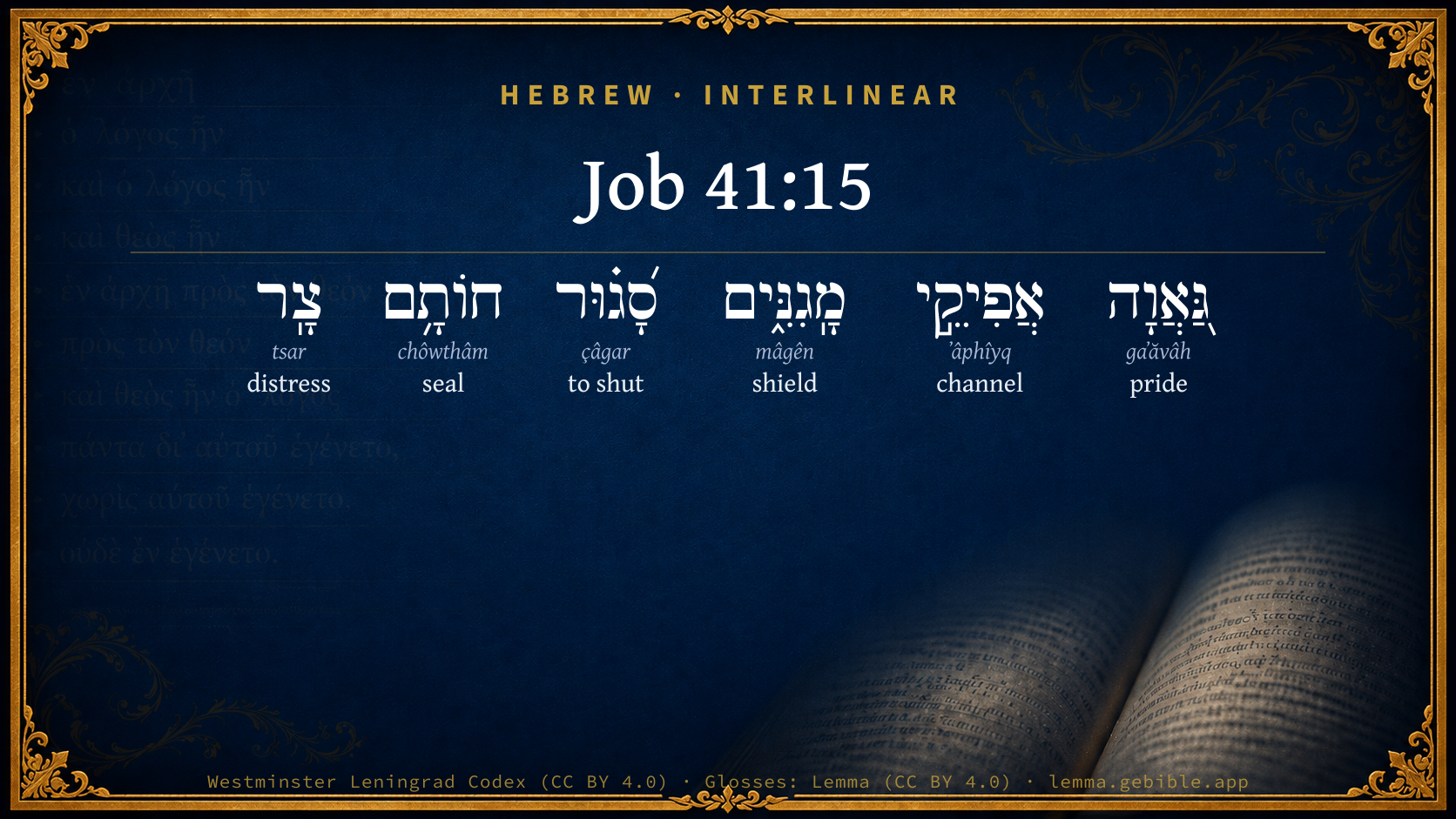
Job 41:15

Hebrew (Westminster Leningrad Codex) Job 41:15 appears in the Hebrew Old Testament. The text above is from the Westminster Leningrad Codex. Each word links to its Strong’s number, a concise gloss, and parsing drawn from the Open Scriptures Hebrew Bible morphology. Click any word for its full Brown-Driver-Briggs (BDB) entry.
Download image
Cite this verse

Job 41:15 (World English Bible). Public Domain. Lemma interlinear Bible study tool, https://lemma.gebible.app/v/job/41/15.

Show BibTeX & RIS
BibTeX
RIS
English Translation
Strong scales are his pride, Shut up together with a close seal.
World English Bible · Public Domain
Download a study sheet

One document with this verse’s original text, its word-by-word gloss line, the meaning frame, cross-references with their text, attributed commentary, and full source and license credits — printable, and it pastes into notes with its structure intact.

This verse Autodidact and up

Study sheet (.html) Plain text (.txt)

A passage Seminary Student

Up to 50 verses in one chapter. A passage sheet keeps up to 6 commentary sources and 12 cross-references per verse, in the order this page ranks them, and says so on the sheet whenever that leaves anything out. Ask for a single verse and you get the Autodidact verse sheet above.

Everything on this page stays free to read, with no account — the sheet is a download of what is already on screen, not access to it.

Want to remove ads? Support Godless Engineer
Compare translations 3

The same verse in 3 English versions, stacked beneath the original-language interlinear above. Click any original word for its lexicon entry.

Each is an independent rendering of the whole verse — the interlinear is not word-aligned to these translations.

Highlighted words mark where these versions differ — a whole-verse word diff, not a word-by-word alignment.

  • World English Bible Public Domain
    Strong scales are his pride, Shut up together with a close seal.
  • King James Version Public Domain
    His scales are his pride, shut up together as with a close seal.
  • unfoldingWord Literal Text CC BY-SA 4.0
    Rows of shields pride, shut together a tight seal.

unfoldingWord Literal Text — © unfoldingWord, licensed CC BY-SA 4.0. Word-aligned USFM3 via Door43 (git.door43.org/unfoldingWord/en_ult).

Versions to compare (up to 4)

3 of 4 selected

Show all 18 translations

Every available English version of this verse, each an independent rendering of the whole verse.

  • World English Bible Public Domain
    Strong scales are his pride, Shut up together with a close seal.
  • Berean Standard Bible Public Domain
    His rows of scales are his pride, tightly sealed together.
  • Majority Standard Bible Public Domain
    His rows of scales are his pride, tightly sealed together.
  • King James Version Public Domain
    His scales are his pride, shut up together as with a close seal.
  • American Standard Version (1901) Public Domain
    `His' strong scales are `his' pride, Shut up together `as with' a close seal.
  • Revised Version (1885) Public Domain
    His strong scales are his pride, shut up together as with a close seal.
  • Geneva Bible (1599) Public Domain
    His heart is as strong as a stone, and as hard as the nether milstone.
  • Douay-Rheims (1899) Public Domain
    His heart shall be as hard as a stone, and as firm as a smith's anvil.
  • Young's Literal Translation Public Domain
    A pride -- strong ones of shields, Shut up -- a close seal.
  • Literal Standard Version CC BY-SA 4.0
    A pride—strong ones of shields, || Shut up—a close seal.
  • Unlocked Literal Bible CC BY-SA 4.0
    his back is made up of rows of shields, tight together as with a close seal.
  • unfoldingWord Literal Text CC BY-SA 4.0
    Rows of shields pride, shut together a tight seal.
  • Darby Bible Public Domain
    The rows of his shields are a pride, shut up together [as with] a close seal.
  • World Messianic Bible Public Domain
    Strong scales are his pride, shut up together with a close seal.
  • Webster's Bible Public Domain
    \\41:24\\His heart is as firm as a stone; yes, as hard as a piece of the nether millstone.
  • Free Bible Version CC BY-SA 4.0
    Its pride is its rows of scales, closed tightly together.
  • Bible in Basic English Public Domain
    His heart is as strong as a stone, hard as the lower crushing-stone.
  • JPS Tanakh (1917) Public Domain
    (41-7) His scales are his pride, shut up together as with a close seal.

Literal Standard Version (2020), Covenant Press — licensed CC BY-SA 4.0. Text via the HelloAO Bible API (eBible.org). Unlocked Literal Bible (unfoldingWord) — licensed CC BY-SA 4.0. Text via the HelloAO Bible API (eBible.org). unfoldingWord Literal Text — © unfoldingWord, licensed CC BY-SA 4.0. Word-aligned USFM3 via Door43 (git.door43.org/unfoldingWord/en_ult). Free Bible Version, Dr. Jonathan Gallagher — licensed CC BY-SA 4.0. Text via the HelloAO Bible API (eBible.org).

Word by word

More ways to search: Search by grammar → Find every occurrence → Compare this word →

Practice this passage: Drill this verse → Learn its vocabulary →

About this verse

These counts appear in no published source. They are computed here, from the morphology-tagged text and Lemma’s own curated glosses. What Lemma adds →

6
words
6
distinct lemmas
Wisdom
section

Notable vocabulary

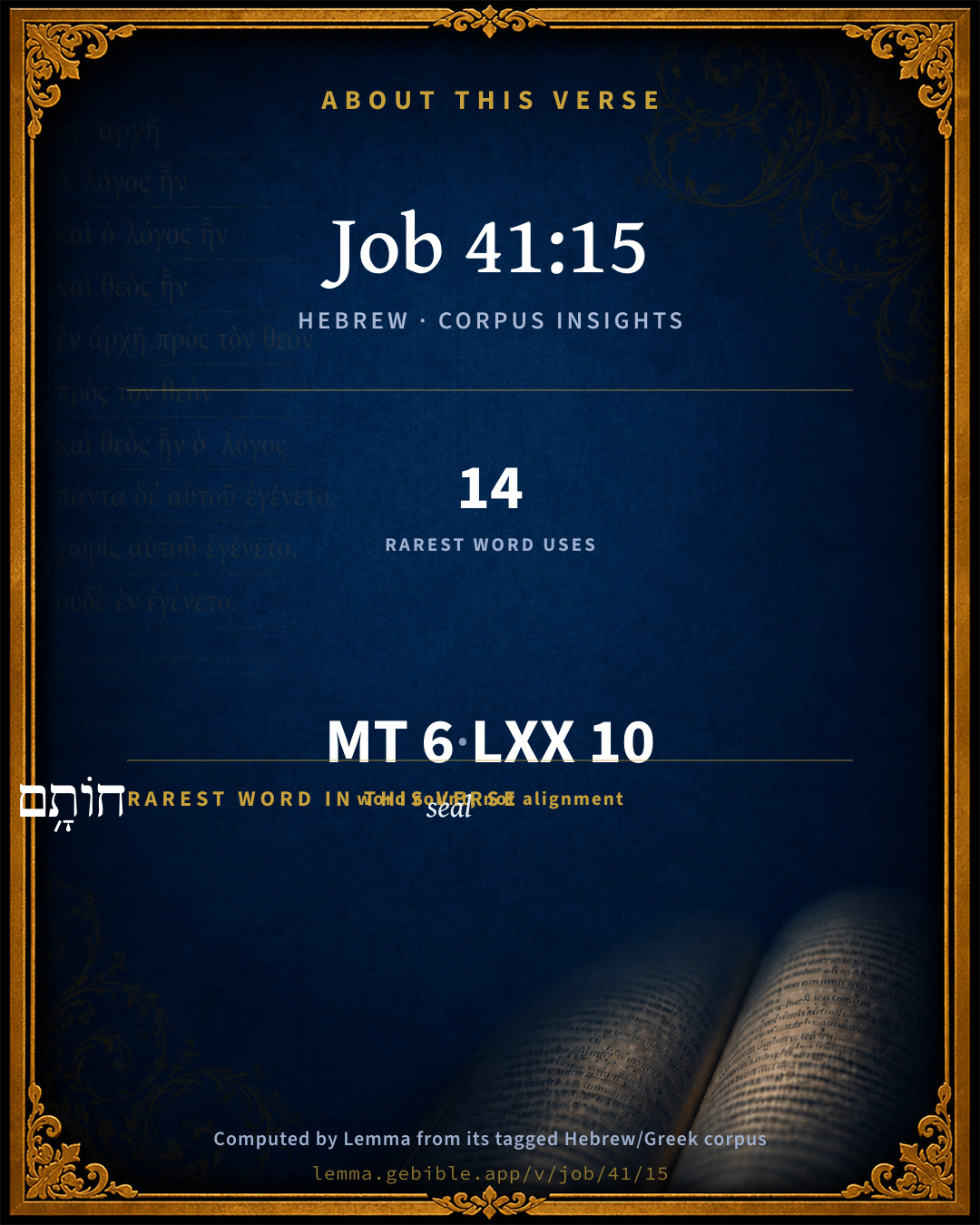
The rarest word here is חוֹתָ֥ם seal H2368 — appearing just 14 times in the whole Hebrew Bible.

Shared distinctive vocabulary

חוֹתָ֥ם seal H2368 occurs in 13 verses of the Hebrew Bible. Also found in:

Grammatical profile

  • 1 verb
  • 4 nouns
  • 1 adjective

Verb forms

  • סָ֝ג֗וּר Qal · Participle Passive

Hebrew & Septuagint length

In English translation the verse runs 12 words from the Hebrew and 14 from the Septuagint (LXX English) — closely comparable.

A rough comparison of the two English renderings, which tokenize alike — not a word-level alignment.

Word counts can differ between the Hebrew and the Greek without any difference in meaning — e.g. the Hebrew direct-object marker אֵת has no separate Greek word, and Greek often adds the article ὁ.

In the original languages it is 6 Hebrew tokens and 10 Greek tokens — but the two are counted differently (Hebrew bundles its prefixes and suffixes into one token; the Greek is in lemma form), so that isn’t a like-for-like length.

Cross-references

3

Topical passages linked to Job 41:15 in the Treasury of Scripture Knowledge — connected by theme and wording, ordered by reader-vote popularity; previews shown in the World English Bible.

  • Jeremiah 9:23 Thus says Yahweh, Don't let the wise man glory in his wisdom, neither let the mighty man glory in his might, don't let the rich man glory in his riches;
  • Revelation 5:2–3 I saw a mighty angel proclaiming with a loud voice, "Who is worthy to open the book, and to break its seals?"
  • Revelation 5:5 One of the elders said to me, "Don't weep. Behold, the Lion who is of the tribe of Judah, the Root of David, has overcome; he who opens the book and its seven seals."

Cross-references courtesy of OpenBible.info (CC BY 4.0).

Hebrew and Greek witnesses Masoretic Hebrew ↔ Greek Septuagint

The same verse in the two great witnesses to the Old Testament, shown verse-for-verse.

These are two independent witnesses, not word-aligned to each other, and the Septuagint is shown in lemma (dictionary) form.

Hebrew Job 41:15 Masoretic · Westminster Leningrad Codex

גַּ֭אֲוָה אֲפִיקֵ֣י מָֽגִנִּ֑ים סָ֝ג֗וּר חוֹתָ֥ם צָֽר

Strong scales are his pride, Shut up together with a close seal.

World English Bible · Public Domain

Greek LXX Job 41:15 Septuagint · lemma form

σάρξ δέ σῶμα αὐτός κολλάω καταχέω ἐπί αὐτός οὐ σαλεύω

His heart is firm as a stone, and it stands like an unyielding anvil.

LXX2012 (modern English Septuagint) · Public Domain

On this verse, Haydock's Catholic Bible Commentary discusses the Septuagint’s reading. Read the note in Commentary ↓

Hebrew: Westminster Leningrad Codex (CC BY 4.0). Greek: Septuagint (public domain); English from LXX2012 (modern English Septuagint) (Public Domain). How the Septuagint differs from the Hebrew →

Commentary

Notes on Job 41:15 from classic Christian and Jewish commentators (each source and its license shown beneath its notes). The classic Christian expositions comment on the surrounding passage and are grouped to its opening verse, so a note may address several verses; the Jewish commentaries on the Tanakh (Rashi and others) are per-verse, so they appear only where the commentator wrote on this verse.

Lemma curates 59 commentaries, every one of them public domain or Creative Commons licensed, each selected and text-cleaned for this edition rather than reprinted as found. About our sources →

Trapp's Complete Commentary

John Trapp

Job 41:15 [His] scales [are his] pride, shut up together [as with] a close seal.

Ver. 15. His scales are his pride] They are like so many glistering shields, wherein he puts his confidence and takes his pride; as thinking them impenetrable.

Shut up together as with a close seal] So closed and put together, like paper sealed with wax, as that nothing can part them. The Jews use to write upon the back of their sealed letters, Nun, Cheth, Shin; that is, Niddui, Cherem, and Shemmatha; all sorts of excommunication to those that open them.

John Trapp, A Commentary or Exposition upon All the Books of the Old and New Testament (1647–1656) — public domain. Text from a community e-Sword module.

Joseph Benson's Commentary

Job 41:15-17. His scales are his pride — He prides and pleases himself in his strong and mighty scales. Hebrew, אפיקי מגנים, aphikee maginnim, robusta scutorum, the strength, or strong things, of his shields are his pride. Or, his body, or his back, (as גאוה, gaavah, is rendered by many ancient and modern interpreters,) is the strength of shields, that is, fortified with scales strong as shields. Heath translates it, Strong scales cover his back. This is remarkably the case with the crocodile, whose strength is in his back, which is covered with impenetrable scales, whereas his belly is very soft, and easily pierced. If it be interpreted as meant of the whale, we must understand by these shields the several coats of his skin, which, though it be smooth and entire, and without scales, may nevertheless be said to be as strong as shields, (shields being formerly made of leather,) because it is exceeding hard and strong, and almost impenetrable, and that not only on his back, as in the crocodile, but also in the belly all over. “The outward, or scarf-skin of the whale,” indeed, “is no thicker than parchment; but this being removed, the real skin appears, of about an inch thick, and covering the fat, or blubber, that lies beneath, which is from eight to twelve inches in thickness. The muscles lie beneath this, and, like the flesh of quadrupeds, are very red and tough.” — Ency. Brit. But as the skin of the whale is all one entire piece, and does not consist of different parts joined together, the following clause, and the contents of the next two verses, do not seem to be properly applicable to it. Shut up together as with a close seal — That is, the shields, or scales, are closely compacted together, as things that are fastened by a seal. One is so near another, &c. — This plainly shows that the scales, or shields, are several, which certainly agrees better to the crocodile than to the whale, unless there be a sort of whales which have scales, as some have affirmed, but it is not yet known or proved. By these shields, or scales, the animal is not only kept warm, for no air can come between them, but kept safe, for no sword can pierce through those scales. They stick together that they cannot be sundered — It is exceeding difficult, and almost impossible, by any power or art, to sever them one from another.

Joseph Benson's Commentary on the Old and New Testaments (1811–1818) — public domain. Text from a community e-Sword module.

Jamieson, Fausset & Brown

Robert Jamieson, A. R. Fausset & David Brown

Rather, his "furrows of shields" (as "tubes," "channels," see on Job 40:18), are, &c., that is, the rows of scales, like shields covering him: he has seventeen such rows.

shut up--firmly closed together. A musket ball cannot penetrate him, save in the eye, throat, and belly.

Jamieson, Fausset & Brown — Commentary Critical and Explanatory on the Whole Bible (1871) — public domain (CC PDM 1.0). Text via the HelloAO Bible API.

Adam Clarke's Commentary

Verse 15. His scales are his pride] They are impenetrable, as we have already seen.

Adam Clarke's Commentary on the Bible (1810–1826) — public domain. Text from a community e-Sword/MySword module.

The Cambridge Bible for Schools and Colleges

gen. ed. J. J. S. Perowne

15. his scales are his pride] Rather, the rows of his shields are a pride. Each of his scales is a shield, and they are disposed in rows, or courses, lit. pipes (ch. Job_40:18), so called from their being curved or bossed. Of these rows there are said to be seventeen. The second clause describes the firmness and closeness with which each scale adheres to the body.

15–17. His armour of scales.

The Cambridge Bible for Schools and Colleges (gen. ed. J. J. S. Perowne; Cambridge University Press, 1878–1918) — public domain. Text from a community e-Sword module.

John Gill's Exposition

His scales are his pride, shut up together as with a close seal. This is notoriously true of the crocodile, whose back and tail are covered with scales, which are in a measure impenetrable and invincible: which all writers concerning it, and travellers that have seen it, agree in; See Gill on Eze 29:4; but the skin of the whale is smooth; the outward skin is thin, like parchment, and is easily pulled off with the hand; and its under skin, though an inch thick, is never stiff nor tough, but soft (d): though, if Nearchus (e) is to be credited, he reports, that one was seen fifty cubits long, with a scaly skin all over it a cubit thick; and such, it is said, were by a storm brought into our river Trent some years ago, and cast ashore, which had scales upon their backs very hard, as large and thick as one of our shillings (f). But Aben Ezra interprets this of the teeth of the leviathan, and in which he is followed by Hasaeus; which are strong like a shield, as the words used signify; so Mr. Broughton,

"the strong shields have pride:''

but then this is as applicable, or more so, to the scales of the crocodile; which are so close as if they were sealed together, and are like a shield, its defence, and in which it prides itself.

(d) Voyage to Spitzbergen, p. 146, 147, 152. (e) Apud Arrian. in Indicis. (f) Vid. Wesley's Dissertations on Job, dissert. 38. p. 290.

John Gill's Exposition of the Whole Bible (1746–1763) — public domain (CC PDM 1.0). Text via the HelloAO Bible API.

Albert Barnes' Notes on the Bible

His scales are his pride - Margin, “strong pieces of shields.” The literal translation of this would be, “Pride, the strong of shields;” that is, the strong shields. There can be no doubt that there is reference to the scales of the animal, as having a resemblance to strong shields laid close to each other. But there is considerable variety of opinion as to its meaning. Umbreit and Prof. Lee take the word here rendered “pride” (גאוה gê'voh) to be the same as (גוה gêvâh), “back,” and then the meaning would be that his back was armed as with a shield - referring, as Prof. Lee supposes, to the dorsal fin of the whale. But there is no necessity for this supposition, and it cannot be denied that it is somewhat forced. The “connection” requires that we should understand it, not of the dorsal fin, but of the scales; for a description immediately follows in continuation of this, which will by no means apply to the fin. The obvious and proper meaning is, that the pride or glory of the animal - that on which his safety depended, and which was the most remarkable thing about him - was his “scales,” which were laid together like firm and compact shields, so that nothing could penetrate them. This description accords better with the crocodile than with any other animal. It is covered with scales, “which are so hard as to resist a musket-ball.” “Ed. Ency.” The description cannot be applied to a whale, which has no scales; and accordingly Prof. Lee supposes that the reference in this verse and the two following is not to the “scales,” but to the “teeth,” and to “the setting in of the dorsal fin!”

Shut up together - Made close or compact.

As with a close seal - As if they had been sealed with wax, so that no air could come between them.

Albert Barnes' Notes on the Bible (1834–1885) — public domain. Text from a community e-Sword/MySword module.

Haydock's Catholic Bible Commentary

Stone. Pineda understands this of the whale’s heart. Others suppose that it alludes to its cruel and fearless temper. (Menochius) --- The Arabs call a valiant man, "heart of stone." (Calmet) --- Smiths. Protestants, "as a piece of the nether millstone," (Haydock) which must be larger and more compact than that which is above. (Calmet) --- Septuagint, "He hath stood immoveable as an anvil." (Haydock)

George Leo Haydock (1774–1849), Haydock's Catholic Family Bible and Commentary, 1859 edition — public domain. Excludes Psalms (Douay-Rheims chapter numbering differs from Protestant) and Deuterocanonical books (Catholic canon only).

Matthew Poole's English Annotations

He prides and pleaseth himself in his strong and mighty scales. Heb. His strong shields (i.e. scales) are his pride. Or, (as other, both ancient and modern, interpreters render it,) his body, (or his back, as this word is used, Isa 38:17; which, if meant of the crocodile, is emphatical, because his scales and strength is in his back, whereas his belly is very soft, and easily pierced) is the strength of shields, i.e. fortified with scales strong as shields. This is meant either,

1. Of the whale whose skin, though it be smooth and entire, and without scales, may be said to be as (which particle is oft understood) strong shields, because it is, as Galen reports, exceeding hard and strong, and almost impenetrable, and like a shield, especially then, when shields were made of leather; and so it is not only on the back, as in the crocodile, but also in the belly all over. Or,

2. Of the crocodile, which hath scales properly so called, and those most truly such as are here described, as all authors and eye-witnesses consent.

Shut up together as with a close seal; closely compacted together, as things that are fastened together by a seal.

Matthew Poole's English Annotations on the Holy Bible (1683–1685) — public domain. Text from a community e-Sword/MySword module.

Whedon's Commentary on the Bible

Daniel D. Whedon

15. Scales — Literally, strong shields, (Rosenmuller, Furst;) or, according to others, (Delitzsch, Hitzig,) furrows of the shields. Tristram observes that the whole head, back, and tail are covered with quadrangular horny plates or scales, which not only protect the body, so that a rifle ball glances from them as from a rock, but also serve as ballast, enabling the creature to sink rapidly on being disturbed, by merely expelling the air from its lungs.

Shut up together… a close seal — Each shield fits as closely as the seal to the clay; nay, more closely, as the next verse shows, for no air can penetrate nature’s work; it is airtight. (See note on Job_38:14.)

Daniel D. Whedon (gen. ed.), Commentary on the Old and New Testaments (1874–1909) — public domain. Text from a community e-Sword module.

The Pulpit Commentary

His scales are his pride; or, his pride is in the channeling of his scales (literally, of his shields). The scales of the crocodile are arranged.in five rows along his entire back, with a depression between the rows which is like a "channel." Each individual scale resembles a shield. They are shut up together as with a close seal; each, i.e. , closely attached to its fellow, so that there is no space between them. "A rifle-ball," according to Canon Tristram, "glances off from them as from a rock" ("Natural History of the Bible," p. 352).

The Pulpit Commentary (1880–1919), ed. H.D.M. Spence-Jones & Joseph S. Exell — public domain. Text from a community e-Sword module.

John Wesley's Explanatory Notes

Shut - Closely compacted together, as things that are fastened together by a seal. This likewise is true of the crocodile, but the skin of the whale is smooth and entire without any scales at all.

John Wesley, Explanatory Notes Upon the Whole Bible (1754–1765) — public domain. Text via the GEBible commentary corpus.

Keil & Delitzsch

C. F. Keil & F. Delitzsch

15 A pride are the furrows of the shields,

Shut by a rigid seal.

16 One joineth on to the other,

And no air entereth between them.

17 One upon another they are arranged,

They hold fast together, inseparably.

Since the writer uses אפיק both in the signif. robustus, Job 12:12, and canalis, Job 40:18, it is doubtful whether it must be explained robusta (robora) scutorum (as e.g., Ges.), or canales scutorum (Hirz., Schlottm., and others). We now prefer the latter, but so that "furrows of the shields" signifies the square shields themselves bounded by these channels; for only thus is the סגוּר, which refers to these shields, considered, each one for itself, suitably attached to what precedes. חותם צר is an acc. of closer definition belonging to it: closed is (each single one) by a firmly attached, and therefore firmly closed, seal. lxx remarkably ὥσπερ σμυρίτης λίθος, i.e., (emery (vid., Krause's Pyrogeteles, 1859, S. 228). Six rows of knotty scales and four scales of the neck cover the upper part of the animal's body, in themselves firm, and attached to one another in almost impenetrable layers, as is described in Job 41:7 in constantly-varying forms of expression (where יגּשׁוּ with Pathach beside Athnach is the correct reading), - a גּאוה, i.e., an equipment of which the animal may be proud. Umbr. takes גאוה, with Bochart, = גּוה, the back; but although in the language much is possible, yet not everything.

Keil & Delitzsch — Biblical Commentary on the Old Testament (1861–1891) — public domain (CC PDM 1.0). Text via the HelloAO Bible API. (Old Testament only.)

Rashi

Rabbi Shlomo Yitzchaki (Rashi)

The flakes of his flesh are joined together Heb. דבקו. They adhere to each other closely, for the fish are composed of many pieces in its flesh, and they adhere to one another. In a large fish, which is cooked, the pieces are noticeable when they are lying one upon the other and one beside the other, and so is the sequence of the world: First he speaks of the scales of the leviathan and then of the flakes of his flesh and the strength of his heart.

flakes Heb. מפלי, an expression of folds of pieces. It is also possible to explain it as פְלָאֵי פלוּיֵי, [if it is split] in the language of the Talmud, an expression of the splits of his flakes.

are joined together the “beth” is vowelized by a small “kamatz” (tzeireh), like (Job 29:1O), “and their tongues stuck (דבקה) to their palates,” and many other cantillated by “ethrahta” or “sof pasuk.” [These are the pause accents.]

poured out upon it Heb. יצוק. Every flake poured out one upon the other, so that it should not move or separate one from the other. [The word] יָצוּק is an expression of being poured, and it is the passive participle, like יָרוּד, descended, from ירד; יָצוּק, poured, from יצק; יָדוּעַ, known, from ידע.

Rashi on the Tanakh — English translations: “The Judaica Press complete Tanach with Rashi, translated by A. J. Rosenberg” (CC BY 4.0); “Pentateuch with Rashi's commentary by M. Rosenbaum and A.M. Silbermann, 1929-1934” (public domain); “The Metsudah Tanach series, Lakewood, N.J” (CC BY 4.0); and “The Book of Joshua, Metsudah Publications, 1997” (CC BY 4.0). Text via Sefaria.

Lesson kit

Teaching starters — assembled from the data on this page, not authored interpretation. Every prompt links to the verse data it draws on. Edit before teaching.

Job, in the Wisdom, opens this verse with 6 words (6 distinct Hebrew lemmas). Its most distinctive word is chôwthâm (“seal”). A historical commentator’s framing appears above. Read the whole chapter for the surrounding context.

Discussion questions

  1. What does “seal” (chôwthâm) contribute to the verse as a whole?
  2. Genesis 38:18 shares the word «seal» with this verse. How do the two illuminate each other?
  3. The translations on this page render this verse differently — a whole-verse word diff, not a word-by-word alignment. What might account for the different wordings?
  4. The verb «סָ֝ג֗וּר» is Qal Participle Passive. How does its form color the action?
  5. Reading how Trapp's Complete Commentary and Joseph Benson's Commentary read this verse, where do the two commentators agree and where do they part?

Things to notice

Reading settings

Reading text

Shown beneath each verse's original-language words.

Old Testament
Old Testament edition

Read the OT as the Masoretic Hebrew (MT) or the Greek Septuagint (LXX).

English shown for the Greek Septuagint (in the Hebrew ↔ Greek comparison).

Comparing translations? Open the Compare panel on any verse page to stack up to four side by side.