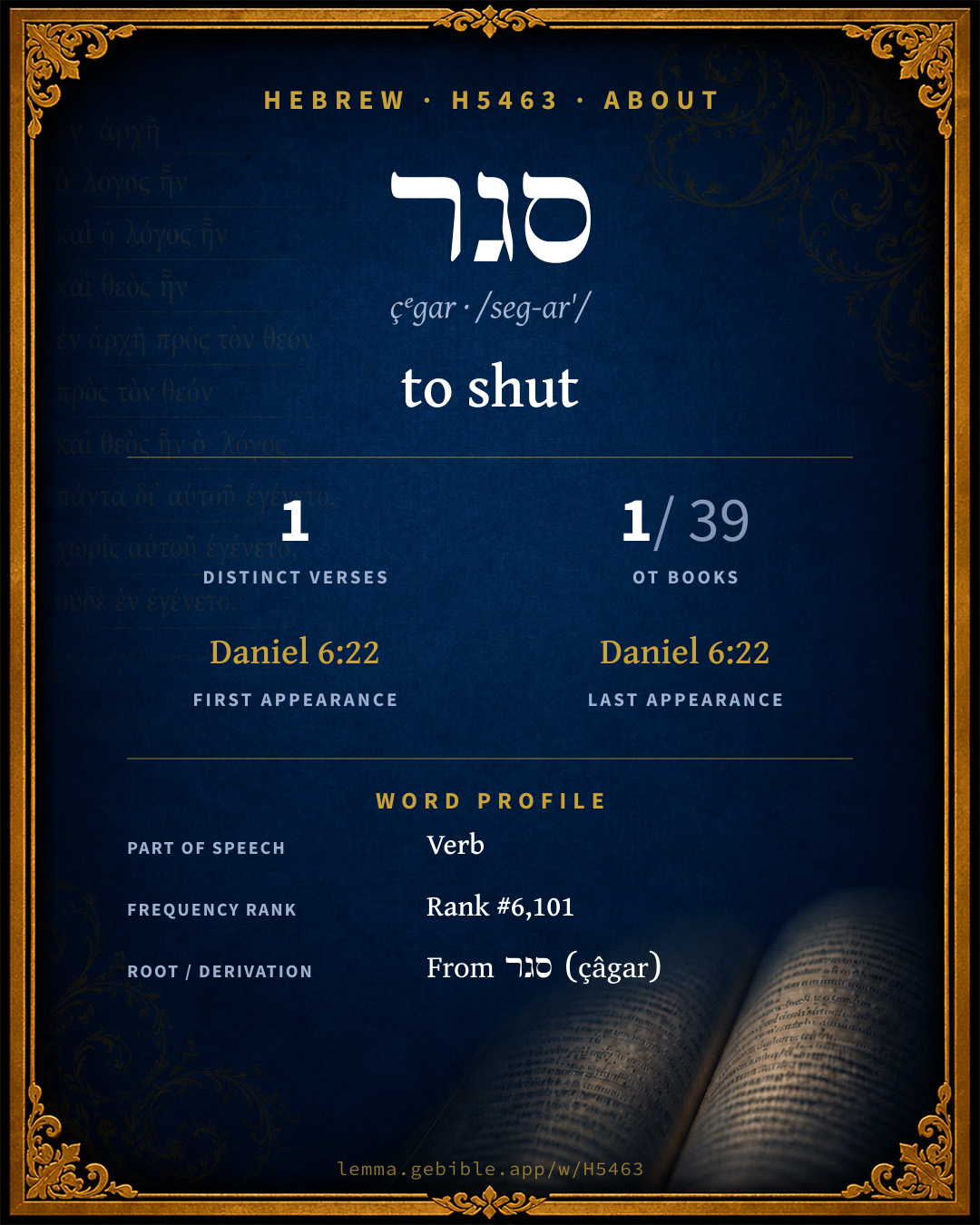
סְגַר
to shut
‘to shut’ is one of 2 main senses fuller range ↓
Full lexicon entry — Brown-Driver-Briggs (BDB)
From Brown-Driver-Briggs (BDB)
Where this word appears
Grammar key — what these labels mean
Stem
- Qal
- The basic, simple active stem — the plain form of the verb (“he wrote”).
Form
- Perfect
- A completed action or state — Hebrew marks aspect (completeness) more than strict tense (“he wrote”).
Person
- 3rd Person
- The one spoken about (“he / she / it / they”).
Gender
- Masculine
- Grammatically masculine.
Number
- Singular
- One.
Every verse where H5463 appears — 1 distinct verse across 1 book. Click any verse to open its interlinear word-by-word view. Verse text shown in the World English Bible for context — . Each verse’s Hebrew form is shown with its reference; the English is not keyword-highlighted, since the data carries no word-level English alignment. Use “Compare translations” on any verse to read it across multiple English versions. This concordance covers the Hebrew Bible; Septuagint (Greek Old Testament) occurrences are not indexed here.
Daniel 1 verse
About this entry
At a glance — auto-summarized from this page’s data, not written by a person. Every figure links to its source below. This summary describes the numbers; it doesn’t interpret them.
At its core, סגר (çᵉgar) means “to shut.” With only 1 verse it sits in the long tail of Hebrew Bible vocabulary. Its uses cluster heavily in Daniel (100% of all occurrences). Its lone occurrence is Daniel 6:22. Catalogued under 2 senses, its meaning is not single-sense. Each statement above links to its evidence; the full detail follows below.
Gloss history
Strong's 1890 vs modern scholarship
About this word
Strong's H5463 catalogs a Hebrew word from the Hebrew Old Testament.
These counts are not copied from any lexicon or concordance. They are computed here, from the morphology-tagged Hebrew Old Testament. What Lemma adds →
- 1
- distinct verses
- The word appears in 1 distinct verse.
- 1 / 39
- OT books
- The word appears in 1 of 39 Old Testament books.
- #6,101
- by frequency
- Rank #6,101 (rank 6,101 of 8,640 Hebrew words by occurrence).
View all 1 occurrence in the concordance →
Most concentrated in
- Daniel 1 verse 100%
By section of the Old Testament
By traditional corpus
Conventional, traditional groupings — biblical authorship is debated, so this is a traditional corpus grouping, not an authorship claim. Each share is this word’s portion of its verses in that division of the Hebrew canon. Each figure is a share of the word’s 1 distinct verse.
- Writings (Ketuvim) 1 verse · 100%
How translations render this word
Counts come from each version’s own published word-to-Strong’s tagging or interlinear alignment — an approximate guide to how each version renders this word, not a word-level alignment the data otherwise carries. Because each total is that version’s own tagged count, the per-version totals vary from one another and need not match the appearance or distinct-verse counts above. These counts may also differ from a printed concordance because Lemma counts each distinctly tagged rendering and does not collapse phrase taggings into a single head-word total. This is a fixed set of word-tagged versions (KJV, ASV, BSB, ULT) and does not change with the reading translation you choose elsewhere. Each version’s license is shown beside its name below (and on Sources).
- King James Version: Hath shut 1×
- American Standard Version: Hath shut 1×
- Berean Standard Bible: Shut 1×
- unfoldingWord Literal Text: Shut 1×
King James Version Public Domain
Renders H5463 across 1 tagged occurrence — most commonly:
American Standard Version Public Domain
Renders H5463 across 1 tagged occurrence — most commonly:
Berean Standard Bible Public Domain
Renders H5463 across 1 tagged occurrence — most commonly:
unfoldingWord Literal Text CC BY-SA 4.0
Renders H5463 across 1 tagged occurrence — most commonly:
Senses in BDB
The 2 senses BDB distinguishes for this word, in lexicon order (not ranked by frequency or importance). The full entry — with sub-senses — is in the Lexicon Entry tab.
- (Peal) to shut
- (TWOT) shirt
Word origin
סְגַר vb. shut;— Pe. Dn 6:23
— Brown-Driver-Briggs (Oxford 1906, public domain), digitized via Sefaria, supplemented by the OpenScriptures HebrewLexicon (CC BY 4.0). See Sources.
Derived from סגר (çâgar) (H5462) — to shut.
Jastrow Dictionary
A second Hebrew/Aramaic lexicon for comparison, covering Aramaic and post-biblical (Talmudic, Targumic, Midrashic) usage that the biblical-Hebrew BDB does not. Matched by lemma rather than by Strong’s number, so a lemma may carry more than one Jastrow headword (shown separately below), and the entries cover usage well beyond the Bible.
סָגַר
- (b. h.) to bar, bolt; to lock up, close. Snh. 38ᵃ (ref. to מסגר, II Kings XXIV, 16) כיון שסוֹגְרִין הלכה וכ׳ after they had closed the discussion about a law (declared it obscure), there was none to open again; Gitt. 88ᵃ; Sifré Deut. 321 אהר שפותח אין סוֹגֵר after he has opened (explained), none can close (raise objection). Tanḥ. Sh’mini 9 עבר על כל בתי … וס׳ אותם he passed over all synagogues and schools and closed them. Mekh. B’shall., s. 3 הים סוגר ושונא רודף וכ׳ the sea forming a bar, and the enemy pursuing &c.; Ex. R. s. 21 (not סגר). Mekh. Yithro, Amal., s. 1 מתחלה … שהיתה סוֹגֶרֶת ומְסוּגֶּרֶת וכ׳ formerly no slave could flee from Egypt, for it was shut up and barred (Josh. VI, 1); a. fr.—Cant. R. to III, 10 (expl. זהב סָגוּר) שהיה סוֹגר בעד כל וכ׳ it locked up the shops of all workers in gold (ruined their trade); Y. Yoma IV, 41ᵈ top מכסיף (corr. acc.); Num. R. s. 12 (not סגור); Ex. R. s. 35 שהיה סגור כל וכ׳ (corr. acc.). e.g. 2 Kings 24:16
- to be locked up. Yoma 45ᵃ כל החנויות נִסְגָּרוֹת all (gold) shops were closed (their business ruined, v. supra); a. e.
- to lock up; to bind over, hand over, deliver. Sifré Deut. 322 בקשו ישראל לברוח … היו מַסְגִּירִים אותם when the Israelites attempted to flee northward, they blocked their way. Ib. 323 (ref. to Deut. XXXII, 30) איני מַסְגִּיר אתכם ע"י עצמי וכ׳ I shall not deliver you (into the hands of the enemy) directly, but through others (who will betray you). Ib. מוכרני מיד ומַסְגִּירַנִי מיד I sell and immediately deliver you. Tanḥ. Sh’mini l. c. (ref. to המסגר, v. supra) שכל או"ה … שהן מַסְגִּירִין לכל האומות all nations go before them into enclosures and flee, for they cause all nations to lock themselves up; a. fr.—Esp. to lock up the leper pending the priest’s observation (Lev. XIII, 4, a. e.). Neg. V, 1; a. fr.—Part. pass. מוּסְגָּר a leper under trial, opp. מוחלט (v. חָלַט I). Meg. I, 7; a. fr. e.g. Deuteronomy 32:30
- to be closed, locked. Part. מְסוּגָּר, f. מְסוּגֶּרֶת, v. supra.
סְגַר
- Targ. Job XXXVIII, 8 Var. Ms. (ed. אגיף). Targ. Y. Deut. XXI, 5.—Part. pass. סְגִיר, סְגִירָא a) fenced in, barred. Targ. Cant. I, 9.—b) leprous, v. סְגִיר.
- same. Targ. Lev. XIII, 4. Ib. XIV, 38; a. fr.
- 1. to be locked up, closed. Targ. Y. Gen. VIII, 2 (h. text ויסכרו). Targ. O. Num. XII, 14; a. fr.—Trnsf. to be engrossed with; to be bewildered, v. אִסְתַּגַּר.
- 2. (v. סְגִיר) to become leprous. Targ. II Chr. XXVI, 22.
סֶגֶר
- (preced.) lock, bolt. Tanḥ. Ḥayé 3 ונעל הס׳ לפניה and he shut the lock before her [perh. סְגוֹר].
A Dictionary of the Targumim, the Talmud Babli and Yerushalmi, and the Midrashic Literature (Marcus Jastrow; London, Luzac, 1903) — Public Domain. Digitized via Sefaria. Digitized via Sefaria. Full attribution on Sources.
Same root — word family
Other BDB entries built from the same root as H5463, grouped by Strong’s listed origin. These share a root / origin per the lexicon — not necessarily a shared meaning. Each links to that word’s own entry.
Derives from
Shares the same root
- מסגר maçgêr H4525 enclosure
- מסגרת miçgereth H4526 border
- סגור çᵉgôwr H5458 fine gold
- סגריד çagrîyd H5464 steady rain
- סוגר çûwgar H5474 cage
Compare all same-root words → Showing 4 of 7 — not the complete family. They share a root, not necessarily a meaning.
Septuagint verse parallels
This word appears in 1 verse that also exists in the Greek Old Testament (Septuagint), out of the 1 Hebrew verse it occurs in. You can read those verses in Greek by switching the Old Testament edition to the Septuagint.
Read these verses in the Septuagint
This is a verse-level parallel only — the same verses exist in both the Hebrew and Greek Old Testaments. No word-level Hebrew↔Greek correspondence is claimed: the data carries no such alignment, so no Greek word is shown as this Hebrew word’s translation. Coverage is not total — the Septuagint omits the deuterocanon and renumbers the Psalms, so some Hebrew verses have no direct Greek parallel.