
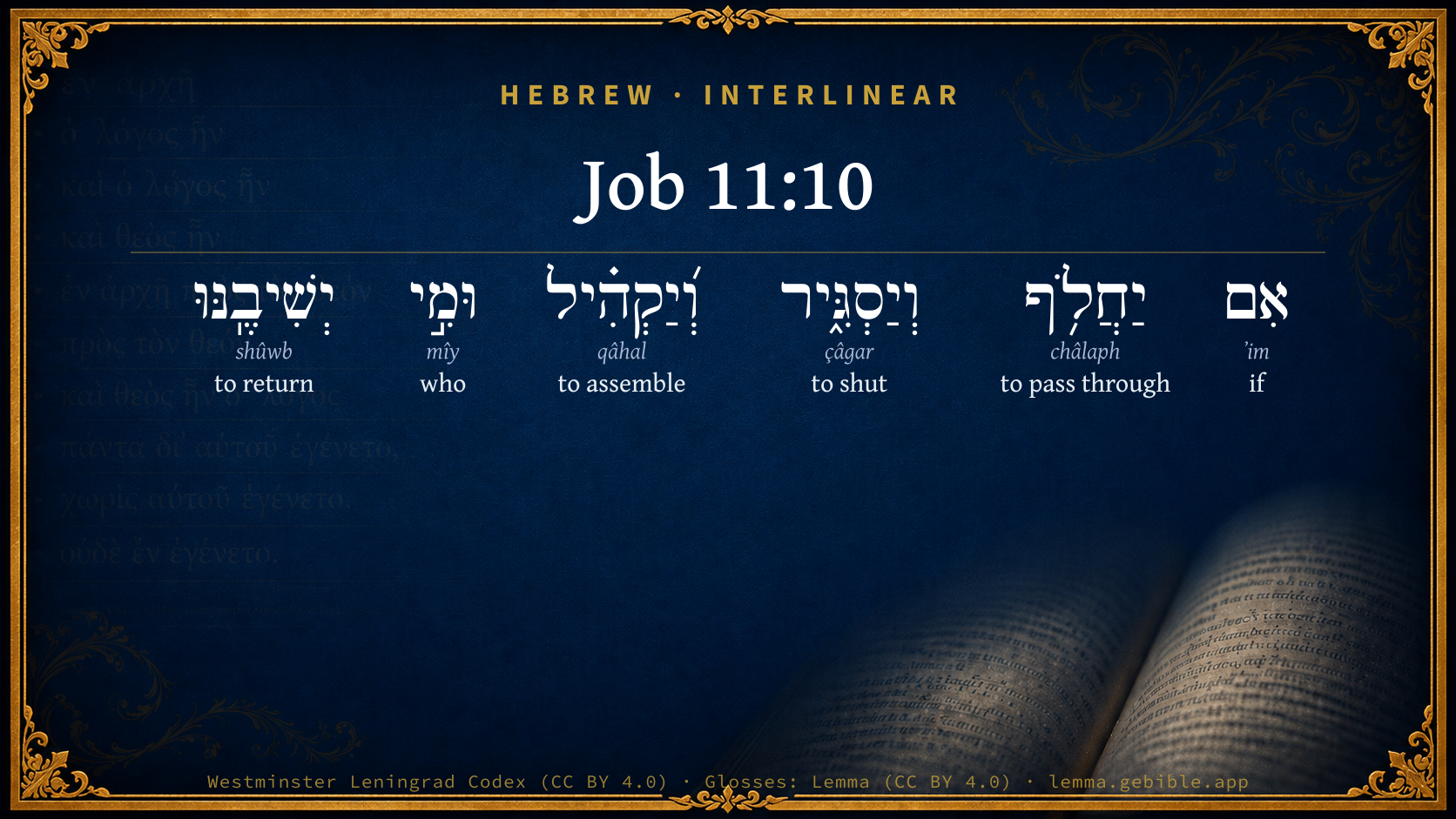
Job 11:10

Hebrew (Westminster Leningrad Codex) Job 11:10 appears in the Hebrew Old Testament. The text above is from the Westminster Leningrad Codex. Each word links to its Strong’s number, a concise gloss, and parsing drawn from the Open Scriptures Hebrew Bible morphology. Click any word for its full Brown-Driver-Briggs (BDB) entry.
Download image
Cite this verse

Job 11:10 (World English Bible). Public Domain. Lemma interlinear Bible study tool, https://lemma.gebible.app/v/job/11/10.

Show BibTeX & RIS
BibTeX
RIS
English Translation
If he passes by, or confines, Or convenes a court, then who can oppose him?
World English Bible · Public Domain
Download a study sheet

One document with this verse’s original text, its word-by-word gloss line, the meaning frame, cross-references with their text, attributed commentary, and full source and license credits — printable, and it pastes into notes with its structure intact.

This verse Autodidact and up

Study sheet (.html) Plain text (.txt)

A passage Seminary Student

Up to 50 verses in one chapter. A passage sheet keeps up to 6 commentary sources and 12 cross-references per verse, in the order this page ranks them, and says so on the sheet whenever that leaves anything out. Ask for a single verse and you get the Autodidact verse sheet above.

Everything on this page stays free to read, with no account — the sheet is a download of what is already on screen, not access to it.

Want to remove ads? Support Godless Engineer
Compare translations 3

The same verse in 3 English versions, stacked beneath the original-language interlinear above. Click any original word for its lexicon entry.

Each is an independent rendering of the whole verse — the interlinear is not word-aligned to these translations.

Highlighted words mark where these versions differ — a whole-verse word diff, not a word-by-word alignment.

  • World English Bible Public Domain
    If he passes by, or confines, Or convenes a court, then who can oppose him?
  • King James Version Public Domain
    If he cut off, and shut up, or gather together, then who can hinder him?
  • unfoldingWord Literal Text CC BY-SA 4.0
    If he comes and imprisons and assembles, then who will turn him back?

unfoldingWord Literal Text — © unfoldingWord, licensed CC BY-SA 4.0. Word-aligned USFM3 via Door43 (git.door43.org/unfoldingWord/en_ult).

Versions to compare (up to 4)

3 of 4 selected

Show all 18 translations

Every available English version of this verse, each an independent rendering of the whole verse.

  • World English Bible Public Domain
    If he passes by, or confines, Or convenes a court, then who can oppose him?
  • Berean Standard Bible Public Domain
    If He comes along to imprison you, or convenes a court, who can stop Him?
  • Majority Standard Bible Public Domain
    If He comes along to imprison you, or convenes a court, who can stop Him?
  • King James Version Public Domain
    If he cut off, and shut up, or gather together, then who can hinder him?
  • American Standard Version (1901) Public Domain
    If he pass through, and shut up, And all unto judgment, then who can hinder him?
  • Revised Version (1885) Public Domain
    If he pass through, and shut up, and call unto judgment, then who can hinder him?
  • Geneva Bible (1599) Public Domain
    If hee cut off and shut vp, or gather together, who can turne him backe?
  • Douay-Rheims (1899) Public Domain
    If he shall overturn all things, or shall press them together, who shall contradict him?
  • Young's Literal Translation Public Domain
    If He pass on, and shut up, and assemble, Who then dost reverse it?
  • Literal Standard Version CC BY-SA 4.0
    If He passes on, and shuts up, and assembles, || Who then reverses it?
  • Unlocked Literal Bible CC BY-SA 4.0
    If he passes through and shuts anyone up, if he calls anyone to judgment, then who can stop him?
  • unfoldingWord Literal Text CC BY-SA 4.0
    If he comes and imprisons and assembles, then who will turn him back?
  • Darby Bible Public Domain
    If he pass by, and shut up, and call to judgment, who can hinder him?
  • World Messianic Bible Public Domain
    If he passes by, or confines, or convenes a court, then who can oppose him?
  • Webster's Bible Public Domain
    If he shall cut off, and shut up, or gather together, then who can hinder him?
  • Free Bible Version CC BY-SA 4.0
    If God comes and imprisons someone, or assembles the court for judgment, who can stop him?
  • Bible in Basic English Public Domain
    If he goes on his way, shutting a man up and putting him to death, who may make him go back from his purpose?
  • JPS Tanakh (1917) Public Domain
    If He pass by, and shut up, or gather in, then who can hinder Him?

Literal Standard Version (2020), Covenant Press — licensed CC BY-SA 4.0. Text via the HelloAO Bible API (eBible.org). Unlocked Literal Bible (unfoldingWord) — licensed CC BY-SA 4.0. Text via the HelloAO Bible API (eBible.org). unfoldingWord Literal Text — © unfoldingWord, licensed CC BY-SA 4.0. Word-aligned USFM3 via Door43 (git.door43.org/unfoldingWord/en_ult). Free Bible Version, Dr. Jonathan Gallagher — licensed CC BY-SA 4.0. Text via the HelloAO Bible API (eBible.org).

Word by word

More ways to search: Search by grammar → Find every occurrence → Compare this word →

Practice this passage: Drill this verse → Learn its vocabulary →

יַחֲלֹ֥ף
châlaph
H2498
“to pass through”
Verb, Qal, Imperfect, 3rd Person, Masculine, Singular
Part of Speech
Verb
Stem
Qal
Form
Imperfect
Person
3rd Person
Gender
Masculine
Number
Singular
Full BDB Definition

Origin: a primitive root

TWOT: 666

to pass on or away, pass through, pass by, go through, grow up, change, to go on from - (Qal) - to pass on quickly - to pass away (vanish) - to come on anew, sprout again (of grass) - to pass through - to overstep, transgress - (Piel) to cause to pass, change - (Hiphil) - to change, substitute, alter, change for better, renew - to show newness (of tree)
  1. אִם ʼim H518 “if” Conjunction
  2. וְיַסְגִּ֑יר çâgar H5462 “and · to shut” Conjunction + Verb, Hiphil, Imperfect, 3rd Person, Masculine, Singular
  3. וְ֝יַקְהִ֗יל qâhal H6950 “and · to assemble” Conjunction + Verb, Hiphil, Imperfect, 3rd Person, Masculine, Singular
  4. וּמִ֣י mîy H4310 “and · who” Conjunction + Particle, Interrogative
  5. יְשִׁיבֶֽנּוּ shûwb H7725 “to return · him” Verb, Hiphil, Imperfect, 3rd Person, Masculine, Singular + Suffix, Personal, 3rd Person, Masculine, Singular

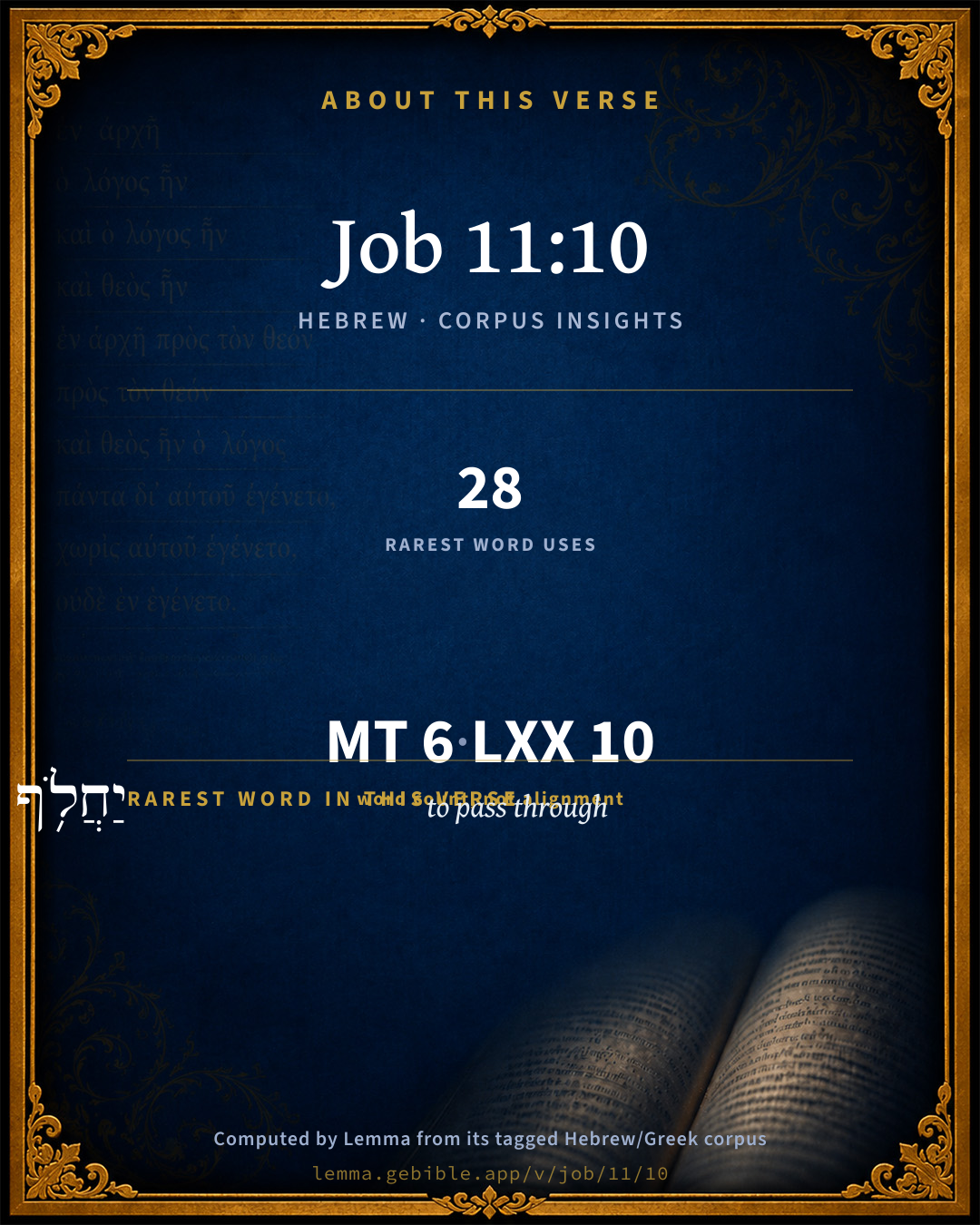
About this verse

These counts appear in no published source. They are computed here, from the morphology-tagged text and Lemma’s own curated glosses. What Lemma adds →

6
words
6
distinct lemmas
Wisdom
section

Shared distinctive vocabulary

יַחֲלֹ֥ף to pass through H2498 occurs in 27 verses of the Hebrew Bible. Also found in:

Grammatical profile

  • 4 verbs
  • 1 conjunction
  • 1 particle

Verb forms

  • יַחֲלֹ֥ף Qal · Imperfect
  • וְיַסְגִּ֑יר Hiphil · Imperfect
  • וְ֝יַקְהִ֗יל Hiphil · Imperfect
  • יְשִׁיבֶֽנּוּ Hiphil · Imperfect

Hebrew & Septuagint length

In English translation the verse runs 15 words from the Hebrew and 16 from the Septuagint (LXX English) — closely comparable.

A rough comparison of the two English renderings, which tokenize alike — not a word-level alignment.

Word counts can differ between the Hebrew and the Greek without any difference in meaning — e.g. the Hebrew direct-object marker אֵת has no separate Greek word, and Greek often adds the article ὁ.

In the original languages it is 6 Hebrew tokens and 10 Greek tokens — but the two are counted differently (Hebrew bundles its prefixes and suffixes into one token; the Greek is in lemma form), so that isn’t a like-for-like length.

Cross-references

11

Topical passages linked to Job 11:10 in the Treasury of Scripture Knowledge — connected by theme and wording, ordered by reader-vote popularity; previews shown in the World English Bible.

  • Job 9:12–13 Behold, he snatches away; who can hinder him? Who will ask him, 'What are you doing?'
  • Job 12:14 Behold, he breaks down, and it can't be built again; He imprisons a man, and there can be no release.
  • Revelation 3:7 "To the angel of the assembly in Philadelphia write: "He who is holy, he who is true, he who has the key of David, he who opens and no one can shut, and who shuts and no one opens, says these things:
  • Deuteronomy 32:30 How should one chase a thousand, Two put ten thousand to flight, Except their Rock had sold them, Yahweh had delivered them up?
  • Job 5:18 For he wounds, and binds up; He injures, and his hands make whole.
  • Job 9:4 God who is wise in heart, and mighty in strength: Who has hardened himself against him, and prospered?
  • Job 34:29 When he gives quietness, who then can condemn? When he hides his face, who then can see him? Alike whether to a nation, or to a man:
  • Job 38:8 "Or who shut up the sea with doors, When it broke forth from the womb,
  • Psalms 31:8 You have not shut me up into the hand of the enemy. You have set my feet in a large place.
  • Isaiah 41:27 [I am the] first [who says] to Zion, Behold, behold them; and I will give to Jerusalem one who brings good news.
  • Daniel 4:35 All the inhabitants of the earth are reputed as nothing; and he does according to his will in the army of heaven, and among the inhabitants of the earth; and none can stay his hand, or tell him, What do you?

Cross-references courtesy of OpenBible.info (CC BY 4.0).

Hebrew and Greek witnesses Masoretic Hebrew ↔ Greek Septuagint

The same verse in the two great witnesses to the Old Testament, shown verse-for-verse.

These are two independent witnesses, not word-aligned to each other, and the Septuagint is shown in lemma (dictionary) form.

Hebrew Job 11:10 Masoretic · Westminster Leningrad Codex

אִם יַחֲלֹ֥ף וְיַסְגִּ֑יר וְ֝יַקְהִ֗יל וּמִ֣י יְשִׁיבֶֽנּוּ

If he passes by, or confines, Or convenes a court, then who can oppose him?

World English Bible · Public Domain

Greek LXX Job 11:10 Septuagint · lemma form

ἐάν δέ καταστρέφω ὁ πᾶς τίς εἶπον αὐτός τίς ποιέω

And if he should overthrow all things, who will say to him, What have you done?

LXX2012 (modern English Septuagint) · Public Domain

Hebrew: Westminster Leningrad Codex (CC BY 4.0). Greek: Septuagint (public domain); English from LXX2012 (modern English Septuagint) (Public Domain). How the Septuagint differs from the Hebrew →

Commentary

Notes on Job 11:10 from classic Christian and Jewish commentators (each source and its license shown beneath its notes). The classic Christian expositions comment on the surrounding passage and are grouped to its opening verse, so a note may address several verses; the Jewish commentaries on the Tanakh (Rashi and others) are per-verse, so they appear only where the commentator wrote on this verse.

Lemma curates 59 commentaries, every one of them public domain or Creative Commons licensed, each selected and text-cleaned for this edition rather than reprinted as found. About our sources →

Trapp's Complete Commentary

John Trapp

Job 11:10 If he cut off, and shut up, or gather together, then who can hinder him?

Ver. 10. If he cut off, and shut up] Heb. If he change, viz. his course or way of proceedings toward men, either to shut them up close prisoners, or otherwise to put them to such straits that (Job-like) they know not what to do, or which way to turn themselves.

Or gather together] viz. His witnesses, say some, against an offender; his armies and military forces, saith the Chaldee paraphrast, to ruin his enemies; his outcasts, say some interpreters, according to that, Psa 147:2, "The Lord doth build up Jerusalem: he gathereth together the outcasts of Israel." If he do any or all of these to show his sovereignty, as well he may,

Then who can hinder him?] Heb. Turn him away, or put a stop to him? If God should do and undo, confound all things, turn the world upside down, who shall contradict him or question him? May he not do with his own as he pleaseth? And might not Zophar have spared thus to have spoken to Job, since Job had said the same to him in effect before? Atqui non erat necesse haec a Zophar dici, quum de his iam et eadem dixisset Iob (Merc.). But Zophar’s design was to prove hereby that he who is by God brought into straits is a wicked liver. He therefore in the two following verses glanceth at him as vain, wicked, brutish, and not unlike to a wild ass’s colt, such as God would surely tame and tutor to better things by afflictions, and so bring him to hand.

John Trapp, A Commentary or Exposition upon All the Books of the Old and New Testament (1647–1656) — public domain. Text from a community e-Sword module.

Joseph Benson's Commentary

Job 11:10. If he cut off — Namely, a person or family; and shut up — In prison, or in the hands of an enemy, or in the net of affliction and trouble, Psa 66:11. Or gather together — Make our condition strait and narrow, as some interpret it; or, gather together as tares to the fire, or gather to himself man’s breath and spirit, Job 34:14. Then who can hinder him? — From doing what he pleaseth with his creatures? Who can either arrest the sentence, or oppose the execution? Who can control his power or arraign his wisdom and justice? If he, who made all out of nothing, think fit to reduce all to nothing; if he that separated between light and darkness, dry land and sea, at first, please to gather them together again; if he that made, think proper to unmake, מי ישׁיבנו, mi jeshibennu, who can turn him; alter his mind, or stay his hand, impede or impeach his proceedings?

Joseph Benson's Commentary on the Old and New Testaments (1811–1818) — public domain. Text from a community e-Sword module.

Whedon's Commentary on the Bible

Daniel D. Whedon

b. If consequently such divine wisdom suddenly arrest and irresistibly drag a sinner to judgment, even a witless man must become wise, and though refractory as the foal of an ass, learn subjection and restraint, Job_11:10-12.

Job had dwelt on the irresistible power of God; Zophar now assails him with both the wisdom and might of God, and whips him with his own words.

10. If he cut off, etc. — If he pass by, and arrest and call to judgment, who will restrain Him? (Dillmann, Umbreit, Delitzsch.)

Cut off — Pass by. The word hhalaph, to glide by, used also of the spirit in the vision of Eliphaz, Job_4:15, expresses the solemn stillness of the Divine Spirit as he moves among men, arresting this one and that one, and calling them to their final account. Not only in this word hhalaph, but in the whole verse, there is an evident, perhaps ironical, reproducing of Job, (Job_9:11-12,) who is there the assailant of God’s justice, but now its presumable victim.

Gather together — קהל, is used for the calling together of the people to take part in a trial, and in the inflicting of judgment. The ancient trials were in public.

Daniel D. Whedon (gen. ed.), Commentary on the Old and New Testaments (1874–1909) — public domain. Text from a community e-Sword module.

Geneva Bible (1599)

Geneva Bible translators

If God should turn the state of things, and establish a new order in nature, who could control him?

Geneva Bible (1599) marginal notes — public domain. Text via Bolls.life.

Jamieson, Fausset & Brown

Robert Jamieson, A. R. Fausset & David Brown

cut off--Rather, as in Job 9:11, "pass over," as a storm; namely, rush upon in anger.

shut up--in prison, with a view to trial.

gather together--the parties for judgment: hold a judicial assembly; to pass sentence on the prisoners.

Jamieson, Fausset & Brown — Commentary Critical and Explanatory on the Whole Bible (1871) — public domain (CC PDM 1.0). Text via the HelloAO Bible API.

Adam Clarke's Commentary

Verse 10. If he cut off] As he is unlimited and almighty, he cannot be controlled. He will do whatsoever he pleases; and he is pleased with nothing but what is right. Who then will dare to find fault? Perhaps Zophar may refer to Job's former state, his losses and afflictions. If he cut off, as he has done, thy children; if he shut up, as he has done, thyself by this sore disease; or gather together hostile bands to invade thy territories and carry away thy property; who can hinder him? He is sovereign, and has a right to dispose of his own property as he pleases.

Adam Clarke's Commentary on the Bible (1810–1826) — public domain. Text from a community e-Sword/MySword module.

Ellicott's Commentary for English Readers

(10) If he cut off.—It is the same word as “a spirit passed before me” (Job_4:15); and as Job himself used (Job_9:11): “he passeth on, but I perceive him not.” “If, then,” says Zophar, “God acteth thus, or if He delivers up a man into the hands of his enemies, or if He calls together a multitude against him—alluding apparently to Job_9:11-12; Job_10:17, where the word rendered changes is a derivative of the word here rendered “cut off”—then who can turn Him back from His intent?” adopting Job’s own question at Job_9:12 : “Who can hinder Him?” Some understand the three terms forensically: “if He arrest, and imprison, and hold assize; “but it is probable that Job’s own statements are alluded to.

A Bible Commentary for English Readers, edited by Charles John Ellicott (1878–1897) — public domain. Text from a community e-Sword module.

The Cambridge Bible for Schools and Colleges

gen. ed. J. J. S. Perowne

10. This omniscience in its operation among sinful men.

If he cut off] if he pass by. Zophar uses Job’s own word and illustration, ch. Job_9:11 (passeth on).

and shut up] i. e. arrest, and put in ward.

or gather together] i. e. call an assembly for judgment, which took place in full concourse of the people; cf. the graphic picture Pro_5:3 seq., esp. Job_11:14.

who can hinder him] Or, turn him back, again Job’s own words, ch. Job_9:12.

The Cambridge Bible for Schools and Colleges (gen. ed. J. J. S. Perowne; Cambridge University Press, 1878–1918) — public domain. Text from a community e-Sword module.

John Gill's Exposition

If he cut off,.... The horns, power, dominion, and authority of the wicked; or the spirits of princes, or kingdoms and states, whole nations, as he did the seven nations of Canaan; or families, as Job's, his servants, and his children; or particular persons, by diseases, or by judgments, by famine, sword, and pestilence; there is none can hinder him; he will do what he pleases: or, as others render it, "if he changes" (l); if he makes revolutions in governments, changes in families, and in the estates of men, as in Job's; or changes men's countenances by death, and sends them out of time into eternity, there is no opposing him: or, "if he passes through" (m), as the word is sometimes used; see Isa 8:8; if he comes out of his place to punish the inhabitants of the earth, and goes through a kingdom and nation, making or suffering to be made devastations everywhere, as he went through the land of Egypt and smote all the firstborn in it, there is no stopping him: or, "if he passes on" (n), or "from" hence, or goes away; see Sa1 11:3; or departs from a people or particular person, even his own people, and hides his face from them, and is long, at least as they think, before he returns; who can behold him, or find him out, or cause him to show himself? see Job 23:3; or, "if he subverts" (o) and overturns things, or should reduce the world and all things in it to a chaos, as at the deluge, or as he overturned the cities of Sodom and Gomorrah, or should set on fire the whole course of nature, and burn up the whole world and all in it, and reduce it to ashes, as he will; there is none can stay his hand, and obstruct him in his designs and measures:

and shut up; should he do so; shut up in a civil sense, either in a prison, as Gersom, or in the hands of an enemy, by giving them unto them, to be enclosed and straitened by them, there is none can deliver; Psa 31:8; or to shut them up as he did Noah in the ark, by protecting them by his power and providence, and so appear to be on their side, and for them; who then can be against them? or what does it signify if any are, if the Lord shuts them up and keeps them close? or in a spiritual sense, if he concludes men in sin, and shuts them up in unbelief, and under the law; who but himself can set them free? or, if good men are shut up in their frames, and straitened in their souls, that they cannot come forth in the lively exercise of grace, and free discharge of duty; there is no opening for them till he pleases, Psa 88:8,

or gather together, then who can hinder him? either gathers them into one place, in a civil sense; or in a gracious manner, with great mercies and everlasting kindness to himself, to have communion with him; to his son, to participate of the blessings of his grace, and to his church and people, to enjoy all spiritual privileges with them; or, gathers men at and by death; see Job 34:14; and as he will gather them at the last day, even all nations, before him, the tares, and burn them and his wheat, and put them into his garner; and when he does any and every of these things, who can hinder him or turn him back from doing what he pleases: Job says much the same in Job 9:12; the Targum is,

"if he passes through and shuts up the heavens with clouds, and gathers armies, who can turn him back?"

(l) "si permutet proprie", Mercerus, Heb. "si mutabit locum", Piscator. (m) "Si transmeabit", Junius & Tremellius, Piscator; "si pervadat", Cocceius; "si transiverit", Michaelis. (n) "Si abierit", Schmidt. (o) "Si subverterit omnia", V. L.

John Gill's Exposition of the Whole Bible (1746–1763) — public domain (CC PDM 1.0). Text via the HelloAO Bible API.

Albert Barnes' Notes on the Bible

If he cut off - Margin, “Make a change.” But neither of these phrases properly expresses the sense of the original. The whole image here is probably that of arresting a criminal and bringing him to trial, and the language is taken from the mode of conducting a prosecution. The word rendered “cut off” - יחלף yachâlop, from חלף châlaph - means properly to pass along; to pass on; then to pass against anyone, to rush on, to assail; and in a remote sense in the Piel and the Hiphil, to cause to pass on or away, that is, to change. This is the sense expressed in the margin. The idea is not that of cutting off, but is that of making a rush upon a man, for the purpose of arresting him and bringing him to trial. There are frequent references to such trials in the book of Job. The Chaldee renders this, “if he pass on and shut up the heavens with clouds” - but the paraphrasist evidently did not understand the passage.

And shut up - That is, imprison or detain with a view to trial. Some such detention is always practiced of necessity before trial.

Or gather together - Gather together the parties for trial; or rather call the individual into court for trial. The word קהל qâhal means properly to call together, to convoke, as a people; and is used to denote the custom of assembling the people for a trial - or, as we would say, to “call the court,” which is now the office of a crier.

Then who can hinder him? - Margin, “Who can turn him away?” He has all power, and no one can resist him. No one can deliver the criminal from his hands. Zophar here is in fact repeating in another form what Job had himself said (Job 9:3 ff), and the sentiment seems to be proverbial. The idea here is, that if God should call a man into judgment, and hold him guilty, he could neither answer nor resist him. God is so great; he so intimately knows the human heart; he has so thorough an acquaintance with all our past sins, that we cannot hope to answer him or escape. Zophar argues on this principle: “God holds you to be guilty. He is punishing you accordingly. You do not feel it so, or suppose that you deserve all this. But he sees your heart, and knows all your life. If he holds you to be guilty, it is so. You cannot answer him, and you should so regard it, and submit.”

Albert Barnes' Notes on the Bible (1834–1885) — public domain. Text from a community e-Sword/MySword module.

Matthew Poole's English Annotations

If he cut off, to wit, a person or a family. Shut up in a prison, or in the hands of an enemy. This shutting up is opposed to the opening of the prison doors, and to that enlargement which God is elsewhere said to give to men.

Gather together; either,

1. In a way of judgment, as a like word is used, Psa 26:9, Gather not my soul with sinners. Or rather,

2. In a way of mercy, as this word is generally used in Scripture; this being every where promised by God to his people as an eminent mercy, that he would gather them together. So this is opposed to the former actions, and the sense of the place is, whether it pleaseth God to scatter a family, or to gather them together from their dispersions.

Who can hinder him from doing what he pleaseth and designeth with his own creatures? who can restrain him, either by giving law to him, or by force and power? or, who can contradict or answer him, or object against him, or retort or return upon him, i.e. charge him with injustice in such proceedings? which sense may seem to agree best both with the scope of the place and state of the question between him and Job; which was not whether any man could resist God’s power, but whether he could question his justice; and with the following verse.

Matthew Poole's English Annotations on the Holy Bible (1683–1685) — public domain. Text from a community e-Sword/MySword module.

The Pulpit Commentary

If he cut off; rather, if he advance. (comp. Job_9:11) And shut up; or, imprison. Or gather together; rather, and call to judgment (see the Revised Version). If God, that is, advance against a man in hostile fashion, seize and imprison him, and then call him to judgment, what is to be said or done? who can interfere with him? Matters must take their course. There is no ground for complaint It is simply God"s mode of administering justice on the earth. Who can hinder him? literally, who can turn him sway? i.e. interfere with his action, interrupt it, divert it.

The Pulpit Commentary (1880–1919), ed. H.D.M. Spence-Jones & Joseph S. Exell — public domain. Text from a community e-Sword module.

John Wesley's Explanatory Notes

Cut off - A person or family. Shut - Its a prison, or in the hands of an enemy. Gather - Whether it pleaseth God to scatter a family, or to gather them together from their dispersions. Hinder - Or, who can contradict him, charge him with injustice in such proceedings?

John Wesley, Explanatory Notes Upon the Whole Bible (1754–1765) — public domain. Text via the GEBible commentary corpus.

Keil & Delitzsch

C. F. Keil & F. Delitzsch

10 When He passes by and arrests

And calls to judgment, who will oppose Him?

11 For He knoweth the men devoid of principle,

And seeth wickedness without observing it.

12 But before an empty head gaineth understanding,

A wild ass would become a man.

In יחלף God is conceived as one who manifests himself by passing to and fro in the powers of nature (in the whirlwind, Isa 21:1). Should He meet with one who is guilty, and seize and bring him to judgment, who then (waw apod.) will turn Him back, i.e., restrain Him? הקהיל is used of bringing to judgment, with reference to the ancient form of trial which was in public, and in which the carrying out of the sentence was partly incumbent on the people (Kg1 21:9; Eze 16:40; Eze 23:46). One might almost imagine that Zophar looks upon himself and the other two friends as forming such an "assembly:" they cannot justify him in opposition to God, since He accounts him guilty. God's mode of trial is summary, because infallible: He knows altogether שׁוא מתי, people who hypocritically disguise their moral nothingness (on this idea, vid., on Psa 26:4); and sees (looks through) און (from the root n, to breathe), otherwise grief, with which one pants, in a moral sense worthlessness, without any trace whatever of worth or substance. He knows and sees this moral wretchedness at once, and need not first of all reflect upon it: non opus habet, as Abenezra has correctly explained, ut diu consideret (comp. the like thought, Job 34:23).

Job 11:12 has been variously misinterpreted. Gesenius in his Handwrterbuch

(Note: Vid., Lexicon, Engl. edition, s.v. לבב Niphal. - Tr.)

translates: but man is empty and void of understanding; but this is contrary to the accentuation, according to which נבוב אישׁ together form the subject. Olshausen translates better: an empty man, on the other hand, is without heart; but the fut. cannot be exactly so used, and if we consider that Piel has never properly a privative meaning, though sometimes a privative idea (as e.g., סקּל, operam consumere in lapidos, scil. ejiciendos), we must regard a privative Niphal as likewise inadmissible. Stickel translates peculiarly: the man devoid of understanding is enraged against God; but this is opposed to the manifest correlation of נבוב and ילּבב, which does not indicate the antithesis of an empty and sulky person (Bttcher): the former rather signifies empty, and the latter to acquire heart or marrow (Heidenheim, לב יקנה), so that לב fills up the hollow space. Hirzel's rendering partly bears out the requirement of this correlation: man has understanding like a hollow pate; but this explanation, like that of Gesenius, violates the accentuation, and produces an affected witticism. The explanation which regards Job 11:12 as descriptive of the wholesome effect of the discipline of the divine judgments (comp. Isa 26:9) is far better; it does not violate the accent, and moreover is more in accordance with the future form: the empty one becomes discerning thereby, the rough, humane (thus recently Ewald, Heiligst., Schlottm.); but according to this explanation, Job 11:12 is not connected with what immediately precedes, nor is the peculiarity of the expression fully brought out. Hupfeld opens up another way of interpreting the passage when he remarks, nil dicto facilius et simplicius; he understands Job 11:12 according to Job 11:12: But man is furnished with an empty heart, i.e., receives at his birth an empty undiscerning heart, and man is born as a wild ass's colt, i.e., as stupid and obstinate. This thought is satisfactorily connected with the preceding; but here also נבוב is taken as predicate in violation of the accentuation, nor is justice done to the correlation above referred to, and the whole sentence is referred to the portion of man at his birth, in opposition to the impression conveyed by the use of the fut. Oehler appears to us to have recognised the right sense: But an empty man is as little endowed with sense, as that a wild ass should ever be born as man - be, so to speak, born again and become a man.

(Note: Wetzstein explains: "But a man that barks like a dog (i.e., rages shamelessly) can become sensible, and a young wild ass (i.e., the wildest and roughest creature) be born again as a man (i.e., become gentle and civilised)," from נבב = נבח, since נבח is the commoner word for "barking" in the Syrian towns and villages, and נבב, on the other hand, is used among those who dwelt in tents. But we must then point it נבּוּב, and the antithesis ילּבב is more favourable the Hebrew meaning, "hollowed out, empty.")

The waw in ועיר is just like Job 5:7; Job 12:11, and brings into close connection the things that are to be compared, as in the form of emblematic proverbs (vid., Herzog's Real Encyklopdie, xiv. 696): the one will happen not earlier than, and as little as, the other. The Niphal נולד, which in Pro 17:17 signifies to become manifest, here borders on the notion of regenerari; a regeneration would be necessary if the wild ass should become human, - a regeneration which is inconceivable. It is by nature refractory, and especially when young (ועיר from Arab. ‛âr, fut. i in the signification vagari, huc illuc discurrere, of a young, restless, wild, frisking animal). Just so, says Zophar, the vacuum in an empty man is incapable of being filled up, - a side hit at Job, which rebounds on Zophar himself; for the dogma of the friends, which forms the sole contents of their hollowness, can indeed not fill with brightness and peace a heart that is passing through conflict. The peculiarity of the expression is no longer unintelligible; Zophar is the most impassioned of the three friends.

Keil & Delitzsch — Biblical Commentary on the Old Testament (1861–1891) — public domain (CC PDM 1.0). Text via the HelloAO Bible API. (Old Testament only.)

unfoldingWord translationNotes

Door43 World Missions Community

If he ... shuts anyone up

"If God ... shuts anyone up in prison"

if he calls anyone to judgment

The abstract noun "judgment" can be translated with the verb "judge." AT: "if God calls anyone to go to him so that God might judge him" (See: Abstract Nouns)

who can stop him?

This question emphasizes that no one can stop God. AT: "no one can stop him!" (See: Rhetorical Question)

does he not notice it?

This emphasizes that God does notice sin. AT: "he surely notices it!" (See: Rhetorical Question)

But foolish people have no understanding

The abstract noun "understanding" can be expressed with the verb "understand." AT: "But foolish people do not understand" (See: Abstract Nouns)

they will get it when a wild donkey gives birth to a man

Since a wild donkey can never give birth to a man, this means that foolish people will never get understanding. AT: "only if a wild donkey could give birth to a man could foolish people get understanding" or "it is as impossible for a foolish person to get understanding as it is for a donkey to give birth to a man" (See: Irony)

translationWords

call

judge

know

iniquity

fool

donkey

unfoldingWord translationNotes — © Distant Shores Media and the Door43 World Missions Community, licensed CC BY-SA 4.0. Source: git.door43.org/Door43/en_tn.

Rashi

Rabbi Shlomo Yitzchaki (Rashi)

If He passes and confines with pains the one He wishes,

and He assembles all His divine ministers to justify His act in having confined.

who among them can hinder Him with words to find injustice in His act? And if because the One being judged is tranquil and silent for many days, that is His way.

Rashi on the Tanakh — English translations: “The Judaica Press complete Tanach with Rashi, translated by A. J. Rosenberg” (CC BY 4.0); “Pentateuch with Rashi's commentary by M. Rosenbaum and A.M. Silbermann, 1929-1934” (public domain); “The Metsudah Tanach series, Lakewood, N.J” (CC BY 4.0); and “The Book of Joshua, Metsudah Publications, 1997” (CC BY 4.0). Text via Sefaria.

Lesson kit

Teaching starters — assembled from the data on this page, not authored interpretation. Every prompt links to the verse data it draws on. Edit before teaching.

Job, in the Wisdom, opens this verse with 6 words (6 distinct Hebrew lemmas). Its most distinctive word is châlaph (“to pass through”). A historical commentator’s framing appears above. Read the whole chapter for the surrounding context.

Discussion questions

  1. The word châlaph carries the sense “to pass through.” How does it shape the verse?
  2. Genesis 31:7 shares the word «to pass through» with this verse. How do the two illuminate each other?
  3. These translations render this verse differently. What is at stake in choosing one wording over another?
  4. The verb «יַחֲלֹ֥ף» is Qal Imperfect. How does its form color the action?
  5. Reading how Trapp's Complete Commentary and Joseph Benson's Commentary read this verse, where do the two commentators agree and where do they part?

Things to notice

Reading settings

Reading text

Shown beneath each verse's original-language words.

Old Testament
Old Testament edition

Read the OT as the Masoretic Hebrew (MT) or the Greek Septuagint (LXX).

English shown for the Greek Septuagint (in the Hebrew ↔ Greek comparison).

Comparing translations? Open the Compare panel on any verse page to stack up to four side by side.