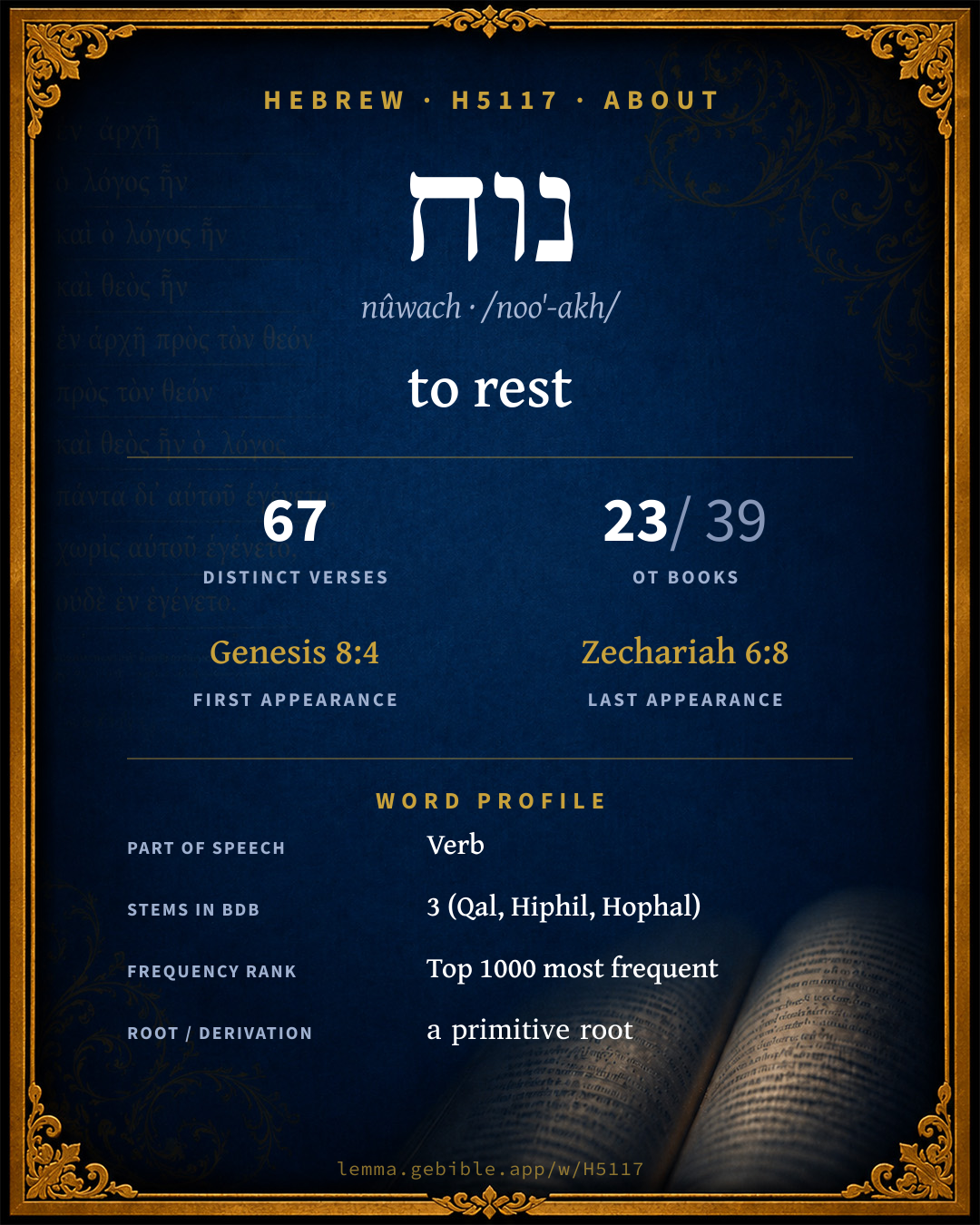
נוּחַ
to rest
‘to rest’ is one of 13 main senses fuller range ↓
Full lexicon entry — Brown-Driver-Briggs (BDB)
From Brown-Driver-Briggs (BDB)
Where this word appears
See every Hiphil verb in the Hebrew Bible →
Grammar key — what these labels mean
Part of speech
- Verb
- An action or state-of-being word.
Noun type
- Common
- A common noun — a general class of person, place, or thing (“king,” “city,” “water”), not a specific name.
Stem
- Qal
- The basic, simple active stem — the plain form of the verb (“he wrote”). Here: ‘rest’
- Hiphil
- The causative active stem (“he caused / brought about”). Here: ‘cause to rest = give rest to’
- Hophal
- The passive counterpart of the Hiphil (“he was caused to…”).
Form
- Imperfect
- An incomplete, ongoing, or future action (“he will / would write”).
- Sequential Perfect
- A perfect with prefixed waw continuing a preceding imperfect or command (waw-consecutive perfect).
- Perfect
- A completed action or state — Hebrew marks aspect (completeness) more than strict tense (“he wrote”).
- Sequential Imperfect
- An imperfect with prefixed waw — the standard past-narrative form (waw-consecutive imperfect).
- Infinitive Construct
- A bound verbal noun, frequently with prepositions (“to write / in writing”).
- Infinitive Absolute
- An unbound verbal noun, often intensifying or standing in for a finite verb.
- Participle Active
- A verbal adjective expressing ongoing or characteristic action (“writing / one who writes”).
- Imperative
- A direct command (“write!”).
State
- Absolute
- The independent form of a noun, not bound to a following word.
Person
- 3rd Person
- The one spoken about (“he / she / it / they”).
- 1st Person
- The speaker (“I / we”).
- 2nd Person
- The one addressed (“you”).
Gender
- Masculine
- Grammatically masculine.
- Common
- Either gender — not distinguished for this form.
- Feminine
- Grammatically feminine.
Number
- Singular
- One.
- Plural
- More than one (in Hebrew, generally three or more).
Grammatical forms 29 distinct
- Verb, Qal, Imperfect, 3rd Person, Masculine, Singular 7 times (10%)
- Verb, Hiphil, Sequential Perfect, 1st Person, Common, Singular 6 times (9%)
- Verb, Hiphil, Perfect, 3rd Person, Masculine, Singular 6 times (9%)
- Verb, Hiphil, Sequential Imperfect, 3rd Person, Masculine, Singular 6 times (9%)
- Verb, Hiphil, Imperfect, 3rd Person, Masculine, Singular 5 times (7%)
- Verb, Qal, Infinitive Construct 5 times (7%)
- Verb, Hiphil, Infinitive Construct 4 times (6%)
- Verb, Hiphil, Sequential Perfect, 3rd Person, Masculine, Singular 2 times (3%)
+21 more forms (26 occurrences)
Parsed forms decoded from the imported morphology (morphhb / Westminster Leningrad Codex — WLC text public domain, morphhb tagging CC BY 4.0), counted across 67 parsed occurrences — not distinct verses.
Every verse where H5117 appears — 67 distinct verses across 23 books. Click any verse to open its interlinear word-by-word view. Verse text shown in the World English Bible for context — . Each verse’s Hebrew form is shown with its reference; the English is not keyword-highlighted, since the data carries no word-level English alignment. Use “Compare translations” on any verse to read it across multiple English versions. This concordance covers the Hebrew Bible; Septuagint (Greek Old Testament) occurrences are not indexed here.
Genesis 1 verse
Exodus 5 verses
- Exodus 10:14 וַ/יָּ֕נַח conj + Qal wimpf 3ms The locusts went up over all the land of Egypt, and rested in all the borders of Egypt. They were very grievous. Before them there were no such locusts as they, neither after them shall be such.
- Exodus 17:11 יָנִ֛יחַ Hiphil impf 3ms It happened, when Moses held up his hand, that Israel prevailed; and when he let down his hand, Amalek prevailed.
- Exodus 20:11 וַ/יָּ֖נַח conj + Qal wimpf 3ms for in six days Yahweh made heaven and earth, the sea, and all that is in them, and rested the seventh day; therefore Yahweh blessed the Sabbath day, and made it holy.
- Exodus 23:12 יָנ֗וּחַ Qal impf 3ms "Six days you shall do your work, and on the seventh day you shall rest, that your ox and your donkey may have rest, and the son of your handmaid, and the alien may be refreshed.
- Exodus 33:14 וַ/הֲנִחֹ֥תִי conj + Hiphil wpf 1cs He said, "My presence will go with you, and I will give you rest."
Numbers 3 verses
- Numbers 10:36 וּ/בְ/נֻחֹ֖/ה conj + prep + Qal inf.cs + sfx pers 3ms When it rested, he said, Return, Yahweh, to the ten thousands of the thousands of Israel.
- Numbers 11:25 כְּ/נ֤וֹחַ prep + Qal inf.cs Yahweh came down in the cloud, and spoke to him, and took of the Spirit that was on him, and put it on the seventy elders: and it happened that when the Spirit rested on them, they prophesied, but they did so no more.
- Numbers 11:26 וַ/תָּ֧נַח conj + Qal wimpf 3fs But there remained two men in the camp, the name of the one was Eldad, and the name of the other Medad: and the Spirit rested on them; and they were of those who were written, but had not gone out to the Tent; and they prophesied in the camp.
Deuteronomy 4 verses
- Deuteronomy 3:20 יָנִ֨יחַ Hiphil impf 3ms until Yahweh give rest to your brothers, as to you, and they also possess the land which Yahweh your God gives them beyond the Jordan: then shall you return every man to his possession, which I have given you.
- Deuteronomy 5:14 יָנ֛וּחַ Qal impf 3ms but the seventh day is a Sabbath to Yahweh your God: [in it] you shall not do any work, you, nor your son, nor your daughter, nor your man-servant, nor your maid-servant, nor your ox, nor your donkey, nor any of your cattle, nor your stranger who is within your gates; that your man-servant and your maid-servant may rest as well as you.
- Deuteronomy 12:10 וְ/הֵנִ֨יחַ conj + Hiphil wpf 3ms But when you go over the Jordan, and dwell in the land which Yahweh your God causes you to inherit, and he gives you rest from all your enemies round about, so that you dwell in safety;
- Deuteronomy 25:19 בְּ/הָנִ֣יחַ prep + Hiphil inf.cs Therefore it shall be, when Yahweh your God has given you rest from all your enemies round about, in the land which Yahweh your God gives you for an inheritance to possess it, that you shall blot out the memory of Amalek from under the sky; you shall not forget.
Joshua 6 verses
- Joshua 1:13 מֵנִ֣יחַ Hiphil ptcp.act ms Remember the word which Moses the servant of Yahweh commanded you, saying, Yahweh your God gives you rest, and will give you this land.
- Joshua 1:15 יָנִ֨יחַ Hiphil impf 3ms until Yahweh have given your brothers rest, as [he has given] you, and they also have possessed the land which Yahweh your God gives them: then you shall return to the land of your possession, and possess it, which Moses the servant of Yahweh gave you beyond the Jordan toward the sunrise.
- Joshua 3:13 כְּ/נ֣וֹחַ prep + Qal inf.cs It shall come to pass, when the soles of the feet of the priests who bear the ark of Yahweh, the Lord of all the earth, shall rest in the waters of the Jordan, that the waters of the Jordan shall be cut off, even the waters that come down from above; and they shall stand in one heap.
- Joshua 21:44 וַ/יָּ֨נַח conj + Hiphil wimpf 3ms Yahweh gave them rest round about, according to all that he swore to their fathers: and there stood not a man of all their enemies before them; Yahweh delivered all their enemies into their hand.
- Joshua 22:4 הֵנִ֨יחַ Hiphil pf 3ms Now Yahweh your God has given rest to your brothers, as he spoke to them: therefore now turn you, and get you to your tents, to the land of your possession, which Moses the servant of Yahweh gave you beyond the Jordan.
- Joshua 23:1 הֵנִ֨יחַ Hiphil pf 3ms It happened after many days, when Yahweh had given rest to Israel from all their enemies round about, and Joshua was old and well stricken in years;
1 Samuel 1 verse
2 Samuel 4 verses
- 2 Samuel 7:1 הֵנִֽיחַ Hiphil pf 3ms It happened, when the king lived in his house, and Yahweh had given him rest from all his enemies round about,
- 2 Samuel 7:11 וַ/הֲנִיחֹ֥תִי conj + Hiphil wpf 1cs and [as] from the day that I commanded judges to be over my people Israel; and I will cause you to rest from all your enemies. Moreover Yahweh tells you that Yahweh will make you a house.
- 2 Samuel 17:12 וְ/נַ֣חְנוּ conj + Qal wpf 1cp So shall we come on him in some place where he shall be found, and we will light on him as the dew falls on the ground; and of him and of all the men who are with him we will not leave so much as one.
- 2 Samuel 21:10 לָ/נ֤וּחַ prep + Qal inf.cs Rizpah the daughter of Aiah took sackcloth, and spread it for her on the rock, from the beginning of harvest until water was poured on them from the sky; and she allowed neither the birds of the sky to rest on them by day, nor the animals of the field by night.
1 Kings 1 verse
2 Kings 1 verse
1 Chronicles 3 verses
- 1 Chronicles 22:9 וַ/הֲנִח֥וֹתִי conj + Hiphil wpf 1cs Behold, a son shall be born to you, who shall be a man of rest; and I will give him rest from all his enemies round about; for his name shall be Solomon, and I will give peace and quietness to Israel in his days:
- 1 Chronicles 22:18 וְ/הֵנִ֥יחַ conj + Hiphil wpf 3ms Isn't Yahweh your God with you? Hasn't he given you rest on every side? for he has delivered the inhabitants of the land into my hand; and the land is subdued before Yahweh, and before his people.
- 1 Chronicles 23:25 הֵנִ֛יחַ Hiphil pf 3ms For David said, Yahweh, the God of Israel, has given rest to his people; and he dwells in Jerusalem forever:
2 Chronicles 4 verses
- 2 Chronicles 14:6 הֵנִ֥יחַ Hiphil pf 3ms He built fortified cities in Judah; for the land was quiet, and he had no war in those years, because Yahweh had given him rest.
- 2 Chronicles 14:7 וַ/יָּ֥נַֽח conj + Hiphil wimpf 3ms For he said to Judah, Let us build these cities, and make about them walls, and towers, gates, and bars; the land is yet before us, because we have sought Yahweh our God; we have sought him, and he has given us rest on every side. So they built and prospered.
- 2 Chronicles 15:15 וַ/יָּ֧נַח conj + Hiphil wimpf 3ms All Judah rejoiced at the oath; for they had sworn with all their heart, and sought him with their whole desire; and he was found of them: and Yahweh gave them rest round about.
- 2 Chronicles 20:30 וַ/יָּ֧נַֽח conj + Hiphil wimpf 3ms So the realm of Jehoshaphat was quiet; for his God gave him rest round about.
Nehemiah 1 verse
Esther 3 verses
- Esther 9:17 וְ/נ֗וֹחַ conj + Qal inf.abs [This was done] on the thirteenth day of the month Adar; and on the fourteenth day of the same they rested, and made it a day of feasting and gladness.
- Esther 9:18 וְ/נ֗וֹחַ conj + n c ms But the Jews who were in Shushan assembled together on the thirteenth [day] of it, and on the fourteenth of it; and on the fifteenth [day] of the same they rested, and made it a day of feasting and gladness.
- Esther 9:22 נָ֨חוּ Qal pf 3cp as the days in which the Jews had rest from their enemies, and the month which was turned to them from sorrow to gladness, and from mourning into a good day; that they should make them days of feasting and gladness, and of sending portions one to another, and gifts to the needy.
Job 3 verses
- Job 3:13 יָנ֬וּחַֽ Qal impf 3ms For now should I have lain down and been quiet. I should have slept, then I would have been at rest,
- Job 3:17 יָ֝נ֗וּחוּ Qal impf 3mp There the wicked cease from troubling; There the weary are at rest.
- Job 3:26 נָ֗חְתִּי Qal pf 1cs I am not at ease, neither am I quiet, neither have I rest; But trouble comes."
Psalms 1 verse
Proverbs 3 verses
- Proverbs 14:33 תָּנ֣וּחַ Qal impf 3fs Wisdom rests in the heart of one who has understanding, And is even made known in the inward part of fools.
- Proverbs 21:16 יָנֽוּחַ Qal impf 3ms The man who wanders out of the way of understanding Shall rest in the assembly of the dead.
- Proverbs 29:17 וִֽ/ינִיחֶ֑/ךָ conj + Hiphil impf 3ms + sfx pers 2ms Correct your son, and he will give you peace; Yes, he will bring delight to your soul.
Ecclesiastes 1 verse
Isaiah 11 verses
- Isaiah 7:2 נָ֥חָֽה Qal pf 3ms It was told the house of David, saying, "Syria is allied with Ephraim." His heart trembled, and the heart of his people, as the trees of the forest tremble with the wind.
- Isaiah 7:19 וְ/נָח֤וּ conj + Qal wpf 3cp They shall come, and shall all rest in the desolate valleys, in the clefts of the rocks, on all thorn-hedges, and on all pastures.
- Isaiah 11:2 וְ/נָחָ֥ה conj + Qal wpf 3fs The Spirit of Yahweh shall rest on him, the spirit of wisdom and understanding, the spirit of counsel and might, the spirit of knowledge and of the fear of Yahweh.
- Isaiah 14:3 הָנִ֤יחַ Hiphil inf.cs It shall happen in the day that Yahweh shall give you rest from your sorrow, and from your trouble, and from the hard service in which you were made to serve,
- Isaiah 14:7 נָ֥חָה Qal pf 3fs The whole earth is at rest, [and] is quiet: they break forth into singing.
- Isaiah 23:12 יָנ֥וּחַֽ Qal impf 3ms He said, You shall no more rejoice, you oppressed virgin daughter of Sidon: arise, pass over to Kittim; even there shall you have no rest.
- Isaiah 25:10 תָנ֥וּחַ Qal impf 3fs For in this mountain will the hand of Yahweh rest; and Moab shall be trodden down in his place, even as straw is trodden down in the water of the dung-hill.
- Isaiah 28:12 הָנִ֣יחוּ Hiphil impv 2mp to whom he said, This is the rest, give you rest to him who is weary; and this is the refreshing: yet they would not hear.
- Isaiah 30:32 יָנִ֤יחַ Hiphil impf 3ms Every stroke of the appointed staff, which Yahweh shall lay on him, shall be with [the sound of] tambourines and harps; and in battles with the brandishing [of his arm] will he fight with them.
- Isaiah 57:2 יָנ֖וּחוּ Qal impf 3mp He enters into peace; they rest in their beds, each one who walks in his uprightness.
- Isaiah 63:14 תְּנִיחֶ֑/נּוּ Hiphil impf 3fs + sfx pers 3ms As the cattle that go down into the valley, the Spirit of Yahweh caused them to rest; so did you lead your people, to make yourself a glorious name.
Lamentations 1 verse
Ezekiel 7 verses
- Ezekiel 5:13 וַ/הֲנִחוֹתִ֧י conj + Hiphil wpf 1cs Thus shall my anger be accomplished, and I will cause my wrath toward them to rest, and I shall be comforted; and they shall know that I, Yahweh, have spoken in my zeal, when I have accomplished my wrath on them.
- Ezekiel 16:42 וַ/הֲנִחֹתִ֤י conj + Hiphil wpf 1cs So will I cause my wrath toward you to rest, and my jealousy shall depart from you, and I will be quiet, and will be no more angry.
- Ezekiel 21:17 וַ/הֲנִחֹתִ֖י conj + Hiphil wpf 1cs I will also strike my hands together, and I will cause my wrath to rest: I, Yahweh, have spoken it.
- Ezekiel 24:13 הֲנִיחִ֥/י Hiphil inf.cs + sfx pers 1cs In your filthiness is lewdness: because I have cleansed you and you weren't cleansed, you shall not be cleansed from your filthiness any more, until I have caused my wrath toward you to rest.
- Ezekiel 37:1 וַ/יְנִיחֵ֖/נִי conj + Hiphil wimpf 3ms + sfx pers 1cs The hand of Yahweh was on me, and he brought me out in the Spirit of Yahweh, and set me down in the midst of the valley; and it was full of bones.
- Ezekiel 40:2 וַ/יְנִיחֵ֗/נִי conj + Hiphil wimpf 3ms + sfx pers 1cs In the visions of God brought he me into the land of Israel, and set me down on a very high mountain, whereon was as it were the frame of a city on the south.
- Ezekiel 44:30 לְ/הָנִ֥יחַ prep + Hiphil inf.cs The first of all the first fruits of every thing, and every offering of everything, of all your offerings, shall be for the priest: you shall also give to the priests the first of your dough, to cause a blessing to rest on your house.
Daniel 1 verse
Habakkuk 1 verse
Zechariah 1 verse
About this entry
At a glance — auto-summarized from this page’s data, not written by a person. Every figure links to its source below. This summary describes the numbers; it doesn’t interpret them.
נוח — transliterated nûwach — is a Hebrew verb carrying the sense “to rest.” Debuting at Genesis 8:4, it then recurs through the corpus. It appears 67 verses across 23 books of the Hebrew Bible, among its moderately common vocabulary. Different stems carry different senses — BDB groups them under 3 stems, among them Qal and Hiphil. Related forms include הנחה, מנוח and נוח. Each statement above links to its evidence; the full detail follows below.
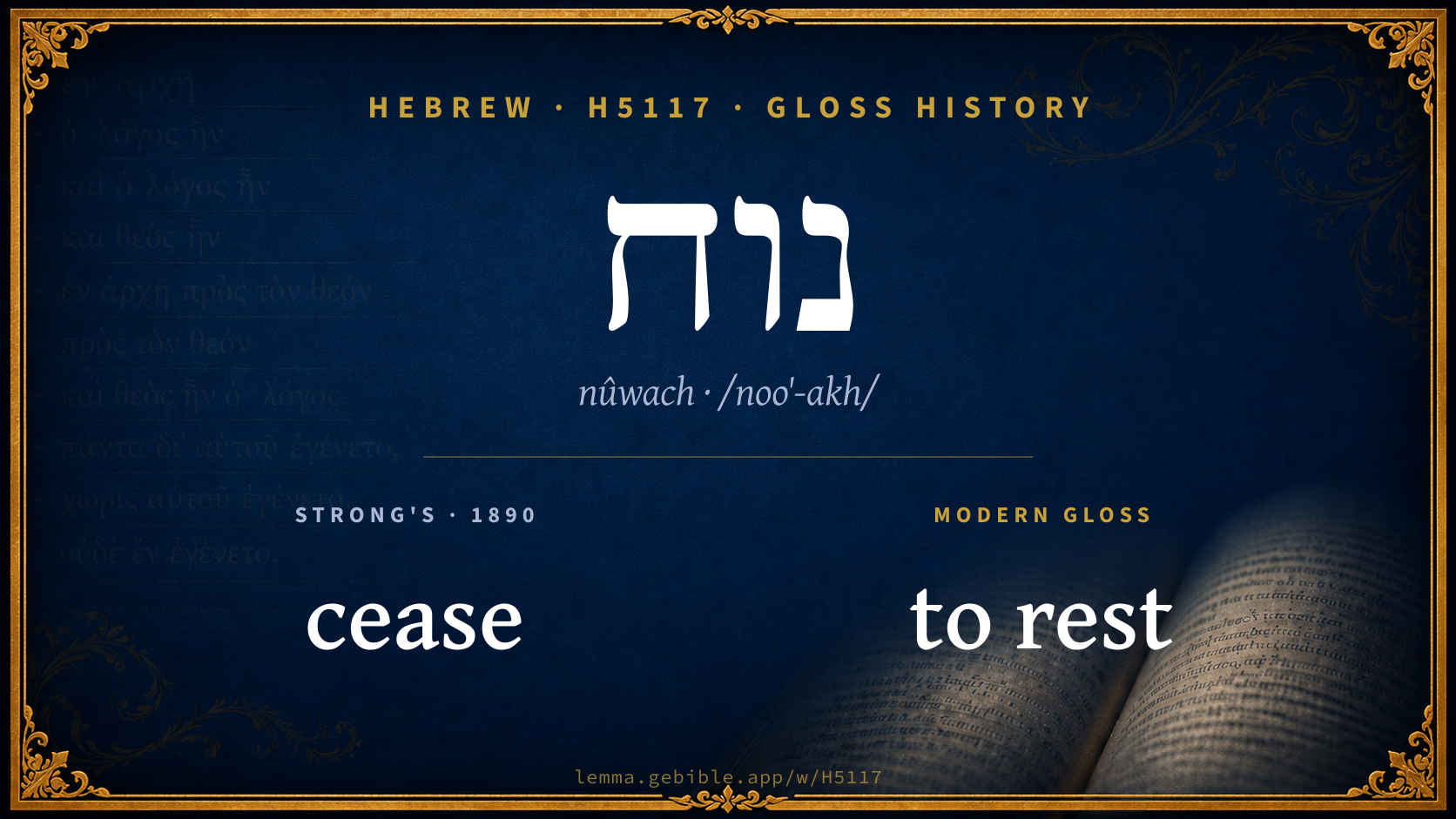
Gloss history
Strong's 1890 vs modern scholarship
About this word
Strong's H5117 catalogs a Hebrew word from the Hebrew Old Testament.
These counts are not copied from any lexicon or concordance. They are computed here, from the morphology-tagged Hebrew Old Testament. What Lemma adds →
- 67
- distinct verses
- The word appears in 67 distinct verses.
- 23 / 39
- OT books
- The word appears in 23 of 39 Old Testament books.
- #587
- by frequency
- Top 1000 most frequent Hebrew words (rank 587 of 8,640 Hebrew words by occurrence).
View all 67 occurrences in the concordance →
By section of the Old Testament
By traditional corpus
Conventional, traditional groupings — biblical authorship is debated, so this is a traditional corpus grouping, not an authorship claim. Each share is this word’s portion of its verses in that division of the Hebrew canon. Each figure is a share of the word’s 67 distinct verses.
- Prophets (Nevi'im) 33 verses · 49%
- Writings (Ketuvim) 21 verses · 31%
- Torah (Pentateuch) 13 verses · 19%
How translations render this word
Counts come from each version’s own published word-to-Strong’s tagging or interlinear alignment — an approximate guide to how each version renders this word, not a word-level alignment the data otherwise carries. Because each total is that version’s own tagged count, the per-version totals vary from one another and need not match the appearance or distinct-verse counts above. These counts may also differ from a printed concordance because Lemma counts each distinctly tagged rendering and does not collapse phrase taggings into a single head-word total. This is a fixed set of word-tagged versions (KJV, ASV, BSB, ULT) and does not change with the reading translation you choose elsewhere. Each version’s license is shown beside its name below (and on Sources).
BDB lists this Strong’s number as 2 distinct words (homographs). Each count above pools all of them and is not split by sense — see the Senses section below. A low-frequency rendering may belong to a different one of those words, not the primary meaning.
- King James Version†: Rest 8×, Rested 6×, Shall rest 3×
- American Standard Version†: Rest 5×, Rested 4×, Shall rest 4×
- Berean Standard Bible†: Rest 12×, Leave 4×, Gave them rest 3×
- unfoldingWord Literal Text†: Rest 9×, Rested 7×, And 5×
King James Version Public Domain
Renders H5117 across 65† tagged occurrences — most commonly:
Plus 38 renderings that appear only once — usually multi-word phrases or single function words the recovered tagging swept in, not distinct renderings.
American Standard Version Public Domain
Renders H5117 across 65† tagged occurrences — most commonly:
Plus 46 renderings that appear only once — usually multi-word phrases or single function words the recovered tagging swept in, not distinct renderings.
Berean Standard Bible Public Domain
Renders H5117 across 140† tagged occurrences — most commonly:
Plus other, less common renderings. Plus 83 renderings that appear only once — usually multi-word phrases or single function words the recovered tagging swept in, not distinct renderings. Not rendered by a distinct English word in 1 further occurrence.
unfoldingWord Literal Text CC BY-SA 4.0
Renders H5117 across 84† tagged occurrences — most commonly:
Plus 39 renderings that appear only once — usually multi-word phrases or single function words the recovered tagging swept in, not distinct renderings.
20 senses and sub-senses in the full BDB
Hebrew verbs can shift meaning by stem (binyan): Qal is the basic action, Niphal is often passive or reflexive, Piel often intensifies or makes it factitive, and Hiphil is typically causative. The senses below are grouped under the stem BDB assigns to each. This entry also uses Hophal (the passive of Hiphil).
What do BDB’s symbols mean?
BDB uses these scholarly abbreviations:
| Symbol | Meaning |
|---|---|
| 𝔊 | the Septuagint (the ancient Greek translation, LXX) |
| 𝔙 | the Vulgate (the Latin translation) |
| 𝔖 | the Syriac version (the Peshitta) |
| 𝔗 | the Targum (the Aramaic translation) |
| ψ | the Psalms |
| √ | root (the underlying root or stem) |
| ‖ | parallel passage (a synonymous or contrasted parallel) |
| † | the dagger: every passage where the word occurs is cited |
The 20 senses and sub-senses the full Brown-Driver-Briggs lexicon distinguishes for this word, in lexicon order (not ranked by frequency), with BDB’s own verbatim wording and sub-sense lettering. Shown in Hebrew script with BDB’s own scholarly abbreviations. The condensed entry is in the Lexicon Entry tab. See also the Forms in the corpus table below.
נוח I rest (NH id.
Qal
- Pf. 3 fs. נָ֫חָה Is 7:2 + 2 times, וְנָחָה Is 11:2; 1 s. נָ֑חְתִּי Jb 3:26; 1 pl. נַחְנוּ 2 S 17:12; 3 pl. נָ֫חוּ Est 9:22, וְנָחוּ Is 7:19; Impf. 3 ms. יָנוּחַ Ex 23:12 + 6 times, וַיָּ֫נַח Ex 10:14; 20:11; 3 fs. תָּנוּחַ Is 25:10 Pr 14:33, וַתָּ֫נַח Gn 8:4 Nu 11:26; 2 ms. תָּנוּחַ Dn 12:13 etc.; Inf. abs. נוֹחַ Est 9:16, 17, 18; cstr. לָנוּחַ 2 S 21:10; כְּנוֹחַ Nu 11:25 Jos 3:13 Ne 9:28; sf. 3 ms. בְּנֻחֹה Nu 10:36;—לְנוּחֶ֑ךָ 2 Ch 6:41 v. מְנוּחָה;— e.g. Isaiah 7:2
- 1. rest, settle down and remain, sq. עַל; of birds 2 S 21:10; ark Gn 8:4 (P); נָ֫חָה אֲרָם עַל־אֶפְרַיִם Is 7:2 Aram hath settled down upon Ephraim; of spirit of י׳ Nu 11:25, 26 (E), Is 11:2; spirit of Elijah 2 K 2:15; sceptre of wicked ψ 125:3 (in fig.); sq. בְּ loc.: of insects Ex 10:14 (J), Is 7:19 (fig. of invaders); of soles of feet resting in water Jos 3:13 (JE); hand of י׳ Is 25:10; wisdom Pr 14:33; anger Ec 7:9; בִּקְהַל וְפָאִים יָנוּחַ Pr 21:16 in the assembly of Shades shall be settle down; abs., = stop, of ark at stages of journey Nu 10:36 (JE); cease speaking 1 S 25:9. e.g. 2 Samuel 21:10
- 2. repose, be quiet, have rest: after labour Ex 20:11 (E; of God), 23:12 (E; of cattle), Dt 5:14 (of slave); have rest from (מִן) enemies Est 9:16 (inf. abs. נוֹחַ, + עָמוֹד, הָרוֹג), v 22, cf. (abs.) v 17, 18 (in both + עָשׂה), Ne 9:28; be at rest (from trouble), abs., Jb 3:26 (+ שָׁלַוְתִּי, שָׁקַטְתִּי); of the earth Is 14:7; in couch of the grave 57:2; in Sheʿôl Jb 3:17, so prob. Dn 12:13; also לֹא תָּנוּחַ לָךְ Is 23:12 = thou shall not be at rest, cf. impers. יָנוּחַ לִי Jb 3:13 = I should be at rest (in Sheʾôl).—אָנוּחַ לְיוֹם צָרָה Hb 3:16 is dub.: I wait quietly for the day of distress De Ke Hi-St SS, so Now, doubtfully; We conj. אֶנָּחֵם as Is 1:24 I will appease me GASm leaves untransl. e.g. Exodus 20:11
Hiphil
- A. Pf. 3 ms. הֵנִיחַ Jos 22:4 +; 1 s. וַהֲנִיחֹ֫תִי 2 S 7:11 +; הֵנִ֫יחוּ Zc 6:8; Impf. 3 ms. יָנִיחַ Ex 17:11 +; וַיָּ֫נַח Jos 21:42 +; sf. וַיְנִיחֵנִי Ez 37:1; 40:2; 3 fs. sf. תְּנִיחֶנּוּ Is 63:14 (but v. infr.), etc.; Imv. mpl. הָנִ֫יחוּ Is 28:12; Inf. cstr. הָנִיחַ Is 14:3 +, sf. הֲנִיחִי Ez 24:13; Pt. מֵנִיחַ Jos 1:13;— e.g. Joshua 22:4
- 1. cause to rest = give rest to:
- a. sq. acc. יָדוֹ Ex 17:11 (E), רוּחִי Zc 6:8; so appar. sq. חֲמָתִי + ב pers., quiet (i.e. sate) my fury by (weak it upon) Ez 5:13 (del. Co), 16:42, 24:13, also 21:22 (Co adds ב pers.). e.g. Exodus 17:11
- b. usually sq. ל pers.: (1) give rest to i.e. bring to resting-place Ex 33:14 (J), Dt 3:20 Jos 1:13, 15; 22:4 (all D), 1 Ch 23:25; so, c. sf., Is 63:14 (si vera l.; Vrss Lo Ew Brd CheHpt. read תַּנְחֶנּוּ, leadeth him, √ נחה); (2) of freedom from enemies, Is 28:12 2 Ch 14:5 + מִכָּל־איבים [מִסָּבִיב] Dt 12:10; 25:19 Jos 23:1 (D), 2 S 7:1, 11 1 Ch 22:9; so + מִסָּבִיב alone 1 K 5:18 Jos 21:42 (P), 1 Ch 22:18 2 Ch 14:6; 15:15; 20:30, so also prob. 32:22 (for MT וַיְנַהֲלֵם מִסָּבִיב); (3) of freedom from suffering, + מֵעָצְבְּךָ וגו׳ Is 14:3. e.g. Exodus 33:14
- c. make quiet in mind, set at rest וִינִיהֶ֑ךָ Pr 29:17 discipline thy son, that he may give thee quiet (of mind; ‖ יִתֵּן מַעֲדַנִּים לְנַפְשֶׁ֑ךָ). e.g. Proverbs 29:17
- 2. cause to rest (i.e. light) upon, c. acc. staff + עַל pers. Is 30:32; c. acc. blessing + אֶל־ Ez 44:30; cause to alight, set down, c. sf. pers. + בְּתוֹךְ loc. Ez 37:1; + אֶל־ loc. 40:2.— For this meaning v. especially B. infr. e.g. Isaiah 30:32
- 1. cause to rest = give rest to:
- B. Pf. 3 ms. הִנִּיחַ Ju 3:1 +, הִנִּחַ 1 K 8:9, sf. וְהִנִּיחוֹ Dt 26:4, וְהִנִּיחָם Lv 16:23 both consec.; 2 ms. וְהִנַּחְתָּ֫ Dt 14:28, sf. וְהִנַּחְתּוֹ 26:10 consec., etc.; Impf. 3 ms. יַנִּיחַ Lv 7:15, וַיַּנַּה Ju 2:23 +, sf. וַיַּנִּיחֵהוּ Ex 16:34; 3 fs. וַתַּנַּח Gn 39:16, 2 ms. juss. אַל־תַּנַּח Ec 7:18 + 2 times, etc.; Imv. ms. הַנַּח Ho 4:7 + 2 times, הַנִּ֫יחָה Ex 32:10 Ju 16:26, etc.; Inf. cstr. sf. לְהַנִּיחוֹ Nu 32:15, לְהַנִּיחָם Est 3:8; Pt. מַנִּיחַ Ec 5:11;— e.g. Judges 3:1
- 1. lay or set down, deposit, let lie, c. acc. rei, usually + word of place: stones at ford of Jordan Jos 4:3, 8 (JE), ark 1 S 6:18, garments Gn 39:16 (J), Lv 16:23 (P), Ez 42:14; 44:19; cf. Ex 16:23, 24, 33, 34 Nu 17:19, 22 (all P), Dt 26:4, 10 1 K 8:9; 13:31 Ez 40:42; 42:13; so, acc. om., Ju 6:18, 20 Dt 14:28 Nu 19:9 (P), 1 S 10:25; place, put, sq. acc. pers. + local modif., Gn 2:15 (J), 19:16 (J), Jos 6:23 (JE), Lv 24:12 Nu 15:34 (both P), Is 14:1; 46:7 Ez 37:14; prob. also Zc 5:11 (read וְהִנִּיחֻהָ, v. Ges§ 72 ee); read וַיַּנִּיחֵם also 2 K 18:11 (𝔊 ἔθετο; for MT וַיַּנְחֵם; cf. וַיּשֶׁב אוֹתָם ‖ 2 K 17:6); place corpse on (אֶל־) ass 1 K 13:29, in grave v 30; horsemen and chariots in cities 2 Ch 1:14; 9:25, so read also ‖ 1 K 10:26 (𝔊 ἔθετο; for MT וַיַּנְחֵם); tables in temple 2 Ch 4:8; idols in shrines 2 K 17:29 (acc. om.). Here belongs perhaps also וְגַם מִזֶּה אַל־תַּנַּח אֶת־יָדֶ֑ךָ Ec 7:18 and also from this do not let thy hand lie (idle), i.e. engage in it, cf. 11:6; lay down forcibly, thrust down הִנִּיחַ לָאָרֶץ בְּיָ֑ד Is 28:2, cf. Am 5:7; perhaps also Ez 22:20 (abs.; but del. Co Berthol, after 𝔊). e.g. Joshua 4:3
- 2. let remain, leave (in present condition), obj. nations Ju 2:23; 3:1 Je 27:11, people in wilderness Nu 32:15 (JE); וְהִנִּיחוּךְ עֵירֹם וְעֶרְיָה Ez 16:39; sq. acc. rei Lv 7:15 1 K 7:47 (leave unweighed); leave behind sq. acc. pers. Gn 42:33 (E), 2 S 16:21; 20:3 1 K 19:3 Je 43:6; + אֶת־פְּנֵי 1 S 22:4 (read וַיַּנִּחֵם, for MT וַיַּנְחֵם, and he left them with 𝔖 𝔗 𝔙 We Dr Klo Bu Löhr HPS; leave name, for a curse Is 65:15; leave or bequeath to (ל), c. acc. rei, ψ 17:14 Ec 2:18. e.g. Judges 2:23
- 3. leave = depart from, מְקוֹמְךָ אַל־תַּנַּח Ec 10:4 do not leave thy place. e.g. Ecclesiastes 10:4
- 4. abandon, sq. acc. pers. Je 14:9; בַּל־תַּנִּיחֵנִי לְעשְׁקָ֑י ψ 119:121 abandon me not to my oppressors. e.g. Jeremiah 14:9
- 5. let alone (refrain from interfering with), sq. ל pers. Ex 32:10 (JE; obj. י׳), Ho 4:17 2 S 16:11 2 K 23:18; sq. acc. pers. Est 3:8; = avoid יַנִּיחַ חֲטָאִים גְּדוֹלִים Ec 10:4 (but read perhaps יָנִיחַ, causeth to rest = allayeth cf. Wild) e.g. Exodus 32:10
- 6. permit, c. acc. pers. Ju 16:26 (v GFM); + inf. לֹא הִנִּיחַ אָדָם לְעָשְׁקָם ψ 105:14 = 1 Ch 16:21, where הִנִּיחַ לְאִישׁ, cf. מַנִּיחַ לוֹ לִישׁוֹן Ec 5:11. e.g. Judges 16:26
Hophal
- A. Pf. 3 ms. הוּנַח־לָ֑נוּ La 5:5 i.e. no rest is granted to us; for 3 fs. וְהֻנִ֫יחָה Zc 5:11 [so Baer Ginsb; Van d. H. והֻנּ׳] read prob. וְהִנִּיחֻהָ v. supr. Hiph. B 1. e.g. Lamentations 5:5
- B. Pt. מֻנָּ֔ח as subst. = space left, open space Ez 41:9, 11(×2). e.g. Ezekiel 41:9
נוח II lead, guide (Arabic نَحَا go in direction of, turn (eyes) toward)
Qal
- Pf. sf. נָחַ֫נִי Gn 24:27 + 2 times; וְנָֽחֲךָ Is 58:11; נָחָם Ex 13:17; 2 ms. נָחִ֫יתָ Ex 15:13 ψ 77:21; Imv. נְחֵה Ex 32:34; sf. נְחֵנִי ψ 5:9 + 2 times;—lead, bring, sq. acc. pers., subj. man Ex 32:34 (sq. אֶל־), cf. ψ 60:11; 108:11 (both sq. עַד־; ‖ הוביל); usually subj. י׳ Gn 24:27 (J; also sq. בַּדֶּרֶךְ + acc. loc.), Ex 13:17 (E; sq. דֶּרֶךְ), 15:13 (song; ‖ נהל), ψ 77:21; fig. of guidance in prosperity and righteousness ψ 5:9 (‖ הושׁר דרך), 27:11 (sq. בְּאֹרַח; ‖ הורה דרך), 139:24 (sq. בדרך עולם); cf. Is 58:11. e.g. Genesis 24:27
Hiphil
- Pf. sf. הִנְחַ֫נִי Gn 24:48; 2 ms. sf. הִנְחִתָם Ne 9:12; Impf. sf. יַנְחֵ֫נִי Nu 23:7 ψ 23:3; יַנְחֶ֫נּוּ Dt 32:12 Pr 18:16; 3 fs. תַּנְחֶה Pr 6:22, etc.; Inf. cstr. sf. לְהַנְחֹתָם Ne 9:19; לַנְחֹתָם Ex 13:21;—lead, guide (= Qal) sq. acc. pers. Nu 23:7 (JE; + מִן).—1 S 22:4 (+ אֶת־פְּנֵי), 1 K 10:26 2 K 18:11 v. sub נוח Hiph. B.—; of guiding = treating kindly (the helpless) Jb 31:18, of guiding constellations 38:32 (‖ הוציא); usually subj. י׳ Gn 24:48 (J; sq. בַּדֶּרֶךְ) Dt 32:12 ψ 78:14, 53, 72 (Isr. as flock; ‖ רעה); Is 57:18 ψ 107:30 (sq. אֶל־); cf. of pillar of cloud Ex 13:21 (J), Ne 9:12, 19; also Jb 12:23, read prob. וַיַּנִּחֵם and leaves them (Je 14:9). ψ 67:5; especially in path of blessing ψ 23:3; 31:4 (‖ נהל), 61:3 (sq. בְּ), 73:24; cf. 43:3; 139:10 (‖ אחז), 143:10 (sq. בְּ); also of instruction, etc., Pr 6:22; 11:3; 18:16 (sq. לִפְנֵי). e.g. Genesis 24:48
Senses from the full Brown-Driver-Briggs lexicon (Brown, Driver, Briggs; Oxford 1906 — public domain), digitized via Sefaria, supplemented by the OpenScriptures HebrewLexicon (CC BY 4.0). Full attribution on Sources.
Word origin
I. vb. rest (NH id.; Aramaic נוּחַ, ܢܳܚ; Ph. נחת n. rest; poss. also vb. ינח (Iph. Pf.), cf. Levy cited CIS i. 118 Lzb 322; Assyrian nâḫu, rest, and deriv.; Ethiopic ኖኀ: be extended, long, rarely rest; Arabic ناخ iv. is make camel lie down on his breast; مُنَاخٌ resting-place of camel, cf. DoughtyArab. Des. i, 397, ii, 63, 486, 642);—
I. vb. lead, guide (Arabic نَحَا go in direction of, turn (eyes) toward);—
— Brown-Driver-Briggs (Oxford 1906, public domain), digitized via Sefaria, supplemented by the OpenScriptures HebrewLexicon (CC BY 4.0). See Sources.
Origin: a primitive root
Jastrow Dictionary
A second Hebrew/Aramaic lexicon for comparison, covering Aramaic and post-biblical (Talmudic, Targumic, Midrashic) usage that the biblical-Hebrew BDB does not. Matched by lemma rather than by Strong’s number, so a lemma may carry more than one Jastrow headword (shown separately below), and the entries cover usage well beyond the Bible.
נוּחַ
- (b. h.) to rest, lie; to be at ease, rest satisfied.—Sabb. 7ᵇ זרק … והלכה ונָחָה וכ׳ if one threw an object higher than ten handbreadths, and in its course it came to rest in a little hole. Ib. וזרק ונָח על גביו and he threw an object and it came to rest on it. Gen. R. s. 25 כיון שעמד נֹחַ נָחוּ when Noah rose, they rested (submitted to man’s rulership; Yalk. Chr. 1072 נִינּוֹחוּ; Yalk. Gen. 42 נִחֲמָן he appeased them); ib. וכיון שעמד נֹחַ נחו and when Noah rose, they remained undisturbed in their graves; Yalk. Chr. l. c. נינוחו.—Meg. 25ᵇ, a. fr. יָנוּחוּ לו ברכות וכ׳ blessings rest upon his head. Sabb. 152ᵇ, a. e. תָּנוּחַ … שהנחת וכ׳ let thy mind be at rest, for thou hast set my mind at rest; a. fr.—Part. נָח, נוֹחַ, f. נוֹחָה; pl. נוֹחִים, נוֹחִין; נוֹחוֹת a) resting. Gen. R. s. 11 אתם נוחין you rest. Y. Erub. III, end, 21ᶜ, a. fr. נוֹחֵי נפש whose souls are at rest; a. fr.—b) pleased. Ab. III, 10 כל שרוח הבריות נ׳ הימנו וכ׳ in whom the mind of man finds pleasure, the mind of God finds pleasure. Shebi. X, 9; a. fr.—V. נוֹחַ.
- (fr. יָנַח)
- 1. to set at rest; to set down, place. Gen. R. l. c. (ref. to Gen. V, 29) או נח זה יְנִיחֵנוּ וכ׳ either let him be called Noaḥ, then it ought to read, ‘he shall set us at rest’, or Naḥman &c. Sabb. l. c. שהֵנַחְתָּ, v. supra; (Snh. 30ᵇ שהתנחת, v. תָּנַח; v. Rabb. D. S. a. l. note 20). Ḥull. 91ᵇ עלי יַנִּיחַ צדיק וכ׳ let this righteous man rest his head on me.—B. Kam. III, 1. B. Mets. VI, 6 הַנַּח לפני put it down before me (I will take charge of it). Sabb. 21ᵇ להַנִּיחָהּ על פתח וכ׳ to place it over the entrance &c.; a. fr. e.g. Genesis 5:29
- 2. to leave; to leave alone; to allow. B. Bath. IX, 1 מי שמת וה׳ בנים וכ׳ if a person died and left sons and daughters. Ib. 3 ראו מה שה׳ לנו וכ׳ see what our father left us. Snh. 30ᵃ מעות שה׳ לו אביו money which his father had left him (without telling him where it was deposited). Pesik. R. s. 26; Yalk. Ps. 884 אבינו ירמיה הרי אתה מַנִּיחֵנוּ שם J., our father, wilt thou leave us there (in Babylonia, without a prophet)?—Bets. 30ᵃ, a. fr. הַנַּח להם לישראל leave Israel alone (let them do as they please). Yoma I, 4 לא היו מְנִיחִים אותו וכ׳ they did not let him eat much. Ab. Zar. 10ᵇ יַנִּיחֶנָּה, v. נוֹמִי. Ib. 17ᵃ לא ה׳ זונה וכ׳ he did not forego a single prostitute &c. Ex. R. s. 30 לא ה׳ שלא היה מצערו he allowed no opportunity to pass without tormenting him; a. v. fr.
- 3. to relieve, remit. Ab. Zar. 13ᵃ יום שע"א מֵנַחַת בו וכ׳ a day on which the idol grants a remission of duties. Ib. כל מי … ויָנִיחַ … יָנִיחַ וכ׳ to him who will take a wreath and place it on his head (in honor of the deity), he will allow a remission &c.; a. fr.
- 4. to wish rest (to a deceased); to bless the memory of. Yalk. Ex. 411 מזכירין ומניחין there are those who are mentioned and blessed (opp. משחקין); Ex. R. s. 48 מדכרין ומניחין; (Tanḥ. Vayakh. 4 מזכירין ומשבחים;) [Midr. Sam. ch. I מדכרין ומניחין we mention and let alone, neither praising nor blaming by mentioning the ancestry].
- 5. to give pleasure. Gen. R. s. 16 לַהֲנִיחוֹ וכ׳ to give him pleasure, to protect him &c.
- to be put down, rested. Sabb. 4ᵃ, a. fr. קלוטה כמי שהוּנְחָה דמיא an object intercepted in the air (crossing an area, v. רָשׁוּת) is considered as having rested there, v. הַנָּחָה. B. Mets. III, 4, a. e. יהא מוּנָח וכ׳, v. אֵלִיָּהוּ. Yoma 72ᵇ עדיין מונח הוא וכ׳ still lies (undisposed of), whosoever desires to obtain it &c. Kidd. 66ᵃ הרי כרוכה ומוּנַחַת וכ׳ it (the Law) is wrapped up and lies in the corner, whosoever wishes to study &c.; a. fr.
- to be released; to be rested. Cant. R. to VII, 5 והגליות באות ונִינּוֹחוֹת וכ׳ and the exiles will come and rest under it; (Yalk. Is. 334 ונוֹחוֹת; Yalk. Zech. 575 וחָנוֹת). Y. Ber. V, end, 9ᵈ בטוח אני שנ׳ בנו וכ׳ I am confident that the son of … will recover from his illness. Gen. R. s. 13 נִינּוֹחוּ they are relieved (out of danger). Yalk. Chr. 1072, v. supra; a. e.
נוּחַ ²
- Targ. Gen. II, 2 ונַח. Targ. II Sam. XXI, 10 לִמְנָח; a. fr.—Part. נְיָיח, נְיָח. Targ. Y. Num. XXIII, 24. Targ. Job III, 25 נְיָיחִית (Ms. נָחִית); a. fr.—B. Mets. 86ᵃ נַח זעפא the storm subsided. Ib. כי הוה נָיְחָא נפשיה when his soul was at rest (when he was dead). Ib. תִּינַח נפשיה וכ׳ let me rather die, than be delivered &c. Ib. ההוא יומא דנח נפשיה on the day when he died. Keth. 104ᵃ, a. fr. נח נפשיה ד־—is dead. Yoma 20ᵇ נִינַח מר leave it alone, sir (be no longer my interpreter). Sabb. 3ᵃ bot. גופו מֵינַח נָיֵיח Ms. M. (v. Rabb. D. S. a. l. note) his body had been resting (and he lifted it from the ground in moving). Ib. 5ᵇ מים מי עבידי דנָיְיחֵי is it possible that water (running down an incline) is at rest at any time?; a. v. fr.
- , אַנַּח
- 1. to give rest, to assuage. Targ. O. Deut. III, 20 דִּינִיחַ (ed. Vien. דִּי יְנִיחַ); Y. דְּיָנִיחַ. Targ. Ezek. XXIV, 13; a. fr.—Targ. II Chr. XV, 15; XX, 30 אַנְיָיח (ed. Lag. אניח; fr. נְיָיח, v. supra).—Ber. 28ᵇ לַאֲנוּחֵי דעתיה וכ׳ to quiet the mind of &c.—[Lev. R. s. 32, a. e. מדכרין ומניחין, v. preced.]
- 2. to rest, put down; to leave alone. Targ. Ex. XXXII, 10 אַנַּח (O. ed. Vien. הַנַּחַ; ed. Berl. אָ׳). Targ. Jud. VI, 18; a. fr.—Sabb. 6ᵃ כי מַנַּח ליה when he sets it down. Keth. 47ᵇ אֲנוּחֵי נַנְחִינְהוּ he must let them lie (store them); a. fr.—Part. pass. מַנַּח; f. מַנְּחָא; pl. מַנְּחֵי. Ḥull. 46ᵃ bot. דמ׳ ביה וכ׳, v. וַרְדָּא. Keth. 84ᵇ דמנחי היכא where were they placed (at the time of death)?; a. fr.
- to be relieved, recover. Targ. Y. Lev. XXVI, 35.
- 1. to be laid down, placed. B. Bath. 14ᵇ דמִתְנַח ליה וכ׳ (Rashi דמַנַּח, v. supra) it was placed by the side; a. e.
- 2. (v. נִיחָא) to be satisfactory. Kidd. 45ᵇ אִיתְנוּחֵי אִיתְנָחָא ליה it was agreeable to him. B. Bath. 129ᵃ אִיתְנָחַת לן חדא Ms. R. (v. Rabb. D. S. a. l. note 60; ed. אנחתת, v. נְחַת) one of thy arguments has been satisfactorily disposed of for us.—Contr. אִינַּח.—תִּינַּח, הָתִינַּח (a dialectical term) this might be right, acceptable, might do well. Sabb. 5ᵃ הת׳ ברשות היחיד וכ׳ this might be acceptable with regard to a covered private ground, but &c. Ib. 132ᵇ ת׳ גדול וכ׳ this may apply to an adult, but &c.; a. fr.
נוֹחַ
- preced.) rest; satisfaction. Tosef. Sot. XIV, 10 ואין נ׳ בעולם לישראל and there is no rest in the world for Israel; Sot. 47ᵇ אין נ׳ בעולם there is no satisfaction (to the Lord) in the world.
נוֹחַ II
- (preced. wds.)
- 1. pleasing, kind. Ab. III, 12 הוי קל לראש ונ׳ לתשחורת be quick (to serve) to thy superior, and kind to youth; Y. Taan. II, 65ᵇ bot. ונ׳ תשח׳ (corr. acc.).
- 2. easy. Gen. R. s. 17 מפני מה האיש נ׳ להתפתות וכ׳ why is man easily pacified, and woman not? Ab. V, 11 נ׳ לכעוס ונ׳ וכ׳ easily angered and easily reconciled, opp. קשה. Yalk. Deut. 845 נֹחַ לקנות שונא וכ׳ it is easy to acquire an enemy, but hard to acquire a friend; נח לעלות לבימה וכ׳ it is easy to be brought up to the platform of the court, but hard to come down (be acquitted); a. fr.—Pl. נוֹחִים, נוֹחוֹת, נֹח׳. Gen. R. s. 90 ונח׳; Yalk. ib. 148 ונוח׳, v. יָפַע.
- 3. נ׳ לו it is good (better) for. Erub. 13ᵇ נ׳ לו לאדם שלא נברא יותר וכ׳ it would have been better for man not to have been born at all than &c. Sabb. 56ᵇ נ׳ לו לאותו … ואל וכ׳ it would have been better for that pious man, had he been a slave in an idolatrous temple, only that it might not be written about him &c.; a. fr.
נוֹחַ III
- pr. n. m., v. נֹחַ
A Dictionary of the Targumim, the Talmud Babli and Yerushalmi, and the Midrashic Literature (Marcus Jastrow; London, Luzac, 1903) — Public Domain. Digitized via Sefaria. Digitized via Sefaria. Full attribution on Sources.
Forms in the corpus
The 62 distinct written forms H5117 takes in the Hebrew Bible, most frequent first — each parse links to that stem’s occurrences in the concordance. Hebrew forms include their vowel points and cantillation, so a single lemma takes many written forms.
The 60 most common forms are shown; 2 rarer forms follow in the full concordance.
Same root — word family
Other BDB entries built from the same root as H5117, grouped by Strong’s listed origin. These share a root / origin per the lexicon — not necessarily a shared meaning. Each links to that word’s own entry.
Derived from this word
- הנחה hănâchâh H2010 holiday
- מנוח mânôwach H4494 resting place
- נוח nûwach H5118 resting place
- ניחוח nîychôwach H5207 soothing
Proper names from this root
People and places named from this root — a name, not an additional meaning of the word.
Compare all same-root words → Showing 4 of 6 — not the complete family. 1 of the same-root words is a proper name (a person or place). They share a root, not necessarily a meaning.
Septuagint verse parallels
This word appears in 66 verses that also exist in the Greek Old Testament (Septuagint), out of the 67 Hebrew verses it occurs in. You can read those verses in Greek by switching the Old Testament edition to the Septuagint.
Read these verses in the Septuagint
- Genesis 8:4
- Exodus 10:14
- Numbers 10:36
- Deuteronomy 3:20
- Joshua 1:13
- 1 Samuel 25:9
- 2 Samuel 7:1
- 1 Kings 5:4
- 2 Kings 2:15
- 1 Chronicles 22:9
- 2 Chronicles 14:6
- Esther 9:17
This is a verse-level parallel only — the same verses exist in both the Hebrew and Greek Old Testaments. No word-level Hebrew↔Greek correspondence is claimed: the data carries no such alignment, so no Greek word is shown as this Hebrew word’s translation. Coverage is not total — the Septuagint omits the deuterocanon and renumbers the Psalms, so some Hebrew verses have no direct Greek parallel.