Isaiah 28:12

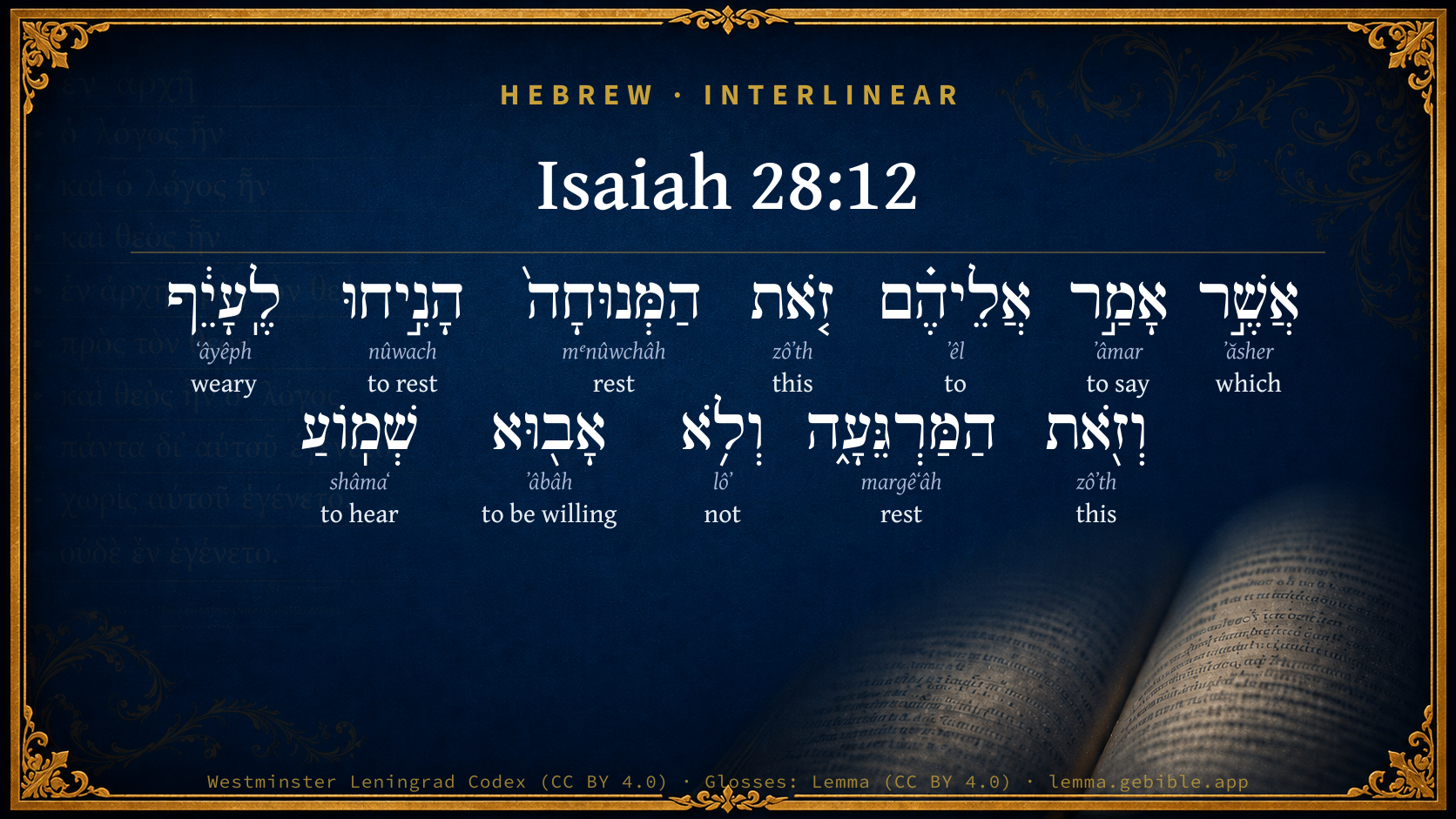
Hebrew (Westminster Leningrad Codex) Isaiah 28:12 appears in the Hebrew Old Testament. The text above is from the Westminster Leningrad Codex. Each word links to its Strong’s number, a concise gloss, and parsing drawn from the Open Scriptures Hebrew Bible morphology. Click any word for its full Brown-Driver-Briggs (BDB) entry.
Download image
Cite this verse

Isaiah 28:12 (World English Bible). Public Domain. Lemma interlinear Bible study tool, https://lemma.gebible.app/v/isaiah/28/12.

Show BibTeX & RIS
BibTeX
RIS
English Translation
to whom he said, This is the rest, give you rest to him who is weary; and this is the refreshing: yet they would not hear.
World English Bible · Public Domain
Highlights
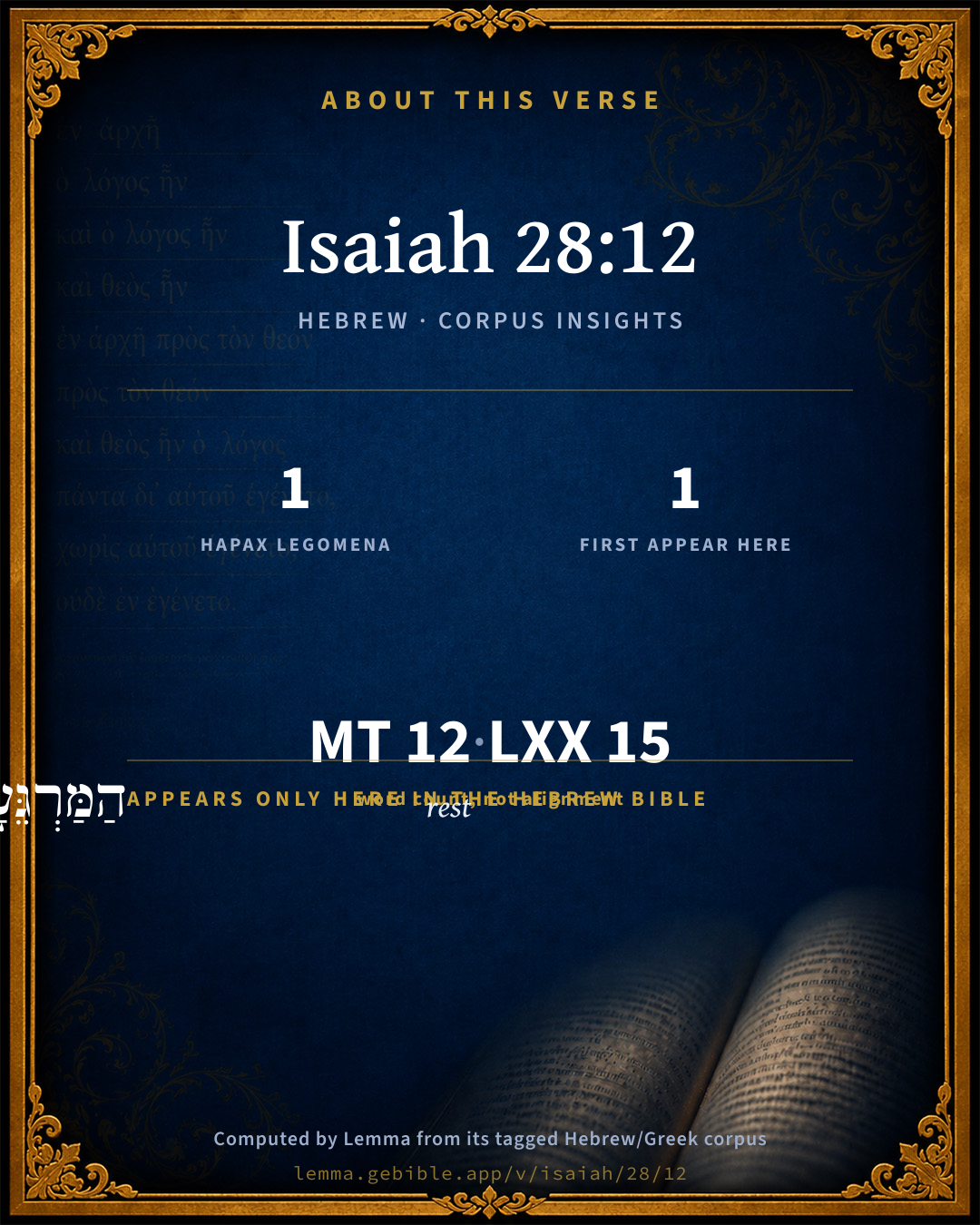
  • 1 hapax legomenon — only here in the Hebrew Bible
  • 1 first appearance in the Hebrew Bible
Full analysis ↓
Download a study sheet

One document with this verse’s original text, its word-by-word gloss line, the meaning frame, cross-references with their text, attributed commentary, and full source and license credits — printable, and it pastes into notes with its structure intact.

This verse Autodidact and up

Study sheet (.html) Plain text (.txt)

A passage Seminary Student

Up to 50 verses in one chapter. A passage sheet keeps up to 6 commentary sources and 12 cross-references per verse, in the order this page ranks them, and says so on the sheet whenever that leaves anything out. Ask for a single verse and you get the Autodidact verse sheet above.

Everything on this page stays free to read, with no account — the sheet is a download of what is already on screen, not access to it.

Want to remove ads? Support Godless Engineer
Compare translations 3

The same verse in 3 English versions, stacked beneath the original-language interlinear above. Click any original word for its lexicon entry.

Each is an independent rendering of the whole verse — the interlinear is not word-aligned to these translations.

Highlighted words mark where these versions differ — a whole-verse word diff, not a word-by-word alignment.

  • World English Bible Public Domain
    to whom he said, This is the rest, give you rest to him who is weary; and this is the refreshing: yet they would not hear.
  • King James Version Public Domain
    To whom he said, This is the rest wherewith ye may cause the weary to rest; and this is the refreshing: yet they would not hear.
  • unfoldingWord Literal Text CC BY-SA 4.0
    he who said to them, “This rest; give rest to the weary, and this refreshing.” But they were not willing to hear.

unfoldingWord Literal Text — © unfoldingWord, licensed CC BY-SA 4.0. Word-aligned USFM3 via Door43 (git.door43.org/unfoldingWord/en_ult).

Versions to compare (up to 4)

3 of 4 selected

Show all 18 translations

Every available English version of this verse, each an independent rendering of the whole verse.

  • World English Bible Public Domain
    to whom he said, This is the rest, give you rest to him who is weary; and this is the refreshing: yet they would not hear.
  • Berean Standard Bible Public Domain
    to whom He has said: “This is the place of rest, let the weary rest; this is the place of repose.” But they would not listen.
  • Majority Standard Bible Public Domain
    to whom He has said: “This is the place of rest, let the weary rest; this is the place of repose.” But they would not listen.
  • King James Version Public Domain
    To whom he said, This is the rest wherewith ye may cause the weary to rest; and this is the refreshing: yet they would not hear.
  • American Standard Version (1901) Public Domain
    to whom he said, This is the rest, give ye rest to him that is weary; and this is the refreshing: yet they would not hear.
  • Revised Version (1885) Public Domain
    to whom he said, This is the rest, give ye rest to him that is weary; and this is the refreshing: yet they would not hear.
  • Geneva Bible (1599) Public Domain
    Vnto whome hee saide, This is the rest: giue rest to him that is weary: and this is the refreshing, but they would not heare.
  • Douay-Rheims (1899) Public Domain
    To whom he said: This is my rest, refresh the weary, and this is my refreshing: and they would not hear.
  • Young's Literal Translation Public Domain
    Unto whom He hath said, `This `is' the rest, give ye rest to the weary, And this -- the refreshing:' And they have not been willing to hear,
  • Literal Standard Version CC BY-SA 4.0
    To whom He has said, “This [is] the rest, give rest to the weary, || And this—the refreshing”: And they have not been willing to hear,
  • Unlocked Literal Bible CC BY-SA 4.0
    In the past he said to them “This is the rest, give rest to him who is weary; and this is the refreshing,” but they would not listen.
  • unfoldingWord Literal Text CC BY-SA 4.0
    he who said to them, “This rest; give rest to the weary, and this refreshing.” But they were not willing to hear.
  • Darby Bible Public Domain
    to whom he said, This is the rest: cause the weary to rest; and this is the refreshing. But they would not hear.
  • World Messianic Bible Public Domain
    to whom he said, “This is the resting place. Give rest to the weary,” and “This is the refreshing;” yet they would not hear.
  • Webster's Bible Public Domain
    To whom he said, This is the rest with which ye may cause the weary to rest; and this is the refreshing: yet they would not hear.
  • Free Bible Version CC BY-SA 4.0
    He had told them, “You can rest here. Let those who are tired rest. This is the place where you can safely relax.” But they refused to listen.
  • Bible in Basic English Public Domain
    To whom he said, This is the rest, give rest to him who is tired; and by this you may get new strength; but they would not give ear.
  • JPS Tanakh (1917) Public Domain
    To whom it was said: 'This is the rest, give ye rest to the weary; and this is the refreshing'; yet they would not hear.

Literal Standard Version (2020), Covenant Press — licensed CC BY-SA 4.0. Text via the HelloAO Bible API (eBible.org). Unlocked Literal Bible (unfoldingWord) — licensed CC BY-SA 4.0. Text via the HelloAO Bible API (eBible.org). unfoldingWord Literal Text — © unfoldingWord, licensed CC BY-SA 4.0. Word-aligned USFM3 via Door43 (git.door43.org/unfoldingWord/en_ult). Free Bible Version, Dr. Jonathan Gallagher — licensed CC BY-SA 4.0. Text via the HelloAO Bible API (eBible.org).

Word by word

More ways to search: Search by grammar → Find every occurrence → Compare this word →

Practice this passage: Drill this verse → Learn its vocabulary →

הַמַּרְגֵּעָ֑ה
margêʻâh
H4774
“the · rest”
Particle, Definite Article + Noun, Common, Feminine, Singular, Absolute
Part of Speech
Particle + Noun
Type
Common
Gender
Feminine
Number
Singular
State
Absolute
Full BDB Definition

Origin: from H7280

TWOT: 2117c

rest, repose, place to rest
  1. אֲשֶׁ֣ר ʼăsher H834 “which” Particle, Relative
  2. אָמַ֣ר ʼâmar H559 “to say” Verb, Qal, Perfect, 3rd Person, Masculine, Singular
  3. אֲלֵיהֶ֗ם ʼêl H413 “to · them” Preposition + Suffix, Personal, 3rd Person, Masculine, Plural
  4. זֹ֤את zôʼth H2063 “this” Pronoun, Demonstrative, Feminine, Singular
  5. הַמְּנוּחָה֙ mᵉnûwchâh H4496 “the · rest” Particle, Definite Article + Noun, Common, Both, Singular, Absolute
  6. הָנִ֣יחוּ nûwach H5117 “rest” Verb, Hiphil, Imperative, 2nd Person, Masculine, Plural
  7. לֶֽעָיֵ֔ף ʻâyêph H5889 “to/for the · weary” Preposition, Determined + Adjective, Adjective, Masculine, Singular, Absolute
  8. וְזֹ֖את zôʼth H2063 “and · this” Conjunction + Pronoun, Demonstrative, Feminine, Singular
  9. וְלֹ֥א lôʼ H3808 “and · not” Conjunction + Particle, Negative
  10. אָב֖וּא ʼâbâh H14 “to be willing” Verb, Qal, Perfect, 3rd Person, Common, Plural
  11. שְׁמֽוֹעַ shâmaʻ H8085 “to hear” Verb, Qal, Infinitive Construct

About this verse

These counts appear in no published source. They are computed here, from the morphology-tagged text and Lemma’s own curated glosses. What Lemma adds →

12
words
11
distinct lemmas
Prophets
section

Notable vocabulary

1 hapax legomenon — a word that appears only here in the entire Hebrew Bible:

  • הַמַּרְגֵּעָ֑ה rest H4774

First appearance in Scripture

This word makes its first canonical appearance in the Hebrew Bible here:

  • הַמַּרְגֵּעָ֑ה rest H4774

Shared distinctive vocabulary

לֶֽעָיֵ֔ף weary H5889 occurs in 17 verses of the Hebrew Bible. Also found in:

Grammatical profile

  • 4 verbs
  • 2 nouns
  • 1 adjective
  • 2 pronouns
  • 1 preposition
  • 2 particles

Verb forms

  • אָמַ֣ר Qal · Perfect
  • הָנִ֣יחוּ Hiphil · Imperative
  • אָב֖וּא Qal · Perfect
  • שְׁמֽוֹעַ Qal · Infinitive Construct

Repetition

A word recurs within this verse — often emphatic in Hebrew:

  • זֹ֤את this H2063 ×2

Hebrew & Septuagint length

In English translation the verse runs 26 words from the Hebrew and 19 from the Septuagint (LXX English) — closely comparable.

A rough comparison of the two English renderings, which tokenize alike — not a word-level alignment.

Word counts can differ between the Hebrew and the Greek without any difference in meaning — e.g. the Hebrew direct-object marker אֵת has no separate Greek word, and Greek often adds the article ὁ.

In the original languages it is 12 Hebrew tokens and 15 Greek tokens — but the two are counted differently (Hebrew bundles its prefixes and suffixes into one token; the Greek is in lemma form), so that isn’t a like-for-like length.

Cross-references

11

Topical passages linked to Isaiah 28:12 in the Treasury of Scripture Knowledge — connected by theme and wording, ordered by reader-vote popularity; previews shown in the World English Bible.

  • Matthew 11:28–29 "Come to me, all you who labor and are heavily burdened, and I will give you rest.
  • Isaiah 30:15 For thus said the Lord Yahweh, the Holy One of Israel, In returning and rest shall you be saved; in quietness and in confidence shall be your strength. You would not:
  • Jeremiah 6:16 Thus says Yahweh, Stand you in the ways and see, and ask for the old paths, where is the good way; and walk therein, and you shall find rest for your souls: but they said, We will not walk [therein].
  • Isaiah 11:10 It shall happen in that day, that the root of Jesse, who stands for an ensign of the peoples, to him shall the nations seek; and his resting-place shall be glorious.
  • Jeremiah 44:16 As for the word that you have spoken to us in the name of Yahweh, we will not listen to you.
  • Zechariah 7:14 "but I will scatter them with a whirlwind among all the nations which they have not known. Thus the land was desolate after them, so that no man passed through nor returned: for they made the pleasant land desolate."
  • Hebrews 12:25 See that you don't refuse him who speaks. For if they didn't escape when they refused him who warned on the Earth, how much more will we not escape who turn away from him who warns from heaven,
  • 2 Chronicles 14:11 Asa cried to Yahweh his God, and said, Yahweh, there is none besides you to help, between the mighty and him who has no strength: help us, Yahweh our God; for we rely on you, and in your name are we come against this multitude. Yahweh, you are our God; don't let man prevail against you.
  • Psalms 81:11–13 But my people didn't listen to my voice. Israel desired none of me.
  • Zechariah 7:11 But they refused to listen, and turned their backs, and stopped their ears, that they might not hear.
  • 2 Chronicles 16:8–9 Weren't the Ethiopians and the Lubim a huge host, with chariots and horsemen exceeding many? yet, because you did rely on Yahweh, he delivered them into your hand.

Cross-references courtesy of OpenBible.info (CC BY 4.0).

Hebrew and Greek witnesses Masoretic Hebrew ↔ Greek Septuagint

The same verse in the two great witnesses to the Old Testament, shown verse-for-verse.

These are two independent witnesses, not word-aligned to each other, and the Septuagint is shown in lemma (dictionary) form.

Hebrew Isaiah 28:12 Masoretic · Westminster Leningrad Codex

אֲשֶׁ֣ר אָמַ֣ר אֲלֵיהֶ֗ם זֹ֤את הַמְּנוּחָה֙ הָנִ֣יחוּ לֶֽעָיֵ֔ף וְזֹ֖את הַמַּרְגֵּעָ֑ה וְלֹ֥א אָב֖וּא שְׁמֽוֹעַ

to whom he said, This is the rest, give you rest to him who is weary; and this is the refreshing: yet they would not hear.

World English Bible · Public Domain

Greek LXX Isaiah 28:12 Septuagint · lemma form

λέγω αὐτός οὗτος ὁ ἀνάπαυμα ὁ πεινάω καί οὗτος ὁ σύντριμμα καί οὐ θέλω ἀκούω

This is the rest to him that is hungry, and this is the calamity: but they would not hear.

LXX2012 (modern English Septuagint) · Public Domain

Hebrew: Westminster Leningrad Codex (CC BY 4.0). Greek: Septuagint (public domain); English from LXX2012 (modern English Septuagint) (Public Domain). How the Septuagint differs from the Hebrew →

Targum (Aramaic paraphrase)

1

The Targum is the ancient Jewish Aramaic paraphrase of the Hebrew Scriptures — an interpretive translation, not the Hebrew text itself. Onkelos (literal) and Pseudo-Jonathan (expansive) render the Torah, and Jonathan the Prophets. Coverage is partial: where no permissively-licensed English translation exists for a verse, only the Aramaic is shown. This is verse-level text, not a word-by-word alignment to the Hebrew.

  1. Targum Jonathan Prophets (Joshua–Malachi)
    דְאָמְרִין לְהוֹן נְבִיַיָא דֵין בֵּית מַקְדְשָׁא פְּלָחוּ בֵיהּ וְדָא אַחְסָנַת בֵּית נְיָחָא וְלָא אָבוּ לְקַבָּלָא אוּלְפַן:

    The prophets said unto them, This is the house of the sanctuary, worship ye in it: and this is the possession in which there is rest; but they would not accept instructions.

    Targum Jonathan — Aramaic: “Mikraot Gedolot” (public domain). English: “Sefaria Community Translation” (CC0 1.0 (public-domain dedication)); “London "Chaldee Paraphrase," 1871” (public domain). Text via Sefaria.

Commentary

Notes on Isaiah 28:12 from classic Christian and Jewish commentators (each source and its license shown beneath its notes). The classic Christian expositions comment on the surrounding passage and are grouped to its opening verse, so a note may address several verses; the Jewish commentaries on the Tanakh (Rashi and others) are per-verse, so they appear only where the commentator wrote on this verse.

Lemma curates 59 commentaries, every one of them public domain or Creative Commons licensed, each selected and text-cleaned for this edition rather than reprinted as found. About our sources →

Trapp's Complete Commentary

John Trapp

Isa 28:12 To whom he said, This [is] the rest [wherewith] ye may cause the weary to rest; and this [is] the refreshing: yet they would not hear.

Ver. 12. To whom he said, This is the rest,] i.e., The ready way to "find rest to your souls" {as Mat 11:28-29} - sc., by obeying my precepts, and embracing my promises.

Wherewith ye may cause the weary to rest,] i.e., Me, who am pressed by your sins, {Amo 2:13} and wearied out with your iniquities, {Isa 43:24} or your poor brethren, tired with miseries, or your own souls, laden with sin guiltiness.

John Trapp, A Commentary or Exposition upon All the Books of the Old and New Testament (1647–1656) — public domain. Text from a community e-Sword module.

The Biblical Illustrator

Joseph S. Exell

Isa_28:12

This is the rest wherewith ye may cause the weary to rest

Rest in Christ

That these words are to be interpreted as relating to Jesus Christ is manifest both from the preceding and subsequent context, and from the general tenor of the Word of God.

The doctrine of salvation through the Messiah opens the sources of genuine happiness to believing men. This is eminently the rest,--it is here alone that they can find satisfaction.

I. THE NATURE OF THAT REST WHICH IS ENJOYED IN CHRIST. The term rest is here employed to denote spiritual enjoyment: it imports that unspeakable delight and satisfaction with which a believing soul reposes itself in Christ Jesus, as its portion and happiness, its all and in all. This is a rest far more refreshing than the most seasonable relief from bodily labours or temporal troubles--no created good can at all be compared with it. It exclusively deserves the name of the rest, as everything else which assumes the appearance of rest is ideal, and this only is real and substantial.

1. What are the sources of spiritual rest? This rest arises from--

(1) A spiritual discovery of the infinite excellence of the Redeemers person. When the enlightened believer is possessed with a sense of the glories of Christs person, all created glory vanishes, as the stars do before the sun.

(2) A view of the all-atoning sacrifice of Jesus Christi Consider three important particulars in the sacrifice of Christ,--its inherent and infinite merit, the authority by which it is appointed, and the public declaration which has been given of its acceptance.

2. The effects with which this rest is accompanied.

(1) Pardon of sin.

(2) Acceptance with God, and the enjoyment of His special favour and love.

(3) Deliverance from the reigning power and dominion of sin.

(4) The delightful prospect of eternal happiness in Heaven.

II. THE CHARACTER OF THE PERSONS FOR WHOM THIS REST IS PROVIDED. The weary. Under this description we may include--

1. All unregenerated sinners to whom this rest is offered. They are represented as wearying themselves with very vanity (Hab_2:13), wearying themselves to commit iniquity. (Jer_9:5), and as wearying God (Isa_7:13; Isa_43:24). To all persons of this description spiritual rest is offered; but it will never be relished till the sinner is united to the Saviour.

2. We are principally to understand by the term weary, all the children of God who are heavy laden with their spiritual burdens. They are weary--

(1) With a sense of aggravated guilt.

(2) With the conflict which they maintain with sin and Satan.

(3) With their crying under the hidings of Gods face (Psa_13:1; Psa_77:7-10).

(4) With those disquieting fears of death where: with they are harassed. (T. Chalmers, D. D.)

Christ the rest-giver

Talleyrand said, Life is one long fatigue. Christ wishes to make it one long rest. (Mrs. Skinner.)

Rejecters of the Gospel admonished

Isaiah was one of the most eloquent of preachers, yet he could not win the ears and hearts of those to whom he spoke. It was not the fault of the preacher that Israel rejected his warnings: all the fault lay with that disobedient and gainsaying nation. The people to whom he spoke so earnestly were drunken in a double sense.

(1) They were overcome with wine (verses 7, 8).

(2) They were also intoxicated with pride. The two forms of drunkenness are equally destructive.

I. THE EXCELLENCE OF THE GOSPEL. This Scripture does not allude to the Gospel primarily, but to the message which Isaiah had to deliver, which was in part the command of the law and in part the promise of grace; but the same rule holds good of all the words of the Lord; and, indeed, any excellence which was found in the prophets message is found yet more abundantly in the fuller testimony of the Gospel in Christ Jesus.

1. The excellence of that Gospel lies in its object, for--

(1) It is a revelation of rest.

(2) It is the cause of rest.

(3) This rest is especially meant for the weary.

(4) In addition to bringing us rest, the message of mercy points us to a refreshing.

If the rested on should grow weary again, the Good Shepherd will give him refreshing; if he wanders, the Lord will restore him; if he grows faint He will revive him. Note, that Isaiah did not come to these people to talk about rest in dubious terms. No; he puts his finger right down on the truth, and says, This is the rest, and this is the refreshing. So we, when we come with a message from God, come with definite teaching. Nor did he preach a rest of a selfish character. That secret something which your own heart possesses shall enable you to communicate good cheer to many a weary heart, and hope to many a desponding mind.

2. The other excellence of the Gospel lies in its manner.

(1) It comes with authority.

(2) It was delivered with great simplicity. Isaiah came with it. precept upon precept, etc. It is the glory of the Gospel that it is so plain.

(3) It is taught us by degrees.

(4) The Gospel is repeated.

(5) It is brought home to us in ways suited to our capacity.

II. THE OBJECTIONS WHICH ARE TAKEN TO THE GOSPEL.

1. They are most wanton. Men object to that which promises them rest.

2. Wilful. This is the refreshing, yet they would not hear.

3. Wicked, because they are rebellion against God, and an insult to His truth and mercy.

4. These people raised objections that were the outgrowth of their pride. They objected to the simplicity of Isaiahs preaching. They said, Who is he? You should not go to hear him; he talks to us as if we were children. Besides, it is the same thing over and over again. Too many wish for a map to Heaven so mysteriously drawn that they may be excused from following it.

III. THE DIVINE REQUITAL OF THESE OBJECTIONS.

1. The Lord threatens them with the loss of that which they despised. In verse 20 he warns them that the shall have no rest henceforth For thy bed is shorter, etc.

2. They shall be punished by a gradual hardening of heart (verse 13). A fall backward is the worst kind of fall.

3. This is to be followed by a growing inability to understand (verse 11).

4. Whatever refuge they choose for themselves shall utterly fail them (verse 17). (C. H. Spurgeon.)

The Biblical Illustrator, edited by Joseph S. Exell (c. 1880s–1900s) — public domain. Text from a community e-Sword module.

The Preacher's Complete Homiletical Commentary

Joseph S. Exell (gen. ed.)

REJECTERS OF THE GOSPEL ADMONISHED

Isa_28:12. To whom He said, This is the rest wherewith ye may cause the weary to rest; and this is the refreshing: yet they would not hear.

Isaiah was one of the most eloquent of preachers, yet he could not win the ears and hearts of those to whom he spoke. He spoke more of Jesus Christ than all the rest of the prophets, yet the message of love was treated as though it were an idle tale. His doc trine was clear as the daylight, yet men would not see it (chap. Isa_53:1). It was not the fault of the preacher that Israel rejected his warnings: all the fault lay with that disobedient and gainsaying nation. The people to whom he spoke so earnestly were drunken in a double sense:—

1. They were overcome with wine (Isa_28:7-8). How is it likely that the truth shall enter an ear which has been rendered deaf by this degrading vice? How is the Word of God likely to operate upon a conscience that has been drenched and drowned by strong drink? Flee from this destroyer before your bands are made strong and you are hopelessly fettered by the habit.

2. They were also intoxicated with pride. Their country was fruitful, and its chief city, Samaria, stood on the hill-top, like a diadem of beauty crowning the land, and they delighted in it. Among them were many champions whose strength sufficed to turn the battle to the gate, therefore they hoped to resist every invader, and so their hearts were lifted up. Moreover, they said, “We are an intelligent people; we are men of cultured intellect, instructed scribes, and we do not need persons like Isaiah to weary us with their ding-dong of ‘precept upon precept, line upon line,’ as if we were mere children at school. Besides, we are good enough. Do we not worship our God under the form of the golden calves in Dan and Bethel? Do we not respect the sacrifices and the holy days?” So spoke the more religious of them, while the rest gloried in their shame. Being intoxicated with pride, it was not likely that they would hear the message of the prophet who bade them turn from their evil ways. Pride is the devil’s drag-net, in which he taketh more fishes than in any other, except procrastination.

The two forms of drunkenness are equally destructive. Whether body or soul be intoxicated, mischief will surely come of it. Let us not get drunk with pride because we are not drunkards; for if we are so vain and foolish, we shall as certainly perish by pride as we should have done by drink.

I. THE EXCELLENCE OF THE GOSPEL as it is set forth in the passage before us. This Scripture does not allude to the Gospel primarily, but to the message which Isaiah had to deliver, which was in part the command of the law and in part the promise of grace: but the same rule holds good of all the words of the Lord; and indeed any excellence which was found in the prophet’s message is found yet more abundantly in the fuller testimony of the Gospel in Christ Jesus.

1. The excellence of that Gospel lies, first, in its object. For

(1.) It is a revelation of rest. Christ’s ambassadors are sent to proclaim to you that which shall give you ease, peace, quiet, rest. It is true we have to begin with certain truths that disturb and distress; but our object is to dig out the foundation into which may be laid the stones of restfulness. The object of the Gospel is not to make men anxious, but to calm their anxieties; not to fill them with endless controversy, but to lead them into all truth. The Gospel gives rest of conscience, by the complete forgiveness of sin through the atoning blood of Christ; rest of heart, by supplying an object for the affections worthy of their love; and rest of intellect, by teaching it certainties which can be accepted without question. Our message does not consist of things guessed at by wit, nor evolved out of man’s inner consciousness by study, nor developed by argument through human reason; but it treats of revealed certainties, absolutely and infallibly true, upon which the understanding may rest itself as thoroughly as a building rests upon a foundation of rock. The Word of the Lord comes to give believing men rest about the present by telling them that God ordereth all things for their good; and as for the future, it brightens all coming time and eternity with promises. The man who will hear the Gospel message, and receive it into his soul, shall know the peace of God, which passeth all understanding, and shall keep his heart and mind by Jesus Christ.

(2.) It is the cause of rest. “This is the rest wherewith ye may cause the weary to rest.” The Gospel of our salvation is not only a command to rest, but it brings the gift of rest within itself. Let the Gospel be admitted into the heart, and it will create a profound calm, hushing all the tumult and strife of conscience, removing all apprehensions of Divine wrath, stilling all rebellion against the supreme Will, and so working in the spirit by the energy of the Holy Ghost a deep and blessed peace.

(3.) This rest is especially meant for the weary. “This is the rest where with ye may cause the weary to rest.” Oh, ye that are weary with the round of worldly pleasure, worn with ambition, fretted with disappointment, embittered by the faithlessness of those you trusted in, come and confide in Jesus and be at rest. Here is the rest, here is the refreshing. Jesus expressly puts it: “Come unto me, all ye that labour and are heavy laden, and I will give you rest.” Despondent and despairing, condemned, and in your own conscience cast out to the gates of hell, yet look to Jesus and rest shall be yours.

(4.) In addition to bringing us rest, the message of mercy points us to a refreshing. “This is the rest wherewith ye may cause the weary to rest; and this is the refreshing.” If the rested one should grow weary again, the Good Shepherd will give him refreshing; if he wanders, the Lord will restore him; if he grows faint, He will revive him; yea, He has begun His gracious work of renewing, and He will continue it by renewing the heart from day to day, blending the will with His own, and making the whole man more and more to rejoice in Him.

Now, note with peculiar joy that Isaiah did not come to these people to talk about rest in dubious terms, and say, “There is no doubt a rest to be found somewhere in that goodness of God of which it is reasonable to conjecture.” No; he puts his finger right down on the truth, and he says, “This is the rest, and this is the refreshing.” Even so we at this day, when we come to you with a message from God, come with definite teaching; we proclaim in the name of God that whosoever believeth in Christ Jesus hath everlasting life: this is the rest, and this is the refreshing.

Nor did he preach a rest of a selfish character. They say we teach men to get peace and rest for themselves, and make themselves comfortable, whatever becomes of others. They know better, and they forge these falsehoods because their heart is false. Are we not always bidding men look out from themselves, and love others even as Christ has loved them? We abhor the idea that personal safety is the consummation of a religious man’s desires, for we believe that the life of grace is the death of selfishness. This is one of the glories of the Gospel, that “this is the rest wherewith ye may cause the weary to rest.” Get rest yourself, and you will soon cause other weary minds to rest. That secret something which your own heart possesses shall enable you to communicate good cheer to many a weary heart, and hope to many a desponding mind.

2. The other excellence of the Gospel of which I shall speak at this time lies in its manner.

(1.) It comes with authority. The Gospel does not pretend to be a speculative scheme or a theory of philosophy which will suit the nineteenth century, but will be exploded in the twentieth. No; it comes to men as a message from God, and he that speaks it aright does not speak it as a thinker uttering his own thoughts; but he utters what he has learned, and acts as God’s tongue, repeating what he finds in God’s Word by the power of God’s Spirit.

2. It was delivered with great simplicity. Isaiah came with it “precept upon precept, line upon line, here a little and there a little.” It is the glory of the Gospel that it is so plain. If it were so profound that we must take a degree at a university before we could comprehend it, what a miserable Gospel it would be for mocking the world with! But it is divinely sublime in its simplicity, and hence the common people hear it gladly. As the verse seems to imply, it is fitted for those who are weaned from the breast; those who are little more than babes may yet drink in this unadulterated milk of the Word. Many a little child has comprehended the salvation of Jesus Christ sufficiently to rejoice in it. I bless God for a simple Gospel, for it suits me, and thousands of others whose minds cannot boast of greatness or genius. It equally suits men of intellect, and it is only quarrelled with by pretenders. A man who really has a capacious mind is usually childlike, and, like Sir Isaac Newton, is glad to sit at Jesu’s feet. Great minds love the simple Gospel of God, for they find rest in it from all the worry and the weariness of questions and of doubts.

3. It is taught us by degrees. It is not forced home upon men’s minds all at once, but it comes “precept upon precept, line upon line, here a little and there a little.” God does not flash the everlasting daylight on weak eyes in one blaze of glory, but there is at first a dim dawn, and the soft incoming of a tender light for tender eyes, and so by degrees we see.

4. The Gospel is repeated. If we do see it at once, it comes again to us, for it is “precept upon precept, line upon line, here a little and there a little.” From morning to morning, from Sunday to Sunday, by book after book, by text after text, by spiritual impression after spiritual impression, the Divine gentleness makes us wise unto salvation.

5. It is brought home to us in ways suitable to our capacity. It is told to us, as it were, with stammering lips (see Isa_28:11), just as mothers teach their little children in a language all their own. In much of the Bible, especially in the Old Testament, God condescends to lay aside His own speech and talk the language of men. He bows to us and tells us His mind in types and ordinances, which are a sort of child-language fitted for our capacity. If you do not understand the Word of God, it is not because He does not put it plainly, but because of the blindness of your heart and the besotted condition of your spirit. Take heed that you are not drunken with the wine of pride, but be willing to learn; for God Himself hath not darkened counsel by mysterious words, but He has put His mind before you as plainly as the sun in the heavens. “Precept upon precept, line upon line, here a little and there a little.”

II. THE OBJECTIONS WHICH ARE TAKEN TO THE GOSPEL.

1. They are most wanton. Men object to that which promises them rest! Above all the things in the world this is what our troubled spirits need. Oh, the intense folly of men, that when the Gospel sets rest before them they will not hear it, but turn upon their heel. There is no system of doctrine under heaven that can give quiet to the conscience of men, quiet that is worth having, except the Gospel; and there are thousands of us who bear witness that we live in the daily enjoyment of peace through believing in Jesus, and yet our honest report is not believed; nay, they will not hear the truth.

2. Objections against the Gospel are wilful, even as it is here said, “This is the refreshing, yet they would not hear.” When men say they cannot believe the Gospel, ask them whether they will patiently hear it in all its simplicity. No, they say, they do not want to hear it. The Gospel is so difficult to believe; so they say. Will they come and hear it preached in its fulness? Will they read the Gospels for themselves carefully? Oh, no; they cannot take the trouble. Just so. But a man who does not want to be convinced must not blame anybody if he remains in error, nor wonder that objections swarm in his mind.

3. Such objections are wicked, because they are rebellion against God and an insult to His truth and mercy. If this Gospel be of God, I am bound to receive it: I have no right to cavil at it, nor raise questions, philosophical or otherwise. It is mine just to say, “Does God say this and that? Then it is true, and I yield to it. Does the Lord thus set before me a way of salvation? I will run in it with delight.”

4. These people raised objections that were the outgrowth of their pride. They objected to the simplicity of Isaiah’s preaching. They said, “Who is he? You should not go to hear him; he talks to us as if we were children. Besides, it is the same thing over and over again. You may go when you like, he is always harping on the same string.” Have you not heard folks say in these days concerning a true Gospel preacher, that he is always preaching about sovereign grace, or the blood of Christ, or crying out, “Believe, believe, and you shall be saved”? They sneer and say, “It is the old ditty over and over again.” The passage translated “precept upon precept, line upon line,” was uttered in ridicule, and sounded like a ding-dong rhyme with which they mocked Isaiah. The words were intended to caricature the preacher; though they do not suggest the idea when translated, they do suggest it readily enough in the Hebrew. There are people now living who, when the Gospel is plainly and simply preached, exclaim, “We want progressive thought; we want”—they do not quite know what they do want. Too many wish for a map to heaven so mysteriously drawn that they may be excused from following it. Multitudes prefer the Gospel shrouded in a mist; they love to see the wisdom of man shut out the wisdom of God. This was the style of objection current in Isaiah’s day, and it is fashionable still.

III. THE DIVINE REQUITAL OF THESE OBJECTORS.

1. The Lord threatens them with the loss of that which they despised. He has sent them a message of rest and they will not have it, and therefore in the 20th verse He warns them that they shall have no rest henceforth: “For the bed is shorter than that a man can stretch himself on it; and the covering narrower than that he can wrap himself in it.” All those who wilfully reject the Gospel and take up with philosophies and speculations will be rewarded with inward discontent. Ask the preachers of that kind of doctrine whether they themselves have found an anchorage, and as a rule they will answer, “No, no; we are in pursuit of truth; we are hunting after it, but we have not reached it yet.” They are never likely to reach it, for they are on the wrong track. The Gospel was made to rest conscience, soul, heart, will, memory, hope, fear, yea, the entire man; but when men laugh at all fixity of belief, how can they be rested? This is the condemnation of the unbeliever, that he shall never find a settlement, but, like the wandering Jew, shall roam for ever. Leave the Cross, and you have left the hinge of all things, and neglected the one sure corner-stone and fixed foundation, and henceforth you shall be as a rolling thing before the whirlwind.

2. They shall be punished by a gradual hardening of heart. They said that Isaiah’s message was “precept upon precept, line upon line, here a little and there a little,” and justice answers them, “Even so it shall be to you a thing despised and ridiculed, so that you will go farther away from it; you will fall backward and be broken, and snared and taken” (Isa_28:13.) A fall backward is the worst kind of fall. If a man falls forward, he may somewhat save himself and rise again; but if he falls backward, he falls with all his weight and is helpless. Those who stumble at Christ, the sure foundation-stone, shall be broken. When opposers hope to retrieve their position, they find themselves snared by their habits, entangled in the net of the great fowler, and taken by the destroyer. This downward course is followed full often by those who begin cavilling at a simple Gospel; they cavil more and more, and become its open enemies to their eternal ruin.

3. This is to be followed by a growing inability to understand. “For with stammering lips and another tongue will He speak to this people.” Since they would not hear plain speech, God will make simplicity itself to seem like stammering to them. Men that cannot endure simple language shall at last become unable to understand it. If men will not understand, they shall not understand. A man may shut his eyes so long that he cannot open them. In India many devotees have held up their arms so long that they can never take them down again. Beware lest an utter imbecility of heart come upon those of you who refuse the Gospel.

Lastly, this warning is given to those who object to the Gospel, that whatever refuge they choose for themselves shall utterly fail them. Thus saith the Lord, “Judgment will I also lay to the line, and righteousness to the plummet: and the hail shall sweep away the refuge of lies, and the waters shall overflow the hiding-place.” Down come the great hailstones dashing everything to shivers, the threatenings of God’s Word breaking to pieces all the false and flattering hopes of the ungodly. Then comes the active wrath of God like an over whelming flood to sweep away everything on which the sinner stood, and he, in his obstinate unbelief, is carried away as with a flood into that utter destruction, that everlasting misery, which God has declared shall be the lot of all those who refuse the living Christ.—C. H. Spurgeon: Metropolitan Tabernacle Pulpit, No. 1593.

The Preacher's Complete Homiletical Commentary (gen. ed. Joseph S. Exell; Funk & Wagnalls, c. 1892) — public domain (pre-1929). A full-Bible homiletical/sermon-outline anthology covering 65 of 66 books (2 John is absent from the source module). Text from a community e-Sword module.

Tyndale Open Study Notes

Tyndale Open Resources

28:12 Had his people listened, God’s revelation would have led them to rest (see 48:18-19). But they would not listen because of their hard hearts (65:12).

Tyndale Open Study Notes — © Tyndale Open Resources, licensed CC BY-SA 4.0. Text via the HelloAO Bible API.

Geneva Bible (1599)

Geneva Bible translators

Show to them that are weary and have need of rest, what is the true rest.

That is, the Prophet, whom God should send.

This is the doctrine, whereupon ye ought to stay and rest.

Geneva Bible (1599) marginal notes — public domain. Text via Bolls.life.

Jamieson, Fausset & Brown

Robert Jamieson, A. R. Fausset & David Brown

Rather, "He (Jehovah) who hath said to them."

this . . . the rest--Reference may be primarily to "rest" from national warlike preparations, the Jews being at the time "weary" through various preceding calamities, as the Syro-Israelite invasion (Isa 7:8; compare Isa 30:15; Isa 22:8; Isa 39:2; Isa 36:1; Kg2 18:8). But spiritually, the "rest" meant is that to be found in obeying those very "precepts" of God (Isa 28:10) which they jeered at (compare Jer 6:16; Mat 11:29).

Jamieson, Fausset & Brown — Commentary Critical and Explanatory on the Whole Bible (1871) — public domain (CC PDM 1.0). Text via the HelloAO Bible API.

Adam Clarke's Commentary

Verse 12. This is the rest - "This is the true rest"] The sense of this verse is: God had warned them by his prophets that their safety and security, their deliverance from their present calamities and from the apprehensions of still greater approaching, depended wholly on their trust in God, their faith and obedience; but they rejected this gracious warning with contempt and mockery.

Adam Clarke's Commentary on the Bible (1810–1826) — public domain. Text from a community e-Sword/MySword module.

Ellicott's Commentary for English Readers

(12) To whom he said, This is the rest . . .—The prophet vindicates himself against the charge of being a repeater of wearisome messages of rebuke. Rather had he pointed the way to a time of repentance, and therefore of rest and refreshment. But to this also they closed their ears. They had but one formula of derision, whatever might be the subject of the prophet’s teaching; and the prophet, with all the scorn of irony, repeats that formula in the words that follow.

A Bible Commentary for English Readers, edited by Charles John Ellicott (1878–1897) — public domain. Text from a community e-Sword module.

The Cambridge Bible for Schools and Colleges

gen. ed. J. J. S. Perowne

12. To whom he said] Rather: He who said to them. The verse reproduces the tenor and aim of all Isaiah’s teaching (cf. Isa_28:16; ch. Isa_30:15). He had sought to point out the true way of rest for the exhausted nation by abstinence from the spirited foreign policy advocated by the anti-Assyrian faction. Two translations, however, are possible. Either: “This (Jerusalem) is the resting-place; give rest to the weary; and this is the place of refreshment”; or: This (line of action) is the (true) rest … and this is the (true) refreshment. The latter seems preferable. The word for “rest” (usually “resting-place”) is used in the same sense as here in 2Sa_14:17. “The weary” is the ordinary plebeian, who had everything to lose and nothing to gain, by the chances of war.

The Cambridge Bible for Schools and Colleges (gen. ed. J. J. S. Perowne; Cambridge University Press, 1878–1918) — public domain. Text from a community e-Sword module.

John Gill's Exposition

But the word of the Lord was unto them precept upon precept,.... Was despised and derided by them; they took the prophet's words out of his mouth, and in a scoffing manner repeated them; which, in the Hebrew text, is in a rhyming form, and were sung and drawled out by them, "Tsau lotsau, Tsau lotsau, Kau lakau, Kau lakau": this is all he can say to us, and we have from him:

precept upon precept, line upon line, line upon line; here a little, and there a little; or the words may be rendered, "and the word of the Lord was unto them precept upon precept", &c.; as it had been, so it still was; the same method was continued to be taken with them, and they still treated as children; and it is suggested that they should remain so, and not be men in understanding; and that they should be ever learning like children, and never come to the knowledge of the truth. Moreover, the words may be rendered, "though the word of the Lord was unto them precept upon precept", &c.; though it was delivered in so plain and easy a manner to them, and such methods of instruction were used gradually and gently, to instil knowledge into them, yet so stupid were they as not to receive it, and so perverse and stubborn as wilfully to reject it; hence they were given up to judicial blindness and hardness, Rom 11:8,

that they might go and fall backward, and be broken, and snared, and taken: go on in their own sinful ways, backslide from God, and be broken by his judgments; and be ensnared and taken in the net of the Babylonians, and be carried by them into captivity; see Eze 12:13 compare with this Mat 21:44 or rather fall into the hands of the Romans, and be taken and dispersed by them among the nations.

John Gill's Exposition of the Whole Bible (1746–1763) — public domain (CC PDM 1.0). Text via the HelloAO Bible API.

Albert Barnes' Notes on the Bible

To whom he said - To whom God had said; that is, to the Jews. He had taught them the way of rest through the prophets, but they had refused to learn.

This is the rest - That is, this is the true way of happiness, to wit, by keeping the commands of God which had been so often repeated as to become to them objects of satiety and disgust.

This is the refreshing - This is the way in which the mind may be comforted.

Albert Barnes' Notes on the Bible (1834–1885) — public domain. Text from a community e-Sword/MySword module.

Haydock's Catholic Bible Commentary

Hear. To leave off their wicked practices, and cruelty. The Jews would not understand: therefore Christ spoke to them in parables, chap. vi. 9., and Matthew xiii. 14., &c.

George Leo Haydock (1774–1849), Haydock's Catholic Family Bible and Commentary, 1859 edition — public domain. Excludes Psalms (Douay-Rheims chapter numbering differs from Protestant) and Deuterocanonical books (Catholic canon only).

Matthew Poole's English Annotations

To whom he said, to which people the Lord, by his minister, said,

This, this doctrine or precept, as it is expressed, Isa 28:9,10, or the word of the Lord, as it follows, Isa 28:13, is the rest; the only way, in the observation of which you will find rest and satisfaction.

Cause the weary to rest, Heb. cause the weary (understand either soul or country) rest. As rest is offered to you by the prophets in God’s name, do you embrace it; which is to be done by hearkening to God’s word, as appears by the following clauses. So shall this people, which hath been so oft and so long wearied and harassed by great and manifold calamities, find rest and peace.

Yet they would not hear; they are wilfully ignorant, and obstinately refused the very means of instruction.

Matthew Poole's English Annotations on the Holy Bible (1683–1685) — public domain. Text from a community e-Sword/MySword module.

The Pulpit Commentary

To whom he said; rather, because he said to them. God had from remote times offered to his people "rest" and "refreshing or a life of ease and peace in Palestine but on condition of their serving him faithfully and observing his Laws. (Deu_28:1-14) But they had re-jeered this "rest," since they had refused to observe the condition on which it was pro-raised. Because they had thus acted, God now brought upon them war and a conqueror.

HOMILIES BY W.M. STATHAM Ver. 12. Rest and refreshment.

"To whom he said, This is the rest wherewith ye may cause the weary to rest; and this is the refreshing: yet they would not hear." Religion is designed to give us both rest and refreshment. We are described here

I AS WEARY, AND NEEDING REST. Weary! Can we not feel that? We wear away. The world is full of cares that fret and chafe us. We lose elasticity of step and cheeriness of heart. How many can say, "I am very weary?" The Bible understands man, and therefore its words are so true and its blessings so welcome. What do the weary need? Why, first of all, rest. We read of Jesus that, being weary, "he sat himself on the well:" so completely exhausted was he that all strength was gone. So not only in a physical sense do we need sweet sleep and rest; but in our human life and in our spiritual life we are weary. What we need is rest in a Person rest in God himself; to rest in the Lord.

II AS WEAK, AND NEEDING REFRESHMENT. We become exhausted in life"s pilgrimage. Even in relation to spiritual supplies, our forces of faith and hope and courage fail. We need new supplies of grace and strength. This is well; for it would not be good for us to be able to live on yesterday"s piety. Languor would come over our efforts after the Divine life if we had no need to seek daily bread. But refreshment comes. The faded flowers of our graces lift their drooping heads again. We have all seen and smelt the sweet fields after the rain-showers; we have all noticed these" seasons of refreshing." So in the highest things. These Hebrews would yet find God. He will be again dew unto Israel, and they will have times of refreshing from the presence of the Lord.

III As HEEDLESS AND UNWILLING TO HEAR. "Yet they would not hear." Some siren voice is still charming them and deadening their hearts to the heavenly ministry. Let us remember that we hear what we will to hear. That is still the responsible function of humanity, viz. to close or to open the ears to the messages of the great King. It is not that God does not speak; for he speaks in many dialects: all the languages of human event and circumstance are at his command. With us let it be, "Speak, Lord; for thy servant heareth. W.M.S.

The Pulpit Commentary (1880–1919), ed. H.D.M. Spence-Jones & Joseph S. Exell — public domain. Text from a community e-Sword module.

John Wesley's Explanatory Notes

This - This doctrine. The rest - The only way, in which you will find rest.

John Wesley, Explanatory Notes Upon the Whole Bible (1754–1765) — public domain. Text via the GEBible commentary corpus.

J. A. Alexander on Isaiah

Joseph Addison Alexander

“Who said to them, this is rest, give rest to the weary, and this is quiet, but they would not hear.” The judgments threatened in the foregoing verse were the more evidently just because He Who threatened them had warned the people and pointed out to them the only way to happiness. The sense is not, that the true way to rest is to give rest to the weary; the latter expression is a kind of parenthesis, as if he had said, this is the true rest, let the weary enjoy it. By this we are therefore to understand, not compassion and kindness—to the suffering, but obedience to the will of God in general. This is the true rest which I alone can give, and the way to which I have clearly marked out. To give rest to the weary means simply to reduce to practice the lesson which God had taught them. This is the way to peace, let those who wish it walk therein. In the last clause, would is not a mere auxiliary, but an independent and emphatic verb, they were not willing.

Joseph Addison Alexander, The Prophecies of Isaiah (1846–1847; New York: Scribner, 1870–1878) — public domain. Text from a community e-Sword module.

Rashi

Rabbi Shlomo Yitzchaki (Rashi)

For he said The prophet said to them, “This is the rest,” that you should have rest, “give rest to the weary,” that you shall not rob him, “and this” shall be “tranquility” for them (var. for you).

Rashi on the Tanakh — English translations: “The Judaica Press complete Tanach with Rashi, translated by A. J. Rosenberg” (CC BY 4.0); “Pentateuch with Rashi's commentary by M. Rosenbaum and A.M. Silbermann, 1929-1934” (public domain); “The Metsudah Tanach series, Lakewood, N.J” (CC BY 4.0); and “The Book of Joshua, Metsudah Publications, 1997” (CC BY 4.0). Text via Sefaria.

Ibn Ezra

Rabbi Abraham ibn Ezra

He said. The prophet said.

This is the rest, etc. Jerusalem is the place of your rest; there procure rest for the weary; he shall not take refuge in Assyria or Egypt.

המרנעה The refreshing. Comp. מרגוע rest (Job 6:16); both words are substantives. According to the grammarian of Jerusalem מרגעה is a participle.

אבו ═ אבוא They would. Comp. ההלכו ═ ההלכוא who went (Jos. 10:24)

Ibn Ezra on the Tanakh — English translations: “Sefaria Community Translation” (CC0 1.0 (public-domain dedication)); “Yalkut, Sifsei Chachomim Chumash, Metsudah Publications, 2009” (CC BY 4.0); and “Commentary of Ibn Ezra on Isaiah - trans. by M. Friedlander, 1873” (public domain). Text via Sefaria.

Lesson kit

Teaching starters — assembled from the data on this page, not authored interpretation. Every prompt links to the verse data it draws on. Edit before teaching.

Isaiah, in the Prophets, opens this verse with 12 words (11 distinct Hebrew lemmas). Its most distinctive word is margêʻâh (“rest”). A historical commentator’s framing appears above. Read the whole chapter for the surrounding context.

Discussion questions

  1. What does “rest” (margêʻâh) contribute to the verse as a whole?
  2. This verse holds 1 word here found nowhere else in the Hebrew Bible. What might the rare word draw attention to?
  3. The word “rest” first appears here in Scripture. What is being introduced at this debut?
  4. Genesis 25:29 shares the word «weary» with this verse. How do the two illuminate each other?
  5. “this” occurs 2× in this one verse. What is the effect of the repetition?
  6. These translations render this verse differently. What is at stake in choosing one wording over another?
  7. The verb «אָמַ֣ר» is Qal Perfect. How does its form color the action?
  8. Reading how Trapp's Complete Commentary and The Biblical Illustrator read this verse, where do the two commentators agree and where do they part?

Things to notice

  • 1 word in this verse appears nowhere else in the Hebrew Bible.
  • 1 word makes its first canonical appearance in Scripture here.
  • This verse counts 12 Hebrew ↔ 15 Greek words.
  • These translations choose different wording for 10 words in this verse.
  • “this” occurs 2× in this single verse.

Reading settings

Reading text

Shown beneath each verse's original-language words.

Old Testament
Old Testament edition

Read the OT as the Masoretic Hebrew (MT) or the Greek Septuagint (LXX).

English shown for the Greek Septuagint (in the Hebrew ↔ Greek comparison).

Comparing translations? Open the Compare panel on any verse page to stack up to four side by side.