Isaiah 63:14

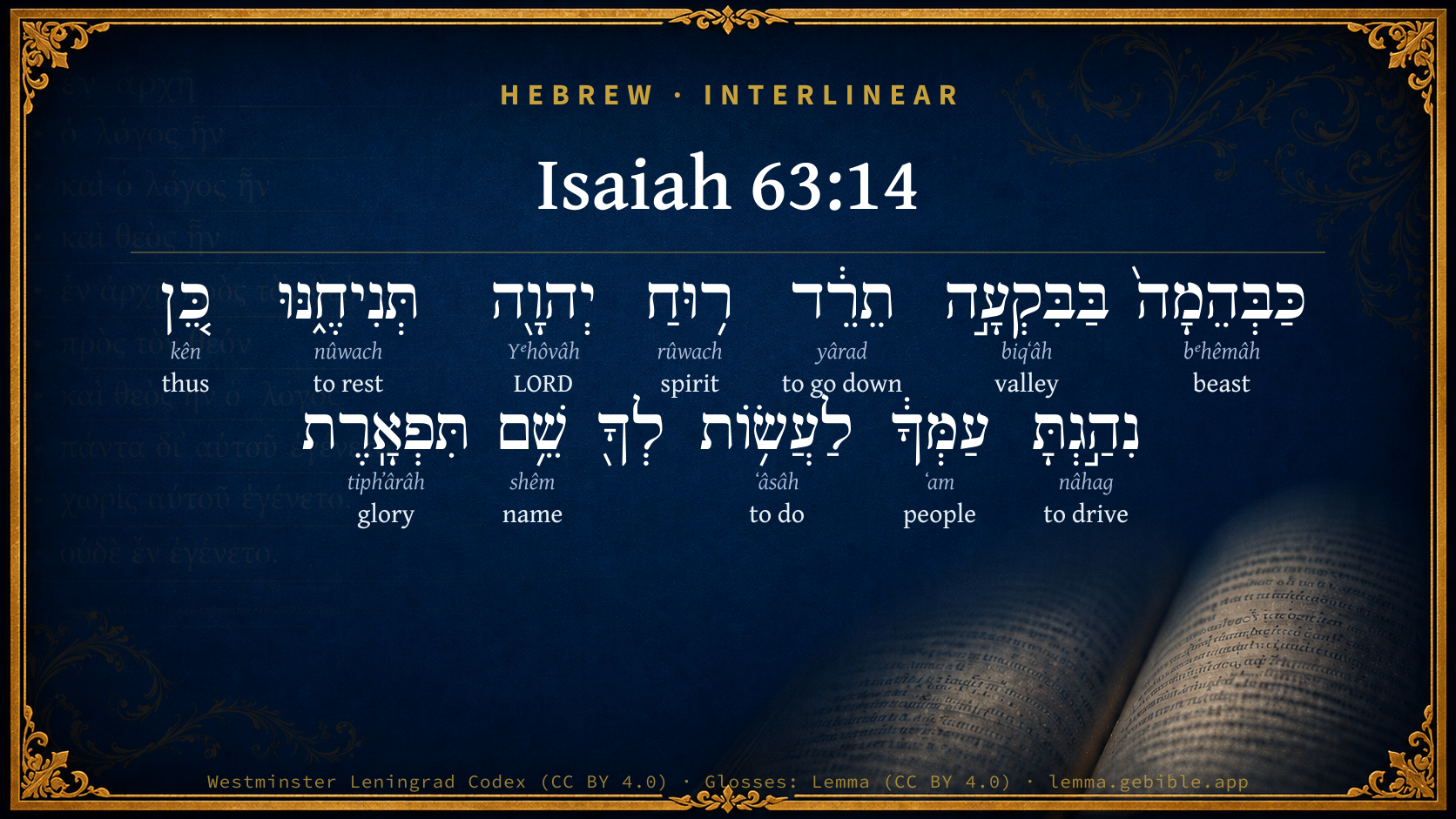
Hebrew (Westminster Leningrad Codex) Isaiah 63:14 appears in the Hebrew Old Testament. The text above is from the Westminster Leningrad Codex. Each word links to its Strong’s number, a concise gloss, and parsing drawn from the Open Scriptures Hebrew Bible morphology. Click any word for its full Brown-Driver-Briggs (BDB) entry.
Download image
Cite this verse

Isaiah 63:14 (World English Bible). Public Domain. Lemma interlinear Bible study tool, https://lemma.gebible.app/v/isaiah/63/14.

Show BibTeX & RIS
BibTeX
RIS
English Translation
As the cattle that go down into the valley, the Spirit of Yahweh caused them to rest; so did you lead your people, to make yourself a glorious name.
World English Bible · Public Domain
Download a study sheet

One document with this verse’s original text, its word-by-word gloss line, the meaning frame, cross-references with their text, attributed commentary, and full source and license credits — printable, and it pastes into notes with its structure intact.

This verse Autodidact and up

Study sheet (.html) Plain text (.txt)

A passage Seminary Student

Up to 50 verses in one chapter. A passage sheet keeps up to 6 commentary sources and 12 cross-references per verse, in the order this page ranks them, and says so on the sheet whenever that leaves anything out. Ask for a single verse and you get the Autodidact verse sheet above.

Everything on this page stays free to read, with no account — the sheet is a download of what is already on screen, not access to it.

Want to remove ads? Support Godless Engineer
Compare translations 3

The same verse in 3 English versions, stacked beneath the original-language interlinear above. Click any original word for its lexicon entry.

Each is an independent rendering of the whole verse — the interlinear is not word-aligned to these translations.

Highlighted words mark where these versions differ — a whole-verse word diff, not a word-by-word alignment.

  • World English Bible Public Domain
    As the cattle that go down into the valley, the Spirit of Yahweh caused them to rest; so did you lead your people, to make yourself a glorious name.
  • King James Version Public Domain
    As a beast goeth down into the valley, the Spirit of the LORD caused him to rest: so didst thou lead thy people, to make thyself a glorious name.
  • unfoldingWord Literal Text CC BY-SA 4.0
    Like cattle going down into a valley, the Spirit of Yahweh made him rest. Thus you led your people, to make for yourself a name of splendor.

unfoldingWord Literal Text — © unfoldingWord, licensed CC BY-SA 4.0. Word-aligned USFM3 via Door43 (git.door43.org/unfoldingWord/en_ult).

Versions to compare (up to 4)

3 of 4 selected

Show all 18 translations

Every available English version of this verse, each an independent rendering of the whole verse.

  • World English Bible Public Domain
    As the cattle that go down into the valley, the Spirit of Yahweh caused them to rest; so did you lead your people, to make yourself a glorious name.
  • Berean Standard Bible Public Domain
    Like cattle going down to the valley, the Spirit of the LORD gave them rest. You led Your people this way to make for Yourself a glorious name.
  • Majority Standard Bible Public Domain
    Like cattle going down to the valley, the Spirit of the LORD gave them rest. You led Your people this way to make for Yourself a glorious name.
  • King James Version Public Domain
    As a beast goeth down into the valley, the Spirit of the LORD caused him to rest: so didst thou lead thy people, to make thyself a glorious name.
  • American Standard Version (1901) Public Domain
    As the cattle that go down into the valley, the Spirit of Jehovah caused them to rest; so didst thou lead thy people, to make thyself a glorious name.
  • Revised Version (1885) Public Domain
    As the cattle that go down into the valley, the spirit of the LORD caused them to rest: so didst thou lead thy people, to make thyself a glorious name.
  • Geneva Bible (1599) Public Domain
    As the beast goeth downe into the valley, the Spirite of the Lord gaue them rest: so diddest thou leade thy people, to make thy selfe a glorious Name.
  • Douay-Rheims (1899) Public Domain
    As a beast that goeth down in the field, the spirit of the Lord was their leader: so didst thou lead thy people to make thyself a glorious name.
  • Young's Literal Translation Public Domain
    As a beast into a valley goeth down, The Spirit of Jehovah causeth him to rest, So hast Thou led Thy people, To make to Thyself a glorious name.
  • Literal Standard Version CC BY-SA 4.0
    As a beast goes down into a valley, || The Spirit of YHWH causes him to rest, || So You have led Your people, || To make to Yourself a glorious Name.
  • Unlocked Literal Bible CC BY-SA 4.0
    As the cattle that go down into the valley, the Spirit of Yahweh gave them rest. So you led your people, to make yourself a name of praise.
  • unfoldingWord Literal Text CC BY-SA 4.0
    Like cattle going down into a valley, the Spirit of Yahweh made him rest. Thus you led your people, to make for yourself a name of splendor.
  • Darby Bible Public Domain
    As cattle go down into the valley, the Spirit of Jehovah gave them rest; so didst thou lead thy people, to make thyself a glorious name.
  • World Messianic Bible Public Domain
    As the livestock that go down into the valley, the LORD’s Spirit caused them to rest. So you led your people to make yourself a glorious name.
  • Webster's Bible Public Domain
    As a beast goeth down in the valley, the Spirit of the LORD caused him to rest: so didst thou lead thy people, to make thyself a glorious name.
  • Free Bible Version CC BY-SA 4.0
    Like cattle descending into a valley, the Lord's Spirit gave them rest. This is how you led your people, earning a glorious reputation for yourself.
  • Bible in Basic English Public Domain
    Like the cattle which go down into the valley, they went without falling, the spirit of the Lord guiding them: so you went before your people, to make yourself a great name.
  • JPS Tanakh (1917) Public Domain
    As the cattle that go down into the valley, the spirit of the LORD caused them to rest; so didst Thou lead Thy people, to make Thyself a glorious name.'

Literal Standard Version (2020), Covenant Press — licensed CC BY-SA 4.0. Text via the HelloAO Bible API (eBible.org). Unlocked Literal Bible (unfoldingWord) — licensed CC BY-SA 4.0. Text via the HelloAO Bible API (eBible.org). unfoldingWord Literal Text — © unfoldingWord, licensed CC BY-SA 4.0. Word-aligned USFM3 via Door43 (git.door43.org/unfoldingWord/en_ult). Free Bible Version, Dr. Jonathan Gallagher — licensed CC BY-SA 4.0. Text via the HelloAO Bible API (eBible.org).

Word by word

More ways to search: Search by grammar → Find every occurrence → Compare this word →

Practice this passage: Drill this verse → Learn its vocabulary →

בַּבִּקְעָ֣ה
biqʻâh
H1237
“in/at the · valley”
Preposition, Determined + Noun, Common, Feminine, Singular, Absolute
Part of Speech
Preposition + Noun
Type
Common
Gender
Feminine
Number
Singular
State
Absolute
Full BDB Definition

Origin: from H1234

TWOT: 271b

valley - plain, level valley
  1. כַּבְּהֵמָה֙ bᵉhêmâh H929 “like/as the · beast” Preposition, Determined + Noun, Common, Feminine, Singular, Absolute
  2. תֵרֵ֔ד yârad H3381 “to go down” Verb, Qal, Imperfect, 3rd Person, Feminine, Singular
  3. ר֥וּחַ rûwach H7307 “spirit of” Noun, Common, Both, Singular, Construct
  4. יְהוָ֖ה Yᵉhôvâh H3068 “LORD” Noun, Proper
  5. תְּנִיחֶ֑נּוּ nûwach H5117 “to rest · him” Verb, Hiphil, Imperfect, 3rd Person, Feminine, Singular + Suffix, Personal, 3rd Person, Masculine, Singular
  6. כֵּ֚ן kên H3651 “thus” Particle, Demonstrative
  7. נִהַ֣גְתָּ nâhag H5090 “to drive” Verb, Piel, Perfect, 2nd Person, Masculine, Singular
  8. עַמְּךָ֔ ʻam H5971 “people · your” Noun, Common, Masculine, Singular, Construct + Suffix, Personal, 2nd Person, Masculine, Singular
  9. לַעֲשׂ֥וֹת ʻâsâh H6213 “to do” Preposition + Verb, Qal, Infinitive Construct
  10. שֵׁ֥ם shêm H8034 “name of” Noun, Common, Masculine, Singular, Construct
  11. תִּפְאָֽרֶת tiphʼârâh H8597 “glory” Noun, Common, Feminine, Singular, Absolute

About this verse

These counts appear in no published source. They are computed here, from the morphology-tagged text and Lemma’s own curated glosses. What Lemma adds →

13
words
12
distinct lemmas
Prophets
section

Notable vocabulary

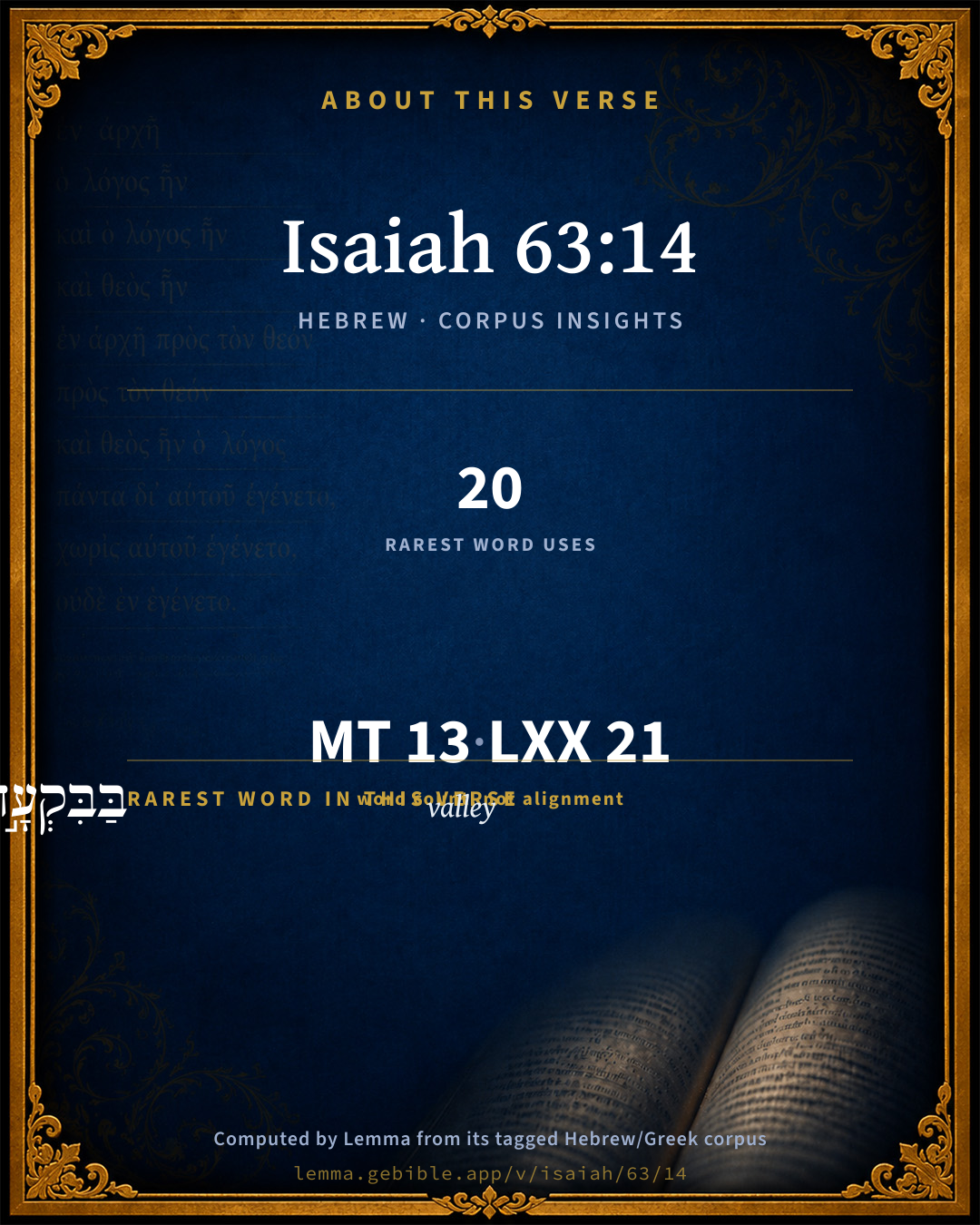
The rarest word here is בַּבִּקְעָ֣ה valley H1237 — appearing just 20 times in the whole Hebrew Bible.

Shared distinctive vocabulary

בַּבִּקְעָ֣ה valley H1237 occurs in 20 verses of the Hebrew Bible. Also found in:

Grammatical profile

  • 4 verbs
  • 7 nouns
  • 1 preposition
  • 1 particle

Verb forms

  • תֵרֵ֔ד Qal · Imperfect
  • תְּנִיחֶ֑נּוּ Hiphil · Imperfect
  • נִהַ֣גְתָּ Piel · Perfect
  • לַעֲשׂ֥וֹת Qal · Infinitive Construct

Hebrew & Septuagint length

In English translation the verse runs 29 words from the Hebrew and 27 from the Septuagint (LXX English) — closely comparable.

A rough comparison of the two English renderings, which tokenize alike — not a word-level alignment.

Word counts can differ between the Hebrew and the Greek without any difference in meaning — e.g. the Hebrew direct-object marker אֵת has no separate Greek word, and Greek often adds the article ὁ.

In the original languages it is 13 Hebrew tokens and 21 Greek tokens — but the two are counted differently (Hebrew bundles its prefixes and suffixes into one token; the Greek is in lemma form), so that isn’t a like-for-like length.

Cross-references

11

Topical passages linked to Isaiah 63:14 in the Treasury of Scripture Knowledge — connected by theme and wording, ordered by reader-vote popularity; previews shown in the World English Bible.

  • Isaiah 63:12 who caused his glorious arm to go at the right hand of Moses? who divided the waters before them, to make himself an everlasting name?
  • Joshua 23:1 It happened after many days, when Yahweh had given rest to Israel from all their enemies round about, and Joshua was old and well stricken in years;
  • Hebrews 4:8–11 For if Joshua had given them rest, he would not have spoken afterward of another day.
  • Numbers 14:21 but in very deed, as I live, and as all the earth shall be filled with the glory of Yahweh;
  • Joshua 22:4 Now Yahweh your God has given rest to your brothers, as he spoke to them: therefore now turn you, and get you to your tents, to the land of your possession, which Moses the servant of Yahweh gave you beyond the Jordan.
  • 2 Samuel 7:23 What one nation in the earth is like your people, even like Israel, whom God went to redeem to himself for a people, and to make him a name, and to do great things for you, and awesome things for your land, before your people, whom you redeem to you out of Egypt, [from] the nations and their gods?
  • 1 Chronicles 29:13 Now therefore, our God, we thank you, and praise your glorious name.
  • Nehemiah 9:5 Then the Levites, Jeshua, and Kadmiel, Bani, Hashabneiah, Sherebiah, Hodiah, Shebaniah, [and] Pethahiah, said, Stand up and bless Yahweh your God from everlasting to everlasting; and blessed be your glorious name, which is exalted above all blessing and praise.
  • Luke 2:14 "Glory to God in the highest, On earth peace, good will toward men."
  • Ephesians 1:6 to the praise of the glory of his grace, by which he freely bestowed favor on us in the Beloved,
  • Ephesians 1:12 to the end that we should be to the praise of his glory, we who had before hoped in Christ:

Cross-references courtesy of OpenBible.info (CC BY 4.0).

Hebrew and Greek witnesses Masoretic Hebrew ↔ Greek Septuagint

The same verse in the two great witnesses to the Old Testament, shown verse-for-verse.

These are two independent witnesses, not word-aligned to each other, and the Septuagint is shown in lemma (dictionary) form.

Hebrew Isaiah 63:14 Masoretic · Westminster Leningrad Codex

כַּבְּהֵמָה֙ בַּבִּקְעָ֣ה תֵרֵ֔ד ר֥וּחַ יְהוָ֖ה תְּנִיחֶ֑נּוּ כֵּ֚ן נִהַ֣גְתָּ עַמְּךָ֔ לַעֲשׂ֥וֹת לְךָ֖ שֵׁ֥ם תִּפְאָֽרֶת

As the cattle that go down into the valley, the Spirit of Yahweh caused them to rest; so did you lead your people, to make yourself a glorious name.

World English Bible · Public Domain

Greek LXX Isaiah 63:14 Septuagint · lemma form

καί ὡς κτῆνος διά πεδίον καταβαίνω πνεῦμα παρά κύριος καί ὁδηγέω αὐτός οὕτως ἄγω ὁ λαός σύ ποιέω σεαυτοῦ ὄνομα δόξα

and as cattle through a plain: the Spirit came down from the Lord, and guided them: thus you led your people, to make yourself a glorious name.

LXX2012 (modern English Septuagint) · Public Domain

On this verse, Adam Clarke's Commentary discusses the Septuagint’s reading. Read the note in Commentary ↓

Hebrew: Westminster Leningrad Codex (CC BY 4.0). Greek: Septuagint (public domain); English from LXX2012 (modern English Septuagint) (Public Domain). How the Septuagint differs from the Hebrew →

Targum (Aramaic paraphrase)

1

The Targum is the ancient Jewish Aramaic paraphrase of the Hebrew Scriptures — an interpretive translation, not the Hebrew text itself. Onkelos (literal) and Pseudo-Jonathan (expansive) render the Torah, and Jonathan the Prophets. Coverage is partial: where no permissively-licensed English translation exists for a verse, only the Aramaic is shown. This is verse-level text, not a word-by-word alignment to the Hebrew.

  1. Targum Jonathan Prophets (Joshua–Malachi)
    כִּבְעִירָא דִי בְּמֵישְׁרָא מַדְבְּרָא מֵימְרָא דַייָ דַבְּרִינוּן כֵּן דִבַּרְתֵּהּ לְעַמָךְ לְמֶעְבַּד לָךְ שׁוּם דְתוּשְׁבְּחָא:

    As a beast is led in a plain, the WORD of the Lord led them; so didst Thou lead Thy people to make Thyself a glorious name.

    Targum Jonathan — Aramaic: “Mikraot Gedolot” (public domain). English: “Sefaria Community Translation” (CC0 1.0 (public-domain dedication)); “London "Chaldee Paraphrase," 1871” (public domain). Text via Sefaria.

Commentary

Notes on Isaiah 63:14 from classic Christian and Jewish commentators (each source and its license shown beneath its notes). The classic Christian expositions comment on the surrounding passage and are grouped to its opening verse, so a note may address several verses; the Jewish commentaries on the Tanakh (Rashi and others) are per-verse, so they appear only where the commentator wrote on this verse.

Lemma curates 59 commentaries, every one of them public domain or Creative Commons licensed, each selected and text-cleaned for this edition rather than reprinted as found. About our sources →

Trapp's Complete Commentary

John Trapp

Isa 63:14 As a beast goeth down into the valley, the Spirit of the LORD caused him to rest: so didst thou lead thy people, to make thyself a glorious name.

Ver. 14. As a beast goeth down into the valley,] i.e., Gently and leisurely, {a} according to that known saying -

“ Ascendente tuo, vel descendente caballo,

Vox ait ista, Fave; vox ait illa, Cave. ”

The Spirit of the Lord caused him to rest.] Or, Led them until he brought them to rest. - scil., in the promised land.

To make thyself a glorious name,] q.d., So thou mayest do again, if thou please to show mercy unto us. Name is here put for fame or renown.

{a} Leniter et commode.

John Trapp, A Commentary or Exposition upon All the Books of the Old and New Testament (1647–1656) — public domain. Text from a community e-Sword module.

Tyndale Open Study Notes

Tyndale Open Resources

63:14 God gave his people rest after he brought them into the Promised Land (see 63:9; Josh 1:13; 22:4; 23:1).

Tyndale Open Study Notes — © Tyndale Open Resources, licensed CC BY-SA 4.0. Text via the HelloAO Bible API.

Jamieson, Fausset & Brown

Robert Jamieson, A. R. Fausset & David Brown

As a beast . . . rest--image from a herd led "down" from the hills to a fertile and well-watered "valley" (Psa 23:2); so God's Spirit "caused Israel to rest" in the promised land after their weary wanderings.

to make . . . name--(So Isa 63:12; Sa2 7:23).

Jamieson, Fausset & Brown — Commentary Critical and Explanatory on the Whole Bible (1871) — public domain (CC PDM 1.0). Text via the HelloAO Bible API.

Adam Clarke's Commentary

Verse 14. The Spirit of the Lord caused him to rest - "The Spirit of JEHOVAH conducted them."] For תניחנו tenichennu, caused him to rest, the Septuagint have ὡδηγησεν αυτους, conducted them; they read תנחם tanchem. The Syriac, Chaldee, and Vulgate read תנחנו tanchennu, conducted him. Two MSS. have the word without the י yod in the middle. See Clarke on Isa 63:13.

Adam Clarke's Commentary on the Bible (1810–1826) — public domain. Text from a community e-Sword/MySword module.

The Cambridge Bible for Schools and Colleges

gen. ed. J. J. S. Perowne

14. As the cattle that go down into the valley (R.V.). It is doubtful whether this clause does not continue Isa_63:13, adding a second image of the security with which Israel went down into the depths of the sea. It has certainly a more forcible sense in that connexion than if taken as an illustration of the words which follow. The only difficulty is that these words may seem too short to stand alone.

caused him to rest] i.e. brought him (the nation) to the resting-place, the Promised Land (Exo_33:14; Deu_12:9; Jos_1:13 &c.). The ancient versions read, less suitably, “led him.”

so didst thou lead &c.] Summarising the previous description and concluding the retrospect.

The Cambridge Bible for Schools and Colleges (gen. ed. J. J. S. Perowne; Cambridge University Press, 1878–1918) — public domain. Text from a community e-Sword module.

John Gill's Exposition

As a beast goeth down into the valley,.... Softly and gently, especially when laden; which may have some respect to the descent of the Israelites into the sea, into which they entered without any fear and dread, and without any hurry and precipitation, though Pharaoh's host was behind them; or rather, "as a beast goes along a valley", or "plain" (c); with ease, and without any interruption, so passed the Israelites through the sea. Thus the Targum renders it,

"as a beast goes, or is led, in a plain;''

so the word is used in Isa 38:8, and elsewhere:

the Spirit of the Lord caused him to rest; or gently led him, that is, Israel; he walked on through the sea, with as much facility, and as little danger, as a beast walks on in a valley, or a horse in a plain. Some understand this of leading Israel through the wilderness, where often resting places were found for them, and at last they were brought to the land of rest, Canaan, and settled there:

so didst thou lead thy people; both through the sea, and through the wilderness, in a like easy, safe, and gentle manner:

to make thyself a glorious name; among the nations of the world, as he did by this amazing appearance of his for Israel; and it is hoped by those, whose words these are, he would do the like again, and get himself immortal glory.

(c) "sicut jumentum quod in campo, vel valle, vel planitie, graditur", Gataker.

John Gill's Exposition of the Whole Bible (1746–1763) — public domain (CC PDM 1.0). Text via the HelloAO Bible API.

Albert Barnes' Notes on the Bible

As a beast that goeth down into the valley - As a herd of cattle in the heat of the day descends into the shady glen in order to find rest. In the vale, streams of water usually flow. By those streams and fountains trees grow luxuriantly, and these furnish a cool and refreshing shade. The cattle, therefore, in the heat of the day, naturally descend from the hills, where there are no fountains and streams, and where they are exposed to an intense sun, to seek refreshment in the shade of the valley. The figure here is that of resting in safety after exposure; and there are few more poetic and beautiful images of comfort than that furnished by cattle lying quietly and safely in the cool shade of a well-watered vale. This image would be much more striking in the intense heat of an Oriental climate than it is with us. Harmer (Obs. i. 168ff) supposes that the allusion here is to the custom prevailing still among the Arabs, when attacked by enemies, of withdrawing with their herds and flocks to some sequestered vale in the deserts, where they find safety. The idea, according to him, is, that Israel lay thus safely encamped in the wilderness; that they, with their flocks and herds and riches, were suffered to remain unattacked by the king of Egypt; and that this was a state of grateful repose, like that which a herd feels after having been closely pursued by an enemy, when it finds a safe retreat in some quiet vale. But it seems to me that the idea first suggested is the most correct - as it is, undoubtedly the most poetical and beautiful of a herd of cattle leaving the hills, and seeking a cooling shade and quiet retreat in a well-watered vale. Such repose, such calm, gentle, undisturbed rest, God gave his people. Such he gives them now, amidst sultry suns and storms, as they pass through the world.

The Spirit of the Lord - (See the note at Isa 63:10).

So didst thou lead - That is, dividing the sea, delivering them from their foes, and leading them calmly and securely on to the land of rest. So now, amidst dangers seen and unseen, God leads his people on toward heaven. He removes the obstacles in their way; he subdues their foes; he ‘makes them to lie down in green pastures, and leads them beside the still waters’ Psa 23:2; and he bears them forward to a world of perfect peace.

Albert Barnes' Notes on the Bible (1834–1885) — public domain. Text from a community e-Sword/MySword module.

Matthew Poole's English Annotations

As a beast goeth down into the valley; a laden beast goeth warily and gently down the hill: or, as a beast goeth down to the valley for grass, that being a mountainous country: or

going down for going along; so the word is used Isa 38:8; noting the evenness of their passage; or alluding to their going down from the shore into that great channel (as the coming out of it is called a going up, Isa 63:11) now made through the sea, orderly, and composedly, not like the Gadarenes’ swine, through consternation, ready to break their necks for haste.

The Spirit of the Lord, i.e. the Lord himself,

caused him to rest; led them easily, that they should not be over-travelled, or fall down, or come to any injury through weariness; thus Jeremiah expresseth it, Jer 31:2, and thus God gave them rest from their enemies, drowning of them in the sea, and in their safe conduct, that they could not annoy or disturb them, leading them till he found them a place for resting; the word for leading and resting being much of a like notion, Zec 10:6; pointing at their several rests by the way, Num 10:33; or it may be read by way of interrogation, as all the foregoing words, and be the close of that inquiry, And where is the Spirit that caused them to rest? or he led them to Canaan, the place of their rest; so called Deu 12:9; Psa 95:11.

So didst thou lead: the prophet here by an apostrophe doth only repeat the words in the name of the Jews that he had spake before, Isa 63:12; q.d. As thou didst then, so mayst thou do again if thou pleasest.

Matthew Poole's English Annotations on the Holy Bible (1683–1685) — public domain. Text from a community e-Sword/MySword module.

Whedon's Commentary on the Bible

Daniel D. Whedon

14, 15. As a beast — Collectively for a herd of cattle or flock of sheep.

Goeth down into the valley — That is, to luxuriant feeding places, and for rest.

So didst thou lead thy people — In a general way all through their history.

Look down from heaven — Isa_57:15. A metaphor, as in the reference designating the infinite grandeur of Deity, not his locality.

Where is thy zeal — Thy former zeal for thy people — thy might once shown so often by their deliverances.

Sounding of thy bowels — Organs of the chest, deemed the seat of compassionate emotions, which, when intense, caused a stirring and a sound. Isa_16:11. The whole importunate appeal for new blessings is made on the ground that God, in olden time, was full of compassion toward Israel, as just stated, Isa_63:13.

Daniel D. Whedon (gen. ed.), Commentary on the Old and New Testaments (1874–1909) — public domain. Text from a community e-Sword module.

The Pulpit Commentary

As a beast goeth down into the valley. Bishop Lowth"s version seems the best," As the herd descendeth to the valley." Israel"s passage through the Sinaitic peninsula into Canaan is compared to tile movement of a herd of cattle from its summer pastures in the mountains to the valley at their base, where for a time it rests. So God gave his people, after their many trials, "rest" in Canaan. (Heb_3:11-18) So didst thou lead thy people. "So" refers, not to the last simile only, but to the entire description contained in vers. 11-14. To make thyself a glorious name. (comp. ver. 12, and see also Eze_36:21-23 Mal_1:2)

The Pulpit Commentary (1880–1919), ed. H.D.M. Spence-Jones & Joseph S. Exell — public domain. Text from a community e-Sword module.

John Wesley's Explanatory Notes

The valley - A laden beast goeth warily and gently down the hill. Rest - Led them easily, that they should not be over-travelled, or fall down, through weariness; thus Jeremiah expresses it, Jer. xxxi, 2, and thus God gave them rest from their enemies, drowning them in the sea, and in their safe conduct, that they could not annoy or disturb them, leading them 'till he found them a place for resting; the word for leading, and resting, being much of a like notion, Zech x, 6, pointing at their several rests by the way, Num. x, 33, or it may be read by way of interrogation, as all the foregoing words, and be the close of that enquiry, And where is the spirit, that caused then to rest? Or, he led them to Canaan the place of their rest.

John Wesley, Explanatory Notes Upon the Whole Bible (1754–1765) — public domain. Text via the GEBible commentary corpus.

J. A. Alexander on Isaiah

Joseph Addison Alexander

“As the herd into the valley will go down, the Spirit of Jehovah will make him rest. So didst thou lead thy people, to make for thyself a name of glory.” This version is not only more exact than the common one, but removes the ambiguity in the construction, by precluding the reference of ‘him’, in ‘make him rest’, to the preceding noun, which is natural enough in the English Version, though forbidden in Hebrew by the difference of gender. The ‘him’ really refers to Israel or the people. A similar agency is elsewhere ascribed to the Spirit of God (Psa 143:10; Hag 2:5; Neh 9:20). The use of the futures in this clause is precisely the same as in the foregoing verse. In the last clause the Prophet ceases to regard the scene as actually present and resumes the tone of historical retrospection, at the same time summing up the whole in one comprehensive proposition, ‘thus didst Thou lead Thy people’. With the last words of the verse compare Isa 60:21; Isa 61:3.

Joseph Addison Alexander, The Prophecies of Isaiah (1846–1847; New York: Scribner, 1870–1878) — public domain. Text from a community e-Sword module.

unfoldingWord translationNotes

Door43 World Missions Community

General Information:

The people of Israel continue speaking.

As the cattle that go down into the valley ... rest

This image pictures cattle going into a valley where there is green grass and water and emphasizes that God led the people of Israel and took care of them. (See: Simile)

to make yourself a name of praise

Here "name of praise" refers to honor and one's reputation. AT: "to make sure you have an honored reputation for yourself" (See: Metonymy)

translationWords

cow

Holy Spirit

rest

people of God

praise

unfoldingWord translationNotes — © Distant Shores Media and the Door43 World Missions Community, licensed CC BY-SA 4.0. Source: git.door43.org/Door43/en_tn.

Rashi

Rabbi Shlomo Yitzchaki (Rashi)

As animals that spread in the valley, and a valley is a smooth land, where there is no obstacle, campagne in French, open country.

spread out Heb. תֵרֵד, spread out. Comp. (supra 45:1) “to flatten (לְרַד) nations before him.” So did the spirit of the Lord guide them to the deep and make therein a paved road.

so You guided Your people So was everything as we said; You guided Your people.

Rashi on the Tanakh — English translations: “The Judaica Press complete Tanach with Rashi, translated by A. J. Rosenberg” (CC BY 4.0); “Pentateuch with Rashi's commentary by M. Rosenbaum and A.M. Silbermann, 1929-1934” (public domain); “The Metsudah Tanach series, Lakewood, N.J” (CC BY 4.0); and “The Book of Joshua, Metsudah Publications, 1997” (CC BY 4.0). Text via Sefaria.

Ibn Ezra

Rabbi Abraham ibn Ezra

As a beast goeth down, etc. After their departure from the sea, God led them through the wilderness as gently as a beast goes down into the valley; thus the spirit of the Lord תניחנו led them that is, Israel;

תניחם═תניחנו. The suffix (ו) of the third person singular may however more accurately be referred to Moses, because of the words which follow, So didst Thou lead Thy people; the prophet speaking both of Moses and the Israelites.

Ibn Ezra on the Tanakh — English translations: “Sefaria Community Translation” (CC0 1.0 (public-domain dedication)); “Yalkut, Sifsei Chachomim Chumash, Metsudah Publications, 2009” (CC BY 4.0); and “Commentary of Ibn Ezra on Isaiah - trans. by M. Friedlander, 1873” (public domain). Text via Sefaria.

Lesson kit

Teaching starters — assembled from the data on this page, not authored interpretation. Every prompt links to the verse data it draws on. Edit before teaching.

Isaiah, in the Prophets, opens this verse with 13 words (12 distinct Hebrew lemmas). Its most distinctive word is biqʻâh (“valley”). A historical commentator’s framing appears above. Read the whole chapter for the surrounding context.

Discussion questions

  1. The word biqʻâh carries the sense “valley.” How does it shape the verse?
  2. How does Genesis 11:2, which shares the word «valley», read alongside this verse?
  3. These translations render this verse differently. What is at stake in choosing one wording over another?
  4. «תֵרֵ֔ד» is a Qal Imperfect verb. How does that grammatical form shape the action described?
  5. Compare how Trapp's Complete Commentary and Tyndale Open Study Notes read this verse. Where do they agree or differ?

Things to notice

Reading settings

Reading text

Shown beneath each verse's original-language words.

Old Testament
Old Testament edition

Read the OT as the Masoretic Hebrew (MT) or the Greek Septuagint (LXX).

English shown for the Greek Septuagint (in the Hebrew ↔ Greek comparison).

Comparing translations? Open the Compare panel on any verse page to stack up to four side by side.