
Isaiah 14:7

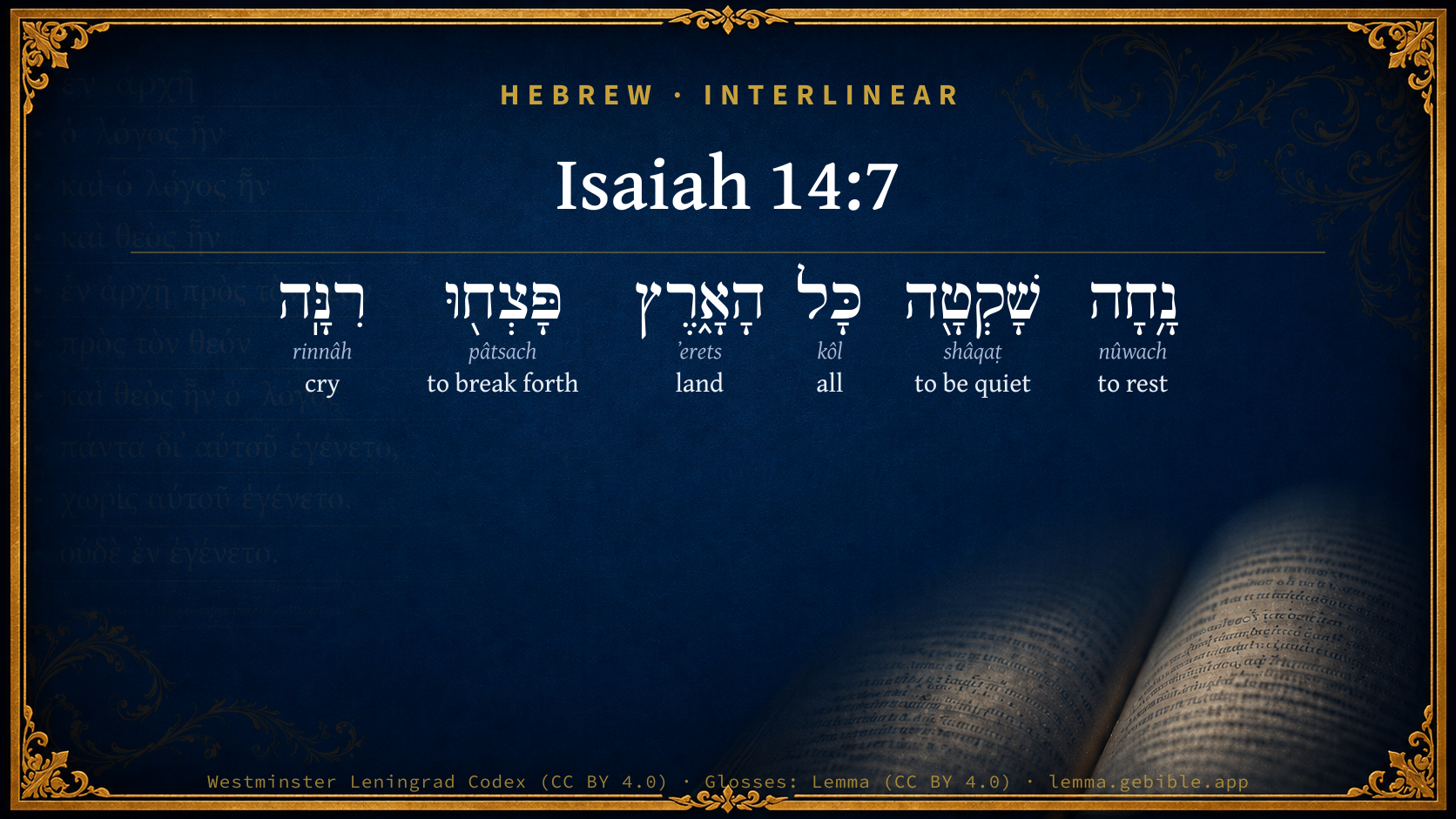
Hebrew (Westminster Leningrad Codex) Isaiah 14:7 appears in the Hebrew Old Testament. The text above is from the Westminster Leningrad Codex. Each word links to its Strong’s number, a concise gloss, and parsing drawn from the Open Scriptures Hebrew Bible morphology. Click any word for its full Brown-Driver-Briggs (BDB) entry.
Download image
Cite this verse

Isaiah 14:7 (World English Bible). Public Domain. Lemma interlinear Bible study tool, https://lemma.gebible.app/v/isaiah/14/7.

Show BibTeX & RIS
BibTeX
RIS
English Translation
The whole earth is at rest, [and] is quiet: they break forth into singing.
World English Bible · Public Domain
Download a study sheet

One document with this verse’s original text, its word-by-word gloss line, the meaning frame, cross-references with their text, attributed commentary, and full source and license credits — printable, and it pastes into notes with its structure intact.

This verse Autodidact and up

Study sheet (.html) Plain text (.txt)

A passage Seminary Student

Up to 50 verses in one chapter. A passage sheet keeps up to 6 commentary sources and 12 cross-references per verse, in the order this page ranks them, and says so on the sheet whenever that leaves anything out. Ask for a single verse and you get the Autodidact verse sheet above.

Everything on this page stays free to read, with no account — the sheet is a download of what is already on screen, not access to it.

Want to remove ads? Support Godless Engineer
Compare translations 3

The same verse in 3 English versions, stacked beneath the original-language interlinear above. Click any original word for its lexicon entry.

Each is an independent rendering of the whole verse — the interlinear is not word-aligned to these translations.

Highlighted words mark where these versions differ — a whole-verse word diff, not a word-by-word alignment.

  • World English Bible Public Domain
    The whole earth is at rest, [and] is quiet: they break forth into singing.
  • King James Version Public Domain
    The whole earth is at rest, and is quiet: they break forth into singing.
  • unfoldingWord Literal Text CC BY-SA 4.0
    All of the earth rests, it reposes; they break forth singing.

unfoldingWord Literal Text — © unfoldingWord, licensed CC BY-SA 4.0. Word-aligned USFM3 via Door43 (git.door43.org/unfoldingWord/en_ult).

Versions to compare (up to 4)

3 of 4 selected

Show all 18 translations

Every available English version of this verse, each an independent rendering of the whole verse.

  • World English Bible Public Domain
    The whole earth is at rest, [and] is quiet: they break forth into singing.
  • Berean Standard Bible Public Domain
    All the earth is at peace and at rest; they break out in song.
  • Majority Standard Bible Public Domain
    All the earth is at peace and at rest; they break out in song.
  • King James Version Public Domain
    The whole earth is at rest, and is quiet: they break forth into singing.
  • American Standard Version (1901) Public Domain
    The whole earth is at rest, `and' is quiet: they break forth into singing.
  • Revised Version (1885) Public Domain
    The whole earth is at rest, and is quiet: they break forth into singing.
  • Geneva Bible (1599) Public Domain
    The whole worlde is at rest and is quiet: they sing for ioye.
  • Douay-Rheims (1899) Public Domain
    The whole earth is quiet and still, it is glad and hath rejoiced.
  • Young's Literal Translation Public Domain
    At rest -- quiet hath been all the earth, They have broken forth `into' singing.
  • Literal Standard Version CC BY-SA 4.0
    At rest—all the earth has been quiet, || They have broken forth [into] singing.
  • Unlocked Literal Bible CC BY-SA 4.0
    The whole earth is at rest and is quiet; they begin celebrating with singing.
  • unfoldingWord Literal Text CC BY-SA 4.0
    All of the earth rests, it reposes; they break forth singing.
  • Darby Bible Public Domain
    The whole earth is at rest, is quiet: they break forth into singing.
  • World Messianic Bible Public Domain
    The whole earth is at rest, and is quiet. They break out in song.
  • Webster's Bible Public Domain
    The whole earth is at rest, and is quiet: they break forth into singing.
  • Free Bible Version CC BY-SA 4.0
    Now the whole earth rests peacefully, and everyone starts celebrating!
  • Bible in Basic English Public Domain
    All the earth is at rest and is quiet: they are bursting into song.
  • JPS Tanakh (1917) Public Domain
    The whole earth is at rest, and is quiet; they break forth into singing.

Literal Standard Version (2020), Covenant Press — licensed CC BY-SA 4.0. Text via the HelloAO Bible API (eBible.org). Unlocked Literal Bible (unfoldingWord) — licensed CC BY-SA 4.0. Text via the HelloAO Bible API (eBible.org). unfoldingWord Literal Text — © unfoldingWord, licensed CC BY-SA 4.0. Word-aligned USFM3 via Door43 (git.door43.org/unfoldingWord/en_ult). Free Bible Version, Dr. Jonathan Gallagher — licensed CC BY-SA 4.0. Text via the HelloAO Bible API (eBible.org).

Word by word

More ways to search: Search by grammar → Find every occurrence → Compare this word →

Practice this passage: Drill this verse → Learn its vocabulary →

About this verse

These counts appear in no published source. They are computed here, from the morphology-tagged text and Lemma’s own curated glosses. What Lemma adds →

6
words
6
distinct lemmas
Prophets
section

Notable vocabulary

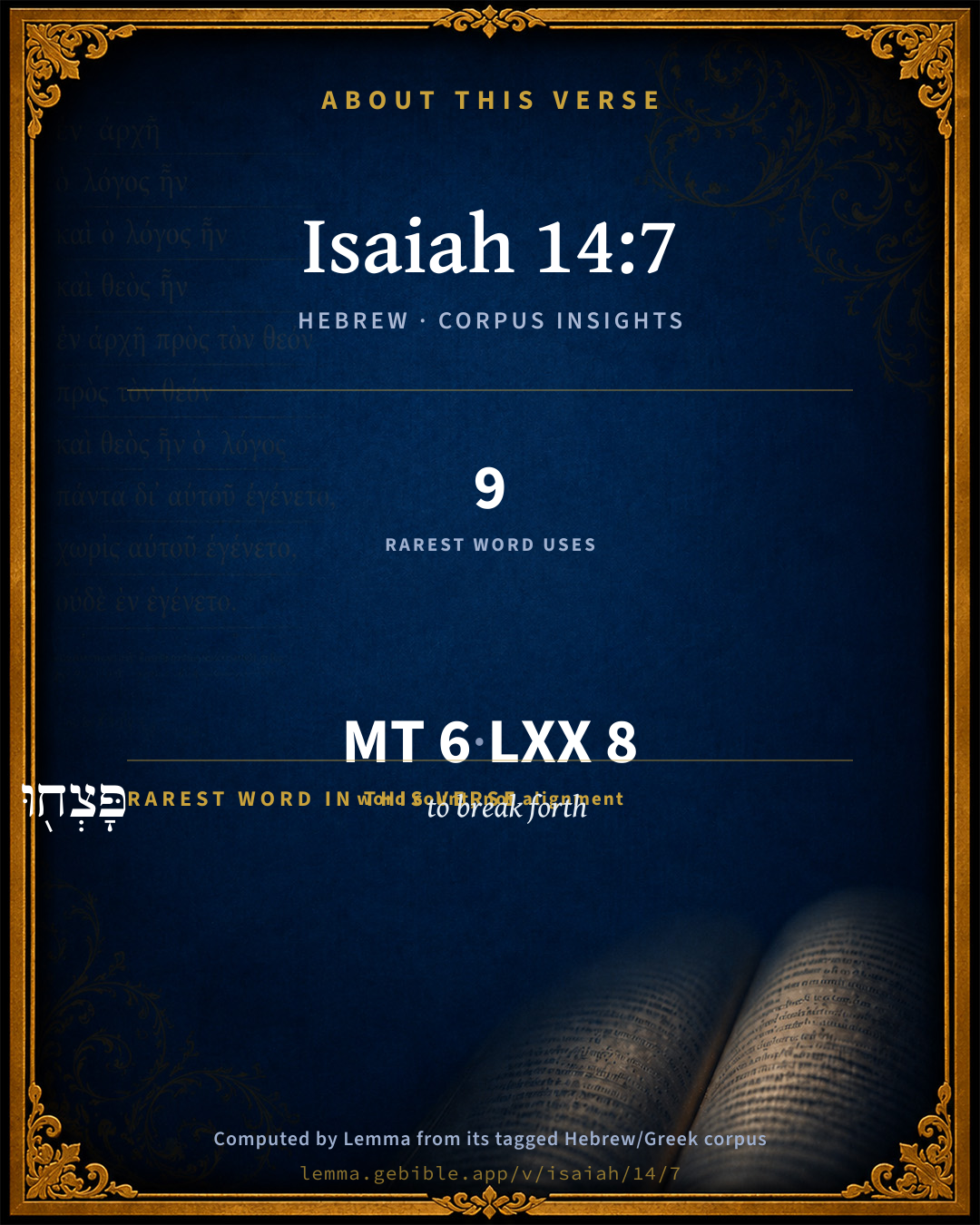
The rarest word here is פָּצְח֖וּ to break forth H6476 — appearing just 9 times in the whole Hebrew Bible.

Shared distinctive vocabulary

פָּצְח֖וּ to break forth H6476 occurs in 8 verses of the Hebrew Bible. Also found in:

Grammatical profile

  • 3 verbs
  • 3 nouns

Verb forms

  • נָ֥חָה Qal · Perfect
  • שָׁקְטָ֖ה Qal · Perfect
  • פָּצְח֖וּ Qal · Perfect

Hebrew & Septuagint length

In English translation the verse runs 14 words from the Hebrew and 7 from the Septuagint (LXX English) — the Septuagint runs noticeably shorter here. See the side-by-side →

A rough comparison of the two English renderings, which tokenize alike — not a word-level alignment.

Word counts can differ between the Hebrew and the Greek without any difference in meaning — e.g. the Hebrew direct-object marker אֵת has no separate Greek word, and Greek often adds the article ὁ.

In the original languages it is 6 Hebrew tokens and 8 Greek tokens — but the two are counted differently (Hebrew bundles its prefixes and suffixes into one token; the Greek is in lemma form), so that isn’t a like-for-like length.

Cross-references

9

Topical passages linked to Isaiah 14:7 in the Treasury of Scripture Knowledge — connected by theme and wording, ordered by reader-vote popularity; previews shown in the World English Bible.

  • Psalms 126:1–3 When Yahweh brought back those who returned to Zion, We were like those who dream.
  • Psalms 96:11–13 Let the heavens be glad, and let the earth rejoice. Let the sea roar, and it's fullness!
  • Psalms 98:7–9 Let the sea roar with its fullness; The world, and those who dwell therein.
  • Isaiah 49:13 Sing, heavens; and be joyful, earth; and break forth into singing, mountains: for Yahweh has comforted his people, and will have compassion on his afflicted.
  • Psalms 98:1 Sing to Yahweh a new song, For he has done marvelous things! His right hand, and his holy arm, have worked salvation for him.
  • Proverbs 11:10 When it goes well with the righteous, the city rejoices. When the wicked perish, there is shouting.
  • Jeremiah 51:48 Then the heavens and the earth, and all that is therein, shall sing for joy over Babylon; for the destroyers shall come to her from the north, says Yahweh.
  • Revelation 18:20 Rejoice over her, O heaven, you saints, apostles, and prophets; for God has judged your judgment on her."
  • Revelation 19:1–6 After these things I heard something like a loud voice of a great multitude in heaven, saying, "Hallelujah! Salvation, power, and glory belong to our God:

Cross-references courtesy of OpenBible.info (CC BY 4.0).

Hebrew and Greek witnesses Masoretic Hebrew ↔ Greek Septuagint

The same verse in the two great witnesses to the Old Testament, shown verse-for-verse.

Here the Septuagint runs noticeably shorter than the Hebrew — LXX2012 (modern English Septuagint) 7 words vs World English Bible 14. A rough length comparison of the two English translations, not a word-level alignment — read both below.

These are two independent witnesses, not word-aligned to each other, and the Septuagint is shown in lemma (dictionary) form.

Hebrew Isaiah 14:7 Masoretic · Westminster Leningrad Codex

נָ֥חָה שָׁקְטָ֖ה כָּל הָאָ֑רֶץ פָּצְח֖וּ רִנָּֽה

The whole earth is at rest, [and] is quiet: they break forth into singing.

World English Bible · Public Domain

Greek LXX Isaiah 14:7 Septuagint · lemma form

ἀναπαύω πείθω πᾶς ὁ γῆ βοάω μετά εὐφροσύνη

All the earth cries aloud with joy:

LXX2012 (modern English Septuagint) · Public Domain

Hebrew: Westminster Leningrad Codex (CC BY 4.0). Greek: Septuagint (public domain); English from LXX2012 (modern English Septuagint) (Public Domain). How the Septuagint differs from the Hebrew →

Targum (Aramaic paraphrase)

1

The Targum is the ancient Jewish Aramaic paraphrase of the Hebrew Scriptures — an interpretive translation, not the Hebrew text itself. Onkelos (literal) and Pseudo-Jonathan (expansive) render the Torah, and Jonathan the Prophets. Coverage is partial: where no permissively-licensed English translation exists for a verse, only the Aramaic is shown. This is verse-level text, not a word-by-word alignment to the Hebrew.

  1. Targum Jonathan Prophets (Joshua–Malachi)
    נָחַת שְׁדוֹכַת כָּל אַרְעָא יַבְעוּ תּוּשְׁבְּחָא:

    The whole earth is at rest, is quiet, they rejoice with a song.

    Targum Jonathan — Aramaic: “Mikraot Gedolot” (public domain). English: “Sefaria Community Translation” (CC0 1.0 (public-domain dedication)); “London "Chaldee Paraphrase," 1871” (public domain). Text via Sefaria.

Commentary

Notes on Isaiah 14:7 from classic Christian and Jewish commentators (each source and its license shown beneath its notes). The classic Christian expositions comment on the surrounding passage and are grouped to its opening verse, so a note may address several verses; the Jewish commentaries on the Tanakh (Rashi and others) are per-verse, so they appear only where the commentator wrote on this verse.

Lemma curates 59 commentaries, every one of them public domain or Creative Commons licensed, each selected and text-cleaned for this edition rather than reprinted as found. About our sources →

Trapp's Complete Commentary

John Trapp

Isa 14:7 The whole earth is at rest, [and] is quiet: they break forth into singing.

Ver. 7. The whole earth is at rest, and is quiet.] Quievit, conticuit. {a} All is hushed that was used to be set in an uproar by these restless ambitionists.

They break forth into singing.] By a wide opening of the lips and lungs, as the word signifieth.

{a} ανεπαυσατο πεποιθως. - Sept.

John Trapp, A Commentary or Exposition upon All the Books of the Old and New Testament (1647–1656) — public domain. Text from a community e-Sword module.

Tyndale Open Study Notes

Tyndale Open Resources

14:7-8 The land and people will be at rest and quiet because the oppression has ended and the king of Babylon has died. • The whole creation will join in praise, able to sing again (see also 42:11; 44:23; cp. Rom 8:22).

Tyndale Open Study Notes — © Tyndale Open Resources, licensed CC BY-SA 4.0. Text via the HelloAO Bible API.

Geneva Bible (1599)

Geneva Bible translators

Meaning, that when tyrants reign, there can be no rest nor quietness, and also how detestable a thing tyranny is, seeing the insensible creatures have occasion to rejoice at their destruction.

Geneva Bible (1599) marginal notes — public domain. Text via Bolls.life.

Jamieson, Fausset & Brown

Robert Jamieson, A. R. Fausset & David Brown

they--the once subject nations of the whole earth. HOUBIGANT places the stop after "fir trees" (Isa 14:8), "The very fir trees break forth," &c. But the parallelism is better in English Version.

Jamieson, Fausset & Brown — Commentary Critical and Explanatory on the Whole Bible (1871) — public domain (CC PDM 1.0). Text via the HelloAO Bible API.

Ellicott's Commentary for English Readers

(7) They break forth into singing . . .—The phrase is noticeable as characteristic of Isaiah (Isa_44:23; Isa_49:13; Isa_52:9; Isa_54:1; Isa_55:12), and is not found elsewhere. The emancipated nations are represented as exulting in the unfamiliar peace that follows on the downfall of their oppressor.

A Bible Commentary for English Readers, edited by Charles John Ellicott (1878–1897) — public domain. Text from a community e-Sword module.

The Cambridge Bible for Schools and Colleges

gen. ed. J. J. S. Perowne

7. they break forth into singing] A favourite idea in the second part of the book: ch. Isa_44:23, Isa_49:13, Isa_54:1, Isa_55:12.

The Cambridge Bible for Schools and Colleges (gen. ed. J. J. S. Perowne; Cambridge University Press, 1878–1918) — public domain. Text from a community e-Sword module.

John Gill's Exposition

The whole earth is at rest, and is quiet,.... The troubler of them being gone; and which will be the ease of the people of God, who in the latter day will fill the face of the earth, when the beast and false prophet will be taken and cast alive into the lake of fire; and especially when Satan shall be bound, and put in prison for a thousand years, that he may deceive the nations no more, Rev 19:20,

they break forth into singing; that is, the inhabitants of the earth, because of the fall of the king of Babylon, they being delivered from so great a tyrant or oppressor; or, "utter a song of praise", as the Targum, Aben Ezra says the word in the Arabic language is expressive of "clearness", and so it does signify to speak purely, dearly, and fluently, with open, mouth, and a clear voice (z); it is rendered in Psa 98:4 "make a loud noise"; by singing a joyful song; and such a song will be sung by the church, when the mystical Babylon is fallen; see Rev 15:2.

(z) "perspicuo, puriore sermone fuit, fluida oratione disertas fuit, ----diserte, eleganter locutus est", Castel. col. 3040.

John Gill's Exposition of the Whole Bible (1746–1763) — public domain (CC PDM 1.0). Text via the HelloAO Bible API.

Albert Barnes' Notes on the Bible

The whole earth is at rest - The kingdom of Babylonia, or Chaldea, extended nearly over the whole pagan world. Now that Babylon was fallen, and that those oppressions would cease, the world is represented as in peace and quietness.

They break forth into singing - That is, the inhabitants of all the nations that were subject to Babylon now rejoice that they are released from its galling and oppressive yoke.

Albert Barnes' Notes on the Bible (1834–1885) — public domain. Text from a community e-Sword/MySword module.

Haydock's Catholic Bible Commentary

Earth. Subject to, or bordering upon the Assyrian empire. Under Darius the Mede, (the Cyaxares of Xenophon) and Cyrus, the people were little molested. (Calmet) --- The neighbouring princes (fir-trees, &c., ver. 8.) were also at rest. (Haydock)

George Leo Haydock (1774–1849), Haydock's Catholic Family Bible and Commentary, 1859 edition — public domain. Excludes Psalms (Douay-Rheims chapter numbering differs from Protestant) and Deuterocanonical books (Catholic canon only).

Matthew Poole's English Annotations

The whole earth; the inhabitants and subjects of that vast empire, who groaned under their cruel bondage.

Matthew Poole's English Annotations on the Holy Bible (1683–1685) — public domain. Text from a community e-Sword/MySword module.

Whedon's Commentary on the Bible

Daniel D. Whedon

7, 8. Earth is at rest — Better, Hath gone into rest.

Is quiet — Has become quiet. The verbs are inchoatively past.

Break forth into singing — There being no subject to the verb, great generality is given to the rejoicing. Yea, the fir trees, etc. — Indeed, cypress and cedar join the chorus. By these, some suppose the usual symbols for rulers, leaders, generals, etc., are intended. Now that they are safe from an all-crushing opposer, they too rejoice. But a better sense is, that firs and cedars are conspicuous parts of the one great scenery, or picture, representing all nature as rejoicing. These almost imperishable timbers were used by the tyrants for ornamental building, for siege apparatus, for fleets and ordinary ships, and they also share the general joy. Tristram, (Nat. Hist. Bible,) regards the “fir” of the Bible to be the Aleppo pine, and for strength and durability to be only inferior to the cedar of Lebanon.

Daniel D. Whedon (gen. ed.), Commentary on the Old and New Testaments (1874–1909) — public domain. Text from a community e-Sword module.

The Pulpit Commentary

At rest... singing. The first result of the fall of Babylon is general peace, rest, and quiet; then the nations, recognizing the blessedness of the change, burst out into a song of rejoicing. The peace did not really continue very long; for Persia took up the role of conqueror which Babylon had been forced to drop, and, under Cambyses and Darius Hystaspis, produced as much stir and disturbance as had been caused by Babylon., Still, there was an interval of about eleven years between the conquest of Babylon by Cyrus (B.C. 538), and the expedition by Cambyses against Egypt (B.C. 527).

The Pulpit Commentary (1880–1919), ed. H.D.M. Spence-Jones & Joseph S. Exell — public domain. Text from a community e-Sword module.

John Wesley's Explanatory Notes

The earth - The subjects of that vast empire, who groaned under their cruel bondage.

John Wesley, Explanatory Notes Upon the Whole Bible (1754–1765) — public domain. Text via the GEBible commentary corpus.

Keil & Delitzsch

C. F. Keil & F. Delitzsch

"The whole earth rests, is quiet: they break forth into singing. Even the cypresses rejoice at thee, the cedars of Lebanon: 'Since thou hast gone to sleep, no one will come up to lay the axe upon us.'" The preterites indicate inchoatively the circumstances into which the whole earth has now entered. The omission of the subject in the case of pâtz'chu (they break forth) gives the greatest generality to the jubilant utterances: pâtzach rinnâh (erumpere gaudio) is an expression that is characteristic of Isaiah alone (e.g., Isa 44:23; Isa 49:13); and it is a distinctive peculiarity of the prophet to bring in the trees of the forest, as living and speaking beings, to share in the universal joy (cf., Isa 55:12). Jerome supposes the trees to be figuratively employed here for the "chiefs of the nations" (principes gentium). But this disposition to allegorize not only destroys the reality of the contents, but the spirit of the poetry also. Cypresses and cedars rejoice because of the treatment which they received from the Chaldean, who made use of the almost imperishable wood of both of them for ornamental buildings, for his siege apparatus, and for his fleets, and even for ordinary ships - as Alexander, for example, built himself a fleet of cypress-wood, and the Syrian vessels had masts of cedar. Of the old cedars of Lebanon, there are hardly thirty left in the principle spot where they formerly grew. Gardner Wilkinson (1843) and Hooker the botanist (1860) estimated the whole number at about four hundred; and according to the conclusion which the latter drew from the number of concentric rings and other signs, not one of them is more than about five hundred years old.

(Note: See Wilkinson's paper in the Athenaeum (London, Noverse 1862).)

Keil & Delitzsch — Biblical Commentary on the Old Testament (1861–1891) — public domain (CC PDM 1.0). Text via the HelloAO Bible API. (Old Testament only.)

J. A. Alexander on Isaiah

Joseph Addison Alexander

“At rest, quiet, is the whole earth. They burst forth into singing (or a shout of joy).” There is no inconsistency between the clauses, as the first is not descriptive of silence, but of tranquility and rest. The land had rest is a phrase employed in the book of Judges (e.g. Jdg 5:31) to describe the condition of the country after a great national deliverance. The verb to burst is peculiarly descriptive of an ebullition of joy long suppressed or suddenly succeeding grief.

Joseph Addison Alexander, The Prophecies of Isaiah (1846–1847; New York: Scribner, 1870–1878) — public domain. Text from a community e-Sword module.

unfoldingWord translationNotes

Door43 World Missions Community

Connecting Statement:

This is part of the taunt song that the Israelites will sing to the king of Babylon.

The whole earth

This refers to everyone on earth. AT: "everyone on earth" (See: Metonymy)

Even the cypress trees rejoice over you with the cedars of Lebanon

Isaiah speaks of the trees as if they were people who could rejoice. This emphasizes that it is such a great thing that God has stopped the king of Babylon that even nature would rejoice if it could. AT: "It will be as if even the cyprus trees and the cedars of Lebanon rejoice over you" (See: Personification)

rejoice over you

Why they rejoice can be stated clearly. AT: "rejoice that God has made you powerless" (See: Assumed Knowledge and Implicit Information)

Since you are laid low

Being laid low represents being made powerless and unimportant. AT: "Since you have become powerless" (See: Metaphor)

Sheol below is eager to meet you

Sheol is spoken of as if it were a person who is eager to meet his guests. This implies that the king dies. AT: "Sheol is like a host eager to meet you" (See: Personification)

It arouses the dead for you, all the kings of the earth

"it wakes up the dead for you, all the kings of the earth." Sheol is spoken of as if it were a person that could wake up those who are in it. AT: "All the dead kings of the earth in Sheol wake up to greet you" (See: Personification)

translationWords

rest

fir

joy

cedar

Lebanon

Hades

die

throne

nation

unfoldingWord translationNotes — © Distant Shores Media and the Door43 World Missions Community, licensed CC BY-SA 4.0. Source: git.door43.org/Door43/en_tn.

Rashi

Rabbi Shlomo Yitzchaki (Rashi)

opened [their mouth] in song This is the song they recited, “All the land rested, became tranquil.”

Rashi on the Tanakh — English translations: “The Judaica Press complete Tanach with Rashi, translated by A. J. Rosenberg” (CC BY 4.0); “Pentateuch with Rashi's commentary by M. Rosenbaum and A.M. Silbermann, 1929-1934” (public domain); “The Metsudah Tanach series, Lakewood, N.J” (CC BY 4.0); and “The Book of Joshua, Metsudah Publications, 1997” (CC BY 4.0). Text via Sefaria.

Ibn Ezra

Rabbi Abraham ibn Ezra

Is at rest, since the death of the King of Babylon.

פצחו They break forth. The root פצח in Arabic means to speak poetically.

Ibn Ezra on the Tanakh — English translations: “Sefaria Community Translation” (CC0 1.0 (public-domain dedication)); “Yalkut, Sifsei Chachomim Chumash, Metsudah Publications, 2009” (CC BY 4.0); and “Commentary of Ibn Ezra on Isaiah - trans. by M. Friedlander, 1873” (public domain). Text via Sefaria.

Lesson kit

Teaching starters — assembled from the data on this page, not authored interpretation. Every prompt links to the verse data it draws on. Edit before teaching.

Isaiah, in the Prophets, opens this verse with 6 words (6 distinct Hebrew lemmas). Its most distinctive word is pâtsach (“to break forth”). The Greek Septuagint runs shorter here. A historical commentator’s framing appears above. Read the whole chapter for the surrounding context.

Discussion questions

  1. The word pâtsach carries the sense “to break forth.” How does it shape the verse?
  2. How does Psalms 98:4, which shares the word «to break forth», read alongside this verse?
  3. The Septuagint runs shorter here than the Hebrew. What might account for the difference?
  4. The translations on this page render this verse differently — a whole-verse word diff, not a word-by-word alignment. What might account for the different wordings?
  5. «נָ֥חָה» is a Qal Perfect verb. How does that grammatical form shape the action described?
  6. Compare how Trapp's Complete Commentary and Tyndale Open Study Notes read this verse. Where do they agree or differ?

Things to notice

Reading settings

Reading text

Shown beneath each verse's original-language words.

Old Testament
Old Testament edition

Read the OT as the Masoretic Hebrew (MT) or the Greek Septuagint (LXX).

English shown for the Greek Septuagint (in the Hebrew ↔ Greek comparison).

Comparing translations? Open the Compare panel on any verse page to stack up to four side by side.