Zechariah 6:8

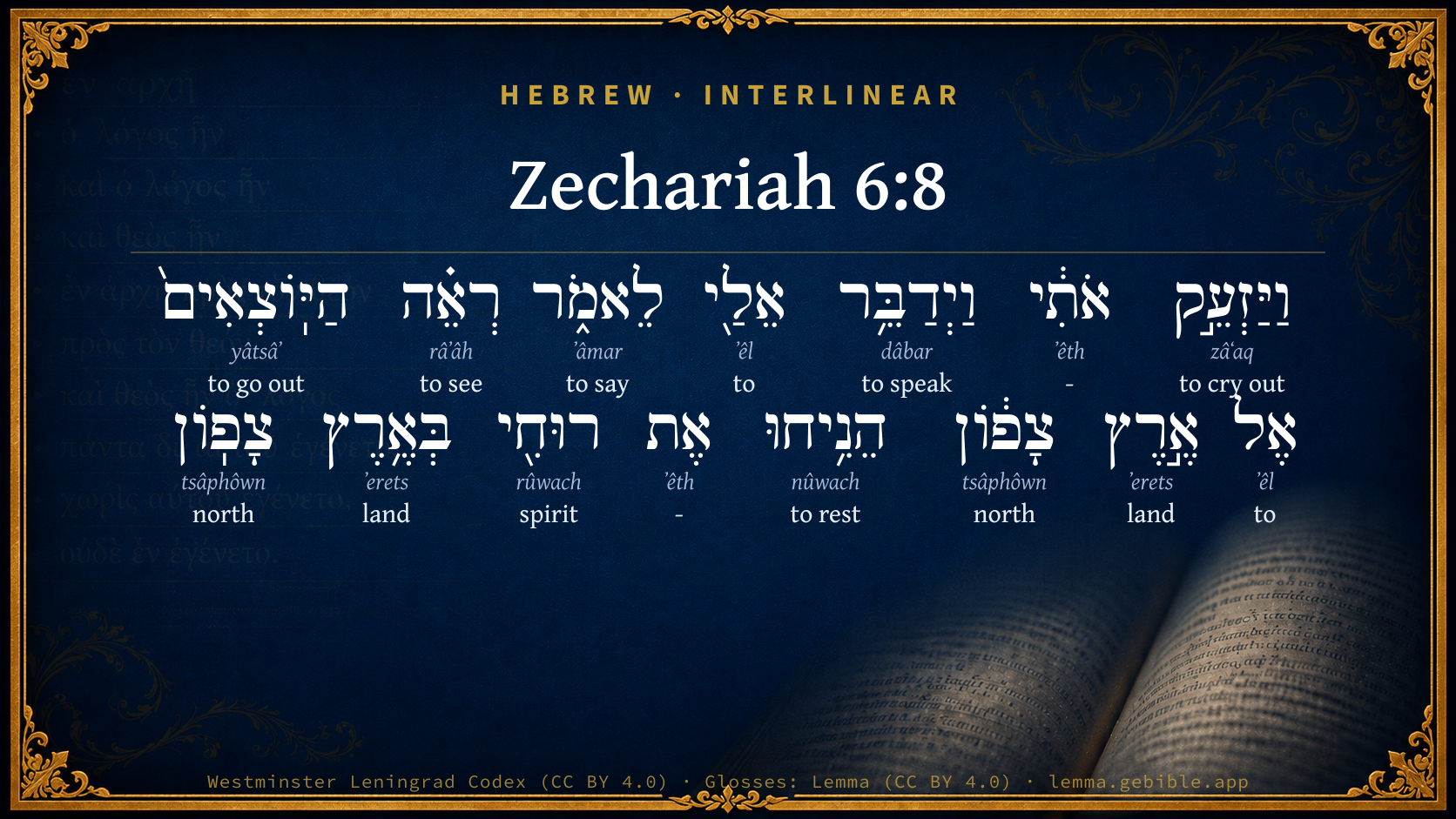
Hebrew (Westminster Leningrad Codex) Zechariah 6:8 appears in the Hebrew Old Testament. The text above is from the Westminster Leningrad Codex. Each word links to its Strong’s number, a concise gloss, and parsing drawn from the Open Scriptures Hebrew Bible morphology. Click any word for its full Brown-Driver-Briggs (BDB) entry.
Download image
Cite this verse

Zechariah 6:8 (World English Bible). Public Domain. Lemma interlinear Bible study tool, https://lemma.gebible.app/v/zechariah/6/8.

Show BibTeX & RIS
BibTeX
RIS
English Translation
Then he called to me, and spoke to me, saying, "Behold, those who go toward the north country have quieted my spirit in the north country."
World English Bible · Public Domain
Download a study sheet

One document with this verse’s original text, its word-by-word gloss line, the meaning frame, cross-references with their text, attributed commentary, and full source and license credits — printable, and it pastes into notes with its structure intact.

This verse Autodidact and up

Study sheet (.html) Plain text (.txt)

A passage Seminary Student

Up to 50 verses in one chapter. A passage sheet keeps up to 6 commentary sources and 12 cross-references per verse, in the order this page ranks them, and says so on the sheet whenever that leaves anything out. Ask for a single verse and you get the Autodidact verse sheet above.

Everything on this page stays free to read, with no account — the sheet is a download of what is already on screen, not access to it.

Want to remove ads? Support Godless Engineer
Compare translations 3

The same verse in 3 English versions, stacked beneath the original-language interlinear above. Click any original word for its lexicon entry.

Each is an independent rendering of the whole verse — the interlinear is not word-aligned to these translations.

Highlighted words mark where these versions differ — a whole-verse word diff, not a word-by-word alignment.

  • World English Bible Public Domain
    Then he called to me, and spoke to me, saying, "Behold, those who go toward the north country have quieted my spirit in the north country."
  • King James Version Public Domain
    Then cried he upon me, and spake unto me, saying, Behold, these that go toward the north country have quieted my spirit in the north country.
  • unfoldingWord Literal Text CC BY-SA 4.0
    And he called out to me and spoke to me, saying, “See, the ones going out to the land of the north have caused my spirit to rest in the land of the north.”

unfoldingWord Literal Text — © unfoldingWord, licensed CC BY-SA 4.0. Word-aligned USFM3 via Door43 (git.door43.org/unfoldingWord/en_ult).

Versions to compare (up to 4)

3 of 4 selected

Show all 18 translations

Every available English version of this verse, each an independent rendering of the whole verse.

  • World English Bible Public Domain
    Then he called to me, and spoke to me, saying, "Behold, those who go toward the north country have quieted my spirit in the north country."
  • Berean Standard Bible Public Domain
    Then the LORD summoned me and said, “Behold, those going to the land of the north have given rest to My Spirit in the land of the north.”
  • Majority Standard Bible Public Domain
    Then the LORD summoned me and said, “Behold, those going to the land of the north have given rest to My Spirit in the land of the north.”
  • King James Version Public Domain
    Then cried he upon me, and spake unto me, saying, Behold, these that go toward the north country have quieted my spirit in the north country.
  • American Standard Version (1901) Public Domain
    Then cried he to me, and spake unto me, saying, Behold, they that go toward the north country have quieted my spirit in the north country.
  • Revised Version (1885) Public Domain
    Then cried he upon me, and spake unto me, saying, Behold, they that go toward the north country have quieted my spirit in the north country.
  • Geneva Bible (1599) Public Domain
    Then cryed hee vpon me, and spake vnto me, saying, Beholde, these that goe towarde the North countrey, haue pacified my spirit in the North countrey.
  • Douay-Rheims (1899) Public Domain
    And he called me, and spoke to me, saying: Behold they that go forth into the land of the north, have quieted my spirit in the land of the north.
  • Young's Literal Translation Public Domain
    And he calleth me, and speaketh unto me, saying, `See, those coming forth unto the land of the north have caused My Spirit to rest in the land of the north.'
  • Literal Standard Version CC BY-SA 4.0
    And he calls me, and speaks to me, saying, “See, those coming forth to the land of the north have caused My Spirit to rest in the land of the north.”
  • Unlocked Literal Bible CC BY-SA 4.0
    Then he called out to me and spoke to me and said, “Look at the ones that are going out to the north country; they will appease my spirit concerning the north country.”
  • unfoldingWord Literal Text CC BY-SA 4.0
    And he called out to me and spoke to me, saying, “See, the ones going out to the land of the north have caused my spirit to rest in the land of the north.”
  • Darby Bible Public Domain
    And he cried unto me, and spoke unto me, saying, See, these that go forth towards the north country have quieted my spirit in the north country.
  • World Messianic Bible Public Domain
    Then he called to me, and spoke to me, saying, “Behold, those who go toward the north country have quieted my spirit in the north country.”
  • Webster's Bible Public Domain
    Then he cried upon me, and spoke to me, saying, Behold, these that go towards the north country have quieted my spirit in the north country.
  • Free Bible Version CC BY-SA 4.0
    Then the angel called to me, saying, “Look! Those who went north have achieved what the Lord wanted in the land of the north.”
  • Bible in Basic English Public Domain
    Then crying out to me, he said, See, those who are going to the north country have given rest to the spirit of the Lord in the north country.
  • JPS Tanakh (1917) Public Domain
    Then cried he upon me, and spoke unto me, saying: 'Behold, they that go toward the north country have eased My spirit in the north country.'

Literal Standard Version (2020), Covenant Press — licensed CC BY-SA 4.0. Text via the HelloAO Bible API (eBible.org). Unlocked Literal Bible (unfoldingWord) — licensed CC BY-SA 4.0. Text via the HelloAO Bible API (eBible.org). unfoldingWord Literal Text — © unfoldingWord, licensed CC BY-SA 4.0. Word-aligned USFM3 via Door43 (git.door43.org/unfoldingWord/en_ult). Free Bible Version, Dr. Jonathan Gallagher — licensed CC BY-SA 4.0. Text via the HelloAO Bible API (eBible.org).

Word by word

More ways to search: Search by grammar → Find every occurrence → Compare this word →

Practice this passage: Drill this verse → Learn its vocabulary →

הֵנִ֥יחוּ
nûwach
H5117
“to rest”
Verb, Hiphil, Perfect, 3rd Person, Common, Plural
Part of Speech
Verb
Stem
Hiphil
Form
Perfect
Person
3rd Person
Gender
Common
Number
Plural
Full BDB Definition

Origin: a primitive root

TWOT: 1323

to rest - (Qal) - to rest, settle down and remain - to repose, have rest, be quiet - (Hiphil) - to cause to rest, give rest to, make quiet - to cause to rest, cause to alight, set down - to lay or set down, deposit, let lie, place - to let remain, leave - to leave, depart from - to abandon - to permit - (Hophal) - to obtain rest, be granted rest - to be left, be placed - open space (substantive)
  1. וַיַּזְעֵ֣ק zâʻaq H2199 “and · to cry out” Conjunction + Verb, Hiphil, Sequential Imperfect, 3rd Person, Masculine, Singular
  2. אֹתִ֔י ʼêth H853 “- · me” Particle, Direct Object + Suffix, Personal, 1st Person, Common, Singular
  3. וַיְדַבֵּ֥ר dâbar H1696 “and · to speak” Conjunction + Verb, Piel, Sequential Imperfect, 3rd Person, Masculine, Singular
  4. אֵלַ֖י ʼêl H413 “to · me” Preposition + Suffix, Personal, 1st Person, Common, Singular
  5. לֵאמֹ֑ר ʼâmar H559 “to say” Preposition + Verb, Qal, Infinitive Construct
  6. רְאֵ֗ה râʼâh H7200 “see” Verb, Qal, Imperative, 2nd Person, Masculine, Singular
  7. הַיּֽוֹצְאִים֙ yâtsâʼ H3318 “the · going out” Particle, Definite Article + Verb, Qal, Participle Active, Masculine, Plural, Absolute
  8. אֶל ʼêl H413 “to” Preposition
  9. אֶ֣רֶץ ʼerets H776 “land of” Noun, Common, Both, Singular, Construct
  10. צָפ֔וֹן tsâphôwn H6828 “north” Noun, Common, Feminine, Singular, Absolute
  11. אֶת ʼêth H853 “-” Particle, Direct Object
  12. רוּחִ֖י rûwach H7307 “spirit · my” Noun, Common, Both, Singular, Construct + Suffix, Personal, 1st Person, Common, Singular
  13. בְּאֶ֥רֶץ ʼerets H776 “in/at · land of” Preposition + Noun, Common, Both, Singular, Construct
  14. צָפֽוֹן tsâphôwn H6828 “north” Noun, Common, Feminine, Singular, Absolute

About this verse

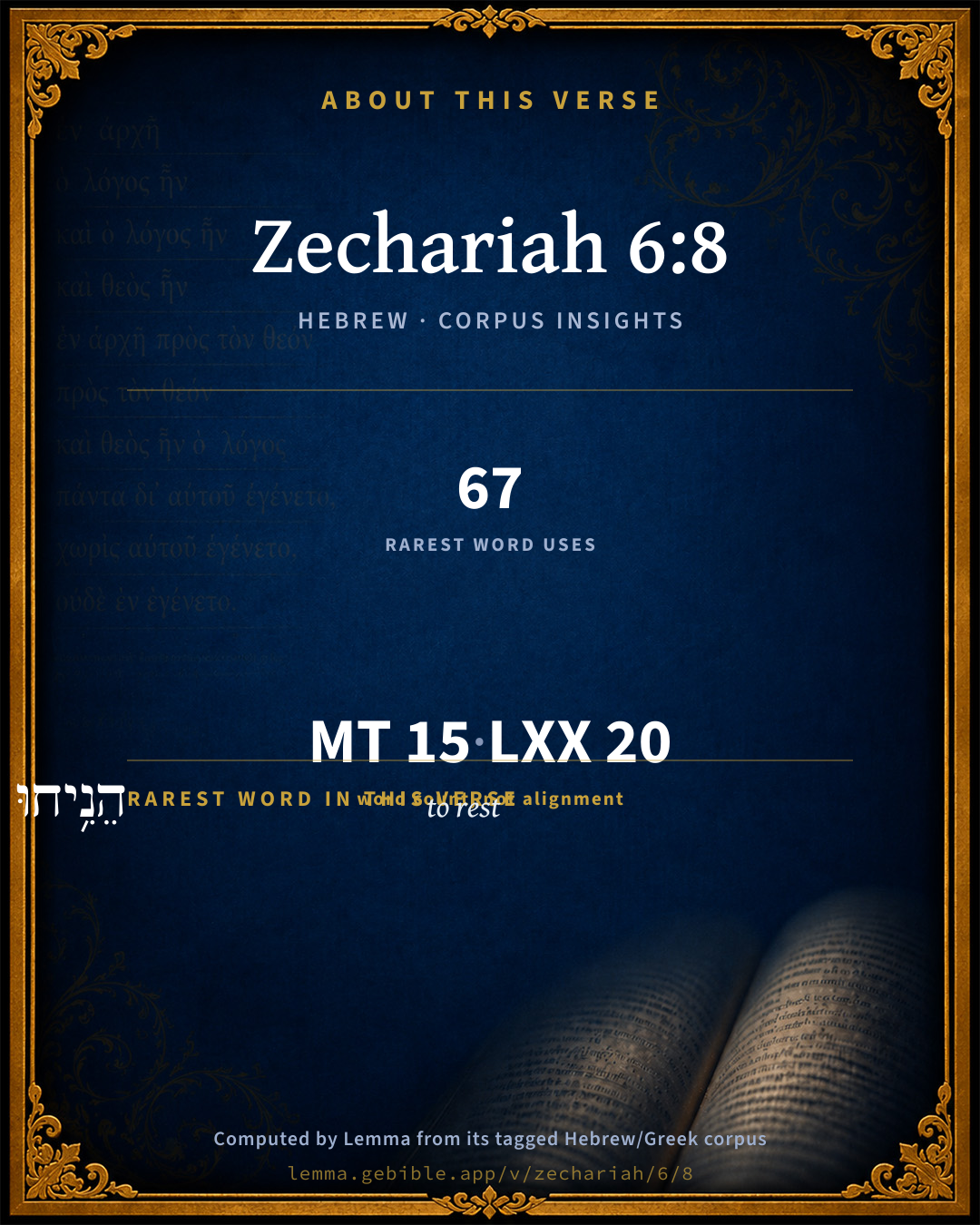
These counts appear in no published source. They are computed here, from the morphology-tagged text and Lemma’s own curated glosses. What Lemma adds →

15
words
11
distinct lemmas
Prophets
section

Grammatical profile

  • 6 verbs
  • 5 nouns
  • 2 prepositions
  • 2 particles

Verb forms

  • וַיַּזְעֵ֣ק Hiphil · Sequential Imperfect
  • וַיְדַבֵּ֥ר Piel · Sequential Imperfect
  • לֵאמֹ֑ר Qal · Infinitive Construct
  • רְאֵ֗ה Qal · Imperative
  • הַיּֽוֹצְאִים֙ Qal · Participle Active
  • הֵנִ֥יחוּ Hiphil · Perfect

Repetition

Words recur within this verse — often emphatic in Hebrew:

  • אֶ֣רֶץ land H776 ×2
  • צָפ֔וֹן north H6828 ×2
  • אֵלַ֖י to H413 ×2

Hebrew & Septuagint length

In English translation the verse runs 26 words from the Hebrew and 31 from the Septuagint (LXX English) — closely comparable.

A rough comparison of the two English renderings, which tokenize alike — not a word-level alignment.

Word counts can differ between the Hebrew and the Greek without any difference in meaning — e.g. the Hebrew direct-object marker אֵת has no separate Greek word, and Greek often adds the article ὁ.

In the original languages it is 15 Hebrew tokens and 20 Greek tokens — but the two are counted differently (Hebrew bundles its prefixes and suffixes into one token; the Greek is in lemma form), so that isn’t a like-for-like length.

Cross-references

15

Topical passages linked to Zechariah 6:8 in the Treasury of Scripture Knowledge — connected by theme and wording, ordered by reader-vote popularity; previews shown in the World English Bible.

  • Ezekiel 5:13 Thus shall my anger be accomplished, and I will cause my wrath toward them to rest, and I shall be comforted; and they shall know that I, Yahweh, have spoken in my zeal, when I have accomplished my wrath on them.
  • Jeremiah 51:48–49 Then the heavens and the earth, and all that is therein, shall sing for joy over Babylon; for the destroyers shall come to her from the north, says Yahweh.
  • Ezekiel 24:13 In your filthiness is lewdness: because I have cleansed you and you weren't cleansed, you shall not be cleansed from your filthiness any more, until I have caused my wrath toward you to rest.
  • Zechariah 1:15 I am very angry with the nations that are at ease; for I was but a little displeased, but they added to the calamity."
  • Judges 8:3 God has delivered into your hand the princes of Midian, Oreb and Zeeb: and what was I able to do in comparison with you? Then their anger was abated toward him, when he had said that.
  • Judges 15:7 Samson said to them, If you do after this manner, surely I will be avenged of you, and after that I will cease.
  • Ecclesiastes 10:4 If the spirit of the ruler rises up against you, don't leave your place; for gentleness lays great offenses to rest.
  • Isaiah 1:24 Therefore the Lord, Yahweh of Hosts, The Mighty One of Israel, says: "Ah, I will get relief from my adversaries, And avenge myself of my enemies;
  • Isaiah 18:3–4 All you inhabitants of the world, and you dwellers on the earth, when an ensign is lifted up on the mountains, look; and when the trumpet is blown, listen.
  • Isaiah 48:14 Assemble yourselves, all you, and hear; who among them has declared these things? He whom Yahweh loves shall perform his pleasure on Babylon, and his arm [shall be on] the Chaldeans.
  • Isaiah 51:22–23 Thus says your Lord Yahweh, and your God who pleads the cause of his people, Behold, I have taken out of your hand the cup of staggering, even the bowl of the cup of my wrath; you shall no more drink it again:
  • Ezekiel 16:42 So will I cause my wrath toward you to rest, and my jealousy shall depart from you, and I will be quiet, and will be no more angry.
  • Ezekiel 16:63 that you may remember, and be confounded, and never open your mouth any more, because of your shame, when I have forgiven you all that you have done, says the Lord Yahweh.
  • Revelation 18:21–22 A mighty angel took up a stone like a great millstone and cast it into the sea, saying, "Thus with violence will Babylon, the great city, be thrown down, and will be found no more at all.
  • Isaiah 42:13–15 Yahweh will go forth as a mighty man; he will stir up [his] zeal like a man of war: he will cry, yes, he will shout aloud; he will do mightily against his enemies.

Cross-references courtesy of OpenBible.info (CC BY 4.0).

Hebrew and Greek witnesses Masoretic Hebrew ↔ Greek Septuagint

The same verse in the two great witnesses to the Old Testament, shown verse-for-verse.

These are two independent witnesses, not word-aligned to each other, and the Septuagint is shown in lemma (dictionary) form.

Hebrew Zechariah 6:8 Masoretic · Westminster Leningrad Codex

וַיַּזְעֵ֣ק אֹתִ֔י וַיְדַבֵּ֥ר אֵלַ֖י לֵאמֹ֑ר רְאֵ֗ה הַיּֽוֹצְאִים֙ אֶל אֶ֣רֶץ צָפ֔וֹן הֵנִ֥יחוּ אֶת רוּחִ֖י בְּאֶ֥רֶץ צָפֽוֹן

Then he called to me, and spoke to me, saying, "Behold, those who go toward the north country have quieted my spirit in the north country."

World English Bible · Public Domain

Greek LXX Zechariah 6:8 Septuagint · lemma form

καί ἀναβοάω καί λαλέω πρός ἐγώ λέγω ἰδού ὁ ἐκπορεύομαι ἐπί γῆ βορέας ἀναπαύω ὁ θυμός ἐγώ ἐν γῆ βορέας

And he cried out and spoke to me, saying, Behold, these go out to the land of the north, and they have quieted my anger in the land of the north.

LXX2012 (modern English Septuagint) · Public Domain

On this verse, Joseph Benson's Commentary discusses the Septuagint’s reading. Read the note in Commentary ↓

Hebrew: Westminster Leningrad Codex (CC BY 4.0). Greek: Septuagint (public domain); English from LXX2012 (modern English Septuagint) (Public Domain). How the Septuagint differs from the Hebrew →

Targum (Aramaic paraphrase)

1

The Targum is the ancient Jewish Aramaic paraphrase of the Hebrew Scriptures — an interpretive translation, not the Hebrew text itself. Onkelos (literal) and Pseudo-Jonathan (expansive) render the Torah, and Jonathan the Prophets. Coverage is partial: where no permissively-licensed English translation exists for a verse, only the Aramaic is shown. This is verse-level text, not a word-by-word alignment to the Hebrew.

  1. Targum Jonathan Prophets (Joshua–Malachi)
    וְאַכְרֵז עָלַי וּמַלֵיל עִמִי לְמֵימָר חֲזֵי דְנַפְקִין לְאַרְעָא צִפּוּנָא אֲמַר לְהוֹן עֲבִידוּ יַת רַעֲוָתִי בְּאַרְעָא צִפּוּנָא:

    (no public-domain English translation for this verse)

    Targum Jonathan — Aramaic: “Mikraot Gedolot” (public domain). English: “Sefaria Community Translation” (CC0 1.0 (public-domain dedication)); “London "Chaldee Paraphrase," 1871” (public domain). Text via Sefaria.

Commentary

Notes on Zechariah 6:8 from classic Christian and Jewish commentators (each source and its license shown beneath its notes). The classic Christian expositions comment on the surrounding passage and are grouped to its opening verse, so a note may address several verses; the Jewish commentaries on the Tanakh (Rashi and others) are per-verse, so they appear only where the commentator wrote on this verse.

Lemma curates 59 commentaries, every one of them public domain or Creative Commons licensed, each selected and text-cleaned for this edition rather than reprinted as found. About our sources →

Trapp's Complete Commentary

John Trapp

Zec 6:8 Then cried he upon me, and spake unto me, saying, Behold, these that go toward the north country have quieted my spirit in the north country.

Ver. 8. Then cried he upon me] That I might the better observe it, since he spake it with such great vehemence.

Have pacified my spirit] i.e. Perfecerunt voluntatem meam, as the Chaldee here hath it, they have done my work thoroughly, to my great contentment. When the Church’s enemies are slaughtered God inviteth the birds and beasts to a feast, as it were for joy; and taketh as much delight in their just punishment as any man can do in a cup of generous wine; whence it is called the wine of God’s wrath, Rev 14:10; see Deu 28:63.

John Trapp, A Commentary or Exposition upon All the Books of the Old and New Testament (1647–1656) — public domain. Text from a community e-Sword module.

Joseph Benson's Commentary

Zec 6:8. Then cried he unto me, Behold, these that go toward the north — Namely, the black horses, denoting the Persian empire; have quieted my spirit in the north country — That is, by conquering the Babylonians, and executing upon them the punishment which they deserved for their cruelty and other crimes, they have satisfied the wrath which I had conceived against that people. So the LXX., ανεπαυσαν τον θυμον μου εν γη Βορρα, they have caused my wrath to cease in the land of the north. Instead of these that go toward the north, it would be better to translate the words, those who have gone toward the north; because it is spoken of the Persians overturning the Babylonian empire, which happened before the prophet was favoured with this vision.

Joseph Benson's Commentary on the Old and New Testaments (1811–1818) — public domain. Text from a community e-Sword module.

Tyndale Open Study Notes

Tyndale Open Resources

6:8 the Lord summoned me: The series of visions closes with a direct word from the Lord to Zechariah. In bypassing the interpreting angel, God emphasizes the sure and effective implementation of his word to Israel. • have vented the anger of my Spirit (literally have given my Spirit rest): “Spirit” can mean “anger,” as it does here (see Judg 8:3; Isa 33:11).

Tyndale Open Study Notes — © Tyndale Open Resources, licensed CC BY-SA 4.0. Text via the HelloAO Bible API.

Geneva Bible (1599)

Geneva Bible translators

By punishing the Chaldeans mine anger ceased, and you were delivered.

Geneva Bible (1599) marginal notes — public domain. Text via Bolls.life.

Jamieson, Fausset & Brown

Robert Jamieson, A. R. Fausset & David Brown

north . . . quieted . . . my spirit--that is, caused My anger to rest (Jdg 8:3, Margin; Ecc 10:4; Eze 5:13; Eze 16:42). Babylon alone of the four great world kingdoms had in Zechariah's time been finally punished; therefore, in its case alone does God now say His anger is satisfied; the others had as yet to expiate their sin; the fourth has still to do so.

The double crown is placed on Joshua's head, symbolizing that the true priesthood and the kingdom shall be conferred on the one Messiah. Compare Heb 6:20; Heb. 7:1-21, on Melchisedek, who similarly combined the kingdom and priesthood as type of Messiah.

Jamieson, Fausset & Brown — Commentary Critical and Explanatory on the Whole Bible (1871) — public domain (CC PDM 1.0). Text via the HelloAO Bible API.

Adam Clarke's Commentary

Verse 8. Have quieted my spirit in the north country.] They have fulfilled my judgments on Assyria and Chaldea. Nabopolassar and Cyrus first, against the Assyrians and Chaldeans; and Alexander next, against the Persians. On this vision Abp. Newcome remarks:-

The black horses seem to denote the Persian empire; which, by subduing the Chaldeans, and being about to inflict a second heavy chastisement on Babylon, quieted God's spirit with respect to Chaldea; a country always spoken of as lying to the north of the Jews.

The white horses seem to be the Macedonian empire; which, like the Persian, overcame Chaldea.

The spotted bay horses seem to be the Roman empire. This description suits it because it was governed by kings, consuls, dictators, and emperors. It penetrated southward to Egypt and Africa. The Roman empire is mentioned twice, Zec 6:6-7, under each epithet given it, Zec 6:3.

Adam Clarke's Commentary on the Bible (1810–1826) — public domain. Text from a community e-Sword/MySword module.

John Calvin's Commentaries

From this verse we learn that the chief object of the vision was — that the Jews might know that the dreadful tumults in Chaldea, which had in part happened, and were yet to take place, were not excited without a design, but that all things were regulated by God’s hidden counsel, and also that God had so disturbed and embarrassed the state of that empire, that the end of it might be looked for. There is therefore no reason for any one too anxiously to labor to understand the import of every part of the prophecy, since its general meaning is evident. But why does the angel expressly speak of the land of the south rather than of the land of the north, or of the whole world? Even because the eyes of all were fixed on that quarter; for Chaldea, we know, had been as it were the grave of the Church, whence the remnant had emerged, that there might be some people by whom God might be worshipped. The angel then invites the Jews here to consider the providence of God, so that they might know that whatever changes had taken place in that country, had proceeded from the hidden counsel of God.

The words, they have quieted my spirit, are understood by interpreters in two ways. Some think that God’s favor towards his people is here designated, as though he had said, that he was already pacified; but others, by the word spirit, understand the vengeance of God, because he had sufficiently poured forth his wrath on the Chaldeans; and both meanings are well adapted to the context. For it was no common solace to the Jews, that God had poured forth his wrath on the Babylonians until it was satiated, as when one ceases not to be angry until he has fulfilled his desire, and this mode of speaking often occurs in Scripture. I am therefore disposed to embrace the second explanation — that God began to be quieted after the second chariot had gone forth; for he was then reconciled to his chosen people, and their deliverance immediately followed. That the Jews might know that God would be propitious to them, he bids them to continue quiet and undisturbed in their minds, until these chariots had run their course through the whole of Chaldea; for what the angel now says would be fulfilled, even that the Spirit of God would be quieted, who seemed before to be disturbed, when he involved all things in darkness, even in Judea itself.

John Calvin's Commentaries (1540-1563) — public domain. Text from the Calvin Translation Society English edition (1840s-50s) via the Christian Classics Ethereal Library (ccel.org). Calvin's coverage is partial (roughly two-thirds of the Bible); uncommented books and verses are honest gaps, never fabricated. The 19th-century editor's footnotes and remarks are omitted so the notes are faithfully Calvin's own voice.

Ellicott's Commentary for English Readers

(8) Cried he upon me, means summoned me. (Comp. “Who calls on Hamlet?”—Shakespeare, Hamlet, Acts 5, scenes 2, 3.)

Have quieted my spirit.—“Spirit” being used, as in Jdg_8:3, in the sense of “wrath.” (For the phrase “to quiet wrath,” comp. Eze_5:12; Eze_16:42; Eze_24:13. This is better than the interpretation, Have made my spirit to rest, i.e., caused my spirit of judgment (Isa_4:4) to fall upon. (Comp. Isa_56:1.) Many commentators have, without any warrant, drawn their interpretation of the colours of the horses in this vision from the Book of Revelation. According to them, “red” means war. “black” famine, “white” victory, “grisled” various chastisements. They identify the “grisled” with the “bay” of the English Version, or rather powerful ones (as they render the word in Zec_6:3; Zec_6:7), and say that the last mission was not received by the so-called “red horses,” but by the “powerful ones” (English Version, “bay,”) as the “grisled” are also called in Zec_6:3, to indicate that the manifold judgments symbolised by the grisled horses will pass over the whole earth in all their force. But it is better to consider that the horses are represented as of different colours merely in order to give greater distinctness to the vision. (Comp. Zec_1:8; Zec_5:9.) For the commentators fail to discover any ethical or historical reason for famine and victory being especially sent to the north, and various chastisements to the south, or why (according to the unamended Hebrew text) the “red” (English Version), i.e., “bay horses,” should not have been sent out at all. According to the amended text, “the bay horses” seek, and obtain, permission to go through all the earth, signifying possibly that Israel’s Protector would defend His people, not only against their ancient enemies, but also against any who should rise up against them from any quarter whatever. The difficulty with the colours of the horses is supposed by Hitzig to have arisen from the carelessness of the writer; but we agree rather with Maurer, who attributes it to a blunder of an early copyist.

A Bible Commentary for English Readers, edited by Charles John Ellicott (1878–1897) — public domain. Text from a community e-Sword module.

The Cambridge Bible for Schools and Colleges

gen. ed. J. J. S. Perowne

8. cried he upon me] The word is used of a royal proclamation cried aloud through the city. Jon_3:7. Here the loud call of the Angel was probably intended to rouse the prophet’s attention to what was the chief point of the vision.

quieted my spirit] Lit. have caused my spirit to rest, which was perturbed before with sore displeasure against my enemies (Zec_1:15), but is now at rest because the righteous retribution is completed. Others take “spirit” to be equivalent here, as it is elsewhere (Ecc_10:4; Pro_29:11, in which latter place, as here, the LXX have θυμός), to anger. “Have made my anger to rest on, i.e. have carried it thither and deposited it there, made it to rest upon them as its abode, as St John says of the unbelieving, ‘the wrath of God abideth on him.’ ” Pusey. See Eze_5:13; Eze_16:42.

Symbolical Action. Crowning of the High-priest, Zec_6:9-15. In another of the “divers manners” (πολυτρόπως, Heb_1:1), which He was pleased to adopt, Almighty God now speaks by the prophet. The visions of the night give place to a literal transaction by day, which, however, repeats and confirms their message. Zechariah is directed to go to the house of Josiah in Jerusalem, and to take from certain Jews who were lodging there gold and silver, a portion of the offerings to the House of God, which they had brought from their brethren still in exile, Zec_6:9-10. Of this gold and silver he is to make a crown, and put it on the head of Joshua the High-priest, Zec_6:11. The significant action is to be accompanied by a prediction in the name of Jehovah, that in due time there shall “grow up the Branch,” who shall be the true builder of the temple of the Lord, who shall be both King and Priest, and in the exercise of those two offices the author and dispenser of peace, Zec_6:12-13. Meanwhile, in gracious remembrance both of those who have brought the offerings and of him who has received them into his house, the crown which has been placed on the High-priest’s head is to be hung up in the Temple at Jerusalem, Zec_6:14, where it will also be a silent prophecy of the day when not only Jewish exiles, but Gentiles also who are now “far off,” shall be builders in the spiritual temple. That event, when it comes to pass, will prove the divine mission of the prophet; but obedience on the part of those who hear the prophecy is the condition of their sharing in the blessings of its fulfilment, Zec_6:15.

The Cambridge Bible for Schools and Colleges (gen. ed. J. J. S. Perowne; Cambridge University Press, 1878–1918) — public domain. Text from a community e-Sword module.

John Gill's Exposition

Then cried he upon me, and spake unto me, saying,.... That is, the Lord of the whole earth spoke to the prophet with a loud voice, and uttered the following words:

Behold, these that go toward the north country; meaning the Medes and Persians, which went towards Babylon:

have quieted my spirit in the north country; by executing the judgments of God upon the Chaldeans, and by helping, favouring, and delivering the people of the Jews; which were very agreeable to the will of God, and well pleasing in his sight, signified by the quieting or refreshing his Spirit.

John Gill's Exposition of the Whole Bible (1746–1763) — public domain (CC PDM 1.0). Text via the HelloAO Bible API.

Albert Barnes' Notes on the Bible

Then God, or the Angel of the Lord - who speaks of what belonged to God alone, “called me” (probably “loudly” Jdg 4:10, Jdg 4:13; 2Sa 20:4-5), so as to command his attention to this which most immediately concerned his people.

These have quieted My spirit in the north country - Or rather, “have made My anger to rest” on, that is, have carried it thither and deposited it there, made it to rest upon them, as its abode, as John saith of the unbelieving, “The wrath of God abideth on him” Joh 3:36. Babylon had been the final antagonist and subduer of the people of God. It had at the outset destroyed the temple of God, and carried off its vessels to adorn idol-temples. Its empire closed on that night when it triumphed over God , using the vessels dedicated to Him, to the glorifying of their idols. “In that night was Belshazzar the king of the Chaldaeans slain.” This final execution of God’s anger upon that their destroyer was the earnest of the rest to them; and in this the visions pause.

Albert Barnes' Notes on the Bible (1834–1885) — public domain. Text from a community e-Sword/MySword module.

Haydock's Catholic Bible Commentary

Spirit. Septuagint, "wrath or fury." (Haydock) --- Nabopolassar overcame the Assyrians, Cyrus the Chaldeans, as Alexander would shortly treat the Persians.

George Leo Haydock (1774–1849), Haydock's Catholic Family Bible and Commentary, 1859 edition — public domain. Excludes Psalms (Douay-Rheims chapter numbering differs from Protestant) and Deuterocanonical books (Catholic canon only).

Matthew Poole's English Annotations

Then, when the prophet had been informed about the former vision,

cried he; the Angel that talked with the prophet, i.e. the Lord Christ, spake aloud. and called to him.

These that go, or are gone, for he speaks of what was already past; it is likely he meaneth the red horses.

Toward the north country; into Babylon.

Have quieted my spirit; either by doing what I appointed them against the cruel Chaldeans, in revenge of my people’s injuries, or bringing my people back out of Babylon into Canaan.

Matthew Poole's English Annotations on the Holy Bible (1683–1685) — public domain. Text from a community e-Sword/MySword module.

Whedon's Commentary on the Bible

Daniel D. Whedon

8. The greatest enemy of the Jews were the Babylonians, or their successors, the Persians; while their power remained intact there was little hope for a complete restoration. In the first and second visions the prophet had been informed that judgment was about to fall upon that nation; here he is assured once more that the day of judgment is at hand. All the chariots are messengers of judgment, but only the one going toward the north is singled out for further comment.

Have quieted my spirit — A prophetic perfect; the act is still future, but it is so certain that the prophet may speak of it as already accomplished. The spirit is the spirit of wrath (Ecc_10:4), which they are about to quiet, that is, to pacify, by the execution of the judgment (Eze_5:13; Eze_16:42).

Daniel D. Whedon (gen. ed.), Commentary on the Old and New Testaments (1874–1909) — public domain. Text from a community e-Sword module.

The Pulpit Commentary

Then cried he upon me. The angel cried aloud, (like a herald announcing a proclamation, Jon_3:7) to call the prophet"s attention to what was coming, which was of most immediate consequence to his people. This angel speaks as in the person of God. Have quieted my spirit; literally, have caused my spirit to rest; LXX, anepausan ton mou , "quieted my anger," i.e. by satiating it. Many commentators take the clause as equivalent to "have caused my wrath to rest upon the land", (comp. Joh_3:36) referring to Jud_1:8:3 Pro_16:32 Ecc_10:4, for the use of the word "spirit" (ruach) in the sense of "anger." Others see here an intimation of mercy and grace to the Jews still resident in Babylonia. But it is plain that the vision is one of judgment: and the Spirit of the Lord is a Spirit of judgment and vengeance, (Isa_4:4) which destroys evil that good may flourish.

The Pulpit Commentary (1880–1919), ed. H.D.M. Spence-Jones & Joseph S. Exell — public domain. Text from a community e-Sword module.

John Wesley's Explanatory Notes

Cried he - Christ spake aloud, and called to him. Quieted my spirit - By doing what I appointed them in revenge of my peoples injuries, and by bringing my people back into Canaan.

John Wesley, Explanatory Notes Upon the Whole Bible (1754–1765) — public domain. Text via the GEBible commentary corpus.

Rashi

Rabbi Shlomo Yitzchaki (Rashi)

Look, those going forth to the northland to cause Media and Persia to mount.

eased My spirit They caused My anger to subside in Babylon when they destroyed Belshazzar and Nebuchadnezzar’s descendants. This is what Isaiah (48:14) said: “The Lord loves him who shall do His will in Babylon, etc.”

Rashi on the Tanakh — English translations: “The Judaica Press complete Tanach with Rashi, translated by A. J. Rosenberg” (CC BY 4.0); “Pentateuch with Rashi's commentary by M. Rosenbaum and A.M. Silbermann, 1929-1934” (public domain); “The Metsudah Tanach series, Lakewood, N.J” (CC BY 4.0); and “The Book of Joshua, Metsudah Publications, 1997” (CC BY 4.0). Text via Sefaria.

Lesson kit

Teaching starters — assembled from the data on this page, not authored interpretation. Every prompt links to the verse data it draws on. Edit before teaching.

Zechariah, in the Prophets, opens this verse with 15 words (11 distinct Hebrew lemmas). Its most distinctive word is nûwach (“to rest”). A historical commentator’s framing appears above. Read the whole chapter for the surrounding context.

Discussion questions

  1. What does “to rest” (nûwach) contribute to the verse as a whole?
  2. How does Ezekiel 5:13, which shares this passage’s theme, read alongside this verse?
  3. What does the repetition of “land” (2× in this one verse) do in this verse?
  4. These translations render this verse differently. What is at stake in choosing one wording over another?
  5. «וַיַּזְעֵ֣ק» is a Hiphil Sequential Imperfect verb. How does that grammatical form shape the action described?
  6. Compare how Trapp's Complete Commentary and Joseph Benson's Commentary read this verse. Where do they agree or differ?

Things to notice

Reading settings

Reading text

Shown beneath each verse's original-language words.

Old Testament
Old Testament edition

Read the OT as the Masoretic Hebrew (MT) or the Greek Septuagint (LXX).

English shown for the Greek Septuagint (in the Hebrew ↔ Greek comparison).

Comparing translations? Open the Compare panel on any verse page to stack up to four side by side.