Isaiah 11:2

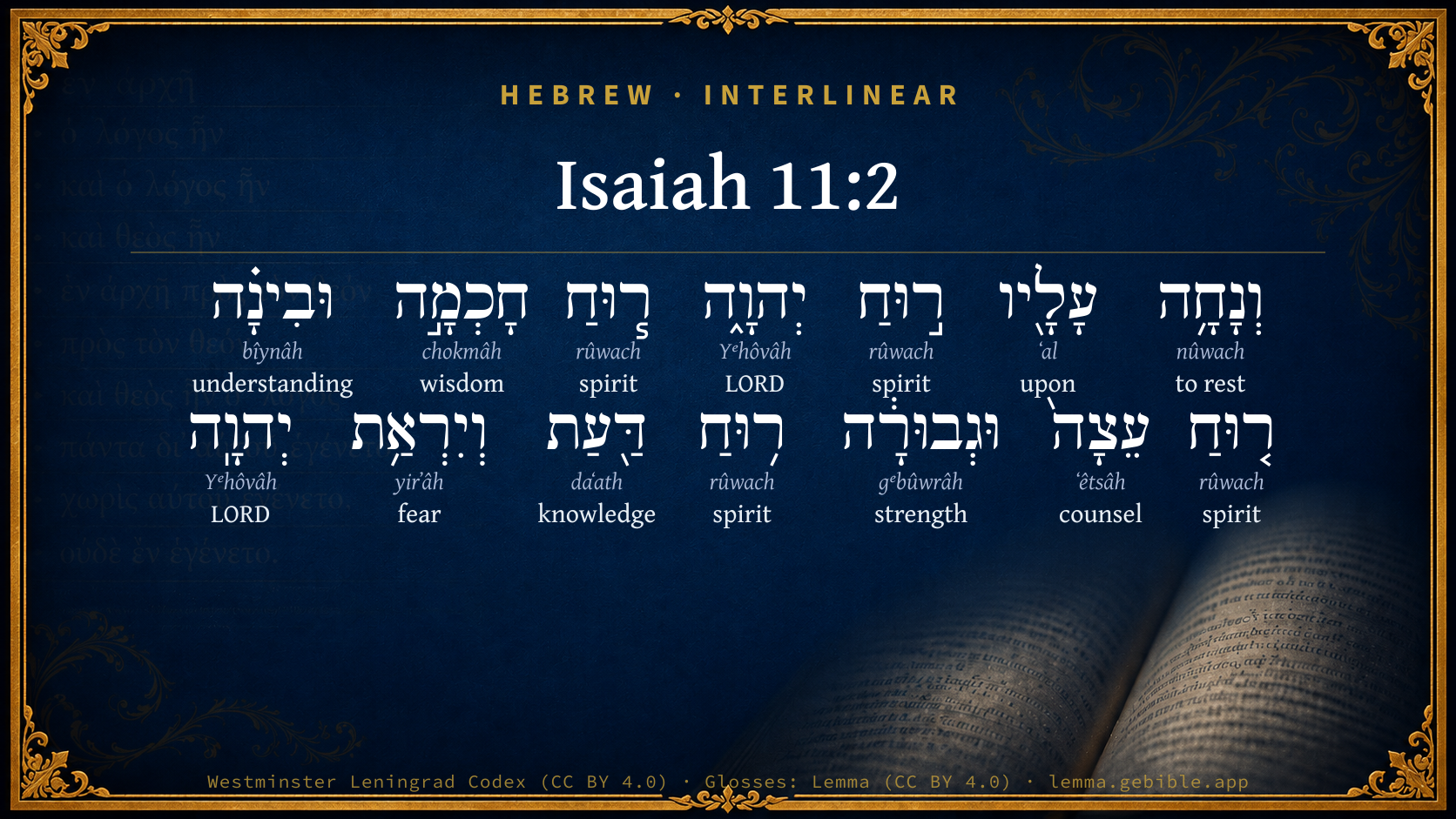
Hebrew (Westminster Leningrad Codex) Isaiah 11:2 appears in the Hebrew Old Testament. The text above is from the Westminster Leningrad Codex. Each word links to its Strong’s number, a concise gloss, and parsing drawn from the Open Scriptures Hebrew Bible morphology. Click any word for its full Brown-Driver-Briggs (BDB) entry.
Download image
Cite this verse

Isaiah 11:2 (World English Bible). Public Domain. Lemma interlinear Bible study tool, https://lemma.gebible.app/v/isaiah/11/2.

Show BibTeX & RIS
BibTeX
RIS
English Translation
The Spirit of Yahweh shall rest on him, the spirit of wisdom and understanding, the spirit of counsel and might, the spirit of knowledge and of the fear of Yahweh.
World English Bible · Public Domain
Download a study sheet

One document with this verse’s original text, its word-by-word gloss line, the meaning frame, cross-references with their text, attributed commentary, and full source and license credits — printable, and it pastes into notes with its structure intact.

This verse Autodidact and up

Study sheet (.html) Plain text (.txt)

A passage Seminary Student

Up to 50 verses in one chapter. A passage sheet keeps up to 6 commentary sources and 12 cross-references per verse, in the order this page ranks them, and says so on the sheet whenever that leaves anything out. Ask for a single verse and you get the Autodidact verse sheet above.

Everything on this page stays free to read, with no account — the sheet is a download of what is already on screen, not access to it.

Want to remove ads? Support Godless Engineer
Compare translations 3

The same verse in 3 English versions, stacked beneath the original-language interlinear above. Click any original word for its lexicon entry.

Each is an independent rendering of the whole verse — the interlinear is not word-aligned to these translations.

Highlighted words mark where these versions differ — a whole-verse word diff, not a word-by-word alignment.

  • World English Bible Public Domain
    The Spirit of Yahweh shall rest on him, the spirit of wisdom and understanding, the spirit of counsel and might, the spirit of knowledge and of the fear of Yahweh.
  • King James Version Public Domain
    And the spirit of the LORD shall rest upon him, the spirit of wisdom and understanding, the spirit of counsel and might, the spirit of knowledge and of the fear of the LORD;
  • unfoldingWord Literal Text CC BY-SA 4.0
    And the Spirit of Yahweh will rest on him, the spirit of wisdom and understanding, the spirit of counsel and might, the spirit of knowledge and the fear of Yahweh.

unfoldingWord Literal Text — © unfoldingWord, licensed CC BY-SA 4.0. Word-aligned USFM3 via Door43 (git.door43.org/unfoldingWord/en_ult).

Versions to compare (up to 4)

3 of 4 selected

Show all 18 translations

Every available English version of this verse, each an independent rendering of the whole verse.

  • World English Bible Public Domain
    The Spirit of Yahweh shall rest on him, the spirit of wisdom and understanding, the spirit of counsel and might, the spirit of knowledge and of the fear of Yahweh.
  • Berean Standard Bible Public Domain
    The Spirit of the LORD will rest on Him—the Spirit of wisdom and understanding, the Spirit of counsel and strength, the Spirit of knowledge and fear of the LORD.
  • Majority Standard Bible Public Domain
    The Spirit of the LORD will rest on Him—the Spirit of wisdom and understanding, the Spirit of counsel and strength, the Spirit of knowledge and fear of the LORD.
  • King James Version Public Domain
    And the spirit of the LORD shall rest upon him, the spirit of wisdom and understanding, the spirit of counsel and might, the spirit of knowledge and of the fear of the LORD;
  • American Standard Version (1901) Public Domain
    And the Spirit of Jehovah shall rest upon him, the spirit of wisdom and understanding, the spirit of counsel and might, the spirit of knowledge and of the fear of Jehovah.
  • Revised Version (1885) Public Domain
    And the spirit of the LORD shall rest upon him, the spirit of wisdom and understanding, the spirit of counsel and might, the spirit of knowledge and of the fear of the LORD;
  • Geneva Bible (1599) Public Domain
    And the Spirite of the Lord shall rest vpon him: the Spirite of wisedome and vnderstanding, the Spirite of counsell and strength, the Spirite of knowledge, and of the feare of the Lord,
  • Douay-Rheims (1899) Public Domain
    And the spirit of the Lord shall rest upon him: the spirit of wisdom, and of understanding, the spirit of counsel, and of fortitude, the spirit of knowledge, and of godliness.
  • Young's Literal Translation Public Domain
    Rested on him hath the Spirit of Jehovah, The spirit of wisdom and understanding, The spirit of counsel and might, The spirit of knowledge and fear of Jehovah.
  • Literal Standard Version CC BY-SA 4.0
    The Spirit of YHWH has rested on Him, || The Spirit of wisdom and understanding, || The Spirit of counsel and might, || The Spirit of knowledge and fear of YHWH.
  • Unlocked Literal Bible CC BY-SA 4.0
    The Spirit of Yahweh will rest upon him, the Spirit of wisdom and understanding, the Spirit of instruction and might, the Spirit of knowledge and of the fear of Yahweh.
  • unfoldingWord Literal Text CC BY-SA 4.0
    And the Spirit of Yahweh will rest on him, the spirit of wisdom and understanding, the spirit of counsel and might, the spirit of knowledge and the fear of Yahweh.
  • Darby Bible Public Domain
    and the Spirit of Jehovah shall rest upon him, the spirit of wisdom and understanding, the spirit of counsel and might, the spirit of knowledge and of the fear of Jehovah.
  • World Messianic Bible Public Domain
    The LORD’s Spirit will rest on him: the spirit of wisdom and understanding, the spirit of counsel and might, the spirit of knowledge and of the fear of the LORD.
  • Webster's Bible Public Domain
    And the spirit of the LORD will rest upon him, the spirit of wisdom and understanding, the spirit of counsel and might, the spirit of knowledge and of the fear of the LORD;
  • Free Bible Version CC BY-SA 4.0
    The Spirit of the Lord will rest on him, which is a Spirit of wisdom and understanding, a Spirit of advice and power, a Spirit of knowledge and awe of the Lord.
  • Bible in Basic English Public Domain
    And the spirit of the Lord will be resting on him, the spirit of wisdom and good sense, the spirit of wise guiding and strength, the spirit of knowledge and of the fear of the Lord;
  • JPS Tanakh (1917) Public Domain
    And the spirit of the LORD shall rest upon him, the spirit of wisdom and understanding, the spirit of counsel and might, the spirit of knowledge and of the fear of the LORD.

Literal Standard Version (2020), Covenant Press — licensed CC BY-SA 4.0. Text via the HelloAO Bible API (eBible.org). Unlocked Literal Bible (unfoldingWord) — licensed CC BY-SA 4.0. Text via the HelloAO Bible API (eBible.org). unfoldingWord Literal Text — © unfoldingWord, licensed CC BY-SA 4.0. Word-aligned USFM3 via Door43 (git.door43.org/unfoldingWord/en_ult). Free Bible Version, Dr. Jonathan Gallagher — licensed CC BY-SA 4.0. Text via the HelloAO Bible API (eBible.org).

Word by word

More ways to search: Search by grammar → Find every occurrence → Compare this word →

Practice this passage: Drill this verse → Learn its vocabulary →

וּבִינָ֗ה
bîynâh
H998
“and · understanding”
Conjunction + Noun, Common, Feminine, Singular, Absolute
Part of Speech
Conjunction + Noun
Type
Common
Gender
Feminine
Number
Singular
State
Absolute
Full BDB Definition

Origin: from H995

TWOT: 239b

understanding, discernment - act - faculty - object - personified
  1. וְנָחָ֥ה nûwach H5117 “and · to rest” Conjunction + Verb, Qal, Sequential Perfect, 3rd Person, Feminine, Singular
  2. עָלָ֖יו ʻal H5921 “upon · him” Preposition + Suffix, Personal, 3rd Person, Masculine, Singular
  3. ר֣וּחַ rûwach H7307 “spirit of” Noun, Common, Both, Singular, Construct
  4. יְהוָ֑ה Yᵉhôvâh H3068 “LORD” Noun, Proper
  5. ר֧וּחַ rûwach H7307 “spirit of” Noun, Common, Both, Singular, Construct
  6. חָכְמָ֣ה chokmâh H2451 “wisdom” Noun, Common, Feminine, Singular, Absolute
  7. ר֤וּחַ rûwach H7307 “spirit of” Noun, Common, Both, Singular, Construct
  8. עֵצָה֙ ʻêtsâh H6098 “counsel” Noun, Common, Feminine, Singular, Absolute
  9. וּגְבוּרָ֔ה gᵉbûwrâh H1369 “and · strength” Conjunction + Noun, Common, Feminine, Singular, Absolute
  10. ר֥וּחַ rûwach H7307 “spirit of” Noun, Common, Both, Singular, Construct
  11. דַּ֖עַת daʻath H1847 “knowledge” Noun, Common, Feminine, Singular, Absolute
  12. וְיִרְאַ֥ת yirʼâh H3374 “and · fear of” Conjunction + Noun, Common, Feminine, Singular, Construct
  13. יְהוָֽה Yᵉhôvâh H3068 “LORD” Noun, Proper

About this verse

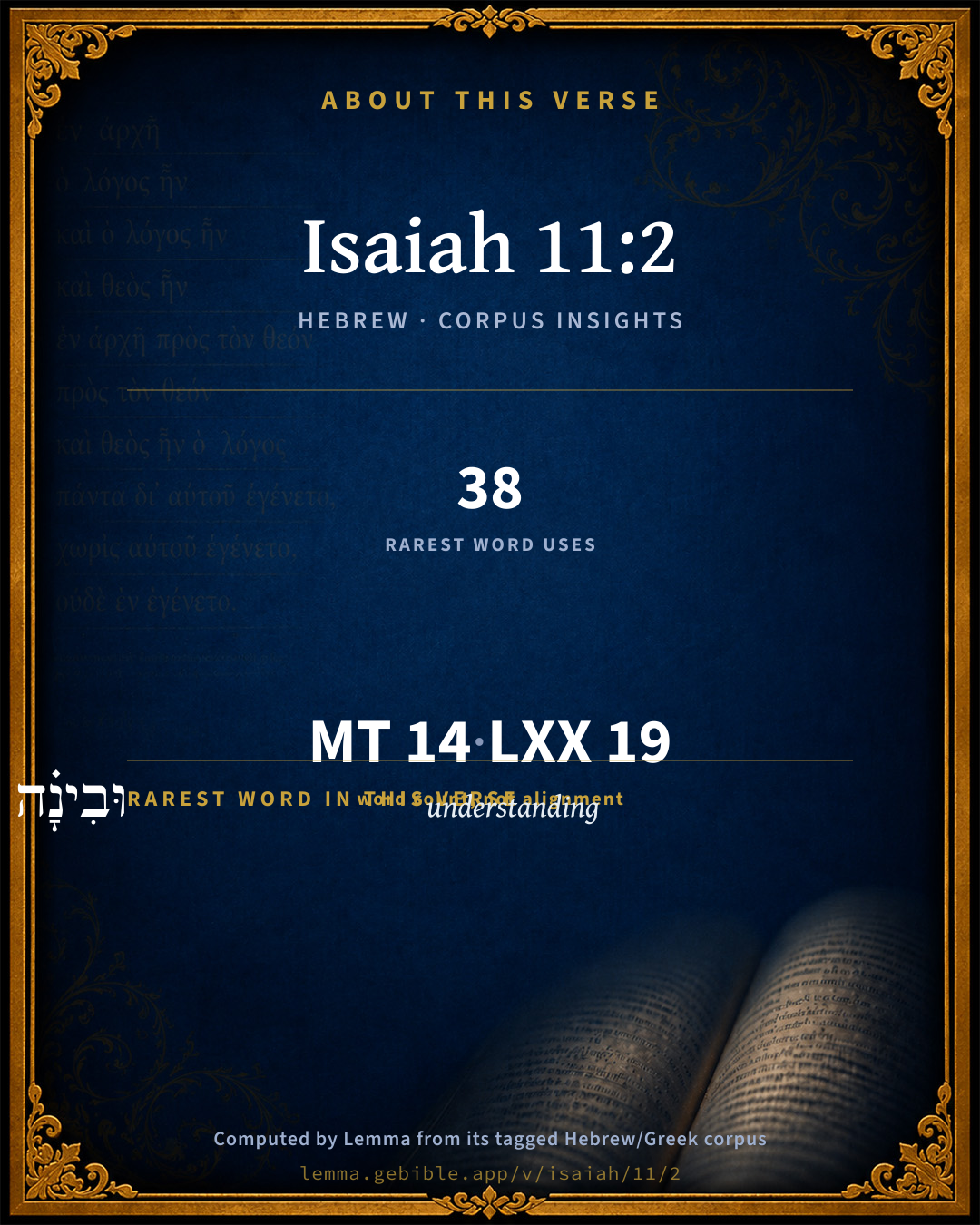
These counts appear in no published source. They are computed here, from the morphology-tagged text and Lemma’s own curated glosses. What Lemma adds →

14
words
10
distinct lemmas
Prophets
section

Shared distinctive vocabulary

וּבִינָ֗ה understanding H998 occurs in 38 verses of the Hebrew Bible. Also found in:

Grammatical profile

  • 1 verb
  • 12 nouns
  • 1 preposition

Verb forms

  • וְנָחָ֥ה Qal · Sequential Perfect

Repetition

Words recur within this verse — often emphatic in Hebrew:

  • ר֣וּחַ spirit H7307 ×4
  • יְהוָ֑ה LORD H3068 ×2

Hebrew & Septuagint length

In English translation the verse runs 30 words from the Hebrew and 30 from the Septuagint (LXX English) — the same length.

A rough comparison of the two English renderings, which tokenize alike — not a word-level alignment.

Word counts can differ between the Hebrew and the Greek without any difference in meaning — e.g. the Hebrew direct-object marker אֵת has no separate Greek word, and Greek often adds the article ὁ.

In the original languages it is 14 Hebrew tokens and 19 Greek tokens — but the two are counted differently (Hebrew bundles its prefixes and suffixes into one token; the Greek is in lemma form), so that isn’t a like-for-like length.

Cross-references

19

Topical passages linked to Isaiah 11:2 in the Treasury of Scripture Knowledge — connected by theme and wording, ordered by reader-vote popularity; previews shown in the World English Bible.

  • Isaiah 61:1 The Spirit of the Lord Yahweh is on me; because Yahweh has anointed me to preach good news to the humble; he has sent me to bind up the broken-hearted, to proclaim liberty to the captives, and the opening [of the prison] to those who are bound;
  • John 16:13 However when he, the Spirit of truth, has come, he will guide you into all truth, for he will not speak from himself; but whatever he hears, he will speak. He will declare to you things that are coming.
  • Ephesians 1:17–18 that the God of our Lord Jesus Christ, the Father of glory, may give to you a spirit of wisdom and revelation in the knowledge of him;
  • 2 Timothy 1:7 For God didn't give us a spirit of fear, but of power, love, and self-control.
  • Isaiah 42:1 Behold, my servant, whom I uphold; my chosen, in whom my soul delights: I have put my Spirit on him; he will bring forth justice to the Gentiles.
  • Matthew 3:16 Jesus, when he was baptized, went up directly from the water: and behold, the heavens were opened to him. He saw the Spirit of God descending as a dove, and coming on him.
  • Colossians 1:8–9 who also declared to us your love in the Spirit.
  • John 3:34 For he whom God has sent speaks the words of God; for God gives the Spirit without measure.
  • James 3:17–18 But the wisdom that is from above is first pure, then peaceful, gentle, reasonable, full of mercy and good fruits, without partiality, and without hypocrisy.
  • 1 Corinthians 1:30 But of him, you are in Christ Jesus, who was made to us wisdom from God, and righteousness and sanctification, and redemption:
  • Isaiah 48:16 Come you near to me, hear you this; from the beginning I have not spoken in secret; from the time that it was, there am I: and now the Lord Yahweh has sent me, and his Spirit.
  • Isaiah 59:21 As for me, this is my covenant with them, says Yahweh: my Spirit who is on you, and my words which I have put in your mouth, shall not depart out of your mouth, nor out of the mouth of your seed, nor out of the mouth of your seed's seed, says Yahweh, from henceforth and forever.
  • John 14:17 the Spirit of truth, whom the world can't receive; for it doesn't see him, neither knows him. You know him, for he lives with you, and will be in you.
  • Deuteronomy 34:9 Joshua the son of Nun was full of the spirit of wisdom; for Moses had laid his hands on him: and the children of Israel listened to him, and did as Yahweh commanded Moses.
  • John 1:32–33 John testified, saying, "I have seen the Spirit descending like a dove out of heaven, and it remained on him.
  • John 15:26 "When the Counselor has come, whom I will send to you from the Father, the Spirit of truth, who proceeds from the Father, he will testify about me.
  • Acts 10:38 even Jesus of Nazareth, how God anointed him with the Holy Spirit and with power, who went about doing good and healing all who were oppressed by the devil, for God was with him.
  • Numbers 11:25–26 Yahweh came down in the cloud, and spoke to him, and took of the Spirit that was on him, and put it on the seventy elders: and it happened that when the Spirit rested on them, they prophesied, but they did so no more.
  • Colossians 2:2–3 that their hearts may be comforted, they being knit together in love, and gaining all riches of the full assurance of understanding, that they may know the mystery of God, both of the Father and of Christ,

Cross-references courtesy of OpenBible.info (CC BY 4.0).

Hebrew and Greek witnesses Masoretic Hebrew ↔ Greek Septuagint

The same verse in the two great witnesses to the Old Testament, shown verse-for-verse.

These are two independent witnesses, not word-aligned to each other, and the Septuagint is shown in lemma (dictionary) form.

Hebrew Isaiah 11:2 Masoretic · Westminster Leningrad Codex

וְנָחָ֥ה עָלָ֖יו ר֣וּחַ יְהוָ֑ה ר֧וּחַ חָכְמָ֣ה וּבִינָ֗ה ר֤וּחַ עֵצָה֙ וּגְבוּרָ֔ה ר֥וּחַ דַּ֖עַת וְיִרְאַ֥ת יְהוָֽה

The Spirit of Yahweh shall rest on him, the spirit of wisdom and understanding, the spirit of counsel and might, the spirit of knowledge and of the fear of Yahweh.

World English Bible · Public Domain

Greek LXX Isaiah 11:2 Septuagint · lemma form

καί ἀναπαύω ἐπί αὐτός πνεῦμα ὁ θεός πνεῦμα σοφία καί σύνεσις πνεῦμα βουλή καί ἰσχύς πνεῦμα γνῶσις καί εὐσέβεια

and the Spirit of God shall rest upon him, the spirit of wisdom and understanding, the spirit of counsel and strength, the spirit of knowledge and godliness shall fill him;

LXX2012 (modern English Septuagint) · Public Domain

Hebrew: Westminster Leningrad Codex (CC BY 4.0). Greek: Septuagint (public domain); English from LXX2012 (modern English Septuagint) (Public Domain). How the Septuagint differs from the Hebrew →

Targum (Aramaic paraphrase)

1

The Targum is the ancient Jewish Aramaic paraphrase of the Hebrew Scriptures — an interpretive translation, not the Hebrew text itself. Onkelos (literal) and Pseudo-Jonathan (expansive) render the Torah, and Jonathan the Prophets. Coverage is partial: where no permissively-licensed English translation exists for a verse, only the Aramaic is shown. This is verse-level text, not a word-by-word alignment to the Hebrew.

  1. Targum Jonathan Prophets (Joshua–Malachi)
    וְתִשְׁרֵי עֲלוֹהִי רוּחַ נְבוּאָה מִן קֳדָם יְיָ רוּחַ חוּכְמָא וְסוּכְלְתָנוּ רוּחַ מְלַךְ וּגְבוּרָא רוּח מַדַע וּדְחַלְתָּא דַיָי:

    And there shall dwell upon him the spirit of prophecy from before the Lord: the spirit of wisdom and understanding, the spirit of counsel and might, the spirit of knowledge and of the fear of the Lord.

    Targum Jonathan — Aramaic: “Mikraot Gedolot” (public domain). English: “Sefaria Community Translation” (CC0 1.0 (public-domain dedication)); “London "Chaldee Paraphrase," 1871” (public domain). Text via Sefaria.

Commentary

Notes on Isaiah 11:2 from classic Christian and Jewish commentators (each source and its license shown beneath its notes). The classic Christian expositions comment on the surrounding passage and are grouped to its opening verse, so a note may address several verses; the Jewish commentaries on the Tanakh (Rashi and others) are per-verse, so they appear only where the commentator wrote on this verse.

Lemma curates 59 commentaries, every one of them public domain or Creative Commons licensed, each selected and text-cleaned for this edition rather than reprinted as found. About our sources →

Trapp's Complete Commentary

John Trapp

Isa 11:2 And the spirit of the LORD shall rest upon him, the spirit of wisdom and understanding, the spirit of counsel and might, the spirit of knowledge and of the fear of the LORD;

Ver. 2. And the Spirit of the Lord shall rest upon him.] After such a description of Christ’s person, {as Isa 11:1} follows here a declaration of his kingdom, which is set forth to be - first, Spiritual; {Isa 11:2} secondly, Just; {Isa 11:3-5} thirdly, Peaceable; {Isa 11:6-9} fourthly, Ample, as made up of Gentiles and Jews. {Isa 11:11, &c.}

Shall rest upon him.] His humanity shall be filled topfull with the gifts and graces of the Holy Ghost, to be as it were an everlasting treasure and cistern full of them for the use of the Church. {Joh 1:16; Joh 3:34 Act 2:33} And this was typified by the Holy Ghost descending in the likeness of a dove, at the time of his baptism, and resting upon him. {Mat 3:16 Joh 1:32-33} {a}

The spirit of wisdom and understanding.] These six princely virtues (for the schoolmen, misled by the Vulgate translation, falsely found their septiformem gratiam Spiritus Sancti) were eminently and transcendently in Christ; they should be also found in some measure in all rulers. {Deu 1:16 Exo 18:25 1Ki 3:12 Lev 19:35-37}

{a} Diodat. Annot.

John Trapp, A Commentary or Exposition upon All the Books of the Old and New Testament (1647–1656) — public domain. Text from a community e-Sword module.

The Biblical Illustrator

Joseph S. Exell

Isa_11:2-5

And the spirit of the Lord shall rest upon Him

The Spirit of the Lord

חריס is the Divine Spirit as the bearer of the whole fulness Divine powers.

Then follow in three pairs the six spirits comprehended by הרוה, the first pair of which relate to the intellectual life, the second to the practical life, and the third to the direct relationship to God. (F. Delitzsch.)

The Spirit of God

The Spirit of God is absolutely the heart of all; it corresponds to the shaft of the seven-flamed candlestick, and the three pairs to the arms that stretched out from it. (F. Delitzsch.)

The great Preacher

Here it is distinctly prophesied that our Saviour, when He should come into the world, would be peculiarly endowed by the Holy Spirit, with wisdom, discernment, and might in speech, such as should make Him a remarkable preacher.

I. WHAT A CONSUMMATE MASTER JESUS WAS OF REAL ELOQUENCE. Of course I do not refer to the petty arts and studied rules of the professional orator and actor. He needed none of these to aid Him; He was infinitely above them all. His whole demeanour was perfectly simple and natural, though earnest, discriminating, and impressive, as the pure love and complete appreciation of truth could make one. Aside from earnestness and naturalness, His great power of eloquence consisted--

1. In the clearness and completeness of His views.

2. In His perfect command, through language, of all the powers and passions of the human soul

II. HOW PLAINLY AND FORCIBLY OUR SAVIOUR PREACHED THE GREAT DOCTRINES OR FUNDAMENTAL FACTS OF THE GOSPEL SYSTEM.

III. THE PECULIAR MANNER AND AMAZING POWER OF THE SAVIOURS PREACHING. (E. P. Marvin.)

The Spirit of Whitsuntide

This is Isaiahs description of the Spirit of Whitsuntide; the royal Spirit which was to descend, and did descend without measure, on the ideal and perfect King. Let us consider what that Spirit is.

1. He is the Spirit of love. God is love; and He is the Spirit of God.

2. He is the Spirit of wisdom. Now, is the spirit of wisdom the same as the spirit of love?

(1) Sound theology, which is the highest reason, tells us that it must be so. To suppose that Gods wisdom and Gods love, or that Gods justice and Gods love, are different from each other, or limit each other, or oppose each other, or are anything but one and the same eternally, is to divide Gods substance; to deny that God is one.

(2) But more; experience will show us that the spirit of love is the same as the spirit of wisdom; that if any man wishes to be truly wise and prudent, his only way is to be loving and charitable. The experience of the apostles proves it. They had the most enormous practical success that men ever had. They, twelve poor men, set out to convert mankind by loving them: and they succeeded. Remember, moreover, that the text speaks of this Spirit of the Lord being given to One who was to be a King, a Ruler, a Guide, and a Judge of men; who was to exercise influence over men for their good. This prophecy was fulfilled first in the King of kings, our Lord Jesus Christ: but it was fulfilled also in His apostles, who were, in their own way and measure, kings of men, exercising a vast influence over them. And how? By the royal Spirit of love. Our own experience will be the same as the apostles experience. If we do not understand our fellow creatures we shall never love them. But it is equally true that if we do not love them we shall never understand them.

3. Next, this royal Spirit is described as the spirit of counsel and might, i.e., the spirit of prudence and practical power the spirit which sees how to deal with human beings, and has the practical power of making them obey. Now that power, again, can only be got by loving human beings. My experience is this: that whensoever in my past life I have been angry and scornful, I have said or done an unwise thing, I have more or less injured my own cause; weakened my own influence on my fellow men; repelled them instead of attracting them.

4. And next: this Spirit is the spirit of knowledge, and of the fear of the Lord. They both begin and end in love.

(1) If you wish for knowledge, you must begin by loving knowledge for its own sake. And the more knowledge you gain, the more you will long to know. And if this be true of things earthly and temporary, how much more of things heavenly and eternal? We must begin by loving whatsoever things are true, whatsoever things are just, whatsoever things are pure, honest, and of good report. We must begin by loving them with a sort of childs love, without understanding them. But as we go on, as St. Paul bids us, to meditate on them; and if there be any virtue and if there be any praise, to think on such things, and feed our minds daily with purifying, elevating, sobering, humanising, enlightening thoughts: then we shall get to love goodness with a reasonable and manly love, to see the beauty of holiness; the strength of self-sacrifice; the glory of justice; the divineness of love; and in a word--to love God for His own sake, and to give Him thanks for His great glory, which is: that He is a good God.

(2) This Spirit is also the spirit of the fear of the Lord. That, too, must be a spirit of love not only to God, but to our fellow creatures. For if we but consider that God the Father loves all; that His mercy is over all His works; and that He hateth nothing that He has made: then, how dare we hate anything that He has made, as long as we have any rational fear of Him, awe and respect for Him, true faith in His infinite majesty and power? If we but consider that God the Son actually came down on earth to die, and to die, too, on the Cross, for all mankind: then, how dare we hate a human being for whom He died! (C. Kingsley, M. A.)

Gifts of the Spirit from Christ to His Church

It was as Head of His Church that the Spirit was shed forth upon Him, and from Him descends upon His members. If we would, then, know what are the graces we are to expect of this kind, we must inquire what our Lord received.

I. THE GIFTS OF THE SPIRIT UPON CHRIST, FITTING HIM FOR HIS MEDIATORIAL OFFICE. Three several branches of grace seem intended: wisdom, might, intelligent devotion to Gods Word.

II. HOW THE GRACES OF SPIRITUAL INFLUENCE FLOW FROM CHRIST TO HIS PEOPLE.

1. They first descended on the apostles when, assembled at Jerusalem, they waited for the promise of the Father.

2. These gifts were not confined to the apostles. Multitudes, through their preaching, were turned from the idolatry of the Gentiles or the superstition of the Jews to serve the living God; and on them, too, the Spirit was bestowed.

3. Neither are these rich streams exhausted. The Saviour still bestows with liberal hand the spiritual influences we need. (J. Ayre, M. A.)

The Spirit of the Lord has always been in human history

It accounts for all heroisms, noble darings, self-sacrifices, for all labours meant, not for the blessedness of the labourer himself, but for the gratification and progress of other ages. (J. Parker, D. D.)

Spiritual endowments for earthly rulers

Modern expositors have often restricted this gracious description of royal enrichment to the ideal King of Israel, the coming Messiah. This application is, no doubt, its ultimate designation, but there is more than sufficient evidence to warrant the discrimination of mediaeval teachers, who boldly selected this heroic passage concerning the seven Spirits of God as a perfect epitome of the gifts that might be rightly claimed for those, and by those, who are Divinely called to wear an earthly crown, and to rule in temporal affairs. Dean Plumptre has suggested that these verses may well represent the programme which Isaiah himself set before his pupil, Hezekiah, on his accession to the throne, which his weak predecessor had suffered to degenerate into a vantage ground for abuse of justice and laxity of morals such as had deteriorated the faith and moral fibre of his people. And, as Dr. George Adam Smith points out, in the theology, art, and worship of the Middle Ages, this text was constantly and consistently associated with the assumption of royal responsibilities, and with the judicial administration of magistrates. It was known as the mirror for magistrates, and was commonly employed at the coronation of kings and the fencing of tribunals of justice. What Isaiah wrote for Hezekiah of Judah became the official prayer, song or ensample of the earliest Christian kings in Europe. It is evidently the model of that royal hymn--not by Charlemagne, as is usually supposed, but by his grandson, Charles the Bald--the Veni Creator Spiritus. So deeply did this sense of the need and privilege of the gifts of the Spirit for the ruling class pervade the life of the times that Henry IIIs order of knighthood, Du Saint Esprit, was restricted to political men, and particularly to magistrates. (F. Platt, B. D.)

Coronation gifts

We may, there fore, claim abundant precedent in using the text to correct two perilous tendencies in the national and religious thought of our own day--one brought about by a mistake made by men of the world in the affairs of State, and the other the result of a misapprehension by men of God in the affairs of the Spirit.

1. The first tendency, which is to depreciate the operation of the Spirit of God in civic life and duty, may be illustrated by a simple fact. In the Speech from the throne, at the opening of Queen Victorias last Parliament, the customary reference at the close to the blessing of Almighty God upon the labours of her faithful Commons was omitted. It was afterwards explained by a responsible Minister of the Crown that the omission was accidental, but the omission marks nevertheless a tendency. The recognition of the Divine in political life has become formal. Its symbols linger, but it is assumed that thoughtful men smile at them and lay the burthen of their survival upon the substantial emoluments of office, or upon the popular love of the spectacular symbols of dignity. In depreciating the Divine right of kings, have we diminished the assurance, By Me kings reign and princes decree justice? Do the splendours of a coronation impress us more than its solemnities! Does the sense of widening empire attract us more than a growing sensitiveness to the supremacy of spiritual obligation! Are we more responsive in national movements to the solicitations of sensual excitement than to the inward suggestions of the Spirit of knowledge and of the fear of the Lord! It was in the midst of social and political conditions strangely analogous to our own that Isaiah set forth his inspired conception of the spiritual qualifications of true kingship amongst men.

2. Between the tendency to depreciate the place of the Divine in national life, and the further tendency in religious thought to limit the sphere of the activities of the Spirit of God unduly to what are termed spiritual as opposed to temporal affairs, there is an inner correspondence that is very significant. There is a mode, popular amongst the religious, of speaking of the work of the Spirit of God as supernatural, and as thus excluding processes known as natural or rational, that is distinctly perilous. This distinction implies that we may feel and know the presence of the Spirit of God at the Keswick Convention, but fails to expect His influence in the Convention at Bloemfontein. It asserts His inspiration in Holy Scripture, but has no sure place for His control or suggestion in the leading articles of the secular press. His gifts may be possessed by the spiritually minded, but the man immersed in political affairs thinks and toils in quite another sphere. His presence is invoked at the councils of the Church, but at the councils of industry it is regarded as a negligible quality. In the problems of the soul His guidance as the Spirit of truth may be consciously expected, but in the problems of science men must follow the light of nature. It was against a similar conception in his time that Isaiahs declaration of the Spirits seven-fold gifts was announced. Israel had made the fatal distinction between secular and sacred that is at the root of so much of our own disregard of God. We do not wonder that with national emergencies and necessities such as these pressing upon him, Isaiah reveals the source and strength of political sagacity and regal authority as dwelling with these august prerogatives of the Spirit of the Lord that are prevailingly intellectual, the spirit of wisdom and understanding, the spirit of counsel and might, the spirit of knowledge and of the fear of the Lord. They display a marvellous coordination of the intellectual and practical life with the sense of the direct relation of the life to God. They cannot be too closely studied and applied as the Divine provision for the governing and political mind, and the scientific temper of our own day. Wisdom is the power of discerning the nature of things through the appearance; understanding the power of discerning the difference of things in their appearance; counsel is the gift of forming right conclusions, and might the ability to carry them through with energy. The knowledge of the Lord is knowledge founded on the fellowship of love; and the fear of the Lord is fear absorbed in reverence. These are the hidden springs of the genius for statesmanship. The Spirit is the true historic glory of royalty, and the secret of citizenship in all abiding developments of popular liberties and imperial expansion; and to accept any statute of limitations in the opulence of His energies in national life is as fatal to permanence as to progress. (F. Platt, B. D.)

The Spirit of God in patriotism and judicial administration

True patriotism is an inspiring variation of the work of the Spirit of God. Judicial administration is a part of religious life and faith. The Lord of hosts is for a spirit of judgment to him that sitteth in judgment, and for strength to them that turn the battle to the gate. (F. Platt, B. D.)

The hallowing of the secular life

Whilst we are heedful of the richer revelation of the grace of the Holy Spirit disclosed in the New Testament, the Old Testament interpretation of His gifts is of essential importance. This may be summed up generally as the hallowing of the secular life, the fertilising contact of the Spirit of God with matter and mind in their organisation in nature and in human society. Joseph as an administrator is recognised as His product--a man in whom the Spirit of God is. It was the equipment of Moses colleagues in the judicature, God took of the Spirit which was upon him and gave it unto them. Of Bezaleel and his weavers and craftsmen the record runs, I have filled him with the Spirit of God in wisdom and understanding, and in knowledge, and in all manner of workmanship to devise cunning work. Samsons might was the Spirit of the Lord, and the Spirit of the Lord clothed itself with Gideon for the prowess of his great military enterprise. The story of the coronation of Saul, Israels earliest king, is the progressive history of the movements and endowments of the Spirit of God. And time would fail to tell of David and the long line of kings whom the same Spirit anointed and established in government. (F. Platt, B. D.)

Christ is full of light

Going into a village at night, with the lights gleaming on each side of the street, in some houses they will be in the basement and nowhere else, and in others in the attic and nowhere else, and in others in some middle chamber; but in no house will every window gleam from top to bottom. So it is with mens faculties. Most of them are in darkness. One shines here, and another there; but there is no man whose soul is luminous throughout. But Christ presented a perfect character. Every room in His soul was filled with light. He is light. (H. W. Beecher.)

The Biblical Illustrator, edited by Joseph S. Exell (c. 1880s–1900s) — public domain. Text from a community e-Sword module.

Joseph Benson's Commentary

Isa 11:2. And the Spirit of the Lord — The Holy Ghost, by which he was anointed, (Act 10:38,) and by whose power his human nature was formed in the womb of the virgin, (Luk 1:35,) shall rest upon him — Shall not only come upon him at certain times, as it came upon the prophets, but shall have its constant and settled abode in him; the spirit of wisdom and understanding — It is not needful exactly to distinguish these two gifts; it is sufficient that they are necessary qualifications for a governor and a teacher, and it is evident they signify perfect knowledge of all things necessary for his own and people’s good, and a sound judgment to distinguish between things that differ; the spirit of counsel and might — Of prudence, to give good counsel; and of might and courage, to execute it; the spirit of knowledge — Of the perfect knowledge of the whole will and counsel of God, as also of all secret things, yea, of the hearts of men; fear of the Lord — A fear of reverence, a care to please him, and aversion to offend him.

Joseph Benson's Commentary on the Old and New Testaments (1811–1818) — public domain. Text from a community e-Sword module.

Tyndale Open Study Notes

Tyndale Open Resources

11:2 The Spirit of the Lord will rest on the Messiah. The succession of David’s line is guaranteed by the Spirit. The Messiah’s coming would bring justice and righteousness (11:4), peace (11:8), and the extension of the Kingdom to the nations (11:10; see also 32:15-16). • The promised Messiah would have great wisdom and understanding, like Solomon, as well as knowledge and the fear of the Lord (1 Kgs 3:28; 4:29; Prov 1:1-7; 2:6-7). • The Spirit of counsel and might alludes to Isa 9:6. The Messiah will be full of wisdom and will have the power to execute his righteous rule.

Tyndale Open Study Notes — © Tyndale Open Resources, licensed CC BY-SA 4.0. Text via the HelloAO Bible API.

Jamieson, Fausset & Brown

Robert Jamieson, A. R. Fausset & David Brown

Spirit of the Lord--JEHOVAH. The Spirit by which the prophets spake: for Messiah was to be a Prophet (Isa 61:1; Deu 18:15, Deu 18:18). Seven gifts of the Holy Spirit are specified, to imply that the perfection of them was to be in Him. Compare "the seven Spirits" (Rev 1:4), that is, the Holy Ghost in His perfect fulness: seven being the sacred number. The prophets had only a portion out of the "fulness" in the Son of God (Joh 1:16; Joh 3:34; Col 1:19).

rest--permanently; not merely come upon Him (Num 11:25-26).

wisdom-- (Co1 1:30; Eph 1:17; Col 2:3).

understanding--coupled with "wisdom," being its fruit. Discernment and discrimination (Mat 22:18; Joh 2:25).

counsel . . . might--the faculty of forming counsels, and that of executing them (Isa 28:29). Counsellor (Isa 9:6).

knowledge--of the deep things of God (Mat 11:27). The knowledge of Him gives us true knowledge (Eph 1:17).

fear of the Lord--reverential, obedient fear. The first step towards true "knowledge" (Job 28:28; Psa 111:10).

Jamieson, Fausset & Brown — Commentary Critical and Explanatory on the Whole Bible (1871) — public domain (CC PDM 1.0). Text via the HelloAO Bible API.

Ellicott's Commentary for English Readers

(2) And the spirit of the Lord shall rest upon him . . .—The words throw us at once back upon the memories of the past, and forwards upon the hopes of the future. It was the “spirit of the Lord” that had made men true heroes and judges in the days of old (Jdg_11:29; Jdg_13:25). It was in the “spirit of the Lord” descending on Jesus of Nazareth and abiding on Him (Joh_1:33) that men were taught to see the token that He was the Christ of God. And in this case the spirit was to give more than the heroic daring which had characterised Jephthah and Samson. The future King was to be as a David and Solomon in one, pre-eminent, chiefly, as the Prince of Peace (Isa_9:7), in the wisdom and counsel which had been the glory of the latter. “Wisdom,” in its highest form, as implying the comprehension of the secret things of God; “understanding,” as the sagacity which discerned the right thing to do and the right word to say (Heb_5:14) in all human relationships; these formed the first link in the chain of supernatural gifts. With these there was to be the “spirit of counsel and might,” the clear purpose and strength which fits a king for the right exercise of sovereignty; and lastly, as at once the crown and source of all, the “spirit of knowledge and of the fear of the Lord,” the reverence and faith which is “the beginning of all wisdom” (Pro_1:7). The copious use of the vocabulary of the Book of Proverbs is interesting as showing the part which that book played in the prophet’s education. (See Introduction.)

A Bible Commentary for English Readers, edited by Charles John Ellicott (1878–1897) — public domain. Text from a community e-Sword module.

The Cambridge Bible for Schools and Colleges

gen. ed. J. J. S. Perowne

2. His supernatural endowment through the spirit of Jehovah with the qualities of a perfect ruler. The “charismata” are grouped in three pairs; when we add the separate mention of the spirit of Jehovah at the head of the list we may perhaps find here the first suggestion of the “seven spirits” of God (Rev_1:4). In reality, however, the three pairs unfold the different aspects of the “Spirit of Jehovah.” The first pair of virtues are intellectual, the second practical, and the third religious.

wisdom and understanding (or “discernment”) are the fundamental intellectual qualifications of a judge or ruler. Deu_1:13; 1Ki_3:12.

counsel and might] “Counsel” is the faculty of adapting means to ends or of forming right resolutions; “might” the energy necessary to carry them through.

of knowledge and of the fear of the Lord] of the knowledge and fear of Jehovah. It seems necessary here to take “knowledge” as equivalent to “knowledge of Jehovah,” in spite of the rule that “not more than one construct can stand before the same genitive” (Davidson, Syntax, § 27. b). “Knowledge of Jehovah” is insight into His character and His moral claims on men, “fear of Jehovah” is the common O.T. expression for piety; both together make up the O.T. idea of religion.

The Cambridge Bible for Schools and Colleges (gen. ed. J. J. S. Perowne; Cambridge University Press, 1878–1918) — public domain. Text from a community e-Sword module.

John Gill's Exposition

And the Spirit of the Lord shall rest upon him,.... The rod and branch, the King Messiah, so qualifying him for his office, and the discharge of it. This shows that Christ's kingdom is of a spiritual nature, and administered in a spiritual manner, for which he was abundantly furnished by the "Spirit of the Lord" resting on him; by whom is meant the third Person in the Trinity, so called, not because created by him, for not any created spirit is meant, but because he proceeded from him; he is the one Jehovah with him, a divine Person, truly God, yet distinct both from the Father and the Son; so that here is a clear proof of the trinity of Persons. Christ was filled with the Spirit from the womb, and he descended and rested upon him at his baptism; he was anointed with him to be Prophet, Priest, and King, and received his gifts and graces from him without measure, which abide with him, and are designed in the following words:

the spirit of wisdom and understanding; which appeared in his disputation with the doctors; in his answers to the ensnaring questions of the Scribes and Pharisees; in the whole of his ministry; and in his conduct at his apprehension, trial, condemnation, and death; as also in the wisdom, knowledge, and understanding he imparted to his disciples, and does more or less to all his people:

the spirit of counsel and might; of "counsel", which fitted him to be the wonderful Counsellor, and qualified him to give suitable and proper advice to the sons of men; and of "might" or "power", to preach the Gospel with authority; do miracles in the confirmation of it; bear the sins of his people, and the punishment due to them; obtain eternal redemption for them; and engage with all their enemies and conquer them:

the spirit of knowledge, and of the fear of the Lord; and so as man had the "knowledge" of God the Father; of his mind and will; of the Scriptures, and things contained therein; of the law and Gospel; all the treasures of wisdom and knowledge were hid in him, which he communicates to his saints; and "of the fear of the Lord", and so had a reverence of him, a strict regard to his will, and always did the things which pleased him; see Heb 5:7 this verse is also applied to the Messiah, both by ancient and modern Jews (u).

(u) T. Bab. Sanhedrin, fol. 93. 2. Zohar in Gen. fol. 68. 3. & in Numb. fol. 54. 4. & 92. 1. & in Deut. fol. 123. 3. Bereshit Rabba, sect. 2. fol. 2. 4. sect. 8. fol. 6. 3. Bemidbar Rabba, sect. 13. fol. 209. 3. Midrash Ruth, fol. 34. 4. Pirke Eliezer, c. 3. fol. 3. 2. Raziel, fol. 11. 1. Tzeror Hammor, fol. 156. 1. Baal Hatturim in Numb. vii. 12. Yalkut Simeoni, par. 1. fol. 3. 1.

John Gill's Exposition of the Whole Bible (1746–1763) — public domain (CC PDM 1.0). Text via the HelloAO Bible API.

Albert Barnes' Notes on the Bible

And the Spirit of the Lord - The Spirit of Yahweh. Chaldee, ‘And there shall rest upon him the spirit of prophecy from before Yahweh.’ In the previous verse, the prophet had announced his origin and his birth. In this, he proceeds to describe his extraordinary endowments, as eminently holy, pure, and wise. There can be no doubt that reference is here had to the Holy Spirit, the third person of the sacred Trinity, as descending upon him in the fullness of his influences, and producing in him perfect wisdom, knowledge, and the fear of the Lord. The Spirit of Yahweh shall rest upon him - a Spirit producing wisdom, understanding, counsel, might, etc. All these are lit the Scriptures traced to the agency of the Holy Spirit; see 1Co 12:8-11. The meaning here is, that the Messiah should be endowed with these eminent prophetic gifts and qualifications for his ministry by the agency of the Holy Spirit. It was by that Spirit that the prophets had been inspired (see 2Pe 1:21; 2Ti 3:16); and as the Messiah was to be a prophet Deu 18:15, Deu 18:18, there was a fitness that he should be endowed in the same manner. If it be asked how one, who was divine in his own nature, could be thus endowed by the aid of the Spirit, the answer is, that he was also to be a man descended from the honored line of David, and that as a man he might be furnished for his work by the agency of the Holy Spirit. His human nature was kept pure; his mind was made eminently wise; his heart always retained the fear and love of God, and there is no absurdity in supposing that these extraordinary endowments were to be traced to God. That he was thus under the influence of the Holy Spirit, is abundantly taught in the New Testament. Thus, in Mat 3:16, the Holy Spirit is represented as descending on him at his baptism, In Joh 3:34, it is said, ‘For he whom God hath sent speaketh the words of God, for God giveth not the Spirit by measure unto him;’ compare Col 1:19.

Shall rest upon him - That is, shall descend on him, and remain with him. It shall not merely come upon him, but shall attend him permanently; compare Num 11:25-26.

The spirit of wisdom - The spirit producing wisdom, or making him wise. Wisdom consists in the choice of the best means to secure the best ends. This attribute is often given to the Messiah in the New Testament, and was always evinced by him; compare 1Co 1:30; Eph 1:17; Col 2:3 : ‘In whom are hid all the treasures of wisdom and knowledge.’

And understanding - The difference between the words here rendered wisdom and understanding is, that the former denotes wisdom properly; and the latter, that judgment resulting from wisdom, by which we distinguish things, or decide on their character.

The spirit of counsel - That by which be shall be qualified to “give” counsel or advice; the qualification of a public instructor and guide; see the note at Isa 9:6.

And might - Strength, vigor, energy; that strength of heart and purpose which will enable a man to meet difficulties, to encounter dangers, to be bold, open, and fearless in the discharge of his duties. It is not necessary to remark, that this characteristic was found in an eminent degree in the Lord Jesus Christ.

Of knowledge - That is, the knowledge of the attributes and plans of Yahweh; compare Mat 11:27 : ‘Neither knoweth any man the Father save the Son.’ Joh 1:18 : ‘No man hath seen God at I any time; the only begotten Son, which is in the bosom of the Father, he hath declared him;’ 1Jo 5:20.

And of the fear of the Lord - The fear of Yahweh is often used to denote piety in general, as consisting in a reverence for the divine commands, and a dread of offending him; “that is,” a desire to please him, which is piety; compare Job 28:28; Psa 19:9; Psa 111:10; Pro 1:7; Pro 3:13; Pro 15:33; Pro 19:23. That this characteristic was found eminently in the Lord Jesus, it is not necessary to attempt to prove.

Albert Barnes' Notes on the Bible (1834–1885) — public domain. Text from a community e-Sword/MySword module.

Haydock's Catholic Bible Commentary

Him. In the form of a dove, John i. 32. (Haydock) --- "The whole fountain of the Holy Ghost descending." (Ev. Nazar.) (St. Jerome) --- Christ was filled with his seven gifts, and of his fullness his servants receive. (Worthington) --- Yet all virtues are the gifts of the holy Spirit, and the number seven is not specified in Hebrew, as the same word (Calmet) yirath, is rendered godliness, which (ver. 3.) means, the fear of the Lord. (Haydock) --- God enables us to penetrate the difficulties of Scripture, and to act with prudence, &c. (Menochius)

George Leo Haydock (1774–1849), Haydock's Catholic Family Bible and Commentary, 1859 edition — public domain. Excludes Psalms (Douay-Rheims chapter numbering differs from Protestant) and Deuterocanonical books (Catholic canon only).

Matthew Poole's English Annotations

The Spirit of the Lord; the Holy Ghost, wherewith he was anointed, Act 10:38, and by whom his mother was overshadowed, Luk 1:35.

Shall rest upon him; not only come upon him at certain times, as he did upon the prophets now and then at his pleasure, but shall have its constant and settled abode in him; although the same phrase be sometimes used of other prophets in an inferior sense, as Num 11:17; 2Ki 2:15.

The Spirit of wisdom and understanding; which hath these perfections in itself, and confers them upon him. It is neither easy, nor at all necessary, exactly to distinguish these two gifts; it is sufficient that they are necessary qualifications for a governor, and for a teacher, both which offices were to meet in the Messiah; and it is evident that they signify a practical and perfect knowledge of all things necessary for the discharge of his trust, and for his own and people’s good, and a sound judgment, to distinguish between things that differ.

Of counsel and might; of prudence, to give good counsel; and of might and courage, to execute it; which are two necessary qualifications of a ruler.

Of knowledge; of the perfect knowledge of the whole will and counsel of God, especially that which concerns the salvation of men, the prosecution whereof was his great work, as also of all secret and hidden things, yea, of the hearts of men, the knowledge whereof is ascribed to Christ. Mat 9:4; Rev 2:23.

Of the fear of the Lord; not a fear of diffidence or horror, but of reverence; a care to please him, and loathness to offend him, which well became the Messiah towards his God and Father.

Matthew Poole's English Annotations on the Holy Bible (1683–1685) — public domain. Text from a community e-Sword/MySword module.

Whedon's Commentary on the Bible

Daniel D. Whedon

2. The Spirit of the Lord — The Holy Spirit of Jehovah, who communicates the whole creative fulness of divine powers.

Shall rest upon him — In dove-like descent, as at the Jordan, with fulness of miraculous powers, and upon his person as the true temple. Three pairs of virtues now follow.

Wisdom and understanding — These are poetically joined, but perhaps as equivalent expressions. They relate to the intellectual life.

Counsel and might — Corresponding, as in Isa_9:7, to “Counsellor and mighty God.” These are combined with “wisdom and understanding” in Pro_8:14. They pertain to the practical life.

Knowledge and… fear of the Lord — These have direct relation to God. Knowledge is founded on fellowship of love, and fear of Jehovah is absorbed in holy reverence. Virtually, “the Spirit” is used seven times. Is this accidental? Theosophy says, No; and seeks its “mystical symmetries” among examples like this, of “sacred sevens,” “triple pairs,” etc. For sacred numbers see Whedon’s supplementary note to chapter vi, of Commentary on Luke. Also Delitzsch’s Biblical Psychology, Mahan’s Psalmonia, and Stuart on the Apocalypse. App. 2. vol. 2.

Daniel D. Whedon (gen. ed.), Commentary on the Old and New Testaments (1874–1909) — public domain. Text from a community e-Sword module.

The Pulpit Commentary

The Spirit of the Lord shall rest upon him. (comp, Mat_3:16 Luk_2:40 Luk_4:1, Luk_4:14, 18 Joh_3:34, etc.) The human nature of our Lord required, and received abundantly, the sanctifying and enlightening influences of the Holy Spirit. These influences were not in him transient or occasional, as in too many men, who more or less resist the Spirit," but permanent and enduring. They rested upon" him; from first to last never quitted, and never will quit, him. The spirit of wisdom and understanding. The influences of the Holy Spirit are manifold, affecting the entire complex nature of man. (see 1Co_12:8-11) Here, three pairs of graces are set forth as specially manifested in the Messiah through the power of the Spirit:

(1) "Wisdom and understanding," or intellectual and moral apprehension (eusunesia ) the ability to perceive moral and abstract truth;

(2) "counsel and might," or the power at once to scheme and originate, and also to carry out thought into act;

(3) "The knowledge and the fear of the Lord," or acquaintance with the true will of God, combined with the determination to carry out that will to the full. (Joh_4:34 Luk_22:42 Heb_10:7) It is needless to say that all these qualities existed in the greatest perfection in our blessed Lord.

Christ"s enduements by the Spirit.

The prophetic conception of Messiah is of a man, specially endowed and fitted for his mission by God"s Spirit. The figures that help prophetic vision are David, endowed with the spirit of rule and of song; and Solomon, endowed with the spirit of wisdom. And the New Testament bids us think of Christ as having the Spirit, not by measure, but without measure the fullness of God dwelling in him. (Col_1:19 Col_2:9) Compare the beginning of our Lord"s sermon at Nazareth: The Spirit of the Lord is upon me". (Luk_4:18) The point suggested is that God"s enduements are always in precise adaptation to a man"s work. Here, in relation to Christ, the qualities are arranged in three pairs, but all spring from one Source, the Spirit of Jehovah, which rests permanently upon him. They are

(1) moral and intellectual clearness of perception;

(2) the wisdom and bravery which befit a ruler;

(3) a knowledge of the requirements of Jehovah, and the will to act agreeably to this knowledge" (Cheyne).

Christ was a Teacher, Healer, Example, Savior, Head of a spiritual kingdom. As fitting him for these positions and offices, he was endued with

I WISDOM. The special gifts of the ruler, as called to judge difficult, complex cases. In its highest form implying comprehension of the secret things of God.

II UNDERSTANDING. Or keen, quick discernment; the sagacity which discovers the right thing to do, and the right word to say, in all human relationships.

III COUNSEL. The power to form wise plans; the clear purpose which fits a king for the exercise of sovereignty. "He shall know how to administer the affairs of his spiritual kingdom in all the branches of it, so as effectually to answer the two great ends of it the glory of God, and the welfare of the children of men.

IV MIGHT. The ability to carry plans into execution. With men we often find a divorce between the skill to plan and the power to execute.

V FEAR OF GOD. The disposition which keeps us ever anxiously watching for, and resolved to do, God"s will. The reverence and faith which is the beginning of all wisdom.

Illustrations of each may readily be found in the life of the Lord Jesus; and it may be urged that all these enduements brought him the power that lies in righteousness the power

(1) to wither all evil;

(2) to nourish all good. R.T.

The Pulpit Commentary (1880–1919), ed. H.D.M. Spence-Jones & Joseph S. Exell — public domain. Text from a community e-Sword module.

John Wesley's Explanatory Notes

Wisdom - It is not needful, exactly to distinguish these two gifts; it is sufficient that they are necessary qualifications for a governor, and a teacher, and it is evident they signify perfect knowledge of all things necessary for his own and peoples good, and a sound judgment, to distinguish between things that differ. Counsel - Of prudence, to give good counsel; and of might and courage, to execute it. Knowledge - Of the perfect knowledge of the whole will and counsel of God, as also of all secret things, yea of the hearts of men. Fear - A fear of reverence, a care to please him, and lothness to offend him.

John Wesley, Explanatory Notes Upon the Whole Bible (1754–1765) — public domain. Text via the GEBible commentary corpus.

Keil & Delitzsch

C. F. Keil & F. Delitzsch

Jehovah acknowledges Him, and consecrates and equips Him for His great work with the seven spirits."And the Spirit of Jehovah descends upon Him, spirit of wisdom and understanding, spirit of counsel and might, spirit of knowledge and fear of Jehovah." "The Spirit of Jehovah" (ruach Yehovah) is the Divine Spirit, as the communicative vehicle of the whole creative fulness of divine powers. Then follow the six spirits, comprehended by the ruach Yehovah in three pairs, of which the first relates to the intellectual life, the second to the practical life, and the third to the direct relation to God. For chocmâh (wisdom) is the power of discerning the nature of things through the appearance, and bı̄nâh (understanding) the power of discerning the differences of things in their appearance; the former is σοφία, the latter διάκρισις or σύνεσις. "Counsel" (etzâh) is the gift of forming right conclusions, and "might" (gebūrâh) the ability to carry them out with energy. "The knowledge of Jehovah" (da‛ath Yehovah) is knowledge founded upon the fellowship of love; and "the fear of Jehovah" (yir'ath Yehovâh), fear absorbed in reverence. There are seven spirits, which are enumerated in order from the highest downwards; since the spirit of the fear of Jehovah is the basis of the whole (Pro 1:7; Job 28:28; Psa 111:10), and the Spirit of Jehovah is the heart of all. It corresponds to the shaft of the seven-lighted candlestick, and the three pair of arms that proceeded from it. In these seven forms the Holy Spirit descended upon the second David for a permanent possession, as is affirmed in the perf. consec. ונהה (with the tone upon the ultimate, on account of the following guttural, to prevent its being pronounced unintelligibly;

(Note: This moving forward of the tone to the last syllable is also found before Ayin in Gen 26:10, and very commonly with kūmâh, and verbs of a similar kind; also before Elohim and Jehovah, to be read Adonai, and before the half-guttural resh, Psa 43:1; Psa 119:154, but nowhere on any other ground than the orthophonic rather than euphonic one mentioned above; compare also וסרה in Isa 11:13, with וסרוּ (with ה following) in Exo 8:7.)

nuach like καταβαίνειν καὶ μένειν, Joh 1:32-33). The seven torches before the throne of God (Rev 4:5, cf., Isa 1:4) burn and give light in His soul. The seven spirits are His seven eyes (Rev 5:6).

Keil & Delitzsch — Biblical Commentary on the Old Testament (1861–1891) — public domain (CC PDM 1.0). Text via the HelloAO Bible API. (Old Testament only.)

J. A. Alexander on Isaiah

Joseph Addison Alexander

The person, whose origin and descent are metaphorically described in the preceding verse, is here described by His personal qualities, as One endowed with the highest intellectual and moral gifts by the direct influences of the Holy Spirit. “And upon Him shall rest the Spirit of Jehovah, a Spirit of wisdom and understanding, a Spirit of counsel and strength, a Spirit of knowledge and of the fear of Jehovah.” The genitives do not denote qualities but effects of the Spirit. The Spirit of Jehovah is not here described as being Himself wise etc. but as the author of wisdom in others. This is evident from the last clause, where the fear of Jehovah cannot be an attribute of His Spirit, but must be a fruit of His influence. The qualities enumerated are not to be confounded as mere synonyms, nor on the other hand distinguished with metaphysical precision. None of these terms is entirely exclusive of the others. Wisdom, understanding, the knowledge of God, the fear of God, are all familiar scriptural descriptions of religion or piety in general. ‘Wisdom and understanding’ are often joined as equivalent expressions. The latter, according to its etymology, strictly denotes the power of discernment or discrimination. Both are applied to theoretical and practical wisdom, and especially to moral and religious subjects. ‘Counsel and strength’ are the ability to plan and the ability to execute, neither of which can avail without the other. The knowledge of God does not in itself mean the love of Him, although it may infer it as a necessary consequence. The correct knowledge of Him certainly produces godly fear or holy reverence, and the two are probably put here for religion in the general. The only person in whom the terms of this prediction have been verified is Jesus Christ, Whose wisdom displayed itself in early life and is expressly ascribed to a special divine influence; Who proved Himself a discerner of the thoughts and intents of the heart; Whose ministry was not only characterized by fortitude and boldness, but attested by miracles and mighty deeds; Whose knowledge of divine things far surpassed that of all other men; and Who was Himself a living model of all piety.

Joseph Addison Alexander, The Prophecies of Isaiah (1846–1847; New York: Scribner, 1870–1878) — public domain. Text from a community e-Sword module.

Scofield Reference Notes

C. I. Scofield

fear (See Scofield "Psa 19:9")

The Scofield Reference Bible (1917 edition), notes by C. I. Scofield — public domain. Text from a community e-Sword module.

Ibn Ezra

Rabbi Abraham ibn Ezra

ונחֽה And shall rest. Comp. ושבֽה (Lev. 23:13), And she shall return. It is a verb.(נוח) ע״ו

The spirit of the Lord, that is, the spirit of wisdom and understanding, such as, e.g., was assigned to Joshua (Deut. 34:9).

And might. Hezekiah was mighty, as stated (2 Kings 20:20)

Ibn Ezra on the Tanakh — English translations: “Sefaria Community Translation” (CC0 1.0 (public-domain dedication)); “Yalkut, Sifsei Chachomim Chumash, Metsudah Publications, 2009” (CC BY 4.0); and “Commentary of Ibn Ezra on Isaiah - trans. by M. Friedlander, 1873” (public domain). Text via Sefaria.

Lesson kit

Teaching starters — assembled from the data on this page, not authored interpretation. Every prompt links to the verse data it draws on. Edit before teaching.

Isaiah, in the Prophets, opens this verse with 14 words (10 distinct Hebrew lemmas). Its most distinctive word is bîynâh (“understanding”). A historical commentator’s framing appears above. Read the whole chapter for the surrounding context.

Discussion questions

  1. How does “understanding” (bîynâh) shape what this verse is saying?
  2. How does Deuteronomy 4:6, which shares the word «understanding», read alongside this verse?
  3. What does the repetition of “spirit” (4× in this one verse) do in this verse?
  4. These translations render this verse differently. What is at stake in choosing one wording over another?
  5. «וְנָחָ֥ה» is a Qal Sequential Perfect verb. How does that grammatical form shape the action described?
  6. Compare how Trapp's Complete Commentary and The Biblical Illustrator read this verse. Where do they agree or differ?

Things to notice

Reading settings

Reading text

Shown beneath each verse's original-language words.

Old Testament
Old Testament edition

Read the OT as the Masoretic Hebrew (MT) or the Greek Septuagint (LXX).

English shown for the Greek Septuagint (in the Hebrew ↔ Greek comparison).

Comparing translations? Open the Compare panel on any verse page to stack up to four side by side.