
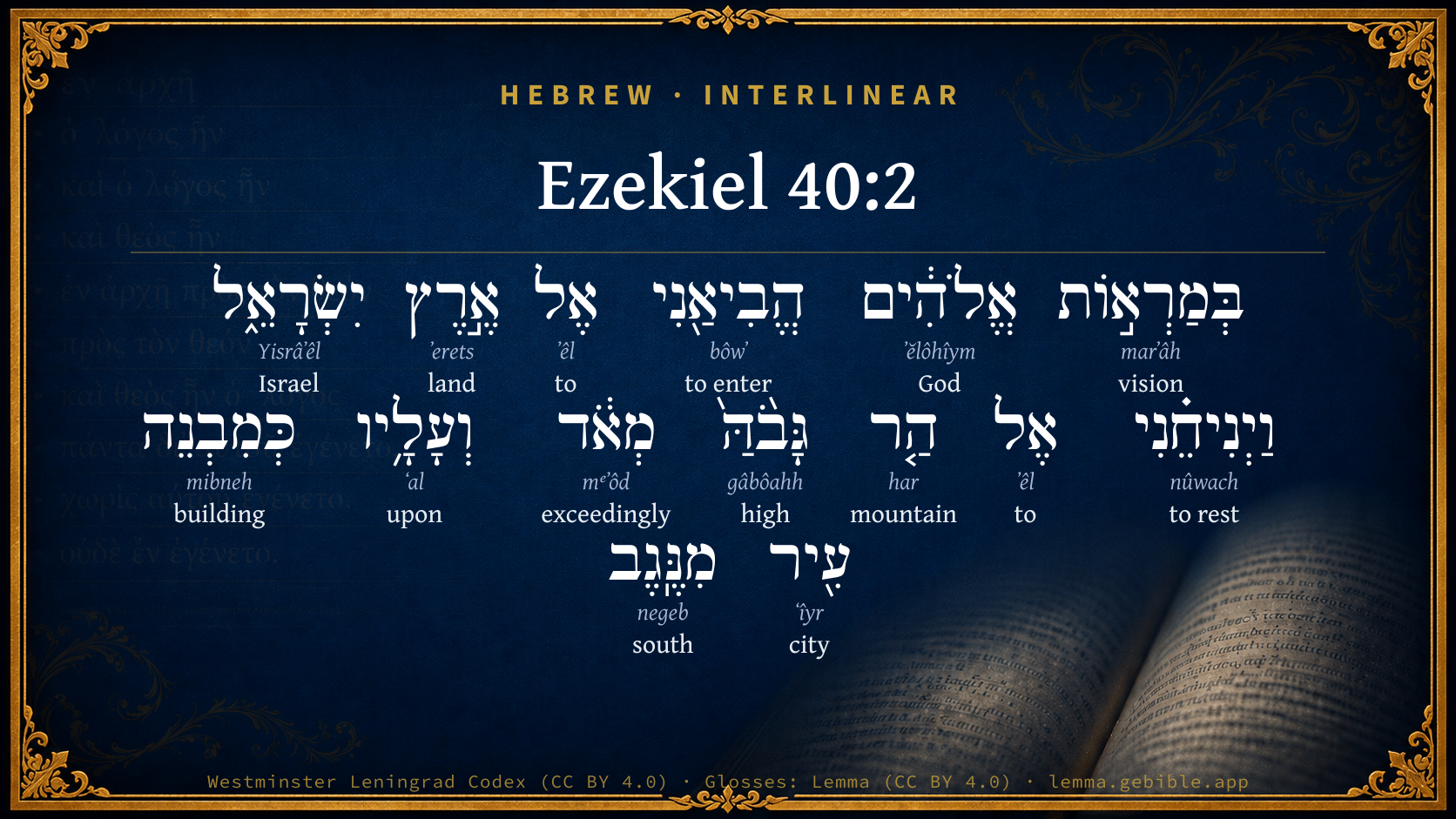
Ezekiel 40:2

Hebrew (Westminster Leningrad Codex) Ezekiel 40:2 appears in the Hebrew Old Testament. The text above is from the Westminster Leningrad Codex. Each word links to its Strong’s number, a concise gloss, and parsing drawn from the Open Scriptures Hebrew Bible morphology. Click any word for its full Brown-Driver-Briggs (BDB) entry.
Download image
Cite this verse

Ezekiel 40:2 (World English Bible). Public Domain. Lemma interlinear Bible study tool, https://lemma.gebible.app/v/ezekiel/40/2.

Show BibTeX & RIS
BibTeX
RIS
English Translation
In the visions of God brought he me into the land of Israel, and set me down on a very high mountain, whereon was as it were the frame of a city on the south.
World English Bible · Public Domain
Highlights
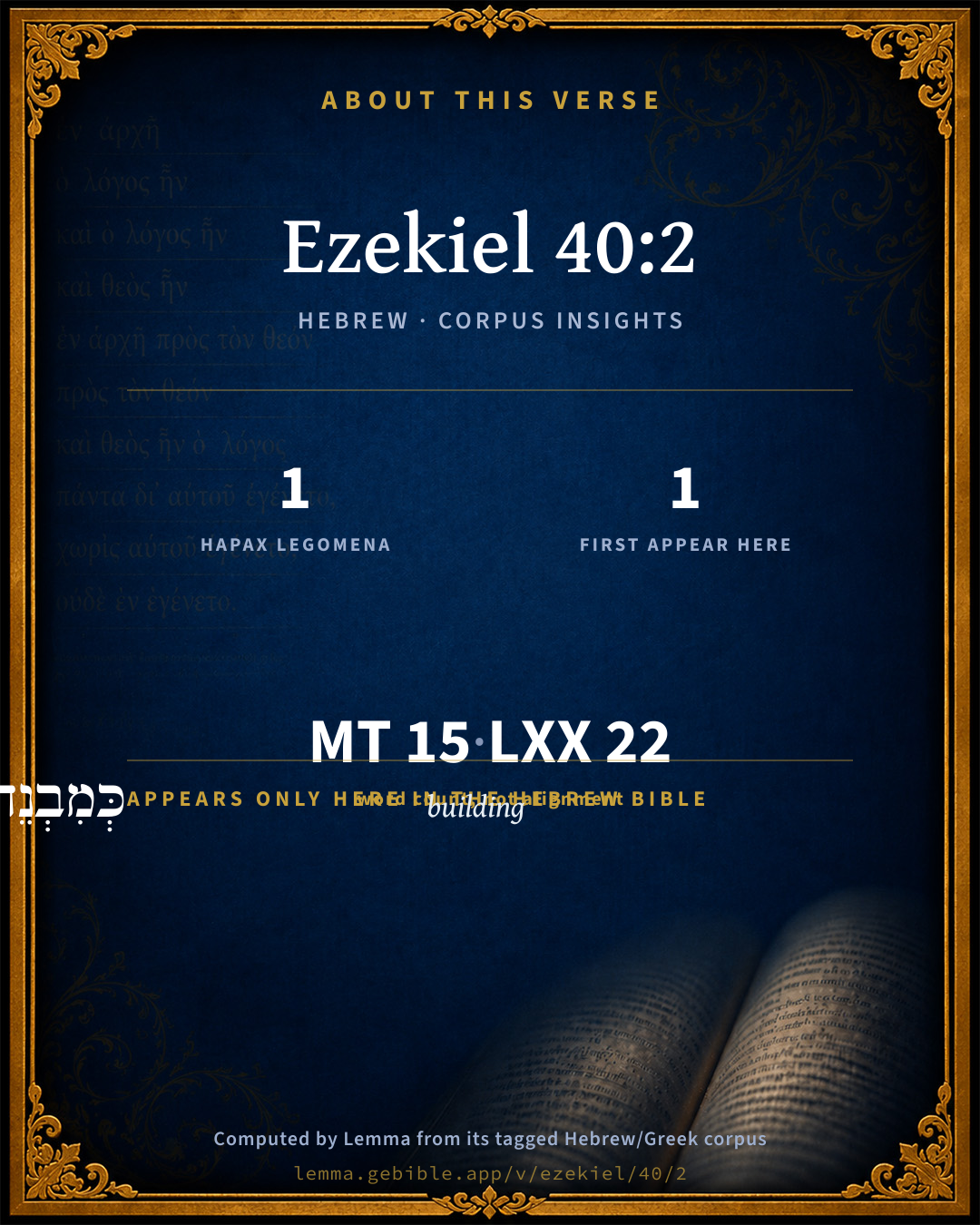
  • 1 hapax legomenon — only here in the Hebrew Bible
  • 1 first appearance in the Hebrew Bible
Full analysis ↓
Download a study sheet

One document with this verse’s original text, its word-by-word gloss line, the meaning frame, cross-references with their text, attributed commentary, and full source and license credits — printable, and it pastes into notes with its structure intact.

This verse Autodidact and up

Study sheet (.html) Plain text (.txt)

A passage Seminary Student

Up to 50 verses in one chapter. A passage sheet keeps up to 6 commentary sources and 12 cross-references per verse, in the order this page ranks them, and says so on the sheet whenever that leaves anything out. Ask for a single verse and you get the Autodidact verse sheet above.

Everything on this page stays free to read, with no account — the sheet is a download of what is already on screen, not access to it.

Want to remove ads? Support Godless Engineer
Compare translations 3

The same verse in 3 English versions, stacked beneath the original-language interlinear above. Click any original word for its lexicon entry.

Each is an independent rendering of the whole verse — the interlinear is not word-aligned to these translations.

Highlighted words mark where these versions differ — a whole-verse word diff, not a word-by-word alignment.

  • World English Bible Public Domain
    In the visions of God brought he me into the land of Israel, and set me down on a very high mountain, whereon was as it were the frame of a city on the south.
  • King James Version Public Domain
    In the visions of God brought he me into the land of Israel, and set me upon a very high mountain, by which was as the frame of a city on the south.
  • unfoldingWord Literal Text CC BY-SA 4.0
    In visions from God he brought me to the land of Israel. He brought me to rest on a very high mountain; to the south were what appeared to be buildings of a city.

unfoldingWord Literal Text — © unfoldingWord, licensed CC BY-SA 4.0. Word-aligned USFM3 via Door43 (git.door43.org/unfoldingWord/en_ult).

Versions to compare (up to 4)

3 of 4 selected

Show all 18 translations

Every available English version of this verse, each an independent rendering of the whole verse.

  • World English Bible Public Domain
    In the visions of God brought he me into the land of Israel, and set me down on a very high mountain, whereon was as it were the frame of a city on the south.
  • Berean Standard Bible Public Domain
    In visions of God He took me to the land of Israel and set me on a very high mountain, on whose southern slope was a structure that resembled a city.
  • Majority Standard Bible Public Domain
    In visions of God He took me to the land of Israel and set me on a very high mountain, on whose southern slope was a structure that resembled a city.
  • King James Version Public Domain
    In the visions of God brought he me into the land of Israel, and set me upon a very high mountain, by which was as the frame of a city on the south.
  • American Standard Version (1901) Public Domain
    In the visions of God brought he me into the land of Israel, and set me down upon a very high mountain, whereon was as it were the frame of a city on the south.
  • Revised Version (1885) Public Domain
    In the visions of God brought he me into the land of Israel, and set me down upon a very high mountain, whereon was as it were the frame of a city on the south.
  • Geneva Bible (1599) Public Domain
    Into the lande of Israel brought he me by a diuine vision, and set me vpon a very hie mountaine, whereupon was as the building of a citie, toward the South.
  • Douay-Rheims (1899) Public Domain
    In the visions of God he brought me into the land of Israel, and set me upon a very high mountain: upon which there was as the building of a city, bending towards the south.
  • Young's Literal Translation Public Domain
    in visions of God He hath brought me in unto the land of Israel, and causeth me to rest on a very high mountain, and upon it `is' as the frame of a city on the south.
  • Literal Standard Version CC BY-SA 4.0
    in visions of God He has brought me into the land of Israel, and causes me to rest on a very high mountain, and on it [is] as the frame of a city from the south.
  • Unlocked Literal Bible CC BY-SA 4.0
    In visions from God he brought me to the land of Israel. He brought me to rest on a very high mountain; to the south were what appeared to be buildings of a city.
  • unfoldingWord Literal Text CC BY-SA 4.0
    In visions from God he brought me to the land of Israel. He brought me to rest on a very high mountain; to the south were what appeared to be buildings of a city.
  • Darby Bible Public Domain
    In the visions of God brought he me into the land of Israel, and set me upon a very high mountain; and upon it was as the building of a city, on the south.
  • World Messianic Bible Public Domain
    In the visions of God he brought me into Eretz-Israel, and set me down on a very high mountain, on which was something like the frame of a city to the south.
  • Webster's Bible Public Domain
    In the visions of God he brought me into the land of Israel, and set me upon a very high mountain, by which was as the frame of a city on the south.
  • Free Bible Version CC BY-SA 4.0
    God took me to the country of Israel in vision and set me down on a very high mountain. On the south side of the mountain there were buildings that seemed to be a city.
  • Bible in Basic English Public Domain
    In the visions of God he took me into the land of Israel, and put me down on a very high mountain, on which there was, as it seemed, a building like a town opposite me.
  • JPS Tanakh (1917) Public Domain
    In the visions of God brought He me into the land of Israel, and set me down upon a very high mountain, whereon was as it were the frame of a city on the south.

Literal Standard Version (2020), Covenant Press — licensed CC BY-SA 4.0. Text via the HelloAO Bible API (eBible.org). Unlocked Literal Bible (unfoldingWord) — licensed CC BY-SA 4.0. Text via the HelloAO Bible API (eBible.org). unfoldingWord Literal Text — © unfoldingWord, licensed CC BY-SA 4.0. Word-aligned USFM3 via Door43 (git.door43.org/unfoldingWord/en_ult). Free Bible Version, Dr. Jonathan Gallagher — licensed CC BY-SA 4.0. Text via the HelloAO Bible API (eBible.org).

Word by word

More ways to search: Search by grammar → Find every occurrence → Compare this word →

Practice this passage: Drill this verse → Learn its vocabulary →

כְּמִבְנֵה
mibneh
H4011
“like/as · building of”
Preposition + Noun, Common, Masculine, Singular, Construct
Part of Speech
Preposition + Noun
Type
Common
Gender
Masculine
Number
Singular
State
Construct
Full BDB Definition

Origin: from H1129

TWOT: 255c

structure, building
  1. בְּמַרְא֣וֹת marʼâh H4759 “in/at · visions of” Preposition + Noun, Common, Feminine, Plural, Construct
  2. אֱלֹהִ֔ים ʼĕlôhîym H430 “God(s)” Noun, Common, Masculine, Plural, Absolute
  3. הֱבִיאַ֖נִי bôwʼ H935 “to enter · me” Verb, Hiphil, Perfect, 3rd Person, Masculine, Singular + Suffix, Personal, 1st Person, Common, Singular
  4. אֶל ʼêl H413 “to” Preposition
  5. אֶ֣רֶץ ʼerets H776 “land of” Noun, Common, Both, Singular, Construct
  6. יִשְׂרָאֵ֑ל Yisrâʼêl H3478 “Israel” Noun, Proper
  7. וַיְנִיחֵ֗נִי nûwach H5117 “and · to rest · me” Conjunction + Verb, Hiphil, Sequential Imperfect, 3rd Person, Masculine, Singular + Suffix, Personal, 1st Person, Common, Singular
  8. אֶל ʼêl H413 “to” Preposition
  9. הַ֤ר har H2022 “mountain” Noun, Common, Masculine, Singular, Absolute
  10. גָּבֹ֨הַּ֙ gâbôahh H1364 “high” Adjective, Adjective, Masculine, Singular, Absolute
  11. מְאֹ֔ד mᵉʼôd H3966 “exceedingly” Adverb
  12. וְעָלָ֥יו ʻal H5921 “and · upon · him” Conjunction + Preposition + Suffix, Personal, 3rd Person, Masculine, Singular
  13. עִ֖יר ʻîyr H5892 “city” Noun, Common, Feminine, Singular, Absolute
  14. מִנֶּֽגֶב negeb H5045 “from · south” Preposition + Noun, Common, Masculine, Singular, Absolute

About this verse

These counts appear in no published source. They are computed here, from the morphology-tagged text and Lemma’s own curated glosses. What Lemma adds →

15
words
14
distinct lemmas
Prophets
section

Notable vocabulary

1 hapax legomenon — a word that appears only here in the entire Hebrew Bible:

  • כְּמִבְנֵה building H4011

First appearance in Scripture

This word makes its first canonical appearance in the Hebrew Bible here:

  • כְּמִבְנֵה building H4011

Shared distinctive vocabulary

בְּמַרְא֣וֹת vision H4759 occurs in 10 verses of the Hebrew Bible. Also found in:

Grammatical profile

  • 2 verbs
  • 8 nouns
  • 1 adjective
  • 3 prepositions
  • 1 adverb

Verb forms

  • הֱבִיאַ֖נִי Hiphil · Perfect
  • וַיְנִיחֵ֗נִי Hiphil · Sequential Imperfect

Repetition

A word recurs within this verse — often emphatic in Hebrew:

  • אֶל to H413 ×2

Hebrew & Septuagint length

In English translation the verse runs 35 words from the Hebrew and 33 from the Septuagint (LXX English) — closely comparable.

A rough comparison of the two English renderings, which tokenize alike — not a word-level alignment.

Word counts can differ between the Hebrew and the Greek without any difference in meaning — e.g. the Hebrew direct-object marker אֵת has no separate Greek word, and Greek often adds the article ὁ.

In the original languages it is 15 Hebrew tokens and 22 Greek tokens — but the two are counted differently (Hebrew bundles its prefixes and suffixes into one token; the Greek is in lemma form), so that isn’t a like-for-like length.

Cross-references

18

Topical passages linked to Ezekiel 40:2 in the Treasury of Scripture Knowledge — connected by theme and wording, ordered by reader-vote popularity; previews shown in the World English Bible.

  • Ezekiel 1:1 Now it happened in the thirtieth year, in the fourth [month], in the fifth [day] of the month, as I was among the captives by the river Chebar, that the heavens were opened, and I saw visions of God.
  • Daniel 7:1 In the first year of Belshazzar king of Babylon Daniel had a dream and visions of his head on his bed: then he wrote the dream and told the sum of the matters.
  • Daniel 7:7 After this I saw in the night-visions, and, behold, a fourth animal, awesome and powerful, and strong exceedingly; and it had great iron teeth; it devoured and broke in pieces, and stamped the residue with its feet: and it was diverse from all the animals that were before it; and it had ten horns.
  • 1 Chronicles 28:12 and the pattern of all that he had by the Spirit, for the courts of the house of Yahweh, and for all the surrounding rooms, for the treasuries of the house of God, and for the treasuries of the dedicated things;
  • 1 Chronicles 28:19 All this, [said David], have I been made to understand in writing from the hand of Yahweh, even all the works of this pattern.
  • Isaiah 2:2–3 It shall happen in the latter days, that the mountain of Yahweh's house shall be established on the top of the mountains, And shall be raised above the hills; And all nations shall flow to it.
  • Isaiah 14:13 You said in your heart, I will ascend into heaven, I will exalt my throne above the stars of God; and I will sit on the mountain of congregation, in the uttermost parts of the north;
  • Ezekiel 8:3 He put forth the form of a hand, and took me by a lock of my head; and the Spirit lifted me up between earth and the sky, and brought me in the visions of God to Jerusalem, to the door of the gate of the inner [court] that looks toward the north; where was the seat of the image of jealousy, which provokes to jealousy.
  • Ezekiel 17:22–23 Thus says the Lord Yahweh: I will also take of the lofty top of the cedar, and will set it; I will crop off from the topmost of its young twigs a tender one, and I will plant it on a high and lofty mountain:
  • Micah 4:1 But in the latter days, It will happen that the mountain of Yahweh's temple will be established on the top of the mountains, And it will be exalted above the hills; And peoples will stream to it.
  • Isaiah 48:2 (for they call themselves of the holy city, and stay themselves on the God of Israel; Yahweh of Hosts is his name):
  • Ezekiel 48:30–35 These are the exits of the city: On the north side four thousand and five hundred [reeds] by measure;
  • Daniel 2:34–35 You saw until a stone was cut out without hands, which struck the image on its feet that were of iron and clay, and broke them in pieces.
  • Acts 2:17 'It will be in the last days, says God, That I will pour out my Spirit on all flesh. Your sons and your daughters will prophesy. Your young men will see visions. Your old men will dream dreams.
  • Acts 16:9 A vision appeared to Paul in the night. There was a man of Macedonia standing, begging him, and saying, "Come over into Macedonia and help us."
  • 2 Corinthians 12:1–7 It is doubtless not profitable for me to boast. For I will come to visions and revelations of the Lord.
  • Galatians 4:26 But the Jerusalem that is above is free, which is the mother of us all.
  • Revelation 21:10–23 He carried me away in the Spirit to a great and high mountain, and showed me the holy city, Jerusalem, coming down out of heaven from God,

Cross-references courtesy of OpenBible.info (CC BY 4.0).

Hebrew and Greek witnesses Masoretic Hebrew ↔ Greek Septuagint

The same verse in the two great witnesses to the Old Testament, shown verse-for-verse.

These are two independent witnesses, not word-aligned to each other, and the Septuagint is shown in lemma (dictionary) form.

Hebrew Ezekiel 40:2 Masoretic · Westminster Leningrad Codex

בְּמַרְא֣וֹת אֱלֹהִ֔ים הֱבִיאַ֖נִי אֶל אֶ֣רֶץ יִשְׂרָאֵ֑ל וַיְנִיחֵ֗נִי אֶל הַ֤ר גָּבֹ֨הַּ֙ מְאֹ֔ד וְעָלָ֥יו כְּמִבְנֵה עִ֖יר מִנֶּֽגֶב

In the visions of God brought he me into the land of Israel, and set me down on a very high mountain, whereon was as it were the frame of a city on the south.

World English Bible · Public Domain

Greek LXX Ezekiel 40:2 Septuagint · lemma form

ἐν ὅρασις θεός εἰς ὁ γῆ ὁ ἰσραήλ καί τίθημι ἐγώ ἐπί ὄρος ὑψηλός σφόδρα καί ἐπί αὐτός ὡσεί οἰκοδομή πόλις ἀπέναντι

in a vision of God into the land of Israel, and set me on a very high mountain, and upon it there was as it were the frame of a city before me.

LXX2012 (modern English Septuagint) · Public Domain

On this verse, The Cambridge Bible for Schools and Colleges discusses the Septuagint’s reading. Read the note in Commentary ↓

Hebrew: Westminster Leningrad Codex (CC BY 4.0). Greek: Septuagint (public domain); English from LXX2012 (modern English Septuagint) (Public Domain). How the Septuagint differs from the Hebrew →

Targum (Aramaic paraphrase)

1

The Targum is the ancient Jewish Aramaic paraphrase of the Hebrew Scriptures — an interpretive translation, not the Hebrew text itself. Onkelos (literal) and Pseudo-Jonathan (expansive) render the Torah, and Jonathan the Prophets. Coverage is partial: where no permissively-licensed English translation exists for a verse, only the Aramaic is shown. This is verse-level text, not a word-by-word alignment to the Hebrew.

  1. Targum Jonathan Prophets (Joshua–Malachi)
    בְּרוּחַ נְבוּאָה דִשְׁרַת עֲלֵי מִן קֳדָם אָעֵלַנִי לְאַרְעָא דְיִשְׂרָאֵל וְאַשְׁרַיַנִי עַל טוּר רָם לַחֲדָא וַעֲלוֹהִי כְּבִנְיָן קַרְתָּא מִדָרוֹמָא:

    (no public-domain English translation for this verse)

    Targum Jonathan — Aramaic: “Mikraot Gedolot” (public domain). English: “Sefaria Community Translation” (CC0 1.0 (public-domain dedication)); “London "Chaldee Paraphrase," 1871” (public domain). Text via Sefaria.

Commentary

Notes on Ezekiel 40:2 from classic Christian and Jewish commentators (each source and its license shown beneath its notes). The classic Christian expositions comment on the surrounding passage and are grouped to its opening verse, so a note may address several verses; the Jewish commentaries on the Tanakh (Rashi and others) are per-verse, so they appear only where the commentator wrote on this verse.

Lemma curates 59 commentaries, every one of them public domain or Creative Commons licensed, each selected and text-cleaned for this edition rather than reprinted as found. About our sources →

Trapp's Complete Commentary

John Trapp

Eze 40:2 In the visions of God brought he me into the land of Israel, and set me upon a very high mountain, by which [was] as the frame of a city on the south.

Ver. 2. Brought he me,] i.e., The Spirit brought me, who is called God’s hand, {Eze 40:1} quia a Patre Filioque quasi marius dimanat: so he is called the "finger of God" {Exo 8:19} - that is, his power.

And set me upon a very high mountain.] Moriah, where had stood the temple which overlooked the city, and had been a kind of heaven upon earth, wherein the holy priests and Israelites were as stars.

By which was the frame of a city.] So the temple seemed to him, for its many courts, walls, towers, gates, &c. So doth the seraglio at this day.

John Trapp, A Commentary or Exposition upon All the Books of the Old and New Testament (1647–1656) — public domain. Text from a community e-Sword module.

The Biblical Illustrator

Joseph S. Exell

Eze_40:2-3

A measuring reed.

The measuring reed

It is a complex and mysterious thing,--this human life which it is appointed us to live. At first glance it seems as if it were simply the outflowing of ourselves from day to day, very much as water flows from a jar, without effort or design or law of movement, Take the history of a day, or the larger history of a life from the cradle to the grave; what subtle breaths of desire, of affection and repulsion determine its movements! What accidents, casual contacts, unexpected pressures of circumstance carve its outlines! Day by day the tapestry is woven. We cannot stop the play of the loom. But what a wilderness of aimless lines comes out in the fabric! What a blur of unfinished patterns, overlying each other! What a tangle of broken threads! But a deeper glance reveals to us the persistent and inexorable action of law in the shaping of our life. Indeed it is easy to formulate a theory of life in which it seems as if it were all law, nothing but law, law that crushed all freedom and spontaneity out of life. This happens when you try to reduce life to a department of physics. You find everywhere law; only the law lies not so much in the life as in the things that press upon it and give it direction. The water that flows from a jar falls and sparkles and runs on the ground with no choice of its own. Every drop is the slave of law. So it seems when we look upon life and treat it as a chapter of mechanics; as if it were simply the product of the forces that beat upon it, as if the measure of the forces gave the measure of the life, as if the colours and shapes it takes in its outflow were all determined by the angle of the sunbeam that strikes it, and the lay of the ground where it falls. It is evident that this conception of life is inadequate and false. It is all the more dangerous, because it falls in with a current fashion of thought and contains a half-truth. We read so much nowadays of force and law, that it is natural to speak of the energy of life under these terms; only, if we take our conceptions of force and law entirely from the physical world, we reduce all the intricate and mysterious movement of life to the irresponsible throbbings of a machine. The life which each of us is living is neither a formless, accidental jumble of thoughts, words and deeds, which link themselves together without any compelling force or law of combination; nor is it the fixed and inevitable result of forces that lie outside the domain of the will, and that beat resistlessly upon our life for good or evil. There is both freedom and law in our life; freedom working within law, along the lines of law. Every human life is a structure like that temple in the prophets dream. It is built up stone by stone. And every stone has a meaning. It falls into its place in obedience to a law. The design of the structure determines the position of the stone. The building grows according to the law of the design. But what determines the design? Here is where the element of choice comes in. We can choose one design or another. But the design once chosen determines the character of the building. It gives the law of measurement to every stone and door post and pinnacle. It is like a man with a measuring reed standing in the gate. Now there are certain things which, you will agree with me, fall entirely within our choice, which have such power and influence in the shaping of character that they become the measuring reeds of life. They give the design on the lines of which the structure of the life is built. One of these things is a mans estimate of himself. What a man holds himself to be, he tries to be, and in the long run becomes. If he count himself a cur, his life will be a kennel, whatever money he may lavish on it and however richly he may decorate it. If he recognise and hold himself true to a royalty of soul, his life will be a palace. Though it have the dimensions of a hut, and the roof cover but a single room, that room will be a throne chamber. Have you never noticed how Christ, in His effort to lift men to higher levels of life, kept in sight this law? Never was such dignity dreamed for human nature as He gave to it. He called men Gods children. And all, that He might win them to a life that had the purity and beauty of God in it, a life that should be worthy of the sons of God. Christ recognised the law: man is the measure of his life. His estimate of his own worth gives the quality of his daily deed and word. The law runs from the sublime heights to which Christ carried it, to the beaten paths where men pass to and fro on the business of the world. If you hold yourself copper, your life will be copper. If you count yourself gold and diamond, your life will be gold and diamond. You must first estimate yourself as something cheap and mean, before you can sell yourself to a cheap and mean sin. But there is another measuring reed of life. As he goes on with the years, every man makes not only an estimate of himself, but also a philosophy of life. If we choose to explain life as a selfish, brutal struggle for existence, as a dull, lingering misery to be borne simply with patience or defiance, as a hunt for pleasurable sensations, as a plot for the mastery of our fellows, as a school for the education of character, as an opportunity of lighting up this earth with something of the life that pulses in the heart of God; in every case, life rises up and answers: Yes, that is my explanation of myself. I can furnish proofs of your theory. You have translated the cipher on my heart. Take me, read me, treat me as you choose; I will supply you with plenty of facts to substantiate your philosophy of me. Life echoes back our own answer. She comes to us and sits down by us and goes to and fro over our threshold, in the very feature, step, and accent of our theory. The smallest details of life take tone and colour from our creed. Our life makes a constant effort to adjust itself to our theory. How can it be otherwise? Our theory is a measuring reed, with which we stand in the gate, and which we apply to every stone and beam that go into the structure of our life. Is it any wonder that the whole structure is simply a sort of flower, which has blossomed on the stalk of our measuring reed? (W. W. Battershall, D. D.)

The Biblical Illustrator, edited by Joseph S. Exell (c. 1880s–1900s) — public domain. Text from a community e-Sword module.

Tyndale Open Study Notes

Tyndale Open Resources

40:2 a very high mountain: Revelations from God often took place on mountaintops in the Old Testament. Moses received God’s law and the design for the Tabernacle at Mount Sinai (Exod 19–40), and he viewed the Promised Land that he would never enter from Pisgah Peak (Deut 34:1-4). Similarly, on this mountaintop Ezekiel met with God and saw the wonderful future that God had prepared for his people, even though he would not live to experience it.

Tyndale Open Study Notes — © Tyndale Open Resources, licensed CC BY-SA 4.0. Text via the HelloAO Bible API.

Geneva Bible (1599)

Geneva Bible translators

Or, visions of God.

Geneva Bible (1599) marginal notes — public domain. Text via Bolls.life.

Jamieson, Fausset & Brown

Robert Jamieson, A. R. Fausset & David Brown

visions of God--divinely sent visions.

very high mountain--Moriah, very high, as compared with the plains of Babylon, still more so as to its moral elevation (Eze 17:22; Eze 20:40).

by which--Ezekiel coming from the north is set down at (as the Hebrew for "upon" may be translated) Mount Moriah, and sees the city-like frame of the temple stretching southward. In Eze 40:3, "God brings him thither," that is, close up to it, so as to inspect it minutely (compare Rev 21:10). In this closing vision, as in the opening one of the book, the divine hand is laid on the prophet, and he is borne away in the visions of God. But the scene there was by the Chebar, Jehovah having forsaken Jerusalem; now it is the mountain of God, Jehovah having returned thither; there, the vision was calculated to inspire terror; here, hope and assurance.

Jamieson, Fausset & Brown — Commentary Critical and Explanatory on the Whole Bible (1871) — public domain (CC PDM 1.0). Text via the HelloAO Bible API.

Adam Clarke's Commentary

Verse 2. Set me upon a very high mountain] Mount Moriah, the mount on which Solomon's temple was built, 2Ch 3:1.

Adam Clarke's Commentary on the Bible (1810–1826) — public domain. Text from a community e-Sword/MySword module.

Ellicott's Commentary for English Readers

(2) In the visions of God.—This expression presupposes that what follows is an ideal description rather than an account of anything that ever had or ever should have a literal existence. The same expression has been used in the same sense in regard to Ezekiel 1-3, and again Ezekiel 8-11. It always refers, not to an actual image of existing things, but to a symbolic representation of their substance.

Upon a very high mountain.—Comp. Isa_2:2; Mic_4:1. This cannot apply literally to the hill of Moriah, surrounded by greater heights, but is frequently used to mark the spiritual importance of the Temple site. (Comp. Eze_17:22-23; also Rev_21:10.)

By which.—The margin is more accurate, upon which. This proposition and the one just before translated upon are different in the original, but upon is the proper sense of this one, while the former has the meaning of unto. The structure which the prophet sees is upon the mountain, and is not the city, but in size and with walls, &c., “as the frame of a city;” in fact, it was the greatly enlarged Temple, as the whole following description snows.

On the south.—The prophet, although transported only in vision, has in mind the usual way of entering Palestine from Chaldæa, viz., at the north. Hence he sees the Temple “on the south.”

A Bible Commentary for English Readers, edited by Charles John Ellicott (1878–1897) — public domain. Text from a community e-Sword module.

The Cambridge Bible for Schools and Colleges

gen. ed. J. J. S. Perowne

2. visions of God] ch. Eze_1:1, Eze_8:3, Eze_11:24.

a very high mountain] The site is the ancient hill of Zion, but it is now exalted above the hills, Isa_2:2; Zec_14:10, cf. Eze_17:22; Eze_20:40.

by which … frame of a city] lit. upon which was as it were a building of a city, i.e. a city-like, or, citadel-like building. The ref. is to the Temple, with its complex of buildings (Eze_40:3).

on the south] The pre-exile Temple at any rate occupied the southern slope of the hill, and possibly Ezek. recalls this. For “on the south” LXX. read fronting me (neged for negeb).

The Cambridge Bible for Schools and Colleges (gen. ed. J. J. S. Perowne; Cambridge University Press, 1878–1918) — public domain. Text from a community e-Sword module.

John Gill's Exposition

In the visions of God brought he me into the land of Israel,.... Or by the spirit of prophecy, as the Targum again; that is, being under the impressions of the Spirit of God, it appeared to him, in a visionary way, as if he was really brought out of Chaldea, and set in the land of Israel; see Eze 8:3, as John was carried away in the spirit to see the New Jerusalem, Rev 21:10,

and set me upon a very high mountain; as John also was, that he might have a view of this large city and temple, which were to fill the whole world: thus Christ was taken up to an exceeding high mountain, to be shown the kingdoms of the world, and the glory of them, Mat 4:8, it is needless to inquire what this mountain was, whether Moriah, on which the temple was formerly built, or any other mountain near Jerusalem, since no material temple is exhibited to be built upon it; nor would such a mountain, especially Zion or Moriah, have been a proper place, if material temple at Jerusalem was here designed, which must have stood upon it; but this is visionary, as well as the city and temple; if it respects anything, it may the strength, the visibility, and exalted state of the church of Christ in the latter day; see Isa 2:2,

by, which was as the flame of a city on the south: the prophet in the vision, and as to his view of things coming from Babylon, which lay north of Judea, has a prospect of the south of the city and temple; and, first, there appeared to him, to the south of the mountain on which he stood, the plan of a city; or which was as one, for the city is not described till last; the description is of the temple first; and which for its wall, gates, courts, and towers, looked more like a city than a temple; nothing is more common than for the church of Christ to be compared to a city, especially as in the latter day; see Psa 87:3.

John Gill's Exposition of the Whole Bible (1746–1763) — public domain (CC PDM 1.0). Text via the HelloAO Bible API.

Albert Barnes' Notes on the Bible

By which - Better as in the margin. (compare Eze 43:12).

As the frame of a city - It is not “a city” which is seen, but a building (the temple and its courts) like a city in its construction, surrounded by massive walls.

On the south - southward, i. e., on the southern slope, just as the temple actually stood on Mount Moriah. The temple was at the northeast corner of the city - part of the western portion of the city being more to the north, but no part directly north of the temple.

Albert Barnes' Notes on the Bible (1834–1885) — public domain. Text from a community e-Sword/MySword module.

Haydock's Catholic Bible Commentary

Mountain; Moria, in spirit. On the eastern side, the road to the city was level. Walls were added after the captivity, on the other sides. (Josephus, Jewish Wars vi. 6.) --- City, the temple was so large. --- South, to one coming from the north, though the temple lay on that side of the town, Psalm xlvii. 2. (Calmet) --- Septuagint read mongod, "over-against," instead of mongob, "south," which has perplexed many. (Houbigant) --- Ezechiel was placed on Sion, which was not very high, but here it denotes the Church. Jerusalem was in ruins. (Worthington)

George Leo Haydock (1774–1849), Haydock's Catholic Family Bible and Commentary, 1859 edition — public domain. Excludes Psalms (Douay-Rheims chapter numbering differs from Protestant) and Deuterocanonical books (Catholic canon only).

Matthew Poole's English Annotations

In the visions: by this it appears it was not a corporeal transumption of the prophet: see Eze 8:3.

Brought me: see Eze 40:1.

Into the land of Israel; the land of Canaan was in a scheme represented to him.

Set me upon a very high mountain; placed him in the most convenient situation for prospect. It were vain to inquire what mountain this was, since this is a vision; probably it was Mount Moriah here signified.

Was the frame, the portrait and model,

of a city; a goodly, fair city, or, by way of eminence,

the city, or of that city which fourteen years ago was burnt.

On the south; on the south of the mountain where the prophet was set, and this was the situation of Jerusalem, on whose north was Mount Zion, Psa 48:2.

Matthew Poole's English Annotations on the Holy Bible (1683–1685) — public domain. Text from a community e-Sword/MySword module.

Whedon's Commentary on the Bible

Daniel D. Whedon

2. The prophet seems in his vision (compare Eze_1:1; Eze_8:3; Eze_11:24) to be brought to the old home land and placed upon the lofty mountain “whereon was a city like mass of buildings,” the new temple.

On the south — As the prophet was supposed to come from the north, the Greek renders, “opposite me.” For a general impression of the temple see frontispiece and the picture introducing chapter 8. These representations do not claim to be necessarily correct in every feature, but they are the best possible with our present knowledge of ancient architecture.

Daniel D. Whedon (gen. ed.), Commentary on the Old and New Testaments (1874–1909) — public domain. Text from a community e-Sword module.

The Pulpit Commentary

In the visions of God; i.e. in the clairvoyant state which had been superinduced upon him by the hand of God, and in which he became conscious both of bodily sensations and mental perceptions transcending those that were possible to him in his natural condition. Upon a very high mountain. (comp. Mat_4:8; Luk_4:5) Schroder stands alone in taking la, as "beside" rather than "upon," other interpreters considering that la, has here the force of l, as in Eze_18:6, and Eze_31:12. That this mountain, though resembling the temple hill in Jerusalem,was not that in reality, but "the mountain of the Lord"s house" of Messianic times (see on Eze_43:12; and comp. Eze_17:22, 23 20:40; Isa_2:2; Mic_4:6) may be inferred from its greater altitude than that of either Moriah or Zion, which pointed obviously to the loftier spiritual elevation of the new Jerusalem. As the frame of a city on the south. What Ezekiel beheld was not "beside" or "by" (Authorized Version), but "on" the mountain, and was not, as Havernick, Ewald, and Kliefoth suppose, the new city of Jerusalem, though this might with a fair measure of accuracy be described as lying south of Moriah on which the temple stood, but the temple itself, which, with its walls and gates, chambers and courts, rose majestically before the prophet"s view, with all the magnificence, and indeed (as the particle yki indicates), with the external appearance of a city. That the prophet should speak of it as "on the south" receives sufficient explanation from the circumstance that he himself came from the north, and had it always before him in a southerly direction. The idea is correctly enough expressed by the ajpenanti of the LXX, which signifies "over against" to one coming from the north.

Ver. 2. The exalted city.

Ezekiel now comes to an elaborate vision of the restored condition of the Jews first that of their city, and then that of the temple which is its crowning glory. Being well acquainted with his native land, which he could never forget in the weary days by the waters of Babylon, he was able to picture its scenes when inspired with prophetic sight. He sees the city of the future, "upon a very high mountain." As the Swiss pines for his mountain home when banished to some dreary fiat land, the Jewish highlander turns in thought from the low river-banks of Mesopotamia to the longed-for heights of his native Judaea. It is a happy thing for him to dream of a city crowning a mountain height. Jerusalem is a mountain-city, standing some two thousand feet above the level of the Mediterranean. Viewed from the wilderness, which, indeed, sinks down another eighteen hundred feet to the Dead Sea, its domes and minarets seem to float in the air like the habitations of a city in cloud-land. The visionary Jerusalem appears to the wrapt seer as an even more exalted city.

I THE CITY OF GOD. Ezekiel conceives his vision of the great future under the image of a splendid city. St. John beheld the heavenly city, the new Jerusalem, as the type of the glorious Church of God, or of human society Christianized. The Greeks conceived their ideal of perfected human life after the model of a pattern city. Undoubtedly, writing as he was to the captives of Babylon, Ezekiel intended to direct attention to the earthly Jerusalem, which, after being destroyed, was to be rebuilt. Thus only could his language be understood by his contemporaries. But the definite, material prediction embodies and exemplifies ideas that may be applied to the spiritual restoration of man, illustrated by this city prospect.

1. There is to be a blessed life on earth. The mountain-city is terrestrial. The Apocalyptic new Jerusalem is let down from heaven. The city of God is set up here in the Christian Church, as St. Augustine showed. But alas! it is as yet but a poor realization of the grand prophetic dream. A few shanties mark the site of the glorious city of the future. That city is yet to be.

2. This blessed life will be social. Perhaps the ancient and the Eastern prized the city well-walled and safe-guarded more than we do in the crowded West, with our modern love of the country. But the essential thought here is that the perfect state is social. In the perfect city order is supreme through universal love a strange contrast to our miserable cities of sin and selfishness. It is the best that, being corrupted, becomes the worst.

II ITS EXALTED POSITRON.

1. It is in the land of Israel. Men must enter the Holy Land to reach the Holy City. Its citizens were Jews as indeed most of the inhabitants of Jerusalem are at the present day. We must be the true people of God, i.e. true followers of Christ, if we would enjoy the privileges of the glorious future.

2. It is set upon a very high mountain." The exaltation of the city suggests many advantages.

(1) Its glory. It is exalted in favor crowning a height.

(2) Its strength. Cities were set aloft that nature might fortify them. Jerusalem is a natural fortress. The city of God is safe.

(3) Its salubrity. High lands are bracing. The Christian life braces the soul in spiritual health.

(4) Its nearness to heaven. Nothing overshadows the exalted city. The people of God are lifted into direct relations with heaven.

(5) Its conspicuousness. "A city that is set upon a hill cannot be hid". (Mat_5:14) The Church is to bear witness to the world. The best gospel is that of lofty Christian living.

The Pulpit Commentary (1880–1919), ed. H.D.M. Spence-Jones & Joseph S. Exell — public domain. Text from a community e-Sword module.

John Wesley's Explanatory Notes

In the visions of God - By this it appears it was not a corporeal transportation of the prophet. The frame - The portrait of a city. On the south - On the south of the mountain, where the prophet was set.

John Wesley, Explanatory Notes Upon the Whole Bible (1754–1765) — public domain. Text via the GEBible commentary corpus.

Rashi

Rabbi Shlomo Yitzchaki (Rashi)

In the visions of God He brought me He did not take me there but made it appear to me as if I were there.

on a very lofty mountain For it is indeed destined to be lofty, as it is said (Isa. 2:2): “and it shall be raised above the hills.”

like the building of a city [Heb. כְּמִבְנֵה עִיר.]

from the south at the south of the mountain.

Rashi on the Tanakh — English translations: “The Judaica Press complete Tanach with Rashi, translated by A. J. Rosenberg” (CC BY 4.0); “Pentateuch with Rashi's commentary by M. Rosenbaum and A.M. Silbermann, 1929-1934” (public domain); “The Metsudah Tanach series, Lakewood, N.J” (CC BY 4.0); and “The Book of Joshua, Metsudah Publications, 1997” (CC BY 4.0). Text via Sefaria.

Lesson kit

Teaching starters — assembled from the data on this page, not authored interpretation. Every prompt links to the verse data it draws on. Edit before teaching.

Ezekiel, in the Prophets, opens this verse with 15 words (14 distinct Hebrew lemmas). Its most distinctive word is mibneh (“building”). A historical commentator’s framing appears above. Read the whole chapter for the surrounding context.

Discussion questions

  1. How does “building” (mibneh) shape what this verse is saying?
  2. 1 word here appears nowhere else in the Hebrew Bible. Why might the author reach for such rare wording?
  3. This is the first place “building” appears in Scripture (first appears here). What does its debut here establish?
  4. How does Genesis 46:2, which shares the word «vision», read alongside this verse?
  5. What does the repetition of “to” (2× in this one verse) do in this verse?
  6. These translations render this verse differently. What is at stake in choosing one wording over another?
  7. «הֱבִיאַ֖נִי» is a Hiphil Perfect verb. How does that grammatical form shape the action described?
  8. Compare how Trapp's Complete Commentary and The Biblical Illustrator read this verse. Where do they agree or differ?

Things to notice

  • 1 word in this verse appears nowhere else in the Hebrew Bible.
  • 1 word makes its first canonical appearance in Scripture here.
  • This verse counts 15 Hebrew ↔ 22 Greek words.
  • These translations choose different wording for 11 words in this verse.
  • “to” occurs 2× in this single verse.

Reading settings

Reading text

Shown beneath each verse's original-language words.

Old Testament
Old Testament edition

Read the OT as the Masoretic Hebrew (MT) or the Greek Septuagint (LXX).

English shown for the Greek Septuagint (in the Hebrew ↔ Greek comparison).

Comparing translations? Open the Compare panel on any verse page to stack up to four side by side.