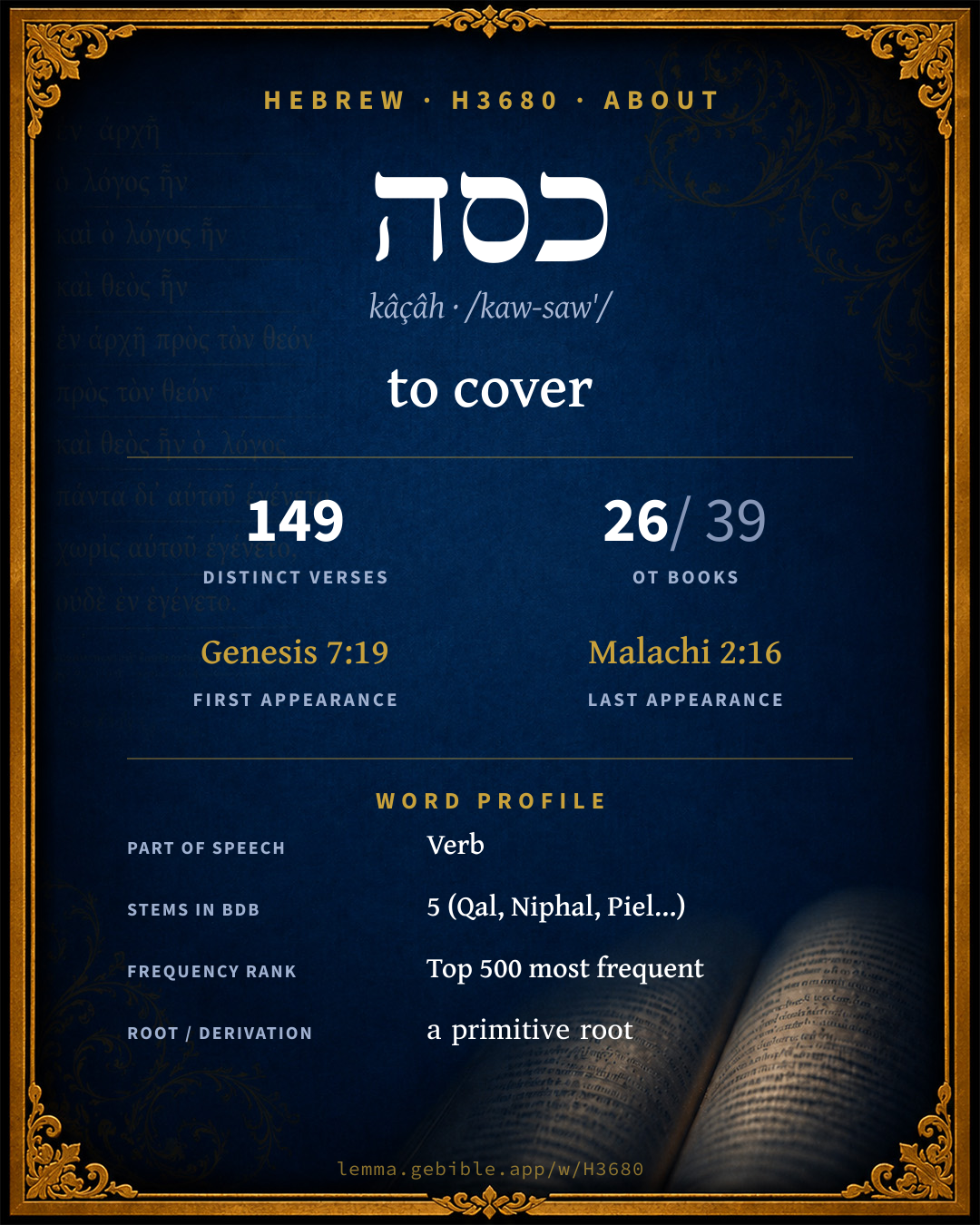
כָּסָה
to cover
also: conceal, hide fuller range ↓
Full lexicon entry — Brown-Driver-Briggs (BDB)
From Brown-Driver-Briggs (BDB)
Where this word appears
See every Piel verb in the Hebrew Bible →
Grammar key — what these labels mean
Part of speech
- Verb
- An action or state-of-being word.
Stem
- Piel
- An intensive or resultative active stem. Here: ‘cover’
- Pual
- The passive counterpart of the Piel. Here: ‘sq. accus. be covered’
- Hithpael
- The reflexive or reciprocal stem (the subject acts on itself).
- Qal
- The basic, simple active stem — the plain form of the verb (“he wrote”). Here: ‘conceal shame Pr 12’
- Niphal
- Usually the simple passive or reflexive of the Qal (“he was written”).
Form
- Infinitive Construct
- A bound verbal noun, frequently with prepositions (“to write / in writing”).
- Perfect
- A completed action or state — Hebrew marks aspect (completeness) more than strict tense (“he wrote”).
- Imperfect
- An incomplete, ongoing, or future action (“he will / would write”).
- Participle Active
- A verbal adjective expressing ongoing or characteristic action (“writing / one who writes”).
- Sequential Imperfect
- An imperfect with prefixed waw — the standard past-narrative form (waw-consecutive imperfect).
- Sequential Perfect
- A perfect with prefixed waw continuing a preceding imperfect or command (waw-consecutive perfect).
- Participle Passive
- A verbal adjective expressing action received (“written”).
- Jussive
- A third- or second-person volitional form expressing wish or command (“let him write”).
- Imperative
- A direct command (“write!”).
State
- Absolute
- The independent form of a noun, not bound to a following word.
- Construct
- A noun bound to a following noun in a possessive / “of” relationship (the construct chain).
Person
- 3rd Person
- The one spoken about (“he / she / it / they”).
- 1st Person
- The speaker (“I / we”).
- 2nd Person
- The one addressed (“you”).
Gender
- Masculine
- Grammatically masculine.
- Feminine
- Grammatically feminine.
- Common
- Either gender — not distinguished for this form.
Number
- Singular
- One.
- Plural
- More than one (in Hebrew, generally three or more).
2 verses where H3680 appears in the Pual stem in the Book of Genesis. Filtered view — show all forms. Click any verse to open its interlinear word-by-word view. Verse text shown in the World English Bible for context — . Each verse’s Hebrew form is shown with its reference; the English is not keyword-highlighted, since the data carries no word-level English alignment. Use “Compare translations” on any verse to read it across multiple English versions. This concordance covers the Hebrew Bible; Septuagint (Greek Old Testament) occurrences are not indexed here.
Genesis
About this entry
At a glance — auto-summarized from this page’s data, not written by a person. Every figure links to its source below. This summary describes the numbers; it doesn’t interpret them.
כסה (kâçâh) is a Hebrew verb most often rendered “to cover.” Where the King James Version keeps “covereth,” modern versions use “covered” — see the renderings breakdown. Spanning 149 verses in 26 books, it ranks among the common words of the Hebrew Bible. It first appears in Genesis 7:19. As a verb its force shifts by stem, across 5 stems (Qal, Niphal, and more). The sections below give every sense, occurrence, and version rendering.
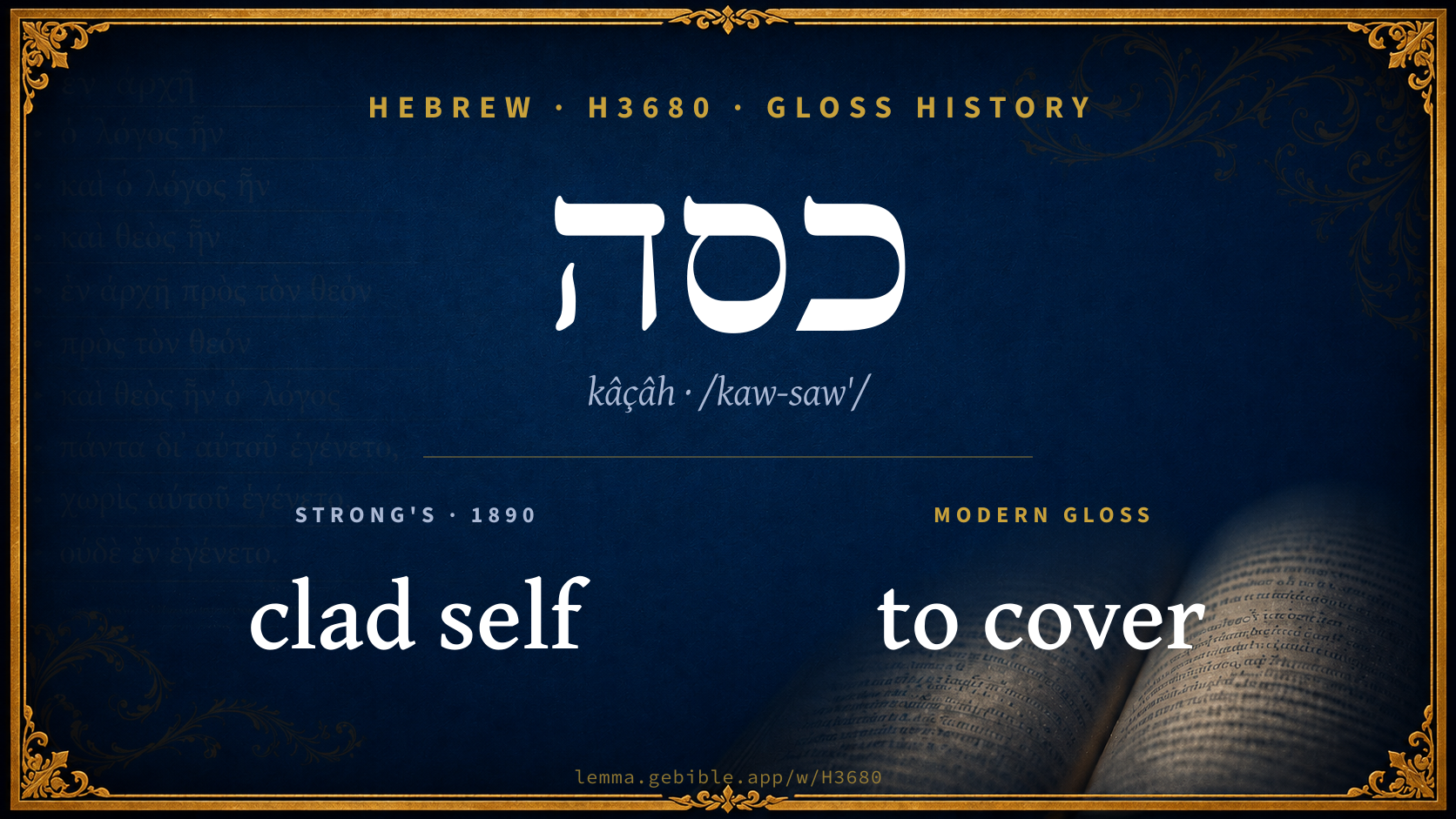
Gloss history
Strong's 1890 vs modern scholarship
About this word
Strong's H3680 catalogs a Hebrew word from the Hebrew Old Testament.
These counts are not copied from any lexicon or concordance. They are computed here, from the morphology-tagged Hebrew Old Testament. What Lemma adds →
- 149
- distinct verses
- The word appears in 149 distinct verses.
- 26 / 39
- OT books
- The word appears in 26 of 39 Old Testament books.
- #294
- by frequency
- Top 500 most frequent Hebrew words (rank 294 of 8,640 Hebrew words by occurrence).
View all 149 occurrences in the concordance →
By section of the Old Testament
By traditional corpus
Conventional, traditional groupings — biblical authorship is debated, so this is a traditional corpus grouping, not an authorship claim. Each share is this word’s portion of its verses in that division of the Hebrew canon. Each figure is a share of the word’s 149 distinct verses.
- Prophets (Nevi'im) 57 verses · 38%
- Torah (Pentateuch) 47 verses · 32%
- Writings (Ketuvim) 45 verses · 30%
How translations render this word
Counts come from each version’s own published word-to-Strong’s tagging or interlinear alignment — an approximate guide to how each version renders this word, not a word-level alignment the data otherwise carries. Because each total is that version’s own tagged count, the per-version totals vary from one another and need not match the appearance or distinct-verse counts above. These counts may also differ from a printed concordance because Lemma counts each distinctly tagged rendering and does not collapse phrase taggings into a single head-word total. This is a fixed set of word-tagged versions (KJV, ASV, BSB, ULT) and does not change with the reading translation you choose elsewhere. Each version’s license is shown beside its name below (and on Sources).
- King James Version: Covered 27×, Cover 25×, Covereth 14×
- American Standard Version: Cover 24×, Covered 23×, Covereth 12×
- Berean Standard Bible: Cover 14×, Covers 14×, Covered 13×
- unfoldingWord Literal Text: Covered 17×, Cover 13×, Covers 11×
King James Version Public Domain
Renders H3680 across 152 tagged occurrences — most commonly:
Plus other, less common renderings. Plus 41 renderings that appear only once — usually multi-word phrases or single function words the recovered tagging swept in, not distinct renderings.
American Standard Version Public Domain
Renders H3680 across 152 tagged occurrences — most commonly:
Plus other, less common renderings. Plus 64 renderings that appear only once — usually multi-word phrases or single function words the recovered tagging swept in, not distinct renderings.
Berean Standard Bible Public Domain
Renders H3680 across 150 tagged occurrences — most commonly:
Plus other, less common renderings. Plus 56 renderings that appear only once — usually multi-word phrases or single function words the recovered tagging swept in, not distinct renderings. Not rendered by a distinct English word in 2 further occurrences.
unfoldingWord Literal Text CC BY-SA 4.0
Renders H3680 across 175 tagged occurrences — most commonly:
Plus other, less common renderings. Plus 44 renderings that appear only once — usually multi-word phrases or single function words the recovered tagging swept in, not distinct renderings.
16 senses and sub-senses in the full BDB
Hebrew verbs can shift meaning by stem (binyan): Qal is the basic action, Niphal is often passive or reflexive, Piel often intensifies or makes it factitive, and Hiphil is typically causative. The senses below are grouped under the stem BDB assigns to each. This entry also uses Pual (the passive of Piel) and Hithpael (reflexive or reciprocal).
What do BDB’s symbols mean?
BDB uses these scholarly abbreviations:
| Symbol | Meaning |
|---|---|
| 𝔊 | the Septuagint (the ancient Greek translation, LXX) |
| 𝔙 | the Vulgate (the Latin translation) |
| 𝔖 | the Syriac version (the Peshitta) |
| 𝔗 | the Targum (the Aramaic translation) |
| ψ | the Psalms |
| √ | root (the underlying root or stem) |
| ‖ | parallel passage (a synonymous or contrasted parallel) |
| † | the dagger: every passage where the word occurs is cited |
The 16 senses and sub-senses the full Brown-Driver-Briggs lexicon distinguishes for this word, in lexicon order (not ranked by frequency), with BDB’s own verbatim wording and sub-sense lettering. Shown in Hebrew script with BDB’s own scholarly abbreviations. The condensed entry is in the Lexicon Entry tab. See also the Forms in the corpus table below.
Qal
- , only Pt. act. כֹּסֶה;—
- 1. conceal shame Pr 12:16; knowledge Pr 12:23. e.g. Proverbs 12:16
- 2. pass. (cstr.) כְּסוּי חֲטָאָה ψ 32:1 covered in respect of sin (by God, which he thus puts out of sight) (‖ נְשׂוּי־פֶּשַׁע). e.g. Psalms 32:1
Niphal
- Pf. 3 fs. נִכְסָ֑תָה, covered, with waves Je 51:42; Inf. cstr. הִכָּסוֹת Ez 24:8, (blood) not to be covered. e.g. Jeremiah 51:42
Piel
- Pf. 3 ms. כִּסָּה Nu 9:15 + 12 times; sf. כִּסָּהוּ Lv 17:13 Nu 17:7; כִּסָּמוֹ Ex 15:10; 3 fs. כִּסְּתָה Gn 38:15 + 5 times; 1 s. כִּסִּיתִי ψ 32:5 + 3 times; כִּסֵּתִי Ez 31:15 (del. Co); כִּסֵּיתִי Ez 32:7 + 13 times Pf.; Impf. 3 ms. יְכַסֶּה Is 6:2 + 8 times; וַיְכַס Ex 10:15 + 4 times; sf. יְכַסֶּ֑דָּ Hab 2:17; יְכַסֶּנָּה Ez 30:18; 3 mpl. sf. יְכַסְיֻמוּ Ex 15:5 + 41 times Impf.; Imv. sf. כַּסּוּנוּ Ho 10:8; Inf. cstr. כַּסּוֹת Mal 2:13 + 11 times; כַּסֹּת Nu 4:15; sf. כַּסֹּתוֹ Ex 26:13; Pt. מְכַסֶּה Pr 10:18 + 12 times; pl. מְכַסִּים Is 11:9; fpl. מְכַסּוֹת Ez 1:11, 23(×2);— e.g. Numbers 9:15
- 1. cover, clothe Ju 4:19 Ez 16:10 (2 acc.), v 18; Jon 3:6 is appar. reflex., c. acc. of garment (strange; read perhaps וַיִּכָּס); nakedness Gn 9:23 (J), Ex 28:42 (P), Ez 16:8 Ho 2:11; the naked Is 58:7 Ez 18:7, 16 (+ acc. rei); the face and legs of seraphim Is 6:2(×2); bodies of cherubim Ez 1:11, 23(×2); the face Gn 38:15 (J), Ez 12:6, 12, fig. Jb 23:17; earth with the great deep ψ 104:6; heavens with glory Hab 3:3; with בְּ of the clothing Gn 38:14 (J), Dt 22:12, these two appar. reflex., cf. Jon 3:6 supr.; Ju 4:18 1 K 1:1; heaven with clouds ψ 147:8, with glory Ez 32:7. e.g. Judges 4:19
- 2. cover, conceal blood Gn 37:26 (J), Jb 16:18; human ordure Dt 23:14; mts. conceal men from God Ho 10:8; cover transgressions Jb 31:33 Pr 17:9; 28:13; iniquity ψ 32:5; righteousness ψ 40:11; hatred Pr 10:18; a thing Pr 11:13; judge’s face so as not to see justice Jb 9:24; heads of rulers and seers Is 29:10; with בְּ of covering Lv 17:13 (H), 1 S 19:13; face by fat Jb 15:27; sun by a cloud Ez 32:7; with מִן from whom Gn 18:17 (J), Jb 33:17. e.g. Genesis 37:26
- 3. cover (with covering of protection), a pit Ex 21:33 (Covt. code); with cloud of incense, the Kapporeth Lv 16:13 (P); coverings of the sacred tent, tabernacle, and their furniture Ex 26:13 Nu 4:9, 15 (P); with בְּ of the covering Nu 4:5, 8, 11, 12 (P); Zion בְּצֵל יָדִי Is 51:16. e.g. Exodus 21:33
- 4. cover, spread over, fat, the inwards Ex 29:13, 22 Lv 3:3, 9, 14; 4:8 (with עַל), 7:3 (P); leprosy, the skin and flesh Lv 13:12, 13 (P); the cloud of the theophany, the mount Ex 24:15, 16 (P), the tent of meeting Ex 40:34 Nu 17:7 (P), and the tabernacle Nu 9:15, 16 (P); altar with tears Mal 2:13 (2 acc.); Jerusalem with multitude of camels Is 60:6; of handiwork 1 K 7:18, 41, 42 = 2 Ch 4:12, 13. e.g. Exodus 29:13
- 5. cover, overwhelm, sq. accus., the sea the Egyptians Ex 14:28 (P), 15:5, 10 (song), Jos 24:7 (E), ψ 78:53; 106:11; waters Jb 22:11; 38:34 ψ 104:9 Je 46:8 Ez 26:19; locusts the eye of the land Ex 10:5, 15 (J), also Israel Nu 22:5, 11 (J); frogs the land Ex 8:2 (P); quails the camp Ex 16:13 (P); cloud the land Ez 30:18; 38:9, 16; darkness the earth Is 60:2; dust a city Ez 26:10; the depths of the sea by God Jb 36:30; with a reference to a person’s shame ψ 44:16; 69:8 Je 51:51 Ob 10 Mi 7:10; horror ψ 55:6 Ez 7:18; violence Pr 10:6, 11 Hb 2:17; confusion Je 3:25; mischief ψ 140:10; God covers sin ψ 85:3 (‖ נשׂא עון), cf. 32:1 (Qal). e.g. Exodus 14:28
- 6. sq. על of person or thing covered, cover over: cherubim over the ark 2 Ch 5:8; over the dead, the earth Nu 16:33 (JE), ψ 106:17 Is 26:21, worms Jb 21:26; dust over blood Ez 24:7; waters over the sea Hb 2:14, cf. לַיָּם Is 11:9; (v. Dr§ 135. 7 Obs.); love covereth over all sins Pr 10:12; God covereth over iniquity Ne 3:37; people not to cover over a guilty person Dt 13:9; + acc. of obj. covering (DaSynt. § 75), fig. covering over the garment with violence Mal 2:16; God’s hands with light Jb 36:32; + בְּ of covering ψ 44:20. e.g. 2 Chronicles 5:8
- —כִסִּתִי (אֵלֶיךָ) ψ 143:9 is error for חָסִיתִי according to 𝔊 κατέφυγον SS, but חסה not cstr. wi. אֶל־; חִכִּיתִי Bae; הֶאֱבַלְתִּי כִּסֵּתִי עָלָיו אֶת־תְּהוֹם Ez 31:15 according to Co I caused the deep to mourn for them (del. כסתי). e.g. Psalms 143:9
Pual
- Pf. 3 mpl. כָּסּוּ ψ 80:11 Pr 24:31; Impf. יְכֻסֶּה Ec 6:4; pl. וַיְכֻסּוּ Gn 7:19, 20; Pt. pl. מְכֻסִּים 1 Ch 21:16; fpl. מְכֻסּוֹת Ez 41:16. e.g. Psalms 80:11
- 1. sq. accus. be covered, hills with shadow ψ 80:11; mountains with water Gn 7:19, 20 (P); field with nettles Pr 24:31; abs., windows of temple Ez 41:16. e.g. Psalms 80:11
- 2. sq. בְּ, be clothed, with sackcloth 1 Ch 21:16; name with darkness Ec 6:4. e.g. 1 Chronicles 21:16
Hithpael
- Impf. וַיִּתְכַּס Is 37:1 = 2 K 19:1; 3 fs. תִּכַּסֶּה Pr 26:26; וַתִּתְכָּ֑ס Gn 24:65; pl. יִתְכַּסּוּ Is 59:6 Jon 3:8; Pt. מִתְכַּסֶּת 1 K 11:29; pl. מִתְכַּסִּים Is 37:2 = 2 K 19:2;—cover, clothe oneself, abs. (of veil) Gn 24:65 (J); with בְּ, of new garment 1 K 11:29; sackcloth 2 K 19:1, 2 = Is 37:1, 2; fig. of works Is 59:6, of hatred with guile Pr 26:26; with acc. Jon 3:8 (שַׂקִּים). e.g. Isaiah 37:1
Senses from the full Brown-Driver-Briggs lexicon (Brown, Driver, Briggs; Oxford 1906 — public domain), digitized via Sefaria, supplemented by the OpenScriptures HebrewLexicon (CC BY 4.0). Full attribution on Sources.
Word origin
vb. cover (NH כָּסָה Pi; Aramaic כְּסָא chiefly Pa; ܟܣܳܐ Pa. hide, cover; ܟܣܳܝܳܐ covering, ܬܰܟܣܺܝܬܳܐ garment; Arabic كَسَا (كسو) clothe, كِسَآءٌ garment; Assyrian kusû, cover; kusîtu, garment DlHWB 342)—
— Brown-Driver-Briggs (Oxford 1906, public domain), digitized via Sefaria, supplemented by the OpenScriptures HebrewLexicon (CC BY 4.0). See Sources.
Origin: a primitive root
Jastrow Dictionary
A second Hebrew/Aramaic lexicon for comparison, covering Aramaic and post-biblical (Talmudic, Targumic, Midrashic) usage that the biblical-Hebrew BDB does not. Matched by lemma rather than by Strong’s number, so a lemma may carry more than one Jastrow headword (shown separately below), and the entries cover usage well beyond the Bible.
כֶּסֶא
- (כָּסָה I) mark, distinction; marked, appointed time. Lev. R. s. 29; Pesik. Baḥod., p. 153ᵃ (ref. to Ps. LXXXI, 4) וכי כל החדשים אינן חדש אלא בכ׳ ‘on the New Moon’, are all other new moons no New Moons (festive days)?; but (therefore is added) bakkesé, on the distinguished (month), v. כָּסָה I. [Pirké d’R. El. ch. VII, end, a. Bets. 16ᵃ our w. is taken in the sense of cover.] e.g. Psalms 81:4
כִּסֵּה
- , v. כִּסֵּא
כֶּסֶה
- , v. כֶּסֶא
כָּסָה
- , v. כסי
כסי
- (cmp. כסח) to make incisions, mark, count. Part. pass. כָּסוּי marked, distinguished. Pesik. R. s. 39 (ref. to Ps. LXXXI, 4, v. כֶּסֶא) מהו בכסא בחדש שהוא כ׳ (not כיסוי) what is bakkesé? In the month which is marked (v. infra). e.g. Psalms 81:4
- to be marked, distinguished. Lev. R. s. 29 (ref. to Ps. l. c.) וכל החדשים אינן נִכְסִין אלא ליום חגנו are all other months (or New Moon Days) not marked?—But (it must be marked by) ‘a festive day’; [read:] חגו בפני עצמו והלא ניסן חדש נִכְסֶה ויש לו חג: (Ar. … חדש ונתכסה) but is not Nisan a marked month with a festival? (Answ.) Its festival is separate from it (not coinciding with the New Moon Day); אלא איזהו חדש נ׳ ויש לו חג וכ׳ but what month is there that is marked and has a festival, and that on the same day?; Pesik. Baḥod., p. 153ᵃ
כסי ²
- (b. h.) to cover.—Part. pass. כָּסוּי, f. כְּסוּיָה; pl. כְּסוּיִים, כְּסוּיִין; כְּסוּיוֹת. Gen. R. s. 52 אתם כִּסִּיתֶם … כְּסוּי עינים you have concealed from me the sight (of truth), therefore the son that you will raise will be of covered eyes (blind); Yalk. Gen. 91 כסות (corr. acc.); B. Kam. 93ᵃ הואיל וכִיסִּית … בנים כְּסוּיֵי עיניים (v. Rabb. D. S. a. l. note). Y. Ter. VIII, 45ᵈ הכְּסוּיִין (not הכיסוין) the covered liquids.
- to cover, hide. Ḥull. VI, 4 … שחט ולא כ׳ לכַסּוֹת if one slaughters and fails to cover the blood, and another person sees it, he is bound to cover it. Pes. 119ᵃ (ref. to Is. XXIII, 18) זהו המְכַסֶּה דברים וכ׳ he who keeps secret the things which the Old of Days has covered (mysteries). B. Kam. l. c.; Gen. R. l. c., v. supra. Pesik. R. s. 26 מְכַסָּה אני ממך shall I conceal it from thee?—Gen. R. s. 87 כִּסְּתָה פניה she covered her (the idol’s) face. Ib. לא כ׳ עליהם הכתוב the Bible did not cover their guilt (v. חָפָה); a. fr.—Part. pass. מְכוּסֶּה, f. מְכוּסָּה; pl. מְכוּסִּים, מְכוּסִּין; מְכוּסּוֹת. Ib. s. 52 (ref. to Gen. XX, 16 [read:] עשאה מטרונה כסות עינים שהיא מכ׳ מן העין he (Abimelech) made a matron of her (Sarah) (giving her) ‘a cover of the eyes’, by which she was protected from the gaze (of men). Pes. 54ᵇ שבעה … מכ׳ וכ׳ seven things are hidden from man; a. fr.—[Gen. R. s. 79, end מה את מכסה בי, read: מב׳, v. בְּסָא.—Sifra B’ḥuck., Par. 2, ch. V כיסה, v. כָּסַח.] e.g. Isaiah 23:18
- to be covered, hidden. Snh. II, 1 (18ᵃ; 19ᵃ) הן נִכְסִין … והוא נ׳ when they (who form the funeral cortege) are hidden from his view (when entering an alley), he (the high priest) appears; when they emerge, he disappears (in the alley). Cant. R. to II, 9 נראה וחוזר ונ׳ is visible and disappears again; Ruth. R. to II, 14; Pesik. Haḥod., p. 49ᵇ. Num. R. s. 22 (play on נְכָסִים) נ׳ מזה וכ׳ they disappear from one and appear to the other; a. fr.
- to be covered, clothed. Bets. 16ᵃ (ref. to בַּכֶּסֶה, Ps. LXXXI, 4) איזהו חג שהחדש מִתְכַּסֶּה בו what festival is that on which the new moon is hidden (seen only by a few)?; Pirké d’R. El. ch. VII, end ביום שמ׳ כולו on the day when the moon is entirely covered. Deut. R. s. 3 מתכ׳ משלו clothed himself at his (the fosterfather’s) expense. Ib. כל … אוכל ומתכ׳ וכ׳ all that is spent on you for eating and clothing &c. Keth. V, 8 מִתְכַּסָּה, v. בְּלָאוֹת. Tam. I, 1 מִתְכַּסִּין, v. כְּסוּת; a. fr. e.g. Psalms 81:4
A Dictionary of the Targumim, the Talmud Babli and Yerushalmi, and the Midrashic Literature (Marcus Jastrow; London, Luzac, 1903) — Public Domain. Digitized via Sefaria. Digitized via Sefaria. Full attribution on Sources.
Forms in the corpus
The 120 distinct written forms H3680 takes in the Hebrew Bible, most frequent first — each parse links to that stem’s occurrences in the concordance. Hebrew forms include their vowel points and cantillation, so a single lemma takes many written forms.
The 60 most common forms are shown; 60 rarer forms follow in the full concordance.
Same root — word family
Other BDB entries built from the same root as H3680, grouped by Strong’s listed origin. These share a root / origin per the lexicon — not necessarily a shared meaning. Each links to that word’s own entry.
Derived from this word
- כסא keçeʼ H3677 full moon
- כסא kiççêʼ H3678 throne
- כסוי kâçûwy H3681 covering
- כסות kᵉçûwth H3682 covering
- כסת keçeth H3704 band
- מכסה mikçeh H4372 covering
- מכסה mᵉkaççeh H4374 covering
Compare all same-root words → Showing 4 of 8 — not the complete family. They share a root, not necessarily a meaning.
Septuagint verse parallels
This word appears in 142 verses that also exist in the Greek Old Testament (Septuagint), out of the 149 Hebrew verses it occurs in. You can read those verses in Greek by switching the Old Testament edition to the Septuagint.
Read these verses in the Septuagint
- Genesis 7:19
- Exodus 8:6
- Leviticus 3:3
- Numbers 4:5
- Deuteronomy 13:8
- Joshua 24:7
- Judges 4:18
- 1 Samuel 19:13
- 1 Kings 1:1
- 2 Kings 19:1
- 1 Chronicles 21:16
- 2 Chronicles 4:12
This is a verse-level parallel only — the same verses exist in both the Hebrew and Greek Old Testaments. No word-level Hebrew↔Greek correspondence is claimed: the data carries no such alignment, so no Greek word is shown as this Hebrew word’s translation. Coverage is not total — the Septuagint omits the deuterocanon and renumbers the Psalms, so some Hebrew verses have no direct Greek parallel.