
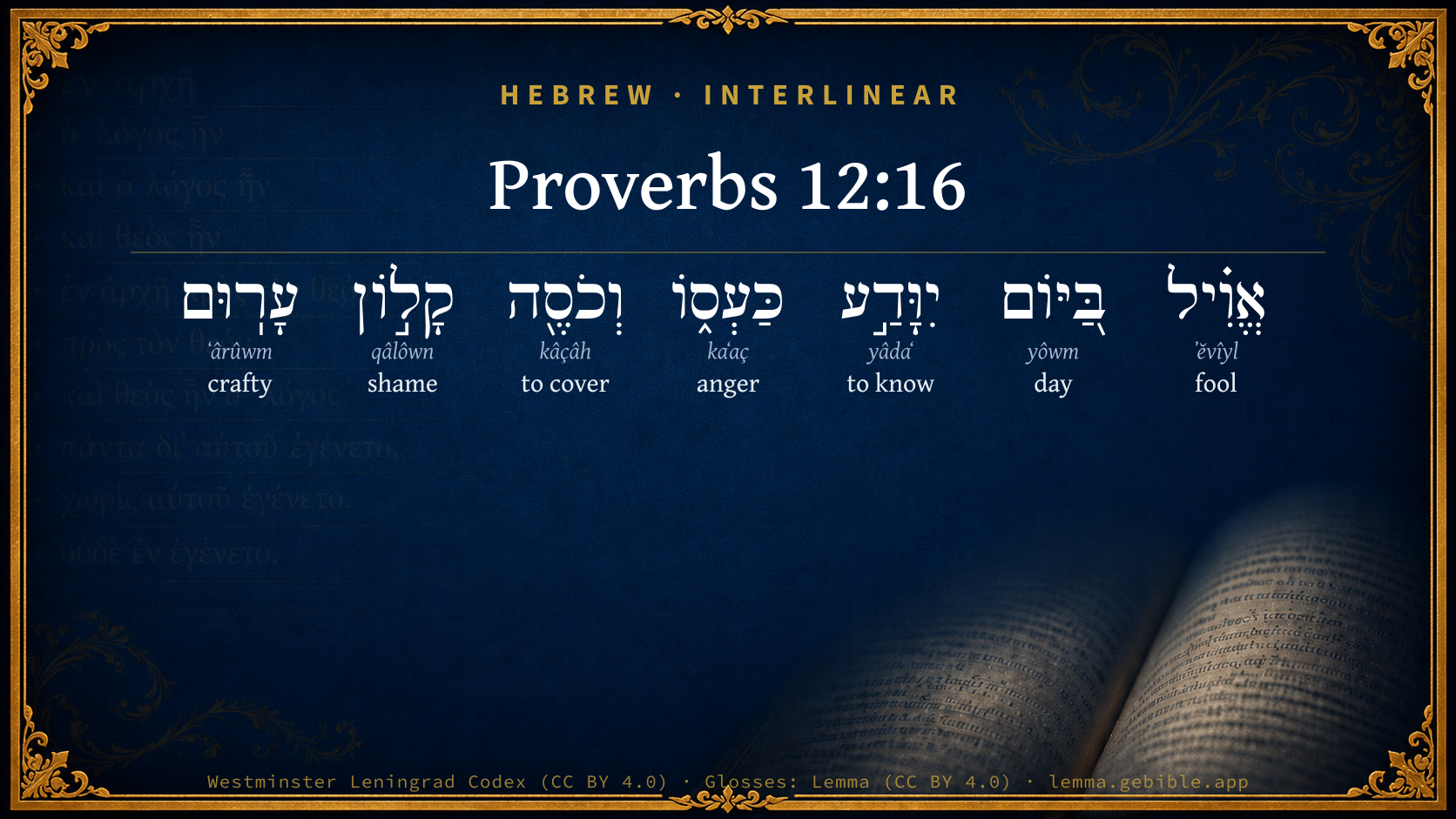
Proverbs 12:16

Hebrew (Westminster Leningrad Codex) Proverbs 12:16 appears in the Hebrew Old Testament. The text above is from the Westminster Leningrad Codex. Each word links to its Strong’s number, a concise gloss, and parsing drawn from the Open Scriptures Hebrew Bible morphology. Click any word for its full Brown-Driver-Briggs (BDB) entry.
Download image
Cite this verse

Proverbs 12:16 (World English Bible). Public Domain. Lemma interlinear Bible study tool, https://lemma.gebible.app/v/proverbs/12/16.

Show BibTeX & RIS
BibTeX
RIS
English Translation
A fool shows his annoyance the same day, But one who overlooks an insult is prudent.
World English Bible · Public Domain
Download a study sheet

One document with this verse’s original text, its word-by-word gloss line, the meaning frame, cross-references with their text, attributed commentary, and full source and license credits — printable, and it pastes into notes with its structure intact.

This verse Autodidact and up

Study sheet (.html) Plain text (.txt)

A passage Seminary Student

Up to 50 verses in one chapter. A passage sheet keeps up to 6 commentary sources and 12 cross-references per verse, in the order this page ranks them, and says so on the sheet whenever that leaves anything out. Ask for a single verse and you get the Autodidact verse sheet above.

Everything on this page stays free to read, with no account — the sheet is a download of what is already on screen, not access to it.

Want to remove ads? Support Godless Engineer
Compare translations 3

The same verse in 3 English versions, stacked beneath the original-language interlinear above. Click any original word for its lexicon entry.

Each is an independent rendering of the whole verse — the interlinear is not word-aligned to these translations.

Highlighted words mark where these versions differ — a whole-verse word diff, not a word-by-word alignment.

  • World English Bible Public Domain
    A fool shows his annoyance the same day, But one who overlooks an insult is prudent.
  • King James Version Public Domain
    A fool's wrath is presently known: but a prudent man covereth shame.
  • unfoldingWord Literal Text CC BY-SA 4.0
    A fool—his anger is known on the day, but a prudent one covers dishonor.

unfoldingWord Literal Text — © unfoldingWord, licensed CC BY-SA 4.0. Word-aligned USFM3 via Door43 (git.door43.org/unfoldingWord/en_ult).

Versions to compare (up to 4)

3 of 4 selected

Show all 18 translations

Every available English version of this verse, each an independent rendering of the whole verse.

  • World English Bible Public Domain
    A fool shows his annoyance the same day, But one who overlooks an insult is prudent.
  • Berean Standard Bible Public Domain
    A fool’s anger is known at once, but a prudent man overlooks an insult.
  • Majority Standard Bible Public Domain
    A fool’s anger is known at once, but a prudent man overlooks an insult.
  • King James Version Public Domain
    A fool's wrath is presently known: but a prudent man covereth shame.
  • American Standard Version (1901) Public Domain
    A fool's vexation is presently known; But a prudent man concealeth shame.
  • Revised Version (1885) Public Domain
    A fool’s vexation is presently known: but a prudent man concealeth shame.
  • Geneva Bible (1599) Public Domain
    A foole in a day shall be knowen by his anger: but he that couereth shame, is wise.
  • Douay-Rheims (1899) Public Domain
    A fool immediately sheweth his anger: but he that dissembleth injuries is wise.
  • Young's Literal Translation Public Domain
    The fool -- in a day is his anger known, And the prudent is covering shame.
  • Literal Standard Version CC BY-SA 4.0
    The fool—his anger is known in a day, || And the prudent is covering shame.
  • Unlocked Literal Bible CC BY-SA 4.0
    A fool shows his anger at once, but one who ignores an insult is prudent.
  • unfoldingWord Literal Text CC BY-SA 4.0
    A fool—his anger is known on the day, but a prudent one covers dishonor.
  • Darby Bible Public Domain
    The vexation of the fool is presently known; but a prudent [man] covereth shame.
  • World Messianic Bible Public Domain
    A fool shows his annoyance the same day, but one who overlooks an insult is prudent.
  • Webster's Bible Public Domain
    A fool's wrath is presently known: but a prudent man covereth shame.
  • Free Bible Version CC BY-SA 4.0
    Stupid people get angry immediately, but if you're sensible you ignore an insult.
  • Bible in Basic English Public Domain
    A foolish man lets his trouble be openly seen, but a sharp man keeps shame secret.
  • JPS Tanakh (1917) Public Domain
    A fool's vexation is presently known; but a prudent man concealeth shame.

Literal Standard Version (2020), Covenant Press — licensed CC BY-SA 4.0. Text via the HelloAO Bible API (eBible.org). Unlocked Literal Bible (unfoldingWord) — licensed CC BY-SA 4.0. Text via the HelloAO Bible API (eBible.org). unfoldingWord Literal Text — © unfoldingWord, licensed CC BY-SA 4.0. Word-aligned USFM3 via Door43 (git.door43.org/unfoldingWord/en_ult). Free Bible Version, Dr. Jonathan Gallagher — licensed CC BY-SA 4.0. Text via the HelloAO Bible API (eBible.org).

Word by word

More ways to search: Search by grammar → Find every occurrence → Compare this word →

Practice this passage: Drill this verse → Learn its vocabulary →

About this verse

These counts appear in no published source. They are computed here, from the morphology-tagged text and Lemma’s own curated glosses. What Lemma adds →

7
words
7
distinct lemmas
Wisdom
section

Notable vocabulary

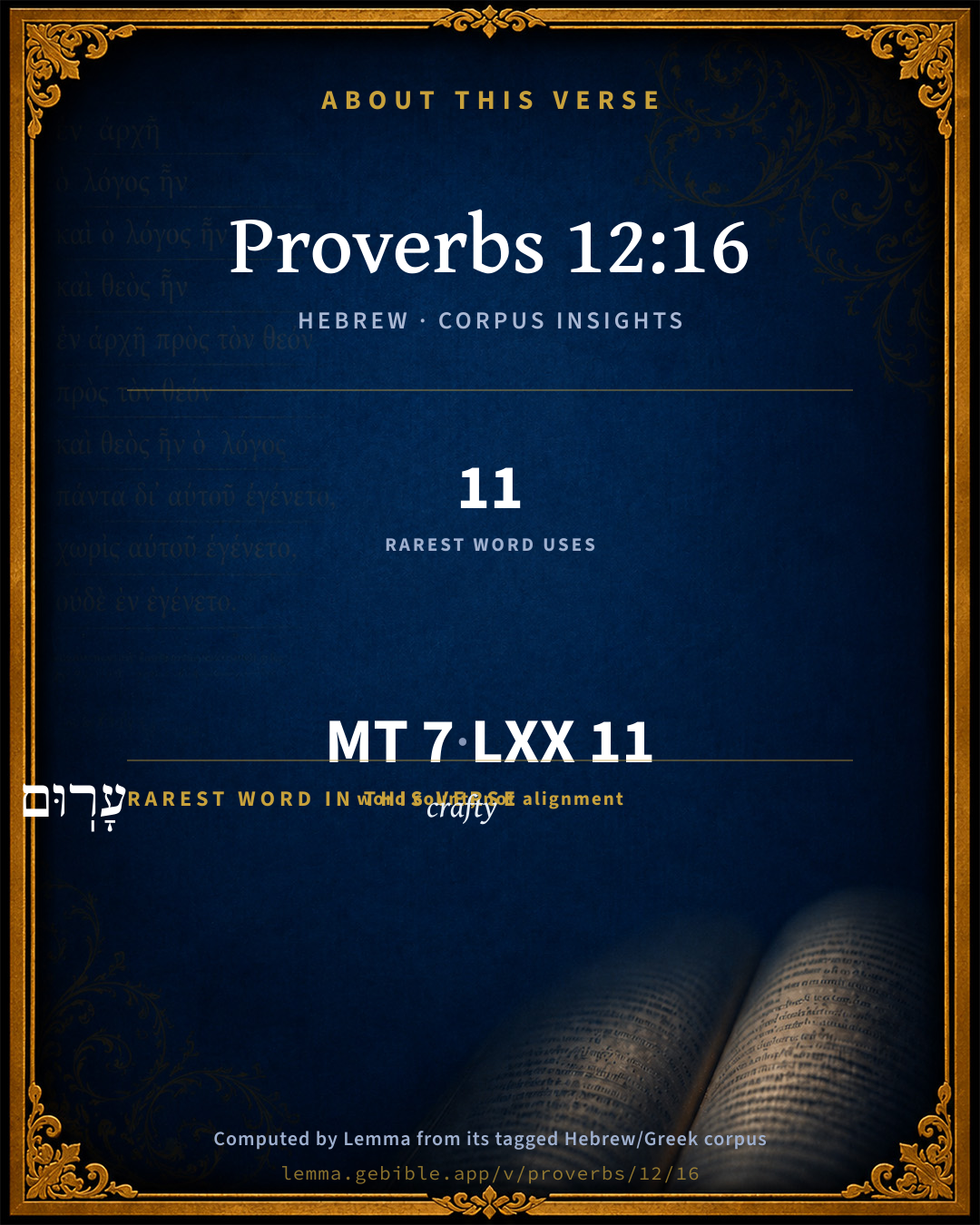
The rarest word here is עָרֽוּם crafty H6175 — appearing just 11 times in the whole Hebrew Bible.

Shared distinctive vocabulary

עָרֽוּם crafty H6175 occurs in 11 verses of the Hebrew Bible. Also found in:

Grammatical profile

  • 2 verbs
  • 3 nouns
  • 2 adjectives

Verb forms

  • יִוָּדַ֣ע Niphal · Imperfect
  • וְכֹסֶ֖ה Qal · Participle Active

Hebrew & Septuagint length

In English translation the verse runs 16 words from the Hebrew and 16 from the Septuagint (LXX English) — the same length.

A rough comparison of the two English renderings, which tokenize alike — not a word-level alignment.

Word counts can differ between the Hebrew and the Greek without any difference in meaning — e.g. the Hebrew direct-object marker אֵת has no separate Greek word, and Greek often adds the article ὁ.

In the original languages it is 7 Hebrew tokens and 11 Greek tokens — but the two are counted differently (Hebrew bundles its prefixes and suffixes into one token; the Greek is in lemma form), so that isn’t a like-for-like length.

Cross-references

9

Topical passages linked to Proverbs 12:16 in the Treasury of Scripture Knowledge — connected by theme and wording, ordered by reader-vote popularity; previews shown in the World English Bible.

  • Proverbs 29:11 A fool vents all of his anger, But a wise man brings himself under control.
  • James 1:19 So, then, my beloved brothers, let every man be swift to hear, slow to speak, and slow to anger;
  • Proverbs 10:12 Hatred stirs up strife, But love covers all wrongs.
  • Proverbs 17:9 He who covers an offense promotes love; But he who repeats a matter separates best friends.
  • Proverbs 25:28 Like a city that is broken down and without walls Is a man whose spirit is without restraint.
  • Proverbs 14:33 Wisdom rests in the heart of one who has understanding, And is even made known in the inward part of fools.
  • Proverbs 16:22 Understanding is a fountain of life to one who has it, But the punishment of fools is their folly.
  • 1 Kings 19:1–2 Ahab told Jezebel all that Elijah had done, and withal how he had slain all the prophets with the sword.
  • 1 Samuel 20:30–34 Then Saul's anger was kindled against Jonathan, and he said to him, You son of a perverse rebellious woman, don't I know that you have chosen the son of Jesse to your own shame, and to the shame of your mother's nakedness?

Cross-references courtesy of OpenBible.info (CC BY 4.0).

Hebrew and Greek witnesses Masoretic Hebrew ↔ Greek Septuagint

The same verse in the two great witnesses to the Old Testament, shown verse-for-verse.

These are two independent witnesses, not word-aligned to each other, and the Septuagint is shown in lemma (dictionary) form.

Hebrew Proverbs 12:16 Masoretic · Westminster Leningrad Codex

אֱוִ֗יל בַּ֭יּוֹם יִוָּדַ֣ע כַּעְס֑וֹ וְכֹסֶ֖ה קָל֣וֹן עָרֽוּם

A fool shows his annoyance the same day, But one who overlooks an insult is prudent.

World English Bible · Public Domain

Greek LXX Proverbs 12:16 Septuagint · lemma form

ἄφρων αὐθημερόν ἐκἀγγέλλω ὀργή αὐτός κρύπτω δέ ὁ ἑαυτοῦ ἀτιμία πανοῦργος

A fool declares his wrath the same day; but a prudent man hides his own disgrace.

LXX2012 (modern English Septuagint) · Public Domain

On this verse, Trapp's Complete Commentary discusses the Septuagint’s reading. Read the note in Commentary ↓

Hebrew: Westminster Leningrad Codex (CC BY 4.0). Greek: Septuagint (public domain); English from LXX2012 (modern English Septuagint) (Public Domain). How the Septuagint differs from the Hebrew →

Commentary

Notes on Proverbs 12:16 from classic Christian and Jewish commentators (each source and its license shown beneath its notes). The classic Christian expositions comment on the surrounding passage and are grouped to its opening verse, so a note may address several verses; the Jewish commentaries on the Tanakh (Rashi and others) are per-verse, so they appear only where the commentator wrote on this verse.

Lemma curates 59 commentaries, every one of them public domain or Creative Commons licensed, each selected and text-cleaned for this edition rather than reprinted as found. About our sources →

Trapp's Complete Commentary

John Trapp

Pro 12:16 A fool’s wrath is presently known: but a prudent [man] covereth shame.

Ver. 16. A fool’s wrath is presently known.] He hath no power over his passions. Hence פתי, a fool, and פתאם, suddenly, rashly, are from the same root. Like tow, he is soon kindled; like a pot, he soon boils; and like a candle whose tallow is mixed with brine, as soon as lighted he spits up and down the room. A fool uttereth all his mind. {Pro 29:11} The Septuagint render it, All his anger - θυμον. For, as the Hebrews well note in a proverb they have, A man’s mind is soon discovered, bekis, bekos, becoynos; - in loculis, in poculis, in ira; - in his purse, in his drink, in his anger. See my "Common Place of Anger."

But a wise man covereth shame.] By concealing his wrath, or rather by suppressing it when it would break forth to his disgrace, or the just grief of another. Ut fragilis glacies, occidit ira mora. {a} This was Saul’s wisdom; {1Sa 10:27} and Jonathan’s, when, incensed by his father’s frowardness, he went shooting; {1Sa 20:35} and Ahasuerus, when in a rage against Haman, he walked into the garden. The philosopher wished Augustus, when angry, to say over the Greek alphabet; Ambrose desired an angel’s authority; {Gal 1:8} Theodosius to repeat the Lord’s Prayer before he decreed anything.

{a} Ovid.

John Trapp, A Commentary or Exposition upon All the Books of the Old and New Testament (1647–1656) — public domain. Text from a community e-Sword module.

The Biblical Illustrator

Joseph S. Exell

Pro_12:16

A fools wrath is presently known: but a prudent man covereth shame.

Wrath as shame

The wise man here uses a very observable word, to express wrath. He calls it shame, for it is a shame for a man to suffer his reason to, be tyrannised over by an unruly passion, which spreads deformity over his countenance, and hurries him on to expressions and actions more like those of one confined in bedlam than one who is supposed to have the use of his reason. A fool disgraces himself by giving way to the impetuous sallies of passion. He discovers his temporary madness by his pale countenance, his quivering lips, and his flashing eyes. But a prudent man covereth shame. When he finds his passions beginning to ferment, he does not give them full scope, but considers whether he does well to be angry, and how far it is lawful and safe for him to give way to this turbulent passion. He does not cover his wrath, that it may have time to work, and draw the powers of reason into its service, that it may break forth with more effect on another occasion--but covers it, that he may have time to suppress and destroy it, by considering its folly and wickedness, by meditating on the example and grace of Christ, and by fervent supplications for the support and assistance of the spirit of meekness. By such means as these the prudent man preserves his own honour, and covers the shame of his neighbour, who is likely to be gained by gentleness and meekness. (G. Lawson.)

The Biblical Illustrator, edited by Joseph S. Exell (c. 1880s–1900s) — public domain. Text from a community e-Sword module.

Joseph Benson's Commentary

Pro 12:16. A fool’s wrath is presently known — By his rash words and indecent actions, whereby he exposes himself to shame; but a prudent man covereth shame — Either, 1st, The shame, reproach, or injury, done to him by others, which he conceals, and bears with patience: or, 2d, His own shame, to which the folly of rash anger would have exposed him.

Joseph Benson's Commentary on the Old and New Testaments (1811–1818) — public domain. Text from a community e-Sword module.

Tyndale Open Study Notes

Tyndale Open Resources

12:16 Keeping a level head allows a wise person to think clearly and avoid reactions that could cause a fight.

Tyndale Open Study Notes — © Tyndale Open Resources, licensed CC BY-SA 4.0. Text via the HelloAO Bible API.

Geneva Bible (1599)

Geneva Bible translators

Which bridleth his affections.

Geneva Bible (1599) marginal notes — public domain. Text via Bolls.life.

Matthew Henry's Commentary

Note, 1. Passion is folly: A fool is known by his anger (so some read it); not but that a wise man may be angry when there is just cause for it, but then he has his anger under check and direction, is lord of his anger, whereas a fool's anger lords it over him. He that, when he is provoked, breaks out into indecent expressions, in words or behaviour, whose passion alters his countenance, makes him outrageous, and leads him to forget himself, Nabal certainly is his name and folly is with him. A fool's indignation is known in the day; he proclaims it openly, whatever company he is in. Or it is known in the day he is provoked; he cannot defer showing his resentments. Those that are soon angry, that are quickly put into a flame by the least spark, have not that rule which they ought to have over their own spirits. 2. Meekness is wisdom: A prudent man covers shame. (1.) He covers the passion that is in his own breast; when his spirit is stirred, and his heart hot within him, he keeps his mouth as with a bridle, and suppresses his resentments, by smothering and stifling them. Anger is shame, and, though a wise man be not perfectly free from it, yet he is ashamed of it, rebukes it, and suffers not the evil spirit to speak. (2.) He covers the provocation that is given him, the indignity that is done him, winks at it, covers it as much as may be from himself, that he may not carry his resentments of it too far. It is a kindness to ourselves, and contributes to the repose of our own minds, to extenuate and excuse the injuries and affronts that we receive, instead of aggravating them and making the worst of them, as we are apt to do.

Matthew Henry's Commentary on the Whole Bible (1708–1710) — public domain (CC PDM 1.0). Text via the HelloAO Bible API.

Jamieson, Fausset & Brown

Robert Jamieson, A. R. Fausset & David Brown

prudent . . . shame--He is slow to denounce his insulters (Jam 1:19).

Jamieson, Fausset & Brown — Commentary Critical and Explanatory on the Whole Bible (1871) — public domain (CC PDM 1.0). Text via the HelloAO Bible API.

Adam Clarke's Commentary

Verse 16. A fool's wrath is presently known] We have a proverb very like this, and it will serve for illustration: -

A fool's bolt is soon shot.

A weak-minded man has no self-government; he is easily angered, and generally speaks whatever comes first to his mind.

Adam Clarke's Commentary on the Bible (1810–1826) — public domain. Text from a community e-Sword/MySword module.

Ellicott's Commentary for English Readers

(16) A fool’s wrath is presently known.—He cannot contain himself if he thinks himself slighted or injured; the “prudent man,” on the other hand, “covereth shame,” not noticing an insult at the time, but waiting for a convenient opportunity of telling the offender of his fault and bringing him to a better mind (Mat_18:15).

A Bible Commentary for English Readers, edited by Charles John Ellicott (1878–1897) — public domain. Text from a community e-Sword module.

The Cambridge Bible for Schools and Colleges

gen. ed. J. J. S. Perowne

16. presently] Lit. in the (same) day. Comp. “Will they make an end in one (lit. the) day?” Neh_4:2 [Heb. 3:34]; αὐθημερόν, LXX.

The Cambridge Bible for Schools and Colleges (gen. ed. J. J. S. Perowne; Cambridge University Press, 1878–1918) — public domain. Text from a community e-Sword module.

John Gill's Exposition

A fool's wrath is presently known,.... Having no command of himself, he cannot repress it, nor keep it in; no sooner is he provoked but he shows it in his countenance, and by his words and actions; it is to be seen in the fire of his eyes, in the frowns of his face, in the gnashing of his teeth, and in the stamping of his feet, as well as in the bitter expressions of his mouth: or "a fool's wrath in that day is known" (b); in the same day in which the provocation is given; yea, in the same hour, and in the same moment; he cannot defer showing it for the least space of time; or it is openly known, it is to be seen and observed by everyone: or thus, "a fool is presently known by his wrath" (c); see Ecc 7:9;

but a prudent man covereth shame; conceals his anger and resentment at any injury done him by words or actions, which if suffered to break out would bring shame and disgrace to him; or he covers the injury itself, the disgraceful words that are spoken of him, and the shameful actions done unto him; he puts up with the contempt that is cast upon him, and bears it patiently; takes no notice of the offence given him, and much less seeks revenge; in which he acts a prudent part, for by so doing he creates less trouble to himself, and gains more credit and reputation from others.

(b) "eo die quo irritatur", Tigurine version; "eodem die", Junius & Tremellius; so Banyus, Merceras, Gejerus. (c) "Cognoscitur ex ira sua", Munster.

John Gill's Exposition of the Whole Bible (1746–1763) — public domain (CC PDM 1.0). Text via the HelloAO Bible API.

Albert Barnes' Notes on the Bible

The “fool” cannot restrain his wrath; it rushes on “presently” (as in the margin, on the same day, however, uselessly. The prudent man knows that to utter his indignation at reproach and shame will but lead to a fresh attack, and takes refuge in reticence.

Albert Barnes' Notes on the Bible (1834–1885) — public domain. Text from a community e-Sword/MySword module.

Haydock's Catholic Bible Commentary

Wise. It is more difficult to repress, than to avoid anger. (St. Ambrose) --- To dissemble, so as to seek an opportunity of revenge, is not commended.

George Leo Haydock (1774–1849), Haydock's Catholic Family Bible and Commentary, 1859 edition — public domain. Excludes Psalms (Douay-Rheims chapter numbering differs from Protestant) and Deuterocanonical books (Catholic canon only).

Matthew Poole's English Annotations

Is presently known, by his rash words and indecent actions, whereby he exposeth himself to shame.

Covereth shame; either,

1. The shame, or reproach, or injury done to him by others, which he concealeth and beareth with patience, and passeth by, as his duty and interest obligeth him to do. Or,

2. His own shame, to which the folly of rash anger would have betrayed him.

Matthew Poole's English Annotations on the Holy Bible (1683–1685) — public domain. Text from a community e-Sword/MySword module.

Whedon's Commentary on the Bible

Daniel D. Whedon

16. A fool’s wrath (vexation) is presently known — Hebrew, the same day. He does not control his temper, but allows others to witness his provocation.

But a prudent man covereth shame — He does not appear to recognise the contempt with which he is treated, takes no notice of a slight or insult, and suppresses the desire to retaliate. Saul, though not a very wise man, once acted on this maxim. 1Sa_10:27.

Daniel D. Whedon (gen. ed.), Commentary on the Old and New Testaments (1874–1909) — public domain. Text from a community e-Sword module.

The Pulpit Commentary

A fool"s wrath is presently ("in the day," auyhmeron ) known. A foolish man, if he is vexed, insulted, or slighted, has no idea of controlling himself or checking the expression of his aroused feelings; he at once, in the same day on which he has been incensed, makes his vexation known. A prudent man covereth concealethshame; takes no notice of an affront at the moment, knowing that by resenting it he will only make matters worse, and that it is best to let passions cool before he tries to set the matter right. (comp. Pro_20:22 Pro_24:29) Christ"s injunction goes far beyond this maxim of worldly prudence: "I say unto you that ye resist not evil;" "Unto him that smiteth thee on the one cheek, offer also the other"; (Mat_5:39 Luk_6:29) and it is certain that these maxims might be carried into practice much more than they are, even in the present state of society. Septuagint, "A clever man (panourgov ; callidus, Vulgate) concealeth his own disgrace." Corn. a Lapide quotes a Hebrew proverb which asserts that a man"s character is accurately discerned "by purse, by cup, by anger;" i.e. by his conduct in money transactions, under the influence of wine, and in the excitement of anger.

See homily on Pro_29:11. C.

The Pulpit Commentary (1880–1919), ed. H.D.M. Spence-Jones & Joseph S. Exell — public domain. Text from a community e-Sword module.

John Wesley's Explanatory Notes

Covereth - The shame, or injury done to him, which he conceals and bears with patience.

John Wesley, Explanatory Notes Upon the Whole Bible (1754–1765) — public domain. Text via the GEBible commentary corpus.

Keil & Delitzsch

C. F. Keil & F. Delitzsch

The relations of the subject and the predicate are the same as in the preceding verse.

The fool makes known his vexation on the same day [at once],

On the contrary, the prudent man hideth the offence.

Very frequently in these proverbs the first line is only defined by the adducing of the second, or the second holds itself in the light of the first. A post-bibl. proverb says that a man is known by three things: by his כוס (his behaviour in drinking), his כיס (his conduct in money transactions), and his כעס (his conduct under deep inward excitement). So here: he is a fool who, if some injury is done to him, immediately shows his vexation in a passionate manner; while, on the contrary the prudent man maintains silence as to the dishonour that is done to him, and represses his displeasure, so as not to increase his vexation to his own injury. Passionless retaliation may in certain cases be a duty of self-preservation, and may appear to be necessary for the protection of truth, but passionate self-defence is always of evil, whether the injury which is inflicted be justifiable or unjustifiable. Regarding ערוּם, callidus, vid., p. 56; Schultens' comparison of the Greek γεγυμνασμένος is only a conceit in want of better knowledge. Regarding כּסה (only here and at Pro 12:23) with מכסּה, as שׁחר (only Pro 11:27) with משׁחר, vid., Ewald, 170a. בּיּום signifies on the self-same day = without delay, immediately, and is well translated by the lxx αὐθήμερον. With another object, 16b is repeated in 23a.

Keil & Delitzsch — Biblical Commentary on the Old Testament (1861–1891) — public domain (CC PDM 1.0). Text via the HelloAO Bible API. (Old Testament only.)

Bridges on Proverbs

Charles Bridges

Let the tongue be ever under discipline. An unbridled tongue is the proof of an unrenewed heart. (Jas 1:26 ; Jas 3:2 .) But specially never let it be loose in a moment of wrath. How readily is the fool known by his wrath! He has no command of himself. On the first rising, he bursts out with an ungovernable impulse. (Pro 14:17, Pro 14:29 ; Pro 25:28 .) Truly is wrath called shame. For is it not a shame, that unruly passions should, as it were, trample reason under foot, disfigure even the countenance, and subjugate the whole man to a temporary madness? (Dan 3:19 .) What else were Saul’s unseemly sallies against David and Jonathan;†1 Jezebel’s boiling rage against Elijah;†2 Nebuchadnezzar’s unreasonable decree to kill his wise men, because they could not interpret his vision?†3

Yet far more painful is the sight of the fool’s wrath in the children of God; in Moses, the meekest of men;†4 in David, "the man after God’s own heart;†5 in "Asa, whose heart was perfect with God all his days."†6 Nothing more excites the scoff of the ungodly, than the sight of these gross ebullitions, which Divine grace ought to restrain. But what is "man in his best estate," left to himself! animated with the spirit of a wild beast! in that day he becomes an object of shame. (Pro 17:12 .)

Self-control, that covers the shame, and represses the rising fermentation, is true Christian prudence. (Pro 29:11 . Jdg 8:2-3 .) Even as a matter of policy, it is most commendable. (1Sa 10:27 .) But as a gracious principle, it is indeed a victory more honourable than the martial triumph (Pro 16:32 ; Pro 19:11 ; Pro 20:3 ); not only subduing our own spirit, but melting the hardness of our adversary. (Rom 12:18-21 .)

Do we feel our temper at any time ready to rise? Cry instantly to Him, who quiets the storm. (Mat 8:26 . Psa 65:7 .) Keep before our eyes his blessed example, "who, being reviled, reviled not again" (1Pe 2:23 ); and be what we behold. (2Co 3:18 .)

Footnotes:

†1 1Sa 18:10-11 ; 1Sa 19:9-11 ; 1Sa 20:30-34 .

†2 1Ki 19:1-2 .

†3 Dan 2:12-13.

†4 Num 20:10-11.

†5 1Sa 25:21-22 .

†6 2Ch 16:10 .

Charles Bridges, An Exposition of the Book of Proverbs (1846) — public domain. Text from a community e-Sword module.

Kretzmann's Popular Commentary

Paul E. Kretzmann

v. 16. A fool’s wrath is presently known, his indignation breaks out suddenly, often without a careful examination of the difficulty which caused it; but a prudent man covereth shame, he exercises prudent self-control, he keeps his temper well in hand always.

Paul E. Kretzmann, Popular Commentary of the Bible (1921–1924) — public domain. Text from a community e-Sword module.

Rashi

Rabbi Shlomo Yitzchaki (Rashi)

A fool’s anger is known within the day On the day he is angry, on that very day he lets his anger be known, for he starts a quarrel and berates his fellow in public, and his anger has no restraint. But the clever man conceals the shame and does not hasten to quarrel. And the Midrash Aggadah states: On the day the first man was created, his sin was known, but the Holy One, blessed be He, Who is clever, did not wish to destroy His creatures. He concealed his shame and postponed His decree from Adam’s day to His day, which is one thousand years.

Rashi on the Tanakh — English translations: “The Judaica Press complete Tanach with Rashi, translated by A. J. Rosenberg” (CC BY 4.0); “Pentateuch with Rashi's commentary by M. Rosenbaum and A.M. Silbermann, 1929-1934” (public domain); “The Metsudah Tanach series, Lakewood, N.J” (CC BY 4.0); and “The Book of Joshua, Metsudah Publications, 1997” (CC BY 4.0). Text via Sefaria.

Lesson kit

Teaching starters — assembled from the data on this page, not authored interpretation. Every prompt links to the verse data it draws on. Edit before teaching.

Proverbs, in the Wisdom, opens this verse with 7 words (7 distinct Hebrew lemmas). Its most distinctive word is ʻârûwm (“crafty”). A historical commentator’s framing appears above. Read the whole chapter for the surrounding context.

Discussion questions

  1. What does “crafty” (ʻârûwm) contribute to the verse as a whole?
  2. How does Genesis 3:1, which shares the word «crafty», read alongside this verse?
  3. These translations render this verse differently; the difference is in the English rendering, not the original. What questions does that raise?
  4. «יִוָּדַ֣ע» is a Niphal Imperfect verb. How does that grammatical form shape the action described?
  5. Compare how Trapp's Complete Commentary and The Biblical Illustrator read this verse. Where do they agree or differ?

Things to notice

Reading settings

Reading text

Shown beneath each verse's original-language words.

Old Testament
Old Testament edition

Read the OT as the Masoretic Hebrew (MT) or the Greek Septuagint (LXX).

English shown for the Greek Septuagint (in the Hebrew ↔ Greek comparison).

Comparing translations? Open the Compare panel on any verse page to stack up to four side by side.