
Ezekiel 26:19

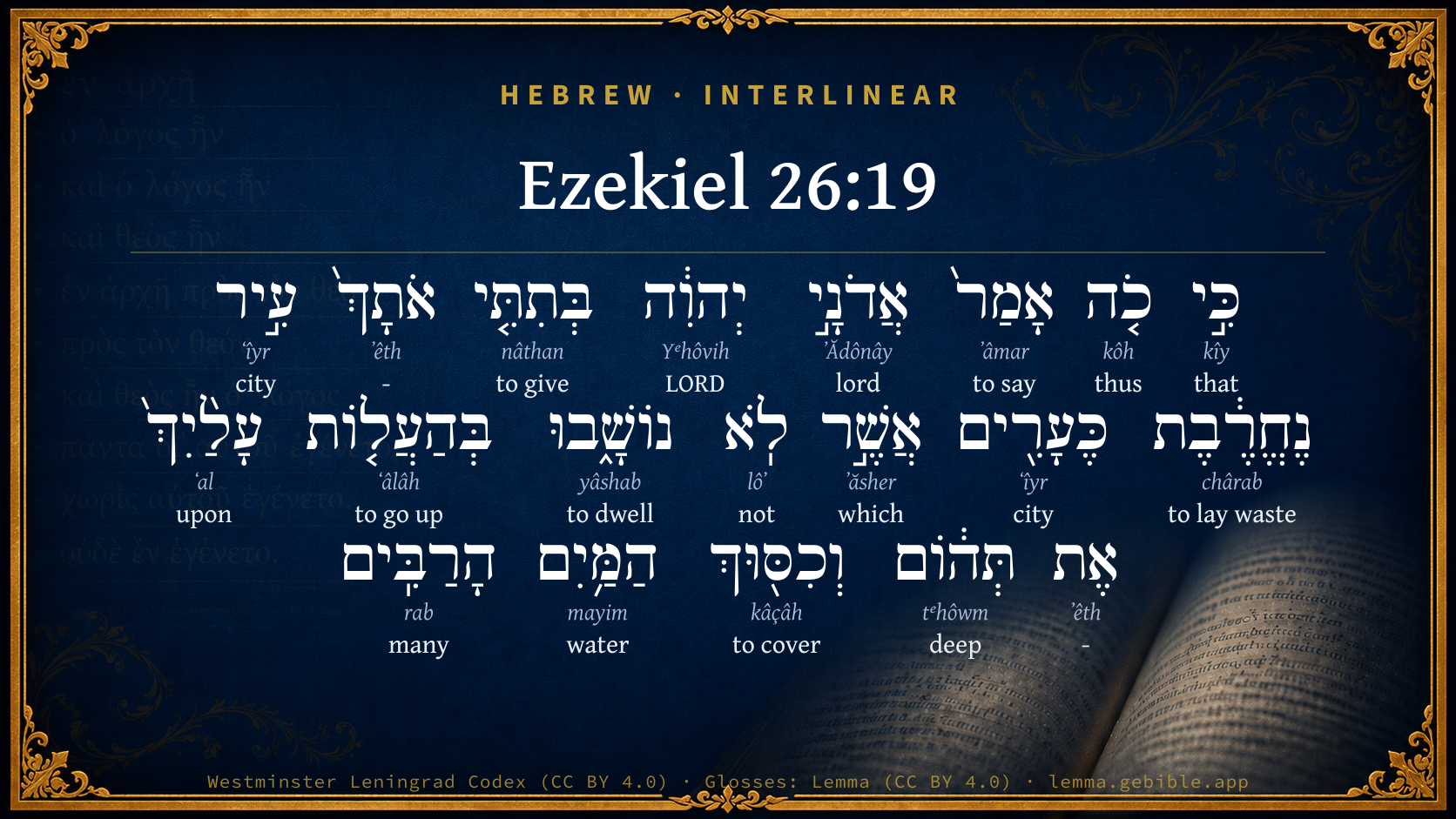
Hebrew (Westminster Leningrad Codex) Ezekiel 26:19 appears in the Hebrew Old Testament. The text above is from the Westminster Leningrad Codex. Each word links to its Strong’s number, a concise gloss, and parsing drawn from the Open Scriptures Hebrew Bible morphology. Click any word for its full Brown-Driver-Briggs (BDB) entry.
Download image
Cite this verse

Ezekiel 26:19 (World English Bible). Public Domain. Lemma interlinear Bible study tool, https://lemma.gebible.app/v/ezekiel/26/19.

Show BibTeX & RIS
BibTeX
RIS
English Translation
For thus says the Lord Yahweh: When I shall make you a desolate city, like the cities that are not inhabited; when I shall bring up the deep on you, and the great waters shall cover you;
World English Bible · Public Domain
Download a study sheet

One document with this verse’s original text, its word-by-word gloss line, the meaning frame, cross-references with their text, attributed commentary, and full source and license credits — printable, and it pastes into notes with its structure intact.

This verse Autodidact and up

Study sheet (.html) Plain text (.txt)

A passage Seminary Student

Up to 50 verses in one chapter. A passage sheet keeps up to 6 commentary sources and 12 cross-references per verse, in the order this page ranks them, and says so on the sheet whenever that leaves anything out. Ask for a single verse and you get the Autodidact verse sheet above.

Everything on this page stays free to read, with no account — the sheet is a download of what is already on screen, not access to it.

Want to remove ads? Support Godless Engineer
Compare translations 3

The same verse in 3 English versions, stacked beneath the original-language interlinear above. Click any original word for its lexicon entry.

Each is an independent rendering of the whole verse — the interlinear is not word-aligned to these translations.

Highlighted words mark where these versions differ — a whole-verse word diff, not a word-by-word alignment.

  • World English Bible Public Domain
    For thus says the Lord Yahweh: When I shall make you a desolate city, like the cities that are not inhabited; when I shall bring up the deep on you, and the great waters shall cover you;
  • King James Version Public Domain
    For thus saith the Lord GOD; When I shall make thee a desolate city, like the cities that are not inhabited; when I shall bring up the deep upon thee, and great waters shall cover thee;
  • unfoldingWord Literal Text CC BY-SA 4.0
    For the Lord Yahweh says this: When I make you a desolate city, like the other cities that are not inhabited, when I raise up the deeps against you, and when the great waters cover you,

unfoldingWord Literal Text — © unfoldingWord, licensed CC BY-SA 4.0. Word-aligned USFM3 via Door43 (git.door43.org/unfoldingWord/en_ult).

Versions to compare (up to 4)

3 of 4 selected

Show all 18 translations

Every available English version of this verse, each an independent rendering of the whole verse.

  • World English Bible Public Domain
    For thus says the Lord Yahweh: When I shall make you a desolate city, like the cities that are not inhabited; when I shall bring up the deep on you, and the great waters shall cover you;
  • Berean Standard Bible Public Domain
    For this is what the Lord GOD says: ‘When I make you a desolate city like other deserted cities, and when I raise up the deep against you so that the mighty waters cover you,
  • Majority Standard Bible Public Domain
    For this is what the Lord GOD says: ‘When I make you a desolate city like other deserted cities, and when I raise up the deep against you so that the mighty waters cover you,
  • King James Version Public Domain
    For thus saith the Lord GOD; When I shall make thee a desolate city, like the cities that are not inhabited; when I shall bring up the deep upon thee, and great waters shall cover thee;
  • American Standard Version (1901) Public Domain
    For thus saith the Lord Jehovah: When I shall make thee a desolate city, like the cities that are not inhabited; when I shall bring up the deep upon thee, and the great waters shall cover thee;
  • Revised Version (1885) Public Domain
    For thus saith the Lord GOD: When I shall make thee a desolate city, like the cities that are not inhabited; when I shall bring up the deep upon thee, and the great waters shall cover thee;
  • Geneva Bible (1599) Public Domain
    For thus saith the Lord God, When I shall make thee a desolate citie, like ye cities that are not inhabited, and when I shall bring the deepe vpon thee, and great waters shall couer thee,
  • Douay-Rheims (1899) Public Domain
    For thus saith the Lord God: When I shall make thee a desolate city like the cities that are not inhabited: and shall bring the deep upon thee, and many waters shall cover thee:
  • Young's Literal Translation Public Domain
    For thus said the Lord Jehovah: In my making thee a city wasted, Like cities that have not been inhabited, In bringing up against thee the deep, Then covered thee have the great waters.
  • Literal Standard Version CC BY-SA 4.0
    For thus said Lord YHWH: “In My making you a city dried up, || Like cities that have not been inhabited, || In bringing up the deep against you, || Then the great waters have covered you.
  • Unlocked Literal Bible CC BY-SA 4.0
    For the Lord Yahweh says this: When I make you a desolate city, like the other cities that are not inhabited, when I raise up the deeps against you, and when the great waters cover you,
  • unfoldingWord Literal Text CC BY-SA 4.0
    For the Lord Yahweh says this: When I make you a desolate city, like the other cities that are not inhabited, when I raise up the deeps against you, and when the great waters cover you,
  • Darby Bible Public Domain
    For thus saith the Lord Jehovah: When I shall make thee a desolate city, like the cities that are not inhabited; when I bring up the deep upon thee, and the great waters cover thee:
  • World Messianic Bible Public Domain
    “For the Lord GOD says: ‘When I make you a desolate city, like the cities that are not inhabited, when I bring up the deep on you, and the great waters cover you,
  • Webster's Bible Public Domain
    For thus saith the Lord GOD; When I shall make thee a desolate city, like the cities that are not inhabited; when I shall bring up the deep upon thee, and great waters shall cover thee;
  • Free Bible Version CC BY-SA 4.0
    For this is what the Lord God says: I will turn you into a ruin just like other uninhabited cities. I will have the sea rise up to cover you with deep water.
  • Bible in Basic English Public Domain
    For this is what the Lord has said: I will make you a waste town, like the towns which are unpeopled; when I make the deep come upon you, covering you with great waters.
  • JPS Tanakh (1917) Public Domain
    For thus saith the Lord GOD: When I shall make thee a desolate city, like the cities that are not inhabited; when I shall bring up the deep upon thee, and the great waters shall cover thee;

Literal Standard Version (2020), Covenant Press — licensed CC BY-SA 4.0. Text via the HelloAO Bible API (eBible.org). Unlocked Literal Bible (unfoldingWord) — licensed CC BY-SA 4.0. Text via the HelloAO Bible API (eBible.org). unfoldingWord Literal Text — © unfoldingWord, licensed CC BY-SA 4.0. Word-aligned USFM3 via Door43 (git.door43.org/unfoldingWord/en_ult). Free Bible Version, Dr. Jonathan Gallagher — licensed CC BY-SA 4.0. Text via the HelloAO Bible API (eBible.org).

Word by word

More ways to search: Search by grammar → Find every occurrence → Compare this word →

Practice this passage: Drill this verse → Learn its vocabulary →

תְּה֔וֹם
tᵉhôwm
H8415
“deep”
Noun, Common, Both, Singular, Absolute
Part of Speech
Noun
Type
Common
Gender
Both
Number
Singular
State
Absolute
Full BDB Definition

Origin: from H1949

TWOT: 2495a

deep, depths, deep places, abyss, the deep, sea - deep (of subterranean waters) - deep, sea, abysses (of sea) - primeval ocean, deep - deep, depth (of river) - abyss, the grave
  1. כִּ֣י kîy H3588 “that” Conjunction
  2. כֹ֤ה kôh H3541 “thus” Adverb
  3. אָמַר֙ ʼâmar H559 “to say” Verb, Qal, Perfect, 3rd Person, Masculine, Singular
  4. אֲדֹנָ֣י ʼĂdônây H136 “Lord · my” Noun, Common, Masculine, Plural, Construct + Suffix, Personal, 1st Person, Common, Singular
  5. יְהוִ֔ה Yᵉhôvih H3069 “LORD” Noun, Proper
  6. בְּתִתִּ֤י nâthan H5414 “in/at · to give · me” Preposition + Verb, Qal, Infinitive Construct + Suffix, Personal, 1st Person, Common, Singular
  7. אֹתָךְ֙ ʼêth H853 “- · you” Particle, Direct Object + Suffix, Personal, 2nd Person, Feminine, Singular
  8. עִ֣יר ʻîyr H5892 “city” Noun, Common, Feminine, Singular, Absolute
  9. נֶחֱרֶ֔בֶת chârab H2717 “laid waste” Verb, Niphal, Participle Passive, Feminine, Singular, Absolute
  10. כֶּעָרִ֖ים ʻîyr H5892 “like/as the · cities” Preposition, Determined + Noun, Common, Feminine, Plural, Absolute
  11. אֲשֶׁ֣ר ʼăsher H834 “which” Particle, Relative
  12. לֹֽא lôʼ H3808 “not” Particle, Negative
  13. נוֹשָׁ֑בוּ yâshab H3427 “to dwell” Verb, Niphal, Perfect, 3rd Person, Common, Plural
  14. בְּהַעֲל֤וֹת ʻâlâh H5927 “in/at · to go up” Preposition + Verb, Hiphil, Infinitive Construct
  15. עָלַ֨יִךְ֙ ʻal H5921 “upon · you” Preposition + Suffix, Personal, 2nd Person, Feminine, Singular
  16. אֶת ʼêth H853 “-” Particle, Direct Object
  17. וְכִסּ֖וּךְ kâçâh H3680 “and · to cover · you” Conjunction + Verb, Piel, Sequential Perfect, 3rd Person, Common, Plural + Suffix, Personal, 2nd Person, Feminine, Singular
  18. הַמַּ֥יִם mayim H4325 “the · water(s)” Particle, Definite Article + Noun, Common, Masculine, Plural, Absolute
  19. הָרַבִּֽים rab H7227 “the · many” Particle, Definite Article + Adjective, Adjective, Masculine, Plural, Absolute

About this verse

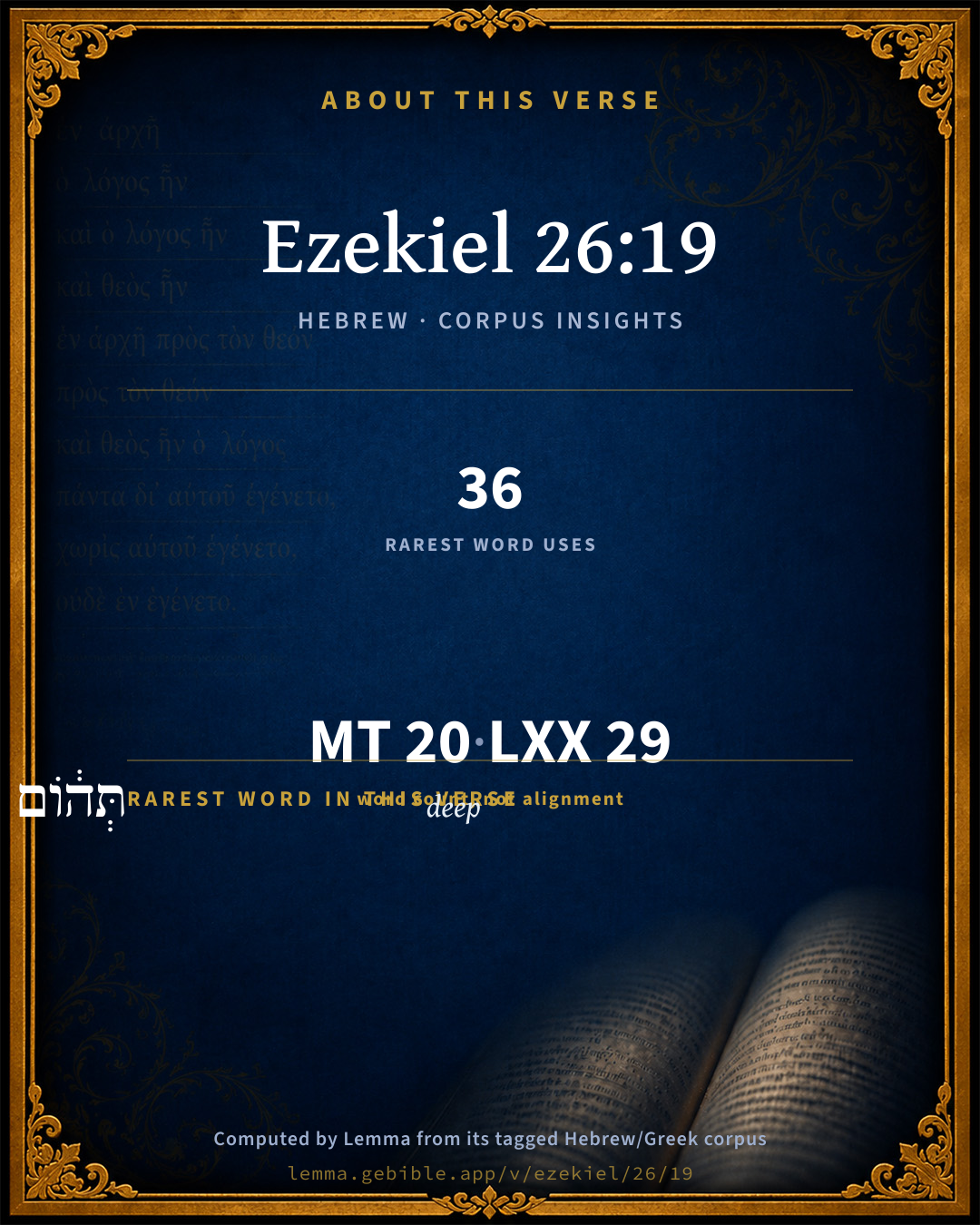
These counts appear in no published source. They are computed here, from the morphology-tagged text and Lemma’s own curated glosses. What Lemma adds →

20
words
18
distinct lemmas
Prophets
section

Shared distinctive vocabulary

תְּה֔וֹם deep H8415 occurs in 35 verses of the Hebrew Bible. Also found in:

Grammatical profile

  • 6 verbs
  • 6 nouns
  • 1 adjective
  • 1 preposition
  • 1 conjunction
  • 1 adverb
  • 4 particles

Verb forms

  • אָמַר֙ Qal · Perfect
  • בְּתִתִּ֤י Qal · Infinitive Construct
  • נֶחֱרֶ֔בֶת Niphal · Participle Passive
  • נוֹשָׁ֑בוּ Niphal · Perfect
  • בְּהַעֲל֤וֹת Hiphil · Infinitive Construct
  • וְכִסּ֖וּךְ Piel · Sequential Perfect

Repetition

A word recurs within this verse — often emphatic in Hebrew:

  • עִ֣יר city H5892 ×2

Hebrew & Septuagint length

In English translation the verse runs 37 words from the Hebrew and 30 from the Septuagint (LXX English) — closely comparable.

A rough comparison of the two English renderings, which tokenize alike — not a word-level alignment.

Word counts can differ between the Hebrew and the Greek without any difference in meaning — e.g. the Hebrew direct-object marker אֵת has no separate Greek word, and Greek often adds the article ὁ.

In the original languages it is 20 Hebrew tokens and 29 Greek tokens — but the two are counted differently (Hebrew bundles its prefixes and suffixes into one token; the Greek is in lemma form), so that isn’t a like-for-like length.

Cross-references

5

Topical passages linked to Ezekiel 26:19 in the Treasury of Scripture Knowledge — connected by theme and wording, ordered by reader-vote popularity; previews shown in the World English Bible.

  • Isaiah 8:7–8 now therefore, behold, the Lord brings up on them the waters of the River, strong and many, [even] the king of Assyria and all his glory: and it shall come up over all its channels, and go over all its banks;
  • Ezekiel 26:3 therefore thus says the Lord Yahweh, Behold, I am against you, Tyre, and will cause many nations to come up against you, as the sea causes its waves to come up.
  • Daniel 9:26 After the sixty-two weeks the Anointed One shall be cut off, and shall have nothing: and the people of the prince who shall come shall destroy the city and the sanctuary; and the end of it shall be with a flood, and even to the end shall be war; desolations are determined.
  • Daniel 11:40 At the time of the end shall the king of the south contend with him; and the king of the north shall come against him like a whirlwind, with chariots, and with horsemen, and with many ships; and he shall enter into the countries, and shall overflow and pass through.
  • Revelation 17:15 He said to me, "The waters which you saw, where the prostitute sits, are peoples, multitudes, nations, and languages.

Cross-references courtesy of OpenBible.info (CC BY 4.0).

Hebrew and Greek witnesses Masoretic Hebrew ↔ Greek Septuagint

The same verse in the two great witnesses to the Old Testament, shown verse-for-verse.

These are two independent witnesses, not word-aligned to each other, and the Septuagint is shown in lemma (dictionary) form.

Hebrew Ezekiel 26:19 Masoretic · Westminster Leningrad Codex

כִּ֣י כֹ֤ה אָמַר֙ אֲדֹנָ֣י יְהוִ֔ה בְּתִתִּ֤י אֹתָךְ֙ עִ֣יר נֶחֱרֶ֔בֶת כֶּעָרִ֖ים אֲשֶׁ֣ר לֹֽא נוֹשָׁ֑בוּ בְּהַעֲל֤וֹת עָלַ֨יִךְ֙ אֶת תְּה֔וֹם וְכִסּ֖וּךְ הַמַּ֥יִם הָרַבִּֽים

For thus says the Lord Yahweh: When I shall make you a desolate city, like the cities that are not inhabited; when I shall bring up the deep on you, and the great waters shall cover you;

World English Bible · Public Domain

Greek LXX Ezekiel 26:19 Septuagint · lemma form

ὅτι ὅδε λέγω κύριος κύριος ὅταν δίδωμι σύ πόλις ἐρημόω ὡς ὁ πόλις ὁ μή καταοἰκέω ἐν ὁ ἀναἄγω ἐγώ ἐπί σύ ὁ ἄβυσσος καί κατακαλύπτω σύ ὕδωρ πολύς

For thus says the Lord God; When I shall make the city desolate, as the cities that shall not be inhabited, when I have brought the deep up upon you,

LXX2012 (modern English Septuagint) · Public Domain

Hebrew: Westminster Leningrad Codex (CC BY 4.0). Greek: Septuagint (public domain); English from LXX2012 (modern English Septuagint) (Public Domain). How the Septuagint differs from the Hebrew →

Targum (Aramaic paraphrase)

1

The Targum is the ancient Jewish Aramaic paraphrase of the Hebrew Scriptures — an interpretive translation, not the Hebrew text itself. Onkelos (literal) and Pseudo-Jonathan (expansive) render the Torah, and Jonathan the Prophets. Coverage is partial: where no permissively-licensed English translation exists for a verse, only the Aramaic is shown. This is verse-level text, not a word-by-word alignment to the Hebrew.

  1. Targum Jonathan Prophets (Joshua–Malachi)
    אֲרֵי כִּדְנַן אֲמַר יְיָ אֱלֹהִים כַּד אֶתֵּן יָתִיךְ קִרְיָא חֶרְבָא כְּקִרְוִין דְלָא אִתּוֹתַבָא בְּאַסָקוּתִי עֲלָךְ מְשִׁרְיַת עַמְמִין דְסַגִיאִין כְּמֵי תְהוֹמָא וְיַחֲפוּנָךְ עַמְמִין סַגִיאִין:

    (no public-domain English translation for this verse)

    Targum Jonathan — Aramaic: “Mikraot Gedolot” (public domain). English: “Sefaria Community Translation” (CC0 1.0 (public-domain dedication)); “London "Chaldee Paraphrase," 1871” (public domain). Text via Sefaria.

Commentary

Notes on Ezekiel 26:19 from classic Christian and Jewish commentators (each source and its license shown beneath its notes). The classic Christian expositions comment on the surrounding passage and are grouped to its opening verse, so a note may address several verses; the Jewish commentaries on the Tanakh (Rashi and others) are per-verse, so they appear only where the commentator wrote on this verse.

Lemma curates 59 commentaries, every one of them public domain or Creative Commons licensed, each selected and text-cleaned for this edition rather than reprinted as found. About our sources →

Ellicott's Commentary for English Readers

(19) Bring up the deep upon thee.—With Eze_26:19 begins the closing section of this prophecy, and in it the other parts are summed up and emphasised. The figurative language by which the overwhelming of Tyre is here described is again appropriate to her natural situation.

A Bible Commentary for English Readers, edited by Charles John Ellicott (1878–1897) — public domain. Text from a community e-Sword module.

Trapp's Complete Commentary

John Trapp

Eze 26:19 For thus saith the Lord GOD; When I shall make thee a desolate city, like the cities that are not inhabited; when I shall bring up the deep upon thee, and great waters shall cover thee;

Ver. 19. When I shall bring up the deep upon thee.] As Eze 26:3; great forces.

And great waters shall cover thee.] So that thou shalt be irrecoverably lost, as places drowned, and never seen any more; Goodwin sands here in Kent, for instance. These did once belong to Goodwin, Earl of Kent, as his lands; but in the reign of William Rufus they were flooded, and remain to this day a dangerous sandy place, where perished, this present year 1658, Col. Reynolds and others, in their return from Mardike.

John Trapp, A Commentary or Exposition upon All the Books of the Old and New Testament (1647–1656) — public domain. Text from a community e-Sword module.

Joseph Benson's Commentary

Eze 26:19-21. Thus saith the Lord, When I shall make thee a desolate city — When I shall fulfil these predictions, and make thee what I now threaten to make thee; like the cities that are not inhabited — Whose walls are broken down, and whose streets are all solitary. When I shall bring up the deep upon thee — This may be understood either figuratively of Nebuchadnezzar’s army, or literally of the sea overflowing and covering a great part of the ancient seat of the city, in consequence of the walls and outworks thereof being demolished. And great waters shall cover thee — Either, literally, the waters of the sea, or, metaphorically, great afflictions. When I shall bring thee down with them that descend into the pit — When thou shalt be brought to utter desolation, like the cities which have been long buried in ruin and oblivion. The phrase of going down into the pit, (by which term is often signified the grave,) is frequently made use of in Scripture, to express the destruction of a person or place. Thus our Saviour says of Capernaum, (Luk 10:15,) Thou shall be thrust down to hell, or, rather, as it ought to be translated, into the state of the dead, that is, thou shall become desolate, or be no longer a city. With the people of old time — With those who are now in entire oblivion, as those who lived in the first ages of the world now are. And shall set thee in the low parts of the earth — Another description of the grave, from the situation and solitude of it; in places desolate of old — Desolate from the beginning. And I shall set glory in the land of the living — That is, when I shall reinstate Judea in glory again. Judea is called the land of the living, (which signifies, according to the genius of the Hebrew language, the land of happy men,) because that the inhabitants were assured of all blessings so long as they served God faithfully. The prophet here foretels that the city of Jerusalem, at whose destruction the inhabitants of Tyre had so greatly exulted, should be again rebuilt in the same place, and even attain to a height of reputation and glory, while the city of Tyre should remain a desolation. I will make thee a terror, and thou shall be no more — Thou shall be left in the ruins of desolation, a terrible example of my vengeance. Though thou be sought for, yet shall thou never be found again — A mode of expression this, which denotes an entire destruction: see notes on Eze 26:4-5; Eze 26:14.

Joseph Benson's Commentary on the Old and New Testaments (1811–1818) — public domain. Text from a community e-Sword module.

Keil & Delitzsch

C. F. Keil & F. Delitzsch

Thus will Tyre, covered by the waves of the sea, sink into the region of the dead, and vanish for ever from the earth. - Eze 26:19. For thus saith the Lord Jehovah, When I make thee a desolate city, like the cities which are no longer inhabited, when I cause the deep to rise over thee, so that the many waters cover thee, Eze 26:20. I cast thee down to those who have gone into the grave, to the people of olden time, and cause thee to dwell in the land of the lower regions, in the ruins from the olden time, with those who have gone into the grave, that thou mayest be no longer inhabited, and I create that which is glorious in the land of the living. Eze 26:21. I make thee a terror, and thou art no more; they will seek thee, and find thee no more for ever, is the saying of the Lord Jehovah. - Not only will ruin and desolation come upon Tyre, but it will sink for ever into the region of the dead. In this concluding thought the whole threat is summed up. The infinitive clauses of Eze 26:19 recapitulate the leading thoughts of the previous strophes, for the purpose of appending the closing thought of banishment to the under-world. By the rising of the deep we are to understand, according to Eze 26:12, that the city in its ruins will be sunk into the depths of the sea. יורדי , those who go down into the pit or grave, are the dead. They are described still further as עם עולם, not "those who are sleeping the long sleep of death," or the generation of old whom all must join; but the people of the "old world" before the flood (Pe2 2:5), who were buried by the waters of the flood, in accordance with Job 22:15, where עולם denotes the generations of the primeval world, and after the analogy of the use of עם עולם in Isa 44:7, to describe the human race as existing from time immemorial.

In harmony with this, חרבות are the ruins of the primeval world which perished in the flood. As עם עולם adds emphasis to the idea of יורדי בור, so also does בּחרבות מעולם to that of ארץ תּחתּיּות. Tyre shall not only descend to the dead in Sheol, but be thrust down to the people of the dead, who were sunk into the depths of the earth by the waters of the flood, and shall there receive its everlasting dwelling-place among the ruins of the primeval world which was destroyed by the flood, beside that godless race of the olden time. ארץ תּחתּיּות, land of the lowest places (cf. Eze 32:18, Eze 32:24), is a periphrasis for Sheol, the region of the dead (compare Eph 4:9, "the lower parts of the earth"). On 'ונתתּי צבי וגו Hitzig has observed with perfect correctness: "If we retain the pointing as the first person, with which the place assigned to the Athnach (-) coincides, we must at any rate not regard the clause as still dependent upon למען, and the force of the לא as continued. We should then have to take the clause as independent and affirmative, as the accentuators and the Targum have done." But as this would give rise to a discrepancy between the two halves of the verse, Hitzig proposes to alter נתתּי retla ot seso into the second person ונתּתי, so that the clause would still be governed by למען לא. But the want of agreement between the two halves of the verse does not warrant an alteration of the text, especially if it lead to nothing better than the forced rendering adopted by Hitzig, "and thou no longer shinest with glory in the land of the living," which there is nothing in the language to justify. And even the explanation proposed by Hvernick and Kliefoth, "that I no longer produce anything glorious from thee (Tyre) in the land of the living," is open to this objection, that "from thee" is arbitrarily interpolated into the text; and if this were what Ezekiel meant, he would either have added לך or written נתתּיך. Moreover, the change of the person is a sufficient objection to our taking נתתּי as dependent upon למען, and supplying לא. ונתתּי is evidently a simple continuation of והושׁבתּיך. And nothing but the weightiest objections should lead us to give up a view which so naturally suggests itself. But no such objections exist. Neither the want of harmony between the two halves of the verse, nor the context, - according to which Tyre and its destruction are referred to both before and immediately after, - forces us to the adoption of explanations at variance with the simple meaning of the words. We therefore adhere to the natural interpretation of the words, "and I set (establish) glory in the land of the living;" and understand by the land of the living, not the theocracy especially, but the earth, in contrast to the region of the dead. The words contain the general thought, that on and after the overthrow of the glory of the ungodly power of the world, He will create that which is glorious on the earth to endure for ever; and this He really does by the establishing of His kingdom. - Tyre, on the contrary, shall become, through its fate, an object of terror, or an example of sudden destruction, and pass away with all its glory, not leaving a trace behind. For Eze 26:21, compare Isa 41:12 and Psa 37:36. וּתבקשׁי, imperf. Pual, has Chateph-patach between the two u, to indicate emphatically that the syllable is only a very loosely closed one (vid., Ewald, 31b, p. 95).

Keil & Delitzsch — Biblical Commentary on the Old Testament (1861–1891) — public domain (CC PDM 1.0). Text via the HelloAO Bible API. (Old Testament only.)

Tyndale Open Study Notes

Tyndale Open Resources

26:19-21 God would demonstrate his sovereign power by utterly destroying Tyre. It would be as though that great city had sunk into the depths of the chaotic ocean waves, with its inhabitants condemned to the pit where the unrighteous dead reside, never to return.

Tyndale Open Study Notes — © Tyndale Open Resources, licensed CC BY-SA 4.0. Text via the HelloAO Bible API.

Jamieson, Fausset & Brown

Robert Jamieson, A. R. Fausset & David Brown

great waters--appropriate metaphor of the Babylonian hosts, which literally, by breaking down insular Tyre's ramparts, caused the sea to "cover" part of her.

Jamieson, Fausset & Brown — Commentary Critical and Explanatory on the Whole Bible (1871) — public domain (CC PDM 1.0). Text via the HelloAO Bible API.

The Cambridge Bible for Schools and Colleges

gen. ed. J. J. S. Perowne

19. Tyre shall be overwhelmed in the great waters, and brought down to the pit, with them dead from of old; she shall never, be inhabited nor found any more.

The Cambridge Bible for Schools and Colleges (gen. ed. J. J. S. Perowne; Cambridge University Press, 1878–1918) — public domain. Text from a community e-Sword module.

John Gill's Exposition

When I shall bring thee down with them that descend into the pit,.... The grave, and make thee like to them:

with the people of old time; either the people of the old world, or, however, who have been dead long ago:

and shall set thee in the low parts of the earth; where the dead are laid:

in places desolate of old: long ago unfrequented by men; as such places be as are for the burial of the dead:

with them that go down to the pit, that thou be not inhabited; all the inhabitants being free among the dead; a heap of words made use of to express the same thing, for the confirmation of it; namely, that the condition of Tyre should be like that of dead men, who have been of old dead, and are remembered no more. Jarchi interprets the "pit", of hell; as if this respected their everlasting perdition, as well as temporal ruin; it may be applied to the beast which goeth into perdition, Rev 17:8,

and I shall set glory in the land of the living; in the land of Israel; so the Targum; and it is interpreted by the Jewish expositors and others the same way; and which may be called "the land of the living"; because the living God was worshipped in it; living men in a spiritual sense dwelt there, who offered up living sacrifices unto God, and who had the promise and pledge of eternal life; and which was the "glory" of all lands, as it is sometimes called, where the same word is used as here, Eze 20:6, which had its accomplishment in some respects at the Jews' return from Babylon; but, as Tyre here is a type of antichrist, it may be observed, that, at the time of his fall and destruction, God will put a glory upon his church and people, upon which there shall be a defence; see Isa 4:5. This is interpreted by the Talmudists (p) of the resurrection of the dead, when they that die in the land of Israel shall live.

(p) Vid. Kimchi in loc. & T. Bab. Cetubot, fol. 111. 1.

John Gill's Exposition of the Whole Bible (1746–1763) — public domain (CC PDM 1.0). Text via the HelloAO Bible API.

Haydock's Catholic Bible Commentary

Waters; great armies, (ver. 3.) or when thou art in the regions below, Job xxvi. 5. (Calmet) --- Tyre was humbled for her pride, but restored after seventy years, Isaias xxiii. Our Saviour retired into those parts, Matthew xv. 21. (Worthington)

George Leo Haydock (1774–1849), Haydock's Catholic Family Bible and Commentary, 1859 edition — public domain. Excludes Psalms (Douay-Rheims chapter numbering differs from Protestant) and Deuterocanonical books (Catholic canon only).

Matthew Poole's English Annotations

Shall make thee a desolate city; have made thee what now I threaten I will make thee.

Like the cities that are not inhabited; in the same state with cities that have not any to dwell in them, whose walls are broken down. and into whose streets all solitary wild beasts may come at pleasure.

The deep; figuratively, Nebuchadnezzar’s army; literally, when thy walls and ramparts are so broken down by the Chaldeans, that the Sea, at high tides, and in stormy swelling seas, overflows part of thine ancient seat.

Great waters; either literally, as the deep coming up; or metaphorically, great afflictions shall flow over thee.

Matthew Poole's English Annotations on the Holy Bible (1683–1685) — public domain. Text from a community e-Sword/MySword module.

Whedon's Commentary on the Bible

Daniel D. Whedon

19. When I shall bring up the deep upon thee — The ruins of the best parts of ancient Tyre are now under water.

Daniel D. Whedon (gen. ed.), Commentary on the Old and New Testaments (1874–1909) — public domain. Text from a community e-Sword module.

The Pulpit Commentary

When I shall bring up the sea. The picture of desolation is completed. The sea washes over the bare rock that was once covered with the palaces of the merchant-princes.

The Pulpit Commentary (1880–1919), ed. H.D.M. Spence-Jones & Joseph S. Exell — public domain. Text from a community e-Sword module.

John Wesley's Explanatory Notes

The deep - Nebuchadnezzar's army. Great waters - Great afflictions.

John Wesley, Explanatory Notes Upon the Whole Bible (1754–1765) — public domain. Text via the GEBible commentary corpus.

unfoldingWord translationNotes

Door43 World Missions Community

Connecting Statement:

Yahweh continues giving Ezekiel his message to Tyre.

When I make you

The word "you" here refers to the city of Tyre. In the original language "you" here is feminine singular.

When I make you a desolate city, like the other cities that are not inhabited

Here Tyre is compared to other cities that no longer had people living in them. (See: Simile)

the deeps

Here "the deeps" means the deep waters of the sea. AT: "the deep waters" (See: Nominal Adjectives)

then I will bring you down to the people of ancient times, like the others who have gone down into the pit; for I will make you live in the lowest realms of the earth as in ruins of ancient times

What Yahweh would do to Tyre is compared to people going to the grave and cities falling into ruin. (See: Personification and Simile)

the pit

This refers to the grave. Because the grave was thought to be the entrance to the world of the dead, the pit also represents that world. (See: Metonymy)

stand in the land of the living

This represents being restored to the city's former existence. (See: Metaphor)

I will place disaster on you

The abstract noun "disaster" can be translated using the adjective "terrible" or the verb "destroy." AT: "I will bring you to a terrible end" or "I will destroy you" (See: Abstract Nouns)

Then you will be sought, but you will never be found ever again

This can be stated in active form. AT: "Then people will seek you but not be able to find you ever again" (See: Active or Passive)

translationWords

Lord Yahweh

desolate

water

pit

unfoldingWord translationNotes — © Distant Shores Media and the Door43 World Missions Community, licensed CC BY-SA 4.0. Source: git.door43.org/Door43/en_tn.

Rashi

Rabbi Shlomo Yitzchaki (Rashi)

when [I] bring up the deep upon you “When I bring upon you companies of nations as numerous as the waters of the deep, and many nations will cover you.” Jonathan translated it in this manner, but according to its apparent meaning, first it was given into the hands of Nebuchadnezzar, and ultimately, the sea came up and inundated it.

Rashi on the Tanakh — English translations: “The Judaica Press complete Tanach with Rashi, translated by A. J. Rosenberg” (CC BY 4.0); “Pentateuch with Rashi's commentary by M. Rosenbaum and A.M. Silbermann, 1929-1934” (public domain); “The Metsudah Tanach series, Lakewood, N.J” (CC BY 4.0); and “The Book of Joshua, Metsudah Publications, 1997” (CC BY 4.0). Text via Sefaria.

Lesson kit

Teaching starters — assembled from the data on this page, not authored interpretation. Every prompt links to the verse data it draws on. Edit before teaching.

Ezekiel, in the Prophets, opens this verse with 20 words (18 distinct Hebrew lemmas). Its most distinctive word is tᵉhôwm (“deep”). A historical commentator’s framing appears above. Read the whole chapter for the surrounding context.

Discussion questions

  1. The word tᵉhôwm carries the sense “deep.” How does it shape the verse?
  2. How does Genesis 1:2, which shares the word «deep», read alongside this verse?
  3. What does the repetition of “city” (2× in this one verse) do in this verse?
  4. These translations render this verse differently. What is at stake in choosing one wording over another?
  5. «אָמַר֙» is a Qal Perfect verb. How does that grammatical form shape the action described?
  6. Compare how Ellicott's Commentary for English Readers and Trapp's Complete Commentary read this verse. Where do they agree or differ?

Things to notice

Reading settings

Reading text

Shown beneath each verse's original-language words.

Old Testament
Old Testament edition

Read the OT as the Masoretic Hebrew (MT) or the Greek Septuagint (LXX).

English shown for the Greek Septuagint (in the Hebrew ↔ Greek comparison).

Comparing translations? Open the Compare panel on any verse page to stack up to four side by side.