
Leviticus 13:12

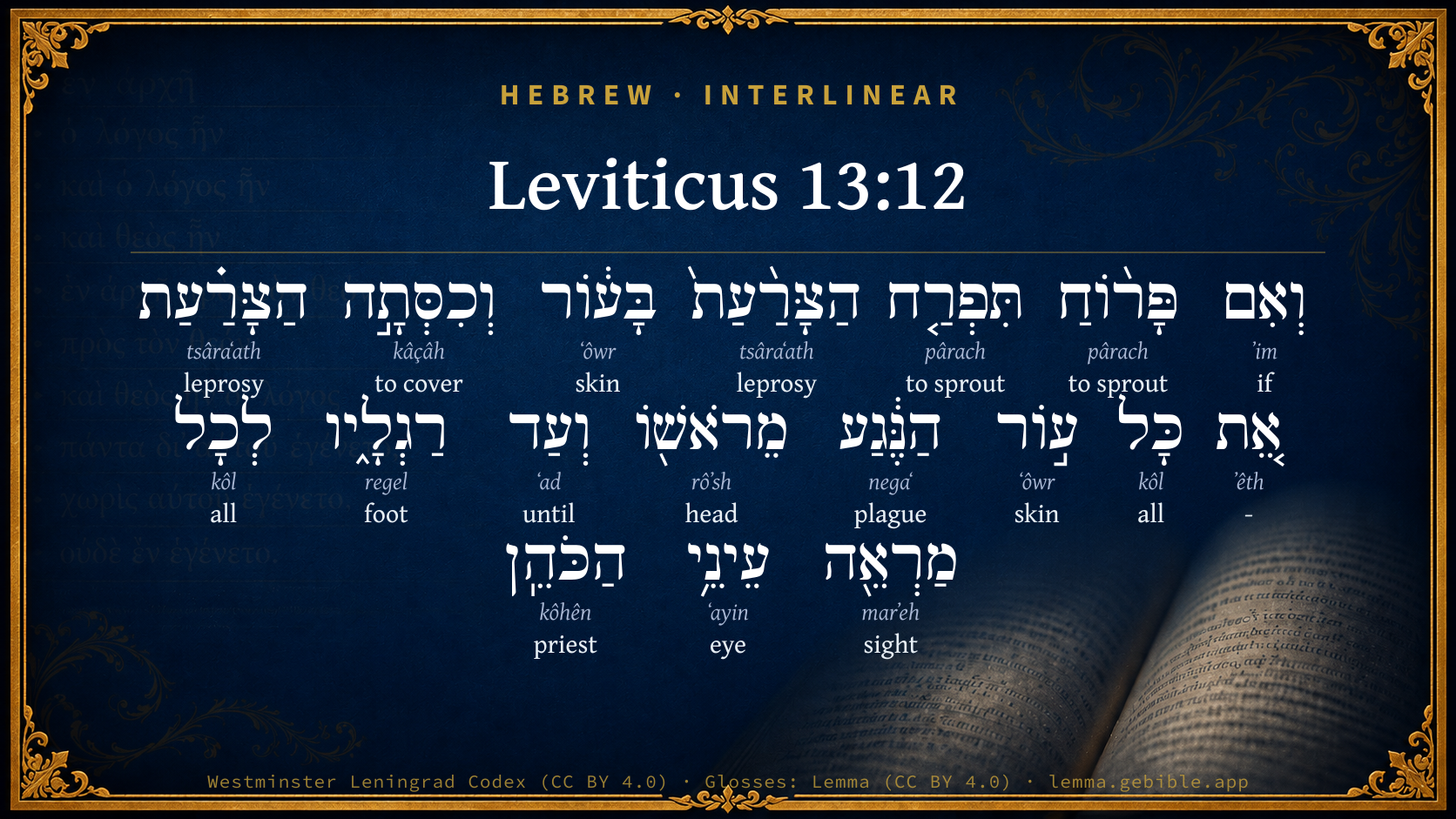
Hebrew (Westminster Leningrad Codex) Leviticus 13:12 appears in the Hebrew Old Testament. The text above is from the Westminster Leningrad Codex. Each word links to its Strong’s number, a concise gloss, and parsing drawn from the Open Scriptures Hebrew Bible morphology. Click any word for its full Brown-Driver-Briggs (BDB) entry.
Download image
Cite this verse

Leviticus 13:12 (World English Bible). Public Domain. Lemma interlinear Bible study tool, https://lemma.gebible.app/v/leviticus/13/12.

Show BibTeX & RIS
BibTeX
RIS
English Translation
"If the leprosy breaks out all over the skin, and the leprosy covers all the skin of the infected person from his head even to his feet, as far as it appears to the priest;
World English Bible · Public Domain
Download a study sheet

One document with this verse’s original text, its word-by-word gloss line, the meaning frame, cross-references with their text, attributed commentary, and full source and license credits — printable, and it pastes into notes with its structure intact.

This verse Autodidact and up

Study sheet (.html) Plain text (.txt)

A passage Seminary Student

Up to 50 verses in one chapter. A passage sheet keeps up to 6 commentary sources and 12 cross-references per verse, in the order this page ranks them, and says so on the sheet whenever that leaves anything out. Ask for a single verse and you get the Autodidact verse sheet above.

Everything on this page stays free to read, with no account — the sheet is a download of what is already on screen, not access to it.

Want to remove ads? Support Godless Engineer
Compare translations 3

The same verse in 3 English versions, stacked beneath the original-language interlinear above. Click any original word for its lexicon entry.

Each is an independent rendering of the whole verse — the interlinear is not word-aligned to these translations.

Highlighted words mark where these versions differ — a whole-verse word diff, not a word-by-word alignment.

  • World English Bible Public Domain
    "If the leprosy breaks out all over the skin, and the leprosy covers all the skin of the infected person from his head even to his feet, as far as it appears to the priest;
  • King James Version Public Domain
    And if a leprosy break out abroad in the skin, and the leprosy cover all the skin of him that hath the plague from his head even to his foot, wheresoever the priest looketh;
  • unfoldingWord Literal Text CC BY-SA 4.0
    But if, breaking out, the skin disease breaks out on the skin, and the skin disease covers all the skin of the infection, from his head and to his feet, to the whole vision of the eyes of the priest,

unfoldingWord Literal Text — © unfoldingWord, licensed CC BY-SA 4.0. Word-aligned USFM3 via Door43 (git.door43.org/unfoldingWord/en_ult).

Versions to compare (up to 4)

3 of 4 selected

Show all 18 translations

Every available English version of this verse, each an independent rendering of the whole verse.

  • World English Bible Public Domain
    "If the leprosy breaks out all over the skin, and the leprosy covers all the skin of the infected person from his head even to his feet, as far as it appears to the priest;
  • Berean Standard Bible Public Domain
    But if the skin disease breaks out all over his skin so that it covers all the skin of the infected person from head to foot, as far as the priest can see,
  • Majority Standard Bible Public Domain
    But if the skin disease breaks out all over his skin so that it covers all the skin of the infected person from head to foot, as far as the priest can see,
  • King James Version Public Domain
    And if a leprosy break out abroad in the skin, and the leprosy cover all the skin of him that hath the plague from his head even to his foot, wheresoever the priest looketh;
  • American Standard Version (1901) Public Domain
    And if the leprosy break out abroad in the skin, and the leprosy cover all the skin of `him that hath' the plague from his head even to his feet, as far as appeareth to the priest;
  • Revised Version (1885) Public Domain
    And if the leprosy break out abroad in the skin, and the leprosy cover all the skin of him that hath the plague from his head even to his feet, as far as appeareth to the priest;
  • Geneva Bible (1599) Public Domain
    Also if the leprosie breake out in the skin, and the leprosie couer all the skin of the plague, from his head euen to his feete, wheresoeuer the Priest looketh,
  • Douay-Rheims (1899) Public Domain
    But if the leprosy spring out running about in the skin, and cover all the skin from the head to the feet, whatsoever falleth under the sight of the eyes,
  • Young's Literal Translation Public Domain
    `And if the leprosy break out greatly in the skin, and the leprosy hath covered all the skin of `him who hath' the plague, from his head even unto his feet, to all that appeareth to the eyes of the priest,
  • Literal Standard Version CC BY-SA 4.0
    And if the leprosy breaks out greatly in the skin, and the leprosy has covered all the skin of [him who has] the plague, from his head even to his feet, to all that appears to the eyes of the priest,
  • Unlocked Literal Bible CC BY-SA 4.0
    If the disease breaks out widely in the skin and covers all the skin of the person with the disease from his head to his feet, as far as it appears to the priest,
  • unfoldingWord Literal Text CC BY-SA 4.0
    But if, breaking out, the skin disease breaks out on the skin, and the skin disease covers all the skin of the infection, from his head and to his feet, to the whole vision of the eyes of the priest,
  • Darby Bible Public Domain
    But if the leprosy break out much in the skin, and the leprosy cover all the skin of [him that hath] the sore, from his head even to his foot, wherever the eyes of the priest look,
  • World Messianic Bible Public Domain
    “If the leprosy breaks out all over the skin, and the leprosy covers all the skin of the infected person from his head even to his feet, as far as it appears to the priest,
  • Webster's Bible Public Domain
    And if a leprosy shall break out in the skin, and the leprosy shall cover all the skin of him that hath the plague from his head even to his foot, wherever the priest looketh;
  • Free Bible Version CC BY-SA 4.0
    However, if the skin disease affects all their skin so that it covers their skin from head to toe, everywhere the priest can see,
  • Bible in Basic English Public Domain
    And if the disease comes out all over his skin, from his head to his feet, as far as the priest is able to see,
  • JPS Tanakh (1917) Public Domain
    And if the leprosy break out abroad in the skin, and the leprosy cover all the skin of him that hath the plague from his head even to his feet, as far as appeareth to the priest;

Literal Standard Version (2020), Covenant Press — licensed CC BY-SA 4.0. Text via the HelloAO Bible API (eBible.org). Unlocked Literal Bible (unfoldingWord) — licensed CC BY-SA 4.0. Text via the HelloAO Bible API (eBible.org). unfoldingWord Literal Text — © unfoldingWord, licensed CC BY-SA 4.0. Word-aligned USFM3 via Door43 (git.door43.org/unfoldingWord/en_ult). Free Bible Version, Dr. Jonathan Gallagher — licensed CC BY-SA 4.0. Text via the HelloAO Bible API (eBible.org).

Word by word

More ways to search: Search by grammar → Find every occurrence → Compare this word →

Practice this passage: Drill this verse → Learn its vocabulary →

הַצָּרַ֨עַת֙
tsâraʻath
H6883
“the · leprosy”
Particle, Definite Article + Noun, Common, Feminine, Singular, Absolute
Part of Speech
Particle + Noun
Type
Common
Gender
Feminine
Number
Singular
State
Absolute
Full BDB Definition

Origin: from H6879

TWOT: 1971a

leprosy - in people, malignant skin disease ( Lev. 13-14 ) - in clothing, a mildew or mould ( Lev 13:47-52 ) - in buildings, a mildew or mould ( Lev. 14:34-53 )
  1. וְאִם ʼim H518 “and · if” Conjunction + Conjunction
  2. פָּר֨וֹחַ pârach H6524 “to sprout” Verb, Qal, Infinitive Absolute
  3. תִּפְרַ֤ח pârach H6524 “to sprout” Verb, Qal, Imperfect, 3rd Person, Feminine, Singular
  4. בָּע֔וֹר ʻôwr H5785 “in/at the · skin” Preposition, Determined + Noun, Common, Masculine, Singular, Absolute
  5. וְכִסְּתָ֣ה kâçâh H3680 “and · to cover” Conjunction + Verb, Piel, Perfect, 3rd Person, Feminine, Singular
  6. הַצָּרַ֗עַת tsâraʻath H6883 “the · leprosy” Particle, Definite Article + Noun, Common, Feminine, Singular, Absolute
  7. אֵ֚ת ʼêth H853 “-” Particle, Direct Object
  8. כָּל kôl H3605 “all of” Noun, Common, Masculine, Singular, Construct
  9. ע֣וֹר ʻôwr H5785 “skin of” Noun, Common, Masculine, Singular, Construct
  10. הַנֶּ֔גַע negaʻ H5061 “the · plague” Particle, Definite Article + Noun, Common, Masculine, Singular, Absolute
  11. מֵרֹאשׁ֖וֹ rôʼsh H7218 “from · head · his” Preposition + Noun, Common, Masculine, Singular, Construct + Suffix, Personal, 3rd Person, Masculine, Singular
  12. וְעַד ʻad H5704 “and · until” Conjunction + Preposition
  13. רַגְלָ֑יו regel H7272 “feet · his” Noun, Common, Feminine, Dual, Construct + Suffix, Personal, 3rd Person, Masculine, Singular
  14. לְכָל kôl H3605 “to/for · all of” Preposition + Noun, Common, Masculine, Singular, Construct
  15. מַרְאֵ֖ה marʼeh H4758 “sight of” Noun, Common, Masculine, Singular, Construct
  16. עֵינֵ֥י ʻayin H5869 “eyes of” Noun, Common, Both, Dual, Construct
  17. הַכֹּהֵֽן kôhên H3548 “the · priest” Particle, Definite Article + Noun, Common, Masculine, Singular, Absolute

About this verse

These counts appear in no published source. They are computed here, from the morphology-tagged text and Lemma’s own curated glosses. What Lemma adds →

18
words
14
distinct lemmas
Pentateuch
section

Shared distinctive vocabulary

הַצָּרַ֨עַת֙ leprosy H6883 occurs in 33 verses of the Hebrew Bible. Also found in:

Grammatical profile

  • 3 verbs
  • 12 nouns
  • 1 preposition
  • 1 conjunction
  • 1 particle

Verb forms

  • פָּר֨וֹחַ Qal · Infinitive Absolute
  • תִּפְרַ֤ח Qal · Imperfect
  • וְכִסְּתָ֣ה Piel · Perfect

Repetition

Words recur within this verse — often emphatic in Hebrew:

  • פָּר֨וֹחַ to sprout H6524 ×2
  • הַצָּרַ֨עַת֙ leprosy H6883 ×2
  • בָּע֔וֹר skin H5785 ×2
  • כָּל all H3605 ×2

Hebrew & Septuagint length

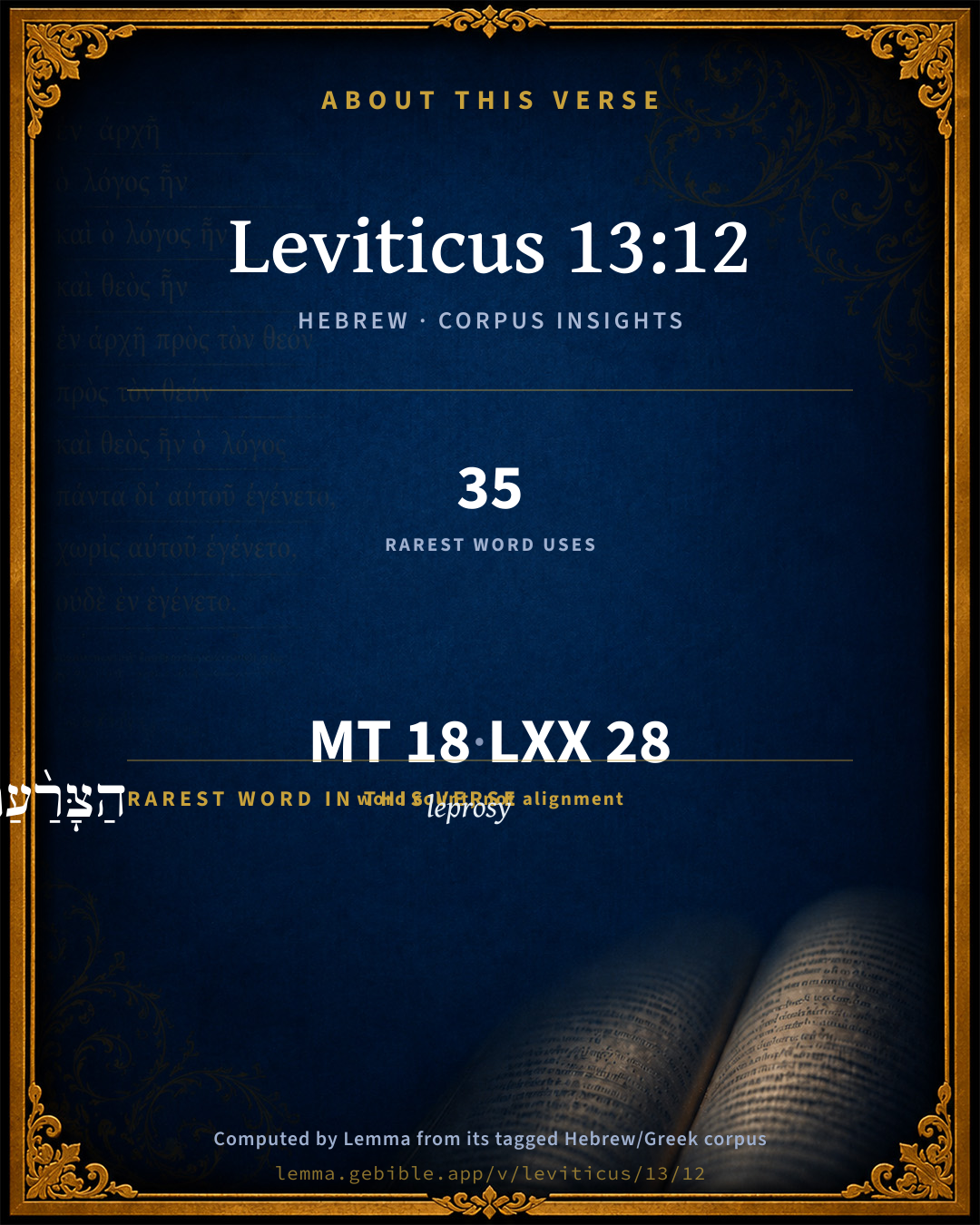
In English translation the verse runs 35 words from the Hebrew and 35 from the Septuagint (LXX English) — the same length.

A rough comparison of the two English renderings, which tokenize alike — not a word-level alignment.

Word counts can differ between the Hebrew and the Greek without any difference in meaning — e.g. the Hebrew direct-object marker אֵת has no separate Greek word, and Greek often adds the article ὁ.

In the original languages it is 18 Hebrew tokens and 28 Greek tokens — but the two are counted differently (Hebrew bundles its prefixes and suffixes into one token; the Greek is in lemma form), so that isn’t a like-for-like length.

Cross-references

7

Topical passages linked to Leviticus 13:12 in the Treasury of Scripture Knowledge — connected by theme and wording, ordered by reader-vote popularity; previews shown in the World English Bible.

  • 1 Kings 8:38 whatever prayer and supplication be made by any man, [or] by all your people Israel, who shall know every man the plague of his own heart, and spread forth his hands toward this house:
  • Job 40:4 "Behold, I am of small account. What shall I answer you? I lay my hand on my mouth.
  • Job 42:6 Therefore I abhor myself, And repent in dust and ashes."
  • Isaiah 64:6 For we are all become as one who is unclean, and all our righteousness are as a polluted garment: and we all do fade as a leaf; and our iniquities, like the wind, take us away.
  • John 16:8–9 When he has come, he will convict the world about sin, about righteousness, and about judgment;
  • Romans 7:14 For we know that the law is spiritual, but I am fleshly, sold under sin.
  • 1 John 1:8–10 If we say that we have no sin, we deceive ourselves, and the truth is not in us.

Cross-references courtesy of OpenBible.info (CC BY 4.0).

Hebrew and Greek witnesses Masoretic Hebrew ↔ Greek Septuagint

The same verse in the two great witnesses to the Old Testament, shown verse-for-verse.

These are two independent witnesses, not word-aligned to each other, and the Septuagint is shown in lemma (dictionary) form.

Hebrew Leviticus 13:12 Masoretic · Westminster Leningrad Codex

וְאִם פָּר֨וֹחַ תִּפְרַ֤ח הַצָּרַ֨עַת֙ בָּע֔וֹר וְכִסְּתָ֣ה הַצָּרַ֗עַת אֵ֚ת כָּל ע֣וֹר הַנֶּ֔גַע מֵרֹאשׁ֖וֹ וְעַד רַגְלָ֑יו לְכָל מַרְאֵ֖ה עֵינֵ֥י הַכֹּהֵֽן

"If the leprosy breaks out all over the skin, and the leprosy covers all the skin of the infected person from his head even to his feet, as far as it appears to the priest;

World English Bible · Public Domain

Greek LXX Leviticus 13:12 Septuagint · lemma form

ἐάν δέ ἐκἀνθέω ἐκἀνθέω ὁ λέπρα ἐν ὁ δέρμα καί καλύπτω ὁ λέπρα πᾶς ὁ δέρμα ὁ ἁφή ἀπό κεφαλή ἕως πούς κατά ὅλος ὁ ὅρασις ὁ ἱερεύς

And if the leprosy should have come out very evidently in the skin, and the leprosy should cover all the skin of the patient from the head to the feet, wherever the priest shall look;

LXX2012 (modern English Septuagint) · Public Domain

Hebrew: Westminster Leningrad Codex (CC BY 4.0). Greek: Septuagint (public domain); English from LXX2012 (modern English Septuagint) (Public Domain). How the Septuagint differs from the Hebrew →

Targum (Aramaic paraphrase)

2

The Targum is the ancient Jewish Aramaic paraphrase of the Hebrew Scriptures — an interpretive translation, not the Hebrew text itself. Onkelos (literal) and Pseudo-Jonathan (expansive) render the Torah, and Jonathan the Prophets. Coverage is partial: where no permissively-licensed English translation exists for a verse, only the Aramaic is shown. This is verse-level text, not a word-by-word alignment to the Hebrew.

  1. Targum Onkelos Torah (Genesis–Deuteronomy)
    וְאִם מִסְגָא תִסְגֵי סְגִירוּתָא בְּמַשְׁכָּא וְתַחְפֵי סְגִירוּתָא יָת כָּל מְשַׁךְ מַכְתָּשָׁא מֵרֵישֵׁהּ וְעַד רַגְלוֹהִי לְכָל חֵיזוּ עֵינֵי כַהֲנָא

    (no public-domain English translation for this verse)

    Targum Onkelos — Aramaic: “Onkelos Genesis” (public domain); “Onkelos Exodus” (public domain); “Onkelos Leviticus” (public domain); “Onkelos Numbers” (public domain); “Onkelos Deuteronomy” (public domain). English: “Sefaria Community Translation” (CC0 1.0 (public-domain dedication)); “J.W. Etheridge. The Targums of Onkelos and Jonathan Ben Uzziel on the Pentateuch. London: Longmans, Green, 1862” (public domain). Text via Sefaria.

  2. Targum Pseudo-Jonathan Torah (Genesis–Deuteronomy)
    וְאִין מִסְגַיָא תַּסְגֵי סְגִירוּתָא בְּמוֹשְׁכָא וְתַחְפֵי סְגִירוּתָא יַת כָּל מְשַׁךְ בִּישְרֵיהּ מֵרֵישֵׁיהּ וְעַד רִיגְלוֹי לְכָל חֵיזְיוּ דְחַמְיַין עֵינוֹי דְכַהֲנָא וּמִתְכַוְונָן בֵּין לִמְדַכְיָא וּבֵין לְסָאֳבָא

    Yet if the leprosy increasing increaseth in the skin, and the leprosy covereth all the skin of his flesh, from his head even to his feet, in whatever part the eyes of the priest may look on, in deliberating between cleanness and uncleanness,

    Targum Pseudo-Jonathan — Aramaic: “Targum Jonathan on Genesis” (public domain); “Targum Jonathan on Exodus” (public domain); “Targum Jonathan on Leviticus” (public domain); “Targum Jonathan on Numbers” (public domain); “Targum Jonathan on Deuteronomy” (public domain). English: “The Targum of Jonathan ben Uzziel, trans. J. W. Etheridge, London, 1862” (public domain). Text via Sefaria.

Commentary

Notes on Leviticus 13:12 from classic Christian and Jewish commentators (each source and its license shown beneath its notes). The classic Christian expositions comment on the surrounding passage and are grouped to its opening verse, so a note may address several verses; the Jewish commentaries on the Tanakh (Rashi and others) are per-verse, so they appear only where the commentator wrote on this verse.

Lemma curates 59 commentaries, every one of them public domain or Creative Commons licensed, each selected and text-cleaned for this edition rather than reprinted as found. About our sources →

Trapp's Complete Commentary

John Trapp

Lev 13:12 And if a leprosy break out abroad in the skin, and the leprosy cover all the skin of [him that hath] the plague from his head even to his foot, wheresoever the priest looketh;

Ver. 12. And if a leprosy.] So called, because so counted at first: but it proves no more than a kind of scurf or scab.

John Trapp, A Commentary or Exposition upon All the Books of the Old and New Testament (1647–1656) — public domain. Text from a community e-Sword module.

Tyndale Open Study Notes

Tyndale Open Resources

13:12-13 The completely white skin might refer simply to a loss of pigment (see also 13:3), whereas raw flesh (13:10, 14) indicated infection and ceremonial uncleanness.

Tyndale Open Study Notes — © Tyndale Open Resources, licensed CC BY-SA 4.0. Text via the HelloAO Bible API.

Geneva Bible (1599)

Geneva Bible translators

Or, bud.

Geneva Bible (1599) marginal notes — public domain. Text via Bolls.life.

Ellicott's Commentary for English Readers

(12, 13) And if a leprosy break out abroad.—There were, however, two phases of this returned distemper which exempted the patient from uncleanness. If the leprosy suddenly covered the whole body so that the patient became perfectly white, in which case there could be no appearance of live flesh, then he was clean. This indicated the crisis, as the whole evil matter thus brought to the surface formed itself into a scale, which dried and peeled off.

A Bible Commentary for English Readers, edited by Charles John Ellicott (1878–1897) — public domain. Text from a community e-Sword module.

The Cambridge Bible for Schools and Colleges

gen. ed. J. J. S. Perowne

The case when the whole body is turned white (12–17)

A form of skin disease which is not infectious seems to be here indicated. A white efflorescence spreads over the whole body, which after a time peels off, and the skin resumes a healthy appearance. The presence of the raw flesh indicates disease (Lev_13:14-15), but as soon as the whole surface becomes white, the priest shall pronounce him clean.

The Cambridge Bible for Schools and Colleges (gen. ed. J. J. S. Perowne; Cambridge University Press, 1878–1918) — public domain. Text from a community e-Sword module.

John Gill's Exposition

And if a leprosy break out abroad in the skin,.... Or, if flowering it flowers (m); the man that has it on him looks like a plant or tree covered with white flowers, being spread all over him in white swellings, bright spots or scabs, as it follows:

and the leprosy cover all the skin of him that hath the plague, from his head even to his foot; such an one as the leper was that came to Christ for healing, said to be full of leprosy, Luk 5:12; and such in a mystical sense is every sinner, whether sensible of it or not, even from the Crown of the head to the sole of the foot, full of the wounds, bruises, and putrefying sores of sin, Isa 1:6,

wheresoever the priest looketh; that is, he cannot look any where upon any part of him but he sees the signs of the leprosy on him; and from whence the Jewish writers gather, that a priest that inspects leprous persons ought to have a clear sight, and to have both his eyes, and that the inspection should not be made in a dark house.

(m) , Sept. "florendo floruerit", Montanus; so Drusius & Tigurine version.

John Gill's Exposition of the Whole Bible (1746–1763) — public domain (CC PDM 1.0). Text via the HelloAO Bible API.

Albert Barnes' Notes on the Bible

The disease here indicated appears to be that now known as Lepra commonis, the common White Leprosy, or Dry Tetter. It first shows itself in reddish pimples, the surface of which becomes white and scaly, spreading in a circular form until they meet each other and cover large patches of the body. It scarcely affects the general health, and for the most part disappears of itself, though it often lasts for years.

From his head even to his foot, wheresoever. the priest looketh - The first appearance of the Lepra Commonis may take place in any part of the body, especially, however, at the larger joints of the limbs; but the spots of elephantiasis are almost always first seen, on those parts which are habitually exposed, the face, ears and hands.

Lev 13:14

Raw flesh - See Lev 13:10.

Lev 13:15

Boil - Probably ulcer. In Job 2:7, and Deu 28:27, Deu 28:35, it would seem highly probable that the word expresses the ulcers of elephantiasis.

Albert Barnes' Notes on the Bible (1834–1885) — public domain. Text from a community e-Sword/MySword module.

The Pulpit Commentary

Vers. 12-17. If a leprosy break out abroad... and cover all the skin. There was a form of disease similar to true leprosy, and bearing the name of leprosy, and by some thought to be the final phase of true leprosy, which was yet not to cause legal uncleanness. It was distinguishable from the leprosy which caused uncleanness by a diffusion of the white flakes over the whole body, and by the absence of any patches bearing the appearance of raw flesh (verses 12, 13). Real leprosy might pass into this harmless kind or phase, and it was known to have done so as soon as the raw patches of flesh had disappeared (verses 16, 17). When this had taken place, the priest pronounced him clean.

The Pulpit Commentary (1880–1919), ed. H.D.M. Spence-Jones & Joseph S. Exell — public domain. Text from a community e-Sword module.

unfoldingWord translationNotes

Door43 World Missions Community

General Information:

Yahweh continues telling Moses and Aaron what the people must do when someone has a skin disease.

the priest must pronounce the person ... clean ... he will be unclean

The man whom other people may touch is spoken of as if he were physically clean and the man whom other people must not touch is spoken of as if he were physically unclean. (See: Metaphor)

translationWords

priest

clean

clean

unfoldingWord translationNotes — © Distant Shores Media and the Door43 World Missions Community, licensed CC BY-SA 4.0. Source: git.door43.org/Door43/en_tn.

Rashi

Rabbi Shlomo Yitzchaki (Rashi)

מראשו FROM THE HEAD of the man ועד רגליו AND UNTO HIS FEET,

לכל מראה עיני הכהן WHERESOEVER THE PRIEST LOOKETH (lit., to the whole sight of the priest’s eyes) — This excludes a priest the sight of whose eyes is darkened (whose sight is imperfect) (Sifra, Tazria Parashat Nega'im, Chapter 4 4).

Rashi on the Tanakh — English translations: “The Judaica Press complete Tanach with Rashi, translated by A. J. Rosenberg” (CC BY 4.0); “Pentateuch with Rashi's commentary by M. Rosenbaum and A.M. Silbermann, 1929-1934” (public domain); “The Metsudah Tanach series, Lakewood, N.J” (CC BY 4.0); and “The Book of Joshua, Metsudah Publications, 1997” (CC BY 4.0). Text via Sefaria.

Ramban (Nachmanides)

Rabbi Moshe ben Nachman (Ramban / Nachmanides)

AND IF THE LEPROSY BREAK OUT ABROAD IN THE SKIN, AND THE LEPROSY COVER ALL THE SKIN OF THE PLAGUE literally: “all the skin of the plague.” It is generally translated though: “all the skin of him that hath the plague.” As explained further, Ramban also understands the verse to apply only where the leprosy covered the whole body, while the expression all the skin of the plague serves to teach us some new matter, as stated in the text. FROM HIS HEAD EVEN TO HIS FOOT … [HE IS CLEAN]. Now the breaking out of the leprosy is not deemed a symptom of purity, until it spreads over the entire body, except for the places which the Sages enumerated in the Mishnah, which do not prevent a person who has turned completely white [from being pronounced pure]. If so, what is the meaning of the phrase all the skin of the plague [which would indicate that only the area of the plague need be turned white]? Rather, the meaning thereof is as follows: “and the leprosy cover all the skin of the plague and from his head even to his foot.” Scripture is thus stating that the place of the plague and the whole body have turned white, but if the whole body has become white, and the appearance of [the area of] the plague has turned to bohak ). Now the verse there concludes that bohak is pure. But Ramban here points out that if the leprosy broke out and covered all the person’s body, except that the original place of the plague turned into bohak, he is impure, since before the rule of the present verse applies, the leprosy must spread also to cover the skin of the plague. The same rule applies even if the skin of the plague became completely healed, as mentioned next in the text. or it became healed, the person is impure.

Ramban (Nachmanides) on the Tanakh — English translation: “Commentary on the Torah by Ramban (Nachmanides). Translated and annotated by Charles B. Chavel. New York, Shilo Pub. House, 1971-1976” (CC BY 4.0). Text via Sefaria.

Lesson kit

Teaching starters — assembled from the data on this page, not authored interpretation. Every prompt links to the verse data it draws on. Edit before teaching.

Leviticus, in the Pentateuch, opens this verse with 18 words (14 distinct Hebrew lemmas). Its most distinctive word is tsâraʻath (“leprosy”). A historical commentator’s framing appears above. Read the whole chapter for the surrounding context.

Discussion questions

  1. What does “leprosy” (tsâraʻath) contribute to the verse as a whole?
  2. How does Leviticus 13:2, which shares the word «leprosy», read alongside this verse?
  3. What does the repetition of “to sprout” (2× in this one verse) do in this verse?
  4. These translations render this verse differently; the difference is in the English rendering, not the original. What questions does that raise?
  5. «פָּר֨וֹחַ» is a Qal Infinitive Absolute verb. How does that grammatical form shape the action described?
  6. Compare how Trapp's Complete Commentary and Tyndale Open Study Notes read this verse. Where do they agree or differ?

Things to notice

Reading settings

Reading text

Shown beneath each verse's original-language words.

Old Testament
Old Testament edition

Read the OT as the Masoretic Hebrew (MT) or the Greek Septuagint (LXX).

English shown for the Greek Septuagint (in the Hebrew ↔ Greek comparison).

Comparing translations? Open the Compare panel on any verse page to stack up to four side by side.