
Isaiah 23:18

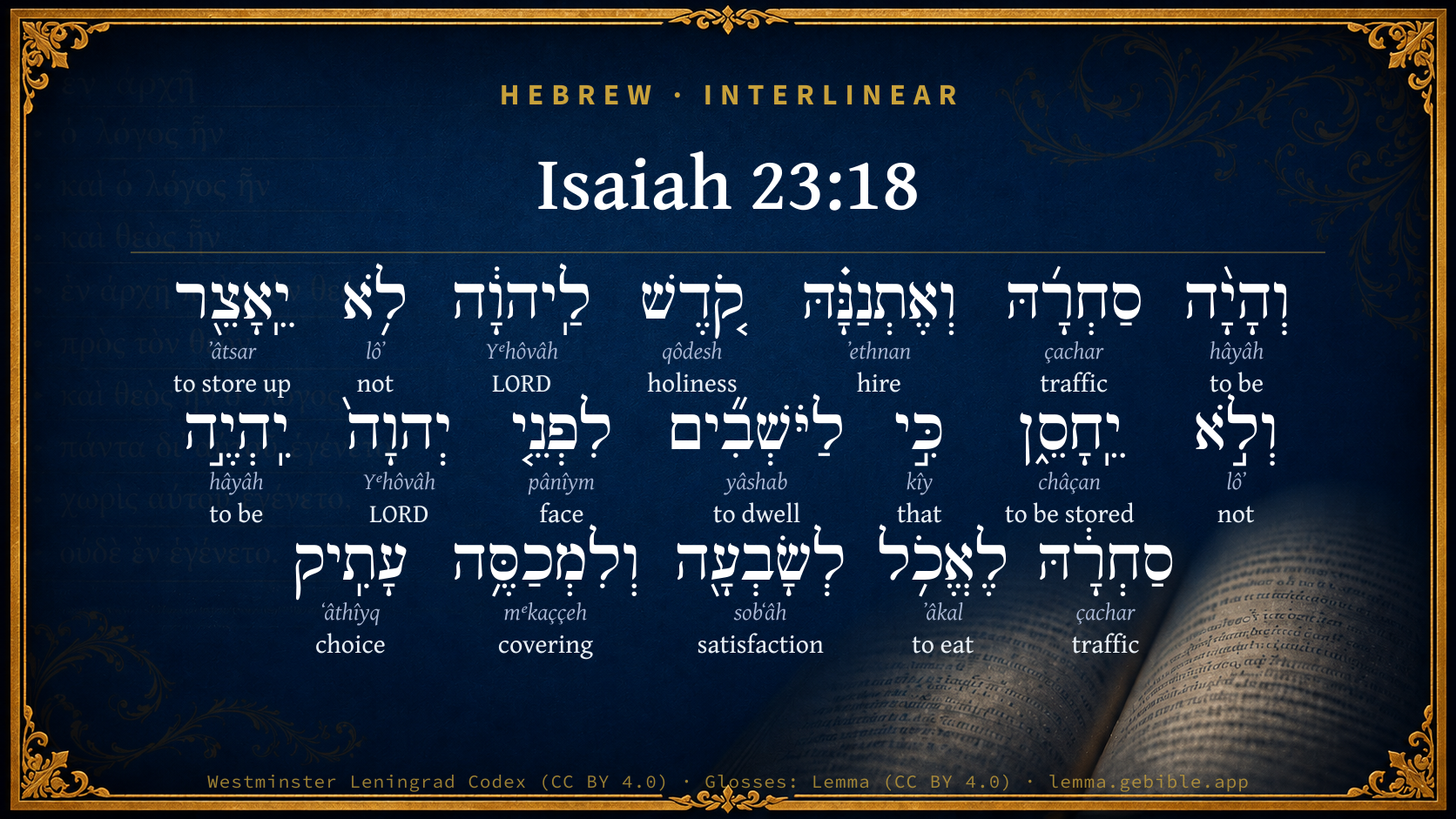
Hebrew (Westminster Leningrad Codex) Isaiah 23:18 appears in the Hebrew Old Testament. The text above is from the Westminster Leningrad Codex. Each word links to its Strong’s number, a concise gloss, and parsing drawn from the Open Scriptures Hebrew Bible morphology. Click any word for its full Brown-Driver-Briggs (BDB) entry.
Download image
Cite this verse

Isaiah 23:18 (World English Bible). Public Domain. Lemma interlinear Bible study tool, https://lemma.gebible.app/v/isaiah/23/18.

Show BibTeX & RIS
BibTeX
RIS
English Translation
Her merchandise and her hire shall be holiness to Yahweh: it shall not be treasured nor laid up; for her merchandise shall be for those who dwell before Yahweh, to eat sufficiently, and for durable clothing.
World English Bible · Public Domain
Highlights
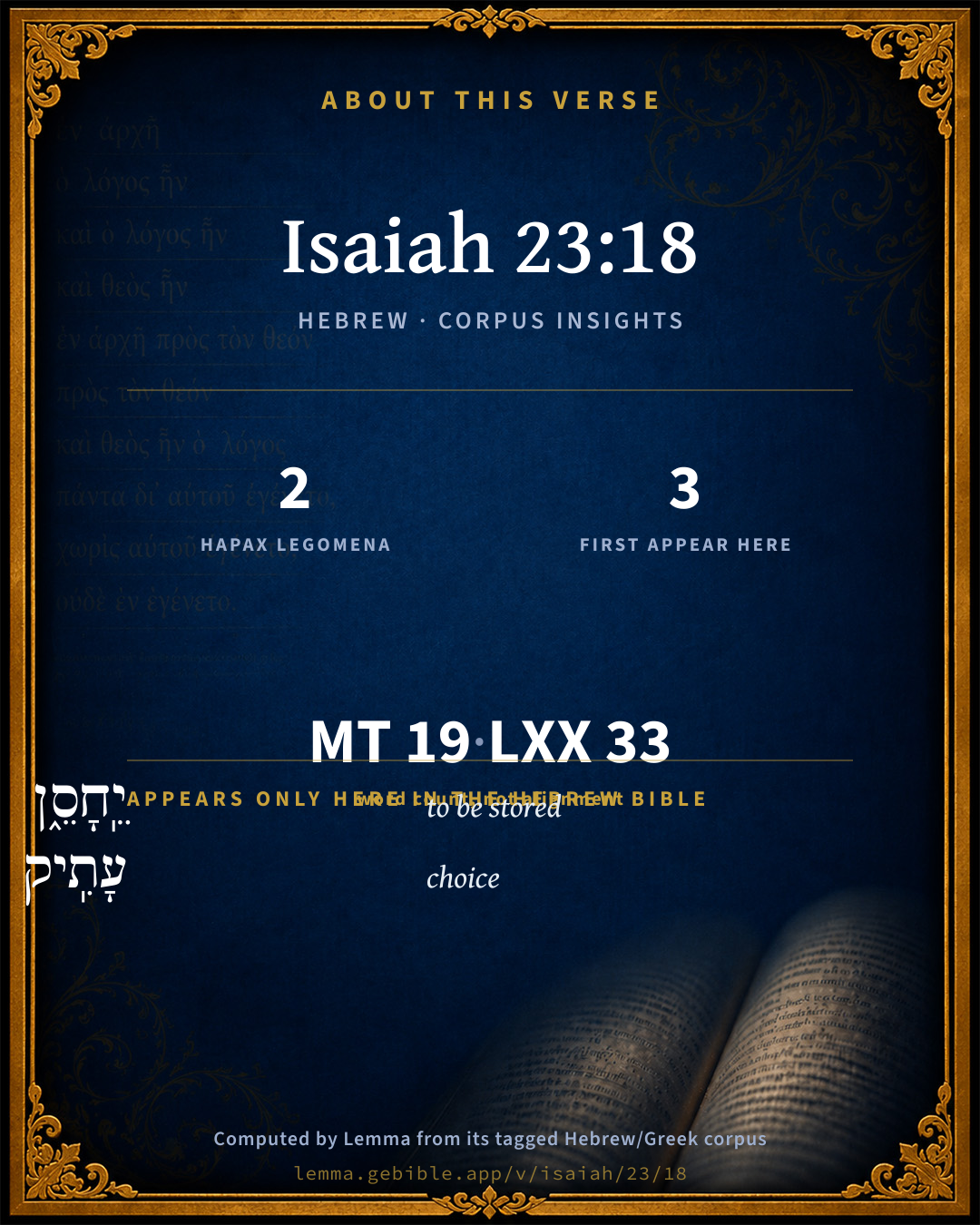
  • 2 hapax legomena — only here in the Hebrew Bible
  • 3 first appearances in the Hebrew Bible
Full analysis ↓
Download a study sheet

One document with this verse’s original text, its word-by-word gloss line, the meaning frame, cross-references with their text, attributed commentary, and full source and license credits — printable, and it pastes into notes with its structure intact.

This verse Autodidact and up

Study sheet (.html) Plain text (.txt)

A passage Seminary Student

Up to 50 verses in one chapter. A passage sheet keeps up to 6 commentary sources and 12 cross-references per verse, in the order this page ranks them, and says so on the sheet whenever that leaves anything out. Ask for a single verse and you get the Autodidact verse sheet above.

Everything on this page stays free to read, with no account — the sheet is a download of what is already on screen, not access to it.

Want to remove ads? Support Godless Engineer
Compare translations 3

The same verse in 3 English versions, stacked beneath the original-language interlinear above. Click any original word for its lexicon entry.

Each is an independent rendering of the whole verse — the interlinear is not word-aligned to these translations.

Highlighted words mark where these versions differ — a whole-verse word diff, not a word-by-word alignment.

  • World English Bible Public Domain
    Her merchandise and her hire shall be holiness to Yahweh: it shall not be treasured nor laid up; for her merchandise shall be for those who dwell before Yahweh, to eat sufficiently, and for durable clothing.
  • King James Version Public Domain
    And her merchandise and her hire shall be holiness to the LORD: it shall not be treasured nor laid up; for her merchandise shall be for them that dwell before the LORD, to eat sufficiently, and for durable clothing.
  • unfoldingWord Literal Text CC BY-SA 4.0
    And her profit and her hire will be holiness to Yahweh. It will not be stored and it will not be hoarded, for her profit will be for the ones dwelling to the face of Yahweh, to eat to satiety and for fine clothing.

unfoldingWord Literal Text — © unfoldingWord, licensed CC BY-SA 4.0. Word-aligned USFM3 via Door43 (git.door43.org/unfoldingWord/en_ult).

Versions to compare (up to 4)

3 of 4 selected

Show all 18 translations

Every available English version of this verse, each an independent rendering of the whole verse.

  • World English Bible Public Domain
    Her merchandise and her hire shall be holiness to Yahweh: it shall not be treasured nor laid up; for her merchandise shall be for those who dwell before Yahweh, to eat sufficiently, and for durable clothing.
  • Berean Standard Bible Public Domain
    Yet her profits and wages will be set apart to the LORD; they will not be stored or saved, for her profit will go to those who live before the LORD, for abundant food and fine clothing.
  • Majority Standard Bible Public Domain
    Yet her profits and wages will be set apart to the LORD; they will not be stored or saved, for her profit will go to those who live before the LORD, for abundant food and fine clothing.
  • King James Version Public Domain
    And her merchandise and her hire shall be holiness to the LORD: it shall not be treasured nor laid up; for her merchandise shall be for them that dwell before the LORD, to eat sufficiently, and for durable clothing.
  • American Standard Version (1901) Public Domain
    And her merchandise and her hire shall be holiness to Jehovah: it shall not be treasured nor laid up; for her merchandise shall be for them that dwell before Jehovah, to eat sufficiently, and for durable clothing.
  • Revised Version (1885) Public Domain
    And her merchandise and her hire shall be holiness to the LORD: it shall not be treasured nor laid up; for her merchandise shall be for them that dwell before the LORD, to eat sufficiently, and for durable clothing.
  • Geneva Bible (1599) Public Domain
    Yet her occupying and her wages shall bee holy vnto the Lord: it shall not be laied vp nor kept in store, but her marchandise shalbe for them that dwell before the Lord, to eate sufficiently, and to haue durable clothing.
  • Douay-Rheims (1899) Public Domain
    And her merchandise and her hire shall be sanctified to the Lord: they shall not be kept in store, nor laid up: for her merchandise shall be for them that shall dwell before the Lord, that they may eat unto fulness, and be clothed for a continuance.
  • Young's Literal Translation Public Domain
    And her merchandise and her gift have been holy to Jehovah, Not treasured up nor stored, For to those sitting before Jehovah is her merchandise, To eat to satiety, and for a lasting covering!
  • Literal Standard Version CC BY-SA 4.0
    And her merchandise and her wage have been holy to YHWH, || Not treasured up nor stored, || For her merchandise is to those sitting before YHWH, || To eat to satiety, and for a lasting covering!
  • Unlocked Literal Bible CC BY-SA 4.0
    Her profits and earnings will be set apart to Yahweh. They will not be stored up or kept in the treasury, for her profits will be given to those who live in Yahweh's presence and will be used to supply them with abundant food and so they can have the best quality clothing.
  • unfoldingWord Literal Text CC BY-SA 4.0
    And her profit and her hire will be holiness to Yahweh. It will not be stored and it will not be hoarded, for her profit will be for the ones dwelling to the face of Yahweh, to eat to satiety and for fine clothing.
  • Darby Bible Public Domain
    And her merchandise and her hire shall be holy to Jehovah: it shall not be treasured nor laid up; for her merchandise shall be for them that dwell before Jehovah, to eat and be sufficed, and for excellent clothing.
  • World Messianic Bible Public Domain
    Her merchandise and her wages will be holiness to the LORD. It will not be treasured nor laid up; for her merchandise will be for those who dwell before the LORD, to eat sufficiently, and for durable clothing.
  • Webster's Bible Public Domain
    And her merchandise and her hire shall be holiness to the LORD: it shall not be treasured nor laid up; for her merchandise shall be for them that dwell before the LORD, for sufficient food, and for durable clothing.
  • Free Bible Version CC BY-SA 4.0
    However, her profits and what she earns will be consecrated to the Lord. They won't be kept or saved up, for her business earnings will go to those who worship the Lord, to provide them with plenty of food and good clothes.
  • Bible in Basic English Public Domain
    And her goods and her trade will be holy to the Lord: they will not be kept back or stored up; for her produce will be for those living in the Lord's land, to give them food for their needs, and fair clothing.
  • JPS Tanakh (1917) Public Domain
    And her gain and her hire shall be holiness to the LORD; it shall not be treasured nor laid up; for her gain shall be for them that dwell before the LORD, to eat their fill, and for stately clothing.

Literal Standard Version (2020), Covenant Press — licensed CC BY-SA 4.0. Text via the HelloAO Bible API (eBible.org). Unlocked Literal Bible (unfoldingWord) — licensed CC BY-SA 4.0. Text via the HelloAO Bible API (eBible.org). unfoldingWord Literal Text — © unfoldingWord, licensed CC BY-SA 4.0. Word-aligned USFM3 via Door43 (git.door43.org/unfoldingWord/en_ult). Free Bible Version, Dr. Jonathan Gallagher — licensed CC BY-SA 4.0. Text via the HelloAO Bible API (eBible.org).

Word by word

More ways to search: Search by grammar → Find every occurrence → Compare this word →

Practice this passage: Drill this verse → Learn its vocabulary →

יֵֽחָסֵ֑ן
châçan
H2630
“to be stored”
Verb, Niphal, Imperfect, 3rd Person, Masculine, Singular
Part of Speech
Verb
Stem
Niphal
Form
Imperfect
Person
3rd Person
Gender
Masculine
Number
Singular
Full BDB Definition

Origin: a primitive root

TWOT: 703

(Niphal) to be treasured up, be hoarded, be laid up, be stored
  1. וְהָיָ֨ה hâyâh H1961 “and · to be” Conjunction + Verb, Qal, Sequential Perfect, 3rd Person, Masculine, Singular
  2. סַחְרָ֜הּ çachar H5504 “traffic · her” Noun, Common, Masculine, Singular, Construct + Suffix, Personal, 3rd Person, Feminine, Singular
  3. וְאֶתְנַנָּ֗הּ ʼethnan H868 “and · hire · her” Conjunction + Noun, Common, Masculine, Singular, Construct + Suffix, Personal, 3rd Person, Feminine, Singular
  4. קֹ֚דֶשׁ qôdesh H6944 “holiness” Noun, Common, Masculine, Singular, Absolute
  5. לַֽיהוָ֔ה Yᵉhôvâh H3068 “to/for · LORD” Preposition + Noun, Proper
  6. לֹ֥א lôʼ H3808 “not” Particle, Negative
  7. יֵֽאָצֵ֖ר ʼâtsar H686 “to store up” Verb, Niphal, Imperfect, 3rd Person, Masculine, Singular
  8. וְלֹ֣א lôʼ H3808 “and · not” Conjunction + Particle, Negative
  9. כִּ֣י kîy H3588 “that” Conjunction
  10. לַיֹּשְׁבִ֞ים yâshab H3427 “to/for the · dwelling” Preposition, Determined + Verb, Qal, Participle Active, Masculine, Plural, Absolute
  11. לִפְנֵ֤י pânîym H6440 “to/for · face(s) of” Preposition + Noun, Common, Both, Plural, Construct
  12. יְהוָה֙ Yᵉhôvâh H3068 “LORD” Noun, Proper
  13. יִֽהְיֶ֣ה hâyâh H1961 “to be” Verb, Qal, Imperfect, 3rd Person, Masculine, Singular
  14. סַחְרָ֔הּ çachar H5504 “traffic · her” Noun, Common, Masculine, Singular, Construct + Suffix, Personal, 3rd Person, Feminine, Singular
  15. לֶאֱכֹ֥ל ʼâkal H398 “to eat” Preposition + Verb, Qal, Infinitive Construct
  16. לְשָׂבְעָ֖ה sobʻâh H7654 “to/for · satisfaction” Preposition + Noun, Common, Feminine, Singular, Absolute
  17. וְלִמְכַסֶּ֥ה mᵉkaççeh H4374 “and · to/for · covering” Conjunction + Preposition + Noun, Common, Masculine, Singular, Absolute
  18. עָתִֽיק ʻâthîyq H6266 “choice” Adjective, Adjective, Masculine, Singular, Absolute

About this verse

These counts appear in no published source. They are computed here, from the morphology-tagged text and Lemma’s own curated glosses. What Lemma adds →

19
words
15
distinct lemmas
Prophets
section

Notable vocabulary

2 hapax legomena — words that appear only here in the entire Hebrew Bible:

  • יֵֽחָסֵ֑ן to be stored H2630
  • עָתִֽיק choice H6266

First appearance in Scripture

These words make their first canonical appearance in the Hebrew Bible here:

  • יֵֽחָסֵ֑ן to be stored H2630
  • לְשָׂבְעָ֖ה satisfaction H7654
  • עָתִֽיק choice H6266

Shared distinctive vocabulary

סַחְרָ֜הּ traffic H5504 occurs in 3 verses of the Hebrew Bible. Also found in:

Grammatical profile

  • 6 verbs
  • 9 nouns
  • 1 adjective
  • 1 conjunction
  • 2 particles

Verb forms

  • וְהָיָ֨ה Qal · Sequential Perfect
  • יֵֽאָצֵ֖ר Niphal · Imperfect
  • יֵֽחָסֵ֑ן Niphal · Imperfect
  • לַיֹּשְׁבִ֞ים Qal · Participle Active
  • יִֽהְיֶ֣ה Qal · Imperfect
  • לֶאֱכֹ֥ל Qal · Infinitive Construct

Repetition

Words recur within this verse — often emphatic in Hebrew:

  • וְהָיָ֨ה to be H1961 ×2
  • סַחְרָ֜הּ traffic H5504 ×2
  • לַֽיהוָ֔ה LORD H3068 ×2
  • לֹ֥א not H3808 ×2

Hebrew & Septuagint length

In English translation the verse runs 36 words from the Hebrew and 48 from the Septuagint (LXX English) — closely comparable.

A rough comparison of the two English renderings, which tokenize alike — not a word-level alignment.

Word counts can differ between the Hebrew and the Greek without any difference in meaning — e.g. the Hebrew direct-object marker אֵת has no separate Greek word, and Greek often adds the article ὁ.

In the original languages it is 19 Hebrew tokens and 33 Greek tokens — but the two are counted differently (Hebrew bundles its prefixes and suffixes into one token; the Greek is in lemma form), so that isn’t a like-for-like length.

Cross-references

27

Topical passages linked to Isaiah 23:18 in the Treasury of Scripture Knowledge — connected by theme and wording, ordered by reader-vote popularity; previews shown in the World English Bible.

  • Psalms 72:10 The kings of Tarshish and of the isles will bring tribute. The kings of Sheba and Seba shall offer gifts.
  • Deuteronomy 26:12–14 When you have made an end of tithing all the tithe of your increase in the third year, which is the year of tithing, then you shall give it to the Levite, to the foreigner, to the fatherless, and to the widow, that they may eat within your gates, and be filled.
  • Philippians 4:17–18 Not that I seek for the gift, but I seek for the fruit that increases to your account.
  • Exodus 28:36 "You shall make a plate of pure gold, and engrave on it, like the engravings of a signet, 'HOLY TO YAHWEH.'
  • Deuteronomy 12:18–19 but you shall eat them before Yahweh your God in the place which Yahweh your God shall choose, you, and your son, and your daughter, and your man-servant, and your maid-servant, and the Levite who is within your gates: and you shall rejoice before Yahweh your God in all that you put your hand to.
  • Galatians 6:6 But let him who is taught in the word share all good things with him who teaches.
  • 2 Chronicles 2:7–9 Now therefore send me a man skillful to work in gold, and in silver, and in brass, and in iron, and in purple, and crimson, and blue, and who knows how to engrave [all manner of] engravings, [to be] with the skillful men who are with me in Judah and in Jerusalem, whom David my father did provide.
  • 2 Chronicles 2:11–16 Then Huram the king of Tyre answered in writing, which he sent to Solomon, Because Yahweh loves his people, he has made you king over them.
  • Psalms 45:12 The daughter of Tyre comes with a gift. The rich among the people entreat your favor.
  • Proverbs 3:9–10 Honor Yahweh with your substance, With the first fruits of all your increase:
  • Proverbs 13:22 A good man leaves an inheritance to his children's children, But the wealth of the sinner is stored for the righteous.
  • Proverbs 28:8 He who increases his wealth by excessive interest Gathers it for one who has pity on the poor.
  • Ecclesiastes 2:26 For to the man who pleases him, God gives wisdom, knowledge, and joy; but to the sinner he gives travail, to gather and to heap up, that he may give to him who pleases God. This also is vanity and a chasing after wind.
  • Isaiah 60:5–9 Then you shall see and be radiant, and your heart shall thrill and be enlarged; because the abundance of the sea shall be turned to you, the wealth of the nations shall come to you.
  • Micah 4:13 Arise and thresh, daughter of Zion; For I will make your horn iron, And I will make your hoofs brass; And you will beat in pieces many peoples: And I will devote their gain to Yahweh, And their substance to the Lord of the whole earth.
  • Zechariah 14:20–21 In that day there will be on the bells of the horses, "HOLY TO YAHWEH;" and the pots in Yahweh's house will be like the bowls before the altar.
  • Malachi 3:10 Bring the whole tithe into the store-house, that there may be food in my house, and test me now in this," says Yahweh of hosts, "if I will not open you the windows of heaven, and pour you out a blessing, that there shall not be room enough for.
  • Matthew 6:19–21 "Don't lay up treasures for yourselves on the earth, where moth and rust consume, and where thieves break through and steal;
  • Matthew 25:35–40 for I was hungry, and you gave me food to eat; I was thirsty, and you gave me drink; I was a stranger, and you took me in;
  • Mark 3:8 from Jerusalem, from Idumaea, beyond the Jordan, and those from around Tyre and Sidon. A great multitude, hearing what great things he did, came to him.
  • Luke 8:3 and Joanna, the wife of Chuzas, Herod's steward; Susanna; and many others; who ministered to them from their possessions.
  • Luke 12:18–20 He said, 'This is what I will do. I will pull down my barns, and build bigger ones, and there I will store all my grain and my goods.
  • Luke 12:33 Sell that which you have, and give gifts to the needy. Make for yourselves purses which don't grow old, a treasure in the heavens that doesn't fail, where no thief approaches, neither moth destroys.
  • Luke 16:9–13 I tell you, make for yourselves friends by means of unrighteous mammon, so that when you fail, they may receive you into the eternal tents.
  • Acts 9:39 Peter got up and went with them. When he had come, they brought him into the upper chamber. All the widows stood by him weeping, and showing the coats and garments which Dorcas had made while she was with them.
  • Acts 21:3–5 When we had come in sight of Cyprus, leaving it on the left hand, we sailed to Syria, and landed at Tyre, for there the ship was to unload her cargo.
  • Romans 15:25–27 But now, I say, I am going to Jerusalem, serving the saints.

Cross-references courtesy of OpenBible.info (CC BY 4.0).

Hebrew and Greek witnesses Masoretic Hebrew ↔ Greek Septuagint

The same verse in the two great witnesses to the Old Testament, shown verse-for-verse.

These are two independent witnesses, not word-aligned to each other, and the Septuagint is shown in lemma (dictionary) form.

Hebrew Isaiah 23:18 Masoretic · Westminster Leningrad Codex

וְהָיָ֨ה סַחְרָ֜הּ וְאֶתְנַנָּ֗הּ קֹ֚דֶשׁ לַֽיהוָ֔ה לֹ֥א יֵֽאָצֵ֖ר וְלֹ֣א יֵֽחָסֵ֑ן כִּ֣י לַיֹּשְׁבִ֞ים לִפְנֵ֤י יְהוָה֙ יִֽהְיֶ֣ה סַחְרָ֔הּ לֶאֱכֹ֥ל לְשָׂבְעָ֖ה וְלִמְכַסֶּ֥ה עָתִֽיק

Her merchandise and her hire shall be holiness to Yahweh: it shall not be treasured nor laid up; for her merchandise shall be for those who dwell before Yahweh, to eat sufficiently, and for durable clothing.

World English Bible · Public Domain

Greek LXX Isaiah 23:18 Septuagint · lemma form

καί εἰμί αὐτός ὁ ἐμπορία καί ὁ μισθός ἅγιος ὁ κύριος οὐ αὐτός συνἄγω ἀλλά ὁ καταοἰκέω ἔναντι κύριος πᾶς ὁ ἐμπορία αὐτός ἐσθίω καί πίνω καί ἐνπίμπλημι εἰς συμβολή μνημόσυνον ἔναντι κύριος

And her trade and her gain shall be holiness to the Lord: it shall not be gathered for them, but for those that dwell before the Lord, even all her trade, to eat and drink and be filled, and for a covenant and a memorial before the Lord.

LXX2012 (modern English Septuagint) · Public Domain

Hebrew: Westminster Leningrad Codex (CC BY 4.0). Greek: Septuagint (public domain); English from LXX2012 (modern English Septuagint) (Public Domain). How the Septuagint differs from the Hebrew →

Targum (Aramaic paraphrase)

1

The Targum is the ancient Jewish Aramaic paraphrase of the Hebrew Scriptures — an interpretive translation, not the Hebrew text itself. Onkelos (literal) and Pseudo-Jonathan (expansive) render the Torah, and Jonathan the Prophets. Coverage is partial: where no permissively-licensed English translation exists for a verse, only the Aramaic is shown. This is verse-level text, not a word-by-word alignment to the Hebrew.

  1. Targum Jonathan Prophets (Joshua–Malachi)
    וִיהֵי סְחוֹרְתָּהּ וְאַגְרָהּ קוּדְשָׁא קֳדָם יְיָ לָא יִתְאַצֵר וְלָא יִתְגְנַז אֲרֵי לְדִמְשַׁמְשִׁין קֳדָם יְיָ יְהֵי אַגְרָה לְמֵיכַל לְמִסְבַּע וְלִכְסוּ דִיקָר:

    And her merchandise and her gain shall be holy before the Lord, it shall not be treasured nor laid up; for it shall be for them that are serving before the Lord; her gain shall be for food sufficient, and for vestments of glory.

    Targum Jonathan — Aramaic: “Mikraot Gedolot” (public domain). English: “Sefaria Community Translation” (CC0 1.0 (public-domain dedication)); “London "Chaldee Paraphrase," 1871” (public domain). Text via Sefaria.

Commentary

Notes on Isaiah 23:18 from classic Christian and Jewish commentators (each source and its license shown beneath its notes). The classic Christian expositions comment on the surrounding passage and are grouped to its opening verse, so a note may address several verses; the Jewish commentaries on the Tanakh (Rashi and others) are per-verse, so they appear only where the commentator wrote on this verse.

Lemma curates 59 commentaries, every one of them public domain or Creative Commons licensed, each selected and text-cleaned for this edition rather than reprinted as found. About our sources →

Ellicott's Commentary for English Readers

(18) Her merchandise and her hire shall be holiness to the Lord.—The words seem to reverse the rule of Deu_23:18, which, probably not without a reference to practices like those connected with the worship of Mylitta (Herod., i. 99), forbade gifts that were so gained from being offered in the Sanctuary. Here, it seems to be implied, the imagery was not to be carried to what might have seemed its logical conclusion. The harlot city, penitent and converted, might be allowed, strange as it might seem, to bring the gains of her harlotry into the temple of the Lord. Interpreted religiously, the prophet sees the admission of proselytes to the worship of Israel in the future, as he had seen it probably in the days of Hezekiah (Psa_87:4). Interpreted politically, the words point to a return to the old alliance between Judah and Tyre in the days of David and Solomon (1Ki_5:1-12), and to the gifts which that alliance involved (Psa_45:12).

For them that dwell before the Lord . . .—These were probably, in the prophet’s thoughts, the citizens of Jerusalem, who were to find in Tyre their chief resource both for food and raiment. Traces of this commerce after the return of the Jews from the captivity are found in Neh_13:16, “men of Tyre” bringing “fish and all manner of ware” to the gates of Jerusalem. Of the more direct service we find evidence in the fact that Tyrians and Zidonians contributed to the erection of the second Temple, as they had done to that of the first (Ezr_3:7).

A Bible Commentary for English Readers, edited by Charles John Ellicott (1878–1897) — public domain. Text from a community e-Sword module.

The Cambridge Bible for Schools and Colleges

gen. ed. J. J. S. Perowne

18. merchandise and hire are synonymous; the one is the literal, the other the metaphorical designation of the same fact.

holiness to the Lord] i.e. “dedicated” to Jehovah (in opposition to the letter of Deu_23:18). The word has no ethical sense; and the idea of “commerce as the handmaid of religion,” if by that it is meant that Tyre’s commerce is to be conducted in a religious spirit, is foreign to the passage. Tyre is still a “harlot” as of old, and her conversion to the true God does not appear to be contemplated here.

shall not be treasured nor laid up] as formerly, for the benefit of Tyre herself. Those that dwell before the Lord are the Jewish people, who according to another prophecy (ch. Isa_61:6) are the priests of humanity.

For durable read stately, as R.V. marg. The word is not found elsewhere.

The Cambridge Bible for Schools and Colleges (gen. ed. J. J. S. Perowne; Cambridge University Press, 1878–1918) — public domain. Text from a community e-Sword module.

Trapp's Complete Commentary

John Trapp

Isa 23:18 And her merchandise and her hire shall be holiness to the LORD: it shall not be treasured nor laid up; for her merchandise shall be for them that dwell before the LORD, to eat sufficiently, and for durable clothing.

Ver. 18. It shall not be treasured.] Being once converted, they shall leave heaping and hoarding wealth, and find other use for it - viz., to feed and clothe God’s ministers and poor people freely and largely.

And for durable clothing.] The Vulgate hath it Vestientur ad vetustatem.

John Trapp, A Commentary or Exposition upon All the Books of the Old and New Testament (1647–1656) — public domain. Text from a community e-Sword module.

The Biblical Illustrator

Joseph S. Exell

Isa_23:18

And her merchandise and her hire shall be holiness to the Lord

Mercantile life

I.

We are reminded that THE MARKET IS A DIVINE INSTITUTION. In this chapter it is not commerce that is doomed to destruction but commercialists. When one thinks of the innate tendency of human nature to exchange commodities, a tendency discoverable even in children and barbarians: the distribution of the necessaries of human subsistence and progress over every zone of the globe, each zone supplying a something which the other does not, and the provisions of each zone, if not essential to human life, essential to human civilisation and comfort; the facilities which nature has provided in rivers, and oceans, and winds for conveying these commodities from one part of the globe to another, and the fact that the social unity and happiness of mankind can only be advanced by the principle of mutual interdependence, and that commerce is essential to this--it is impossible to escape the conclusion that trade is of Divineappointment. The principle is as old as the race, as wide as the world, as operative as life itself.

II. The chapter reminds us that THE MARKET IS UNDER THE SCRUTINY OF THE RIGHTEOUS GOVERNOR OF THE WORLD. Though the Tyrian traders pursued their daily race for wealth, and indulged in the luxuries which their wealth could supply, utterly regardless of God, He was not regardless of them. So now, God is as truly in the market as in the temple, and as truly demands worship at the stall of the one, as at the altar of the other.

III. The chapter reminds us that MERCANTILE PROSPERITY IS NO GUARANTEE FOR THE SAFETY OF A COUNTRY. If commercial prosperity could have saved a people, Tyre would have remained. But where is Tyre now? As she rose in wealth, she sank in vice. Righteousness alone exalteth a nation.

IV. The chapter reminds us that THE MARKET SHOULD BE SUBSERVIENT TO THE TEMPLE. This indeed is the grand subject of our text. (Homilist.)

True religion in Tyre

The prophecy does not mean that this would take place immediately after the rebuilding, but subsequently to the seventy years of its desolation. After the return of the Jews from Babylon they penetrated different countries and everywhere endeavoured to proselyte their inhabitants. That the Christian religion was established at Tyre, is not only indicated by the fact that Paul found several of his disciples there on his way to Jerusalem (Act_21:3-4), but from the statement of subsequent historians. Eusebius says, that when the Church of God was founded in Tyre much of its wealth was consecrated to God. And Jerome says, We have seen churches built to the Lord in Tyre. So not only has the prophecy of its destruction been fulfilled, but the prophecy in the text, namely, its restoration and consecration to God, has also to some extent been realised. (Homilist.)

Business

In relation to this subject there are several popular errors.

1. One is, that which makes business an end in itself. The pursuit of wealth for its own sake eats up the soul and reduces the man to a grub, it may be a bloated and a decorated grub, still a grub.

2. Another error is the using of the market as a means of ultimate retirement. What is this but to grasp at a shadow? The man who spends his best energies and days in accumulating riches becomes utterly unfit for the enjoyment of a retired life.

3. Another error is the regarding business and religion as antagonistic elements. Man is a moral being, and everywhere and everywhen his moral obligation meets him. There is no more opposition between business and religion than there is between the body and the soul. It is by the body only that the soul can be truly developed.

4. There is yet another error that is noteworthy, that of making religion subservient to business. There are men who make gain of godliness. (Homilist.)

The subserviency of the market to the temple

The market should be subordinate to the temple. This will appear if we consider the following things--

I. THE RELATION OF MAN TO BOTH.

1. His relation to the market or to business is material. But his spiritual part is related to religion. It hungers for spiritual knowledge, for moral holiness, for communion with God. It does not live by bread alone. Now, as the spiritual part of man is confessedly of more value than the material, should not that work which is necessary for the latter be made subservient to the interest of the former?

2. Again, his relation to the market is temporary. How short is mans mercantile life? But his relation to spiritual engagements is abiding. Ought not the market, therefore, to be rendered subservient to the interests of the temple?

II. THE ADAPTATION OF THE MARKET TO THE PROMOTION OF PERSONAL RELIGION.

1. Commerce is suited to promote religious discipline. Neither inactivity nor exclusive solitude is favourable to spiritual development. The duties of the market properly discharged tend to quicken, test, and strengthen the eternal principles of virtue. Those principles, like trees, always require the open air, and oftentimes storms to deepen their roots, and strengthen their fibres. In the market, man has his integrity, patience, faith in God put to the test.

2. Not only is the market a good scene for spiritual discipline, but for spiritual intercourse as well In it there is not only the exchange of material commodities, but an exchange of thoughts and emotions and purposes. Mind flows into mind, and the souls of nations mingle their ideas. What an immense influence for good or ill can men exert in the market! One impious mind in the market may pour its poisonous influence far into the civilised world. On the other hand, what an opportunity has the godly man for spiritual usefulness! The apostles often went into the market place to preach because of its opportunities for diffusing the truth. It seems that the Author of our being made an exchange of temporal commodities necessary for us in order that we may exchange the spiritual commodities of true thoughts and high purposes.

3. Once more, it is one of the best scenes for the practical display of religious truth. When does piety appear to the best advantage? On its knees in the closet? No one sees it there. In the temple, in the presence of the great congregation, going out in song and sigh? No. But in the market, a thing of life and strength. The man who stands firm in the market to principles in the midst of temptation, who stoops not to the mean, the greedy and the false, but who governs his spirit with calmness amidst the annoyances and disturbances of commercial life, gives a far better revelation of genuine religion than is contained in the grandest sermon ever preached. The British market is almost the heart of the world: give to it a holy and healthy pulsation, and its sanitary influence shall be felt afar.

Conclusion--

1. The principles of righteousness should govern us in the discharge of commercial duties.

2. Spiritual prosperity is the only true test of commercial success The more a man succeeds in the accumulation of wealth apart from the growth of his soul, the more really disastrous is his business. He becomes a moral bankrupt. Nay, more, the real man is lost--lost in the clerk, the shopkeeper, the merchant. (Homilist.)

Undue devotion to business

There are too many people in England on whose gravestones the French epitaph might be written, He was born a man and died a grocer. (C. Kingsley, M. A.)

.

The Biblical Illustrator, edited by Joseph S. Exell (c. 1880s–1900s) — public domain. Text from a community e-Sword module.

Joseph Benson's Commentary

Isa 23:18. And her merchandise, &c., shall be holiness to the Lord. — The meaning of the prophet is extremely clear, namely, “that the time should come, after the restoration of Tyre, in which the Tyrians, out of reverence to the true God, would consecrate their wealth and gain to him, and would readily contribute that gain and wealth to the support of the teachers of true religion. In short, that the Tyrians should become converts to that religion. The reader will easily observe that the passage is metaphorical.” “The Tyrians were much addicted to the worship of Hercules, as he was called by the Greeks, or of Baal, as he is denominated in Scripture; but, in process of time, by the means of some Jews and proselytes, living and conversing with them, some of them also became proselytes to the Jewish religion; so that we find a great multitude of people from the sea-coast of Tyre and Sidon came to hear our Saviour; and he, though peculiarly sent to the lost sheep of the house of Israel, yet came into the coasts of Tyre and Sidon; and the first fruits of the gospel there was a Tyrian woman, a woman of Canaan, as she is called, a Syro-phenician by nation. When St. Paul, in his way to Jerusalem, came to Tyre, he found disciples there, who were inspired by the Holy Ghost, and prophesied; and with them he tarried seven days. In the time of Dioclesian’s persecution, the Tyrians were such sincere converts to Christianity that they exhibited several glorious examples of confessors and martyrs; and when the storm of persecution was blown over, under their Bishop Paulinus, they built an oratory, or rather a temple, for the public worship of God, the most magnificent and sumptuous in all Palestine. Eusebius produces this last occurrence in proof of the completion of Isaiah’s prophecy; and St. Jerome is of the same opinion. To these proofs we will only add, that as Tyre consecrated its merchandise and hire unto the Lord, so it had the honour of being erected into an archbishopric, and the first under the patriarchate of Jerusalem, having fourteen bishops under its primacy; and in this state it continued several years.” — Bishop Newton.

Joseph Benson's Commentary on the Old and New Testaments (1811–1818) — public domain. Text from a community e-Sword module.

The Pulpit Commentary

Her merchandise and her hire shall be holiness to the Lord. There is nothing intrinsically wrong or debasing in commerce. Rightly pursued, and engaged in with the view of devoting the profits made in it to good and pious ends, the commercial life may be as religious, and as acceptable to God as any other. The world has known many merchants who were Christians, in the highest sense of the word. Solomon in his best days was a merchant, (1Ki_9:27, 28 10:22) but one who employed the wealth which he derived from commerce to the honor and glory of God. It shall not be treasured nor laid up. The merchants shall not lay it up in their own coffers, but expend it wisely and religiously. It shall be for them that dwell before the Lord; i.e. it shall be applied to religious uses to the sustentation of ministers, the relief of the poor and necessitous among God"s people, and other similar purposes. Such an employment of the gains made sanctifies commerce, and makes it a good and a blessed thing.

Gain and devotion.

We are reminded that

I WE CANNOT DEVOTE TO GOD"S SERVICE ANYTHING WE HAVE NOT HONORABLY GAINED. It may be said that the text, taken with its context (see ver. 17), does not sustain this thought; that, indeed, it points in the opposite direction. But in addition to such explicit prohibitions as that in Deu_23:18, we have the whole strain and spirit of the Law of God. It is the glory of that Law that it so states, establishes, guards, enforces, emphasizes, the purity of the Divine Lawgiver that if any solitary passage like this one seems to sanction that which is inconsistent with it, we are quite sure that, either in its rendering or in our interpretation of it, there must be a mistake. Everything was done that could be done to separate the people of God from the impurities and iniquities into which other nations had fallen, and into the sanction of which they had pressed even their religious rites. We may be uncertain about many things in Scripture, but we are quite sure of this, that no smallest countenance is meant to be given in any single part of it to the devotion of ill-earned gain to the service of the holy God. (see Act_19:18, Act_19:19) Not only such "hire" as seems to be hinted at here, bat all revenue that is obtained by unworthy, unprincipled, unconscientious means must be wholly unfit for an offering on the altar of God.

II THAT WE HAVE NO RIGHT TO WITHHOLD FROM GOD"S SERVICE THE RESOURCES WE CAN CONTROL. They are not to be "treasured or laid up." To keep them back for use at some future time, to hold them in reserve for some possible emergency, is:

1. Disobedient. God plainly and repeatedly requires of us that we should put out our "talents" in his service and in that of our fellow-men; and all the resources we may have at our disposal of every kind are talents committed to our charge.

2. Distrustful. It indicates a lack of faith in the readiness of God to provide for our returning wants, and to meet our necessities as they arise.

3. Selfish and unsympathizing. It is the action of one who has no heart to feel the strong and pressing claims of ignorance, sorrow, and degradation on our pity and our help.

4. Wasteful.

III THAT WE SHOULD DEVOTE SOME GOOD PART OF OUR SUBSTANCE TO THE MAINTENANCE OF PUBLIC WORSHIP. "For them that dwell before the Lord," etc.

1. All our possessions are to be gained, held, and used religiously; they are to be "holiness to the Lord.

2. Much of what we have at our disposal should be spent in the furtherance of philanthropy: in the cause of education; in the restoration of the sick and suffering; in the reclamation of the fallen; in the help and rehabilitation of the unfortunate, etc.

3. Some of our "means" we should apply specially to the maintenance of Christian worship and of the Christian ministry. It is, indeed, possible to give handsomely toward the erection of sacred structures, and, in so doing, to be ministering to our own importance; men may be magnifying themselves when they propose and pretend to be honoring God. But, on the other hand, we render true, acceptable, and lasting service when we give freely and in such a way as to encourage similar generosity in others towards the worship of God, towards the publication of redeeming truth at home or abroad, towards the support of those who employ all their time and expend all their strength in the noble work of saving men and training them for the kingdom of heaven. C.

Commerce the handmaid of religion.

"Her merchandise and her hire shall be holiness unto the Lord." This appears to be a prediction of the conversion of the Tyrians to the worship and service of the true God. "Instead of hoarding up their gains, or devoting them as presents to the temple of Hercules, as they had formerly done, they would now consecrate them to the support of true religion, "In the line of fulfillment we may note that Jesus Christ visited the neighborhood; (Mat_15:21) St. Paul found disciples there; (Act_21:3-6) and it early became a Christian bishopric. The prophecy would be accomplished if the Christians of Tyre sent girls to Jerusalem; as such gifts would be regarded as representative of the "merchandise." Dean Plumptre says, "Interpreted religiously, the prophet sees the admission of proselytes to the worship of Israel in the future, as he had seen it probably in the days of Hezekiah. (Psa_87:4) Interpreted politically, the words point to a return to the old alliance between Judah and Tyre in the days of Solomon, (1Ki_5:1-12) and to the gifts which that alliance involved." (Psa_45:12) The Tyrians and Zidonians contributed to the erection of the second temple. (Ezr_3:7) Commerce. as having regard to purely worldly interests, is called "harlotry." "Large marts of commerce are often compared to harlots seeking many lovers, that is, they court merchants, and admit any one for the sake of gain." Commerce is the handmaid of religion when she is

I THE AGENT FOR RIGHTEOUSNESS. In the sense of uprightness and fairness between man and man. Religion is the chief support of practical rightness, truth to word and promise, fair taking of samples, honest wages, reasonable profits, and doing the best for those who buy of us and those who sell to us. But religion is glad of the help of all good business principles, and all good business customs. Religion is strengthened by the sense of honor that is found in commercial men. Honest commerce helps on the work which religion would do in the world.

II THE AGENT FOR CHARITY. In the sense of gentle consideration for others, and helpfulness to all who are in distress. The tendency of commerce is towards selfishness, but when touched by the spirit of religion it is sensitive to the needs of the poor, who are always multiplied by advancing civilization. Religion inspires workers among the poor and suffering and disabled. Commerce is noble when, acting as handmaid to religion, it supports the workers with its wealth, helping the hungry and the outcast to "sufficiency for eating, and to durable clothing. R.T.

The Pulpit Commentary (1880–1919), ed. H.D.M. Spence-Jones & Joseph S. Exell — public domain. Text from a community e-Sword module.

Tyndale Open Study Notes

Tyndale Open Resources

23:18 Even though Tyre’s earnings came from unrighteous commerce, the profits will be given to the Lord rather than being squandered. • There will be good food and fine clothing for the Lord’s priests. The theme of the wealth of the nations being brought to the Lord in Jerusalem is more fully developed in 60:5-11; 61:6.

Tyndale Open Study Notes — © Tyndale Open Resources, licensed CC BY-SA 4.0. Text via the HelloAO Bible API.

Geneva Bible (1599)

Geneva Bible translators

He showeth that God yet by the preaching of the Gospel will call Tyre to repentance, and turn her heart from avarice and filthy gain, unto the true worshipping of God, and liberality toward his Saints.

Geneva Bible (1599) marginal notes — public domain. Text via Bolls.life.

Jamieson, Fausset & Brown

Robert Jamieson, A. R. Fausset & David Brown

merchandise . . . holiness--Her traffic and gains shall at last (long after the restoration mentioned in Isa 23:17) be consecrated to Jehovah. Jesus Christ visited the neighborhood of Tyre (Mat 15:21); Paul found disciples there (Act 21:3-6); it early became a Christian bishopric, but the full evangelization of that whole race, as of the Ethiopians (Isa 18:1-7), of the Egyptians and Assyrians (Isa. 19:1-25), is yet to come (Isa 60:5).

not treasured--but freely expended in His service.

them that dwell before the Lord--the ministers of religion. But HORSLEY translates, "them that sit before Jehovah" as disciples.

durable clothing--Changes of raiment constituted much of the wealth of former days.

The four chapters (the twenty-fourth through the twenty-seventh) form one continuous poetical prophecy: descriptive of the dispersion and successive calamities of the Jews (Isa 24:1-12); the preaching of the Gospel by the first Hebrew converts throughout the world (Isa 24:13-16); the judgments on the adversaries of the Church and its final triumph (Isa 24:16-23); thanksgiving for the overthrow of the apostate faction (Isa 25:1-12), and establishment of the righteous in lasting peace (Isa. 26:1-21); judgment on leviathan and entire purgation of the Church (Isa 27:1-13). Having treated of the several nations in particular--Babylon, Philistia, Moab, Syria, Israel, Egypt, Edom, and Tyre (the miniature representative of all, as all kingdoms flocked into it)--he passes to the last times of the world at large and of Judah the representative and future head of the churches.

Next: Isaiah Chapter 24

Jamieson, Fausset & Brown — Commentary Critical and Explanatory on the Whole Bible (1871) — public domain (CC PDM 1.0). Text via the HelloAO Bible API.

John Gill's Exposition

And her merchandise, and her hire,.... Or, "but her merchandise", &c. not the same as before; or, however, not as carried on at the same time, but many ages after, even in the times of the Gospel; for this part of the prophecy respects the conversion of the Tyrians, in the first ages of Christianity; this is prophesied of elsewhere, Psa 45:12 and was fulfilled in the times of the apostles, Act 11:19 and so Kimchi and Jarchi say this is a prophecy to be fulfilled in the days of the Messiah (m); and then the trade of this people, and what they got by it,

should be holiness to the Lord; that is, devoted, at least, great part of it, to holy uses and service; that is, in defraying of all expenses in carrying on the worship of God, for the maintenance of Gospel ministers, and for the supply and support of the poor saints:

it shall not be treasured, nor laid up: in order to be laid out in pride and luxury; or to be kept as useless, to gratify a covetous disposition; or for posterity to come:

for her merchandise shall be laid up for them, that dwell before the Lord; part of what should be gained by trading, at least, should be laid by for religious uses, as is directed, Co1 16:1 even for the relief of poor saints in general, who assemble together before the Lord, for the sake of his worship; and particularly for the support of the ministers of the Gospel, who stand before the Lord, and minister in holy things, in his name, to the people:

to eat sufficiently; that they may have food convenient for them, and enough of it; or, in other words, have a sufficient maintenance, a comfortable supply of food for themselves and families, and raiment also; as follows:

and for durable clothing; that they may have a supply of clothing, and never want a coat to put upon their backs. This prophecy, as it belongs to Gospel times, is a proof of the maintenance of Gospel ministers, that they ought to be liberally provided for; and care should be taken that they want not food and raiment, but have a fulness and sufficiency of both, and that which is convenient for them.

(m) So in Midrash, Kohelet, fol. 62. 3.

Next: Isaiah Chapter 24

John Gill's Exposition of the Whole Bible (1746–1763) — public domain (CC PDM 1.0). Text via the HelloAO Bible API.

Albert Barnes' Notes on the Bible

And her merchandise - The prophecy here does not mean that this would take place immediately after her rebuilding, but that subsequent to the seventy years of desolation this would occur.

Shall be holiness to the Lord - This undoubtedly means, that at some future period, after the rebuilding of Tyre, the true religion would prevail there, and her wealth would be devoted to his service. That the true religion prevailed at Tyre subsequently to its restoration and rebuilding there can be no doubt. The Christian religion was early established at Tyre. It was visited by the Saviour Mat 15:21, and by Paul. Paul found several disciples of Christ there when on his way to Jerusalem Act 21:3-6. It suffered much, says Lowth, under the Diocletian persecution. Eusebius (Hist. x. 4.) says that ‘when the church of God was founded in Tyre, and in other places, much of its wealth was consecrated to God, and was brought as an offering to the church, and was presented for the support of the ministry agreeable to the commandments of the Lord.’ Jerome says, ‘We have seen churches built to the Lord in Tyre; we have beheld the wealth of all, which was not treasured up nor hid, but which was given to those who dwelt before the Lord.’ It early became a Christian bishopric; and in the fourth century of the Christian era, Jerome (Commentary in Eze 26:7; Eze 27:2) speaks of Tyre as the most noble and beautiful city of Phenicia, and as still trading with all the world. Reland enumerates the following list of bishops as having been present from Tyre at various councils; namely, Cassius, Paulinus, Zeno, Vitalis, Uranius, Zeno, Photius, and Eusebius (see Reland’s Palestine, pp. 1002-101l, in Ugolin vi.) Tyre continued Christian until it was taken by the Saracens in 639 a.d.; but was recovered again by Christians in 1124. In 1280, it was conquered by the Mamelukes, and was taken by the Turks in 1516. It is now under the dominion of the Sultan as a part of Syria.

It shall not be treasured ... - It shall be regarded as consecrated to the Lord, and freely expended in his service.

For them that dwell before the Lord - For the ministers of religion. The language is taken from the custom of the Jews, when the priests dwelt at Jerusalem. The meaning is, that the wealth of Tyre would be consecrated to the service and support of religion.

For durable clothing - Wealth formerly consisted much in changes of raiment; and the idea here is, that the wealth of Tyre would be devoted to God, and that it would be furnished for the support of those who ministered at the altar.

Albert Barnes' Notes on the Bible (1834–1885) — public domain. Text from a community e-Sword/MySword module.

Haydock's Catholic Bible Commentary

Sanctified to the Lord. This alludes to the conversion of the Gentiles. (Challoner) --- Before, the Tyrian were great enemies to the Jews, 2 Esdras xiii. 16., and 1 Machabees v. 15. Our Saviour wrought a miracle in favour of one of this country, Matthew v. 22., and Zacharias viii. 20. (Calmet) --- Continuance. Literally, "old age." Aquila, "with changes of dress." (Haydock)

George Leo Haydock (1774–1849), Haydock's Catholic Family Bible and Commentary, 1859 edition — public domain. Excludes Psalms (Douay-Rheims chapter numbering differs from Protestant) and Deuterocanonical books (Catholic canon only).

Matthew Poole's English Annotations

Her merchandise and her hire shall be holiness to the Lord: he speaks not here of what the Tyrians would do immediately after their restitution, but some time after it, even in the days of the Messiah; of which even some of the Jewish rabbies understand it, and to which the prophets have a special respect in their several prophecies, and Isaiah among and above the rest of them. So this is a prophecy concerning the conversion of the Tyrians to the true religion, of the accomplishment whereof something is said Act 21:3-5, and more in other authors.

It shall not be treasured nor laid up, either out of covetousness, or for the service of their pride and luxury, as they formerly did; but now they shall freely lay it out upon pious and charitable uses.

For them that dwell before the Lord; for the support and encouragement of the ministers of holy things, who shall teach the good knowledge of the Lord, who dwell in God’s house, and minister in his presence; the support of such persons being not only an act of justice and charity, but also of piety, and of great use and necessity to maintain and propagate religion in the world. Although this doth not exclude, but rather imply, their liberality in contributing to the necessities of all Christians.

Matthew Poole's English Annotations on the Holy Bible (1683–1685) — public domain. Text from a community e-Sword/MySword module.

Whedon's Commentary on the Bible

Daniel D. Whedon

18. Her merchandise… be holiness to the Lord — The diffusion of the good seed of Messianic truths must produce not a little fruit among the Phoenician populations. Christ in a solitary mission there found the soil good for scattering that seed. Seagoing communication to all parts of the Gentile world was another overruled result of Tyrian commerce to carry the Gospel messengers to far off ports. The trade of commerce, first learned in Phoenicia, is now transferred to all parts of the world. All men are made near neighbours by means of it. See chapter 60.

Daniel D. Whedon (gen. ed.), Commentary on the Old and New Testaments (1874–1909) — public domain. Text from a community e-Sword module.

John Wesley's Explanatory Notes

Holiness - This is a prophecy concerning the conversion of the Tyrians to the true religion. Laid up - Either out of covetousness, or for their pride and luxury, as they formerly did; but now they shall freely lay it out upon pious and charitable uses. Shall be - For the support and encouragement of the ministers of holy things, who shall teach the good knowledge of the Lord. Although this does not exclude, but rather imply their liberality in contributing to the necessities of all Christians.

John Wesley, Explanatory Notes Upon the Whole Bible (1754–1765) — public domain. Text via the GEBible commentary corpus.

Keil & Delitzsch

C. F. Keil & F. Delitzsch

This restoration of the trade of Tyre is called a visitation on the part of Jehovah, because, however profane the conduct of Tyre might be, it was nevertheless a holy purpose to which Jehovah rendered it subservient. "And her gain and her reward of prostitution will be holy to Jehovah: it is not stored up nor gathered together; but her gain from commerce will be theirs who dwell before Jehovah, to eat to satiety and for stately clothing." It is not the conversion of Tyre which is held up to view, but something approaching it. Sachar (which does not render it at all necessary to assume a form sâchâr for Isa 23:3) is used here in connection with 'ethnân, to denote the occupation itself which yielded the profit. This, and also the profit acquired, would become holy to Jehovah; the latter would not be treasured up and capitalized as it formerly was, but they would give tribute and presents from it to Israel, and thus help to sustain in abundance and clothe in stately dress the nation which dwelt before Jehovah, i.e., whose true dwelling-place was in the temple before the presence of God (Psa 27:4; Psa 84:5; mecasseh = that which covers, i.e., the covering; ‛âthik, like the Arabic ‛atik, old, noble, honourable). A strange prospect! As Jerome says, "Haec secundum historiam necdum facta comperimus."

The Assyrians, therefore, were not the predicted instruments of the punishment to be inflicted upon Phoenicia. Nor was Shalmanassar successful in his Phoenician war, as the extract from the chronicle of Menander in the Antiquities of Josephus (Ant. ix. 14, 2) clearly shows. Elulaeus, the king of Tyre, had succeeded in once more subduing the rebellious Cyprians (Kittaioi). But with their assistance (if indeed ἐπὶ τούτους πέμπσας is to be so interpreted)

(Note: The view held by Johann Brandis is probably the more correct one-namely, that Shalmanassar commenced the contest by sending an army over to the island against the Chittaeans (ἐπὶ not in the sense of ad, to, but of contra, against, just as in the expression further on, ἐπ ̓ αὐτοὺς ὑπέστρεψε, contra eos rediit), probably to compel them to revolt again from the Tyrians. Rawlinson (Monarchies, ii. 405) proposes, as an emendation of the text, ἐπὶ του'τον, by which the Cyprian expedition is got rid of altogether.))

Shalmanassar made war upon Phoenicia, though a general peace soon put an end to this campaign. Thereupon Sidon, Ace, Palaetyrus, and many other cities, fell away from Tyrus (insular Tyre), and placed themselves under Assyrian supremacy. But as the Tyrians would not do this, Shalmanassar renewed the war; and the Phoenicians that were under his sway supplied him with six hundred ships and eight hundred rowers for this purpose. The Tyrians, however, fell upon them with twelve vessels of war, and having scattered the hostile fleet, took about five hundred prisoners. This considerably heightened the distinction of Tyre. And the king of Assyria was obliged to content himself with stationing guards on the river (Leontes), and at the conduits, to cut off the supply of fresh water from the Tyrians. This lasted for five years, during the whole of which time the Tyrians drank from wells that they hand sunk themselves. Now, unless we want to lower the prophecy into a mere picture of the imagination, we cannot understand it as pointing to Asshur as the instrument of punishment, for the simple reason that Shalmanassar was obliged to withdraw from the "fortress of the sea" without accomplishing his purpose, and only succeeded in raising it to all the greater honour. But it is a question whether even Nebuchadnezzar was more successful with insular Tyre. All that Josephus is able to tell us from the Indian and Phoenician stories of Philostratus, is that Nebuchadnezzar besieged Tyre for thirteen years in the reign of Ithobal (Ant. x. 11, 1). And from Phoenician sources themselves, he merely relates (c. Ap. i. 21) that Nebuchadnezzar besieged Tyre for thirteen years under Ithobal (viz., from the seventh year of his reign onwards). But so much, at any rate, may apparently be gathered from the account of the Tyrian government which follows, viz., that the Persian era was preceded by the subjection of the Tyrians to the Chaldeans, inasmuch as they sent twice to fetch their king from Babylon. When the Chaldeans made themselves masters of the Assyrian empire, Phoenicia (whether with or without insular Tyre, we do not know) was a satrapy of that empire (Josephus, Ant. x. 11, 1; c. Ap. i. 19, from Berosus), and this relation still continued at the close of the Chaldean rule. So much is certain, however - and Berosus, in fact, says it expressly - viz. that Nebuchadnezzar once more subdued Phoenicia when it rose in rebellion; and that when he was called home to Babylon in consequence of the death of his father, he returned with Phoenician prisoners. What we want, however, is a direct account of the conquest of Tyre by the Chaldeans. Neither Josephus nor Jerome could give any such account. And the Old Testament Scriptures appear to state the very opposite - namely, the failure of Nebuchadnezzar's enterprise. For in the twenty-seventh year after Jehoiachim's captivity (the sixteenth from the destruction of Jerusalem) the following word of the Lord came to Ezekiel (Eze 29:17-18): "Son of man, Nebuchadnezzar the king of Babylon has caused his army to perform a long and hard service against Tyre: every head is made bald, and every shoulder peeled; yet neither he nor his army has any wages at Tyre for the hard service which they have performed around the same." It then goes on to announce that Jehovah would give Egypt to Nebuchadnezzar, and that this would be the wages of his army. Gesenius, Winer, Hitzig, and others, infer from this passage, when taken in connection with other non-Israelitish testimonies given by Josephus, which merely speak of a siege, that Nebuchadnezzar did not conquer Tyre; but Hengstenberg (de rebus Tyriorum, 1832), Hvernick (Ezek. pp. 427-442), and Drechsler (Isaiah ii. 166-169) maintain by arguments, which have been passed again and again through the sieve, that this passage presupposes the conquest of Tyre, and merely announces the disproportion between the profit which Nebuchadnezzar derived from it and the effort that it cost him. Jerome (on Ezekiel) gives the same explanation. When the army of Nebuchadnezzar had made insular Tyre accessible by heaping up an embankment with enormous exertions, and they were in a position to make use of their siege artillery, they found that the Tyrians had carried away all their wealth in vessels to the neighbouring islands; "so that when the city was taken, Nebuchadnezzar found nothing to repay him for his labour; and because he had obeyed the will of God in this undertaking, after the Tyrian captivity had lasted a few years, Egypt was given to him" (Jerome).

I also regard this as the correct view to take; though without wishing to maintain that the words might not be understood as implying the failure of the siege, quite as readily as the uselessness of the conquest. But on the two following grounds, I am persuaded that they are used here in the latter sense. (1.) In the great trilogy which contains Ezekiel's prophecy against Tyre (Ezek 26-28), and in which he more than once introduces thoughts and figures from Isaiah 23, which he still further amplifies and elaborates (according to the general relation in which he stands to his predecessors, of whom he does not make a species of mosaic, as Jeremiah does, but whom he rather expands, fills up, and paraphrases, as seen more especially in his relation to Zephaniah), he predicts the conquest of insular Tyre by Nebuchadnezzar. He foretells indeed even more than this; but if Tyre had not been at least conquered by Nebuchadnezzar, the prophecy would have fallen completely to the ground, like any merely human hope. Now we candidly confess that, on doctrinal grounds, it is impossible for us to make such an assumption as this. There is indeed an element of human hope in all prophecy, but it does not reach such a point as to be put to shame by the test supplied in Deu 18:21-22. (2.) If I take a comprehensive survey of the following ancient testimonies: (a) that Nebuchadnezzar, when called home in consequence of his father's death, took some Phoenician prisoners with him (Berosus, ut sup.); (b) that with this fact before us, the statement found in the Phoenician sources, to the effect that the Tyrians fetched two of their rulers from Babylon, viz., Merbal and Eirom, presents a much greater resemblance to Kg2 24:12, Kg2 24:14, and Dan 1:3, than to Kg1 12:2-3, with which Hitzig compares it; (c) that, according to Josephus (c. Ap. i. 20), it was stated "in the archives of the Phoenicians concerning this king Nebuchadnezzar, that he conquered all Syria and Phoenicia;" and (d) that the voluntary submission to the Persians (Herod. Isa 3:19; Xen. Cyrop. i. 1, 4) was not the commencement of servitude, but merely a change of masters; - if, I say, I put all these things together, the conclusion to which I am brought is, that the thirteen years' siege of Tyre by Nebuchadnezzar ended in its capture, possibly through capitulation (as Winer, Movers, and others assume).

The difficulties which present themselves to us when we compare together the prophecies of Isaiah and Ezekiel, are still no doubt very far from being removed; but it is in this way alone that any solution of the difficulty is to be found. For even assuming that Nebuchadnezzar conquered Tyre, he did not destroy it, as the words of the two prophecies would lead us to expect. The real solution of the difficulty has been already given by Hvernick and Drechsler: "The prophet sees the whole enormous mass of destruction which eventually came upon the city, concentrated, as it were, in Nebuchadnezzar's conquest, inasmuch as in the actual historical development it was linked on to that fact like a closely connected chain. The power of Tyre as broken by Nebuchadnezzar is associated in his view with its utter destruction." Even Alexander did not destroy Tyre, when he had conquered it after seven months' enormous exertions. Tyre was still a flourishing commercial city of considerable importance under both the Syrian and the Roman sway. In the time of the Crusades it was still the same; and even the Crusaders, who conquered it in 1125, did not destroy it. It was not till about a century and a half later that the destruction was commenced by the removal of the fortifications on the part of the Saracens. At the present time, all the glory of Tyre is either sunk in the sea or buried beneath the sand - an inexhaustible mine of building materials for Beirut and other towns upon the coast. Amidst these vast ruins of the island city, there is nothing standing now but a village of wretched wooden huts. And the island is an island no longer. The embankment which Alexander threw up has grown into a still broader and stronger tongue of earth through the washing up of sand, and now connects the island with the shore - a standing memorial of divine justice (Strauss, Sinai und Golgotha, p. 357). This picture of destruction stands before the prophet's mental eye, and indeed immediately behind the attack of the Chaldeans upon Tyre - the two thousand years between being so compressed, that the whole appears as a continuous event. This is the well-known law of perspective, by which prophecy is governed throughout. This law cannot have been unknown to the prophets themselves, inasmuch as they needed it to accredit their prophecies even to themselves. Still more was it necessary for future ages, in order that they might not be deceived with regard to the prophecy, that this universally determining law, in which human limitations are left unresolved, and are miraculously intermingled with the eternal view of God, should be clearly known.

But another enigma presents itself. The prophet foretells a revival of Tyre at the end of seventy years, and the passing over of its world-wide commerce into the service of the congregation of Jehovah. We cannot agree with R. O. Gilbert (Theodulia, 1855, pp. 273-4) in regarding the seventy years as a sacred number, which precludes all clever human calculation, because the Lord thereby conceals His holy and irresistible decrees. The meaning of the seventy is clear enough: they are, as we saw, the seventy years of the Chaldean rule. And this is also quite enough, if only a prelude to what is predicted here took place in connection with the establishment of the Persian sway. Such a prelude there really was in the fact, that, according to the edict of Cyrus, both Sidonians and Tyrians assisted in the building of the temple at Jerusalem (Ezr 3:7, cf., Isa 1:4). A second prelude is to be seen in the fact, that at the very commencement of the labours of the apostles there was a Christian church in Tyre, which was visited by the Apostle Paul (Act 21:3-4), and that this church steadily grew from that time forward. In this way again the trade of Tyre entered the service of the God of revelation. But it is Christian Tyre which now lies in ruins. One of the most remarkable ruins is the splendid cathedral of Tyre, for which Eusebius of Caesarea wrote a dedicatory address, and in which Friedrich Barbarossa, who was drowned in the Kalykadnos in the year 1190, is supposed to have been buried. Hitherto, therefore, these have been only preludes to the fulfilment of the prophecy. Its ultimate fulfilment has still to be waited for. But whether the fulfilment will be an ideal one, when not only the kingdoms of the world, but also the trade of the world, shall belong to God and His Christ; or spiritually, in the sense in which this word is employed in the Apocalypse, i.e., by the true essence of the ancient Tyre reappearing in another city, like that of Babylon in Rome; or literally, by the fishing village of Tzur actually disappearing again as Tyre rises from its ruins - it would be impossible for any commentator to say, unless he were himself a prophet.

Keil & Delitzsch — Biblical Commentary on the Old Testament (1861–1891) — public domain (CC PDM 1.0). Text via the HelloAO Bible API. (Old Testament only.)

J. A. Alexander on Isaiah

Joseph Addison Alexander

“And her gain and her hire shall be holiness (or holy (i.e., consecrated) to Jehovah); it shall not be stored and it shall not be hoarded; for her gain shall be for those who sit (or dwell) before Jehovah, to eat to satiety, and for substantial clothing.” By those who dwell before Jehovah we are probably to understand His worshippers in general and His official servants in particular. There may be an allusion to the chambers around the temple which were occupied by priests and Levites when in actual service. The general sense of the prediction evidently is, that the commercial gains of Tyre should redound to the advantage of the servants of Jehovah.

Joseph Addison Alexander, The Prophecies of Isaiah (1846–1847; New York: Scribner, 1870–1878) — public domain. Text from a community e-Sword module.

Rashi

Rabbi Shlomo Yitzchaki (Rashi)

holy to the Lord The righteous are destined to plunder her when the king Messiah comes.

it shall not be stored to be a treasure for her kings.

and it shall not be inherited They will not leave it over as an inheritance to their children.

and for stately clothing (וְלִמְכַסֶּה עָתִיק) for beautiful clothing means laudable, as (Psalms 94:4): “They speak with haughtiness (עָתָק).”

Rashi on the Tanakh — English translations: “The Judaica Press complete Tanach with Rashi, translated by A. J. Rosenberg” (CC BY 4.0); “Pentateuch with Rashi's commentary by M. Rosenbaum and A.M. Silbermann, 1929-1934” (public domain); “The Metsudah Tanach series, Lakewood, N.J” (CC BY 4.0); and “The Book of Joshua, Metsudah Publications, 1997” (CC BY 4.0). Text via Sefaria.

Ibn Ezra

Rabbi Abraham ibn Ezra

And her merchandise, etc. Of her profits she will sanctify a part to the Lord.

לא יאצר It shall not be treasured up. It shall not be put in the storehouse ולא יחסן.(אוצר) Nor laid up. It will not be put away in a strong place (חוסן).

To them that dwell before the Lord. To the exiles of Jerusalem, when they will return in the days of Cyrus.

To eat sufficiently. The exiles will be satisfied.

וּלְמִבְסֶה ═ וְלִמְבַסֶּה And for a clothing.

עתיק Durable. Strong; comp. עתק strength (1 Sam. 2:3).

Some ask, How can the prophet promise that the hire of the harlot Tyre will be sanctified to the Lord, since the Law prohibits the hire of an harlot to be brought to the house of the Lord? (Deut. 23:19). The reply to this question is, that the Law prohibits the real hire of an harlot, but the prophet uses the words, her hire, in a figurative sense; in reality, he does not speak of an harlot at all.

Ibn Ezra on the Tanakh — English translations: “Sefaria Community Translation” (CC0 1.0 (public-domain dedication)); “Yalkut, Sifsei Chachomim Chumash, Metsudah Publications, 2009” (CC BY 4.0); and “Commentary of Ibn Ezra on Isaiah - trans. by M. Friedlander, 1873” (public domain). Text via Sefaria.

Lesson kit

Teaching starters — assembled from the data on this page, not authored interpretation. Every prompt links to the verse data it draws on. Edit before teaching.

Isaiah, in the Prophets, opens this verse with 19 words (15 distinct Hebrew lemmas). Its most distinctive word is châçan (“to be stored”). A historical commentator’s framing appears above. Read the whole chapter for the surrounding context.

Discussion questions

  1. What does “to be stored” (châçan) contribute to the verse as a whole?
  2. 2 words here appear nowhere else in the Hebrew Bible. Why might the author reach for such rare wording?
  3. 3 words make their first appearance in Scripture here. What does this debut establish?
  4. How does Proverbs 3:14, which shares the word «traffic», read alongside this verse?
  5. What does the repetition of “to be” (2× in this one verse) do in this verse?
  6. These translations render this verse differently. What is at stake in choosing one wording over another?
  7. «וְהָיָ֨ה» is a Qal Sequential Perfect verb. How does that grammatical form shape the action described?
  8. Compare how Ellicott's Commentary for English Readers and The Cambridge Bible for Schools and Colleges read this verse. Where do they agree or differ?

Things to notice

  • 2 words in this verse appear nowhere else in the Hebrew Bible.
  • 3 words make their first canonical appearance in Scripture here.
  • This verse counts 19 Hebrew ↔ 33 Greek words.
  • These translations choose different wording for 21 words in this verse.
  • “to be” occurs 2× in this single verse.

Reading settings

Reading text

Shown beneath each verse's original-language words.

Old Testament
Old Testament edition

Read the OT as the Masoretic Hebrew (MT) or the Greek Septuagint (LXX).

English shown for the Greek Septuagint (in the Hebrew ↔ Greek comparison).

Comparing translations? Open the Compare panel on any verse page to stack up to four side by side.