Proverbs 24:31

Hebrew (Westminster Leningrad Codex) Proverbs 24:31 appears in the Hebrew Old Testament. The text above is from the Westminster Leningrad Codex. Each word links to its Strong’s number, a concise gloss, and parsing drawn from the Open Scriptures Hebrew Bible morphology. Click any word for its full Brown-Driver-Briggs (BDB) entry.
Download image
Cite this verse

Proverbs 24:31 (World English Bible). Public Domain. Lemma interlinear Bible study tool, https://lemma.gebible.app/v/proverbs/24/31.

Show BibTeX & RIS
BibTeX
RIS
English Translation
Behold, it was all grown over with thorns. Its surface was covered with nettles, And its stone wall was broken down.
World English Bible · Public Domain
Highlights
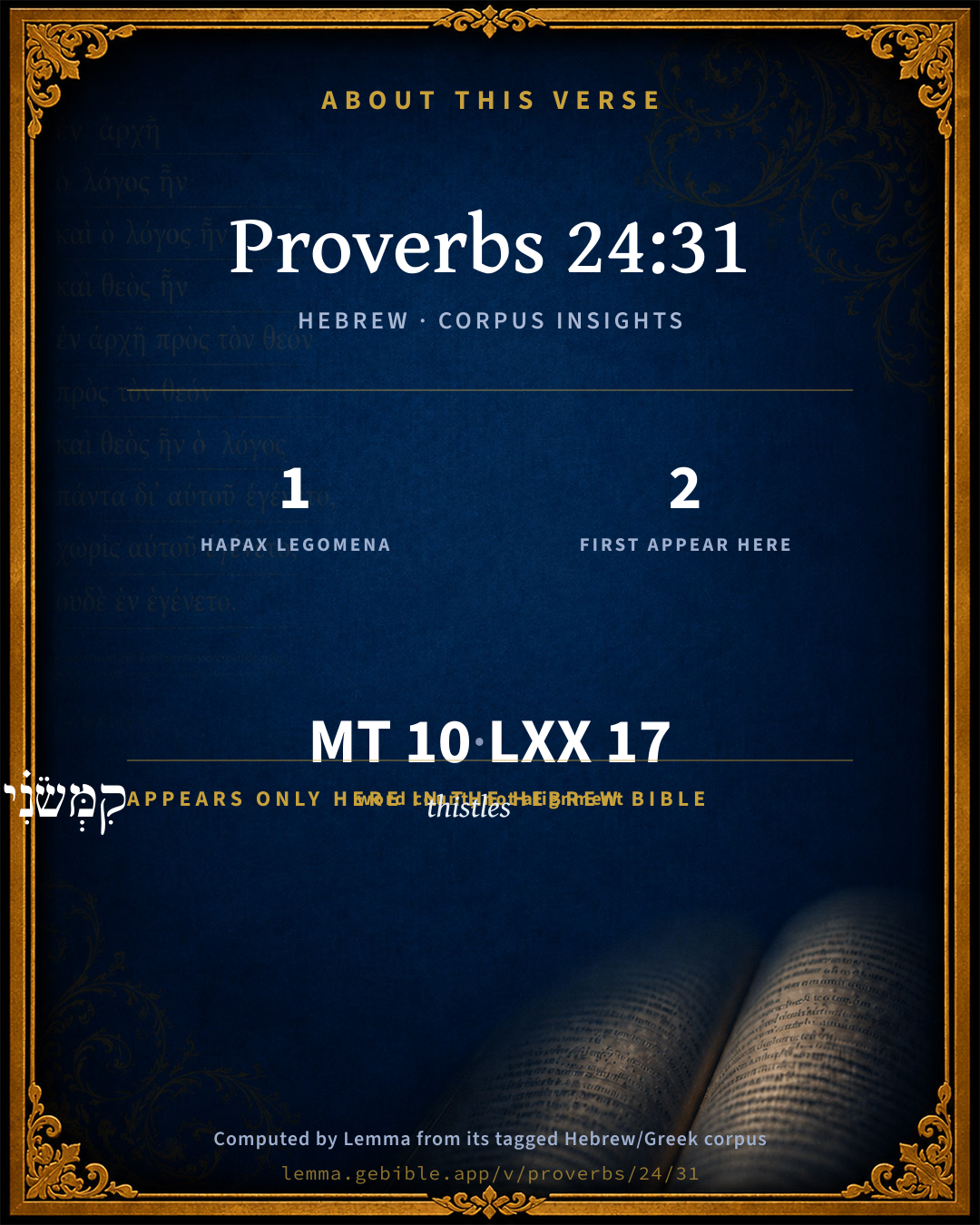
  • 1 hapax legomenon — only here in the Hebrew Bible
  • 2 first appearances in the Hebrew Bible
Full analysis ↓
Download a study sheet

One document with this verse’s original text, its word-by-word gloss line, the meaning frame, cross-references with their text, attributed commentary, and full source and license credits — printable, and it pastes into notes with its structure intact.

This verse Autodidact and up

Study sheet (.html) Plain text (.txt)

A passage Seminary Student

Up to 50 verses in one chapter. A passage sheet keeps up to 6 commentary sources and 12 cross-references per verse, in the order this page ranks them, and says so on the sheet whenever that leaves anything out. Ask for a single verse and you get the Autodidact verse sheet above.

Everything on this page stays free to read, with no account — the sheet is a download of what is already on screen, not access to it.

Want to remove ads? Support Godless Engineer
Compare translations 3

The same verse in 3 English versions, stacked beneath the original-language interlinear above. Click any original word for its lexicon entry.

Each is an independent rendering of the whole verse — the interlinear is not word-aligned to these translations.

Highlighted words mark where these versions differ — a whole-verse word diff, not a word-by-word alignment.

  • World English Bible Public Domain
    Behold, it was all grown over with thorns. Its surface was covered with nettles, And its stone wall was broken down.
  • King James Version Public Domain
    And, lo, it was all grown over with thorns, and nettles had covered the face thereof, and the stone wall thereof was broken down.
  • unfoldingWord Literal Text CC BY-SA 4.0
    And behold, all of it went up thorns, its face was covered weeds, and the wall of its stones was torn down.

unfoldingWord Literal Text — © unfoldingWord, licensed CC BY-SA 4.0. Word-aligned USFM3 via Door43 (git.door43.org/unfoldingWord/en_ult).

Versions to compare (up to 4)

3 of 4 selected

Show all 18 translations

Every available English version of this verse, each an independent rendering of the whole verse.

  • World English Bible Public Domain
    Behold, it was all grown over with thorns. Its surface was covered with nettles, And its stone wall was broken down.
  • Berean Standard Bible Public Domain
    Thorns had grown up everywhere, thistles had covered the ground, and the stone wall was broken down.
  • Majority Standard Bible Public Domain
    Thorns had grown up everywhere, thistles had covered the ground, and the stone wall was broken down.
  • King James Version Public Domain
    And, lo, it was all grown over with thorns, and nettles had covered the face thereof, and the stone wall thereof was broken down.
  • American Standard Version (1901) Public Domain
    And, lo, it was all grown over with thorns, The face thereof was covered with nettles, And the stone wall thereof was broken down.
  • Revised Version (1885) Public Domain
    And, lo, it was all grown over with thorns, the face thereof was covered with nettles, and the stone wall thereof was broken down.
  • Geneva Bible (1599) Public Domain
    And lo, it was al growen ouer with thornes, and nettles had couered the face thereof, and the stone wall thereof was broken downe.
  • Douay-Rheims (1899) Public Domain
    And behold it was all filled with nettles, and thorns had covered the face thereof, and the stone wall was broken down.
  • Young's Literal Translation Public Domain
    And lo, it hath gone up -- all of it -- thorns! Covered its face have nettles, And its stone wall hath been broken down.
  • Literal Standard Version CC BY-SA 4.0
    And behold, it has gone up—all of it—thorns! Nettles have covered its face, || And its stone wall has been broken down.
  • Unlocked Literal Bible CC BY-SA 4.0
    Thorns had grown up everywhere, the ground was covered with nettles, and its stone wall was broken down.
  • unfoldingWord Literal Text CC BY-SA 4.0
    And behold, all of it went up thorns, its face was covered weeds, and the wall of its stones was torn down.
  • Darby Bible Public Domain
    and lo, it was all grown over with thistles, and nettles had covered the face thereof, and its stone wall was broken down.
  • World Messianic Bible Public Domain
    Behold, it was all grown over with thorns. Its surface was covered with nettles, and its stone wall was broken down.
  • Webster's Bible Public Domain
    And lo, it was all grown over with thorns, and nettles had covered the face of it, and its stone wall was broken down.
  • Free Bible Version CC BY-SA 4.0
    It was all overgrown with thorns, the ground was covered with weeds, and the stone wall had fallen down.
  • Bible in Basic English Public Domain
    And it was all full of thorns, and covered with waste plants, and its stone wall was broken down.
  • JPS Tanakh (1917) Public Domain
    And, lo, it was all grown over with thistles, the face thereof was covered with nettles, and the stone wall thereof was broken down.

Literal Standard Version (2020), Covenant Press — licensed CC BY-SA 4.0. Text via the HelloAO Bible API (eBible.org). Unlocked Literal Bible (unfoldingWord) — licensed CC BY-SA 4.0. Text via the HelloAO Bible API (eBible.org). unfoldingWord Literal Text — © unfoldingWord, licensed CC BY-SA 4.0. Word-aligned USFM3 via Door43 (git.door43.org/unfoldingWord/en_ult). Free Bible Version, Dr. Jonathan Gallagher — licensed CC BY-SA 4.0. Text via the HelloAO Bible API (eBible.org).

Word by word

More ways to search: Search by grammar → Find every occurrence → Compare this word →

Practice this passage: Drill this verse → Learn its vocabulary →

קִמְּשֹׂנִ֗ים
qimmâshôwn
H7063
“thistles”
Noun, Common, Masculine, Plural, Absolute
Part of Speech
Noun
Type
Common
Gender
Masculine
Number
Plural
State
Absolute
Full BDB Definition

Origin: from the same as H7057

TWOT: 2037a

thistles or nettles, a thorny or useless plant
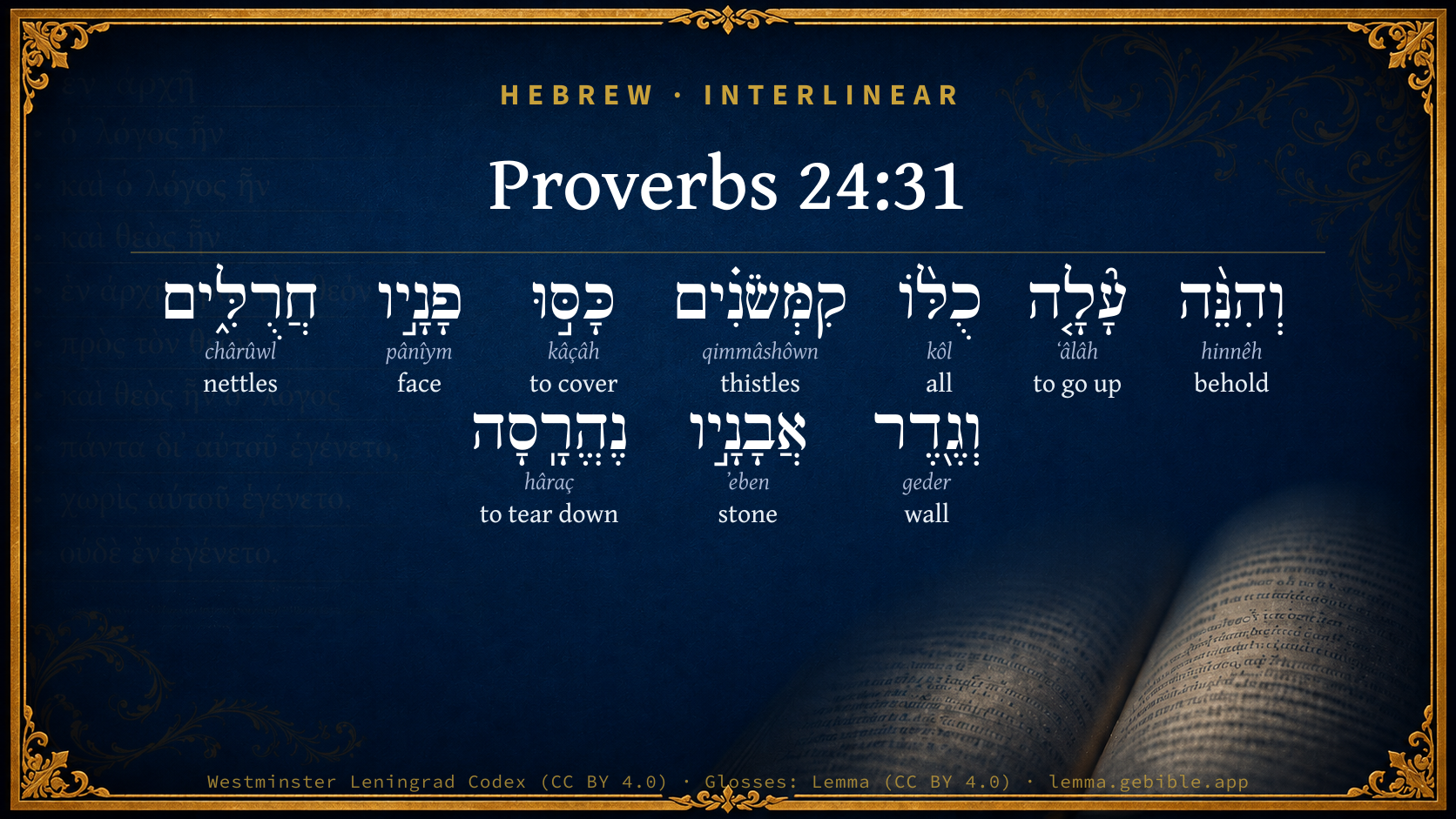
  1. וְהִנֵּ֨ה hinnêh H2009 “and · behold” Conjunction + Particle, Demonstrative
  2. עָ֘לָ֤ה ʻâlâh H5927 “to go up” Verb, Qal, Perfect, 3rd Person, Masculine, Singular
  3. כֻלּ֨וֹ kôl H3605 “all · his” Noun, Common, Masculine, Singular, Construct + Suffix, Personal, 3rd Person, Masculine, Singular
  4. כָּסּ֣וּ kâçâh H3680 “to cover” Verb, Pual, Perfect, 3rd Person, Common, Plural
  5. פָנָ֣יו pânîym H6440 “face(s) · his” Noun, Common, Both, Plural, Construct + Suffix, Personal, 3rd Person, Masculine, Singular
  6. חֲרֻלִּ֑ים chârûwl H2738 “nettles” Noun, Common, Masculine, Plural, Absolute
  7. וְגֶ֖דֶר geder H1444 “and · wall of” Conjunction + Noun, Common, Masculine, Singular, Construct
  8. אֲבָנָ֣יו ʼeben H68 “stones · his” Noun, Common, Feminine, Plural, Construct + Suffix, Personal, 3rd Person, Masculine, Singular
  9. נֶהֱרָֽסָה hâraç H2040 “to tear down” Verb, Niphal, Perfect, 3rd Person, Feminine, Singular

About this verse

These counts appear in no published source. They are computed here, from the morphology-tagged text and Lemma’s own curated glosses. What Lemma adds →

10
words
10
distinct lemmas
Wisdom
section

Notable vocabulary

1 hapax legomenon — a word that appears only here in the entire Hebrew Bible:

  • קִמְּשֹׂנִ֗ים thistles H7063

First appearance in Scripture

These words make their first canonical appearance in the Hebrew Bible here:

  • קִמְּשֹׂנִ֗ים thistles H7063
  • וְגֶ֖דֶר wall H1444

Shared distinctive vocabulary

וְגֶ֖דֶר wall H1444 occurs in 2 verses of the Hebrew Bible. Also found in:

Grammatical profile

  • 3 verbs
  • 6 nouns
  • 1 particle

Verb forms

  • עָ֘לָ֤ה Qal · Perfect
  • כָּסּ֣וּ Pual · Perfect
  • נֶהֱרָֽסָה Niphal · Perfect

Hebrew & Septuagint length

In English translation the verse runs 21 words from the Hebrew and 25 from the Septuagint (LXX English) — closely comparable.

A rough comparison of the two English renderings, which tokenize alike — not a word-level alignment.

Word counts can differ between the Hebrew and the Greek without any difference in meaning — e.g. the Hebrew direct-object marker אֵת has no separate Greek word, and Greek often adds the article ὁ.

In the original languages it is 10 Hebrew tokens and 17 Greek tokens — but the two are counted differently (Hebrew bundles its prefixes and suffixes into one token; the Greek is in lemma form), so that isn’t a like-for-like length.

Cross-references

12

Topical passages linked to Proverbs 24:31 in the Treasury of Scripture Knowledge — connected by theme and wording, ordered by reader-vote popularity; previews shown in the World English Bible.

  • Isaiah 5:5 Now I will tell you what I will do to my vineyard. I will take away its hedge, and it will be eaten up. I will break down its wall of it, and it will be trampled down.
  • Ecclesiastes 10:18 By slothfulness the roof sinks in; And through idleness of the hands the house leaks.
  • Jeremiah 4:3 For thus says Yahweh to the men of Judah and to Jerusalem, Break up your fallow ground, and don't sow among thorns.
  • Matthew 13:22 What was sown among the thorns, this is he who hears the word, but the cares of this age and the deceitfulness of riches choke the word, and he becomes unfruitful.
  • Genesis 3:17–19 To Adam he said, "Because you have listened to your wife's voice, and have eaten of the tree, of which I commanded you, saying, 'You shall not eat of it,' cursed is the ground for your sake. In toil you will eat of it all the days of your life.
  • Job 31:40 Let briars grow instead of wheat, And stinkweed instead of barley." The words of Job are ended.
  • Proverbs 19:23 The fear of Yahweh leads to life, then contentment; He rests and will not be touched by trouble.
  • Proverbs 20:4 The sluggard will not plow by reason of the winter; Therefore he shall beg in harvest, and have nothing.
  • Proverbs 22:13 The sluggard says, "There is a lion outside! I will be killed in the streets!"
  • Proverbs 23:21 For the drunkard and the glutton shall become poor; And drowsiness clothes them in rags.
  • Matthew 13:7 Others fell among thorns. The thorns grew up and choked them:
  • Hebrews 6:8 but if it bears thorns and thistles, it is rejected and near being cursed, whose end is to be burned.

Cross-references courtesy of OpenBible.info (CC BY 4.0).

Hebrew and Greek witnesses Masoretic Hebrew ↔ Greek Septuagint

The same verse in the two great witnesses to the Old Testament, shown verse-for-verse.

These are two independent witnesses, not word-aligned to each other, and the Septuagint is shown in lemma (dictionary) form.

Hebrew Proverbs 24:31 Masoretic · Westminster Leningrad Codex

וְהִנֵּ֨ה עָ֘לָ֤ה כֻלּ֨וֹ קִמְּשֹׂנִ֗ים כָּסּ֣וּ פָנָ֣יו חֲרֻלִּ֑ים וְגֶ֖דֶר אֲבָנָ֣יו נֶהֱרָֽסָה

Behold, it was all grown over with thorns. Its surface was covered with nettles, And its stone wall was broken down.

World English Bible · Public Domain

Greek LXX Proverbs 24:31 Septuagint · lemma form

ἐάν ἀποἵημι αὐτός χερσεύω καί χορτομανέω ὅλος καί γίγνομαι ἐκλείπω ὁ δέ φραγμός ὁ λίθος αὐτός κατασκάπτω

If you let him alone, he will altogether remain barren and covered with weeds; and he becomes destitute, and his stone walls are broken down.

LXX2012 (modern English Septuagint) · Public Domain

On this verse, The Pulpit Commentary discusses the Septuagint’s reading. Read the note in Commentary ↓

Hebrew: Westminster Leningrad Codex (CC BY 4.0). Greek: Septuagint (public domain); English from LXX2012 (modern English Septuagint) (Public Domain). How the Septuagint differs from the Hebrew →

Commentary

Notes on Proverbs 24:31 from classic Christian and Jewish commentators (each source and its license shown beneath its notes). The classic Christian expositions comment on the surrounding passage and are grouped to its opening verse, so a note may address several verses; the Jewish commentaries on the Tanakh (Rashi and others) are per-verse, so they appear only where the commentator wrote on this verse.

Lemma curates 59 commentaries, every one of them public domain or Creative Commons licensed, each selected and text-cleaned for this edition rather than reprinted as found. About our sources →

Trapp's Complete Commentary

John Trapp

Pro 24:31 And, lo, it was all grown over with thorns, [and] nettles had covered the face thereof, and the stone wall thereof was broken down.

Ver. 31. And, lo, it was all grown over with thorns.] So is the spiritual sluggard’s soul with lusts and sins, under the which lurketh that old serpent.

John Trapp, A Commentary or Exposition upon All the Books of the Old and New Testament (1647–1656) — public domain. Text from a community e-Sword module.

The Cambridge Bible for Schools and Colleges

gen. ed. J. J. S. Perowne

31. nettles] “Or, wild vetches,” R.V. marg. here and Job_30:7; Zep_2:9, where the same Heb. word occurs.

The Cambridge Bible for Schools and Colleges (gen. ed. J. J. S. Perowne; Cambridge University Press, 1878–1918) — public domain. Text from a community e-Sword module.

John Gill's Exposition

Yet a little sleep, a little slumber,.... The sight of the field and vineyard of the slothful put Solomon in mind of an observation he had made before, which fitly describes the disposition and gesture of the sluggard, by which means his field and vineyard came to ruin; while he should be up and tilling his field and planting his vineyard, he is in his bed; and awaking, instead of rising, craves for and indulges himself in another little doze, and which he repeats again and again;

a little folding of the hands to sleep; which ought to have been employed another way; See Gill on Pro 6:10.

John Gill's Exposition of the Whole Bible (1746–1763) — public domain (CC PDM 1.0). Text via the HelloAO Bible API.

The Pulpit Commentary

Thorns. Kimmashon is the word here used, but the plant has not been certainly identified. (comp. Isa_34:13) Nettles (charul). The stinging nettle is quite common in Palestine, but the plant here meant is probably the prickly acanthus, which quickly covers any spot left uncultivated. (Job_30:7) Revised Version margin suggests wild vetches. Ovid, "Trist.," 5:12. 21"Adde, quod ingenium louga rubigine laesum Torpet, et est multo, quam fuitante, minus. Fertilis, assiduo si non renovetur aratro, Nil, nisicum spinis gramen, habebit ager.

So spiritual writers have used this apologue as teaching a lesson concerning the soul and the life of man, how that spiritual sloth allows the growth of evil habits, and the carelessness which maintains not the defence of law and prayer, but admits the enemy, and the result is the loss of the true riches and the perishing of the heavenly life. The two verses are thus rendered, or morally applied, in the Septuagint: "A foolish man is as a farm. and a man wanting in sense is as a vineyard; if you leave him, he will be barren, and will be altogether covered with weeds, and he will become deserted, and his fences of stone are broken down."

The Pulpit Commentary (1880–1919), ed. H.D.M. Spence-Jones & Joseph S. Exell — public domain. Text from a community e-Sword module.

Kretzmann's Popular Commentary

Paul E. Kretzmann

v. 31. and, lo, it was all grown over with thorns, the entire field, for want of cultivation, had produced noxious weeds, and nettles had covered the face thereof, and the stone wall thereof was broken down, another sign of utter neglect.

Paul E. Kretzmann, Popular Commentary of the Bible (1921–1924) — public domain. Text from a community e-Sword module.

Rashi

Rabbi Shlomo Yitzchaki (Rashi)

thistles Heb. קמשונים, thistles.

nettles חרלים. They are larger than thistles, and they are as sharp as thorns.

and its stone fence had been torn down Thus, one who does not review his studies first forgets the beginnings of the chapters and at the end confuses the names of the Sages from this one to that one, thereby saying “unclean” for something that is clean and “clean” for something that is unclean, and he destroys the world.

Rashi on the Tanakh — English translations: “The Judaica Press complete Tanach with Rashi, translated by A. J. Rosenberg” (CC BY 4.0); “Pentateuch with Rashi's commentary by M. Rosenbaum and A.M. Silbermann, 1929-1934” (public domain); “The Metsudah Tanach series, Lakewood, N.J” (CC BY 4.0); and “The Book of Joshua, Metsudah Publications, 1997” (CC BY 4.0). Text via Sefaria.

Lesson kit

Teaching starters — assembled from the data on this page, not authored interpretation. Every prompt links to the verse data it draws on. Edit before teaching.

Proverbs, in the Wisdom, opens this verse with 10 words (10 distinct Hebrew lemmas). Its most distinctive word is qimmâshôwn (“thistles”). A historical commentator’s framing appears above. Read the whole chapter for the surrounding context.

Discussion questions

  1. What does “thistles” (qimmâshôwn) contribute to the verse as a whole?
  2. 1 word here appears nowhere else in the Hebrew Bible. Why might the author reach for such rare wording?
  3. 2 words make their first appearance in Scripture here. What does this debut establish?
  4. How does Ezekiel 42:10, which shares the word «wall», read alongside this verse?
  5. These translations render this verse differently. What is at stake in choosing one wording over another?
  6. «עָ֘לָ֤ה» is a Qal Perfect verb. How does that grammatical form shape the action described?
  7. Compare how Trapp's Complete Commentary and The Cambridge Bible for Schools and Colleges read this verse. Where do they agree or differ?

Things to notice

Reading settings

Reading text

Shown beneath each verse's original-language words.

Old Testament
Old Testament edition

Read the OT as the Masoretic Hebrew (MT) or the Greek Septuagint (LXX).

English shown for the Greek Septuagint (in the Hebrew ↔ Greek comparison).

Comparing translations? Open the Compare panel on any verse page to stack up to four side by side.