
2 Chronicles 4:12

Hebrew (Westminster Leningrad Codex) 2 Chronicles 4:12 appears in the Hebrew Old Testament. The text above is from the Westminster Leningrad Codex. Each word links to its Strong’s number, a concise gloss, and parsing drawn from the Open Scriptures Hebrew Bible morphology. Click any word for its full Brown-Driver-Briggs (BDB) entry.
Download image
Cite this verse

2 Chronicles 4:12 (World English Bible). Public Domain. Lemma interlinear Bible study tool, https://lemma.gebible.app/v/2-chronicles/4/12.

Show BibTeX & RIS
BibTeX
RIS
English Translation
the two pillars, and the bowls, and the two capitals which were on the top of the pillars, and the two networks to cover the two bowls of the capitals that were on the top of the pillars,
World English Bible · Public Domain
Download a study sheet

One document with this verse’s original text, its word-by-word gloss line, the meaning frame, cross-references with their text, attributed commentary, and full source and license credits — printable, and it pastes into notes with its structure intact.

This verse Autodidact and up

Study sheet (.html) Plain text (.txt)

A passage Seminary Student

Up to 50 verses in one chapter. A passage sheet keeps up to 6 commentary sources and 12 cross-references per verse, in the order this page ranks them, and says so on the sheet whenever that leaves anything out. Ask for a single verse and you get the Autodidact verse sheet above.

Everything on this page stays free to read, with no account — the sheet is a download of what is already on screen, not access to it.

Want to remove ads? Support Godless Engineer
Compare translations 3

The same verse in 3 English versions, stacked beneath the original-language interlinear above. Click any original word for its lexicon entry.

Each is an independent rendering of the whole verse — the interlinear is not word-aligned to these translations.

Highlighted words mark where these versions differ — a whole-verse word diff, not a word-by-word alignment.

  • World English Bible Public Domain
    the two pillars, and the bowls, and the two capitals which were on the top of the pillars, and the two networks to cover the two bowls of the capitals that were on the top of the pillars,
  • King James Version Public Domain
    To wit, the two pillars, and the pommels, and the chapiters which were on the top of the two pillars, and the two wreaths to cover the two pommels of the chapiters which were on the top of the pillars;
  • unfoldingWord Literal Text CC BY-SA 4.0
    the two pillars, and the bowls, and the capitals on the head of the two pillars, and the two trellises to cover the two bowls of the capitals that were on the head of the pillars,

unfoldingWord Literal Text — © unfoldingWord, licensed CC BY-SA 4.0. Word-aligned USFM3 via Door43 (git.door43.org/unfoldingWord/en_ult).

Versions to compare (up to 4)

3 of 4 selected

Show all 18 translations

Every available English version of this verse, each an independent rendering of the whole verse.

  • World English Bible Public Domain
    the two pillars, and the bowls, and the two capitals which were on the top of the pillars, and the two networks to cover the two bowls of the capitals that were on the top of the pillars,
  • Berean Standard Bible Public Domain
    the two pillars; the two bowl-shaped capitals atop the pillars; the two sets of network covering both bowls of the capitals atop the pillars;
  • Majority Standard Bible Public Domain
    the two pillars; the two bowl-shaped capitals atop the pillars; the two sets of network covering both bowls of the capitals atop the pillars;
  • King James Version Public Domain
    To wit, the two pillars, and the pommels, and the chapiters which were on the top of the two pillars, and the two wreaths to cover the two pommels of the chapiters which were on the top of the pillars;
  • American Standard Version (1901) Public Domain
    the two pillars, and the bowls, and the two capitals which were on the top of the pillars, and the two networks to cover the two bowls of the capitals that were on the top of the pillars,
  • Revised Version (1885) Public Domain
    the two pillars, and the bowls, and the two chapiters which were on the top of the pillars; and the two networks to cover the two bowls of the chapiters that were on the top of the pillars;
  • Geneva Bible (1599) Public Domain
    To wit, two pillars, and the bowles and the chapiters on the top of ye two pillars, and two grates to couer the two bowles of the chapiters which were vpon the toppe of the pillars:
  • Douay-Rheims (1899) Public Domain
    And Hiram made caldrons, and fleshhooks, and bowls: and finished all the king's work in the house of God:
  • Young's Literal Translation Public Domain
    two pillars, and the bowls, and the crowns on the heads of the two pillars, and the two wreaths to cover the two bowls of the crowns that `are' on the heads of the pillars;
  • Literal Standard Version CC BY-SA 4.0
    two pillars, and the bowls, and the crowns on the heads of the two pillars, and the two networks to cover the two bowls of the crowns that [are] on the heads of the pillars;
  • Unlocked Literal Bible CC BY-SA 4.0
    the two pillars, the bowl-like capitals that were on top of the two pillars, and the two sets of decorative latticework to cover the two bowl-like capitals that were on top of the pillars.
  • unfoldingWord Literal Text CC BY-SA 4.0
    the two pillars, and the bowls, and the capitals on the head of the two pillars, and the two trellises to cover the two bowls of the capitals that were on the head of the pillars,
  • Darby Bible Public Domain
    two pillars, and the globes and the capitals on the top of the pillars, two; and the two networks, to cover the two globes of the capitals which were on the top of the pillars;
  • World Messianic Bible Public Domain
    the two pillars, the bowls, the two capitals which were on the top of the pillars, the two networks to cover the two bowls of the capitals that were on the top of the pillars,
  • Webster's Bible Public Domain
    To wit, the two pillars, and the pommels, and the capitals which were on the top of the two pillars, and the two wreaths to cover the two pommels of the capitals which were on the top of the pillars;
  • Free Bible Version CC BY-SA 4.0
    the two columns; the two bowl-shaped capitals on top of the columns; the two sets of network that covered both bowls of the capitals on top of the columns;
  • Bible in Basic English Public Domain
    The two pillars, and the two crowns on the tops of the pillars, and the network covering the two cups of the crowns on the tops of the pillars;
  • JPS Tanakh (1917) Public Domain
    the two pillars, and the bowls, and the two capitals which were on the top of the pillars; and the two networks to cover the two bowls of the capitals that were on the top of the pillars;

Literal Standard Version (2020), Covenant Press — licensed CC BY-SA 4.0. Text via the HelloAO Bible API (eBible.org). Unlocked Literal Bible (unfoldingWord) — licensed CC BY-SA 4.0. Text via the HelloAO Bible API (eBible.org). unfoldingWord Literal Text — © unfoldingWord, licensed CC BY-SA 4.0. Word-aligned USFM3 via Door43 (git.door43.org/unfoldingWord/en_ult). Free Bible Version, Dr. Jonathan Gallagher — licensed CC BY-SA 4.0. Text via the HelloAO Bible API (eBible.org).

Word by word

More ways to search: Search by grammar → Find every occurrence → Compare this word →

Practice this passage: Drill this verse → Learn its vocabulary →

וְהַגֻּלּ֧וֹת
gullâh
H1543
“and · the · bowls”
Conjunction + Particle, Definite Article + Noun, Common, Feminine, Plural, Absolute
Part of Speech
Conjunction + Particle + Noun
Type
Common
Gender
Feminine
Number
Plural
State
Absolute
Full BDB Definition

Origin: from H1556

TWOT: 353c

bowl, spring, basin - basin - bowl - of a lamp - of bowl shaped portion of capitals of pillars of the temple
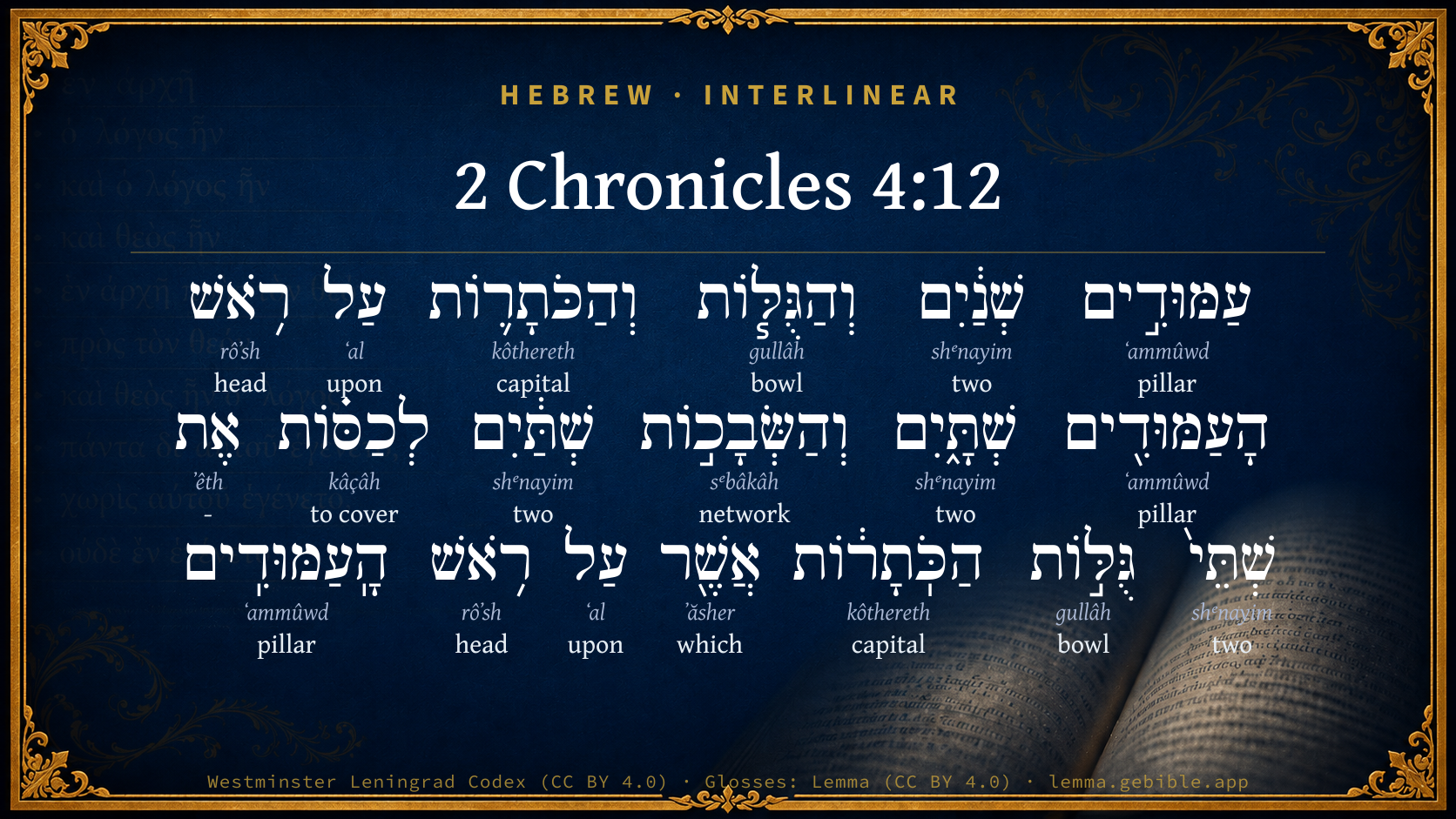
  1. עַמּוּדִ֣ים ʻammûwd H5982 “pillars” Noun, Common, Masculine, Plural, Absolute
  2. שְׁנַ֔יִם shᵉnayim H8147 “two” Adjective, Cardinal number, Masculine, Dual, Absolute
  3. וְהַכֹּתָר֛וֹת kôthereth H3805 “and · the · capitals” Conjunction + Particle, Definite Article + Noun, Common, Feminine, Plural, Absolute
  4. עַל ʻal H5921 “upon” Preposition
  5. רֹ֥אשׁ rôʼsh H7218 “head of” Noun, Common, Masculine, Singular, Construct
  6. הָעַמּוּדִ֖ים ʻammûwd H5982 “the · pillars” Particle, Definite Article + Noun, Common, Masculine, Plural, Absolute
  7. שְׁתָּ֑יִם shᵉnayim H8147 “two” Adjective, Cardinal number, Feminine, Dual, Absolute
  8. וְהַשְּׂבָכ֣וֹת sᵉbâkâh H7639 “and · the · networks” Conjunction + Particle, Definite Article + Noun, Common, Feminine, Plural, Absolute
  9. שְׁתַּ֔יִם shᵉnayim H8147 “two” Adjective, Cardinal number, Feminine, Dual, Absolute
  10. לְכַסּ֗וֹת kâçâh H3680 “to cover” Preposition + Verb, Piel, Infinitive Construct
  11. אֶת ʼêth H853 “-” Particle, Direct Object
  12. שְׁתֵּי֙ shᵉnayim H8147 “two” Adjective, Cardinal number, Feminine, Dual, Construct
  13. גֻּלּ֣וֹת gullâh H1543 “bowls of” Noun, Common, Feminine, Plural, Construct
  14. הַכֹּֽתָר֔וֹת kôthereth H3805 “the · capitals” Particle, Definite Article + Noun, Common, Feminine, Plural, Absolute
  15. אֲשֶׁ֖ר ʼăsher H834 “which” Particle, Relative
  16. עַל ʻal H5921 “upon” Preposition
  17. רֹ֥אשׁ rôʼsh H7218 “head of” Noun, Common, Masculine, Singular, Construct
  18. הָֽעַמּוּדִֽים ʻammûwd H5982 “the · pillars” Particle, Definite Article + Noun, Common, Masculine, Plural, Absolute

About this verse

These counts appear in no published source. They are computed here, from the morphology-tagged text and Lemma’s own curated glosses. What Lemma adds →

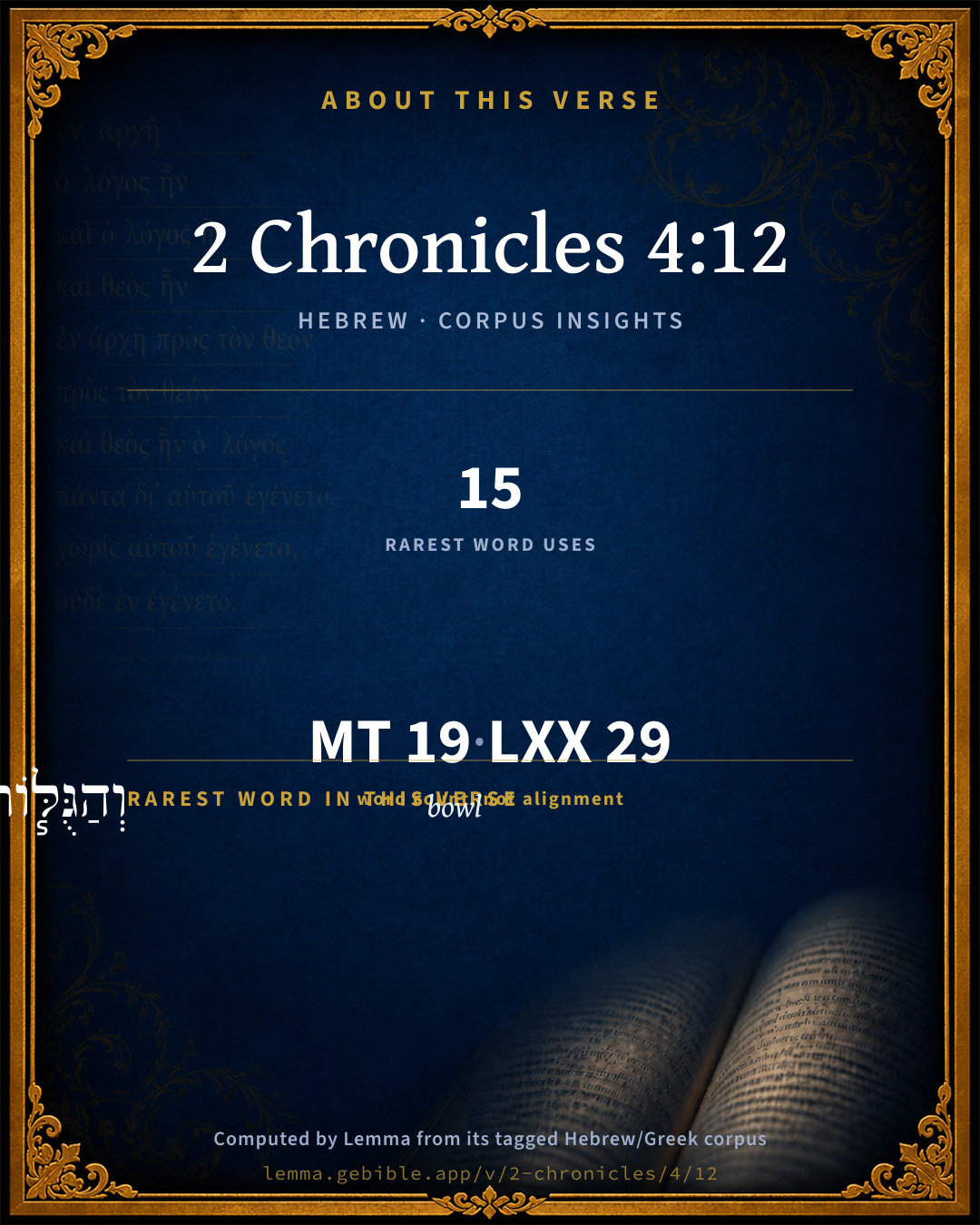
19
words
10
distinct lemmas
Historical
section

Notable vocabulary

The rarest word here is וְהַגֻּלּ֧וֹת bowl H1543 — appearing just 15 times in the whole Hebrew Bible.

Shared distinctive vocabulary

וְהַגֻּלּ֧וֹת bowl H1543 occurs in 9 verses of the Hebrew Bible. Also found in:

Grammatical profile

  • 1 verb
  • 10 nouns
  • 4 adjectives
  • 2 prepositions
  • 2 particles

Verb forms

  • לְכַסּ֗וֹת Piel · Infinitive Construct

Repetition

Words recur within this verse — often emphatic in Hebrew:

  • שְׁנַ֔יִם two H8147 ×4
  • עַמּוּדִ֣ים pillar H5982 ×3
  • וְהַגֻּלּ֧וֹת bowl H1543 ×2
  • וְהַכֹּתָר֛וֹת capital H3805 ×2
  • עַל upon H5921 ×2
  • רֹ֥אשׁ head H7218 ×2

Hebrew & Septuagint length

In English translation the verse runs 38 words from the Hebrew and 36 from the Septuagint (LXX English) — closely comparable.

A rough comparison of the two English renderings, which tokenize alike — not a word-level alignment.

Word counts can differ between the Hebrew and the Greek without any difference in meaning — e.g. the Hebrew direct-object marker אֵת has no separate Greek word, and Greek often adds the article ὁ.

In the original languages it is 19 Hebrew tokens and 29 Greek tokens — but the two are counted differently (Hebrew bundles its prefixes and suffixes into one token; the Greek is in lemma form), so that isn’t a like-for-like length.

Cross-references

2

Topical passages linked to 2 Chronicles 4:12 in the Treasury of Scripture Knowledge — connected by theme and wording, ordered by reader-vote popularity; previews shown in the World English Bible.

  • 1 Kings 7:41 the two pillars, and the two bowls of the capitals that were on the top of the pillars; and the two networks to cover the two bowls of the capitals that were on the top of the pillars;
  • 2 Chronicles 3:15–17 Also he made before the house two pillars of thirty-five cubits high, and the capital that was on the top of each of them was five cubits.

Cross-references courtesy of OpenBible.info (CC BY 4.0).

Hebrew and Greek witnesses Masoretic Hebrew ↔ Greek Septuagint

The same verse in the two great witnesses to the Old Testament, shown verse-for-verse.

These are two independent witnesses, not word-aligned to each other, and the Septuagint is shown in lemma (dictionary) form.

Hebrew 2 Chronicles 4:12 Masoretic · Westminster Leningrad Codex

עַמּוּדִ֣ים שְׁנַ֔יִם וְהַגֻּלּ֧וֹת וְהַכֹּתָר֛וֹת עַל רֹ֥אשׁ הָעַמּוּדִ֖ים שְׁתָּ֑יִם וְהַשְּׂבָכ֣וֹת שְׁתַּ֔יִם לְכַסּ֗וֹת אֶת שְׁתֵּי֙ גֻּלּ֣וֹת הַכֹּֽתָר֔וֹת אֲשֶׁ֖ר עַל רֹ֥אשׁ הָֽעַמּוּדִֽים

the two pillars, and the bowls, and the two capitals which were on the top of the pillars, and the two networks to cover the two bowls of the capitals that were on the top of the pillars,

World English Bible · Public Domain

Greek LXX 2 Chronicles 4:12 Septuagint · lemma form

στῦλος δύο καί ἐπί αὐτός γωλαθ ὁ χωθαρεθ ἐπί ὁ κεφαλή ὁ στῦλος δύο καί δίκτυον δύο συνκαλύπτω ὁ κεφαλή ὁ χωθαρεθ ὅς εἰμί ἐπί ὁ κεφαλή ὁ στῦλος

two pillars, and upon them an embossed work for the capitals on the heads of the two pillars, and two nets to cover the heads of the capitals which are on the heads of the pillars;

LXX2012 (modern English Septuagint) · Public Domain

Hebrew: Westminster Leningrad Codex (CC BY 4.0). Greek: Septuagint (public domain); English from LXX2012 (modern English Septuagint) (Public Domain). How the Septuagint differs from the Hebrew →

Commentary

Notes on 2 Chronicles 4:12 from classic Christian and Jewish commentators (each source and its license shown beneath its notes). The classic Christian expositions comment on the surrounding passage and are grouped to its opening verse, so a note may address several verses; the Jewish commentaries on the Tanakh (Rashi and others) are per-verse, so they appear only where the commentator wrote on this verse.

Lemma curates 59 commentaries, every one of them public domain or Creative Commons licensed, each selected and text-cleaned for this edition rather than reprinted as found. About our sources →

Trapp's Complete Commentary

John Trapp

2Ch 4:12 [To wit], the two pillars, and the pommels, and the chapiters [which were] on the top of the two pillars, and the two wreaths to cover the two pommels of the chapiters which [were] on the top of the pillars;

Ver. 12. And the chapiters.] Of these, see 1Ki 7:16.

John Trapp, A Commentary or Exposition upon All the Books of the Old and New Testament (1647–1656) — public domain. Text from a community e-Sword module.

Ellicott's Commentary for English Readers

(12) And the pommels, and the chapiters—i.e., the globes and the capitals. Kings, Authorised Version has bowls, but in Hebrew the word is the same (gullôth, globes). “The globes of the capitals” (Kings) is plainly incorrect.

Which were on the top of the two pillars.—Heb. (and the globes and the capitals), on the top of the pillars, two; i.e., two globes and capitals. The word “two” (shtayim) is feminine, agreeing with “globes and capitals,” which are also feminine; whereas “pillars” is a masculine term.

Wreaths.—Heb., sĕbâkhôth, lattices. (Comp. 2Ki_1:2.) The Authorised version of 1Ki_7:41 gives “network,” but the Hebrew word is the same as here.

A Bible Commentary for English Readers, edited by Charles John Ellicott (1878–1897) — public domain. Text from a community e-Sword module.

The Cambridge Bible for Schools and Colleges

gen. ed. J. J. S. Perowne

12. two pillars] See 2Ch_3:15-17.

the pommels] R.V. the bowls, as in 1Ki_7:41 for the same Hebrew word, i.e. the bowl-shaped part of the capital of a pillar. “Pommel” = “knob.”

the chapiters] In modern English, “capitals.”

two wreaths] R.V. two networks, as in 1Ki_7:41 for the same Hebrew word.

The Cambridge Bible for Schools and Colleges (gen. ed. J. J. S. Perowne; Cambridge University Press, 1878–1918) — public domain. Text from a community e-Sword module.

Haydock's Catholic Bible Commentary

Pommels, (epistylia.) Hebrew, "cordons," or rows of pomegranates, (3 Kings vii. 18.) each consisting of one hundred; so that at the two pillars were adorned with a double row, both together would have four hundred. (Calmet) --- The precise number is fixed at ninety-six for each row, Jeremias lii. 23. (Tirinus)

George Leo Haydock (1774–1849), Haydock's Catholic Family Bible and Commentary, 1859 edition — public domain. Excludes Psalms (Douay-Rheims chapter numbering differs from Protestant) and Deuterocanonical books (Catholic canon only).

The Pulpit Commentary

The pommels. The Hebrew word is tlogu, translated in the parallel "bowls." The word occurs in the Old Testament twelve times, and is translated six times (in Judges and Joshua)" springs," four times "bowls," and twice "pommels." It was an architectural ornament to the capital, in shape like a ball. The chapiters. The Hebrew word is Tr,t,ko, occurring twenty-three times or more, and always translated thus; in modern architecture, the head or capital of the pillar. The two wreaths. The word is trtKo, occurring fifteen times, and translated seven times "net-work," five times "wreath," or "wreathen-work," once a "snare," once "checker work," and once a "lattice." These wreaths were of some lace pattern plaiting and festoons of fancy chain-work. The fuller expression of them is found in 1Ki_7:17, though in description not more distinct, certainly of checker-work, and wreaths of chain-work."

The Pulpit Commentary (1880–1919), ed. H.D.M. Spence-Jones & Joseph S. Exell — public domain. Text from a community e-Sword module.

Rashi

Rabbi Shlomo Yitzchaki (Rashi)

and the two bowls and chapiters atop the pillars for the two pillars.

and the networks were two These are the chains mentioned above (3:16), and the proof that it is so is that neither here nor in Kings does he mention the chains anywhere.

to cover the two bowls of the chapiters to cover the hollow of the chapiters with chains, and those branches were like palm branches, as I explained (ad loc.).

Rashi on the Tanakh — English translations: “The Judaica Press complete Tanach with Rashi, translated by A. J. Rosenberg” (CC BY 4.0); “Pentateuch with Rashi's commentary by M. Rosenbaum and A.M. Silbermann, 1929-1934” (public domain); “The Metsudah Tanach series, Lakewood, N.J” (CC BY 4.0); and “The Book of Joshua, Metsudah Publications, 1997” (CC BY 4.0). Text via Sefaria.

Lesson kit

Teaching starters — assembled from the data on this page, not authored interpretation. Every prompt links to the verse data it draws on. Edit before teaching.

2 Chronicles, in the Historical, opens this verse with 19 words (10 distinct Hebrew lemmas). Its most distinctive word is gullâh (“bowl”). A historical commentator’s framing appears above. Read the whole chapter for the surrounding context.

Discussion questions

  1. The word gullâh carries the sense “bowl.” How does it shape the verse?
  2. How does Joshua 15:19, which shares the word «bowl», read alongside this verse?
  3. What does the repetition of “two” (4× in this one verse) do in this verse?
  4. These translations render this verse differently. What is at stake in choosing one wording over another?
  5. «לְכַסּ֗וֹת» is a Piel Infinitive Construct verb. How does that grammatical form shape the action described?
  6. Compare how Trapp's Complete Commentary and Ellicott's Commentary for English Readers read this verse. Where do they agree or differ?

Things to notice

Reading settings

Reading text

Shown beneath each verse's original-language words.

Old Testament
Old Testament edition

Read the OT as the Masoretic Hebrew (MT) or the Greek Septuagint (LXX).

English shown for the Greek Septuagint (in the Hebrew ↔ Greek comparison).

Comparing translations? Open the Compare panel on any verse page to stack up to four side by side.