Ezekiel 7:18

Hebrew (Westminster Leningrad Codex) Ezekiel 7:18 appears in the Hebrew Old Testament. The text above is from the Westminster Leningrad Codex. Each word links to its Strong’s number, a concise gloss, and parsing drawn from the Open Scriptures Hebrew Bible morphology. Click any word for its full Brown-Driver-Briggs (BDB) entry.
Download image
Cite this verse

Ezekiel 7:18 (World English Bible). Public Domain. Lemma interlinear Bible study tool, https://lemma.gebible.app/v/ezekiel/7/18.

Show BibTeX & RIS
BibTeX
RIS
English Translation
They shall also gird themselves with sackcloth, and horror shall cover them; and shame shall be on all faces, and baldness on all their heads.
World English Bible · Public Domain
Download a study sheet

One document with this verse’s original text, its word-by-word gloss line, the meaning frame, cross-references with their text, attributed commentary, and full source and license credits — printable, and it pastes into notes with its structure intact.

This verse Autodidact and up

Study sheet (.html) Plain text (.txt)

A passage Seminary Student

Up to 50 verses in one chapter. A passage sheet keeps up to 6 commentary sources and 12 cross-references per verse, in the order this page ranks them, and says so on the sheet whenever that leaves anything out. Ask for a single verse and you get the Autodidact verse sheet above.

Everything on this page stays free to read, with no account — the sheet is a download of what is already on screen, not access to it.

Want to remove ads? Support Godless Engineer
Compare translations 3

The same verse in 3 English versions, stacked beneath the original-language interlinear above. Click any original word for its lexicon entry.

Each is an independent rendering of the whole verse — the interlinear is not word-aligned to these translations.

Highlighted words mark where these versions differ — a whole-verse word diff, not a word-by-word alignment.

  • World English Bible Public Domain
    They shall also gird themselves with sackcloth, and horror shall cover them; and shame shall be on all faces, and baldness on all their heads.
  • King James Version Public Domain
    They shall also gird themselves with sackcloth, and horror shall cover them; and shame shall be upon all faces, and baldness upon all their heads.
  • unfoldingWord Literal Text CC BY-SA 4.0
    and they will wear sackcloth, and terror will cover them; and shame will be on every face, and baldness on all of their heads.

unfoldingWord Literal Text — © unfoldingWord, licensed CC BY-SA 4.0. Word-aligned USFM3 via Door43 (git.door43.org/unfoldingWord/en_ult).

Versions to compare (up to 4)

3 of 4 selected

Show all 18 translations

Every available English version of this verse, each an independent rendering of the whole verse.

  • World English Bible Public Domain
    They shall also gird themselves with sackcloth, and horror shall cover them; and shame shall be on all faces, and baldness on all their heads.
  • Berean Standard Bible Public Domain
    They will put on sackcloth, and terror will overwhelm them. Shame will cover all their faces, and all their heads will be shaved.
  • Majority Standard Bible Public Domain
    They will put on sackcloth, and terror will overwhelm them. Shame will cover all their faces, and all their heads will be shaved.
  • King James Version Public Domain
    They shall also gird themselves with sackcloth, and horror shall cover them; and shame shall be upon all faces, and baldness upon all their heads.
  • American Standard Version (1901) Public Domain
    They shall also gird themselves with sackcloth, and horror shall cover them; and shame shall be upon all faces, and baldness upon all their heads.
  • Revised Version (1885) Public Domain
    They shall also gird themselves with sackcloth, and horror shall cover them; and shame shall be upon all faces, and baldness upon all their heads.
  • Geneva Bible (1599) Public Domain
    They shall also girde them selues with sackecloth, and feare shall couer them, and shame shalbe vpon all faces, and baldnes vpon their heads.
  • Douay-Rheims (1899) Public Domain
    And they shall gird themselves with haircloth, and fear shall cover them, and shame shall be upon every face, and baldness upon all their heads.
  • Young's Literal Translation Public Domain
    And they have girded on sackcloth, And covered them hath trembling, And unto all faces `is' shame, And on all their heads -- baldness.
  • Literal Standard Version CC BY-SA 4.0
    And they have girded on sackcloth, || And trembling has covered them, || And shame [is] on all faces, || And baldness on all their heads.
  • Unlocked Literal Bible CC BY-SA 4.0
    and they will wear sackcloth, and terror will cover them; and shame will be on every face, and baldness on all of their heads.
  • unfoldingWord Literal Text CC BY-SA 4.0
    and they will wear sackcloth, and terror will cover them; and shame will be on every face, and baldness on all of their heads.
  • Darby Bible Public Domain
    And they shall gird on sackcloth, and horror shall cover them; and shame shall be upon all faces, and baldness upon all their heads.
  • World Messianic Bible Public Domain
    They will also clothe themselves with sackcloth, and horror will cover them. Shame will be on all faces, and baldness on all their heads.
  • Webster's Bible Public Domain
    They shall also gird themselves with sackcloth, and horror shall cover them; and shame shall be upon all faces, and baldness upon all their heads.
  • Free Bible Version CC BY-SA 4.0
    They will put on clothes made of sackcloth, and they will be totally terrified. They will all be ashamed and shave their heads in mourning.
  • Bible in Basic English Public Domain
    And they will put haircloth round them, and deep fear will be covering them; and shame will be on all faces, and the hair gone from all their heads.
  • JPS Tanakh (1917) Public Domain
    They shall also gird themselves with sackcloth, and horror shall cover them; and shame shall be upon all faces, and baldness upon all their heads.

Literal Standard Version (2020), Covenant Press — licensed CC BY-SA 4.0. Text via the HelloAO Bible API (eBible.org). Unlocked Literal Bible (unfoldingWord) — licensed CC BY-SA 4.0. Text via the HelloAO Bible API (eBible.org). unfoldingWord Literal Text — © unfoldingWord, licensed CC BY-SA 4.0. Word-aligned USFM3 via Door43 (git.door43.org/unfoldingWord/en_ult). Free Bible Version, Dr. Jonathan Gallagher — licensed CC BY-SA 4.0. Text via the HelloAO Bible API (eBible.org).

Word by word

More ways to search: Search by grammar → Find every occurrence → Compare this word →

Practice this passage: Drill this verse → Learn its vocabulary →

פַּלָּצ֑וּת
pallâtsûwth
H6427
“trembling”
Noun, Common, Feminine, Singular, Absolute
Part of Speech
Noun
Type
Common
Gender
Feminine
Number
Singular
State
Absolute
Full BDB Definition

Origin: from H6426

TWOT: 1778a

shuddering, trembling
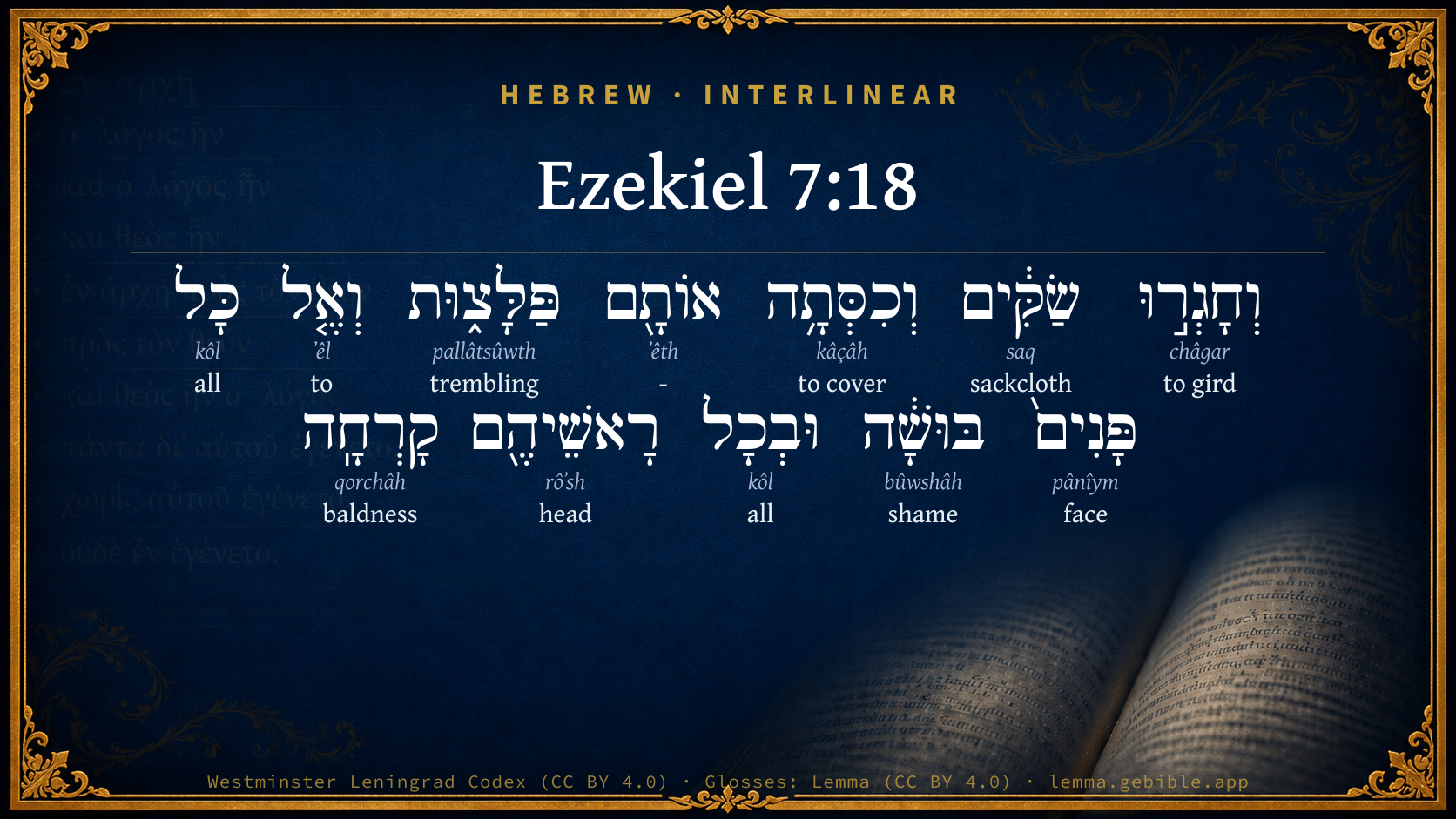
  1. וְחָגְר֣וּ châgar H2296 “and · to gird” Conjunction + Verb, Qal, Sequential Perfect, 3rd Person, Common, Plural
  2. שַׂקִּ֔ים saq H8242 “sacks” Noun, Common, Masculine, Plural, Absolute
  3. וְכִסְּתָ֥ה kâçâh H3680 “and · to cover” Conjunction + Verb, Piel, Perfect, 3rd Person, Feminine, Singular
  4. אוֹתָ֖ם ʼêth H853 “- · them” Particle, Direct Object + Suffix, Personal, 3rd Person, Masculine, Plural
  5. וְאֶ֤ל ʼêl H413 “and · to” Conjunction + Preposition
  6. כָּל kôl H3605 “all of” Noun, Common, Masculine, Singular, Construct
  7. פָּנִים֙ pânîym H6440 “face(s)” Noun, Common, Both, Plural, Absolute
  8. בּוּשָׁ֔ה bûwshâh H955 “shame” Noun, Common, Feminine, Singular, Absolute
  9. וּבְכָל kôl H3605 “and · in/at · all of” Conjunction + Preposition + Noun, Common, Masculine, Singular, Construct
  10. רָאשֵׁיהֶ֖ם rôʼsh H7218 “heads · their” Noun, Common, Masculine, Plural, Construct + Suffix, Personal, 3rd Person, Masculine, Plural
  11. קָרְחָֽה qorchâh H7144 “baldness” Noun, Common, Feminine, Singular, Absolute

About this verse

These counts appear in no published source. They are computed here, from the morphology-tagged text and Lemma’s own curated glosses. What Lemma adds →

12
words
11
distinct lemmas
Prophets
section

Notable vocabulary

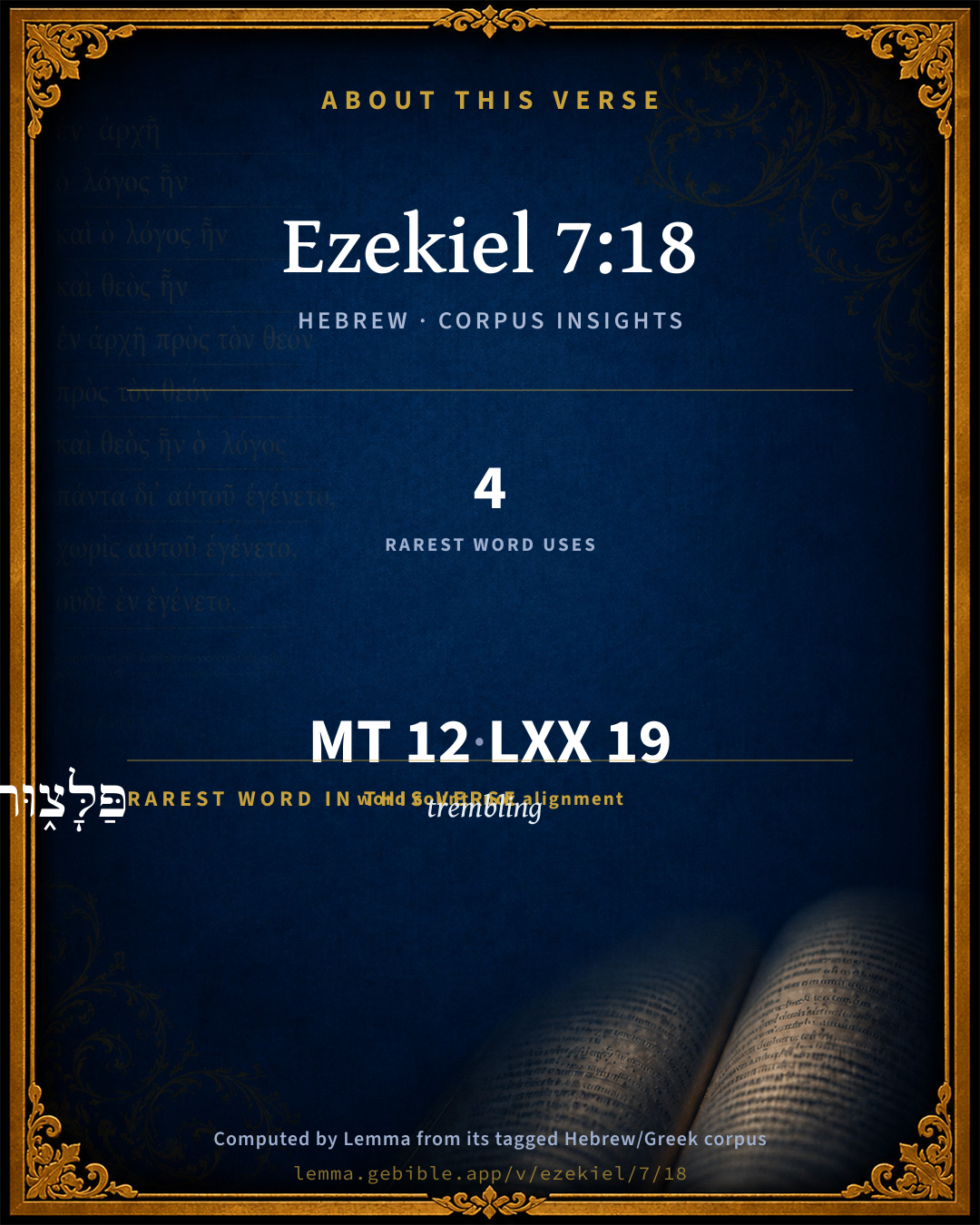
The rarest word here is פַּלָּצ֑וּת trembling H6427 — appearing just 4 times in the whole Hebrew Bible.

Shared distinctive vocabulary

פַּלָּצ֑וּת trembling H6427 occurs in 4 verses of the Hebrew Bible. Also found in:

Grammatical profile

  • 2 verbs
  • 8 nouns
  • 1 preposition
  • 1 particle

Verb forms

  • וְחָגְר֣וּ Qal · Sequential Perfect
  • וְכִסְּתָ֥ה Piel · Perfect

Repetition

A word recurs within this verse — often emphatic in Hebrew:

Hebrew & Septuagint length

In English translation the verse runs 25 words from the Hebrew and 27 from the Septuagint (LXX English) — closely comparable.

A rough comparison of the two English renderings, which tokenize alike — not a word-level alignment.

Word counts can differ between the Hebrew and the Greek without any difference in meaning — e.g. the Hebrew direct-object marker אֵת has no separate Greek word, and Greek often adds the article ὁ.

In the original languages it is 12 Hebrew tokens and 19 Greek tokens — but the two are counted differently (Hebrew bundles its prefixes and suffixes into one token; the Greek is in lemma form), so that isn’t a like-for-like length.

Cross-references

11

Topical passages linked to Ezekiel 7:18 in the Treasury of Scripture Knowledge — connected by theme and wording, ordered by reader-vote popularity; previews shown in the World English Bible.

  • Isaiah 15:2–3 They are gone up to Bayith, and to Dibon, to the high places, to weep: Moab wails over Nebo, and over Medeba; on all their heads is baldness, every beard is cut off.
  • Amos 8:10 I will turn your feasts into mourning, And all your songs into lamentation; And I will make you wear sackcloth on all your bodies, And baldness on every head. I will make it like the mourning for an only son, And the end of it like a bitter day.
  • Job 21:6 When I remember, I am troubled. Horror takes hold of my flesh.
  • Isaiah 3:24 It shall happen that instead of sweet spices, there shall be rottenness; Instead of a belt, a rope; Instead of well set hair, baldness; Instead of a robe, a girding of sackcloth; And branding instead of beauty.
  • Ezekiel 27:31 and they shall make themselves bald for you, and gird them with sackcloth, and they shall weep for you in bitterness of soul with bitter mourning.
  • Genesis 15:12 When the sun was going down, a deep sleep fell on Abram. Now terror and great darkness fell on him.
  • Psalms 35:26 Let them be disappointed and confounded together who rejoice at my calamity. Let them be clothed with shame and dishonor who magnify themselves against me.
  • Psalms 55:4–5 My heart is severely pained within me. The terrors of death have fallen on me.
  • Jeremiah 3:25 Let us lie down in our shame, and let our confusion cover us; for we have sinned against Yahweh our God, we and our fathers, from our youth even to this day; and we have not obeyed the voice of Yahweh our God.
  • Jeremiah 48:37 For every head is bald, and every beard clipped: on all the hands are cuttings, and on the loins sackcloth.
  • Revelation 6:15–17 The kings of the earth, the princes, the commanding officers, the rich, the strong, and every slave and free person, hid themselves in the caves and in the rocks of the mountains.

Cross-references courtesy of OpenBible.info (CC BY 4.0).

Hebrew and Greek witnesses Masoretic Hebrew ↔ Greek Septuagint

The same verse in the two great witnesses to the Old Testament, shown verse-for-verse.

These are two independent witnesses, not word-aligned to each other, and the Septuagint is shown in lemma (dictionary) form.

Hebrew Ezekiel 7:18 Masoretic · Westminster Leningrad Codex

וְחָגְר֣וּ שַׂקִּ֔ים וְכִסְּתָ֥ה אוֹתָ֖ם פַּלָּצ֑וּת וְאֶ֤ל כָּל פָּנִים֙ בּוּשָׁ֔ה וּבְכָל רָאשֵׁיהֶ֖ם קָרְחָֽה

They shall also gird themselves with sackcloth, and horror shall cover them; and shame shall be on all faces, and baldness on all their heads.

World English Bible · Public Domain

Greek LXX Ezekiel 7:18 Septuagint · lemma form

καί περιζωννύω σάκκος καί καλύπτω αὐτός θάμβος καί ἐπί πᾶς πρόσωπον αἰσχύνη ἐπί αὐτός καί ἐπί πᾶς κεφαλή φαλάκρωμα

And they shall gird themselves with sackcloth, and amazement shall cover them; and shame shall be upon them, even upon every face, and baldness upon every head.

LXX2012 (modern English Septuagint) · Public Domain

Hebrew: Westminster Leningrad Codex (CC BY 4.0). Greek: Septuagint (public domain); English from LXX2012 (modern English Septuagint) (Public Domain). How the Septuagint differs from the Hebrew →

Targum (Aramaic paraphrase)

1

The Targum is the ancient Jewish Aramaic paraphrase of the Hebrew Scriptures — an interpretive translation, not the Hebrew text itself. Onkelos (literal) and Pseudo-Jonathan (expansive) render the Torah, and Jonathan the Prophets. Coverage is partial: where no permissively-licensed English translation exists for a verse, only the Aramaic is shown. This is verse-level text, not a word-by-word alignment to the Hebrew.

  1. Targum Jonathan Prophets (Joshua–Malachi)
    וְיֵסְרוּן סַקִין וְתַחְפֵי יַתְהוֹן אִתְכְּנָעוּתָא וְעַל כָּל אַפֵּיהוֹן בַּהֲתָא וּבְכָל רֵישֵׁיהוֹן מְרַט:

    (no public-domain English translation for this verse)

    Targum Jonathan — Aramaic: “Mikraot Gedolot” (public domain). English: “Sefaria Community Translation” (CC0 1.0 (public-domain dedication)); “London "Chaldee Paraphrase," 1871” (public domain). Text via Sefaria.

Commentary

Notes on Ezekiel 7:18 from classic Christian and Jewish commentators (each source and its license shown beneath its notes). The classic Christian expositions comment on the surrounding passage and are grouped to its opening verse, so a note may address several verses; the Jewish commentaries on the Tanakh (Rashi and others) are per-verse, so they appear only where the commentator wrote on this verse.

Lemma curates 59 commentaries, every one of them public domain or Creative Commons licensed, each selected and text-cleaned for this edition rather than reprinted as found. About our sources →

Trapp's Complete Commentary

John Trapp

Eze 7:18 They shall also gird [themselves] with sackcloth, and horror shall cover them; and shame [shall be] upon all faces, and baldness upon all their heads.

Ver. 18. They shall also gird themselves with sackcloth.] They shall be a miserable mourning people for a long while.

Horror shall cover them.] Such heartquake as is in earthquakes - horripilatio.

Shame shall be upon all faces.] Pudor a rebus putidis, {a} - Ashamed they shall be of their doings, ashamed of their disappointments.

And baldness upon all their heads.] A sign of sorrow among the Jews. The Romans (contrariwise), in times of sorrow, suffered their hair to grow, saith Plutarch; so did Mephibosheth in David’s days.

{a} Scal.

John Trapp, A Commentary or Exposition upon All the Books of the Old and New Testament (1647–1656) — public domain. Text from a community e-Sword module.

Jamieson, Fausset & Brown

Robert Jamieson, A. R. Fausset & David Brown

cover them--as a garment.

baldness--a sign of mourning (Isa 3:24; Jer 48:37; Mic 1:16).

Jamieson, Fausset & Brown — Commentary Critical and Explanatory on the Whole Bible (1871) — public domain (CC PDM 1.0). Text via the HelloAO Bible API.

John Calvin's Commentaries

He continues the same sentiment. He says, such was the slaughter of the people that they should all gird themselves with sackcloth. But it seems little in accordance with this, that those who should be astonished should gird themselves with sackcloth, so as not to bewail the dead. But the prophets so vary their discourse because they cannot otherwise affect obstinate minds. Although therefore these things do not seem at first sight to agree, that they should bind themselves in sackcloth, and upon all their heads should be baldness: then that all should perish without grief or sorrow: yet these things suit well enough, because the Prophet does not express what they should do, but what the event should be. Since, therefore, slaughter shall occur on every side, at length God shall consume some by pestilence, others by famine: therefore he adds, there should be material for grief, although in consequence of the multitude of evils they should be lifeless, and torpid, and omit all signs of sorrow. Therefore they shall gird themselves with sackcloth We know that this was a remarkable symbol of penitence, but it is often transferred to common sorrow, and even profane men clothe themselves in sackcloth, although they do not acknowledge God the author of evils. Hence when the Prophet says, all should take sackcloth in which to clothe themselves, he does not mean that they should feel punishments divinely inflicted that they should repent; but he only expresses the common ceremony of grief in distress which is also common to the wicked and to despisers of God, Now he adds, fear shall cover them, and disgrace, or shame, shall be on all faces: then upon all heads shall be baldness This was forbidden by the law, (Deuteronomy 14:1;) since we know that God restrained too much intemperance in sorrow, when he forbids the people to fall upon their face, or to make themselves bald; for that was preposterous affectation. And we know that men are ambitious in grief. Hence that God may impose restraint upon sorrow, he forbids his people to cut the skin, or to produce baldness. Hence we see that the Prophet does not speak of the true sign of repentance, but only marks, as I have said, that God’s vengeance should be so horrible, that dread should cover them, and then that shame and confusion of face should come upon them: then, that they should cut the skin like the Gentiles, and put on sackcloth like men abandoned to destruction,

John Calvin's Commentaries (1540-1563) — public domain. Text from the Calvin Translation Society English edition (1840s-50s) via the Christian Classics Ethereal Library (ccel.org). Calvin's coverage is partial (roughly two-thirds of the Bible); uncommented books and verses are honest gaps, never fabricated. The 19th-century editor's footnotes and remarks are omitted so the notes are faithfully Calvin's own voice.

The Cambridge Bible for Schools and Colleges

gen. ed. J. J. S. Perowne

18. horror shall cover them] Or, trembling, terror, Job_21:6. It shall take such hold of them that it shall be all over them, like a garment covering them. Cf. Isa_59:17, he was clad with zeal as a cloke; Psa_55:6.

baldness] A sign of mourning: Isa_15:2, On all heads shall be baldness; Mic: Mic_1:16, Enlarge thy baldness like the vulture. This tonsure in token of mourning, common among many nations of antiquity, was confined among the Hebrews to shaving the front part of the head (Deu_14:1), and was forbidden by the Law in the case of priests (Lev_21:5, cf. Eze_44:20), and of the whole people (Deu_14:1), cf. Amo_8:10; Jer_16:6; Lev_19:27.

The Cambridge Bible for Schools and Colleges (gen. ed. J. J. S. Perowne; Cambridge University Press, 1878–1918) — public domain. Text from a community e-Sword module.

John Gill's Exposition

They shall cast their silver in the streets, and their gold shall be removed,.... As being of no use unto them to preserve them from famine and pestilence, and as being an hinderance to them in their flight from the enemy. Kimchi observes that this may be interpreted of their idols of gold and silver, which shall now be had in contempt by them, and cast away, when they shall find they cannot save them from ruin; see Isa 2:20;

their silver and their gold shall not be able to deliver them in the day of the wrath of the Lord; these can neither deliver from temporal judgments nor from wrath to come; see Pro 10:2; nor idols made of them:

they shall not satisfy their souls, nor fill their bowels; gold and silver cannot be eaten; these will not satisfy the craving appetite, nor fill the hungry belly: the words show that the famine would be so great, that bread could not be got for any money; and therefore gold and silver would be of no avail; since they could not be fed upon, or give any satisfaction to a famishing soul; nor could idols of gold and silver neither:

because it is the stumbling block of their iniquity; what was the occasion of their iniquity, covetousness, and idolatry, at which they stumbled, and fell into sin, and so into punishment for it.

John Gill's Exposition of the Whole Bible (1746–1763) — public domain (CC PDM 1.0). Text via the HelloAO Bible API.

Albert Barnes' Notes on the Bible

Various signs of mourning common in eastern countries. Baldness was forbidden to the Israelites Deu 14:1. They seem, however, in later times to have adopted the custom of foreign nations in this matter, not without permission. Compare Isa 22:12.

Albert Barnes' Notes on the Bible (1834–1885) — public domain. Text from a community e-Sword/MySword module.

Haydock's Catholic Bible Commentary

Heads. They cut their hair in times of penance and of mourning.

George Leo Haydock (1774–1849), Haydock's Catholic Family Bible and Commentary, 1859 edition — public domain. Excludes Psalms (Douay-Rheims chapter numbering differs from Protestant) and Deuterocanonical books (Catholic canon only).

Matthew Poole's English Annotations

It is a very general usage in the Eastern parts in deepest sorrows and distresses to put sackcloth on, and to gird it close to their bodies.

Horror; either dreadful apprehensions of growing evils, or continued shakings from impressions of what formerly they felt, according to Lev 26:16,36.

Cover them; be on every side, no side safety, or quiet, and confidence. Shame of disappointment, which breeds consternation; and shame of conscious guilt and unbecoming deportment, which fills the countenance as much with blushing as it fills the conscience with guilt and sin.

Baldness; either by pulling off the hair amidst their sorrows, or cutting off their hair in token of greatest mourning, Isa 15:2; Jer 7:29; 48:37; Amo 8:10.

Matthew Poole's English Annotations on the Holy Bible (1683–1685) — public domain. Text from a community e-Sword/MySword module.

Whedon's Commentary on the Bible

Daniel D. Whedon

18. In funeral garb, covered with “trembling,” with shamed faces and dishonored heads (Eze_44:20; Isa_15:2; Deu_14:1; Amo_8:10), the rich men flee from the city and seek to escape the universal doom. (See notes Eze_27:30-31.)

Daniel D. Whedon (gen. ed.), Commentary on the Old and New Testaments (1874–1909) — public domain. Text from a community e-Sword module.

The Pulpit Commentary

They shall also gird, etc. The words become more general, and include those who should remain in the city as well as the fugitives. For both there should be the inward feelings of horror and shame, and their outward symbols of sackcloth (Gen_37:34; 2Sa_3:31, 2Sa_3:32; 2Ki_6:30; Isa_15:3; Jer_4:8, et al. ) and baldness. (Isa_3:24 Isa_15:2 Isa_22:12; Amo_8:10)

The Pulpit Commentary (1880–1919), ed. H.D.M. Spence-Jones & Joseph S. Exell — public domain. Text from a community e-Sword module.

John Wesley's Explanatory Notes

Baldness - Either by pulling off the hair amidst their sorrows, or cutting it off in token of mourning.

John Wesley, Explanatory Notes Upon the Whole Bible (1754–1765) — public domain. Text via the GEBible commentary corpus.

Lesson kit

Teaching starters — assembled from the data on this page, not authored interpretation. Every prompt links to the verse data it draws on. Edit before teaching.

Ezekiel, in the Prophets, opens this verse with 12 words (11 distinct Hebrew lemmas). Its most distinctive word is pallâtsûwth (“trembling”). A historical commentator’s framing appears above. Read the whole chapter for the surrounding context.

Discussion questions

  1. What does “trembling” (pallâtsûwth) contribute to the verse as a whole?
  2. How does Job 21:6, which shares the word «trembling», read alongside this verse?
  3. What does the repetition of “all” (2× in this one verse) do in this verse?
  4. These translations render this verse differently; the difference is in the English rendering, not the original. What questions does that raise?
  5. «וְחָגְר֣וּ» is a Qal Sequential Perfect verb. How does that grammatical form shape the action described?
  6. Compare how Trapp's Complete Commentary and Jamieson, Fausset & Brown read this verse. Where do they agree or differ?

Things to notice

Reading settings

Reading text

Shown beneath each verse's original-language words.

Old Testament
Old Testament edition

Read the OT as the Masoretic Hebrew (MT) or the Greek Septuagint (LXX).

English shown for the Greek Septuagint (in the Hebrew ↔ Greek comparison).

Comparing translations? Open the Compare panel on any verse page to stack up to four side by side.