
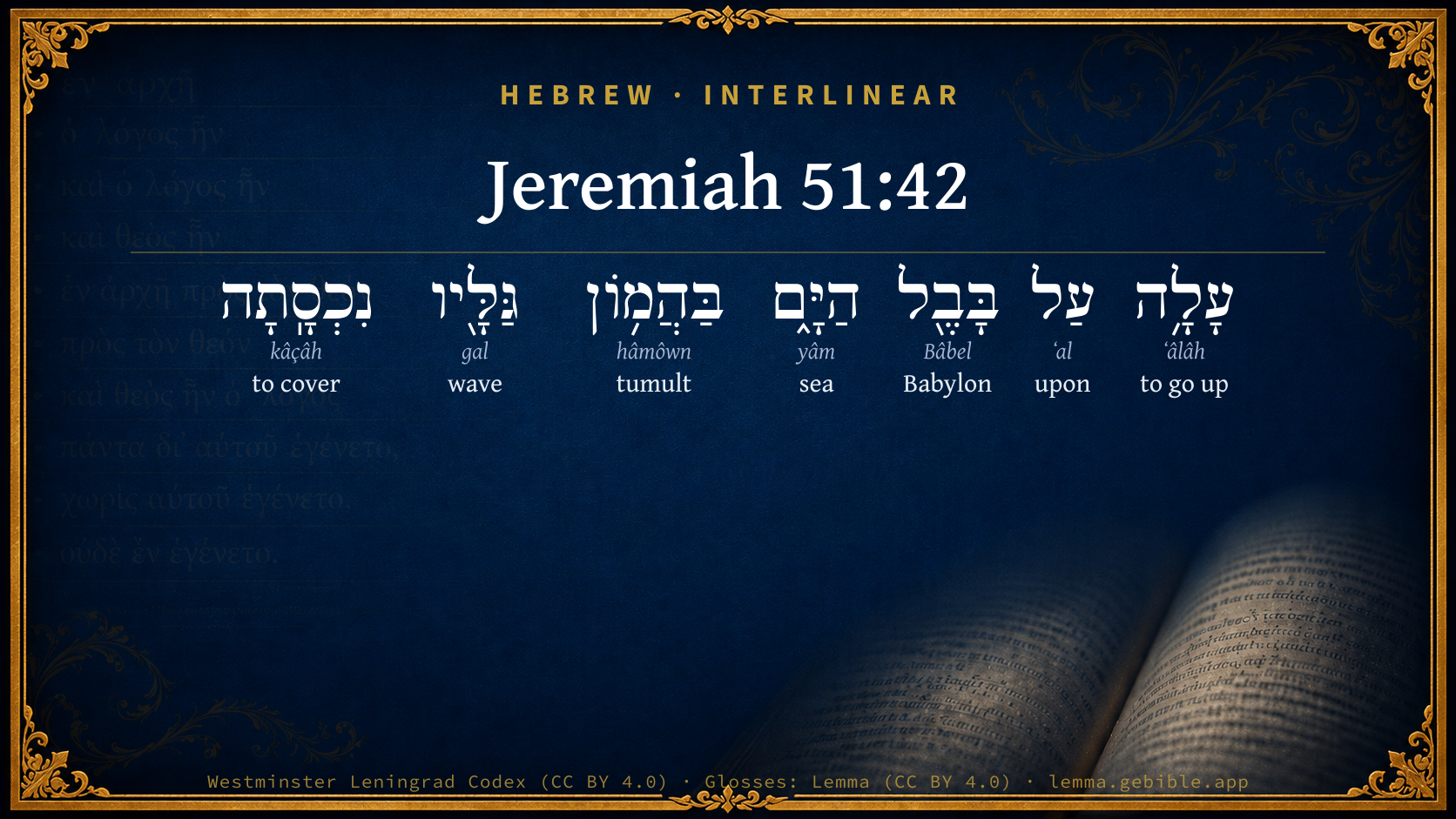
Jeremiah 51:42

Hebrew (Westminster Leningrad Codex) Jeremiah 51:42 appears in the Hebrew Old Testament. The text above is from the Westminster Leningrad Codex. Each word links to its Strong’s number, a concise gloss, and parsing drawn from the Open Scriptures Hebrew Bible morphology. Click any word for its full Brown-Driver-Briggs (BDB) entry.
Download image
Cite this verse

Jeremiah 51:42 (World English Bible). Public Domain. Lemma interlinear Bible study tool, https://lemma.gebible.app/v/jeremiah/51/42.

Show BibTeX & RIS
BibTeX
RIS
English Translation
The sea is come up on Babylon; she is covered with the multitude of the waves of it.
World English Bible · Public Domain
Download a study sheet

One document with this verse’s original text, its word-by-word gloss line, the meaning frame, cross-references with their text, attributed commentary, and full source and license credits — printable, and it pastes into notes with its structure intact.

This verse Autodidact and up

Study sheet (.html) Plain text (.txt)

A passage Seminary Student

Up to 50 verses in one chapter. A passage sheet keeps up to 6 commentary sources and 12 cross-references per verse, in the order this page ranks them, and says so on the sheet whenever that leaves anything out. Ask for a single verse and you get the Autodidact verse sheet above.

Everything on this page stays free to read, with no account — the sheet is a download of what is already on screen, not access to it.

Want to remove ads? Support Godless Engineer
Compare translations 3

The same verse in 3 English versions, stacked beneath the original-language interlinear above. Click any original word for its lexicon entry.

Each is an independent rendering of the whole verse — the interlinear is not word-aligned to these translations.

Highlighted words mark where these versions differ — a whole-verse word diff, not a word-by-word alignment.

  • World English Bible Public Domain
    The sea is come up on Babylon; she is covered with the multitude of the waves of it.
  • King James Version Public Domain
    The sea is come up upon Babylon: she is covered with the multitude of the waves thereof.
  • unfoldingWord Literal Text CC BY-SA 4.0
    The sea has come up over Babylon! She is covered with its roaring waves.

unfoldingWord Literal Text — © unfoldingWord, licensed CC BY-SA 4.0. Word-aligned USFM3 via Door43 (git.door43.org/unfoldingWord/en_ult).

Versions to compare (up to 4)

3 of 4 selected

Show all 18 translations

Every available English version of this verse, each an independent rendering of the whole verse.

  • World English Bible Public Domain
    The sea is come up on Babylon; she is covered with the multitude of the waves of it.
  • Berean Standard Bible Public Domain
    The sea has come up over Babylon; she is covered in turbulent waves.
  • Majority Standard Bible Public Domain
    The sea has come up over Babylon; she is covered in turbulent waves.
  • King James Version Public Domain
    The sea is come up upon Babylon: she is covered with the multitude of the waves thereof.
  • American Standard Version (1901) Public Domain
    The sea is come up upon Babylon; she is covered with the multitude of the waves thereof.
  • Revised Version (1885) Public Domain
    The sea is come up upon Babylon: she is covered with the multitude of the waves thereof.
  • Geneva Bible (1599) Public Domain
    The sea is come vp vpon Babel: he is couered with the multitude of the waues thereof.
  • Douay-Rheims (1899) Public Domain
    The sea is come up over Babylon: she is covered with the multitude of the waves thereof.
  • Young's Literal Translation Public Domain
    Come up against Babylon hath the sea, With a multitude of its billows it hath been covered.
  • Literal Standard Version CC BY-SA 4.0
    The sea has come up over Babylon, || She has been covered with a multitude of its billows.
  • Unlocked Literal Bible CC BY-SA 4.0
    The sea has come up over Babylon! She is covered with its roaring waves.
  • unfoldingWord Literal Text CC BY-SA 4.0
    The sea has come up over Babylon! She is covered with its roaring waves.
  • Darby Bible Public Domain
    The sea is come up upon Babylon: she is covered with the multitude of its waves.
  • World Messianic Bible Public Domain
    The sea has come up on Babylon. She is covered with the multitude of its waves.
  • Webster's Bible Public Domain
    The sea is come up upon Babylon: she is covered with the multitude of its waves.
  • Free Bible Version CC BY-SA 4.0
    It's as if the sea has flooded over Babylon, covering her in crashing waves.
  • Bible in Basic English Public Domain
    The sea has come up over Babylon; she is covered with the mass of its waves.
  • JPS Tanakh (1917) Public Domain
    The sea is come up upon Babylon; she is covered with the multitude of the waves thereof.

Literal Standard Version (2020), Covenant Press — licensed CC BY-SA 4.0. Text via the HelloAO Bible API (eBible.org). Unlocked Literal Bible (unfoldingWord) — licensed CC BY-SA 4.0. Text via the HelloAO Bible API (eBible.org). unfoldingWord Literal Text — © unfoldingWord, licensed CC BY-SA 4.0. Word-aligned USFM3 via Door43 (git.door43.org/unfoldingWord/en_ult). Free Bible Version, Dr. Jonathan Gallagher — licensed CC BY-SA 4.0. Text via the HelloAO Bible API (eBible.org).

Word by word

More ways to search: Search by grammar → Find every occurrence → Compare this word →

Practice this passage: Drill this verse → Learn its vocabulary →

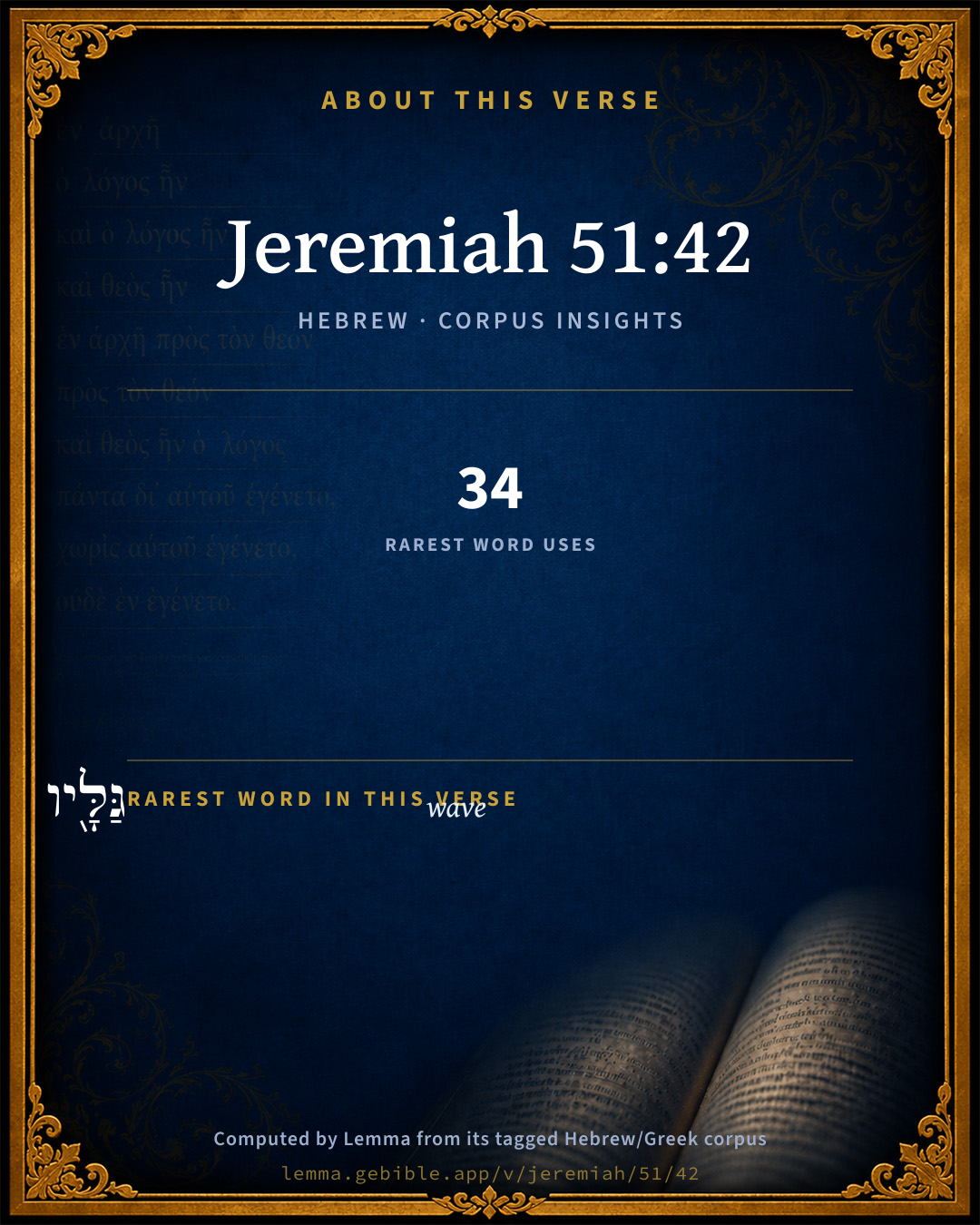
About this verse

These counts appear in no published source. They are computed here, from the morphology-tagged text and Lemma’s own curated glosses. What Lemma adds →

7
words
7
distinct lemmas
Prophets
section

Shared distinctive vocabulary

גַּלָּ֖יו wave H1530 occurs in 31 verses of the Hebrew Bible. Also found in:

Grammatical profile

  • 2 verbs
  • 4 nouns
  • 1 preposition

Verb forms

  • עָלָ֥ה Qal · Perfect
  • נִכְסָֽתָה Niphal · Perfect

Cross-references

11

Topical passages linked to Jeremiah 51:42 in the Treasury of Scripture Knowledge — connected by theme and wording, ordered by reader-vote popularity; previews shown in the World English Bible.

  • Isaiah 8:7–8 now therefore, behold, the Lord brings up on them the waters of the River, strong and many, [even] the king of Assyria and all his glory: and it shall come up over all its channels, and go over all its banks;
  • Daniel 9:26 After the sixty-two weeks the Anointed One shall be cut off, and shall have nothing: and the people of the prince who shall come shall destroy the city and the sanctuary; and the end of it shall be with a flood, and even to the end shall be war; desolations are determined.
  • Psalms 18:4 The cords of death surrounded me. The floods of ungodliness made me afraid.
  • Psalms 18:16 He sent from on high. He took me. He drew me out of many waters.
  • Psalms 42:7 Deep calls to deep at the noise of your waterfalls. All your waves and your billows have swept over me.
  • Psalms 65:7 Who stills the roaring of the seas, The roaring of their waves, And the turmoil of the nations.
  • Psalms 93:3 The floods have lifted up, Yahweh, The floods have lifted up their voice. The floods lift up their waves.
  • Jeremiah 51:55 For Yahweh lays Babylon waste, and destroys out of her the great voice; and their waves roar like many waters; the noise of their voice is uttered:
  • Ezekiel 27:26–34 Your rowers have brought you into great waters: the east wind has broken you in the heart of the seas.
  • Luke 21:25 There will be signs in the sun, moon, and stars; and on the earth anxiety of nations, in perplexity for the roaring of the sea and the waves;
  • Revelation 17:15–16 He said to me, "The waters which you saw, where the prostitute sits, are peoples, multitudes, nations, and languages.

Cross-references courtesy of OpenBible.info (CC BY 4.0).

Hebrew and Greek witnesses Masoretic Hebrew ↔ Greek Septuagint

The same verse in the two great witnesses to the Old Testament, shown verse-for-verse.

These are two independent witnesses, not word-aligned to each other, and the Septuagint is shown in lemma (dictionary) form.

Hebrew Jeremiah 51:42 Masoretic · Westminster Leningrad Codex

עָלָ֥ה עַל בָּבֶ֖ל הַיָּ֑ם בַּהֲמ֥וֹן גַּלָּ֖יו נִכְסָֽתָה

The sea is come up on Babylon; she is covered with the multitude of the waves of it.

World English Bible · Public Domain

Greek LXX Structure differs

In the Septuagint, Jeremiah is about an eighth shorter than the Hebrew and arranges its material differently — the Oracles Against the Nations (Hebrew chapters 46–51) appear in the middle of the Greek book, after 25:13. Because the chapter and verse boundaries do not line up, a verse-for-verse comparison with the Hebrew is not shown.

A verse-for-verse comparison isn’t shown here because the chapters and verses don’t line up. Switch to the LXX edition with the MT / LXX toggle above to read the Greek directly.

Hebrew: Westminster Leningrad Codex (CC BY 4.0). Greek: Septuagint (public domain); English from a public-domain English Septuagint. How the Septuagint differs from the Hebrew →

Targum (Aramaic paraphrase)

1

The Targum is the ancient Jewish Aramaic paraphrase of the Hebrew Scriptures — an interpretive translation, not the Hebrew text itself. Onkelos (literal) and Pseudo-Jonathan (expansive) render the Torah, and Jonathan the Prophets. Coverage is partial: where no permissively-licensed English translation exists for a verse, only the Aramaic is shown. This is verse-level text, not a word-by-word alignment to the Hebrew.

  1. Targum Jonathan Prophets (Joshua–Malachi)
    סְלִיק עַל בָּבֶל מְלַךְ בְּמַשִׁרְיָתֵיהּ דְסַגִי כְּמֵי יַמָא בְּאִתְרְגוּשַׁת גַלוֹהִי חֲפָא:

    (no public-domain English translation for this verse)

    Targum Jonathan — Aramaic: “Mikraot Gedolot” (public domain). English: “Sefaria Community Translation” (CC0 1.0 (public-domain dedication)); “London "Chaldee Paraphrase," 1871” (public domain). Text via Sefaria.

Commentary

Notes on Jeremiah 51:42 from classic Christian and Jewish commentators (each source and its license shown beneath its notes). The classic Christian expositions comment on the surrounding passage and are grouped to its opening verse, so a note may address several verses; the Jewish commentaries on the Tanakh (Rashi and others) are per-verse, so they appear only where the commentator wrote on this verse.

Lemma curates 59 commentaries, every one of them public domain or Creative Commons licensed, each selected and text-cleaned for this edition rather than reprinted as found. About our sources →

Trapp's Complete Commentary

John Trapp

Jer 51:42 The sea is come up upon Babylon: she is covered with the multitude of the waves thereof.

Ver. 42. The sea is come up upon Babylon.] A sea of hostile forces; what wonder, therefore, though she be taken?

John Trapp, A Commentary or Exposition upon All the Books of the Old and New Testament (1647–1656) — public domain. Text from a community e-Sword module.

Tyndale Open Study Notes

Tyndale Open Resources

51:42 The sea represents the armies that overwhelmed Babylon. The crashing waves symbolize the assault against the city.

Tyndale Open Study Notes — © Tyndale Open Resources, licensed CC BY-SA 4.0. Text via the HelloAO Bible API.

Geneva Bible (1599)

Geneva Bible translators

The great army of the Medes and Persians.

Geneva Bible (1599) marginal notes — public domain. Text via Bolls.life.

Jamieson, Fausset & Brown

Robert Jamieson, A. R. Fausset & David Brown

The sea--the host of Median invaders. The image (compare Jer 47:2; Isa 8:7-8) is appropriately taken from the Euphrates, which, overflowing in spring, is like a "sea" near Babylon (Jer 51:13, Jer 51:32, Jer 51:36).

Jamieson, Fausset & Brown — Commentary Critical and Explanatory on the Whole Bible (1871) — public domain (CC PDM 1.0). Text via the HelloAO Bible API.

Adam Clarke's Commentary

Verse 42. The sea is come up] A multitude of foes have inundated the city.

Adam Clarke's Commentary on the Bible (1810–1826) — public domain. Text from a community e-Sword/MySword module.

John Calvin's Commentaries

THE Prophet here employs a comparison, in order more fully to confirm his prophecy respecting the destruction of Babylon; for, as it was incredible that it could be subdued by the power or forces of men, he compares the calamity by which God would overwhelm it to a deluge. He then says that the army of the Persians and of the Medes would be like the sea, for it would irresistibly overflow; as when a storm rises, the sea swells, so he says the Medes and the Persians would come with such force, that Babylon would be overwhelmed with a deluge rather than with the forces of men. We now then understand the Prophet’s meaning, when he says that Babylon would be covered with waves when the Medes and the Persians came It then follows, —

John Calvin's Commentaries (1540-1563) — public domain. Text from the Calvin Translation Society English edition (1840s-50s) via the Christian Classics Ethereal Library (ccel.org). Calvin's coverage is partial (roughly two-thirds of the Bible); uncommented books and verses are honest gaps, never fabricated. The 19th-century editor's footnotes and remarks are omitted so the notes are faithfully Calvin's own voice.

Ellicott's Commentary for English Readers

(42) The sea is come up upon Babylon . . .—The literal explanation of the words as referring to the foundation of the Euphrates adopted by some commentators is clearly inadmissible, and is at variance with the next verse. The prophet falls back on an image which he had used before (Jer_46:7), and which had become familiar through Isaiah (Isa_8:7-8; Isa_17:12), and speaks of Babylon as covered with the great sea of nations that were sweeping over her.

A Bible Commentary for English Readers, edited by Charles John Ellicott (1878–1897) — public domain. Text from a community e-Sword module.

The Cambridge Bible for Schools and Colleges

gen. ed. J. J. S. Perowne

42. The sea is come up] the hostile army arriving in overwhelming force. Cp. Jer_46:7-8, Jer_47:2; Isa_17:12.

The Cambridge Bible for Schools and Colleges (gen. ed. J. J. S. Perowne; Cambridge University Press, 1878–1918) — public domain. Text from a community e-Sword module.

John Gill's Exposition

And I will punish Bel in Babylon,.... The idol of the Babylonians, who had a temple in Babylon, where he was worshipped: the same is called Belus by Aelianus (g), Curtius (h), and Pausanias (i); perhaps the same Herodian (k) calls Belis, and says some take him to be Apollo; for more of him; see Gill on Isa 46:1; and See Gill on Jer 50:2; who was punished when his temple was demolished, and plundered of its wealth; this golden image of Belus was broke to pieces, and the gold of it carried away. The Targum is,

"I will visit or punish them that worship Bel in Babylon:''

and I will bring forth out of his mouth that which he hath swallowed up; the rich offerings made to him when victories were obtained; all success being ascribed to him; and the spoils of conquered enemies, which were brought and laid up in his temple, particularly the vessels of the sanctuary at Jerusalem, which were deposited there; see Ch2 36:7; and which were restored by Cyrus, Ezr 1:7; which restoration of them greatly fulfilled this prophecy; and was a refunding of what was lodged with him, or a vomiting what he had swallowed up; compare with this the story of "Bel and the dragon":

and the nations shall not flow together any more unto him; either to worship him, or bring their presents to him, to ingratiate themselves with the king of Babylon:

yea, the wall of Babylon shall fall; which Bel was not able to defend; and therefore should be deserted by his worshippers. The Targum renders it in the plural, the walls of Babylon; of which; see Gill on Jer 51:58. Some think that not the wall of the city is here meant: but the temple of Bel, which was as a wall or fortress to the city; but now should fall, and be so no more; since it is not easy to give a reason why mention here should be made of the fall of the walls of the city; and seeing express mention is made of this afterwards.

(g) Var. Hist. l. 13. c. 3. (h) Hist. l. 5. c. 1. (i) L. 1. sive Attica, p. 29. (k) Hist. l. 8. c. 7.

John Gill's Exposition of the Whole Bible (1746–1763) — public domain (CC PDM 1.0). Text via the HelloAO Bible API.

Albert Barnes' Notes on the Bible

By a grand metaphor the invading army is compared to the sea.

Albert Barnes' Notes on the Bible (1834–1885) — public domain. Text from a community e-Sword/MySword module.

Haydock's Catholic Bible Commentary

Sea: numerous armies of Cyrus, or the waters of the Euphrates let loose. (Calmet) --- In the days of Alexander [the Great], many tombs of the kings were inundated. (Strabo xv.)

George Leo Haydock (1774–1849), Haydock's Catholic Family Bible and Commentary, 1859 edition — public domain. Excludes Psalms (Douay-Rheims chapter numbering differs from Protestant) and Deuterocanonical books (Catholic canon only).

Matthew Poole's English Annotations

A multitude of enemies, that are like the sea in which there is a multitude of waters, or that will overrun them as the sea overfloweth the shore, or any land into which it once breaketh.

Matthew Poole's English Annotations on the Holy Bible (1683–1685) — public domain. Text from a community e-Sword/MySword module.

The Pulpit Commentary

The sea is come up, etc. It is not clear whether this is to be taken literally or metaphorically (of the sea of nations, comp. ver. 55). Probably it is meant literally. It is said that the annual inundations of the Euphrates at present render many parts of the ruins of Babylon inaccessible.

The Pulpit Commentary (1880–1919), ed. H.D.M. Spence-Jones & Joseph S. Exell — public domain. Text from a community e-Sword module.

John Wesley's Explanatory Notes

The sea - A multitude of enemies.

John Wesley, Explanatory Notes Upon the Whole Bible (1754–1765) — public domain. Text via the GEBible commentary corpus.

Keil & Delitzsch

C. F. Keil & F. Delitzsch

Description of the fall. The sea that has come over Babylon and covered it with its waves, was taken figuratively, even by the Chaldee paraphrasts, and understood as meaning the hostile army that overwhelms the land with its hosts. Only J. D. Michaelis was inclined to take the words in their proper meaning, and understood them as referring to the inundation of Babylon by the Euphrates in August and in winter. But however true it may be, that, in consequence of the destruction or decay of the great river-walls built by Nebuchadnezzar, the Euphrates may inundate the city of Babylon when it wells into a flood, yet the literal acceptation of the words is unwarranted, for the simple reason that they do not speak of any momentary or temporary inundation, and that, because Babylon is to be covered with water, the cities of Babylonia are to become an arid steppe. The sea is therefore the sea of nations, cf. Jer 46:7; the description reminds us of the destruction of Pharaoh and his host in the Red Sea. On Jer 51:43, cf. Jer 48:9; Jer 49:18, Jer 49:33., Jer 50:12. The suffix in בּהן refers to "her cities;" but the repetition of ארץ is not for that reason wrong, as Graf thinks, but is to be explained on the ground that the cities of Babylonia are compared to a barren land; and the idea is properly this: The cities become an arid country of steppes, a land in whose cities nobody can dwell.

Keil & Delitzsch — Biblical Commentary on the Old Testament (1861–1891) — public domain (CC PDM 1.0). Text via the HelloAO Bible API. (Old Testament only.)

Rashi

Rabbi Shlomo Yitzchaki (Rashi)

The sea has ascended upon Babylon A huge army, like the waters of [the sea].

Rashi on the Tanakh — English translations: “The Judaica Press complete Tanach with Rashi, translated by A. J. Rosenberg” (CC BY 4.0); “Pentateuch with Rashi's commentary by M. Rosenbaum and A.M. Silbermann, 1929-1934” (public domain); “The Metsudah Tanach series, Lakewood, N.J” (CC BY 4.0); and “The Book of Joshua, Metsudah Publications, 1997” (CC BY 4.0). Text via Sefaria.

Lesson kit

Teaching starters — assembled from the data on this page, not authored interpretation. Every prompt links to the verse data it draws on. Edit before teaching.

Jeremiah, in the Prophets, opens this verse with 7 words (7 distinct Hebrew lemmas). Its most distinctive word is gal (“wave”). A historical commentator’s framing appears above. Read the whole chapter for the surrounding context.

Discussion questions

  1. How does “wave” (gal) shape what this verse is saying?
  2. How does Genesis 31:46, which shares the word «wave», read alongside this verse?
  3. The translations on this page render this verse differently — a whole-verse word diff, not a word-by-word alignment. What might account for the different wordings?
  4. «עָלָ֥ה» is a Qal Perfect verb. How does that grammatical form shape the action described?
  5. Compare how Trapp's Complete Commentary and Tyndale Open Study Notes read this verse. Where do they agree or differ?

Things to notice

Reading settings

Reading text

Shown beneath each verse's original-language words.

Old Testament
Old Testament edition

Read the OT as the Masoretic Hebrew (MT) or the Greek Septuagint (LXX).

English shown for the Greek Septuagint (in the Hebrew ↔ Greek comparison).

Comparing translations? Open the Compare panel on any verse page to stack up to four side by side.