
Job 22:11

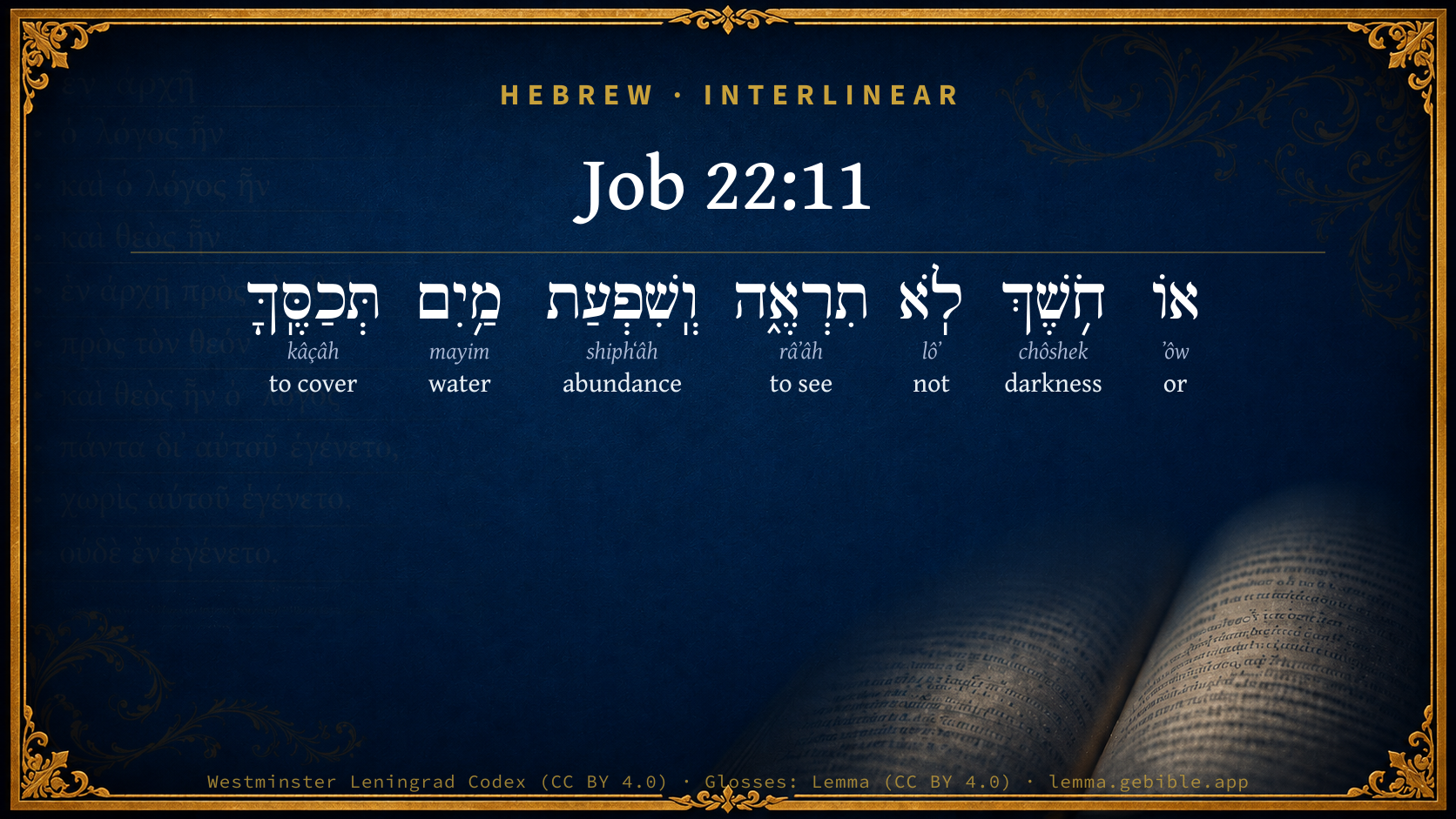
Hebrew (Westminster Leningrad Codex) Job 22:11 appears in the Hebrew Old Testament. The text above is from the Westminster Leningrad Codex. Each word links to its Strong’s number, a concise gloss, and parsing drawn from the Open Scriptures Hebrew Bible morphology. Click any word for its full Brown-Driver-Briggs (BDB) entry.
Download image
Cite this verse

Job 22:11 (World English Bible). Public Domain. Lemma interlinear Bible study tool, https://lemma.gebible.app/v/job/22/11.

Show BibTeX & RIS
BibTeX
RIS
English Translation
Or darkness, so that you can not see, And floods of waters cover you.
World English Bible · Public Domain
Download a study sheet

One document with this verse’s original text, its word-by-word gloss line, the meaning frame, cross-references with their text, attributed commentary, and full source and license credits — printable, and it pastes into notes with its structure intact.

This verse Autodidact and up

Study sheet (.html) Plain text (.txt)

A passage Seminary Student

Up to 50 verses in one chapter. A passage sheet keeps up to 6 commentary sources and 12 cross-references per verse, in the order this page ranks them, and says so on the sheet whenever that leaves anything out. Ask for a single verse and you get the Autodidact verse sheet above.

Everything on this page stays free to read, with no account — the sheet is a download of what is already on screen, not access to it.

Want to remove ads? Support Godless Engineer
Compare translations 3

The same verse in 3 English versions, stacked beneath the original-language interlinear above. Click any original word for its lexicon entry.

Each is an independent rendering of the whole verse — the interlinear is not word-aligned to these translations.

Highlighted words mark where these versions differ — a whole-verse word diff, not a word-by-word alignment.

  • World English Bible Public Domain
    Or darkness, so that you can not see, And floods of waters cover you.
  • King James Version Public Domain
    Or darkness, that thou canst not see; and abundance of waters cover thee.
  • unfoldingWord Literal Text CC BY-SA 4.0
    Or darkness—you cannot see! And an abundance of waters covers you.

unfoldingWord Literal Text — © unfoldingWord, licensed CC BY-SA 4.0. Word-aligned USFM3 via Door43 (git.door43.org/unfoldingWord/en_ult).

Versions to compare (up to 4)

3 of 4 selected

Show all 18 translations

Every available English version of this verse, each an independent rendering of the whole verse.

  • World English Bible Public Domain
    Or darkness, so that you can not see, And floods of waters cover you.
  • Berean Standard Bible Public Domain
    it is so dark you cannot see, and a flood of water covers you.
  • Majority Standard Bible Public Domain
    it is so dark you cannot see, and a flood of water covers you.
  • King James Version Public Domain
    Or darkness, that thou canst not see; and abundance of waters cover thee.
  • American Standard Version (1901) Public Domain
    Or darkness, so that thou canst not see, And abundance of waters cover thee.
  • Revised Version (1885) Public Domain
    Or darkness, that thou canst not see, and abundance of waters cover thee.
  • Geneva Bible (1599) Public Domain
    Or darkenes that thou shouldest not see, and abundance of waters shall couer thee.
  • Douay-Rheims (1899) Public Domain
    And didst thou think that thou shouldst not see darkness, and that thou shouldst not be covered with the violence of overflowing waters?
  • Young's Literal Translation Public Domain
    Or darkness -- thou dost not see, And abundance of waters doth cover thee.
  • Literal Standard Version CC BY-SA 4.0
    Or darkness—you do not see, || And abundance of waters covers you.
  • Unlocked Literal Bible CC BY-SA 4.0
    There is darkness, so that you cannot see; an abundance of waters covers you.
  • unfoldingWord Literal Text CC BY-SA 4.0
    Or darkness—you cannot see! And an abundance of waters covers you.
  • Darby Bible Public Domain
    Or darkness, that thou canst not see, and floods of waters cover thee.
  • World Messianic Bible Public Domain
    or darkness, so that you can not see, and floods of waters cover you.
  • Webster's Bible Public Domain
    Or darkness, that thou canst not see; and abundance of waters cover thee.
  • Free Bible Version CC BY-SA 4.0
    That's why it's so dark you cannot see, and why you feel like you're drowning.
  • Bible in Basic English Public Domain
    Your light is made dark so that you are unable to see, and you are covered by a mass of waters.
  • JPS Tanakh (1917) Public Domain
    Or darkness, that thou canst not see, and abundance of waters cover thee.

Literal Standard Version (2020), Covenant Press — licensed CC BY-SA 4.0. Text via the HelloAO Bible API (eBible.org). Unlocked Literal Bible (unfoldingWord) — licensed CC BY-SA 4.0. Text via the HelloAO Bible API (eBible.org). unfoldingWord Literal Text — © unfoldingWord, licensed CC BY-SA 4.0. Word-aligned USFM3 via Door43 (git.door43.org/unfoldingWord/en_ult). Free Bible Version, Dr. Jonathan Gallagher — licensed CC BY-SA 4.0. Text via the HelloAO Bible API (eBible.org).

Word by word

More ways to search: Search by grammar → Find every occurrence → Compare this word →

Practice this passage: Drill this verse → Learn its vocabulary →

About this verse

These counts appear in no published source. They are computed here, from the morphology-tagged text and Lemma’s own curated glosses. What Lemma adds →

7
words
7
distinct lemmas
Wisdom
section

Notable vocabulary

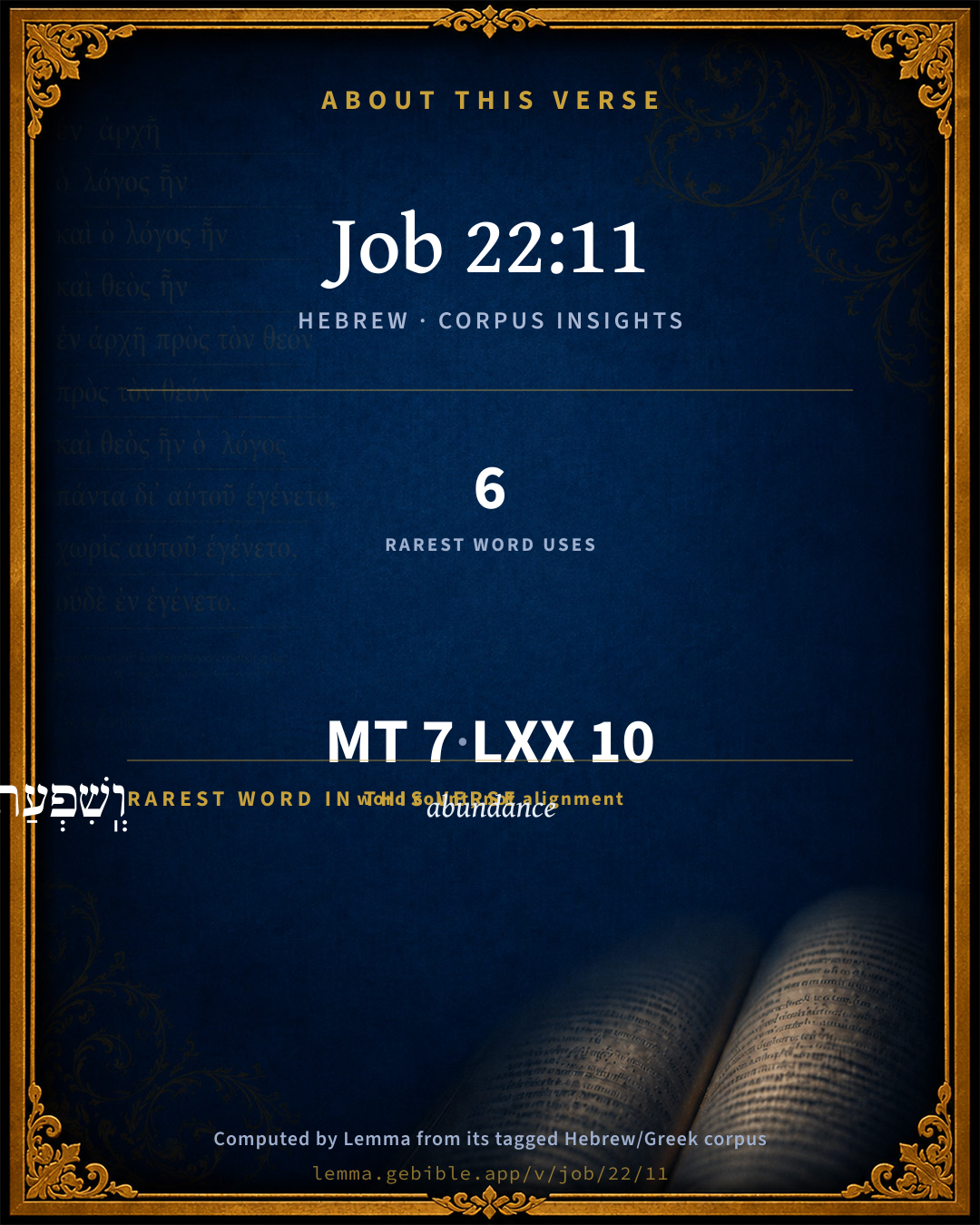
The rarest word here is וְֽשִׁפְעַת abundance H8229 — appearing just 6 times in the whole Hebrew Bible.

Shared distinctive vocabulary

וְֽשִׁפְעַת abundance H8229 occurs in 5 verses of the Hebrew Bible. Also found in:

Grammatical profile

  • 2 verbs
  • 3 nouns
  • 1 conjunction
  • 1 particle

Verb forms

  • תִרְאֶ֑ה Qal · Imperfect
  • תְּכַסֶּֽךָּ Piel · Imperfect

Hebrew & Septuagint length

In English translation the verse runs 14 words from the Hebrew and 16 from the Septuagint (LXX English) — closely comparable.

A rough comparison of the two English renderings, which tokenize alike — not a word-level alignment.

Word counts can differ between the Hebrew and the Greek without any difference in meaning — e.g. the Hebrew direct-object marker אֵת has no separate Greek word, and Greek often adds the article ὁ.

In the original languages it is 7 Hebrew tokens and 10 Greek tokens — but the two are counted differently (Hebrew bundles its prefixes and suffixes into one token; the Greek is in lemma form), so that isn’t a like-for-like length.

Cross-references

15

Topical passages linked to Job 22:11 in the Treasury of Scripture Knowledge — connected by theme and wording, ordered by reader-vote popularity; previews shown in the World English Bible.

  • Psalms 69:1–2 Save me, God, For the waters have come up to my neck!
  • Lamentations 3:54 Waters flowed over my head; I said, I am cut off.
  • Jonah 2:3 For you threw me into the depths, In the heart of the seas. The flood was all around me. All your waves and your billows passed over me.
  • Job 19:8 He has walled up my way so that I can't pass, And has set darkness in my paths.
  • Psalms 124:4–5 Then the waters would have overwhelmed us, The stream would have gone over our soul;
  • Job 5:14 They meet with darkness in the day-time, And grope at noonday as in the night.
  • Job 18:6 The light shall be dark in his tent, His lamp above him shall be put out.
  • Job 18:18 He shall be driven from light into darkness, And chased out of the world.
  • Job 38:34 "Can you lift up your voice to the clouds, That abundance of waters may cover you?
  • Psalms 42:7 Deep calls to deep at the noise of your waterfalls. All your waves and your billows have swept over me.
  • Proverbs 4:19 The way of the wicked is like darkness. They don't know what they stumble over.
  • Isaiah 8:22 and they shall look to the earth, and see, distress and darkness, the gloom of anguish; and into thick darkness [they shall be] driven away.
  • Lamentations 3:2 He has led me and caused me to walk in darkness, and not in light.
  • Joel 2:2–3 A day of darkness and gloominess, A day of clouds and thick darkness. As the dawn spreading on the mountains, A great and strong people; There has never been the like, Neither will there be any more after them, Even to the years of many generations.
  • Matthew 8:12 but the children of the Kingdom will be thrown out into the outer darkness. There will be weeping and the gnashing of teeth."

Cross-references courtesy of OpenBible.info (CC BY 4.0).

Hebrew and Greek witnesses Masoretic Hebrew ↔ Greek Septuagint

The same verse in the two great witnesses to the Old Testament, shown verse-for-verse.

These are two independent witnesses, not word-aligned to each other, and the Septuagint is shown in lemma (dictionary) form.

Hebrew Job 22:11 Masoretic · Westminster Leningrad Codex

אוֹ חֹ֥שֶׁךְ לֹֽא תִרְאֶ֑ה וְֽשִׁפְעַת מַ֥יִם תְּכַסֶּֽךָּ

Or darkness, so that you can not see, And floods of waters cover you.

World English Bible · Public Domain

Greek LXX Job 22:11 Septuagint · lemma form

ὁ φῶς σύ σκότος ἀποβαίνω κοιμάω δέ ὕδωρ σύ καλύπτω

The light has proved darkness to you, and water has covered you on your lying down.

LXX2012 (modern English Septuagint) · Public Domain

On this verse, Adam Clarke's Commentary discusses the Septuagint’s reading. Read the note in Commentary ↓

Hebrew: Westminster Leningrad Codex (CC BY 4.0). Greek: Septuagint (public domain); English from LXX2012 (modern English Septuagint) (Public Domain). How the Septuagint differs from the Hebrew →

Commentary

Notes on Job 22:11 from classic Christian and Jewish commentators (each source and its license shown beneath its notes). The classic Christian expositions comment on the surrounding passage and are grouped to its opening verse, so a note may address several verses; the Jewish commentaries on the Tanakh (Rashi and others) are per-verse, so they appear only where the commentator wrote on this verse.

Lemma curates 59 commentaries, every one of them public domain or Creative Commons licensed, each selected and text-cleaned for this edition rather than reprinted as found. About our sources →

Trapp's Complete Commentary

John Trapp

Job 22:11 Or darkness, [that] thou canst not see; and abundance of waters cover thee.

Ver. 11. Or darkness, that thou canst not see] Sunt tenebrae supplicia, et damnatorum desperationes, saith Brentius here. By darkness are meant punishments, temporal and eternal. Others understand the text of blindness and confusion of mind, that can neither see the cause of trouble nor find an issue.

And abundance of waters cover thee] So that although thou shouldest escape, the snares, outlive the fears, run away in the dark, yet how wilt thou avoid the deluge of destruction, the overflowing scourge that carrieth all before it?

John Trapp, A Commentary or Exposition upon All the Books of the Old and New Testament (1647–1656) — public domain. Text from a community e-Sword module.

Geneva Bible (1599)

Geneva Bible translators

That is, manifold afflictions.

Geneva Bible (1599) marginal notes — public domain. Text via Bolls.life.

Jamieson, Fausset & Brown

Robert Jamieson, A. R. Fausset & David Brown

that--so that thou.

abundance--floods. Danger by floods is a less frequent image in this book than in the rest of the Old Testament (Job 11:16; Job 27:20).

Jamieson, Fausset & Brown — Commentary Critical and Explanatory on the Whole Bible (1871) — public domain (CC PDM 1.0). Text via the HelloAO Bible API.

Adam Clarke's Commentary

Verse 11. Or darkness, that thou canst not see] The sense of this passage, in the connection that the particle or gives it with the preceding verse, is not easy to be ascertained. To me it seems very probable that a letter has been lost from the first word; and that או o which we translate OR, was originally אור or LIGHT. The copy used by the Septuagint had certainly this reading; and therefore they translate the verse thus: Το φως σοι εις σκοτος απεβη; Thy LIGHT is changed into darkness; that is, Thy prosperity is turned into adversity.

Houbigant corrects the text thus: instead of או חשך לא תראה o chosech lo tireh, or darkness thou canst not see, he reads חשך לא אור תראה chosech lo or tireh, darkness, not light, shalt thou behold; that is, Thou shalt dwell in thick darkness. Mr. Good translates: "Or darkness which thou canst not penetrate, and a flood of waters shall cover thee." Thou shalt either be enveloped in deep darkness, or overwhelmed with a flood.

The versions all translate differently; and neither they nor the MSS. give any light, except what is afforded by the Septuagint. Coverdale is singular: Shuldest thou then send darcknesse? Shulde not the water floude runne over the? Perhaps the meaning is: "Thou art so encompassed with darkness, that thou canst not see thy way; and therefore fallest into the snares and traps that are laid for thee."

Adam Clarke's Commentary on the Bible (1810–1826) — public domain. Text from a community e-Sword/MySword module.

John Gill's Exposition

Is not God in the height of heaven?.... The heaven is high, it has its name from its height, and is noted for it; some of the heavens are higher than others, as the heaven of heavens, the third heaven, the habitation of angels and glorified saints; and here God dwells, this is the habitation of his holiness, and the high and holy place he inhabits; his throne is in heaven, in the heaven of heavens is his throne, where he in an especial manner manifests his glory, and the lustre of it; he is not indeed continued here, the heaven of heavens cannot contain him, he is everywhere; yet this is his court and palace, where his residence and retinue is and angels behold his face, and wait upon him; and because this is the principal seat of his majesty, it becomes one of his names, Dan 4:26; and the words here will bear to be rendered, "is not God the height of the heavens?" (t) or, as the Vulgate Latin version, "higher than the heavens"; he is above them, more exalted than they, being the Creator of them, see Heb 7:26;

and behold the height of the stars, how high they are; or "the head" or "top of the stars" (u), which Ben Gersom interprets of the supreme orb, or that high and vast space in which the fixed stars are, or the highest of them, which are at the greatest distance; according to Mr. Huygens (w) a cannon ball discharged would be twenty five years in passing from the earth to the sun, from, Jupiter to the sun an hundred twenty five years, from Saturn two hundred fifty, and from the sun to the dog star (v) 691,600 years; and if therefore it would be so long going to the nearest of the fixed stars, how great must be the distance of them from our earth, which are so much higher than the dog star as that is from the sun? But, though these are so exceeding high, yet God is higher than they, see Isa 14:13; the truth contained in these words was what both Eliphaz and Job were agreed in, let them be spoken by which they will, some ascribing them to the One, and some to the other; from whence Eliphaz represents Job drawing an inference very impious, blasphemous, and atheistical.

(t) "sublimitas coelorum", Bolducius; "altitudo coeli", Michaelis; "altitudo coelorum", Schultens. (u) "capat stellarum", Montanus, Bolaucius, Mercerus, Cocceius; "verticem stellarum", V. L. Tigurine version, Michaelis, Schultens. (w) Cosmotheoros, l. 2. p. 125, 137. (v) (The Dog Star is the brighest star in the heavens when viewed from the earth. It has a visual magnitude of -1.4 and is 8.7 light years from the earth. It is in the constellation Sirius. The closest star to the earth is Centaurus and has a visual magnitude of 0 and is 4.3 light years from the earth. It is several times fainter the the Dog Star but is still quite bright compared to neighbouring stars. 1969 Oberserver's Handbook, p. 74, 75. The Royal Astonomical Society of Canada, Toronto, Ontario. Editor)

John Gill's Exposition of the Whole Bible (1746–1763) — public domain (CC PDM 1.0). Text via the HelloAO Bible API.

Albert Barnes' Notes on the Bible

Or darkness - Darkness and night in the Scriptures are emblems of calamity.

That thou canst not see - Deep and fearful darkness; total night, so that nothing is visible. That is, the heaviest calamities had overwhelmed him.

And abundance of waters - An emblem, also, of calamities; Job 27:20; Psa 69:1-2; Psa 73:10.

Albert Barnes' Notes on the Bible (1834–1885) — public domain. Text from a community e-Sword/MySword module.

Haydock's Catholic Bible Commentary

Waters, and misery, (Calmet) which such conduct deserved. (Haydock)

George Leo Haydock (1774–1849), Haydock's Catholic Family Bible and Commentary, 1859 edition — public domain. Excludes Psalms (Douay-Rheims chapter numbering differs from Protestant) and Deuterocanonical books (Catholic canon only).

Matthew Poole's English Annotations

Darkness; either,

1. A darkness and confusion of mind so great that thou canst not discern the true cause and use of all thy sufferings. Or,

2. Grievous calamities, which are oft called darkness, which are such that thou canst see no way nor possibility of escaping. Either thou art troubled with fear of further evils, as it is said, Job 21:10, or with the gross darkness of thy present state of misery.

Abundance of waters, i.e. plenty and variety of sore afflictions, which are frequently compared to waters, as Psa 18:16; 66:12; Isa 43:2.

Matthew Poole's English Annotations on the Holy Bible (1683–1685) — public domain. Text from a community e-Sword/MySword module.

Whedon's Commentary on the Bible

Daniel D. Whedon

11. Darkness, etc. — Dillmann and Schlottmann make this a question, but the text is better — (thus Hitzig.) The darkness is moral, blurring the vision. Eliphaz represents Job’s sins as encompassing him like thick, dark clouds, and overwhelming him as a flood.

Daniel D. Whedon (gen. ed.), Commentary on the Old and New Testaments (1874–1909) — public domain. Text from a community e-Sword module.

The Pulpit Commentary

Or darkness, that thou canst not see. Job had complained of the "darkness" that was "set in his paths", (Job_19:8) meaning probably his inability to discover the cause of his afflictions. And abundance of waters cover thee. The comparison of severe affliction to an overwhelming flood is very common in Scripture. (see Psa_42:7 Psa_69:1-3, Psa_69:14, 15 124:4, 5 Lam_3:54, etc.) So Shakespeare speaks of "a sea of troubles."

The Pulpit Commentary (1880–1919), ed. H.D.M. Spence-Jones & Joseph S. Exell — public domain. Text from a community e-Sword module.

John Wesley's Explanatory Notes

Or - Either thou art troubled with fear of further evils or with the gross darkness of thy present state of misery. Waters - Variety of sore afflictions, which are frequently compared to water.

John Wesley, Explanatory Notes Upon the Whole Bible (1754–1765) — public domain. Text via the GEBible commentary corpus.

Rashi

Rabbi Shlomo Yitzchaki (Rashi)

or darkness so that you do not see That is to say, You shall not put your eyes and your trust in strength, and say...

Rashi on the Tanakh — English translations: “The Judaica Press complete Tanach with Rashi, translated by A. J. Rosenberg” (CC BY 4.0); “Pentateuch with Rashi's commentary by M. Rosenbaum and A.M. Silbermann, 1929-1934” (public domain); “The Metsudah Tanach series, Lakewood, N.J” (CC BY 4.0); and “The Book of Joshua, Metsudah Publications, 1997” (CC BY 4.0). Text via Sefaria.

Lesson kit

Teaching starters — assembled from the data on this page, not authored interpretation. Every prompt links to the verse data it draws on. Edit before teaching.

Job, in the Wisdom, opens this verse with 7 words (7 distinct Hebrew lemmas). Its most distinctive word is shiphʻâh (“abundance”). A historical commentator’s framing appears above. Read the whole chapter for the surrounding context.

Discussion questions

  1. How does “abundance” (shiphʻâh) shape what this verse is saying?
  2. How does 2 Kings 9:17, which shares the word «abundance», read alongside this verse?
  3. These translations render this verse differently. What is at stake in choosing one wording over another?
  4. «תִרְאֶ֑ה» is a Qal Imperfect verb. How does that grammatical form shape the action described?
  5. Compare how Trapp's Complete Commentary and Geneva Bible (1599) read this verse. Where do they agree or differ?

Things to notice

Reading settings

Reading text

Shown beneath each verse's original-language words.

Old Testament
Old Testament edition

Read the OT as the Masoretic Hebrew (MT) or the Greek Septuagint (LXX).

English shown for the Greek Septuagint (in the Hebrew ↔ Greek comparison).

Comparing translations? Open the Compare panel on any verse page to stack up to four side by side.