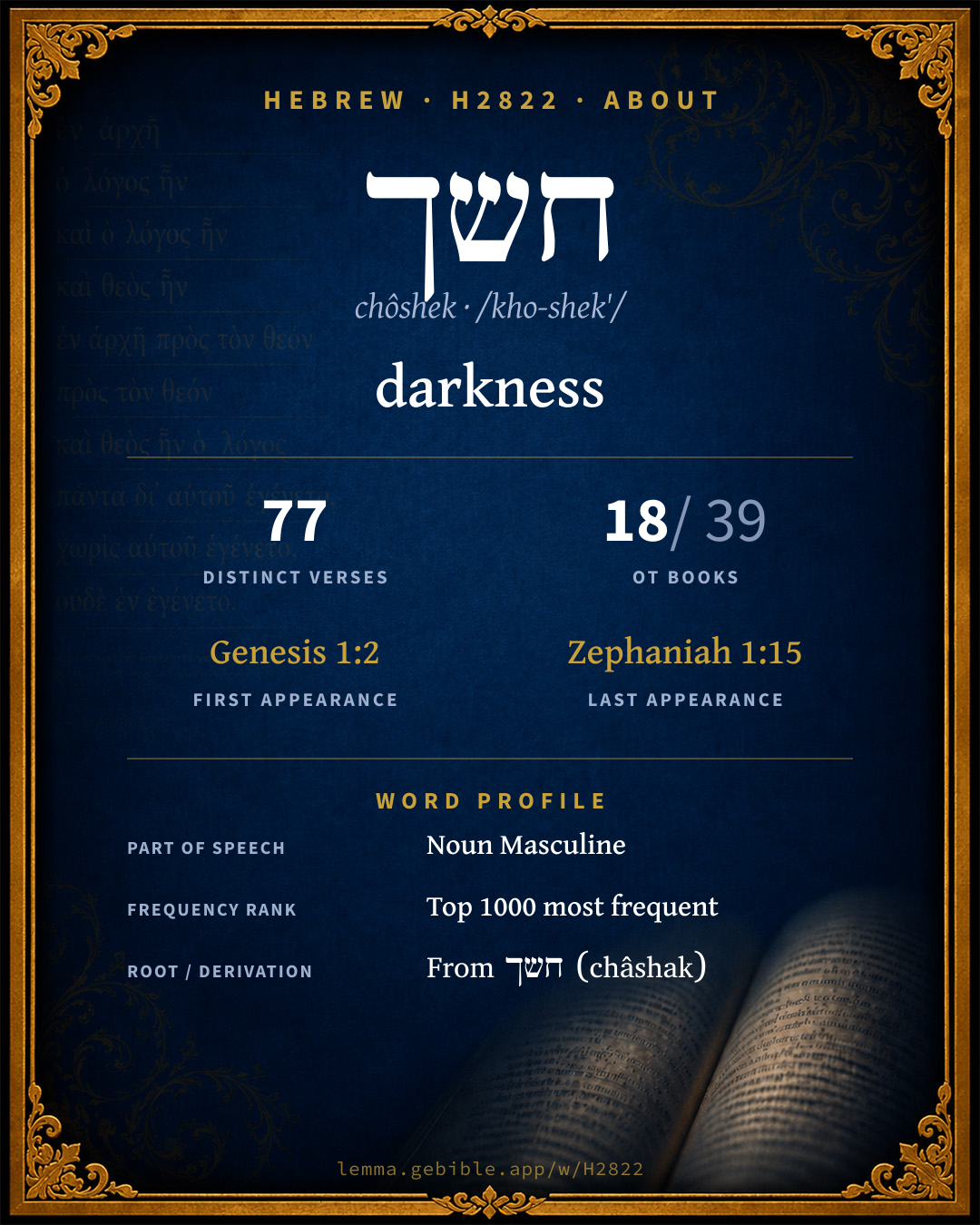
חֹ֫שֶׁךְ
darkness
‘darkness’ is one of 3 main senses fuller range ↓
Full lexicon entry — Brown-Driver-Briggs (BDB)
From Brown-Driver-Briggs (BDB)
Where this word appears
See every Absolute-state word in the Hebrew Bible →
Grammar key — what these labels mean
Part of speech
- Noun
- A naming word — a person, place, thing, or idea.
Noun type
- Common
- A common noun — a general class of person, place, or thing (“king,” “city,” “water”), not a specific name.
State
- Absolute
- The independent form of a noun, not bound to a following word.
- Construct
- A noun bound to a following noun in a possessive / “of” relationship (the construct chain).
Gender
- Masculine
- Grammatically masculine.
Number
- Singular
- One.
Grammatical forms
- Noun, Common, Masculine, Singular, Absolute 77 times (96%)
- Noun, Common, Masculine, Singular, Construct 3 times (4%)
Parsed forms decoded from the imported morphology (morphhb / Westminster Leningrad Codex — WLC text public domain, morphhb tagging CC BY 4.0), counted across 80 parsed occurrences — not distinct verses.
Every verse where H2822 appears — 77 distinct verses across 18 books. Click any verse to open its interlinear word-by-word view. Verse text shown in the World English Bible for context — . Each verse’s Hebrew form is shown with its reference; the English is not keyword-highlighted, since the data carries no word-level English alignment. Use “Compare translations” on any verse to read it across multiple English versions. This concordance covers the Hebrew Bible; Septuagint (Greek Old Testament) occurrences are not indexed here.
Genesis 4 verses
- Genesis 1:2 וְ/חֹ֖שֶׁךְ conj + n c ms Now the earth was formless and empty. Darkness was on the surface of the deep. God's Spirit was hovering over the surface of the waters.
- Genesis 1:4 הַ/חֹֽשֶׁךְ ptcl def.art + n c ms God saw the light, and saw that it was good. God divided the light from the darkness.
- Genesis 1:5 וְ/לַ/חֹ֖שֶׁךְ conj + prep det + n c ms God called the light Day, and the darkness he called Night. There was evening and there was morning, one day.
- Genesis 1:18 הַ/חֹ֑שֶׁךְ ptcl def.art + n c ms and to rule over the day and over the night, and to divide the light from the darkness. God saw that it was good.
Exodus 3 verses
- Exodus 10:21 חֹ֖שֶׁךְ חֹֽשֶׁךְ n c ms n c ms Yahweh said to Moses, "Stretch out your hand toward the sky, that there may be darkness over the land of Egypt, even darkness which may be felt."
- Exodus 10:22 חֹֽשֶׁךְ n c ms cs Moses stretched forth his hand toward the sky, and there was a thick darkness in all the land of Egypt three days.
- Exodus 14:20 וְ/הַ/חֹ֔שֶׁךְ conj + ptcl def.art + n c ms It came between the camp of Egypt and the camp of Israel; and there was the cloud and the darkness, yet gave it light by night: and the one didn't come near the other all the night.
Deuteronomy 2 verses
- Deuteronomy 4:11 חֹ֖שֶׁךְ n c ms You came near and stood under the mountain; and the mountain burned with fire to the heart of the sky, with darkness, cloud, and thick darkness.
- Deuteronomy 5:23 הַ/חֹ֔שֶׁךְ ptcl def.art + n c ms It happened, when you heard the voice out of the midst of the darkness, while the mountain was burning with fire, that you came near to me, even all the heads of your tribes, and your elders;
Joshua 1 verse
1 Samuel 1 verse
2 Samuel 2 verses
Job 23 verses
- Job 3:4 חֹ֥שֶׁךְ n c ms Let that day be darkness; Don't let God from above seek for it, Neither let the light shine on it.
- Job 3:5 חֹ֣שֶׁךְ n c ms Let darkness and the shadow of death claim it for their own. Let a cloud dwell on it. Let all that makes black the day terrify it.
- Job 5:14 חֹ֑שֶׁךְ n c ms They meet with darkness in the day-time, And grope at noonday as in the night.
- Job 10:21 חֹ֣שֶׁךְ n c ms Before I go where I shall not return from, To the land of darkness and of the shadow of death;
- Job 12:22 חֹ֑שֶׁךְ n c ms He uncovers deep things out of darkness, And brings out to light the shadow of death.
- Job 12:25 חֹ֥שֶׁךְ n c ms They grope in the dark without light. He makes them stagger like a drunken man.
- Job 15:22 חֹ֑שֶׁךְ n c ms He doesn't believe that he shall return out of darkness, He is waited for by the sword.
- Job 15:23 חֹֽשֶׁךְ n c ms He wanders abroad for bread, saying, 'Where is it?' He knows that the day of darkness is ready at his hand.
- Job 15:30 חֹ֗שֶׁךְ n c ms He shall not depart out of darkness; The flame shall dry up his branches, By the breath of God's mouth shall he go away.
- Job 17:12 חֹֽשֶׁךְ n c ms They change the night into day, Saying 'The light is near' in the presence of darkness.
- Job 17:13 בַּ֝/חֹ֗שֶׁךְ prep det + n c ms If I look for Sheol as my house, If I have spread my couch in the darkness,
- Job 18:18 חֹ֑שֶׁךְ n c ms He shall be driven from light into darkness, And chased out of the world.
- Job 19:8 חֹ֣שֶׁךְ n c ms He has walled up my way so that I can't pass, And has set darkness in my paths.
- Job 20:26 חֹשֶׁךְ֮ n c ms All darkness is laid up for his treasures. An unfanned fire shall devour him. It shall consume that which is left in his tent.
- Job 22:11 חֹ֥שֶׁךְ n c ms Or darkness, so that you can not see, And floods of waters cover you.
- Job 23:17 חֹ֑שֶׁךְ n c ms Because I was not cut off before the darkness, Neither did he cover the thick darkness from my face.
- Job 24:16 בַּ/חֹ֗שֶׁךְ prep det + n c ms In the dark they dig through houses. They shut themselves up in the daytime. They don't know the light.
- Job 26:10 חֹֽשֶׁךְ n c ms He has described a boundary on the surface of the waters, And to the confines of light and darkness.
- Job 28:3 לַ/חֹ֗שֶׁךְ prep det + n c ms Man sets an end to darkness, And searches out, to the furthest bound, The stones of obscurity and of thick darkness.
- Job 29:3 חֹֽשֶׁךְ n c ms When his lamp shone on my head, And by his light I walked through darkness;
- Job 34:22 חֹ֭שֶׁךְ n c ms There is no darkness, nor thick gloom, Where the workers of iniquity may hide themselves.
- Job 37:19 חֹֽשֶׁךְ n c ms Teach us what we shall tell him; For we can't make our case by reason of darkness.
- Job 38:19 וְ֝/חֹ֗שֶׁךְ conj + n c ms "What is the way to the dwelling of light? As for darkness, where is the place of it,
Psalms 11 verses
- Psalms 18:11 חֹ֨שֶׁךְ n c ms He made darkness his hiding-place, his pavilion around him, Darkness of waters, thick clouds of the skies.
- Psalms 18:28 חָשְׁכִּֽ/י n c ms cs + sfx pers 1cs For you will light my lamp, Yahweh. My God will light up my darkness.
- Psalms 35:6 חֹ֥שֶׁךְ n c ms Let their way be dark and slippery, Yahweh's angel pursuing them.
- Psalms 88:12 בַּ/חֹ֣שֶׁךְ prep det + n c ms Are your wonders made known in the dark? Or your righteousness in the land of forgetfulness?
- Psalms 104:20 חֹ֭שֶׁךְ n c ms You make darkness, and it is night, In which all the animals of the forest prowl.
- Psalms 105:28 חֹ֭שֶׁךְ n c ms He sent darkness, and made it dark. They didn't rebel against his words.
- Psalms 107:10 חֹ֣שֶׁךְ n c ms Some sat in darkness and in the shadow of death, Being bound in affliction and iron,
- Psalms 107:14 מֵ/חֹ֣שֶׁךְ prep + n c ms He brought them out of darkness and the shadow of death, And broke their bonds in sunder.
- Psalms 112:4 בַּ/חֹ֣שֶׁךְ prep det + n c ms Light dawns in the darkness for the upright, Gracious, merciful, and righteous.
- Psalms 139:11 חֹ֣שֶׁךְ n c ms If I say, "Surely the darkness will overwhelm me; The light around me will be night;"
- Psalms 139:12 חֹשֶׁךְ֮ n c ms Even the darkness doesn't hide from you, But the night shines as the day. The darkness is like light to you.
Proverbs 2 verses
Ecclesiastes 5 verses
- Ecclesiastes 2:13 הַ/חֹֽשֶׁךְ ptcl def.art + n c ms Then I saw that wisdom excels folly, as far as light excels darkness.
- Ecclesiastes 2:14 בַּ/חֹ֣שֶׁךְ prep det + n c ms The wise man's eyes are in his head, and the fool walks in darkness--and yet I perceived that one event happens to them all.
- Ecclesiastes 5:17 בַּ/חֹ֣שֶׁךְ prep det + n c ms All his days he also eats in darkness, he is frustrated, and has sickness and wrath.
- Ecclesiastes 6:4 וּ/בַ/חֹ֣שֶׁךְ וּ/בַ/חֹ֖שֶׁךְ conj + prep det + n c ms conj + prep det + n c ms for it comes in vanity, and departs in darkness, and its name is covered with darkness.
- Ecclesiastes 11:8 הַ/חֹ֔שֶׁךְ ptcl def.art + n c ms Yes, if a man lives many years, let him rejoice in them all; But let him remember the days of darkness, for they shall be many. All that comes is vanity.
Isaiah 13 verses
- Isaiah 5:20 חֹ֤שֶׁךְ לְ/חֹ֔שֶׁךְ n c ms prep + n c ms Woe to those who call evil good, and good evil; Who put darkness for light, And light for darkness; Who put bitter for sweet, And sweet for bitter!
- Isaiah 5:30 חֹ֔שֶׁךְ n c ms They will roar against them in that day like the roaring of the sea. If one looks to the land, behold, darkness and distress. The light is darkened in its clouds.
- Isaiah 9:2 בַּ/חֹ֔שֶׁךְ prep det + n c ms The people who walked in darkness have seen a great light: those who lived in the land of the shadow of death, on them has the light shined.
- Isaiah 29:18 וּ/מֵ/חֹ֔שֶׁךְ conj + prep + n c ms In that day shall the deaf hear the words of the book, and the eyes of the blind shall see out of obscurity and out of darkness.
- Isaiah 42:7 חֹֽשֶׁךְ n c ms to open the blind eyes, to bring out the prisoners from the dungeon, and those who sit in darkness out of the prison-house.
- Isaiah 45:3 חֹ֔שֶׁךְ n c ms and I will give you the treasures of darkness, and hidden riches of secret places, that you may know that it is I, Yahweh, who call you by your name, even the God of Israel.
- Isaiah 45:7 חֹ֔שֶׁךְ n c ms I form the light, and create darkness; I make peace, and create evil. I am Yahweh, who does all these things.
- Isaiah 45:19 חֹ֔שֶׁךְ n c ms I have not spoken in secret, in a place of the land of darkness; I didn't say to the seed of Jacob, Seek you me in vain: I, Yahweh, speak righteousness, I declare things that are right.
- Isaiah 47:5 בַ/חֹ֖שֶׁךְ prep det + n c ms Sit you silent, and get you into darkness, daughter of the Chaldeans; for you shall no more be called The mistress of kingdoms.
- Isaiah 49:9 בַּ/חֹ֖שֶׁךְ prep det + n c ms saying to those who are bound, Go forth; to those who are in darkness, Show yourselves. They shall feed in the ways, and on all bare heights shall be their pasture.
- Isaiah 58:10 בַּ/חֹ֨שֶׁךְ֙ prep det + n c ms and if you draw out your soul to the hungry, and satisfy the afflicted soul: then shall your light rise in darkness, and your obscurity be as the noonday;
- Isaiah 59:9 חֹ֔שֶׁךְ n c ms Therefore is justice far from us, neither does righteousness overtake us: we look for light, but, behold, darkness; for brightness, but we walk in obscurity.
- Isaiah 60:2 הַ/חֹ֨שֶׁךְ֙ ptcl def.art + n c ms For, behold, darkness shall cover the earth, and gross darkness the peoples; but Yahweh will arise on you, and his glory shall be seen on you.
Lamentations 1 verse
Ezekiel 2 verses
- Ezekiel 8:12 בַּ/חֹ֔שֶׁךְ prep det + n c ms Then said he to me, Son of man, have you seen what the elders of the house of Israel do in the dark, every man in his chambers of imagery? for they say, Yahweh doesn't see us; Yahweh has forsaken the land.
- Ezekiel 32:8 חֹ֨שֶׁךְ֙ n c ms All the bright lights of the sky will I make dark over you, and set darkness on your land, says the Lord Yahweh.
Joel 2 verses
- Joel 2:2 חֹ֣שֶׁךְ n c ms A day of darkness and gloominess, A day of clouds and thick darkness. As the dawn spreading on the mountains, A great and strong people; There has never been the like, Neither will there be any more after them, Even to the years of many generations.
- Joel 2:31 לְ/חֹ֔שֶׁךְ prep + n c ms The sun will be turned into darkness, And the moon into blood, Before the great and terrible day of Yahweh comes.
Amos 2 verses
Micah 1 verse
Nahum 1 verse
Zephaniah 1 verse
About this entry
At a glance — auto-summarized from this page’s data, not written by a person. Every figure links to its source below. This summary describes the numbers; it doesn’t interpret them.
“darkness” is the headline sense of the Hebrew noun חשך (chôshek). Scripture first uses it in Genesis 1:2. With 77 verses in 18 books, it is a moderately common word in the Hebrew Bible. It concentrates in Job, which alone accounts for 30% of its uses. Carrying more than one sense, it rewards its full sense range. The sections below give every sense, occurrence, and version rendering.
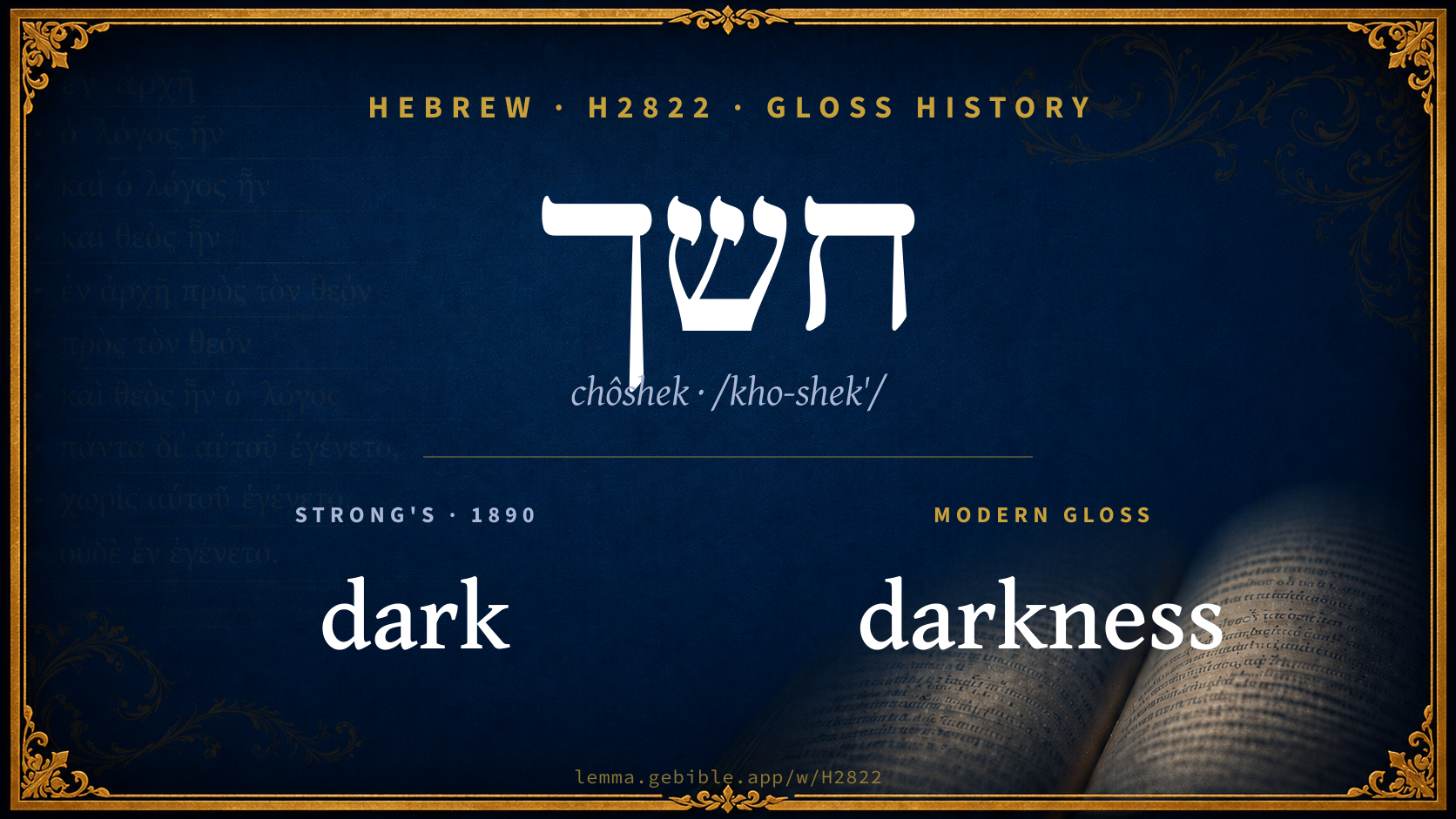
Gloss history
Strong's 1890 vs modern scholarship
About this word
Strong's H2822 catalogs a Hebrew word from the Hebrew Old Testament.
These counts are not copied from any lexicon or concordance. They are computed here, from the morphology-tagged Hebrew Old Testament. What Lemma adds →
- 77
- distinct verses
- The word appears in 77 distinct verses.
- 18 / 39
- OT books
- The word appears in 18 of 39 Old Testament books.
- #501
- by frequency
- Top 1000 most frequent Hebrew words (rank 501 of 8,640 Hebrew words by occurrence).
View all 77 occurrences in the concordance →
By section of the Old Testament
By traditional corpus
Conventional, traditional groupings — biblical authorship is debated, so this is a traditional corpus grouping, not an authorship claim. Each share is this word’s portion of its verses in that division of the Hebrew canon. Each figure is a share of the word’s 77 distinct verses.
- Writings (Ketuvim) 42 verses · 55%
- Prophets (Nevi'im) 26 verses · 34%
- Torah (Pentateuch) 9 verses · 12%
How translations render this word
Counts come from each version’s own published word-to-Strong’s tagging or interlinear alignment — an approximate guide to how each version renders this word, not a word-level alignment the data otherwise carries. Because each total is that version’s own tagged count, the per-version totals vary from one another and need not match the appearance or distinct-verse counts above. These counts may also differ from a printed concordance because Lemma counts each distinctly tagged rendering and does not collapse phrase taggings into a single head-word total. This is a fixed set of word-tagged versions (KJV, ASV, BSB, ULT) and does not change with the reading translation you choose elsewhere. Each version’s license is shown beside its name below (and on Sources).
- King James Version: Darkness 53×, Dark 5×, Be darkness 2×
- American Standard Version: Darkness 55×, Dark 4×, Be darkness 2×
- Berean Standard Bible: Darkness 70×, Dark 2×
- unfoldingWord Literal Text: Darkness 72×, Dark 5×
King James Version Public Domain
Renders H2822 across 80 tagged occurrences — most commonly:
Plus 20 renderings that appear only once — usually multi-word phrases or single function words the recovered tagging swept in, not distinct renderings.
American Standard Version Public Domain
Renders H2822 across 80 tagged occurrences — most commonly:
Plus 19 renderings that appear only once — usually multi-word phrases or single function words the recovered tagging swept in, not distinct renderings.
Berean Standard Bible Public Domain
Renders H2822 across 80 tagged occurrences — most commonly:
Plus 8 renderings that appear only once — usually multi-word phrases or single function words the recovered tagging swept in, not distinct renderings.
unfoldingWord Literal Text CC BY-SA 4.0
Renders H2822 across 80 tagged occurrences — most commonly:
Plus 3 renderings that appear only once — usually multi-word phrases or single function words the recovered tagging swept in, not distinct renderings.
10 senses and sub-senses in the full BDB
What do BDB’s symbols mean?
BDB uses these scholarly abbreviations:
| Symbol | Meaning |
|---|---|
| 𝔊 | the Septuagint (the ancient Greek translation, LXX) |
| 𝔙 | the Vulgate (the Latin translation) |
| 𝔖 | the Syriac version (the Peshitta) |
| 𝔗 | the Targum (the Aramaic translation) |
| ψ | the Psalms |
| √ | root (the underlying root or stem) |
| ‖ | parallel passage (a synonymous or contrasted parallel) |
| † | the dagger: every passage where the word occurs is cited |
The 10 senses and sub-senses the full Brown-Driver-Briggs lexicon distinguishes for this word, in lexicon order (not ranked by frequency), with BDB’s own verbatim wording and sub-sense lettering. Shown in Hebrew script with BDB’s own scholarly abbreviations. The condensed entry is in the Lexicon Entry tab. See also the Forms in the corpus table below.
- 1. darkness (opp. אוֹר) lit. Gn 1:2, 4 (P), Is 45:7 Jb 26:10 Ec 2:13, cf. in imprecation Jb 3:4, 5 (ח׳ וצלמות = לילה Gn 1:5, 18 (P), cf. Jos 2:5 (JE), Is 45:19 Jb 17:12; 24:16; 38:19 ψ 104:20; darkness in mines Jb 28:3; of extraordinary darkness, in Egypt Ex 10:21(×2) (E); ח׳־אֲפֵלָה Ex 10:22 (E), ψ 105:28, from pillar of cloud Ex 14:20 (J); at Mt. Sinai Dt 4:11; 5:20; of clouds of theophany 2 S 22:12 = ψ 18:12; of darkness in death, or Sheʾôl, 1 S 2:9 Jb 10:21 (אֶרֶץ ח׳ וצלמות), 17:13; 18:18 ψ 88:13 Pr 20:20 (אִישׁוֹן ח׳ = extreme of darkness). e.g. Genesis 1:2
- 2. = secret place(s) Id 45:3 Jb 12:22 (‖ צלמות); = hiding-place Jb 34:22 (‖ id.), cf. ψ 139:11, 12;—on Ez 8:12, v. supr. e.g. Isaiah 45:3
- 3. fig.,
- a. = distress Is 5:30; 9:1; 29:18 (fig. of blindness), 42:7; 49:9; 58:10; 59:9; 60:2 La 3:2 Mi 7:8 ψ 18:29 = 2 S 22:29, Jb 15:22, 23, 30; 20:26; 22:11; 23:17; 29:3 ψ 107:10, 14 (in both ‖ צלמות), 112:4 Ec 5:16; 11:8. e.g. Isaiah 5:30
- b. = dread, terror, symbol. of judgment Am 5:18, 20 Zp 1:15 Na 1:8 Ez 32:8 Jo 2:4; 3:4. e.g. Amos 5:18
- c. = mourning Is 47:5. e.g. Isaiah 47:5
- d. = perplexity Jb 5:14; 12:25; 19:8; confusion ψ 35:6. e.g. Job 5:14
- e. = ignorance Jb 37:19 Ec 2:14. e.g. Job 37:19
- f. = evil, sin Is 5:20(×2) Pr 2:13. e.g. Isaiah 5:20
- g. = obscurity Ec 6:4(×2). e.g. Ecclesiastes 6:4
Senses from the full Brown-Driver-Briggs lexicon (Brown, Driver, Briggs; Oxford 1906 — public domain), digitized via Sefaria, supplemented by the OpenScriptures HebrewLexicon (CC BY 4.0). Full attribution on Sources.
Word origin
n.m. Ex 10:21 darkness, obscurity;—abs. חֹשֶׁךְ Gn 1:2 + 75 times (+ Ex 8:12 del. Co A B etc.); cstr. id. Ex 10:22; sf. חָשְׁכִּי ψ 18:29 = 2 S 22:29;—
— Brown-Driver-Briggs (Oxford 1906, public domain), digitized via Sefaria, supplemented by the OpenScriptures HebrewLexicon (CC BY 4.0). See Sources.
Derived from חשך (châshak) (H2821) — to be dark.
Jastrow Dictionary
A second Hebrew/Aramaic lexicon for comparison, covering Aramaic and post-biblical (Talmudic, Targumic, Midrashic) usage that the biblical-Hebrew BDB does not. Matched by lemma rather than by Strong’s number, so a lemma may carry more than one Jastrow headword (shown separately below), and the entries cover usage well beyond the Bible.
חָשַׂךְ
- , v. חָסַךְ
חֲשַׂךְ
- (v. חָסַךְ) to spare, withhold. Targ. Prov. XIII, 24 חָשֵׂךְ, חָשֵׂיךְ (part.). Ib. XVII, 27.
- to deduct. Y. Pes. IV, end, 31ᶜ מַחְשַׂכְנָא (not מחשב׳), v. גּוֹדְלָנָא.
חָשַׁךְ
- [to be pressed, thick,] to be dark. Sabb. 34ᵃ; 51ᵃ משחָשְׁכָה; ib. IV, 2 משתֶּחְשַׁךְ when it darkens (at nightfall, v. חֲשֵׁיכָה). Snh. 22ᵃ עולם ח׳ בעדו the world around him is dark; Ab. Zar. 8ᵃ (some ed. חָשׁוּךְ). Ber. 16ᵇ אל יֶחְשְׁכוּ וכ׳ let not our eyes be obscured; a. fr. V. חָשׁוּךְ.
- 1. to be overtaken by (the Sabbath) nightfall. Sabb. XXIV, 1 מי שה׳ בדרך he who is on the road at nightfall (on Friday).
- 2. to wait for the nightfall, to make preparations to be ready for work on the exit of the Sabbath, v. חֲשִׁיכָה. Ib. XXIII, 3 אין מַחְשִׁיכִין על וכ׳ you must not, during the day, walk to the extreme end of the Sabbath limit to await the night there for the purpose of hiring workmen etc.; אבל מַחְשִׁיךְ הוא וכ׳ but one may do so for the purpose of going at nightfall to watch his field, and then he may also take his fruits home. Ib. להַחְשִׁיךְ עליו to await the night at the Sabbath limit for the purpose of doing it. Ib. 4; a. fr.
- 3. to darken, obscure. Cant. R. to I, 1 (ref. to חשכים, Prov. XXII, 29) that is Potifar שה׳ הקב"ה וכ׳ whose eyes the Lord darkened etc. Ex. R. s. 51 (ref. to חשכה, Gen. XV, 12) that is Media שהֶחְשִׁיכָה וכ׳ who made Israel’s eyes dim (with tears) by her decrees. Pesik. R. s. 47 (ref. to Job XXXVIII, 2) הֶחְשַׁכְתָּ וכ׳ (not החשב׳) thou hast obscured the council which I held in heavens (when the Lord vouched for Job’s integrity); a. fr. e.g. Proverbs 22:29
- 4. to become dark. Midr. Till. to Ps. XVIII, 12 (ref. to the versions חשכת, Ps. l. c., and חשרת II Sam. XXII, 12) when the clouds are laden with the waters, הן מַחְשִׁיכִין מן המים וכ׳ they receive a dark color from the waters, and afterwards they drop them as through a sieve. e.g. 2 Samuel 22:12
חֲשַׁךְ
- Targ. Job. XVIII, 6. Targ. Ex. X, 15; a. fr.—Taan. 10ᵃ חֲשׁוּךְ ענני וכ׳ when the clouds are dark, they contain much water.
- 1. to darken, obscure. Targ. Ps. CV, 28; a. e.
- 2. to do something at night, to be late. Tam. 27ᵇ חַשֵּׁיךְ תקין נפשך וכ׳ at bed-time attend to thy body, and in the morning etc. Ber. 8ᵃ מקדמי ומְחַשְּׁכֵי וכ׳ they go to Synagogue early and late. Ib. קדימו וחַשִּׁיכוּ ועיילו וכ׳ (Ms. M. ואַחְשִׁיכוּ, Af., v. Rabb. D. S. a. l.) go ye early and late to etc. Targ. Y. Deut. XXVIII, 65, v. מַחַשְׁכָן.
- 1. to obscure. Targ. Job XXXVIII, 2; a. e.
- 2. to do something late. Targ. I Sam. XVII, 16.—Ber. l. c., v. supra.
- to grow dark. Targ. Ps. LXIX, 24; a. e.—Snh. 96ᵃ עד דאתא איח׳ by the time he came it had grown dark.
חֲשַׁךְ ²
- (cmp. חסך) to be reduced, lean. Targ. Ps. XXXI, 11 (h. text עששו, v. Rashi a. l.)
- same. Targ. Job XXXIII, 21 Ms. (ed. שפיין).
חשֶׁךְ
- darkness. Ex. R. s. 14. Ḥag. 12ᵃ; a. v. fr.—הָרֵי ח׳ Dark Mountains, behind which the Amazons live (Amazonici Mountes, v. Sm. Class. Dict. s. v.). Lev. R. s. 27; Pesik. Shor, p. 74ᵃ; Tam. 32ᵃ. [The Jewish legend relating the meeting of Alexander the Great with the Amazons seems to point to Africa, v. קרטגינא).
A Dictionary of the Targumim, the Talmud Babli and Yerushalmi, and the Midrashic Literature (Marcus Jastrow; London, Luzac, 1903) — Public Domain. Digitized via Sefaria. Digitized via Sefaria. Full attribution on Sources.
Forms in the corpus
The 35 distinct written forms H2822 takes in the Hebrew Bible, most frequent first — each parse links to that state’s occurrences in the concordance. Hebrew forms include their vowel points and cantillation, so a single lemma takes many written forms.
Same root — word family
Other BDB entries built from the same root as H2822, grouped by Strong’s listed origin. These share a root / origin per the lexicon — not necessarily a shared meaning. Each links to that word’s own entry.
Derives from
Shares the same root
- חשוך chăshôwk H2816 darkness
- חשך châshôk H2823 obscure
- חשכה cheshkâh H2824 darkness
- חשכה chăshêkâh H2825 darkness
- מחשך machshâk H4285 darkness
Compare all same-root words → Showing 4 of 7 — not the complete family. They share a root, not necessarily a meaning.
Septuagint verse parallels
This word appears in 75 verses that also exist in the Greek Old Testament (Septuagint), out of the 77 Hebrew verses it occurs in. You can read those verses in Greek by switching the Old Testament edition to the Septuagint.
Read these verses in the Septuagint
- Genesis 1:2
- Exodus 10:21
- Deuteronomy 4:11
- Joshua 2:5
- 1 Samuel 2:9
- 2 Samuel 22:12
- Job 3:4
- Psalms 18:11
- Proverbs 2:13
- Ecclesiastes 2:13
- Isaiah 5:20
- Lamentations 3:2
This is a verse-level parallel only — the same verses exist in both the Hebrew and Greek Old Testaments. No word-level Hebrew↔Greek correspondence is claimed: the data carries no such alignment, so no Greek word is shown as this Hebrew word’s translation. Coverage is not total — the Septuagint omits the deuterocanon and renumbers the Psalms, so some Hebrew verses have no direct Greek parallel.