
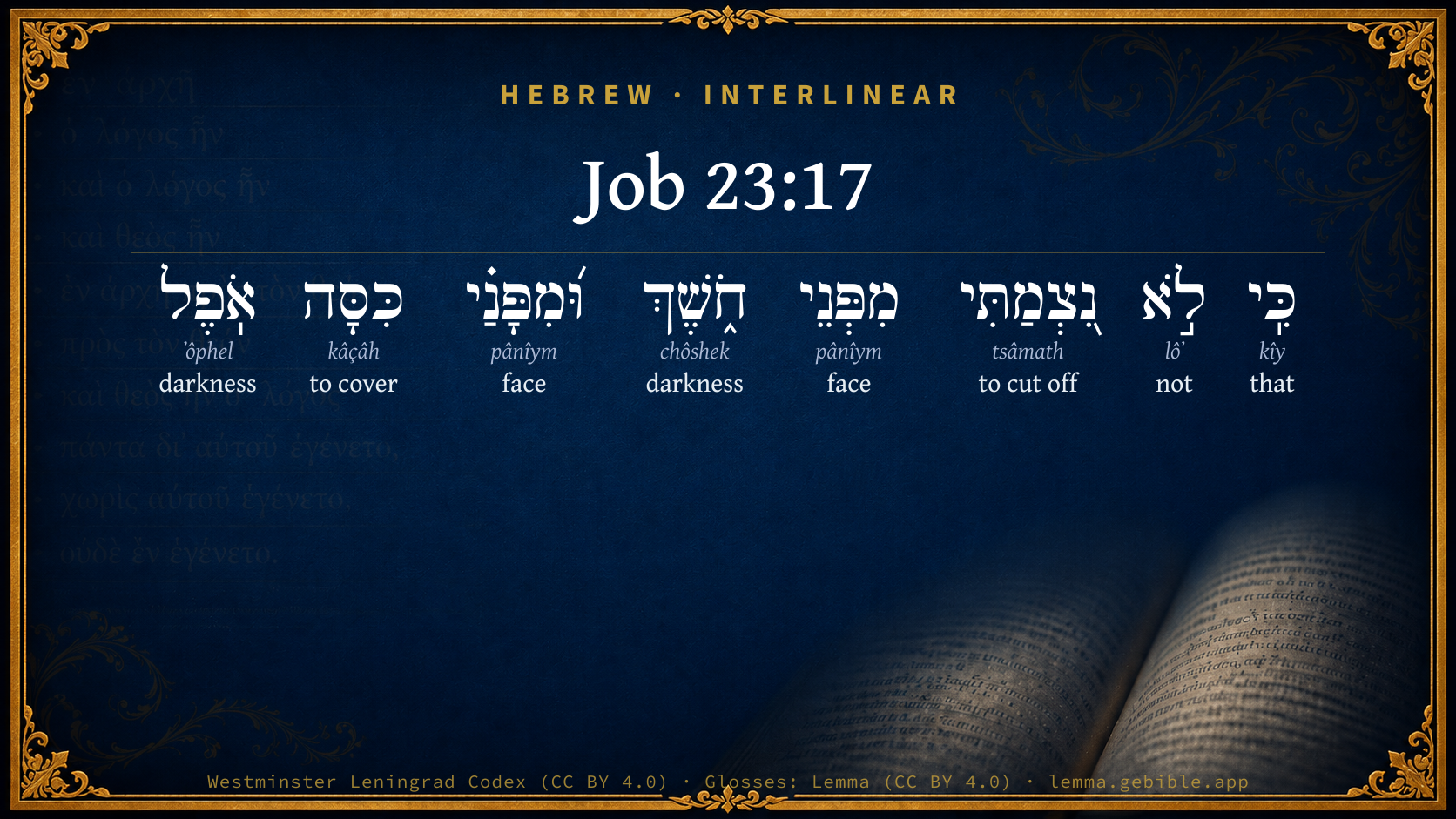
Job 23:17

Hebrew (Westminster Leningrad Codex) Job 23:17 appears in the Hebrew Old Testament. The text above is from the Westminster Leningrad Codex. Each word links to its Strong’s number, a concise gloss, and parsing drawn from the Open Scriptures Hebrew Bible morphology. Click any word for its full Brown-Driver-Briggs (BDB) entry.
Download image
Cite this verse

Job 23:17 (World English Bible). Public Domain. Lemma interlinear Bible study tool, https://lemma.gebible.app/v/job/23/17.

Show BibTeX & RIS
BibTeX
RIS
English Translation
Because I was not cut off before the darkness, Neither did he cover the thick darkness from my face.
World English Bible · Public Domain
Download a study sheet

One document with this verse’s original text, its word-by-word gloss line, the meaning frame, cross-references with their text, attributed commentary, and full source and license credits — printable, and it pastes into notes with its structure intact.

This verse Autodidact and up

Study sheet (.html) Plain text (.txt)

A passage Seminary Student

Up to 50 verses in one chapter. A passage sheet keeps up to 6 commentary sources and 12 cross-references per verse, in the order this page ranks them, and says so on the sheet whenever that leaves anything out. Ask for a single verse and you get the Autodidact verse sheet above.

Everything on this page stays free to read, with no account — the sheet is a download of what is already on screen, not access to it.

Want to remove ads? Support Godless Engineer
Compare translations 3

The same verse in 3 English versions, stacked beneath the original-language interlinear above. Click any original word for its lexicon entry.

Each is an independent rendering of the whole verse — the interlinear is not word-aligned to these translations.

Highlighted words mark where these versions differ — a whole-verse word diff, not a word-by-word alignment.

  • World English Bible Public Domain
    Because I was not cut off before the darkness, Neither did he cover the thick darkness from my face.
  • King James Version Public Domain
    Because I was not cut off before the darkness, neither hath he covered the darkness from my face.
  • unfoldingWord Literal Text CC BY-SA 4.0
    For I was not cut off from the face of the darkness, and from my face gloom covers.

unfoldingWord Literal Text — © unfoldingWord, licensed CC BY-SA 4.0. Word-aligned USFM3 via Door43 (git.door43.org/unfoldingWord/en_ult).

Versions to compare (up to 4)

3 of 4 selected

Show all 18 translations

Every available English version of this verse, each an independent rendering of the whole verse.

  • World English Bible Public Domain
    Because I was not cut off before the darkness, Neither did he cover the thick darkness from my face.
  • Berean Standard Bible Public Domain
    Yet I am not silenced by the darkness, by the thick darkness that covers my face.
  • Majority Standard Bible Public Domain
    Yet I am not silenced by the darkness, by the thick darkness that covers my face.
  • King James Version Public Domain
    Because I was not cut off before the darkness, neither hath he covered the darkness from my face.
  • American Standard Version (1901) Public Domain
    Because I was not cut off before the darkness, Neither did he cover the thick darkness from my face.
  • Revised Version (1885) Public Domain
    Because I was not cut off before the darkness, neither did he cover the thick darkness from my face.
  • Geneva Bible (1599) Public Domain
    For I am not cut off in darknesse, but he hath hid the darkenesse from my face.
  • Douay-Rheims (1899) Public Domain
    For I have not perished because of the darkness that hangs over me, neither hath the mist covered my face.
  • Young's Literal Translation Public Domain
    For I have not been cut off before darkness, And before me He covered thick darkness.
  • Literal Standard Version CC BY-SA 4.0
    For I have not been cut off before darkness, || And before me He covered thick darkness.”
  • Unlocked Literal Bible CC BY-SA 4.0
    I have not been brought to an end by darkness, because of the thick darkness that covers the gloom of my face.
  • unfoldingWord Literal Text CC BY-SA 4.0
    For I was not cut off from the face of the darkness, and from my face gloom covers.
  • Darby Bible Public Domain
    Because I was not cut off before the darkness, neither hath he hidden the gloom from me.
  • World Messianic Bible Public Domain
    Because I was not cut off before the darkness, neither did he cover the thick darkness from my face.
  • Webster's Bible Public Domain
    Because I was not cut off before the darkness, neither hath he covered the darkness from my face.
  • Free Bible Version CC BY-SA 4.0
    Yet I'm still here despite the dark—even though I can't see through the utter darkness.”
  • Bible in Basic English Public Domain
    For I am overcome by the dark, and by the black night which is covering my face.
  • JPS Tanakh (1917) Public Domain
    Because I was not cut off before the darkness, neither did He cover the thick darkness from my face.

Literal Standard Version (2020), Covenant Press — licensed CC BY-SA 4.0. Text via the HelloAO Bible API (eBible.org). Unlocked Literal Bible (unfoldingWord) — licensed CC BY-SA 4.0. Text via the HelloAO Bible API (eBible.org). unfoldingWord Literal Text — © unfoldingWord, licensed CC BY-SA 4.0. Word-aligned USFM3 via Door43 (git.door43.org/unfoldingWord/en_ult). Free Bible Version, Dr. Jonathan Gallagher — licensed CC BY-SA 4.0. Text via the HelloAO Bible API (eBible.org).

Word by word

More ways to search: Search by grammar → Find every occurrence → Compare this word →

Practice this passage: Drill this verse → Learn its vocabulary →

About this verse

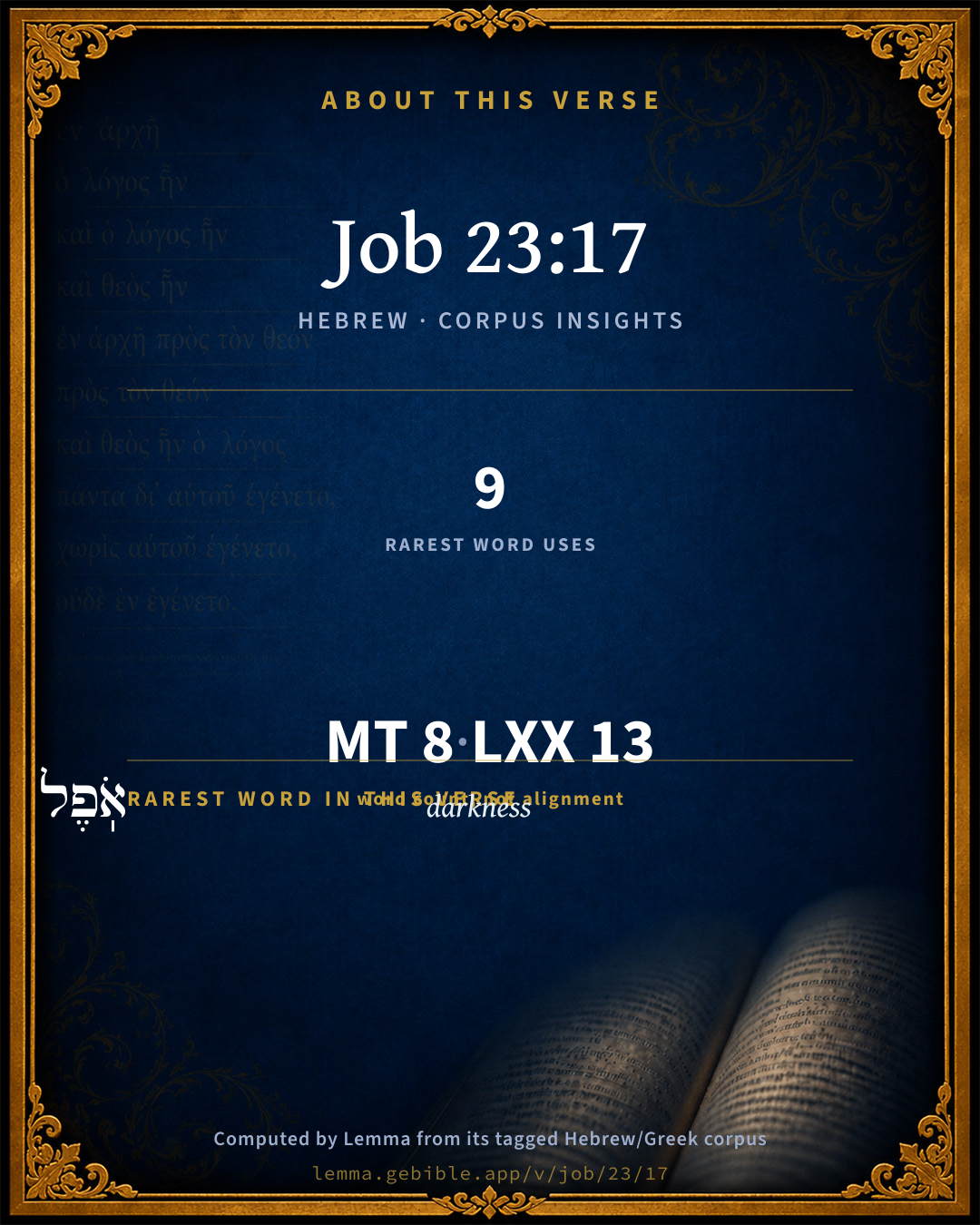
These counts appear in no published source. They are computed here, from the morphology-tagged text and Lemma’s own curated glosses. What Lemma adds →

8
words
7
distinct lemmas
Wisdom
section

Notable vocabulary

The rarest word here is אֹֽפֶל darkness H652 — appearing just 9 times in the whole Hebrew Bible.

Shared distinctive vocabulary

אֹֽפֶל darkness H652 occurs in 8 verses of the Hebrew Bible. Also found in:

Grammatical profile

  • 2 verbs
  • 4 nouns
  • 1 conjunction
  • 1 particle

Verb forms

  • נִ֭צְמַתִּי Niphal · Perfect
  • כִּסָּה Piel · Perfect

Repetition

A word recurs within this verse — often emphatic in Hebrew:

  • מִפְּנֵי face H6440 ×2

Hebrew & Septuagint length

In English translation the verse runs 19 words from the Hebrew and 19 from the Septuagint (LXX English) — the same length.

A rough comparison of the two English renderings, which tokenize alike — not a word-level alignment.

Word counts can differ between the Hebrew and the Greek without any difference in meaning — e.g. the Hebrew direct-object marker אֵת has no separate Greek word, and Greek often adds the article ὁ.

In the original languages it is 8 Hebrew tokens and 13 Greek tokens — but the two are counted differently (Hebrew bundles its prefixes and suffixes into one token; the Greek is in lemma form), so that isn’t a like-for-like length.

Cross-references

8

Topical passages linked to Job 23:17 in the Treasury of Scripture Knowledge — connected by theme and wording, ordered by reader-vote popularity; previews shown in the World English Bible.

  • Job 19:8 He has walled up my way so that I can't pass, And has set darkness in my paths.
  • Isaiah 57:1 The righteous perishes, and no man lays it to heart; and merciful men are taken away, none considering that the righteous is taken away from the evil [to come].
  • 2 Kings 22:20 Therefore, behold, I will gather you to your fathers, and you shall be gathered to your grave in peace, neither shall your eyes see all the evil which I will bring on this place. They brought the king word again.
  • Job 6:9 Even that it would please God to crush me; That he would let loose his hand, and cut me off!
  • Job 15:22 He doesn't believe that he shall return out of darkness, He is waited for by the sword.
  • Job 18:6 The light shall be dark in his tent, His lamp above him shall be put out.
  • Job 18:18 He shall be driven from light into darkness, And chased out of the world.
  • Job 22:11 Or darkness, so that you can not see, And floods of waters cover you.

Cross-references courtesy of OpenBible.info (CC BY 4.0).

Hebrew and Greek witnesses Masoretic Hebrew ↔ Greek Septuagint

The same verse in the two great witnesses to the Old Testament, shown verse-for-verse.

These are two independent witnesses, not word-aligned to each other, and the Septuagint is shown in lemma (dictionary) form.

Hebrew Job 23:17 Masoretic · Westminster Leningrad Codex

כִּֽי לֹ֣א נִ֭צְמַתִּי מִפְּנֵי חֹ֑שֶׁךְ וּ֝מִפָּנַ֗י כִּסָּה אֹֽפֶל

Because I was not cut off before the darkness, Neither did he cover the thick darkness from my face.

World English Bible · Public Domain

Greek LXX Job 23:17 Septuagint · lemma form

οὐ γάρ οἶδα ὅτι ἐπιἔρχομαι ἐγώ σκότος πρό πρόσωπον δέ ἐγώ καλύπτω γνόφος

For I knew not that darkness would come upon me, and thick darkness has covered me before my face.

LXX2012 (modern English Septuagint) · Public Domain

Hebrew: Westminster Leningrad Codex (CC BY 4.0). Greek: Septuagint (public domain); English from LXX2012 (modern English Septuagint) (Public Domain). How the Septuagint differs from the Hebrew →

Commentary

Notes on Job 23:17 from classic Christian and Jewish commentators (each source and its license shown beneath its notes). The classic Christian expositions comment on the surrounding passage and are grouped to its opening verse, so a note may address several verses; the Jewish commentaries on the Tanakh (Rashi and others) are per-verse, so they appear only where the commentator wrote on this verse.

Lemma curates 59 commentaries, every one of them public domain or Creative Commons licensed, each selected and text-cleaned for this edition rather than reprinted as found. About our sources →

Trapp's Complete Commentary

John Trapp

Job 23:17 Because I was not cut off before the darkness, [neither] hath he covered the darkness from my face.

Ver. 17. Because I was not cut off before the darkness] i.e. The afflictions that now are upon me. It is a mercy to some to die sometimes, as Josiah, and those righteous ones, Isa 57:1, who were taken away from the evil to come. When God’s glory was to pass by, he put Moses into the hole of the rock; so he sometimes doth his servants, till the glory of his justice hath passed upon others.

Neither hath he covered the darkness from my face] i.e. He hath neither prevented my troubles by death, as I wished he would have done, Job 3:3; Job 3:11-13, nor yet will he put an end to them by the same means; for, Mors aerumnarum requies (Chaucer’s motto), Death is a rest from trouble. To the tossed soul it is as Mount Ararat was to Noah, where the ark rested; as Michel was to David, a means to shift him out of the way, when Saul sent to slay him; or as the fall of the house was to Samson, an end of all his sorrows and servitude.

John Trapp, A Commentary or Exposition upon All the Books of the Old and New Testament (1647–1656) — public domain. Text from a community e-Sword module.

Geneva Bible (1599)

Geneva Bible translators

He showeth the cause of his fear, which is, that he being in trouble seeth none end, neither yet knoweth the cause.

Geneva Bible (1599) marginal notes — public domain. Text via Bolls.life.

Jamieson, Fausset & Brown

Robert Jamieson, A. R. Fausset & David Brown

Because I was not taken away by death from the evil to come (literally, "from before the face of the darkness," Isa 57:1). Alluding to the words of Eliphaz (Job 22:11), "darkness," that is, calamity.

cut off--rather, in the Arabic sense, brought to the land of silence; my sad complaint hushed in death [UMBREIT]. "Darkness" in the second clause, not the same Hebrew word as in the first, "cloud," "obscurity." Instead of "covering the cloud (of evil) from my face," He "covers" me with it (Job 22:11).

Next: Job Chapter 24

Jamieson, Fausset & Brown — Commentary Critical and Explanatory on the Whole Bible (1871) — public domain (CC PDM 1.0). Text via the HelloAO Bible API.

Adam Clarke's Commentary

Verse 17. Because I was not cut off] "O, why can I not draw darkness over my face? Why may not thick darkness cover my face?" Mr. Good. This verse should be read in connection with the preceding; and then we shall have the following sense.

Ver. 16: "The Lord hath beaten down my strength, and my soul has been terrified by his fear."

Ver. 17: "For it is not this deep night in which I am enveloped, nor the evils which I suffer, that have overwhelmed me; I sink only through the fear which the presence of his Majesty inspires. This is my greatest affliction; sufferings, diseases, yea, death itself, are nothing in comparison of the terror which my soul feels in the presence of his tremendous holiness and justice."

NOTHING can humble a pious mind so much as Scriptural apprehensions of the majesty of God. It is easy to contemplate his goodness, loving-kindness, and mercy; in all these we have an interest, and from them we expect the greatest good: but to consider his holiness and justice, the infinite righteousness of his nature, under the conviction that we have sinned, and broken the laws prescribed by his sovereign Majesty, and to feel ourselves brought as into the presence of his judgment-seat, - who can bear the thought? If cherubim and seraphim veil their faces before his throne, and the holiest soul exclaims,

I loathe myself when God I see,

And into nothing fall;

what must a sinner feel, whose conscience is not yet purged from dead works and who feels the wrath of God abiding on him? And how without such a mediator and sacrifice as Jesus Christ is, can any human spirit come into the presence of its Judge? Those who can approach him without terror, know little of his justice and nothing of their sin. When we approach him in prayer, or in any ordinance, should we not feel more reverence than we generally do?

Adam Clarke's Commentary on the Bible (1810–1826) — public domain. Text from a community e-Sword/MySword module.

The Cambridge Bible for Schools and Colleges

gen. ed. J. J. S. Perowne

17. This verse reads,

For I am not dismayed because of the darkness,

Nor because of myself whom thick darkness covereth.

The words refer back to the language of Eliphaz, ch. Job_22:11, “or seest thou not the darkness?” The “darkness” is the fatal calamity that has overtaken Job, a frequent use of the word. What dismays Job, or strikes him dumb with moral awe, is not his calamity in itself, nor himself (or, his face) marred and distorted by disease, but this, that it is God who has inflicted the calamity upon him, not because he is guilty, but in the arbitrary and unjust exercise of His almighty power. This is the point in this whole speech, both in ch. 23 and ch. 24; Job misses any true moral rule in the world. The A. V. seems to make the enigma consist in this, that Job was not removed by death before such afflictions overtook him. But this would at best have substituted one enigma for another.

The Cambridge Bible for Schools and Colleges (gen. ed. J. J. S. Perowne; Cambridge University Press, 1878–1918) — public domain. Text from a community e-Sword module.

Albert Barnes' Notes on the Bible

Because I was not cut off before the darkness - Before these calamities came upon me. Because I was not taken away in the midst of prosperity, and while I was enjoying his smiles and the proofs of his love. His trouble is, that he was spared to pass through these trials, and to be treated as if he were one of the worst of men. This is what now perplexes him, and what he cannot understand. He does not know why God had reserved him to treat him as if he were the chief of sinners.

Neither hath he covered the darkness from my face - The word “neither” is supplied here by our translators, but not improperly. The difficulty with Job was, that God had not “hidden” this darkness and calamity so that he had not seen it. He could not understand why, since he was his friend, God had not taken him away, so that all should have seen, even in his death, that he was the friend of God. This feeling is not, perhaps, very uncommon among those who are called to pass through trials. They do not understand why they were reserved to these sufferings, and why God did not take them away before the billows of calamity rolled over them.

Albert Barnes' Notes on the Bible (1834–1885) — public domain. Text from a community e-Sword/MySword module.

Haydock's Catholic Bible Commentary

Face. My afflictions have not yet taken away my life, as might have been expected. (Haydock) --- I am less affected with my miseries, than with the dread of God’s presence, ver. 15, 16. (Calmet)

George Leo Haydock (1774–1849), Haydock's Catholic Family Bible and Commentary, 1859 edition — public domain. Excludes Psalms (Douay-Rheims chapter numbering differs from Protestant) and Deuterocanonical books (Catholic canon only).

Matthew Poole's English Annotations

Because I was not cut off; because God did not cut me off by death. Before the darkness, i.e. before these dark and dismal miseries came upon me. Or, before the face, or by reason of the darkness, i.e. that God hath not yet cut me off by these calamities, but prolonged nay days under them, that he might increase my torment.

Neither hath he covered the darkness from my face; so that I might no longer see or feel my miseries, but might be taken out of them by my long-desired death. Seeing (and consequently having before one’s face) is oft put for experiencing, for enjoying good, or feeling evil, as Job 20:17; Psa 16:10, &c. Or, but he hath covered darkness, to wit, death, which is so called Job 10:21,22, and elsewhere, from my face, i.e. he will not allow me the favour to see death.

Matthew Poole's English Annotations on the Holy Bible (1683–1685) — public domain. Text from a community e-Sword/MySword module.

Whedon's Commentary on the Bible

Daniel D. Whedon

17. Cut off — The key to this much-vexed passage lies in nitsmath, “cut off,” which should bear its Arabic meaning of brought to silence. Eliphaz (Job_22:11) had taunted Job not only with his fear, but with the darkness and deluge that covered him. He replies, For I grow not dumb because of (or before) the darkness, nor because of (or before) myself, whom thick darkness hath covered. Thus most moderns. Job is still ready to maintain what he believes to be the right; he will “not be reduced to silence,” notwithstanding the black midnight darkness (אפל) which had overwhelmed him. This bold and defiant declaration is transitional to the awful arraignment of God’s ways in the following chapter. “From the incomprehensible punishment which, without reason, is passing over him, he now again comes to speak of the incomprehensible connivance of God, which permits the godlessness of the world to go on unpunished.” — Delitzsch.

Daniel D. Whedon (gen. ed.), Commentary on the Old and New Testaments (1874–1909) — public domain. Text from a community e-Sword module.

The Pulpit Commentary

Because I was not cut off before the darkness, neither hath he covered the darkness from my face. Job complains of two things:

(1) That he was not cut off (i.e. removed from earth) before the great darkness fell upon his life. (comp. Job_3:11-13)

(2) That he was not "covered," i.e. sheltered and protected, by the love and care of God when the dark days came.

The Pulpit Commentary (1880–1919), ed. H.D.M. Spence-Jones & Joseph S. Exell — public domain. Text from a community e-Sword module.

John Wesley's Explanatory Notes

Because - God did not cut me off by death. Before - These miseries came upon me. Covered - By hiding me in the grave.

John Wesley, Explanatory Notes Upon the Whole Bible (1754–1765) — public domain. Text via the GEBible commentary corpus.

Rashi

Rabbi Shlomo Yitzchaki (Rashi)

Because I was not cut off from before the darkness Because of this I am startled; because I was not completely cut off and laid permanently in the grave before this darkness that has come upon me, and because He did not cover this thick darkness from before me until my death.

and [because He did not] cover the thick darkness from before me This refers back to “because not” at the beginning of the verse.

Rashi on the Tanakh — English translations: “The Judaica Press complete Tanach with Rashi, translated by A. J. Rosenberg” (CC BY 4.0); “Pentateuch with Rashi's commentary by M. Rosenbaum and A.M. Silbermann, 1929-1934” (public domain); “The Metsudah Tanach series, Lakewood, N.J” (CC BY 4.0); and “The Book of Joshua, Metsudah Publications, 1997” (CC BY 4.0). Text via Sefaria.

Lesson kit

Teaching starters — assembled from the data on this page, not authored interpretation. Every prompt links to the verse data it draws on. Edit before teaching.

Job, in the Wisdom, opens this verse with 8 words (7 distinct Hebrew lemmas). Its most distinctive word is ʼôphel (“darkness”). A historical commentator’s framing appears above. Read the whole chapter for the surrounding context.

Discussion questions

  1. The word ʼôphel carries the sense “darkness.” How does it shape the verse?
  2. Job 3:6 shares the word «darkness» with this verse. How do the two illuminate each other?
  3. “face” occurs 2× in this one verse. What is the effect of the repetition?
  4. These translations render this verse differently. What is at stake in choosing one wording over another?
  5. The verb «נִ֭צְמַתִּי» is Niphal Perfect. How does its form color the action?
  6. Reading how Trapp's Complete Commentary and Geneva Bible (1599) read this verse, where do the two commentators agree and where do they part?

Things to notice

Reading settings

Reading text

Shown beneath each verse's original-language words.

Old Testament
Old Testament edition

Read the OT as the Masoretic Hebrew (MT) or the Greek Septuagint (LXX).

English shown for the Greek Septuagint (in the Hebrew ↔ Greek comparison).

Comparing translations? Open the Compare panel on any verse page to stack up to four side by side.