
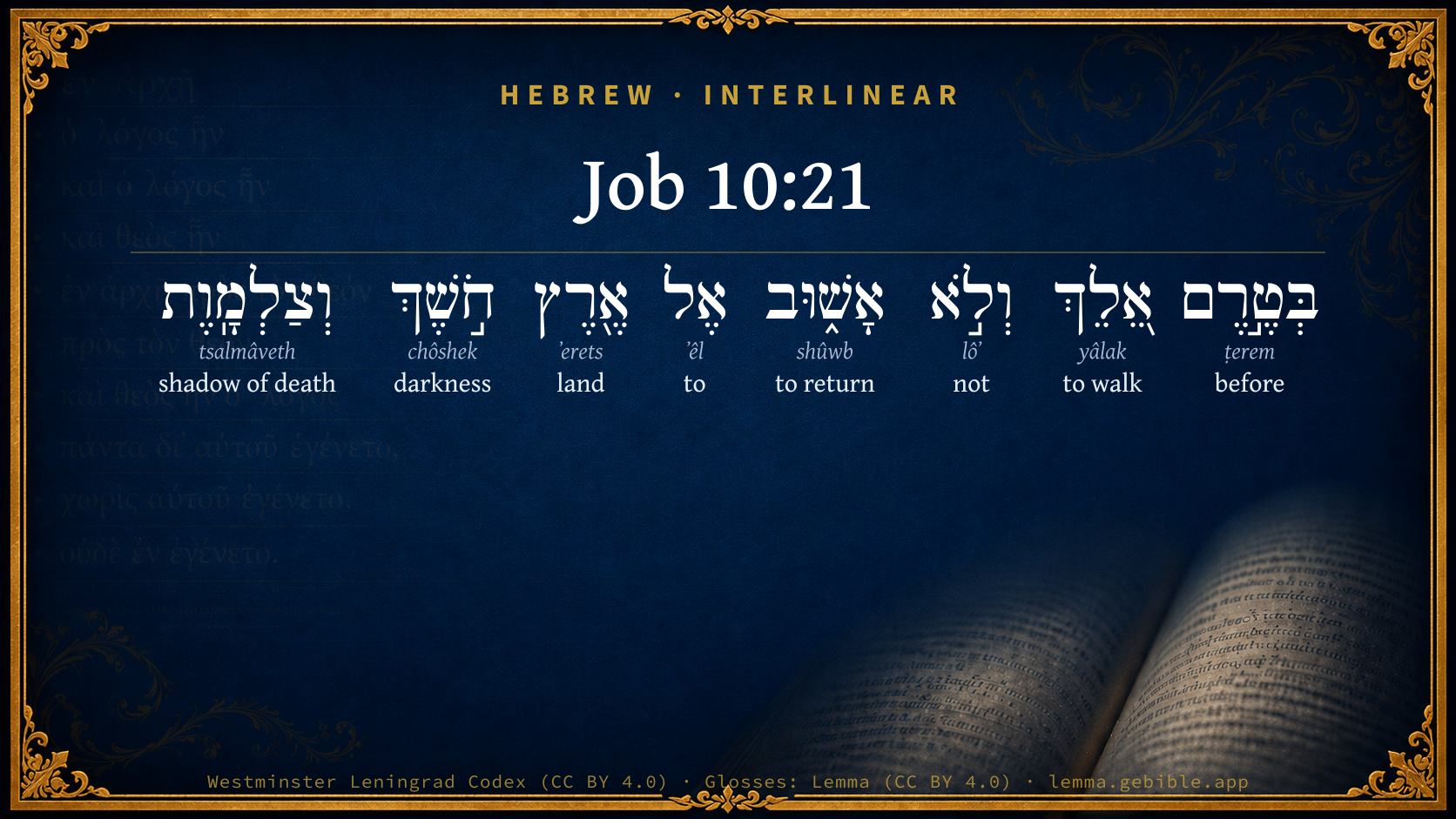
Job 10:21

Hebrew (Westminster Leningrad Codex) Job 10:21 appears in the Hebrew Old Testament. The text above is from the Westminster Leningrad Codex. Each word links to its Strong’s number, a concise gloss, and parsing drawn from the Open Scriptures Hebrew Bible morphology. Click any word for its full Brown-Driver-Briggs (BDB) entry.
Download image
Cite this verse

Job 10:21 (World English Bible). Public Domain. Lemma interlinear Bible study tool, https://lemma.gebible.app/v/job/10/21.

Show BibTeX & RIS
BibTeX
RIS
English Translation
Before I go where I shall not return from, To the land of darkness and of the shadow of death;
World English Bible · Public Domain
Download a study sheet

One document with this verse’s original text, its word-by-word gloss line, the meaning frame, cross-references with their text, attributed commentary, and full source and license credits — printable, and it pastes into notes with its structure intact.

This verse Autodidact and up

Study sheet (.html) Plain text (.txt)

A passage Seminary Student

Up to 50 verses in one chapter. A passage sheet keeps up to 6 commentary sources and 12 cross-references per verse, in the order this page ranks them, and says so on the sheet whenever that leaves anything out. Ask for a single verse and you get the Autodidact verse sheet above.

Everything on this page stays free to read, with no account — the sheet is a download of what is already on screen, not access to it.

Want to remove ads? Support Godless Engineer
Compare translations 3

The same verse in 3 English versions, stacked beneath the original-language interlinear above. Click any original word for its lexicon entry.

Each is an independent rendering of the whole verse — the interlinear is not word-aligned to these translations.

Highlighted words mark where these versions differ — a whole-verse word diff, not a word-by-word alignment.

  • World English Bible Public Domain
    Before I go where I shall not return from, To the land of darkness and of the shadow of death;
  • King James Version Public Domain
    Before I go whence I shall not return, even to the land of darkness and the shadow of death;
  • unfoldingWord Literal Text CC BY-SA 4.0
    Before I go—and do not return— to the land of darkness and deep darkness,

unfoldingWord Literal Text — © unfoldingWord, licensed CC BY-SA 4.0. Word-aligned USFM3 via Door43 (git.door43.org/unfoldingWord/en_ult).

Versions to compare (up to 4)

3 of 4 selected

Show all 18 translations

Every available English version of this verse, each an independent rendering of the whole verse.

  • World English Bible Public Domain
    Before I go where I shall not return from, To the land of darkness and of the shadow of death;
  • Berean Standard Bible Public Domain
    before I go—never to return—to a land of darkness and gloom,
  • Majority Standard Bible Public Domain
    before I go—never to return—to a land of darkness and gloom,
  • King James Version Public Domain
    Before I go whence I shall not return, even to the land of darkness and the shadow of death;
  • American Standard Version (1901) Public Domain
    Before I go whence I shall not return, `Even' to the land of darkness and of the shadow of death;
  • Revised Version (1885) Public Domain
    Before I go whence I shall not return, even to the land of darkness and of the shadow of death;
  • Geneva Bible (1599) Public Domain
    Before I goe and shall not returne, euen to the land of darkenesse and shadow of death:
  • Douay-Rheims (1899) Public Domain
    Before I go, and return no more, to a land that is dark and covered with the mist of death:
  • Young's Literal Translation Public Domain
    Before I go, and return not, Unto a land of darkness and death-shade,
  • Literal Standard Version CC BY-SA 4.0
    Before I go, and do not return, || To a land of darkness and death-shade,
  • Unlocked Literal Bible CC BY-SA 4.0
    before I go from where I will not return, to the land of darkness and of the shadow of death,
  • unfoldingWord Literal Text CC BY-SA 4.0
    Before I go—and do not return— to the land of darkness and deep darkness,
  • Darby Bible Public Domain
    Before I go, and never to return, -- to the land of darkness and the shadow of death;
  • World Messianic Bible Public Domain
    before I go where I will not return from, to the land of darkness and of the shadow of death;
  • Webster's Bible Public Domain
    Before I go whence I shall not return, even to the land of darkness, and the shades of death;
  • Free Bible Version CC BY-SA 4.0
    before I go to where I shall never return from, the land of darkness and the shadow of death—
  • Bible in Basic English Public Domain
    Before I go to the place from which I will not come back, to the land where all is dark and black,
  • JPS Tanakh (1917) Public Domain
    Before I go whence I shall not return, even to the land of darkness and of the shadow of death;

Literal Standard Version (2020), Covenant Press — licensed CC BY-SA 4.0. Text via the HelloAO Bible API (eBible.org). Unlocked Literal Bible (unfoldingWord) — licensed CC BY-SA 4.0. Text via the HelloAO Bible API (eBible.org). unfoldingWord Literal Text — © unfoldingWord, licensed CC BY-SA 4.0. Word-aligned USFM3 via Door43 (git.door43.org/unfoldingWord/en_ult). Free Bible Version, Dr. Jonathan Gallagher — licensed CC BY-SA 4.0. Text via the HelloAO Bible API (eBible.org).

Word by word

More ways to search: Search by grammar → Find every occurrence → Compare this word →

Practice this passage: Drill this verse → Learn its vocabulary →

About this verse

These counts appear in no published source. They are computed here, from the morphology-tagged text and Lemma’s own curated glosses. What Lemma adds →

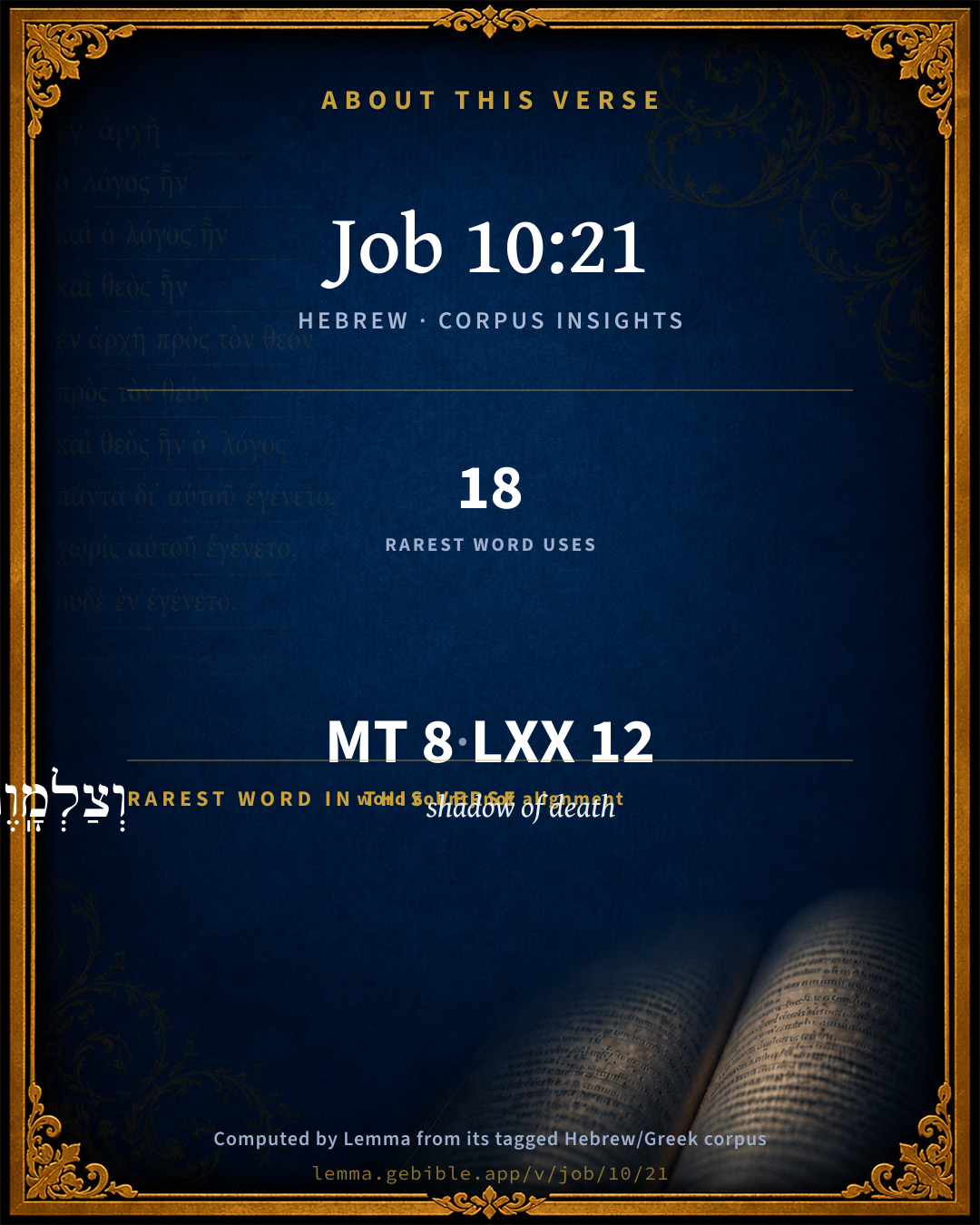
8
words
8
distinct lemmas
Wisdom
section

Notable vocabulary

The rarest word here is וְצַלְמָֽוֶת shadow of death H6757 — appearing just 18 times in the whole Hebrew Bible.

Shared distinctive vocabulary

וְצַלְמָֽוֶת shadow of death H6757 occurs in 17 verses of the Hebrew Bible. Also found in:

Grammatical profile

  • 2 verbs
  • 3 nouns
  • 1 preposition
  • 1 adverb
  • 1 particle

Verb forms

  • אֵ֭לֵךְ Qal · Imperfect
  • אָשׁ֑וּב Qal · Imperfect

Hebrew & Septuagint length

In English translation the verse runs 20 words from the Hebrew and 15 from the Septuagint (LXX English) — closely comparable.

A rough comparison of the two English renderings, which tokenize alike — not a word-level alignment.

Word counts can differ between the Hebrew and the Greek without any difference in meaning — e.g. the Hebrew direct-object marker אֵת has no separate Greek word, and Greek often adds the article ὁ.

In the original languages it is 8 Hebrew tokens and 12 Greek tokens — but the two are counted differently (Hebrew bundles its prefixes and suffixes into one token; the Greek is in lemma form), so that isn’t a like-for-like length.

Cross-references

12

Topical passages linked to Job 10:21 in the Treasury of Scripture Knowledge — connected by theme and wording, ordered by reader-vote popularity; previews shown in the World English Bible.

  • Job 3:5 Let darkness and the shadow of death claim it for their own. Let a cloud dwell on it. Let all that makes black the day terrify it.
  • 2 Samuel 12:23 But now he is dead, why should I fast? can I bring him back again? I shall go to him, but he will not return to me.
  • Job 16:22 For when a few years are come, I shall go the way from whence I shall not return.
  • Job 7:8–10 The eye of him who sees me shall see me no more. Your eyes shall be on me, but I shall not be.
  • Psalms 23:4 Even though I walk through the valley of the shadow of death, I will fear no evil, for you are with me. Your rod and your staff, they comfort me.
  • 2 Samuel 14:14 For we must needs die, and are as water split on the ground, which can't be gathered up again; neither does God take away life, but devises means, that he who is banished not be an outcast from him.
  • Job 3:13 For now should I have lain down and been quiet. I should have slept, then I would have been at rest,
  • Job 14:10–14 But man dies, and is laid low. Yes, man gives up the spirit, and where is he?
  • Psalms 88:11–12 Is your loving kindness declared in the grave? Or your faithfulness in Destruction?
  • Psalms 88:6 You have laid me in the lowest pit, In the darkest depths.
  • Isaiah 38:11 I said, I shall not see Yah, Yah in the land of the living: I shall see man no more with the inhabitants of the world.
  • Jeremiah 2:6 Neither said they, Where is Yahweh who brought us up out of the land of Egypt, who led us through the wilderness, through a land of deserts and of pits, through a land of drought and of the shadow of death, through a land that none passed through, and where no man lived?

Cross-references courtesy of OpenBible.info (CC BY 4.0).

Hebrew and Greek witnesses Masoretic Hebrew ↔ Greek Septuagint

The same verse in the two great witnesses to the Old Testament, shown verse-for-verse.

These are two independent witnesses, not word-aligned to each other, and the Septuagint is shown in lemma (dictionary) form.

Hebrew Job 10:21 Masoretic · Westminster Leningrad Codex

בְּטֶ֣רֶם אֵ֭לֵךְ וְלֹ֣א אָשׁ֑וּב אֶל אֶ֖רֶץ חֹ֣שֶׁךְ וְצַלְמָֽוֶת

Before I go where I shall not return from, To the land of darkness and of the shadow of death;

World English Bible · Public Domain

Greek LXX Job 10:21 Septuagint · lemma form

πρό ὁ ἐγώ πορεύομαι ὅθεν οὐ ἀναστρέφω εἰς γῆ σκοτεινός καί γνοφερός

before I go whence I shall not return, to a land of darkness and gloominess;

LXX2012 (modern English Septuagint) · Public Domain

Hebrew: Westminster Leningrad Codex (CC BY 4.0). Greek: Septuagint (public domain); English from LXX2012 (modern English Septuagint) (Public Domain). How the Septuagint differs from the Hebrew →

Commentary

Notes on Job 10:21 from classic Christian and Jewish commentators (each source and its license shown beneath its notes). The classic Christian expositions comment on the surrounding passage and are grouped to its opening verse, so a note may address several verses; the Jewish commentaries on the Tanakh (Rashi and others) are per-verse, so they appear only where the commentator wrote on this verse.

Lemma curates 59 commentaries, every one of them public domain or Creative Commons licensed, each selected and text-cleaned for this edition rather than reprinted as found. About our sources →

Trapp's Complete Commentary

John Trapp

Job 10:21 Before I go [whence] I shall not return, [even] to the land of darkness and the shadow of death;

Ver. 21. Before I go whence I shall not return] Before I go out of this world, never more to return hither to enjoy the comforts that are here to be had. Death is a departure hence, 1Pe 1:15 Luk 9:31. And so the ancients (Irenaeus, Clement, and others) used to call it. I shall change my place, but not my company, said that dying saint who had here walked with God in uprightness, and was now to bid adieu to all worldly interests (Tertul.). The old Romans were wont to say of a dead friend, Abiit, et reversurus est, He is gone, and will come again. It seems hereby that they had some dark notions of a resurrection; whence also their poets called a dead body a soul; - animamque sepulchro condimus (Virg. Æneid). The Hebrews did the like, Num 5:2; Num 9:10; Num 19:11 Hag 2:13-14, as having a more sure word of prophecy; and Job was clear in this point, firmly believing in the resurrection of his body, Job 19:26-27. It must needs be therefore that he speaks here of not returning into this world. See the like, Job 16:22 Psa 39:13 2Sa 12:23.

Even to the land of darkness, &c.] {See Trapp on "Job 10:22"}

John Trapp, A Commentary or Exposition upon All the Books of the Old and New Testament (1647–1656) — public domain. Text from a community e-Sword module.

Geneva Bible (1599)

Geneva Bible translators

He speaketh thus in the person of a sinner, that is overcome with passions and with the feeling of God’s judgments, and therefore cannot apprehend in that state the mercies of God, and comfort of the resurrection.

Geneva Bible (1599) marginal notes — public domain. Text via Bolls.life.

Adam Clarke's Commentary

Verse 21. I shall not return] I shall not return again from the dust to have a dwelling among men.

To the land of darkness] See Clarke on Job 3:5. There are here a crowd of obscure and dislocated terms, admirably expressive of the obscurity and uncertainty of the subject. What do we know of the state of separate spirits? What do we know of the spiritual world? How do souls exist separate from their respective bodies? Of what are they capable and what is their employment? Who can answer these questions? Perhaps nothing can be said much better of the state than is here said, a land of obscurity, like darkness.

The shadow of death] A place where death rules, over which he projects his shadow, intercepting every light of every kind of life. Without any order, ולא סדרים velo sedarim, having no arrangements, no distinctions of inhabitants; the poor and the rich are there, the master and his slave, the king and the beggar, their bodies in equal corruption and disgrace, their souls distinguished only by their moral character. Stripped of their flesh, they stand in their naked simplicity before God in that place.

Adam Clarke's Commentary on the Bible (1810–1826) — public domain. Text from a community e-Sword/MySword module.

John Gill's Exposition

A land of darkness, as darkness itself,.... Not merely like it, but truly so; as gross thick darkness, like that of Egypt, that might be felt; even blackness of darkness, which is as dark as it possibly can be; not only dark, but darkness, extremely dark:

and of the shadow of death; which is repeated for the illustration and confirmation of it, as having in it all kind of darkness, and that to the greatest degree:

without any order, or "orders" (i); or vicissitudes and successions of day and night, summer and winter, heat and cold, wet and dry; or revolutions of sun, moon, and stars, or of the constellations, as Aben Ezra; and whither persons go without any order, either of age, sex, or station; sometimes a young man, sometimes an old man, and the one before the other; sometimes a man, sometimes a woman; sometimes a king, prince, and nobleman, and sometimes a peasant; sometimes a rich man, and sometimes a poor man; no order is observed, but as death seizes them they are brought and laid in the grave, and there is no order there; the bones and dust of one and the other in a short time are mixed together, and, there is no knowing to whom they belong, only by the omniscient God:

and where the light is as darkness; were there anything in the grave that could with any propriety be called light, even that is nothing but darkness; darkness and light are the same thing there: or when "it shineth it is darkness" (k); that is, when the sun shines brightest here, as at noon day, it is entire darkness in the grave; no light is discerned there, the rays of the sun cannot penetrate there; and could they, there is no visive faculty in the dead to receive them; all darkness is in those secret places.

(i) "et non ordines", Pagninus, Montanus, Bolducius, Mercerus; "sine ordinibus", Cocceius, Schmidt. (k) "splendet", Beza, Junius & Tremellius, Piscator.

Next: Job Chapter 11

John Gill's Exposition of the Whole Bible (1746–1763) — public domain (CC PDM 1.0). Text via the HelloAO Bible API.

Albert Barnes' Notes on the Bible

Before I go - from where “I shall not return.” To the grave, to the land of shades, to

“That undiscovered country, from whose bourne

No traveler returns.”

To the land of darkness - This passage is important as furnishing an illustration of what was early understood about the regions of the dead. The essential idea here is that it was a land of darkness, of total and absolute night. This idea Job presents in a great variety of forms and phrases. He amplifies it, and uses apparently all the epithets which he can command to represent the utter and entire darkness of the place. The place referred to is not the grave, but the region beyond, the abode of departed spirits, the Hades of the ancients; and the idea here is, that it is a place where not a clear ray of light ever shines. That this was a common opinion of the ancients in regard to the world of departed spirits, is well known. Virgil thus speaks of those gloomy regions:

Oii, quibusimperium est animarum, umbraeque silentes,

Et Chaos, et Phlegethon, loca nocte tacentia late,

Sit mihi fas audita loqui; slt numine vestro

Pandere res alta terra et caligine mersas.

Ibant obscuri sola sub nocte per umbram,

Perque domos Ditis vacuas, et inania regna:

Quale per incertam lunam sub luce maligna

Est iter in silvis: ubi coelum condidit umbra

Jupiter, et rebus nox abstulit atra colorem

Aeneid vi. 259ff

A similar view of Hades was held by the Greeks. Thus, Theognis, 1007:

Ὠς μάκαρ εὐδυίμων τε και ὄλβιος, ὅστις ἄπειρος

Ἄθλων, εἰς ἥ δου δῶμα μέλαν κατέβη.

Hōs makar eudaimōn te kai olbios, hostis apeiros

Athlōn eis h' dou dōma melan katebē.

There is nowhere to be found, however, a description which for intensity and emphasis of expression surpasses this of Job.

Shadow of death - See this phrase explained in the note at Job 3:5.

Albert Barnes' Notes on the Bible (1834–1885) — public domain. Text from a community e-Sword/MySword module.

Haydock's Catholic Bible Commentary

Death, to the grave, or to hell, (Calmet) if my sins deserve it. (Haydock)

George Leo Haydock (1774–1849), Haydock's Catholic Family Bible and Commentary, 1859 edition — public domain. Excludes Psalms (Douay-Rheims chapter numbering differs from Protestant) and Deuterocanonical books (Catholic canon only).

Matthew Poole's English Annotations

To the place whence I shall not return into this world and life: see Job 7:9,10.

Darkness and the shadow of death, i.e. a dark and dismal shade: See Poole "Job 3:5".

Matthew Poole's English Annotations on the Holy Bible (1683–1685) — public domain. Text from a community e-Sword/MySword module.

Whedon's Commentary on the Bible

Daniel D. Whedon

21. Whence I shall not return —

The undiscovered country, from whose bourne

No traveller returns. — Hamlet, Job_3:1.

Daniel D. Whedon (gen. ed.), Commentary on the Old and New Testaments (1874–1909) — public domain. Text from a community e-Sword module.

The Pulpit Commentary

Before I go whence I shall not return. (comp. Job_7:9; and see 2Sa_12:23) Even to the land of darkness and the shadow of death. Job"s idea of the receptacle of the dead, while it has some analogies with the Egyptian under-world, and even more with the Greek and Roman conceptions of Hades or Orcus, was probably derived from Babylonia, or Chaldea, on which the land that he inhabited bordered. (Job_1:17) It was within the earth, consequently dark and sunless (compare the Umbrae of the Romans, and Euripides"s nekrwn keuymwna kai skotou pulav ), deep, (Job_11:8) dreary, fastened with belts and. (Job_17:16) The Babylonians spoke of it as "the abode of darkness and famine, where earth was men"s food, and their nourishment clay; where light was not seen, but in darkness they dwelt; where ghosts, like birds, fluttered their wings; and where, on the doors and on the doorposts, the dust lay undisturbed" (Transactions of the Society of Biblical Archaeology, vol. 1. p. 118).

Vers. 21, 22. The land of darkness.

I DEATH APPEARS TO LEAD TO A LAND OF DARKNESS.

1. We cannot see what lies beyond. Science cannot penetrate this mystery of mysteries. At best she can but dimly surmise the existence of an "unseen universe." Philosophy may reason of the soul"s immortality, but can throw no light into the tomb. The mind dashes itself in vain against the awful wall that separates it from the world beyond. One by one our most intimate friends leave us, and the dark doors open to receive them, but never a ray of light comes out, and "the rest is silence.

2. We shrink by natural instinct from death. Reason as we may, the grave is a horror to us. We people the land of the dead with terrors of the imagination. La Rochefoucauld says, "Neither the sun nor death can be looked at steadily," "Death is a fearful thing. ...To die, and go we know not where To lie in cold obstruction, and to rot; This sensible warm motion to become A kneaded clod; and the delighted spirit To bathe in fiery floods, or to reside In thrilling regions of thick-ribbed lee; To be imprison"d in the viewless winds, And blown with restless violence round about The pendent world, or to be worse than worst Of those, that lawless and incertain thoughts Imagine howling! too horrible! The weariest and most loathed worldly life That ago, ache, penury, and imprisonment Can lay on nature, is a paradise To what we fear of death. (Shakespeare.)

II WHETHER DEATH WILL LEAD TO A LAND OF DARKNESS DEPENDS ON OUR USE OF LIFE. Nature, science, philosophy, all leave the future obscure. But God has lifted the veil in the gospel enough to give us guidance, warning, and consolation. We learn from the revelation of Christ that the unseen land need be no place of terror and darkness. What it will be depends on our present conduct.

1. Death leads the impenitent sinner into a land of darkness. For him the horrors of imagination cannot be too black. No one can conceive the chill desolation of the "outer darkness," the dread despair of seeing the "door shut" on a rejected soul. The darkness will consist in separation from God, from blessed companionship, from joy, from life for the future existence of the lost is never called a future life. The dolorous words of Job are not too strong for the fate of lost souls.

2. Death leads the people of God into a land of light. The old-world gloom of the grove is dissipated by Christ, who has "brought life and immortality to light through the gospel". (2Ti_1:10) Here we have a great advance from the Old Testament standpoint, "The resurrection of Christ has thrown a flood of light into the regions beyond. It has shown us a "land of the leal," where the blessed dwell in light eternal St. Paul could even desire to depart and be with Christ, counting it gain to. (Php_1:21-23) All who have turned from sin to Christ may despise the darkness of death, for this is but the portal to the home of eternal life. W.F.A.

The Pulpit Commentary (1880–1919), ed. H.D.M. Spence-Jones & Joseph S. Exell — public domain. Text from a community e-Sword module.

Rashi

Rabbi Shlomo Yitzchaki (Rashi)

before I go While I am still alive, and the time for me to die has not yet arrived, desist from me and I will rest.

Rashi on the Tanakh — English translations: “The Judaica Press complete Tanach with Rashi, translated by A. J. Rosenberg” (CC BY 4.0); “Pentateuch with Rashi's commentary by M. Rosenbaum and A.M. Silbermann, 1929-1934” (public domain); “The Metsudah Tanach series, Lakewood, N.J” (CC BY 4.0); and “The Book of Joshua, Metsudah Publications, 1997” (CC BY 4.0). Text via Sefaria.

Lesson kit

Teaching starters — assembled from the data on this page, not authored interpretation. Every prompt links to the verse data it draws on. Edit before teaching.

Job, in the Wisdom, opens this verse with 8 words (8 distinct Hebrew lemmas). Its most distinctive word is tsalmâveth (“shadow of death”). A historical commentator’s framing appears above. Read the whole chapter for the surrounding context.

Discussion questions

  1. How does “shadow of death” (tsalmâveth) shape what this verse is saying?
  2. How does Job 3:5, which shares the word «shadow of death», read alongside this verse?
  3. These translations render this verse differently; the difference is in the English rendering, not the original. What questions does that raise?
  4. «אֵ֭לֵךְ» is a Qal Imperfect verb. How does that grammatical form shape the action described?
  5. Compare how Trapp's Complete Commentary and Geneva Bible (1599) read this verse. Where do they agree or differ?

Things to notice

Reading settings

Reading text

Shown beneath each verse's original-language words.

Old Testament
Old Testament edition

Read the OT as the Masoretic Hebrew (MT) or the Greek Septuagint (LXX).

English shown for the Greek Septuagint (in the Hebrew ↔ Greek comparison).

Comparing translations? Open the Compare panel on any verse page to stack up to four side by side.