
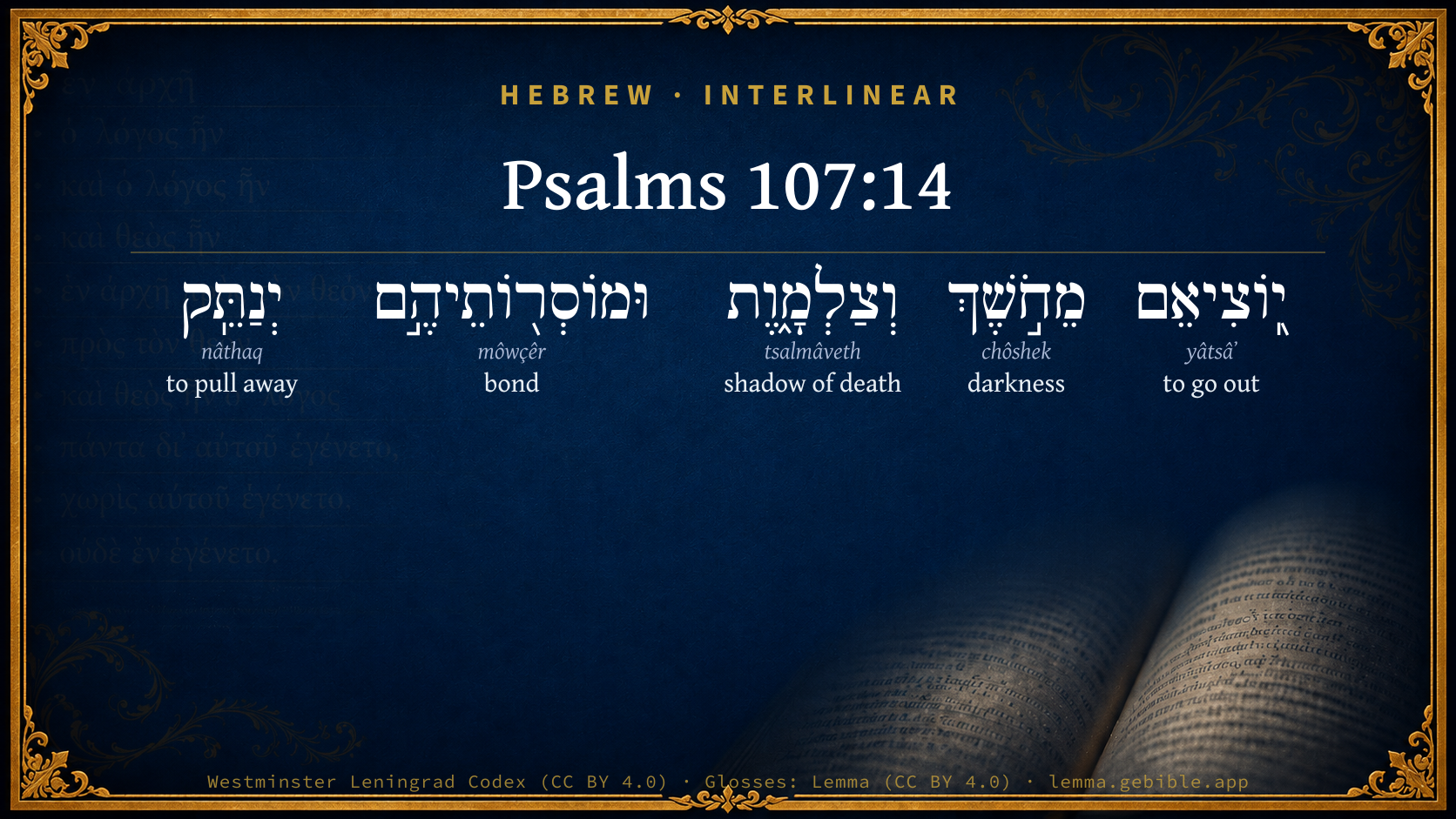
Psalms 107:14

Hebrew (Westminster Leningrad Codex) Psalms 107:14 appears in the Hebrew Old Testament. The text above is from the Westminster Leningrad Codex. Each word links to its Strong’s number, a concise gloss, and parsing drawn from the Open Scriptures Hebrew Bible morphology. Click any word for its full Brown-Driver-Briggs (BDB) entry.
Download image
Cite this verse

Psalms 107:14 (World English Bible). Public Domain. Lemma interlinear Bible study tool, https://lemma.gebible.app/v/psalms/107/14.

Show BibTeX & RIS
BibTeX
RIS
English Translation
He brought them out of darkness and the shadow of death, And broke their bonds in sunder.
World English Bible · Public Domain
Download a study sheet

One document with this verse’s original text, its word-by-word gloss line, the meaning frame, cross-references with their text, attributed commentary, and full source and license credits — printable, and it pastes into notes with its structure intact.

This verse Autodidact and up

Study sheet (.html) Plain text (.txt)

A passage Seminary Student

Up to 50 verses in one chapter. A passage sheet keeps up to 6 commentary sources and 12 cross-references per verse, in the order this page ranks them, and says so on the sheet whenever that leaves anything out. Ask for a single verse and you get the Autodidact verse sheet above.

Everything on this page stays free to read, with no account — the sheet is a download of what is already on screen, not access to it.

Want to remove ads? Support Godless Engineer
Compare translations 3

The same verse in 3 English versions, stacked beneath the original-language interlinear above. Click any original word for its lexicon entry.

Each is an independent rendering of the whole verse — the interlinear is not word-aligned to these translations.

Highlighted words mark where these versions differ — a whole-verse word diff, not a word-by-word alignment.

  • World English Bible Public Domain
    He brought them out of darkness and the shadow of death, And broke their bonds in sunder.
  • King James Version Public Domain
    He brought them out of darkness and the shadow of death, and brake their bands in sunder.
  • unfoldingWord Literal Text CC BY-SA 4.0
    He brought them out of darkness and gloom and broke apart their bonds.

unfoldingWord Literal Text — © unfoldingWord, licensed CC BY-SA 4.0. Word-aligned USFM3 via Door43 (git.door43.org/unfoldingWord/en_ult).

Versions to compare (up to 4)

3 of 4 selected

Show all 18 translations

Every available English version of this verse, each an independent rendering of the whole verse.

  • World English Bible Public Domain
    He brought them out of darkness and the shadow of death, And broke their bonds in sunder.
  • Berean Standard Bible Public Domain
    He brought them out of darkness and the shadow of death and broke away their chains.
  • Majority Standard Bible Public Domain
    He brought them out of darkness and the shadow of death and broke away their chains.
  • King James Version Public Domain
    He brought them out of darkness and the shadow of death, and brake their bands in sunder.
  • American Standard Version (1901) Public Domain
    He brought them out of darkness and the shadow of death, And brake their bonds in sunder.
  • Revised Version (1885) Public Domain
    He brought them out of darkness and the shadow of death, and brake their bands in sunder.
  • Geneva Bible (1599) Public Domain
    He brought them out of darkenes, and out of the shadowe of death, and brake their bandes asunder.
  • Douay-Rheims (1899) Public Domain
    And he brought them out of darkness, and the shadow of death; and broke their bonds in sunder.
  • Young's Literal Translation Public Domain
    He bringeth them out from the dark place, And death-shade, And their bands He draweth away.
  • Literal Standard Version CC BY-SA 4.0
    He brings them out from the dark place, || And death-shade, || And He draws away their bands.
  • Unlocked Literal Bible CC BY-SA 4.0
    He brought them out of darkness and gloom and broke their bonds.
  • unfoldingWord Literal Text CC BY-SA 4.0
    He brought them out of darkness and gloom and broke apart their bonds.
  • Darby Bible Public Domain
    He brought them out of darkness and the shadow of death, and broke their bands in sunder.
  • World Messianic Bible Public Domain
    He brought them out of darkness and the shadow of death, and broke away their chains.
  • Webster's Bible Public Domain
    He brought them out of darkness and the shades of death, and broke their bands asunder.
  • Free Bible Version CC BY-SA 4.0
    He brought them out of complete darkness, he broke their chains to pieces.
  • Bible in Basic English Public Domain
    He took them out of the dark and the black night, and all their chains were broken.
  • JPS Tanakh (1917) Public Domain
    He brought them out of darkness and the shadow of death, and broke their bands in sunder.

Literal Standard Version (2020), Covenant Press — licensed CC BY-SA 4.0. Text via the HelloAO Bible API (eBible.org). Unlocked Literal Bible (unfoldingWord) — licensed CC BY-SA 4.0. Text via the HelloAO Bible API (eBible.org). unfoldingWord Literal Text — © unfoldingWord, licensed CC BY-SA 4.0. Word-aligned USFM3 via Door43 (git.door43.org/unfoldingWord/en_ult). Free Bible Version, Dr. Jonathan Gallagher — licensed CC BY-SA 4.0. Text via the HelloAO Bible API (eBible.org).

Word by word

More ways to search: Search by grammar → Find every occurrence → Compare this word →

Practice this passage: Drill this verse → Learn its vocabulary →

About this verse

These counts appear in no published source. They are computed here, from the morphology-tagged text and Lemma’s own curated glosses. What Lemma adds →

5
words
5
distinct lemmas
Wisdom
section

Notable vocabulary

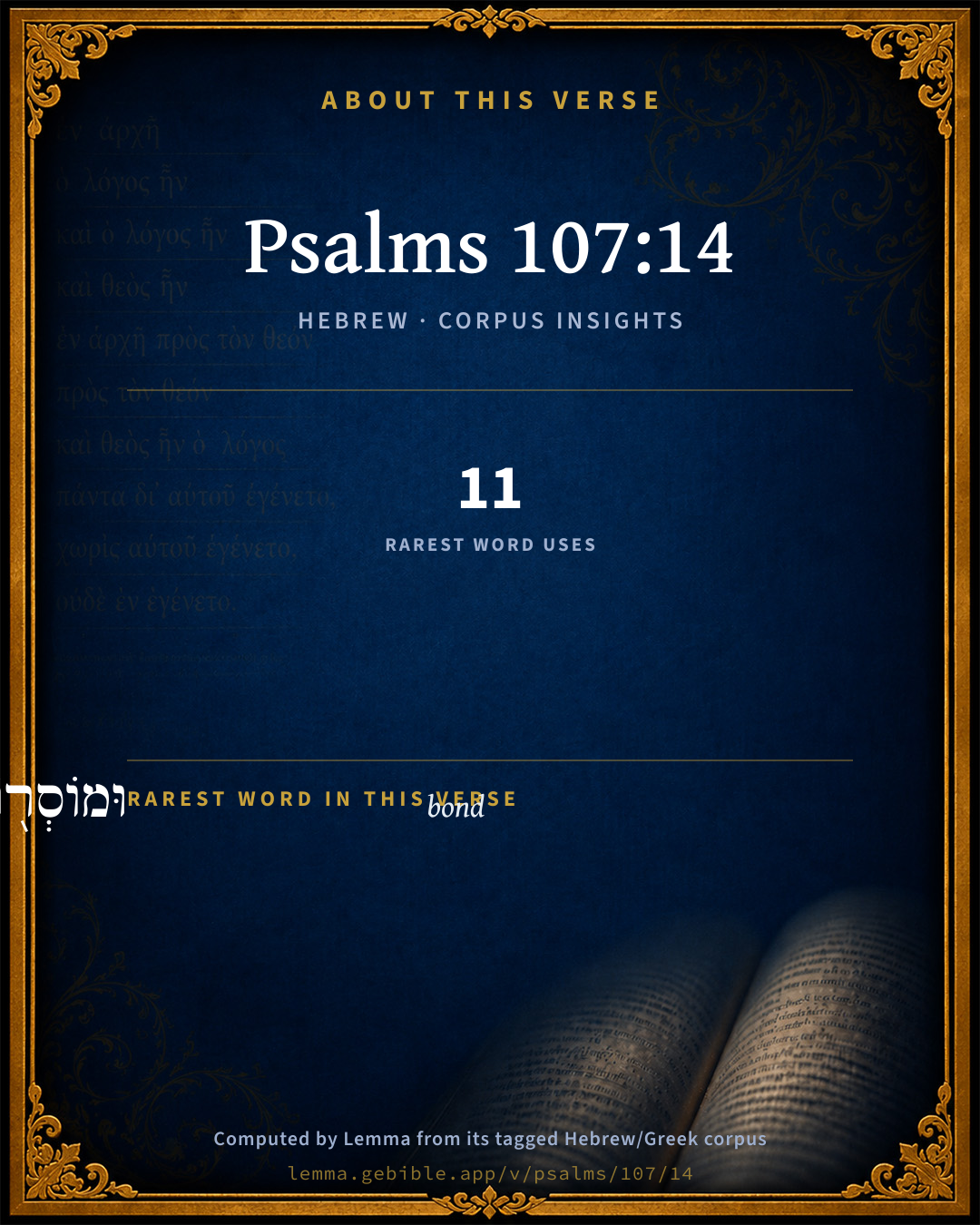
The rarest word here is וּמוֹסְר֖וֹתֵיהֶ֣ם bond H4147 — appearing just 11 times in the whole Hebrew Bible.

Shared distinctive vocabulary

וּמוֹסְר֖וֹתֵיהֶ֣ם bond H4147 occurs in 11 verses of the Hebrew Bible. Also found in:

Grammatical profile

  • 2 verbs
  • 3 nouns

Verb forms

  • יֽ֭וֹצִיאֵם Hiphil · Imperfect
  • יְנַתֵּֽק Piel · Imperfect

Hebrew & Septuagint length

In English translation the verse runs 17 words from the Hebrew and 17 from the Septuagint (LXX English) — the same length.

A rough comparison of the two English renderings, which tokenize alike — not a word-level alignment.

Word counts can differ between the Hebrew and the Greek without any difference in meaning — e.g. the Hebrew direct-object marker אֵת has no separate Greek word, and Greek often adds the article ὁ.

Cross-references

27

Topical passages linked to Psalms 107:14 in the Treasury of Scripture Knowledge — connected by theme and wording, ordered by reader-vote popularity; previews shown in the World English Bible.

  • Isaiah 42:16 I will bring the blind by a way that they don't know; in paths that they don't know will I lead them; I will make darkness light before them, and crooked places straight. These things will I do, and I will not forsake them.
  • Psalms 116:16 Yahweh, truly I am your servant. I am your servant, the son of your handmaid. You have freed me from my chains.
  • Ephesians 5:8 For you were once darkness, but are now light in the Lord. Walk as children of light,
  • Zechariah 9:11–12 As for you also, Because of the blood of your covenant, I have set free your prisoners from the pit in which is no water.
  • 1 Peter 2:9 But you are a chosen race, a royal priesthood, a holy nation, a people for God's own possession, that you may show forth the excellencies of him who called you out of darkness into his marvelous light:
  • Psalms 107:10 Some sat in darkness and in the shadow of death, Being bound in affliction and iron,
  • Isaiah 61:1 The Spirit of the Lord Yahweh is on me; because Yahweh has anointed me to preach good news to the humble; he has sent me to bind up the broken-hearted, to proclaim liberty to the captives, and the opening [of the prison] to those who are bound;
  • Jeremiah 52:31–34 It happened in the seven and thirtieth year of the captivity of Jehoiachin king of Judah, in the twelfth month, in the five and twentieth day of the month, that Evilmerodach king of Babylon, in the [first] year of his reign, lifted up the head of Jehoiachin king of Judah, and brought him forth out of prison;
  • Acts 5:19 But an angel of the Lord opened the prison doors by night, and brought them out, and said,
  • Job 36:8 If they are bound in fetters, And are taken in the cords of afflictions,
  • Job 42:10–12 Yahweh turned the captivity of Job, when he prayed for his friends. Yahweh gave Job twice as much as he had before.
  • Psalms 68:6 God sets the lonely in families. He brings out the prisoners with singing, But the rebellious dwell in a sun-scorched land.
  • Psalms 102:20 To hear the groans of the prisoner; To free those who are condemned to death;
  • Psalms 105:19–20 Until the time that his word happened, And Yahweh's word proved him true.
  • Luke 13:16 Ought not this woman, being a daughter of Abraham, whom Satan had bound eighteen long years, be freed from this bondage on the Sabbath day?"
  • Acts 5:25 One came and told them, "Behold, the men whom you put in prison are in the temple, standing and teaching the people."
  • Job 3:5 Let darkness and the shadow of death claim it for their own. Let a cloud dwell on it. Let all that makes black the day terrify it.
  • Job 10:21–22 Before I go where I shall not return from, To the land of darkness and of the shadow of death;
  • Job 33:30 To bring back his soul from the pit, That he may be enlightened with the light of the living.
  • Psalms 146:7 Who executes justice for the oppressed; Who gives food to the hungry. Yahweh frees the prisoners.
  • Isaiah 49:9 saying to those who are bound, Go forth; to those who are in darkness, Show yourselves. They shall feed in the ways, and on all bare heights shall be their pasture.
  • Isaiah 60:1–3 Arise, shine; for your light is come, and the glory of Yahweh is risen on you.
  • Acts 12:7–10 And behold, an angel of the Lord stood by him, and a light shone in the cell. He struck Peter on the side, and woke him up, saying, "Stand up quickly!" His chains fell off from his hands.
  • Acts 16:26–40 Suddenly there was a great earthquake, so that the foundations of the prison were shaken; and immediately all the doors were opened, and everyone's bonds were loosened.
  • Job 15:30 He shall not depart out of darkness; The flame shall dry up his branches, By the breath of God's mouth shall he go away.
  • Job 19:8 He has walled up my way so that I can't pass, And has set darkness in my paths.
  • Job 15:22 He doesn't believe that he shall return out of darkness, He is waited for by the sword.

Cross-references courtesy of OpenBible.info (CC BY 4.0).

Hebrew and Greek witnesses Masoretic Hebrew ↔ Greek Septuagint

The same verse in the two great witnesses to the Old Testament, shown verse-for-verse.

You’re reading Greek Psalm 106 (Hebrew Psalm 107). The Septuagint counts the superscription, so verse numbers can differ from the Hebrew — chapter-level alignment, not verse-by-verse. Numbering follows Rahlfs.

These are two independent witnesses, not word-aligned to each other, and the Septuagint is shown in lemma (dictionary) form.

Hebrew Psalms 107:14 Masoretic · Westminster Leningrad Codex

יֽ֭וֹצִיאֵם מֵחֹ֣שֶׁךְ וְצַלְמָ֑וֶת וּמוֹסְר֖וֹתֵיהֶ֣ם יְנַתֵּֽק

He brought them out of darkness and the shadow of death, And broke their bonds in sunder.

World English Bible · Public Domain

Greek LXX Greek Psalm 106:14 Septuagint · lemma form

καί ἐκἄγω αὐτός ἐκ σκότος καί σκιά θάνατος καί ὁ δεσμός αὐτός διαῥήγνυμι

And he brought them out of darkness and the shadow of death, and broke their bonds asunder.

LXX2012 (modern English Septuagint) · Public Domain

Hebrew: Westminster Leningrad Codex (CC BY 4.0). Greek: Septuagint (public domain); English from LXX2012 (modern English Septuagint) (Public Domain). How the Septuagint differs from the Hebrew →

Commentary

Notes on Psalms 107:14 from classic Christian and Jewish commentators (each source and its license shown beneath its notes). The classic Christian expositions comment on the surrounding passage and are grouped to its opening verse, so a note may address several verses; the Jewish commentaries on the Tanakh (Rashi and others) are per-verse, so they appear only where the commentator wrote on this verse.

Lemma curates 59 commentaries, every one of them public domain or Creative Commons licensed, each selected and text-cleaned for this edition rather than reprinted as found. About our sources →

Trapp's Complete Commentary

John Trapp

Psa 107:14 He brought them out of darkness and the shadow of death, and brake their bands in sunder.

Ver. 14. He brought them out of darkness] He sent his mandamus {a}, as Psa 44:4, and that did the deed, as Act 5:19; Act 12:7.

{a} Originally applied generically to a number of ancient writs, letters missive, or mandates, issued by the sovereign, directing the performance of certain acts.

John Trapp, A Commentary or Exposition upon All the Books of the Old and New Testament (1647–1656) — public domain. Text from a community e-Sword module.

The Biblical Illustrator

Joseph S. Exell

Psa_107:14-16

He brought them out of darkness and the shadow of death.

Song for the free, and hope for the bound

The deliverance here intended is one which is brought to us by redemption, and comes by the way of the great sacrifice upon Calvary.

I. Who are these favoured men?

1. Guilty men (verse 11). Hear this, ye sinful ones, and take heart! God has wrought great wonders for a people whom it seemed impossible for Him to notice. If they came into prison through rebellion, you would expect Him to leave them there. Yet rebels are set free by an act of immeasurable grace. The Redeemer has received gifts for men, yea, for the rebellious also.

2. Doomed men (verse 10). It is your condemned condition which needs free mercy; and, behold, the Lord meets your need in His boundless grace!

3. Bound men (verse 10). You long to be delivered, but you are unable to cut the cords which hold you. Jesus Christ has come on purpose that He might proclaim the opening of the prisons to them that are bound.

4. Weary men (verse 12). Come unto Me, etc.

5. Downcast men (verse 12). The Lord Jesus delights to lift up those that lie at His feet.

6. Helpless men. What a word that is--None to help! The proverb says, God helps those that help themselves. There is a sort of truth in it; but I venture to cover it with a far greater truth: God helps those that cannot help themselves. When there is none to help thee, then God will help thee.

7. They did at last take to praying (verse 13). There is that about prayer which makes it a token for good, a pledge of blessings on the road, a door of hope in dark hours. Where is the man that cries? Where is the man that prays? That is the man of whom it shall be said, and of others like him, The Lord brought them out of darkness and the shadow of death, etc.

II. How has this deliverance been wrought?

1. By the Lord Himself. There is no salvation worth the having which has not the hand of the Godhead in it. None but the Trinity can deliver a captive soul from the chains of sin, and death, and hell.

2. Next, the Lord did it alone He hath broken the gates of brass. Nobody else was there to aid in liberating the prisoner. When our Lord Jesus trod the winepress, He was alone. When the Spirit of God came to work in us eternal life, He wrought alone.

3. By the Lords own goodness. He gives the alms of His grace only to the undeserving.

4. Most completely--light, life, and liberty.

5. Everlastingly. O child of God, you were once shut up as with gates of brass, and bars of iron, and the devil thinks that one of these days he will get you behind those gates again! But he never will, for the Lord hath broken the gates of brass. The means of our captivity are no longer available.

III. What is to be done about this?

1. If the Lord has set any of you free--record it. Say, The Lord hath done great things for us.

2. When you have recorded it, then praise God with all your heart, every one of you, every day. When you have praised God yourselves, then entreat others to join with you. The oratorio of Gods praise needs a full choir. (C. H. Spurgeon.)

The Biblical Illustrator, edited by Joseph S. Exell (c. 1880s–1900s) — public domain. Text from a community e-Sword module.

J. A. Alexander on Psalms

Joseph Addison Alexander

14. (Psa 107:14) He brings them out from darkness and deathshade, and their bonds he severs. The terms used in describing the deliverance are studiously made to correspond with the account of the captivity in ver. 10. It is more remarkable, though possibly fortuitous, that the words of the second clause are the same which David puts into the mouth of the revolted nations, Psa 2:3. The English word severs is here used instead of breaks, in order to represent the more uncommon and poetical term used in Hebrew.

Joseph Addison Alexander, The Psalms Translated and Explained (1850) — public domain. Text from a community e-Sword module.

Adam Clarke's Commentary

Verse 14. He brought then out of darkness]

1. Gave them again peace and prosperity.

2. Repealed the sentence of death.

3. "Unbound the poor prisoners."

4. Broke their iron bonds in sunder.

Adam Clarke's Commentary on the Bible (1810–1826) — public domain. Text from a community e-Sword/MySword module.

Ellicott's Commentary for English Readers

(14) Break their bands in sunder.—See Psa_2:3.

A Bible Commentary for English Readers, edited by Charles John Ellicott (1878–1897) — public domain. Text from a community e-Sword module.

John Gill's Exposition

For he hath broken the gates of brass,.... The prison doors made of brass, as sometimes of iron, for the security of the prisoners; see Act 12:10. And cut the bars of iron in sunder; with which they were barred and secured. Hyperbolical phrases these, as Kimchi, expressing how exceeding strong the prison doors were, and the impossibility of an escape out of them, unless the Lord had delivered them; but when he works, none can let; all obstructions are easily removed by him; which is the sense of the words, see Isa 45:2. Vitringa, on Rev 12:2, interprets this of the subjection of the Roman emperors to the faith and obedience of Christ.

, interprets this of the subjection of the Roman emperors to the faith and obedience of Christ.

Psalms 107:17

psa 107:17

psa 107:17

psa 107:17Fools, because of their transgression,.... Or, "because of the way" (h) "of it"; their sinful course of life; for it is not for a single transgression they are afflicted, but for a continued series of sinning, which is a transgression of the law of God. By "fools" are meant not idiots, men devoid of common sense and natural understanding, but immoral persons; such who have no understanding of divine and spiritual things; are destitute of the fear of God, which is the beginning of wisdom; without the true knowledge of God himself; place their happiness in sensual enjoyments; seek only the gratification of their lust; scoff at religion, make a mock at sin, and have no concern about a future state, and the welfare of their immortal souls.

And because of their iniquities, are afflicted; or "afflict themselves", or "find themselves afflicted" (i); rather "bring affliction on themselves" (k). Not that these are the only persons that are afflicted; for many truly wise, good, and gracious persons, have a large share of afflictions; though not in a way of punishment for sin, or in wrath and hot displeasure, but in a way of fatherly chastisement, and in love: nor are fools for the most part afflicted, nor so much as others; they are not in trouble and plagued as other men; which has been a stumbling to good men: however, sometimes they are afflicted in this life, and in a way of punishment for sin; and very often are but the more hardened by it; though to some it is an ordinance for good; they are awakened by it to a sense of sin, and acknowledgment of it, and to seek for pardoning grace and mercy. This is the "third" instance of persons in distress calling on the Lord, and finding relief (l), and being under obligation to praise him.

(h) "propter viam", Pagninus, Montanus, Piscator. (i) "sese adflictos sentiebant", Michaelis. (k) So Tigurine version. (l) "Flectitur iratus voce rogante Deus", Ovid. de Arte Amandi, l. 1.

John Gill's Exposition of the Whole Bible (1746–1763) — public domain (CC PDM 1.0). Text via the HelloAO Bible API.

Albert Barnes' Notes on the Bible

He brought them out of darkness and the shadow of death - From their captivity; from calamity which seemed to be as gloomy as the shadow of death.

And brake their bands in sunder - Delivered them from their bondage, as if the bands of a prisoner or captive were suddenly broken.

Albert Barnes' Notes on the Bible (1834–1885) — public domain. Text from a community e-Sword/MySword module.

The Treasury of David

Charles H. Spurgeon

Ver. 14. He brought them out of darkness and the shadow of death. The Lord in providence fetches out prisoners from their cells and bids them breathe the sweet fresh air again, and then he takes off their fetters, and gives liberty to their aching limbs. So also he frees men from care and trouble, and especially from the misery and slavery of sin. This he does with his own hand, for in the experience of all the saints it is certified that there is no jail delivery unless by the Judge himself.

And brake their bands in sunder. Set them free by force, so liberating them that they could not be chained again, for he had broken the manacles to pieces. The Lord's deliverances are of the most complete and triumphant kind, he neither leaves the soul in darkness nor in bonds, nor does he permit the powers of evil again to enthral the liberated captive. What he does is done for ever. Glory be to his name.

Ver. 14. God gives light, life, liberty.

Psalms 107:15*

Charles H. Spurgeon's The Treasury of David (1869–1885) — public domain. Psalms only. Text from a community e-Sword/MySword module.

Whedon's Commentary on the Bible

Daniel D. Whedon

14. Darkness—Compare Isa_42:7, and Psa_107:10, above.

Daniel D. Whedon (gen. ed.), Commentary on the Old and New Testaments (1874–1909) — public domain. Text from a community e-Sword module.

The Pulpit Commentary

He brought them out of dark ness and the shadow of death. Wherein they sat (ver. 10). And brake their bands in sunder. Freed them from their fetters (ver. 10), whatever they were.

The Pulpit Commentary (1880–1919), ed. H.D.M. Spence-Jones & Joseph S. Exell — public domain. Text from a community e-Sword module.

unfoldingWord translationNotes

Door43 World Missions Community

He brought them

"Yahweh brought those in prison"

darkness and gloom

Both "darkness" and "gloom" have basically the same meaning and are used to emphasize how dark the prison was. See how you translated this in Psalms 107:10. AT: "complete darkness" (See: Doublet)

Oh that people would praise Yahweh for his covenant faithfulness

Here the word "Oh" is used to convey a strong desire for people to praise Yahweh. The abstract noun "faithfulness" can be translated with an adjective. See how you translated this in Psalms 107:8. AT: "Let people praise Yahweh because he is faithful to his covenant" or "People should praise Yahweh because he is faithful to his covenant" (See: Exclamations and Abstract Nouns)

For he

"because he"

For he has broken the gates of bronze and cut through the bars of iron

Both of these phrases describe Yahweh freeing his people from prison and are used to emphasize that Yahweh truly freed them. AT: "He freed his people from prison" (See: Parallelism and Assumed Knowledge and Implicit Information)

translationWords

darkness

bind

covenant faithfulness

amazed

gate

bronze

unfoldingWord translationNotes — © Distant Shores Media and the Door43 World Missions Community, licensed CC BY-SA 4.0. Source: git.door43.org/Door43/en_tn.

Lesson kit

Teaching starters — assembled from the data on this page, not authored interpretation. Every prompt links to the verse data it draws on. Edit before teaching.

Psalms, in the Wisdom, opens this verse with 5 words (5 distinct Hebrew lemmas). Its most distinctive word is môwçêr (“bond”). A historical commentator’s framing appears above. Read the whole chapter for the surrounding context.

Discussion questions

  1. The word môwçêr carries the sense “bond.” How does it shape the verse?
  2. How does Job 39:5, which shares the word «bond», read alongside this verse?
  3. These translations render this verse differently. What is at stake in choosing one wording over another?
  4. «יֽ֭וֹצִיאֵם» is a Hiphil Imperfect verb. How does that grammatical form shape the action described?
  5. Compare how Trapp's Complete Commentary and The Biblical Illustrator read this verse. Where do they agree or differ?

Things to notice

Reading settings

Reading text

Shown beneath each verse's original-language words.

Old Testament
Old Testament edition

Read the OT as the Masoretic Hebrew (MT) or the Greek Septuagint (LXX).

English shown for the Greek Septuagint (in the Hebrew ↔ Greek comparison).

Comparing translations? Open the Compare panel on any verse page to stack up to four side by side.