Job 28:3

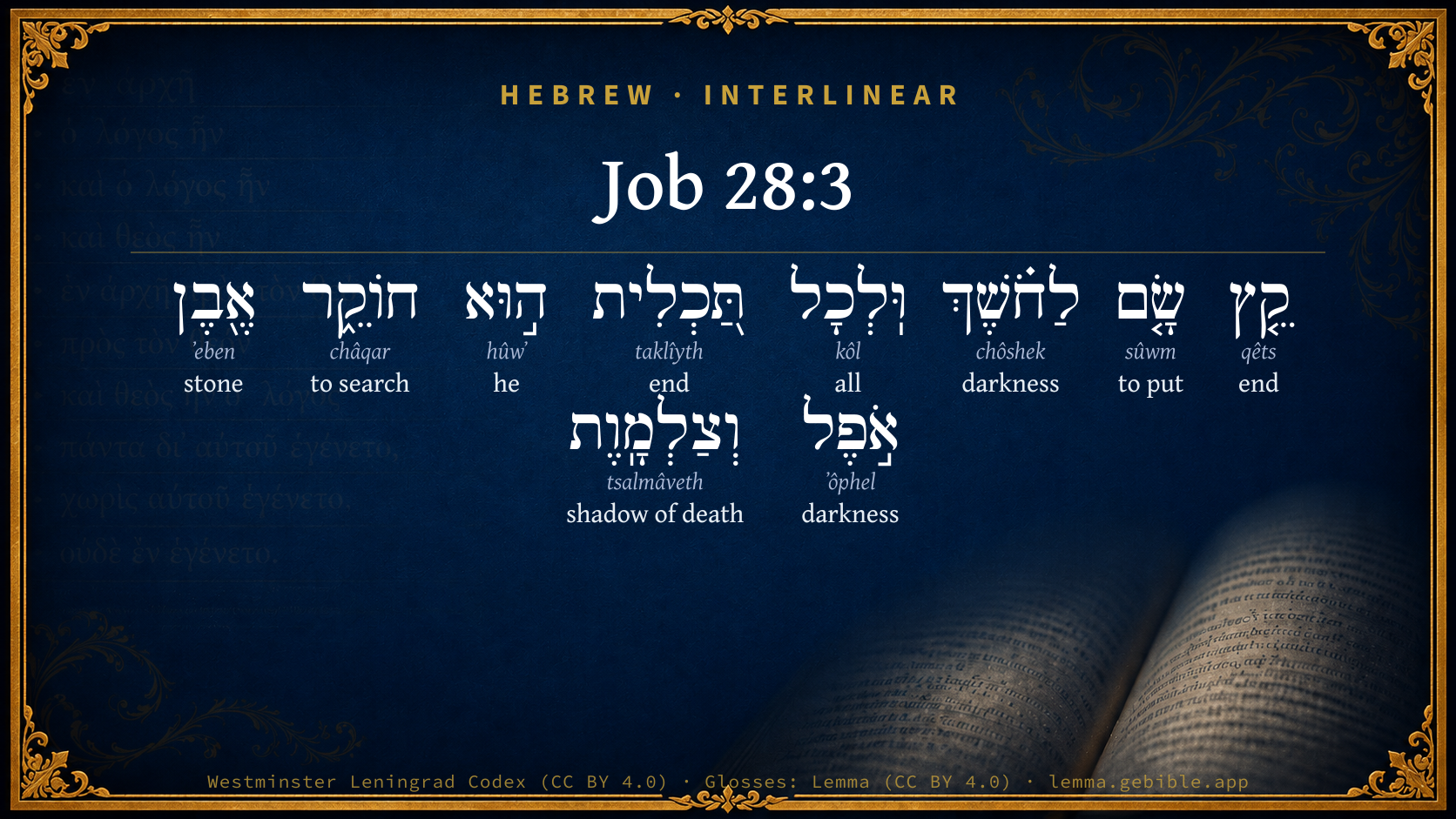
Hebrew (Westminster Leningrad Codex) Job 28:3 appears in the Hebrew Old Testament. The text above is from the Westminster Leningrad Codex. Each word links to its Strong’s number, a concise gloss, and parsing drawn from the Open Scriptures Hebrew Bible morphology. Click any word for its full Brown-Driver-Briggs (BDB) entry.
Download image
Cite this verse

Job 28:3 (World English Bible). Public Domain. Lemma interlinear Bible study tool, https://lemma.gebible.app/v/job/28/3.

Show BibTeX & RIS
BibTeX
RIS
English Translation
Man sets an end to darkness, And searches out, to the furthest bound, The stones of obscurity and of thick darkness.
World English Bible · Public Domain
Download a study sheet

One document with this verse’s original text, its word-by-word gloss line, the meaning frame, cross-references with their text, attributed commentary, and full source and license credits — printable, and it pastes into notes with its structure intact.

This verse Autodidact and up

Study sheet (.html) Plain text (.txt)

A passage Seminary Student

Up to 50 verses in one chapter. A passage sheet keeps up to 6 commentary sources and 12 cross-references per verse, in the order this page ranks them, and says so on the sheet whenever that leaves anything out. Ask for a single verse and you get the Autodidact verse sheet above.

Everything on this page stays free to read, with no account — the sheet is a download of what is already on screen, not access to it.

Want to remove ads? Support Godless Engineer
Compare translations 3

The same verse in 3 English versions, stacked beneath the original-language interlinear above. Click any original word for its lexicon entry.

Each is an independent rendering of the whole verse — the interlinear is not word-aligned to these translations.

Highlighted words mark where these versions differ — a whole-verse word diff, not a word-by-word alignment.

  • World English Bible Public Domain
    Man sets an end to darkness, And searches out, to the furthest bound, The stones of obscurity and of thick darkness.
  • King James Version Public Domain
    He setteth an end to darkness, and searcheth out all perfection: the stones of darkness, and the shadow of death.
  • unfoldingWord Literal Text CC BY-SA 4.0
    Setting an end to darkness, he is searching out, to every extremity, a stone of gloom and deep darkness.

unfoldingWord Literal Text — © unfoldingWord, licensed CC BY-SA 4.0. Word-aligned USFM3 via Door43 (git.door43.org/unfoldingWord/en_ult).

Versions to compare (up to 4)

3 of 4 selected

Show all 18 translations

Every available English version of this verse, each an independent rendering of the whole verse.

  • World English Bible Public Domain
    Man sets an end to darkness, And searches out, to the furthest bound, The stones of obscurity and of thick darkness.
  • Berean Standard Bible Public Domain
    Man puts an end to the darkness; he probes the farthest recesses for ore in deepest darkness.
  • Majority Standard Bible Public Domain
    Man puts an end to the darkness; he probes the farthest recesses for ore in deepest darkness.
  • King James Version Public Domain
    He setteth an end to darkness, and searcheth out all perfection: the stones of darkness, and the shadow of death.
  • American Standard Version (1901) Public Domain
    `Man' setteth an end to darkness, And searcheth out, to the furthest bound, The stones of obscurity and of thick darkness.
  • Revised Version (1885) Public Domain
    Man setteth an end to darkness, and searcheth out to the furthest bound the stones of thick darkness and of the shadow of death.
  • Geneva Bible (1599) Public Domain
    God putteth an end to darkenesse, and he tryeth the perfection of all things: he setteth a bond of darkenesse, and of the shadowe of death.
  • Douay-Rheims (1899) Public Domain
    He hath set a time for darkness, and the end of all things he considereth, the stone also that is in the dark and the shadow of death.
  • Young's Literal Translation Public Domain
    An end hath he set to darkness, And to all perfection he is searching, A stone of darkness and death-shade.
  • Literal Standard Version CC BY-SA 4.0
    He has set an end to darkness, || And he is searching to all perfection, || A stone of darkness and death-shade.
  • Unlocked Literal Bible CC BY-SA 4.0
    A man sets an end to darkness and searches out, to the farthest limit, the stones in obscurity and thick darkness.
  • unfoldingWord Literal Text CC BY-SA 4.0
    Setting an end to darkness, he is searching out, to every extremity, a stone of gloom and deep darkness.
  • Darby Bible Public Domain
    [Man] putteth an end to the darkness, and exploreth to the utmost limit, the stones of darkness and of the shadow of death.
  • World Messianic Bible Public Domain
    Man sets an end to darkness, and searches out, to the furthest bound, the stones of obscurity and of thick darkness.
  • Webster's Bible Public Domain
    He setteth an end to darkness, and searcheth out all perfection: the stones of darkness, and the shades of death.
  • Free Bible Version CC BY-SA 4.0
    Miners take lamps into the darkness underground and search for ore as far as they can go in the shadows and the gloom.
  • Bible in Basic English Public Domain
    Man puts an end to the dark, searching out to the farthest limit the stones of the deep places of the dark.
  • JPS Tanakh (1917) Public Domain
    Man setteth an end to darkness, and searcheth out to the furthest bound the stones of thick darkness and of the shadow of death.

Literal Standard Version (2020), Covenant Press — licensed CC BY-SA 4.0. Text via the HelloAO Bible API (eBible.org). Unlocked Literal Bible (unfoldingWord) — licensed CC BY-SA 4.0. Text via the HelloAO Bible API (eBible.org). unfoldingWord Literal Text — © unfoldingWord, licensed CC BY-SA 4.0. Word-aligned USFM3 via Door43 (git.door43.org/unfoldingWord/en_ult). Free Bible Version, Dr. Jonathan Gallagher — licensed CC BY-SA 4.0. Text via the HelloAO Bible API (eBible.org).

Word by word

More ways to search: Search by grammar → Find every occurrence → Compare this word →

Practice this passage: Drill this verse → Learn its vocabulary →

תַּ֭כְלִית
taklîyth
H8503
“end”
Noun, Common, Feminine, Singular, Absolute
Part of Speech
Noun
Type
Common
Gender
Feminine
Number
Singular
State
Absolute
Full BDB Definition

Origin: from H3615

TWOT: 982f

end, perfection, consummation, completion, completeness - end - completeness
  1. קֵ֤ץ qêts H7093 “end” Noun, Common, Masculine, Singular, Absolute
  2. שָׂ֤ם sûwm H7760 “putting” Verb, Qal, Participle Active, Masculine, Singular, Absolute
  3. לַחֹ֗שֶׁךְ chôshek H2822 “to/for the · darkness” Preposition, Determined + Noun, Common, Masculine, Singular, Absolute
  4. וּֽלְכָל kôl H3605 “and · to/for · all of” Conjunction + Preposition + Noun, Common, Masculine, Singular, Construct
  5. ה֣וּא hûwʼ H1931 “he” Pronoun, Personal, 3rd Person, Masculine, Singular
  6. חוֹקֵ֑ר châqar H2713 “searching” Verb, Qal, Participle Active, Masculine, Singular, Absolute
  7. אֶ֖בֶן ʼeben H68 “stone of” Noun, Common, Feminine, Singular, Construct
  8. אֹ֣פֶל ʼôphel H652 “darkness” Noun, Common, Masculine, Singular, Absolute
  9. וְצַלְמָֽוֶת tsalmâveth H6757 “and · shadow of death” Conjunction + Noun, Common, Masculine, Singular, Absolute

About this verse

These counts appear in no published source. They are computed here, from the morphology-tagged text and Lemma’s own curated glosses. What Lemma adds →

10
words
10
distinct lemmas
Wisdom
section

Notable vocabulary

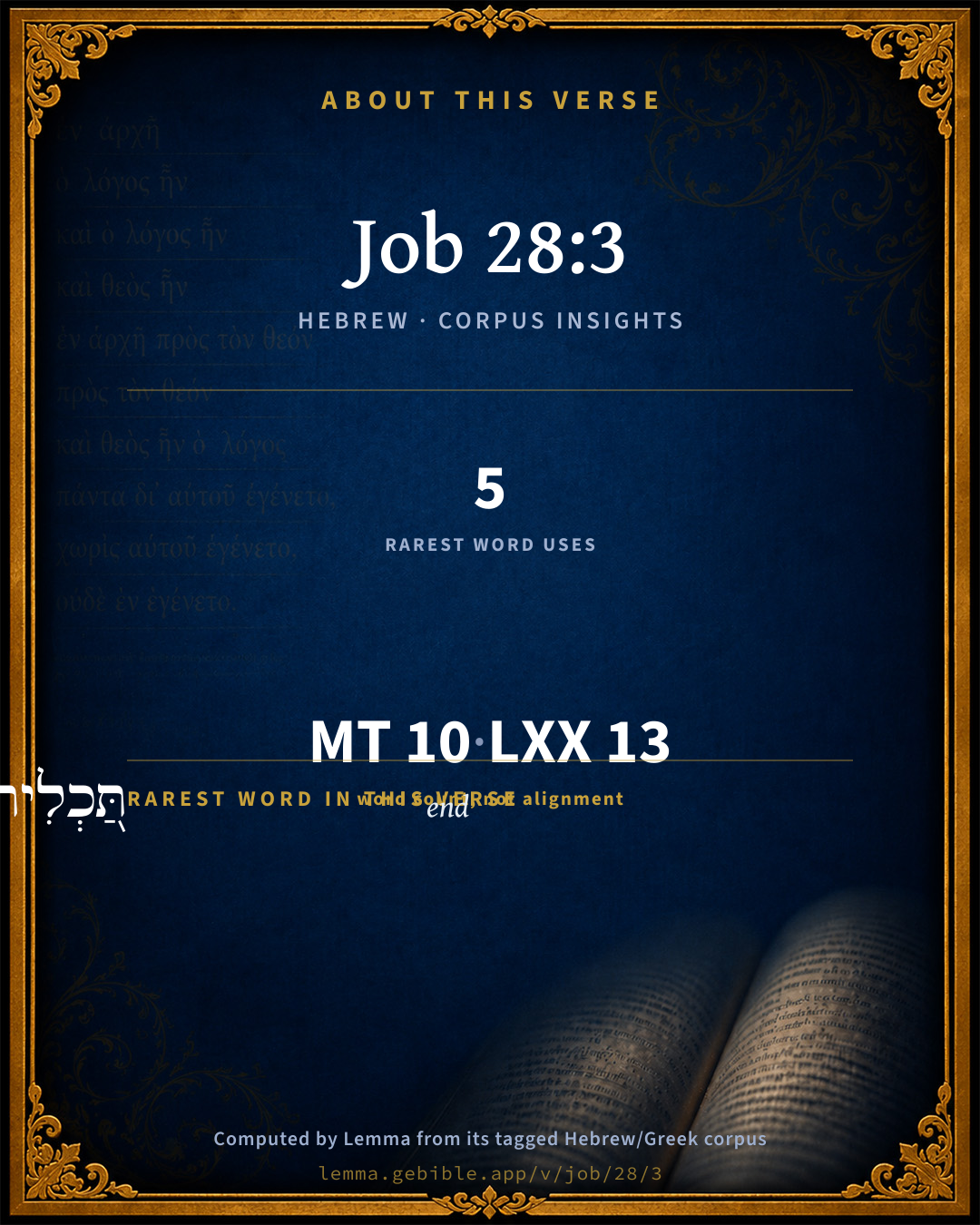
The rarest word here is תַּ֭כְלִית end H8503 — appearing just 5 times in the whole Hebrew Bible.

Shared distinctive vocabulary

תַּ֭כְלִית end H8503 occurs in 5 verses of the Hebrew Bible. Also found in:

Grammatical profile

  • 2 verbs
  • 7 nouns
  • 1 pronoun

Verb forms

  • שָׂ֤ם Qal · Participle Active
  • חוֹקֵ֑ר Qal · Participle Active

Hebrew & Septuagint length

In English translation the verse runs 21 words from the Hebrew and 22 from the Septuagint (LXX English) — closely comparable.

A rough comparison of the two English renderings, which tokenize alike — not a word-level alignment.

Word counts can differ between the Hebrew and the Greek without any difference in meaning — e.g. the Hebrew direct-object marker אֵת has no separate Greek word, and Greek often adds the article ὁ.

In the original languages it is 10 Hebrew tokens and 13 Greek tokens — but the two are counted differently (Hebrew bundles its prefixes and suffixes into one token; the Greek is in lemma form), so that isn’t a like-for-like length.

Cross-references

8

Topical passages linked to Job 28:3 in the Treasury of Scripture Knowledge — connected by theme and wording, ordered by reader-vote popularity; previews shown in the World English Bible.

  • Ecclesiastes 1:13 I applied my heart to seek and to search out by wisdom concerning all that is done under the sky. It is a heavy burden that God has given to the sons of men to be afflicted with.
  • Job 10:21–22 Before I go where I shall not return from, To the land of darkness and of the shadow of death;
  • Job 12:22 He uncovers deep things out of darkness, And brings out to light the shadow of death.
  • Job 38:16–17 "Have you entered into the springs of the sea? Or have you walked in the recesses of the deep?
  • Proverbs 2:4 If you seek her as silver, And search for her as for hidden treasures:
  • Habakkuk 2:13 Behold, isn't it of Yahweh of Hosts that the peoples labor for the fire, and the nations weary themselves for vanity?
  • Matthew 6:33 But seek first God's Kingdom, and his righteousness; and all these things will be given to you as well.
  • Luke 16:8 "His lord commended the dishonest manager because he had done wisely, for the children of this world are, in their own generation, wiser than the children of the light.

Cross-references courtesy of OpenBible.info (CC BY 4.0).

Hebrew and Greek witnesses Masoretic Hebrew ↔ Greek Septuagint

The same verse in the two great witnesses to the Old Testament, shown verse-for-verse.

These are two independent witnesses, not word-aligned to each other, and the Septuagint is shown in lemma (dictionary) form.

Hebrew Job 28:3 Masoretic · Westminster Leningrad Codex

קֵ֤ץ שָׂ֤ם לַחֹ֗שֶׁךְ וּֽלְכָל תַּ֭כְלִית ה֣וּא חוֹקֵ֑ר אֶ֖בֶן אֹ֣פֶל וְצַלְמָֽוֶת

Man sets an end to darkness, And searches out, to the furthest bound, The stones of obscurity and of thick darkness.

World English Bible · Public Domain

Greek LXX Job 28:3 Septuagint · lemma form

τάξις τίθημι σκότος καί πᾶς πέρας αὐτός ἐκἀκριβαζομαι λίθος σκοτία καί σκιά θάνατος

He has set a bound to darkness, and he searches out every limit: a stone is darkness, and the shadow of death.

LXX2012 (modern English Septuagint) · Public Domain

Hebrew: Westminster Leningrad Codex (CC BY 4.0). Greek: Septuagint (public domain); English from LXX2012 (modern English Septuagint) (Public Domain). How the Septuagint differs from the Hebrew →

Commentary

Notes on Job 28:3 from classic Christian and Jewish commentators (each source and its license shown beneath its notes). The classic Christian expositions comment on the surrounding passage and are grouped to its opening verse, so a note may address several verses; the Jewish commentaries on the Tanakh (Rashi and others) are per-verse, so they appear only where the commentator wrote on this verse.

Lemma curates 59 commentaries, every one of them public domain or Creative Commons licensed, each selected and text-cleaned for this edition rather than reprinted as found. About our sources →

Trapp's Complete Commentary

John Trapp

Job 28:3 He setteth an end to darkness, and searcheth out all perfection: the stones of darkness, and the shadow of death.

Ver. 3. He setteth an end to darkness] i.e. He (viz. the miner) brings light down into the dark entrails of the earth, and fetches out those metals that had long lain hid there, and that else would never have been beheld. Though Nature hath taken pleasure, as one speaketh, to hide all these metals, yet industry provideth man of certain marks for to discover them, and infallible conjectures to know the time when they must be drawn out of their darkness. Habent metallici suas virgas metallicas, Metal workers have their metal rods, whereby they search into and distinguish between metals and minerals.

Quasque recondiderat, Stygiisque admoverat undis,

Effodiuntur opes irritamenta malorum (Ovid. Metam.).

And searcheth out all perfection] sc. That is to be found in those subterraneous cells, in that bosom and bottom of the earth; the utmost that is there to be had he thoroughly eviscerateth, digging many yards underground, where nothing is to be seen but a deadly shade; Ex cuius horrore mori quis posset; enough to frighten one to death; beside the deadly damps, which suddenly breaking out of the veins of the earth, do sometimes choke the workmen.

The stones of darkness, &c.] That is, the darkest stones that lie lowest of all in the earth’s bowels, whither one would wonder how any man should ever come; and especially how the sun and stars should come by their influences to make those metals, and the precious stones, that are engendered and bred in the darksome and deadly vaults of the earth.

John Trapp, A Commentary or Exposition upon All the Books of the Old and New Testament (1647–1656) — public domain. Text from a community e-Sword module.

Geneva Bible (1599)

Geneva Bible translators

There is nothing but it is compassed within certain limits, and hath an end, but God’s wisdom.

Geneva Bible (1599) marginal notes — public domain. Text via Bolls.life.

Jamieson, Fausset & Brown

Robert Jamieson, A. R. Fausset & David Brown

"Man makes an end of darkness," by exploring the darkest depths (with torches).

all perfection--rather, carries out his search to the utmost perfection; most thoroughly searches the stones of darkness and of the shadow of death (thickest gloom); that is, the stones, whatever they be, embedded in the darkest bowels of the earth [UMBREIT] (Job 26:10).

Jamieson, Fausset & Brown — Commentary Critical and Explanatory on the Whole Bible (1871) — public domain (CC PDM 1.0). Text via the HelloAO Bible API.

Adam Clarke's Commentary

Verse 3. He setteth an end to darkness] As it is likely Job still refers to mining, the words above may be understood as pointing out the persevering industry of man in penetrating into the bowels of the earth, in order to seek for metals and precious stones. Even the stones that lay hidden in the bowels of the earth he has digged for and brought to light, and has penetrated in directions in which the solar light could not be transmitted; so that he appears to have gone to the regions of the shadow of death. Mr. Good translates: "Man delveth into the region of darkness; and examineth, to the uttermost limit, the stones of darkness and death-shade."

Adam Clarke's Commentary on the Bible (1810–1826) — public domain. Text from a community e-Sword/MySword module.

Ellicott's Commentary for English Readers

(3) He setteth an end to darkness.—May be read thus, Man setteth an end to darkness, and searcheth out to the furthest bound the stones of darkness and the shadow of death.

A Bible Commentary for English Readers, edited by Charles John Ellicott (1878–1897) — public domain. Text from a community e-Sword module.

The Cambridge Bible for Schools and Colleges

gen. ed. J. J. S. Perowne

3–11. Description of mining operations.

he setteth] To prevent ambiguity it is better to translate, man setteth, or, men set. The phrase “setteth an end to darkness” hardly refers to the light shed by the miner’s lamp; the expression is more general, meaning that men penetrate into what is dark and deep in the earth as if it were light and above ground—as the next clause explains.

searcheth out all perfection] Rather, searcheth out to the very end, or, utmost limit, the stones of darkness and the shadow of death, that is, the darkest recesses in the bowels of the earth. The word, very end or utmost limit is that occurring, ch. Job_26:10 (see notes) and ch. Job_11:7. On “shadow of death” see on ch. Job_24:17.

The Cambridge Bible for Schools and Colleges (gen. ed. J. J. S. Perowne; Cambridge University Press, 1878–1918) — public domain. Text from a community e-Sword module.

John Gill's Exposition

He setteth an end to darkness,.... Some understand this and what follows of God, who, by making the luminaries, has fixed the periods and revolutions of light and darkness, of day and night; or who has determined the times before appointed, for the discoveries of things in nature, as mines of gold, silver, and precious stones, how long they should lie in darkness, and then be brought to light, and who searches out the perfection of all things in nature; and makes them known to men, when he himself and his ways are not to be found out unto perfection by men; but rather this is to be understood of the miner that digs for the above metals, who, when he opens a mine, lets in natural light, or carries artificial light along with him, and so puts an end to the darkness which had reigned there before, even from the creation:

and searcheth out all perfection; searches thoroughly the mines he opens, and gets all he can out of them, and searches perfectly into the nature of the ore; he finds, and tries, and proves it, what it is, its worth and value:

the stones of darkness, and the shadow of death; searches and digs through them, to get at what he is seeking; or brings stones, precious stones, to light, which lay in darkness from the beginning, and in such places which were the shadow of death, and looked dismal and horrible, and even threatened with death, to get into and fetch them out: so spiritual miners, that search into the mines of the Scriptures, should not be discouraged with darkness and difficulties that may attend their search; but should continue it, in order to find out truths that have lain in darkness, more precious than gold and silver, and the richest gems; and such who search for them in like manner as miners do shall find them, Pro 2:4.

John Gill's Exposition of the Whole Bible (1746–1763) — public domain (CC PDM 1.0). Text via the HelloAO Bible API.

Albert Barnes' Notes on the Bible

He setteth an end to darkness - That is, man does. The reference here is undoubtedly to the operations of mining, and the idea is, that man delves into the darkest regions; he goes even to the outer limits of darkness; he penetrates everywhere. Probably the allusion is derived from the custom of carrying torches into mines.

And searcheth out all perfection - Makes a complete search; examines everything; carries the matter to the utmost. The idea is not that he searches out all perfection - as our translation would seem to convey; but that he makes a complete and thorough search - and yet after all he does not come to the true and highest wisdom.

The stones of darkness - The last stone, says Herder, in the mining investigations in the time of Job; the corner or boundary stone, as it were, of the kingdom of darkness and night. Prof. Lee supposes that there is allusion here to the fact that stones were used as “weights,” and that the idea is, that man had ascertained the “exact weight” of the gross darkness, that is, had taken an accurate admeasurement of it, or had wholly investigated it. But this solution seems far-fetched. Schultens supposes the center of the earth to be denoted by this expression. But it seems to me that the words “stone” and “darkness” are to be separated, and that the one is not used to qualify the other. The sense is, that man searches out everything; he perfectly and accurately penetrates everywhere, and examines all objects; “the stone” (אבן 'eben), that is, the rocks, the mines; “the darkness” (אפל 'ôphel), that is, the darkness of the cavern, the interior of the earth; “and the shadow of death” (צלמות tsalmâveth), that is, the most dark and impenetrable regions of the earth. So it is rendered by Coverdale: “The stones, the dark, and the horrible shadow.”

Albert Barnes' Notes on the Bible (1834–1885) — public domain. Text from a community e-Sword/MySword module.

Haydock's Catholic Bible Commentary

He (God) hath, &c. (Haydock) --- Darkness, before which these inventions could not be made; (Menochius) or, man has been able to measure the hours of day and night by the shadow of the sun, and by other means. He always strives to perfect his works, and examines with care the mines which lay concealed in the most profound obscurity. (Calmet) --- Precious stones and metals lie the deepest. (Menochius) --- From the consideration of these beautiful works, men ought to raise their minds to the Creator, and wisely rest in him alone. (Worthington)

George Leo Haydock (1774–1849), Haydock's Catholic Family Bible and Commentary, 1859 edition — public domain. Excludes Psalms (Douay-Rheims chapter numbering differs from Protestant) and Deuterocanonical books (Catholic canon only).

Matthew Poole's English Annotations

He; either,

1. Man, the miner; or,

2. God, of whose works of nature he here speaks; or,

3. God as the chief author and director, and man as God’s instrument in the work.

An end; or, a bound, how far the darkness shall reach, and how far the dark and hidden parts and treasures of the earth shall be searched, and discovered, and brought to light.

All perfection, i.e. metals and minerals, which are nothing else but earth concocted, and hardened, and brought to maturity and perfection. Or, unto all perfection, i.e. he perfectly and exactly searcheth them out; although the Hebrew lamed may be here only a note of the accusative case, as our translation takes it.

The stones; either gems and precious stones, which are called by this word, Pro 26:8; or those stones out of which the metals forementioned are taken.

Of darkness, and the shadow of death; which lie hid in the dark and deadly shades and bowels of the earth.

Matthew Poole's English Annotations on the Holy Bible (1683–1685) — public domain. Text from a community e-Sword/MySword module.

Whedon's Commentary on the Bible

Daniel D. Whedon

3. He — The miner.

An end to darkness — The torch of the miner dispels the darkness of the mine, and thus “he setteth an end to darkness.” and searcheth out perfectly, (literally, to every extremity, to the utmost,) the stones of darkness (metals) and the shadow of death. Ancient commentators thought that Job meant by this phrase to designate the centre of the earth. Schultens gives sixteen theories on this subject. Pliny, whose description of mining (about A.D. 77) remarkably illustrates that of Job says: “We penetrate the bowels of the earth and seek riches in the abode of the dead (manes.”) — Nat. Hist., Job_33:21.

Daniel D. Whedon (gen. ed.), Commentary on the Old and New Testaments (1874–1909) — public domain. Text from a community e-Sword module.

The Pulpit Commentary

He setteth an end to darkness. Man, in his desire to obtain these metals, "setteth an end to darkness," i.e. letteth in the light of day, or the artificial light which he carries with him, upon the natural abode of darkness, the inner parts of the earth. The miner"s first operation is to pierce the ground with a shaft, perpendicular, horizontal, or oblique, as suits his purpose. Through this the light enters into what was previously pitch darkness. And searcheth out all perfection: the stones of darkness, and the shadow of death; rather, and searcheth out to the furthest bound the stones of thick darkness and of the shadow of death; explores, i.e. "the entire murky regina within the earth, notwithstanding its fearful gloom and obscurity.

The Pulpit Commentary (1880–1919), ed. H.D.M. Spence-Jones & Joseph S. Exell — public domain. Text from a community e-Sword module.

John Wesley's Explanatory Notes

Perfection - Whatever is deeply wrought in the deepest caverns. Stones of darkness - The precious stones which lie hid in the dark bowels of the earth, where no living thing can dwell.

John Wesley, Explanatory Notes Upon the Whole Bible (1754–1765) — public domain. Text via the GEBible commentary corpus.

unfoldingWord translationNotes

Door43 World Missions Community

A man sets an end to darkness

Here "sets an end to darkness" represents shining a light in the darkness. People used a lantern or a torch for light. AT: "A man carries light into dark places" (See: Metonymy)

to the farthest limit

"to the farthest parts of the mine"

obscurity ... thick darkness

These two phrases are used together to emphasize that the mine is extremely dark. (See: Doublet)

shaft

a deep narrow hole dug into the ground or rock. People go down into the hole to mine it.

places that are forgotten by anyone's foot

The foot is spoken of as if it is a person who can remember. AT: "places where people no longer walk" or "where no one ever walks" (See: Personification)

He hangs far away from people

How and where he hangs can be stated clearly. AT: "Far away from people, he hangs from a rope in the shaft" (See: Assumed Knowledge and Implicit Information)

translationWords

darkness

people group

life

unfoldingWord translationNotes — © Distant Shores Media and the Door43 World Missions Community, licensed CC BY-SA 4.0. Source: git.door43.org/Door43/en_tn.

Rashi

Rabbi Shlomo Yitzchaki (Rashi)

He made an end The Omnipresent [made an end] when there will be darkness, for the heavens shall vanish and the earth shall rot away, and He fathoms the end of everything.

a stone A stone whence darkness and the shadow of death emanate. A stone is the place of the source of trouble. For this reason, a place of trouble is called a stone, like a man who dashes his foot against a stone, who suffers pain. So I heard. This is like (Isa. 34:11), “a line of waste and stones of destruction”; (Dan. 2:45), “that from the mountain a stone was cut.”

Rashi on the Tanakh — English translations: “The Judaica Press complete Tanach with Rashi, translated by A. J. Rosenberg” (CC BY 4.0); “Pentateuch with Rashi's commentary by M. Rosenbaum and A.M. Silbermann, 1929-1934” (public domain); “The Metsudah Tanach series, Lakewood, N.J” (CC BY 4.0); and “The Book of Joshua, Metsudah Publications, 1997” (CC BY 4.0). Text via Sefaria.

Lesson kit

Teaching starters — assembled from the data on this page, not authored interpretation. Every prompt links to the verse data it draws on. Edit before teaching.

Job, in the Wisdom, opens this verse with 10 words (10 distinct Hebrew lemmas). Its most distinctive word is taklîyth (“end”). A historical commentator’s framing appears above. Read the whole chapter for the surrounding context.

Discussion questions

  1. How does “end” (taklîyth) shape what this verse is saying?
  2. Nehemiah 3:21 shares the word «end» with this verse. How do the two illuminate each other?
  3. These translations render this verse differently; the difference is in the English rendering, not the original. What questions does that raise?
  4. The verb «שָׂ֤ם» is Qal Participle Active. How does its form color the action?
  5. Reading how Trapp's Complete Commentary and Geneva Bible (1599) read this verse, where do the two commentators agree and where do they part?

Things to notice

Reading settings

Reading text

Shown beneath each verse's original-language words.

Old Testament
Old Testament edition

Read the OT as the Masoretic Hebrew (MT) or the Greek Septuagint (LXX).

English shown for the Greek Septuagint (in the Hebrew ↔ Greek comparison).

Comparing translations? Open the Compare panel on any verse page to stack up to four side by side.