Zephaniah 1:15

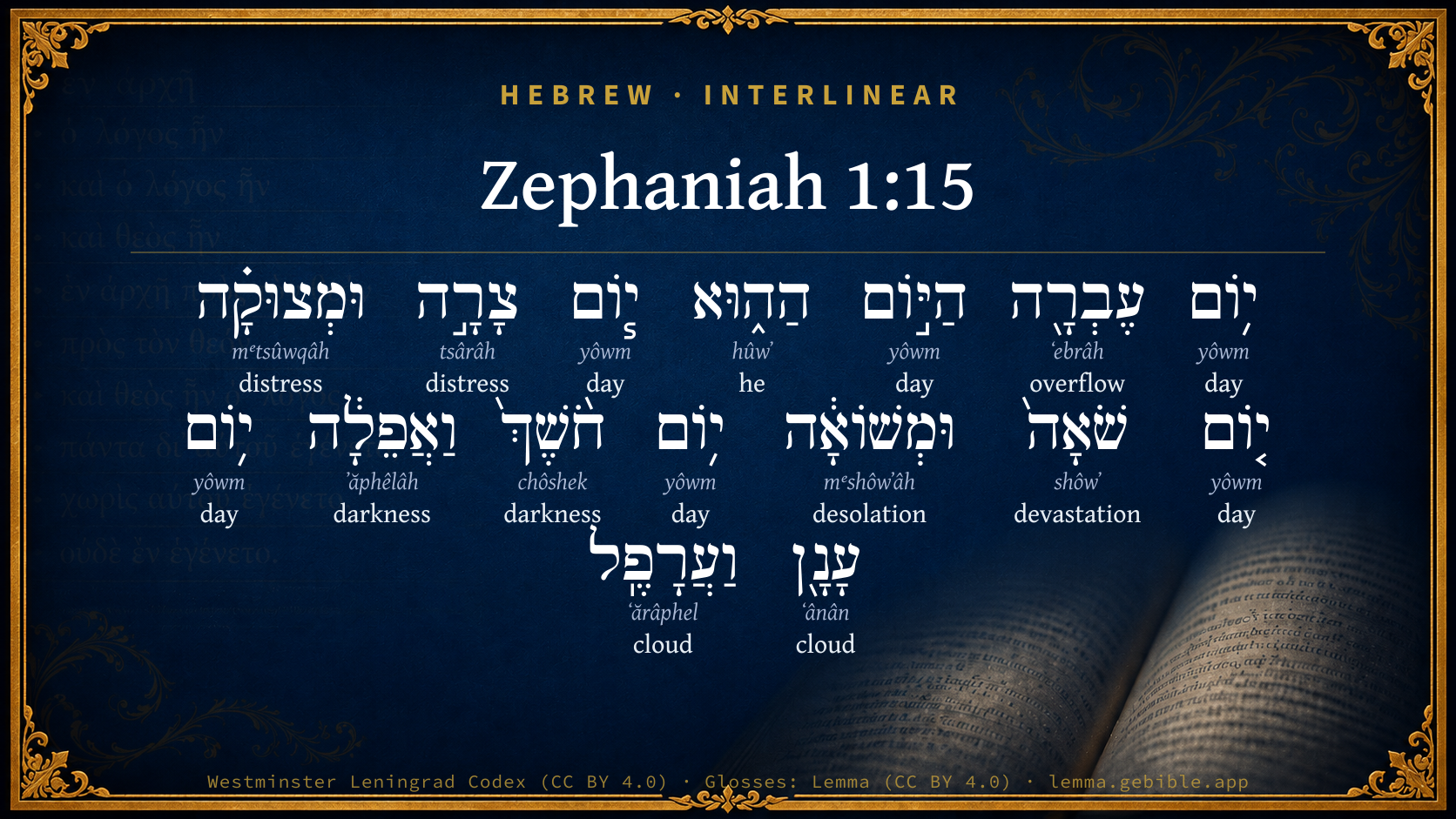
Hebrew (Westminster Leningrad Codex) Zephaniah 1:15 appears in the Hebrew Old Testament. The text above is from the Westminster Leningrad Codex. Each word links to its Strong’s number, a concise gloss, and parsing drawn from the Open Scriptures Hebrew Bible morphology. Click any word for its full Brown-Driver-Briggs (BDB) entry.
Download image
Cite this verse

Zephaniah 1:15 (World English Bible). Public Domain. Lemma interlinear Bible study tool, https://lemma.gebible.app/v/zephaniah/1/15.

Show BibTeX & RIS
BibTeX
RIS
English Translation
That day is a day of wrath, a day of distress and anguish, a day of trouble and ruin, a day of darkness and gloom, a day of clouds and blackness,
World English Bible · Public Domain
Download a study sheet

One document with this verse’s original text, its word-by-word gloss line, the meaning frame, cross-references with their text, attributed commentary, and full source and license credits — printable, and it pastes into notes with its structure intact.

This verse Autodidact and up

Study sheet (.html) Plain text (.txt)

A passage Seminary Student

Up to 50 verses in one chapter. A passage sheet keeps up to 6 commentary sources and 12 cross-references per verse, in the order this page ranks them, and says so on the sheet whenever that leaves anything out. Ask for a single verse and you get the Autodidact verse sheet above.

Everything on this page stays free to read, with no account — the sheet is a download of what is already on screen, not access to it.

Want to remove ads? Support Godless Engineer
Compare translations 3

The same verse in 3 English versions, stacked beneath the original-language interlinear above. Click any original word for its lexicon entry.

Each is an independent rendering of the whole verse — the interlinear is not word-aligned to these translations.

Highlighted words mark where these versions differ — a whole-verse word diff, not a word-by-word alignment.

  • World English Bible Public Domain
    That day is a day of wrath, a day of distress and anguish, a day of trouble and ruin, a day of darkness and gloom, a day of clouds and blackness,
  • King James Version Public Domain
    That day is a day of wrath, a day of trouble and distress, a day of wasteness and desolation, a day of darkness and gloominess, a day of clouds and thick darkness,
  • unfoldingWord Literal Text CC BY-SA 4.0
    That day a day of wrath, a day of distress and anguish, a day of destruction and desolation, a day of darkness and gloom, a day of cloud and overcast,

unfoldingWord Literal Text — © unfoldingWord, licensed CC BY-SA 4.0. Word-aligned USFM3 via Door43 (git.door43.org/unfoldingWord/en_ult).

Versions to compare (up to 4)

3 of 4 selected

Show all 18 translations

Every available English version of this verse, each an independent rendering of the whole verse.

  • World English Bible Public Domain
    That day is a day of wrath, a day of distress and anguish, a day of trouble and ruin, a day of darkness and gloom, a day of clouds and blackness,
  • Berean Standard Bible Public Domain
    That day will be a day of wrath, a day of trouble and distress, a day of destruction and desolation, a day of darkness and gloom, a day of clouds and blackness,
  • Majority Standard Bible Public Domain
    That day will be a day of wrath, a day of trouble and distress, a day of destruction and desolation, a day of darkness and gloom, a day of clouds and blackness,
  • King James Version Public Domain
    That day is a day of wrath, a day of trouble and distress, a day of wasteness and desolation, a day of darkness and gloominess, a day of clouds and thick darkness,
  • American Standard Version (1901) Public Domain
    That day is a day of wrath, a day of trouble and distress, a day of wasteness and desolation, a day of darkness and gloominess, a day of clouds and thick darkness,
  • Revised Version (1885) Public Domain
    That day is a day of wrath, a day of trouble and distress, a day of wasteness and desolation, a day of darkness and gloominess, a day of clouds and thick darkness,
  • Geneva Bible (1599) Public Domain
    That day is a day of wrath, a day of trouble and heauinesse, a day of destruction and desolation, a day of obscuritie and darkenesse, a day of cloudes and blackenesse,
  • Douay-Rheims (1899) Public Domain
    That day is a day of wrath, a day of tribulation and distress, a day of calamity and misery, a day of darkness and obscurity, a day of clouds and whirlwinds,
  • Young's Literal Translation Public Domain
    A day of wrath `is' that day, A day of adversity and distress, A day of waste and desolation, A day of darkness and gloominess, A day of cloud and thick darkness.
  • Literal Standard Version CC BY-SA 4.0
    A day of wrath [is] that day, || A day of adversity and distress, || A day of devastation and desolation, || A day of darkness and gloominess, || A day of cloud and thick darkness,
  • Unlocked Literal Bible CC BY-SA 4.0
    That day will be a day of fury, a day of distress and anguish, a day of storm and devastation, a day of darkness and gloom, a day of clouds and thick darkness.
  • unfoldingWord Literal Text CC BY-SA 4.0
    That day a day of wrath, a day of distress and anguish, a day of destruction and desolation, a day of darkness and gloom, a day of cloud and overcast,
  • Darby Bible Public Domain
    That day is a day of wrath, a day of trouble and distress, a day of ruin and desolation, a day of darkness and gloom, a day of clouds and gross darkness,
  • World Messianic Bible Public Domain
    That day is a day of wrath, a day of distress and anguish, a day of trouble and ruin, a day of darkness and gloom, a day of clouds and blackness,
  • Webster's Bible Public Domain
    That day is a day of wrath, a day of trouble and distress, a day of wasting and desolation, a day of darkness and gloominess, a day of clouds and thick darkness,
  • Free Bible Version CC BY-SA 4.0
    It will be a day of anger, a day of trouble and distress, a day of disaster and ruin, a day of darkness and gloom, a day of clouds and blackness,
  • Bible in Basic English Public Domain
    That day is a day of wrath, a day of trouble and sorrow, a day of wasting and destruction, a day of dark night and deep shade, a day of cloud and thick dark.
  • JPS Tanakh (1917) Public Domain
    That day is a day of wrath, a day of trouble and distress, a day of wasteness and desolation, a day of darkness and gloominess, a day of clouds and thick darkness,

Literal Standard Version (2020), Covenant Press — licensed CC BY-SA 4.0. Text via the HelloAO Bible API (eBible.org). Unlocked Literal Bible (unfoldingWord) — licensed CC BY-SA 4.0. Text via the HelloAO Bible API (eBible.org). unfoldingWord Literal Text — © unfoldingWord, licensed CC BY-SA 4.0. Word-aligned USFM3 via Door43 (git.door43.org/unfoldingWord/en_ult). Free Bible Version, Dr. Jonathan Gallagher — licensed CC BY-SA 4.0. Text via the HelloAO Bible API (eBible.org).

Word by word

More ways to search: Search by grammar → Find every occurrence → Compare this word →

Practice this passage: Drill this verse → Learn its vocabulary →

וּמְשׁוֹאָ֔ה
mᵉshôwʼâh
H4875
“and · desolation”
Conjunction + Noun, Common, Feminine, Singular, Absolute
Part of Speech
Conjunction + Noun
Type
Common
Gender
Feminine
Number
Singular
State
Absolute
Full BDB Definition

Origin: from the same as H7722

TWOT: 2339b

desolation, ruin
  1. י֥וֹם yôwm H3117 “day of” Noun, Common, Masculine, Singular, Construct
  2. עֶבְרָ֖ה ʻebrâh H5678 “overflow” Noun, Common, Feminine, Singular, Absolute
  3. הַיּ֣וֹם yôwm H3117 “the · day” Particle, Definite Article + Noun, Common, Masculine, Singular, Absolute
  4. הַה֑וּא hûwʼ H1931 “the · he” Particle, Definite Article + Pronoun, Personal, 3rd Person, Masculine, Singular
  5. י֧וֹם yôwm H3117 “day of” Noun, Common, Masculine, Singular, Construct
  6. צָרָ֣ה tsârâh H6869 “distress” Noun, Common, Feminine, Singular, Absolute
  7. וּמְצוּקָ֗ה mᵉtsûwqâh H4691 “and · distress” Conjunction + Noun, Common, Feminine, Singular, Absolute
  8. י֤וֹם yôwm H3117 “day of” Noun, Common, Masculine, Singular, Construct
  9. שֹׁאָה֙ shôwʼ H7722 “devastation” Noun, Common, Feminine, Singular, Absolute
  10. י֥וֹם yôwm H3117 “day of” Noun, Common, Masculine, Singular, Construct
  11. חֹ֨שֶׁךְ֙ chôshek H2822 “darkness” Noun, Common, Masculine, Singular, Absolute
  12. וַאֲפֵלָ֔ה ʼăphêlâh H653 “and · darkness” Conjunction + Noun, Common, Feminine, Singular, Absolute
  13. י֥וֹם yôwm H3117 “day of” Noun, Common, Masculine, Singular, Construct
  14. עָנָ֖ן ʻânân H6051 “cloud” Noun, Common, Masculine, Singular, Absolute
  15. וַעֲרָפֶֽל ʻărâphel H6205 “and · cloud” Conjunction + Noun, Common, Masculine, Singular, Absolute

About this verse

These counts appear in no published source. They are computed here, from the morphology-tagged text and Lemma’s own curated glosses. What Lemma adds →

16
words
11
distinct lemmas
Prophets
section

Notable vocabulary

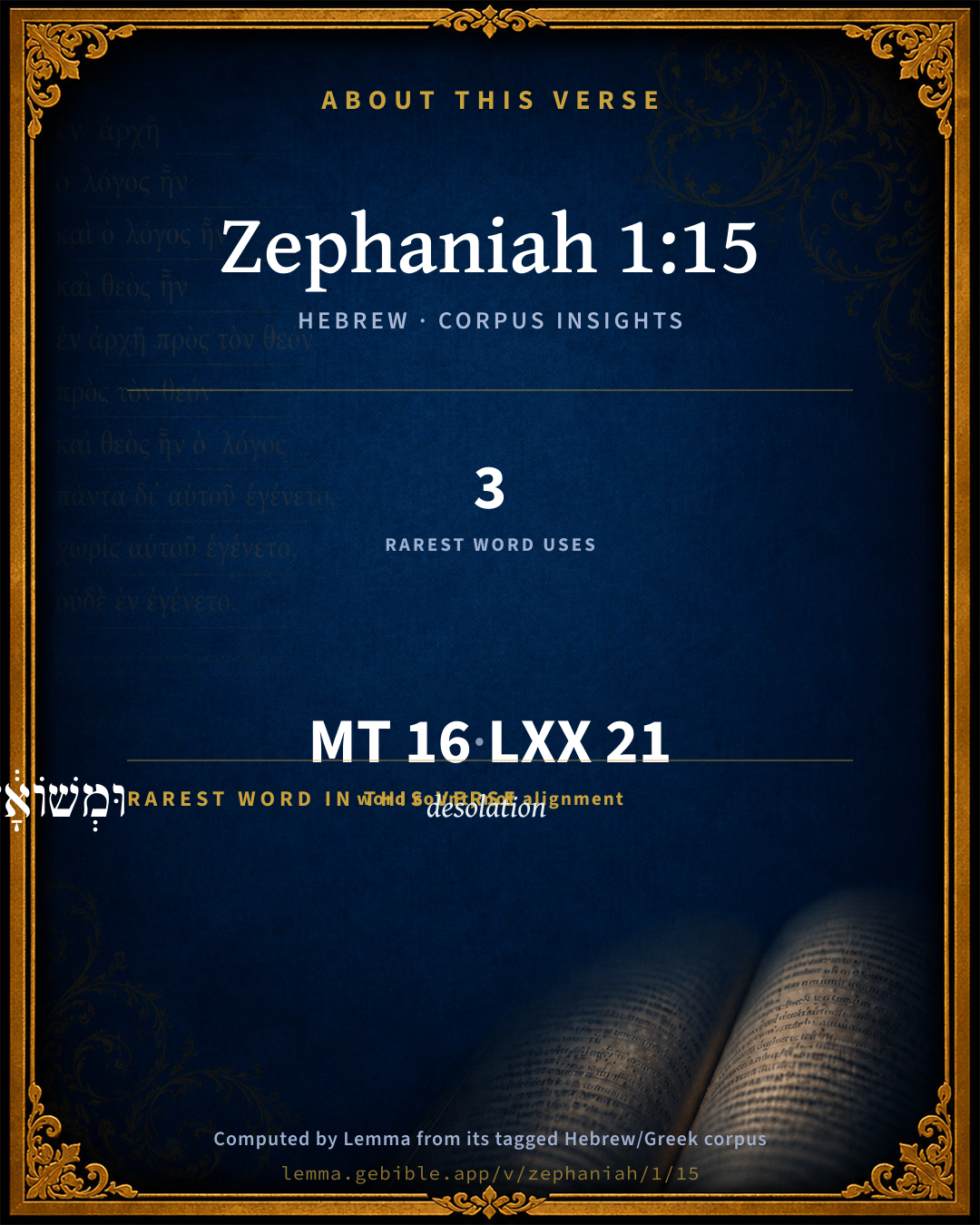
The rarest word here is וּמְשׁוֹאָ֔ה desolation H4875 — appearing just 3 times in the whole Hebrew Bible.

Shared distinctive vocabulary

וּמְשׁוֹאָ֔ה desolation H4875 occurs in 3 verses of the Hebrew Bible. Also found in:

Grammatical profile

  • 15 nouns
  • 1 pronoun

Repetition

A word recurs within this verse — often emphatic in Hebrew:

  • י֥וֹם day H3117 ×6

Hebrew & Septuagint length

In English translation the verse runs 31 words from the Hebrew and 32 from the Septuagint (LXX English) — closely comparable.

A rough comparison of the two English renderings, which tokenize alike — not a word-level alignment.

Word counts can differ between the Hebrew and the Greek without any difference in meaning — e.g. the Hebrew direct-object marker אֵת has no separate Greek word, and Greek often adds the article ὁ.

In the original languages it is 16 Hebrew tokens and 21 Greek tokens — but the two are counted differently (Hebrew bundles its prefixes and suffixes into one token; the Greek is in lemma form), so that isn’t a like-for-like length.

Cross-references

12

Topical passages linked to Zephaniah 1:15 in the Treasury of Scripture Knowledge — connected by theme and wording, ordered by reader-vote popularity; previews shown in the World English Bible.

  • Joel 2:2 A day of darkness and gloominess, A day of clouds and thick darkness. As the dawn spreading on the mountains, A great and strong people; There has never been the like, Neither will there be any more after them, Even to the years of many generations.
  • Isaiah 22:5 For it is a day of confusion, and of treading down, and of perplexity, from the Lord, Yahweh of Hosts, in the valley of vision; a breaking down of the walls, and a crying to the mountains.
  • Revelation 6:17 for the great day of his wrath has come; and who is able to stand?"
  • Jeremiah 30:7 Alas! for that day is great, so that none is like it: it is even the time of Jacob's trouble; but he shall be saved out of it.
  • Amos 5:18–20 "Woe to you who desire the day of Yahweh! Why do you long for the day of Yahweh? It is darkness, And not light.
  • Job 3:4–8 Let that day be darkness; Don't let God from above seek for it, Neither let the light shine on it.
  • Joel 2:11 Yahweh thunders his voice before his army; For his forces are very great; For he is strong who obeys his command; For the day of Yahweh is great and very awesome, And who can endure it?
  • Zephaniah 1:18 Neither their silver nor their gold will be able to deliver them in the day of Yahweh's wrath, but the whole land will be devoured by the fire of his jealousy; for he will make an end, yes, a terrible end, of all those who dwell in the land.
  • Zephaniah 2:2 before the appointed time when the day passes as the chaff, before the fierce anger of Yahweh comes on you, before the day of Yahweh's anger comes on you.
  • Luke 21:22–23 For these are days of vengeance, that all things which are written may be fulfilled.
  • Romans 2:5 But according to your hardness and unrepentant heart you are treasuring up for yourself wrath in the day of wrath, revelation, and of the righteous judgment of God;
  • 2 Peter 3:7 But the heavens that now are, and the earth, by the same word have been stored up for fire, being reserved against the day of judgment and destruction of ungodly men.

Cross-references courtesy of OpenBible.info (CC BY 4.0).

Hebrew and Greek witnesses Masoretic Hebrew ↔ Greek Septuagint

The same verse in the two great witnesses to the Old Testament, shown verse-for-verse.

These are two independent witnesses, not word-aligned to each other, and the Septuagint is shown in lemma (dictionary) form.

Hebrew Zephaniah 1:15 Masoretic · Westminster Leningrad Codex

י֥וֹם עֶבְרָ֖ה הַיּ֣וֹם הַה֑וּא י֧וֹם צָרָ֣ה וּמְצוּקָ֗ה י֤וֹם שֹׁאָה֙ וּמְשׁוֹאָ֔ה י֥וֹם חֹ֨שֶׁךְ֙ וַאֲפֵלָ֔ה י֥וֹם עָנָ֖ן וַעֲרָפֶֽל

That day is a day of wrath, a day of distress and anguish, a day of trouble and ruin, a day of darkness and gloom, a day of clouds and blackness,

World English Bible · Public Domain

Greek LXX Zephaniah 1:15 Septuagint · lemma form

ἡμέρα ὀργή ὁ ἡμέρα ἐκεῖνος ἡμέρα θλῖψις καί ἀνάγκη ἡμέρα ἀωρία καί ἀφανισμός ἡμέρα σκότος καί γνόφος ἡμέρα νεφέλη καί ὁμίχλη

A mighty day of wrath is that day, a day of affliction and distress, a day of desolation and destruction, a day of gloominess and darkness, a day of cloud and vapor,

LXX2012 (modern English Septuagint) · Public Domain

Hebrew: Westminster Leningrad Codex (CC BY 4.0). Greek: Septuagint (public domain); English from LXX2012 (modern English Septuagint) (Public Domain). How the Septuagint differs from the Hebrew →

Targum (Aramaic paraphrase)

1

The Targum is the ancient Jewish Aramaic paraphrase of the Hebrew Scriptures — an interpretive translation, not the Hebrew text itself. Onkelos (literal) and Pseudo-Jonathan (expansive) render the Torah, and Jonathan the Prophets. Coverage is partial: where no permissively-licensed English translation exists for a verse, only the Aramaic is shown. This is verse-level text, not a word-by-word alignment to the Hebrew.

  1. Targum Jonathan Prophets (Joshua–Malachi)
    יוֹמָא תַּעֲבוֹר יוֹמָא הַהוּא יוֹם עָקָא וְעִיוּק יוֹם רְגוּשׁ וְאִתְרְגוּשָׁא חֲשׁוֹךְ וְקִבְלָא יוֹם עֲנָנָא וַאֲמִטְתָא:

    (no public-domain English translation for this verse)

    Targum Jonathan — Aramaic: “Mikraot Gedolot” (public domain). English: “Sefaria Community Translation” (CC0 1.0 (public-domain dedication)); “London "Chaldee Paraphrase," 1871” (public domain). Text via Sefaria.

Commentary

Notes on Zephaniah 1:15 from classic Christian and Jewish commentators (each source and its license shown beneath its notes). The classic Christian expositions comment on the surrounding passage and are grouped to its opening verse, so a note may address several verses; the Jewish commentaries on the Tanakh (Rashi and others) are per-verse, so they appear only where the commentator wrote on this verse.

Lemma curates 59 commentaries, every one of them public domain or Creative Commons licensed, each selected and text-cleaned for this edition rather than reprinted as found. About our sources →

Trapp's Complete Commentary

John Trapp

Zep 1:15 That day [is] a day of wrath, a day of trouble and distress, a day of wasteness and desolation, a day of darkness and gloominess, a day of clouds and thick darkness,

Ver. 15. That day is a day of wrath, a day of trouble and distress] By this synathroismos, or heap of words, the prophet would frighten and arouse these dead and indolent sinners, settled upon their lees, so wedded and wedged to their wicked practices that nothing can sunder them but an extraordinary touch from the hand of Heaven. See Joe 2:1-3 cf. Amo 5:18-20, {See Trapp on "Amo 5:18"} {See Trapp on "Amo 5:19"} {See Trapp on "Amo 5:20"} and consider what the terror of the Lord’s last day will be.

John Trapp, A Commentary or Exposition upon All the Books of the Old and New Testament (1647–1656) — public domain. Text from a community e-Sword module.

Whedon's Commentary on the Bible

Daniel D. Whedon

15, 16. “In order to depict more fully the terrible character of this day, Zephaniah crowds together in Zep_1:15-16 all the words supplied by the language to describe the terror of the judgment.”

Day of wrath — A day on which the wrath of Jehovah will manifest itself against everything that is impure and sinful (see on Nah_1:2). The effects of this manifestation are described in the rest of the verse (compare Isa_22:5).

1. Trouble and distress — Men will not know what to do (Job_15:24).

2. Wasteness and desolation — The land will be wasted and thus share in the judgment (Job_38:27).

3. Darkness… gloominess,… clouds… thick darkness — If meant to be understood literally, the words express the thought that nature also will be affected by the terrible judgment (see on Joe_2:2; Joe_2:30-31); they might, however, be used figuratively (see on Amo_5:18). Zep_1:16 shows that war will be the means of executing the judgment.

Trumpet — Better, horn (see on Hos_5:8).

Alarm — The same word is translated “shouting” in Amo_1:14; Amo_2:2 (see there). The shouting of the attacking soldiers and the sound of the signal horns will be heard everywhere.

Fenced cities — Of Judah (compare Isa_2:15; Mic_5:11).

High towers — R.V., “battlements.” The corners and battlements of the walls surrounding the cities (2Ch_26:15).

Daniel D. Whedon (gen. ed.), Commentary on the Old and New Testaments (1874–1909) — public domain. Text from a community e-Sword module.

The Expositor's Bible

ZEPHANIAH

Dies Ira, Dies Illa!- Zep_1:15

"His book is the first tinging of prophecy with apocalypse: that is the moment which it supplies in the history of Israels religion."

William Robertson Nicoll, ed., The Expositor's Bible (London: Hodder & Stoughton, 1887–1910) — public domain. 65 of 66 books (1 Corinthians is not separately keyed, as that volume carries no machine-parseable verse references); section-level commentary keyed to the opening verse. Introductory and overview sections not keyed to a specific passage are excluded.

Tyndale Open Study Notes

Tyndale Open Resources

1:15 darkness and gloom: See also Isa 13:9-10; Joel 2:1-2; Amos 5:18-20.

Tyndale Open Study Notes — © Tyndale Open Resources, licensed CC BY-SA 4.0. Text via the HelloAO Bible API.

Jamieson, Fausset & Brown

Robert Jamieson, A. R. Fausset & David Brown

wasteness . . . desolation--The Hebrew terms by their similarity of sounds, Shoah, Umeshoah, express the dreary monotony of desolation (see on Nah 2:10).

Jamieson, Fausset & Brown — Commentary Critical and Explanatory on the Whole Bible (1871) — public domain (CC PDM 1.0). Text via the HelloAO Bible API.

Adam Clarke's Commentary

Verse 15. That day is a day of wrath] See the parallel passages in the margin (Isa 22:5; Jer 30:7; Joe 2:2, Joe 2:11; Amo 5:18; Zep 1:18), and the notes there. From the fourteenth to the sixteenth verse inclusive (Zep 1:14-16) there is a most beautiful amplification of the disasters that were coming on Jerusalem; the invasion, incursion, attack, carnage, confusion, horrible din occasioned by the sound of the trumpet, the cries of the people, and the shrieks and groans of the dying, are pointed out with great force and mighty effect.

Adam Clarke's Commentary on the Bible (1810–1826) — public domain. Text from a community e-Sword/MySword module.

John Calvin's Commentaries

The Prophet shows here how foolish they were who extenuated God’s vengeance, as hypocrites and all wicked men are wont to do. Hence he accuses the Jews of madness, that they thought that the way of reconciliation would be easy to them, when they had by their perverseness provoked God to come against them as an armed enemy. For though the ungodly do not promise to themselves anything of God’s favor, yet they entertain vain imaginations, as though he might with no trouble be pacified: they do not think that he will be propitious to them, and yet in the meantime they deride his vengeance. Against this kind of senselessness the Prophet now inveighs. We have stated in other places, that these kinds of figurative expressions were intended solely for this end—to constrain men to entertain some fear, for they willfully deluded themselves: for the Prophets had to do, partly with open despisers of God, and partly with his masked worshipers, whose holiness was hypocrisy.

This, then, was the reason why he said, that that day would be a day of wrath, and also a day of distress and of affliction, of tumult and desolation, of darkness and of thick darkness, of clouds and of mist. In short, he intended to remove from the Jews that confidence with which they flattered themselves, yea, the confidence which they derived from their contempt of God: for the flesh is secure, while it has coverts, where it may withdraw itself from the presence of God. True confidence cannot exceed moderation, that is, the confidence that is founded on God’s word, for thus men come nigh to God: but the flesh wishes for no other rest but in the forgetfulness of God. And we have already seen in the Prophet Amos, (Amos 5:18,) why the day of Jehovah is painted as being so dreadful; he had, as I have said, to contend with hypocrites, who made an improper use of God’s name, and at the same time slumbered in gross insensibility. Hence Amos said, It will be a day, not of light, but of darkness; not of joy, but of sorrow. Why then do ye anxiously expect the day of the Lord? For the Jews, glorying in being the chosen people of God, and trusting only in their false title of adoption, thought that everything was lawful for them, as though God had renounced his own authority. And thus hypocrites ever flatter themselves, as though they held God bound to them. Our Prophet does not, as Amos, distinctly express these sentiments, yet the meaning of the words is the same, and that is, that when God ascends his tribunal, there is no hope for pardon. He at the same time cuts off from them all their vain confidences; for though God excludes all escapes, yet hypocrites look here and there, before and behind, to the right hand and to the left.

The Prophet therefore intimates, that there would be everywhere darkness and thick darkness, clouds and mists, affliction and distress,—Why? because it would be the day of wrath; for God, after having borne patiently a long time with the Jews, and seen that they perversely abused his patience, would at length put forth his power. And that they might not set up their own strongholds against God, he says, that war was proclaimed against the fortified cities and high citadels. We hence see that he deprives the Jews of all help, in order that they might understand that they were to perish, except they repented, and thus return into favor with God. It shall then be a day of the trumpet and of shouting, —How? on all fortified cities. For the Jews, as it is usually done, compared the strength of their enemies with their own. It was not their purpose to go forth beyond their own borders: and they thought that they would be able to resist, and be sufficiently fortified, if any foreign enemy invaded them. The Prophet laughs to scorn this notion, for God had declared war against their fortified cities. It follows —

John Calvin's Commentaries (1540-1563) — public domain. Text from the Calvin Translation Society English edition (1840s-50s) via the Christian Classics Ethereal Library (ccel.org). Calvin's coverage is partial (roughly two-thirds of the Bible); uncommented books and verses are honest gaps, never fabricated. The 19th-century editor's footnotes and remarks are omitted so the notes are faithfully Calvin's own voice.

Ellicott's Commentary for English Readers

(15) Clouds and thick darkness.—As when Jehovah revealed Himself on Mount Sinai: see Deu_4:11.

A Bible Commentary for English Readers, edited by Charles John Ellicott (1878–1897) — public domain. Text from a community e-Sword module.

The Cambridge Bible for Schools and Colleges

gen. ed. J. J. S. Perowne

15. a day of wrath] i.e. of the outpouring of the wrath of God. The effects of this wrath are then detailed: (1) trouble and distress; (2) wasteness and desolation; (3) darkness and gloominess, clouds and thick darkness. The combination “trouble and distress” is found again Job_15:24; cf. Isa_30:6; “wasteness” or devastation “and desolation,” Job_38:27; and the phrase “a day of darkness,” &c. Joe_2:2. Cf. Isa_13:10; Amo_5:18. These supernatural terrors are not to be regarded as figures, they are realities; the world is a human and moral world: nature is convulsed and dissolved in man’s judgment, and transfigured and glorified in his redemption. The first words of the Vulgate translation of this verse, Dies iræ dies illa, were adopted by Thomas of Celano as the opening words of his splendid hymn on the Last Judgment. See Trench, Sacred Latin Poetry, p. 296.

The Cambridge Bible for Schools and Colleges (gen. ed. J. J. S. Perowne; Cambridge University Press, 1878–1918) — public domain. Text from a community e-Sword module.

John Gill's Exposition

That day [is] a day of wrath Both of the wrath of God against his people for their sins; these judgments being the effects of his wrath, provoked by their iniquities; and of the wrath and cruelty of the Chaldeans, exercised in a furious manner: a day of trouble and distress; to the inhabitants of Jerusalem, they being taken and led captive, their houses plundered and demolished, and the whole city and temple laid in ruins: a day of wasteness and desolation; of the whole country of Judea, and the metropolis of it; of their houses, fields, and vineyards: a day of darkness and gloominess, a day of clouds and thick darkness: as it might be in a natural sense; the displeasure of God being shown in the very heavens, by the darkness and gloominess of them, and the thick clouds with which they were covered; and made still more dark and gloomy by the burning of the city, and the smoke of it; and, in such circumstances, gloominess and melancholy must sit upon the minds of men: and thick clouds and darkness portend greater troubles and calamities coming on; and the whole is expressive of great adversity; for, as light frequently designs prosperity, so darkness adversity.

John Gill's Exposition of the Whole Bible (1746–1763) — public domain (CC PDM 1.0). Text via the HelloAO Bible API.

Albert Barnes' Notes on the Bible

A day of wrath - In which all the wrath of Almighty God, which evil angels and evil men have treasured to them for that day, shall be poured out: “the” day of wrath, because then they shall be brought face to face before the presence of God, but thenceforth they shall be cast out of it forever.

A day of trouble and distress - Both words express, how anguish shall narrow and hem them in; so that there shall be no escape; above them, God displeased; below, the flames of Hell; around, devils to drag them away, and Angels casting them forth “in bundles to burn them;” without, “the books” which shall be opened;” and within, conscience leaving them no escape.

A day of wasteness and desolation - In which all things shall return to their primeval void, before “the Spirit of God brooded upon the face of the waters,” His presence being altogether withdrawn.

A day of darkness and gloominess - For sun and moon shall lose their brightness, and no brightness from the Lamb shall shine upon the wicked, but they shall be driven into “outer darkness.”

A day of clouds and thick darkness - Hiding from them the Face of the Sun of Righteousness, and covering Him, so that their “prayers should not pass through” Lam 3:44.

Albert Barnes' Notes on the Bible (1834–1885) — public domain. Text from a community e-Sword/MySword module.

Haydock's Catholic Bible Commentary

Day, is a day. The repetition elegantly describes the great danger. (Worthington)

George Leo Haydock (1774–1849), Haydock's Catholic Family Bible and Commentary, 1859 edition — public domain. Excludes Psalms (Douay-Rheims chapter numbering differs from Protestant) and Deuterocanonical books (Catholic canon only).

Matthew Poole's English Annotations

That day, great day, Zep 1:14,

is a day of wrath, from the Chaldeans; and from the Lord, actively, upon the Jews, passively.

A day of trouble and distress: here the prophet heapeth up words of much the same sense, to express the grievousness of the troubles of those times which shall suddenly come upon them; most distressing trouble, none knowing how to bear it, or where to hide from it.

Of wasteness and desolation; most desolate wasteness in city, villages, and fields; every where the spoiling soldier shall lay waste, carrying away all he can, and destroying what he cannot carry away,

Of darkness and gloominess; possibly it might be so as to the temper of the air, dark and gloomy, but figuratively I am sure it was so.

Of clouds and thick darkness; either literally, from the heavens clouded over them, or (if it refer, as it may, to the day of sacking Jerusalem, and effects of it) darkness, gloominess, clouds, and thick darkness, arising from the smoke and fire of the city every where fired by the enemy; but metaphorically these speak the most unparalleled calamities.

Matthew Poole's English Annotations on the Holy Bible (1683–1685) — public domain. Text from a community e-Sword/MySword module.

The Pulpit Commentary

That day is a day of wrath; Vulgate, Dies irae, dies illa, words which form the commencement of the famous hymn. The better to describe the terrible nature of the judgment, the prophet crowds together all available expressions of terror and calamity. First, it is a day when God"s anger shall blaze forth. (Isa_9:18) Of trouble and distress. In its effects upon sinners. (Job_15:24) Of wasteness and desolation. As if things returned to the primeval chaos. (Gen_1:2; comp. Job_30:3 Job_38:27, where there is a similar combination; see note on Nah_2:10) Of darkness and gloominess. (Joe_2:2 Amo_5:18, Amo_5:20) Of clouds and thick darkness. (Deu_4:11; comp. Hab_3:11)

The Pulpit Commentary (1880–1919), ed. H.D.M. Spence-Jones & Joseph S. Exell — public domain. Text from a community e-Sword module.

John Wesley's Explanatory Notes

A day - Of unparalleled calamities.

John Wesley, Explanatory Notes Upon the Whole Bible (1754–1765) — public domain. Text via the GEBible commentary corpus.

Rashi

Rabbi Shlomo Yitzchaki (Rashi)

a day of ruin, an expression of desolation.

and desolation A greater degree of desolation.

Rashi on the Tanakh — English translations: “The Judaica Press complete Tanach with Rashi, translated by A. J. Rosenberg” (CC BY 4.0); “Pentateuch with Rashi's commentary by M. Rosenbaum and A.M. Silbermann, 1929-1934” (public domain); “The Metsudah Tanach series, Lakewood, N.J” (CC BY 4.0); and “The Book of Joshua, Metsudah Publications, 1997” (CC BY 4.0). Text via Sefaria.

Lesson kit

Teaching starters — assembled from the data on this page, not authored interpretation. Every prompt links to the verse data it draws on. Edit before teaching.

Zephaniah, in the Prophets, opens this verse with 16 words (11 distinct Hebrew lemmas). Its most distinctive word is mᵉshôwʼâh (“desolation”). A historical commentator’s framing appears above. Read the whole chapter for the surrounding context.

Discussion questions

  1. How does “desolation” (mᵉshôwʼâh) shape what this verse is saying?
  2. How does Job 30:3, which shares the word «desolation», read alongside this verse?
  3. What does the repetition of “day” (6× in this one verse) do in this verse?
  4. These translations render this verse differently. What is at stake in choosing one wording over another?
  5. Compare how Trapp's Complete Commentary and Whedon's Commentary on the Bible read this verse. Where do they agree or differ?

Things to notice

Reading settings

Reading text

Shown beneath each verse's original-language words.

Old Testament
Old Testament edition

Read the OT as the Masoretic Hebrew (MT) or the Greek Septuagint (LXX).

English shown for the Greek Septuagint (in the Hebrew ↔ Greek comparison).

Comparing translations? Open the Compare panel on any verse page to stack up to four side by side.