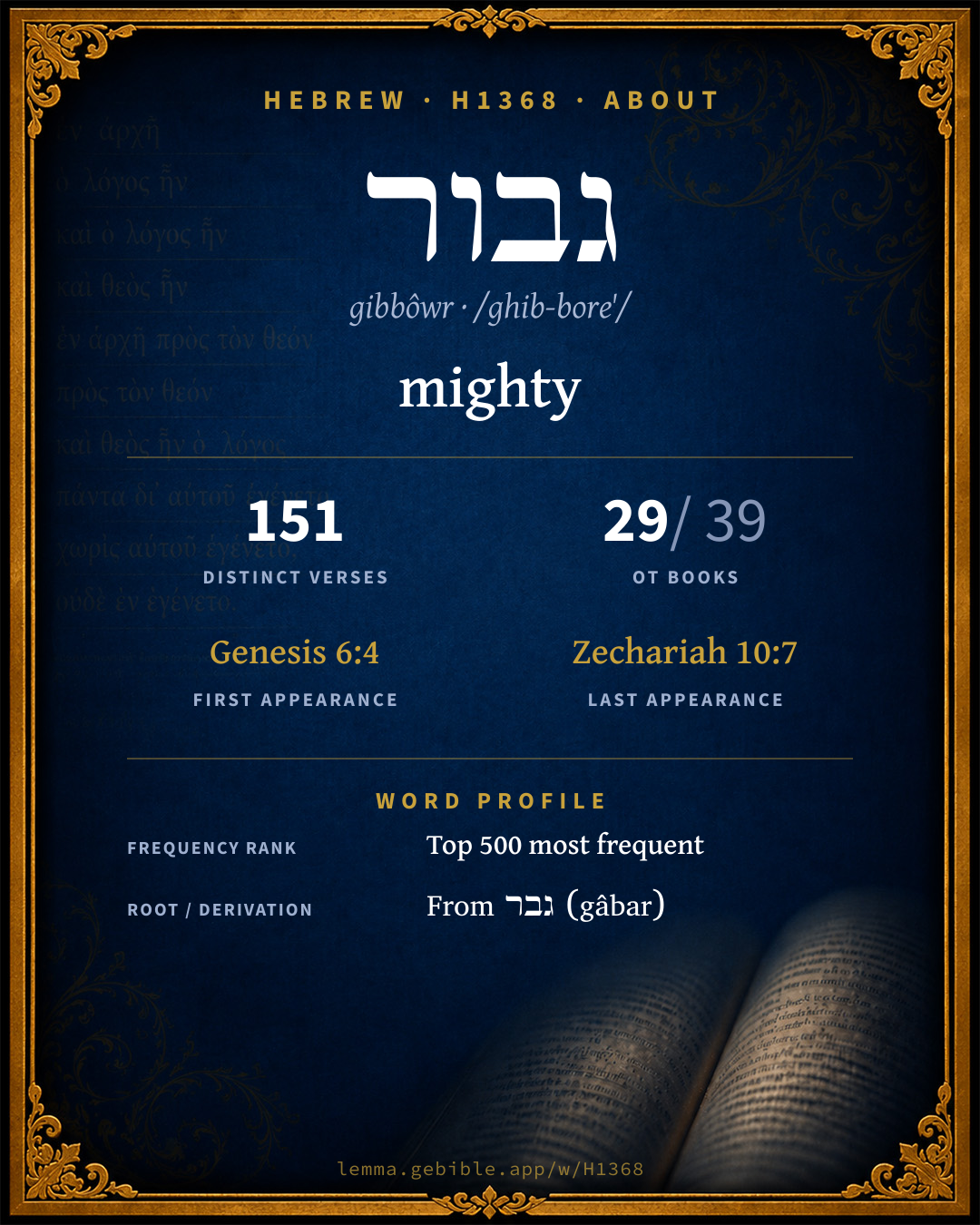
גִּבּוֹר
mighty
‘mighty’ is one of 2 main senses fuller range ↓
Full lexicon entry — Brown-Driver-Briggs (BDB)
From Brown-Driver-Briggs (BDB)
Where this word appears
See every Absolute-state word in the Hebrew Bible →
Grammar key — what these labels mean
Part of speech
- Adjective
- A word that describes or qualifies a noun.
State
- Construct
- A noun bound to a following noun in a possessive / “of” relationship (the construct chain).
- Absolute
- The independent form of a noun, not bound to a following word.
Gender
- Masculine
- Grammatically masculine.
Number
- Plural
- More than one (in Hebrew, generally three or more).
- Singular
- One.
Every verse where H1368 appears in the Book of Jeremiah — 18 distinct verses. Click any verse to open its interlinear word-by-word view. Verse text shown in the World English Bible for context — . Each verse’s Hebrew form is shown with its reference; the English is not keyword-highlighted, since the data carries no word-level English alignment. Use “Compare translations” on any verse to read it across multiple English versions. This concordance covers the Hebrew Bible; Septuagint (Greek Old Testament) occurrences are not indexed here.
Jeremiah
- Jeremiah 5:16 גִּבּוֹרִֽים adj Adjective mp Their quiver is an open tomb, they are all mighty men.
- Jeremiah 9:23 הַ/גִּבּ֖וֹר ptcl def.art + Adjective Adjective ms Thus says Yahweh, Don't let the wise man glory in his wisdom, neither let the mighty man glory in his might, don't let the rich man glory in his riches;
- Jeremiah 14:9 כְּ/גִבּ֖וֹר prep + Adjective Adjective ms Why should you be like a scared man, as a mighty man who can't save? yet you, Yahweh, are in the midst of us, and we are called by your name; don't leave us.
- Jeremiah 20:11 כְּ/גִבּ֣וֹר prep + Adjective Adjective ms But Yahweh is with me as an awesome mighty one: therefore my persecutors shall stumble, and they shall not prevail; they shall be utterly disappointed, because they have not dealt wisely, even with an everlasting dishonor which shall never be forgotten.
- Jeremiah 26:21 גִּבּוֹרָ֤י/ו adj Adjective mp cs + sfx pers 3ms and when Jehoiakim the king, with all his mighty-men, and all the princes, heard his words, the king sought to put him to death; but when Uriah heard it, he was afraid, and fled, and went into Egypt:
- Jeremiah 32:18 הַ/גִּבּ֔וֹר ptcl def.art + Adjective Adjective ms who show loving kindness to thousands, and recompense the iniquity of the fathers into the bosom of their children after them; the great, the mighty God, Yahweh of Hosts is his name;
- Jeremiah 46:5 וְ/גִבּוֹרֵי/הֶ֣ם conj + Adjective Adjective mp cs + sfx pers 3mp Why have I seen it? they are dismayed and are turned backward; and their mighty ones are beaten down, and have fled apace, and don't look back: terror is on every side, says Yahweh.
- Jeremiah 46:6 הַ/גִּבּ֑וֹר ptcl def.art + Adjective Adjective ms Don't let the swift flee away, nor the mighty man escape; in the north by the river Euphrates have they stumbled and fallen.
- Jeremiah 46:9 הַ/גִּבּוֹרִ֑ים ptcl def.art + Adjective Adjective mp Go up, you horses; and rage, you chariots; and let the mighty men go forth: Cush and Put, who handle the shield; and the Ludim, who handle and bend the bow.
- Jeremiah 46:12 גִבּ֤וֹר בְּ/גִבּוֹר֙ adj Adjective ms prep + Adjective Adjective ms The nations have heard of your shame, and the earth is full of your cry; for the mighty man has stumbled against the mighty, they are fallen both of them together.
- Jeremiah 48:14 גִּבּוֹרִ֖ים adj Adjective mp How say you, We are mighty men, and valiant men for the war?
- Jeremiah 48:41 גִּבּוֹרֵ֤י adj Adjective mp cs Kerioth is taken, and the strongholds are seized, and the heart of the mighty men of Moab at that day shall be as the heart of a woman in her pangs.
- Jeremiah 49:22 גִּבּוֹרֵ֤י adj Adjective mp cs Behold, he shall come up and fly as the eagle, and spread out his wings against Bozrah: and the heart of the mighty men of Edom at that day shall be as the heart of a woman in her pangs.
- Jeremiah 50:9 כְּ/גִבּ֣וֹר prep + Adjective Adjective ms For, behold, I will stir up and cause to come up against Babylon a company of great nations from the north country; and they shall set themselves in array against her; from there she shall be taken: their arrows shall be as of an expert mighty man; none shall return in vain.
- Jeremiah 50:36 גִּבּוֹרֶ֖י/הָ adj Adjective mp cs + sfx pers 3fs A sword is on the boasters, and they shall become fools; a sword is on her mighty men, and they shall be dismayed.
- Jeremiah 51:30 גִבּוֹרֵ֨י adj Adjective mp cs The mighty men of Babylon have forborne to fight, they remain in their strongholds; their might has failed; they are become as women: her dwelling-places are set on fire; her bars are broken.
- Jeremiah 51:56 גִּבּוֹרֶ֔י/הָ adj Adjective mp cs + sfx pers 3fs for the destroyer is come on her, even on Babylon, and her mighty men are taken, their bows are broken in pieces; for Yahweh is a God of recompenses, he will surely requite.
- Jeremiah 51:57 וְ/גִבּוֹרֶ֔י/הָ conj + Adjective Adjective mp cs + sfx pers 3fs I will make drunk her princes and her wise men, her governors and her deputies, and her mighty men; and they shall sleep a perpetual sleep, and not wake up, says the King, whose name is Yahweh of Hosts.
About this entry
At a glance — auto-summarized from this page’s data, not written by a person. Every figure links to its source below. This summary describes the numbers; it doesn’t interpret them.
גבור — transliterated gibbôwr — is a Hebrew word carrying the sense “mighty.” Older and newer Bibles part ways — “mighty” in the King James Version, “warriors” (unfoldingWord Literal Text) in modern versions. See the renderings breakdown. It appears 151 verses across 29 books of the Hebrew Bible, among its common vocabulary. Its earliest occurrence is Genesis 6:4. BDB distinguishes 2 senses for it. See the sense tree, 151-verse concordance, and the renderings breakdown below.
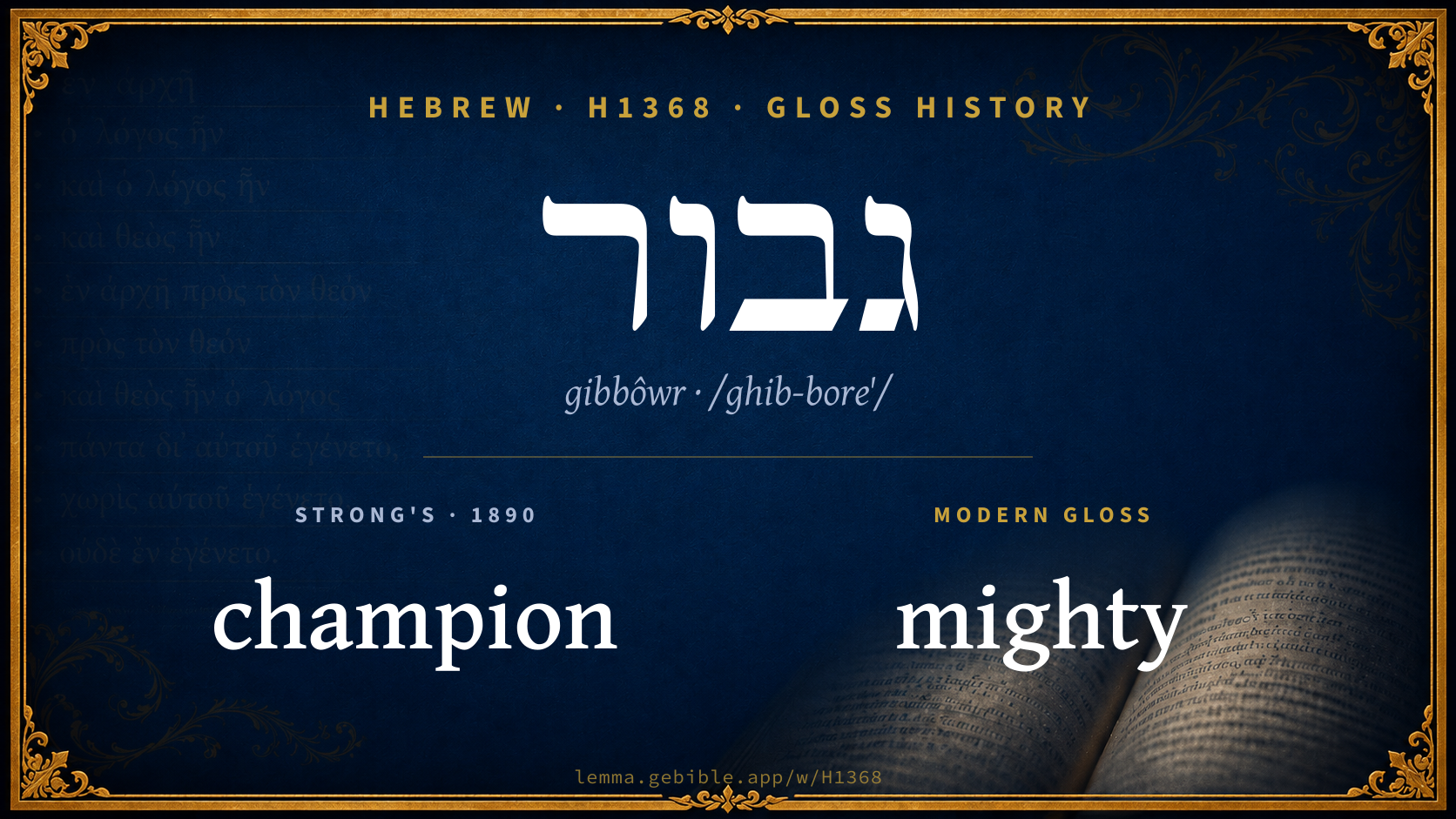
Gloss history
Strong's 1890 vs modern scholarship
About this word
Strong's H1368 catalogs a Hebrew word from the Hebrew Old Testament.
These counts are not copied from any lexicon or concordance. They are computed here, from the morphology-tagged Hebrew Old Testament. What Lemma adds →
- 151
- distinct verses
- The word appears in 151 distinct verses.
- 29 / 39
- OT books
- The word appears in 29 of 39 Old Testament books.
- #288
- by frequency
- Top 500 most frequent Hebrew words (rank 288 of 8,640 Hebrew words by occurrence).
View all 151 occurrences in the concordance →
Most concentrated in
- 1 Chronicles 29 verses 19%
- Jeremiah 18 verses 12%
- 2 Samuel 16 verses 11%
By section of the Old Testament
By traditional corpus
Conventional, traditional groupings — biblical authorship is debated, so this is a traditional corpus grouping, not an authorship claim. Each share is this word’s portion of its verses in that division of the Hebrew canon. Each figure is a share of the word’s 151 distinct verses.
- Prophets (Nevi'im) 83 verses · 55%
- Writings (Ketuvim) 64 verses · 42%
- Torah (Pentateuch) 4 verses · 3%
How translations render this word
Counts come from each version’s own published word-to-Strong’s tagging or interlinear alignment — an approximate guide to how each version renders this word, not a word-level alignment the data otherwise carries. Because each total is that version’s own tagged count, the per-version totals vary from one another and need not match the appearance or distinct-verse counts above. These counts may also differ from a printed concordance because Lemma counts each distinctly tagged rendering and does not collapse phrase taggings into a single head-word total. This is a fixed set of word-tagged versions (KJV, ASV, BSB, ULT) and does not change with the reading translation you choose elsewhere. Each version’s license is shown beside its name below (and on Sources).
- King James Version: Mighty 33×, Mighty men 33×, Mighty man 12×
- American Standard Version: Mighty men 36×, Mighty 29×, Mighty man 11×
- Berean Standard Bible: Mighty men 49×, Mighty 36×, Warriors 11×
- unfoldingWord Literal Text: Warriors 27×, Mighty 25×, Warriors of 23×
King James Version Public Domain
Renders H1368 across 158 tagged occurrences — most commonly:
Plus other, less common renderings. Plus 54 renderings that appear only once — usually multi-word phrases or single function words the recovered tagging swept in, not distinct renderings.
American Standard Version Public Domain
Renders H1368 across 156 tagged occurrences — most commonly:
Plus 54 renderings that appear only once — usually multi-word phrases or single function words the recovered tagging swept in, not distinct renderings.
Berean Standard Bible Public Domain
Renders H1368 across 156 tagged occurrences — most commonly:
Plus 28 renderings that appear only once — usually multi-word phrases or single function words the recovered tagging swept in, not distinct renderings. Not rendered by a distinct English word in 3 further occurrences.
unfoldingWord Literal Text CC BY-SA 4.0
Renders H1368 across 157 tagged occurrences — most commonly:
Plus other, less common renderings. Plus 26 renderings that appear only once — usually multi-word phrases or single function words the recovered tagging swept in, not distinct renderings.
Senses in BDB
The 2 senses BDB distinguishes for this word, in lexicon order (not ranked by frequency or importance). The full entry — with sub-senses — is in the Lexicon Entry tab.
- strong, mighty (adjective)
- strong man, brave man, mighty man (noun masculine)
Word origin
גִּבּוֹר 159 adj. strong, mighty
— Brown-Driver-Briggs (Oxford 1906, public domain), digitized via Sefaria, supplemented by the OpenScriptures HebrewLexicon (CC BY 4.0). See Sources.
Derived from גבר (gâbar) (H1396) — to be strong.
Jastrow Dictionary
A second Hebrew/Aramaic lexicon for comparison, covering Aramaic and post-biblical (Talmudic, Targumic, Midrashic) usage that the biblical-Hebrew BDB does not. Matched by lemma rather than by Strong’s number, so a lemma may carry more than one Jastrow headword (shown separately below), and the entries cover usage well beyond the Bible.
גִּבּוֹר
- strong, brave, mighty; hero. Ned. 38ᵃ על ג׳ on a strong man; Sabb. 92ᵃ. Ab. IV, 1 איזהו ג׳ who is a hero?; Tam. 32ᵃ; a. fr.—Pl. גִּבּוֹרִים. Gen. R. s. 37 פלשתים ג׳ Philisteans which means giants, opp. ננסים. Sot. 42ᵇ ד׳ ג׳ four (Philistean) heroes; a. e.
גבור
- , Meg. 18ᵃ, v. נְבוּר
A Dictionary of the Targumim, the Talmud Babli and Yerushalmi, and the Midrashic Literature (Marcus Jastrow; London, Luzac, 1903) — Public Domain. Digitized via Sefaria. Digitized via Sefaria. Full attribution on Sources.
Forms in the corpus
The 89 distinct written forms H1368 takes in the Hebrew Bible, most frequent first — each parse links to that state’s occurrences in the concordance. Hebrew forms include their vowel points and cantillation, so a single lemma takes many written forms.
The 60 most common forms are shown; 29 rarer forms follow in the full concordance.
Same root — word family
Other BDB entries built from the same root as H1368, grouped by Strong’s listed origin. These share a root / origin per the lexicon — not necessarily a shared meaning. Each links to that word’s own entry.
Derives from
Shares the same root
Derived from this word
Compare all same-root words → Showing 4 of 6 — not the complete family. They share a root, not necessarily a meaning.
Septuagint verse parallels
This word appears in 135 verses that also exist in the Greek Old Testament (Septuagint), out of the 151 Hebrew verses it occurs in. You can read those verses in Greek by switching the Old Testament edition to the Septuagint.
Read these verses in the Septuagint
- Genesis 6:4
- Deuteronomy 10:17
- Joshua 1:14
- Judges 5:13
- Ruth 2:1
- 1 Samuel 2:4
- 2 Samuel 1:19
- 1 Kings 1:8
- 2 Kings 5:1
- 1 Chronicles 1:10
- 2 Chronicles 13:3
- Ezra 7:28
This is a verse-level parallel only — the same verses exist in both the Hebrew and Greek Old Testaments. No word-level Hebrew↔Greek correspondence is claimed: the data carries no such alignment, so no Greek word is shown as this Hebrew word’s translation. Coverage is not total — the Septuagint omits the deuterocanon and renumbers the Psalms, so some Hebrew verses have no direct Greek parallel.