
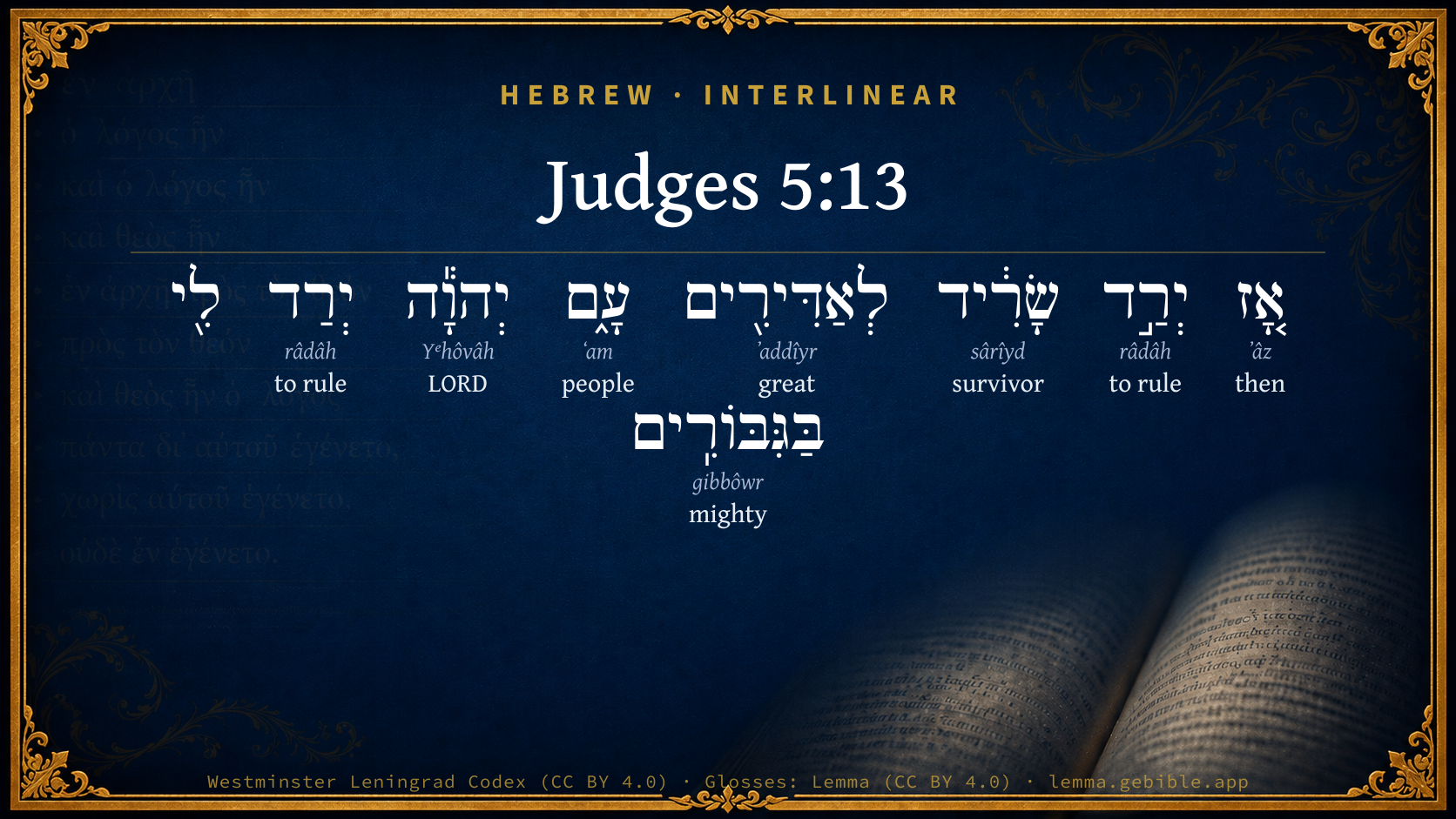
Judges 5:13

Hebrew (Westminster Leningrad Codex) Judges 5:13 appears in the Hebrew Old Testament. The text above is from the Westminster Leningrad Codex. Each word links to its Strong’s number, a concise gloss, and parsing drawn from the Open Scriptures Hebrew Bible morphology. Click any word for its full Brown-Driver-Briggs (BDB) entry.
Download image
Cite this verse

Judges 5:13 (World English Bible). Public Domain. Lemma interlinear Bible study tool, https://lemma.gebible.app/v/judges/5/13.

Show BibTeX & RIS
BibTeX
RIS
English Translation
Then came down a remnant of the nobles [and] the people; Yahweh came down for me against the mighty.
World English Bible · Public Domain
Download a study sheet

One document with this verse’s original text, its word-by-word gloss line, the meaning frame, cross-references with their text, attributed commentary, and full source and license credits — printable, and it pastes into notes with its structure intact.

This verse Autodidact and up

Study sheet (.html) Plain text (.txt)

A passage Seminary Student

Up to 50 verses in one chapter. A passage sheet keeps up to 6 commentary sources and 12 cross-references per verse, in the order this page ranks them, and says so on the sheet whenever that leaves anything out. Ask for a single verse and you get the Autodidact verse sheet above.

Everything on this page stays free to read, with no account — the sheet is a download of what is already on screen, not access to it.

Want to remove ads? Support Godless Engineer
Compare translations 3

The same verse in 3 English versions, stacked beneath the original-language interlinear above. Click any original word for its lexicon entry.

Each is an independent rendering of the whole verse — the interlinear is not word-aligned to these translations.

Highlighted words mark where these versions differ — a whole-verse word diff, not a word-by-word alignment.

  • World English Bible Public Domain
    Then came down a remnant of the nobles [and] the people; Yahweh came down for me against the mighty.
  • King James Version Public Domain
    Then he made him that remaineth have dominion over the nobles among the people: the LORD made me have dominion over the mighty.
  • unfoldingWord Literal Text CC BY-SA 4.0
    Then the remnant came down to the nobles, the people of Yahweh came down to me against the warriors.

unfoldingWord Literal Text — © unfoldingWord, licensed CC BY-SA 4.0. Word-aligned USFM3 via Door43 (git.door43.org/unfoldingWord/en_ult).

Versions to compare (up to 4)

3 of 4 selected

Show all 18 translations

Every available English version of this verse, each an independent rendering of the whole verse.

  • World English Bible Public Domain
    Then came down a remnant of the nobles [and] the people; Yahweh came down for me against the mighty.
  • Berean Standard Bible Public Domain
    Then the survivors came down to the nobles; the people of the LORD came down to me against the mighty.
  • Majority Standard Bible Public Domain
    Then the survivors came down to the nobles; the people of the LORD came down to me against the mighty.
  • King James Version Public Domain
    Then he made him that remaineth have dominion over the nobles among the people: the LORD made me have dominion over the mighty.
  • American Standard Version (1901) Public Domain
    Then came down a remnant of the nobles `and' the people; Jehovah came down for me against the mighty.
  • Revised Version (1885) Public Domain
    Then came down a remnant of the nobles and the people; the LORD came down for me against the mighty.
  • Geneva Bible (1599) Public Domain
    For they that remaine, haue dominio ouer the mightie of the people: the Lord hath giuen me dominion ouer the strong.
  • Douay-Rheims (1899) Public Domain
    The remnants of the people are saved, the Lord hath fought among the valiant ones.
  • Young's Literal Translation Public Domain
    Then him who is left of the honourable ones He caused to rule the people of Jehovah, He caused me to rule among the mighty.
  • Literal Standard Version CC BY-SA 4.0
    Then him who is left of the majestic ones He caused to rule the people of YHWH, || He caused me to rule among the mighty.
  • Unlocked Literal Bible CC BY-SA 4.0
    Then the survivors came down to the nobles; the people of Yahweh came down to me with the warriors.
  • unfoldingWord Literal Text CC BY-SA 4.0
    Then the remnant came down to the nobles, the people of Yahweh came down to me against the warriors.
  • Darby Bible Public Domain
    Then down marched the remnant of the noble; the people of the LORD marched down for him against the mighty.
  • World Messianic Bible Public Domain
    “Then a remnant of the nobles and the people came down. The LORD came down for me against the mighty.
  • Webster's Bible Public Domain
    Then he made him that remaineth have dominion over the nobles among the people: the LORD made me have dominion over the mighty.
  • Free Bible Version CC BY-SA 4.0
    The survivors went to attack the nobles, the people of the Lord went to attack the powerful.
  • Bible in Basic English Public Domain
    Then the chiefs went down to the doors; the Lord's people went down among the strong ones.
  • JPS Tanakh (1917) Public Domain
    Then made He a remnant to have dominion over the nobles and the people; the LORD made me have dominion over the mighty.

Literal Standard Version (2020), Covenant Press — licensed CC BY-SA 4.0. Text via the HelloAO Bible API (eBible.org). Unlocked Literal Bible (unfoldingWord) — licensed CC BY-SA 4.0. Text via the HelloAO Bible API (eBible.org). unfoldingWord Literal Text — © unfoldingWord, licensed CC BY-SA 4.0. Word-aligned USFM3 via Door43 (git.door43.org/unfoldingWord/en_ult). Free Bible Version, Dr. Jonathan Gallagher — licensed CC BY-SA 4.0. Text via the HelloAO Bible API (eBible.org).

Word by word

More ways to search: Search by grammar → Find every occurrence → Compare this word →

Practice this passage: Drill this verse → Learn its vocabulary →

About this verse

These counts appear in no published source. They are computed here, from the morphology-tagged text and Lemma’s own curated glosses. What Lemma adds →

9
words
7
distinct lemmas
Historical
section

Shared distinctive vocabulary

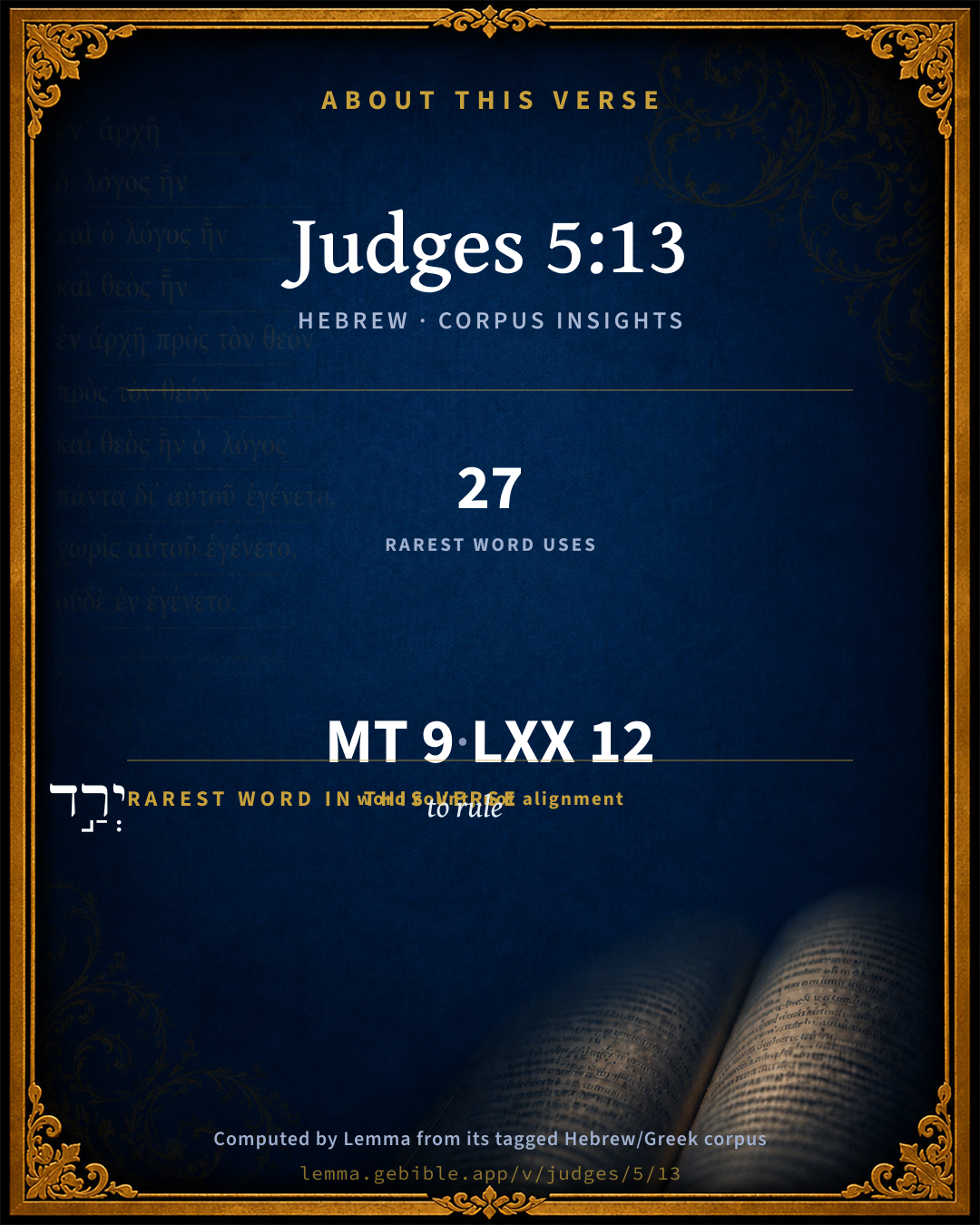
יְרַ֣ד to rule H7287 occurs in 25 verses of the Hebrew Bible. Also found in:

Grammatical profile

  • 2 verbs
  • 3 nouns
  • 2 adjectives
  • 1 preposition
  • 1 adverb

Verb forms

  • יְרַ֣ד Qal · Perfect
  • יְרַד Qal · Perfect

Repetition

A word recurs within this verse — often emphatic in Hebrew:

  • יְרַ֣ד to rule H7287 ×2

Hebrew & Septuagint length

In English translation the verse runs 19 words from the Hebrew and 23 from the Septuagint (LXX English) — closely comparable.

A rough comparison of the two English renderings, which tokenize alike — not a word-level alignment.

Word counts can differ between the Hebrew and the Greek without any difference in meaning — e.g. the Hebrew direct-object marker אֵת has no separate Greek word, and Greek often adds the article ὁ.

In the original languages it is 9 Hebrew tokens and 12 Greek tokens — but the two are counted differently (Hebrew bundles its prefixes and suffixes into one token; the Greek is in lemma form), so that isn’t a like-for-like length.

Cross-references

8

Topical passages linked to Judges 5:13 in the Treasury of Scripture Knowledge — connected by theme and wording, ordered by reader-vote popularity; previews shown in the World English Bible.

  • Revelation 2:26–27 He who overcomes, and he who keeps my works to the end, to him I will give authority over the nations.
  • Psalms 75:7 But God is the judge. He puts down one, and lifts up another.
  • Isaiah 41:15–16 Behold, I have made you [to be] a new sharp threshing instrument having teeth; you shall thresh the mountains, and beat them small, and shall make the hills as chaff.
  • Romans 8:37 No, in all these things, we are more than conquerors through him who loved us.
  • Psalms 49:14 They are appointed as a flock for Sheol. Death shall be their shepherd. The upright shall have dominion over them in the morning. Their beauty shall decay in Sheol, Far from their mansion.
  • Ezekiel 17:24 All the trees of the field shall know that I, Yahweh, have brought down the high tree, have exalted the low tree, have dried up the green tree, and have made the dry tree to flourish; I, Yahweh, have spoken and have done it.
  • Daniel 7:18–27 But the saints of the Most High shall receive the kingdom, and possess the kingdom forever, even forever and ever.
  • Revelation 3:9 Behold, I give of the synagogue of Satan, of those who say they are Jews, and they are not, but lie. Behold, I will make them to come and worship before your feet, and to know that I have loved you.

Cross-references courtesy of OpenBible.info (CC BY 4.0).

Hebrew and Greek witnesses Masoretic Hebrew ↔ Greek Septuagint

The same verse in the two great witnesses to the Old Testament, shown verse-for-verse.

These are two independent witnesses, not word-aligned to each other, and the Septuagint is shown in lemma (dictionary) form.

Hebrew Judges 5:13 Masoretic · Westminster Leningrad Codex

אָ֚ז יְרַ֣ד שָׂרִ֔יד לְאַדִּירִ֖ים עָ֑ם יְהוָ֕ה יְרַד לִ֖י בַּגִּבּוֹרִֽים

Then came down a remnant of the nobles [and] the people; Yahweh came down for me against the mighty.

World English Bible · Public Domain

Greek LXX Judges 5:13 Septuagint · lemma form

τότε καταβαίνω κατάλειμμα ὁ ἰσχυρός λαός κύριος καταβαίνω αὐτός ἐν ὁ κραταιός

Then went down the remnant to the strong, the people of the Lord went down for him among the mighty ones from me.

LXX2012 (modern English Septuagint) · Public Domain

On this verse, Keil & Delitzsch discusses the Septuagint’s reading. Read the note in Commentary ↓

Hebrew: Westminster Leningrad Codex (CC BY 4.0). Greek: Septuagint (public domain); English from LXX2012 (modern English Septuagint) (Public Domain). How the Septuagint differs from the Hebrew →

Targum (Aramaic paraphrase)

1

The Targum is the ancient Jewish Aramaic paraphrase of the Hebrew Scriptures — an interpretive translation, not the Hebrew text itself. Onkelos (literal) and Pseudo-Jonathan (expansive) render the Torah, and Jonathan the Prophets. Coverage is partial: where no permissively-licensed English translation exists for a verse, only the Aramaic is shown. This is verse-level text, not a word-by-word alignment to the Hebrew.

  1. Targum Jonathan Prophets (Joshua–Malachi)
    בְּכֵן נְחַת חַד מִמַשְׁרִיַת יִשְׂרָאֵל וְתַבַּר תְּקוֹף גִבָּרֵי עַמְמַיָא הָא לָא מִגְבוּרָא דִדְהוֹן הֲוַת דָא אֱלָהֵן יְיָ תְּבַר קֳדָם עַמֵיהּ תְּקוֹף גִבָּרֵי סַנְאֵיהוֹן:

    (no public-domain English translation for this verse)

    Targum Jonathan — Aramaic: “Mikraot Gedolot” (public domain). English: “Sefaria Community Translation” (CC0 1.0 (public-domain dedication)); “London "Chaldee Paraphrase," 1871” (public domain). Text via Sefaria.

Commentary

Notes on Judges 5:13 from classic Christian and Jewish commentators (each source and its license shown beneath its notes). The classic Christian expositions comment on the surrounding passage and are grouped to its opening verse, so a note may address several verses; the Jewish commentaries on the Tanakh (Rashi and others) are per-verse, so they appear only where the commentator wrote on this verse.

Lemma curates 59 commentaries, every one of them public domain or Creative Commons licensed, each selected and text-cleaned for this edition rather than reprinted as found. About our sources →

Trapp's Complete Commentary

John Trapp

Jdg 5:13 Then he made him that remaineth have dominion over the nobles among the people: the LORD made me have dominion over the mighty.

Ver. 13. Then he made him that remaineth,] i.e., Once he made the relics of the Canaanites to rule over the nobles of Israel; but now the Lord hath made me or my people to have dominion over those mighties. Or rather thus, Then he made the residue of Israel to prevail over their oppressors. The Lord made me, a weak woman, to get the better of those nobles and high officials.

John Trapp, A Commentary or Exposition upon All the Books of the Old and New Testament (1647–1656) — public domain. Text from a community e-Sword module.

Joseph Benson's Commentary

Jdg 5:13. Then he made him that remaineth have dominion, &c. — This verse is very obscure, nor is it easy to fix the sense of the original, the principal verb in the sentence, ירד, jerad, which occurs in both clauses of it, meaning both to have, or to cause to have dominion, and also to descend, or come down. According to our translation, which seems as accurate as any proposed, the sense is, that God had not only preserved a remnant of his people from the fury of the oppressor, and from the destruction which Sisera designed, but also now gave them the victory, and thereby the dominion over the nobles of Canaan, who had been combined against them. The Lord made me have dominion — Though but a weak woman. But Dr. Kennicott’s translation of the verse, which is countenanced by the Seventy, is,

“Then, when the remainder descended after their chiefs,

Jehovah’s people descended after me against the mighty:”

which interpretation agrees in substance with that of the ingenious Mr. Green and some others.

Joseph Benson's Commentary on the Old and New Testaments (1811–1818) — public domain. Text from a community e-Sword module.

Keil & Delitzsch

C. F. Keil & F. Delitzsch

13 Then came down a remnant of nobles of the nation;

Jehovah came down to me among the heroes.

14 Of Ephraim, whose root in Amalek;

Behind thee Benjamin among thy peoples.

From Machir came down leaders,

And from Zebulun marchers with the staff of the conductor.

15a And princes in Issachar with Deborah,

And Issachar as well as Barak,

Driven into the valley through his feet.

Looking back to the commencement of the battle, the poetess describes the streaming of the brave men of the nation down from the mountains, to fight the enemy with Barak and Deborah in the valley of Jezreel; though the whole nation did not raise as one man against its oppressors, but only a remnant of the noble and brave in the nation, with whom Jehovah went into the battle. In Jdg 5:13 the Masoretic pointing of ירד is connected with the rabbinical idea of the word as the fut. apoc. of רדה: "then (now) will the remnant rule over the glorious," i.e., the remnant left in Israel over the stately foe; "Jehovah rules for me (or through me) over the heroes in Sisera's army," which Luther has also adopted. But, as Schnurr. has maintained, this view is decidedly erroneous, inasmuch as it is altogether irreconcilable with the description which follows of the marching of the tribes of Israel into the battle. ירד is to be understood in the same sense as ירדוּ in Jdg 5:14, and to be pointed as a perfect ירד.

(Note: The Cod. Al. of the lxx contains the correct rendering, τότε κατέβη κατάλειμμα. In the Targum also ירד is correctly translated נתת, descendit, although the germs of the rabbinical interpretation are contained in the paraphrase of the whole verse: tunc descendit unus ex exercitu Israel et fregit fortitudinem fortium gentium. Ecce non ex fortitudine manus eorum fuit hoc; sed Dominus fregit ante populum suum fortitudinem virorum osorum eorum.)

"There came down," sc., from the mountains of the land into the plain of Jezreel, a remnant of nobles. לאדּירים is used instead of a closer subordination through the construct state, to bring out the idea of שׂריד into greater prominence (see Ewald, 292). עם is in apposition to לאדּירים, and not to be connected with the following word יהוה, as it is by some, in opposition to the accents. The thought is rather this: with the nobles or among the brave Jehovah himself went against the foe. לי is a dat. commodi, equivalent to "for my joy."

Keil & Delitzsch — Biblical Commentary on the Old Testament (1861–1891) — public domain (CC PDM 1.0). Text via the HelloAO Bible API. (Old Testament only.)

Adam Clarke's Commentary

Verse 13. Make him that remaineth] This appears to be spoken of Barak, who is represented as being only a remnant of the people.

Adam Clarke's Commentary on the Bible (1810–1826) — public domain. Text from a community e-Sword/MySword module.

Ellicott's Commentary for English Readers

(13) Then he made him that remaineth have dominion.—The translation, reading, and punctuation of this verse is uncertain. The MSS. of the LXX. vary, and the Vulgate merely gives a paraphrase. The Alexandrine MS. of the LXX. may be correct: “Then descended a remnant against the mighty.” Ewald renders it, “Then descended a remnant of the nobles of the people.” They were only “a remnant,” because at least six of the tribes—Judah, Simeon, Dan, Asher, Reuben, Gad—held aloof.

The Lord made me have dominion over the mighty.—Rather, Jehovah descended to me among the heroes. The LXX. (Cod. B) and others connect “people” with this clause: “The people of Jehovah descended,” &c., and perhaps correctly.

A Bible Commentary for English Readers, edited by Charles John Ellicott (1878–1897) — public domain. Text from a community e-Sword module.

The Cambridge Bible for Schools and Colleges

gen. ed. J. J. S. Perowne

13. Then came down a remnant] The Massoretic scribes intended the verb to mean ‘then may the remnant (i.e. of Israel) rule over the noble ones,’ a prayer; but the noble ones like the mighty are most naturally Israelites, and after then the LXX and other Verss. give a perfect. With a slight change of pronunciation the RV. renders ‘Then came down a remnant of the nobles and the people,’ inserting and without any right. The word for remnant means, not ‘a mere handful,’ but survivors from a battle, a sense unsuitable here; we may perhaps correct the form to Israel (Budde, Moore), and thus obtain a good parallelism to the people of the Lord, as the words are to be read (LXX. B). The whole verse may be restored:

Then came down Israel like noble ones,

The people of the Lord came down for Him as heroes.

For Him (LXX) is preferable to for me in the text.

The Cambridge Bible for Schools and Colleges (gen. ed. J. J. S. Perowne; Cambridge University Press, 1878–1918) — public domain. Text from a community e-Sword module.

John Gill's Exposition

Then he made him that remaineth,.... The people of Israel that remained, who had been under the yoke of Jabin king of Canaan, under which many of the Israelites very probably died; but now the few mean and miserable that remained were raised to an high estate, and made to

have dominion over the nobles among the people; that is, over the Canaanitish nobility, that were among the people under Jabin; but he being conquered by the Israelites, his people and even his nobles became subject to them; and this was the Lord's doing, as the following words show:

the Lord made me have dominion over the mighty; that is, Deborah, to whom God gave dominion either over the mighty ones of Israel, being raised up to be their judge; or over the mighty Canaanites, she having a concern in the conquest of them and triumph over them, through her direction, advice, command, and presence, though a woman.

John Gill's Exposition of the Whole Bible (1746–1763) — public domain (CC PDM 1.0). Text via the HelloAO Bible API.

Albert Barnes' Notes on the Bible

This verse is otherwise rendered: “then a remnant of the nobles came down; the people of the Lord came down for me against the mighty.” The following verses mention in detail who this “remnant” were.

Albert Barnes' Notes on the Bible (1834–1885) — public domain. Text from a community e-Sword/MySword module.

Haydock's Catholic Bible Commentary

Remnants. Many of the Israelites had been slain by Jabin, but the Lord enabled the valiant Barac to requite him. Hebrew, "Then he made him that remaineth have dominion over the nobles among the people. The Lord made me rule over the mighty." Barac and Debbora were raised from an humble state to govern Israel; while the nobles were passed over. (Haydock) --- The people of God, which was reduced to such abjection and misery, is now become formidable to the greatest princes, who look upon themselves as something great, and are called beneficent, Luke xxii. 25. Septuagint, "Then his (Barac’s) force was magnified: Lord, humble before me those who exceed me in strength." Chaldean, "Then one of the army of Israel (Barac) crushed the power of these mighty nations," &c. (Calmet)

George Leo Haydock (1774–1849), Haydock's Catholic Family Bible and Commentary, 1859 edition — public domain. Excludes Psalms (Douay-Rheims chapter numbering differs from Protestant) and Deuterocanonical books (Catholic canon only).

Matthew Poole's English Annotations

Thus God did not only preserve the poor and despised remnant of his people from the fury of the oppressor before this war, and from the destruction which Sisera designed and promised himself to bring upon them by this war; but also gave them the victory, and thereby the dominion over the princes and nobles of Canaan, who were combined against them.

Me, though but a weak woman.

Matthew Poole's English Annotations on the Holy Bible (1683–1685) — public domain. Text from a community e-Sword/MySword module.

Whedon's Commentary on the Bible

Daniel D. Whedon

13. Then came down — We feel constrained to discard the Masoretic punctuation in this word ירד, and translate it as if written ירד. To render it in the imperative, or with Robinson and others to supply I said, is awkward and unnecessary. The poetess refers to the coming down from their mountain homes of the valiant heroes who rendered such noble services in this war. The words nobles, mighty ones, rulers, commanders, and princes, in this and the two following verses, are to be understood as titles of honour attributed to those valiant soldiers in view of their noble work.

Jehovah came down to me — To me, Deborah. This coming of Jehovah to the prophetess is explained by Jdg_4:6-7. Jehovah came to Deborah with a revelation of the triumph over Jabin’s army which was about to exalt Israel from the dust.

Among the mighty ones — Not against the mighty, for then we should have אל, but ב, in, or among. As the heroes of the land rallied around her, Jehovah himself came, as it were, among them, and also accompanied her as an ally to the war.

Daniel D. Whedon (gen. ed.), Commentary on the Old and New Testaments (1874–1909) — public domain. Text from a community e-Sword module.

The Pulpit Commentary

Then he gave dominion to a mere remnant of Israel over the powerful among the people of Canaan, the Lord gave me dominion over the mighty men of Jabin.

The Pulpit Commentary (1880–1919), ed. H.D.M. Spence-Jones & Joseph S. Exell — public domain. Text from a community e-Sword module.

John Wesley's Explanatory Notes

He made him, &c. - Thus God did not only preserve the poor and despised remnant of his people, from the fury of the oppressor, and from the destruction which Sisera designed, but also gave them the victory, and thereby the dominion over the nobles of Canaan, who were combined against them. Me - Tho' but a weak woman.

John Wesley, Explanatory Notes Upon the Whole Bible (1754–1765) — public domain. Text via the GEBible commentary corpus.

Rashi

Rabbi Shlomo Yitzchaki (Rashi)

Dominated.יְרַד is similar to יִרְדֶה, "dominated," as in "to prostrate nations before him." The surviving Yisroelites dominated the mighty among the idolators.

Adonoy empowered me over the mighty. Gave me dominion over the mighty warriors among the nations.

Rashi on the Tanakh — English translations: “The Judaica Press complete Tanach with Rashi, translated by A. J. Rosenberg” (CC BY 4.0); “Pentateuch with Rashi's commentary by M. Rosenbaum and A.M. Silbermann, 1929-1934” (public domain); “The Metsudah Tanach series, Lakewood, N.J” (CC BY 4.0); and “The Book of Joshua, Metsudah Publications, 1997” (CC BY 4.0). Text via Sefaria.

Radak

Rabbi David Kimhi (Radak)

Then the remnant yerad: That is yeradah, in its complete form. And the explantion is that the Holy One, blessed be He, had Israel, who is the remnant, subdue (radah) and control the mighty ones of the people of Yavin, the king of Canaan. And the [letter,] lamed (which otherwise means, to or for), [in] le'adirim is in place of bet (making it, among). And Yonatan translated (it in the Targum) to be like (Job 2:13), "And they sat with him le'aretz"; and (Genesis 4:23), "I killed a man le'pitzi"; and others beside them.

Radak on the Tanakh — English translations: “Sefaria Community Translation” (CC0 1.0 (public-domain dedication)); “Eliyahu Munk, HaChut Hameshulash” (CC BY 4.0); “Rabbi Mike Feuer, Jerusalem Anthology” (CC BY 4.0); and “R. David Kimhi on the first book of Psalms, Translated by R.G. Finch, London, 1919” (public domain). Text via Sefaria.

Lesson kit

Teaching starters — assembled from the data on this page, not authored interpretation. Every prompt links to the verse data it draws on. Edit before teaching.

Judges, in the Historical, opens this verse with 9 words (7 distinct Hebrew lemmas). Its most distinctive word is râdâh (“to rule”). A historical commentator’s framing appears above. Read the whole chapter for the surrounding context.

Discussion questions

  1. The word râdâh carries the sense “to rule.” How does it shape the verse?
  2. How does Genesis 1:26, which shares the word «to rule», read alongside this verse?
  3. What does the repetition of “to rule” (2× in this one verse) do in this verse?
  4. These translations render this verse differently; the difference is in the English rendering, not the original. What questions does that raise?
  5. «יְרַ֣ד» is a Qal Perfect verb. How does that grammatical form shape the action described?
  6. Compare how Trapp's Complete Commentary and Joseph Benson's Commentary read this verse. Where do they agree or differ?

Things to notice

Reading settings

Reading text

Shown beneath each verse's original-language words.

Old Testament
Old Testament edition

Read the OT as the Masoretic Hebrew (MT) or the Greek Septuagint (LXX).

English shown for the Greek Septuagint (in the Hebrew ↔ Greek comparison).

Comparing translations? Open the Compare panel on any verse page to stack up to four side by side.