Obadiah 1:9

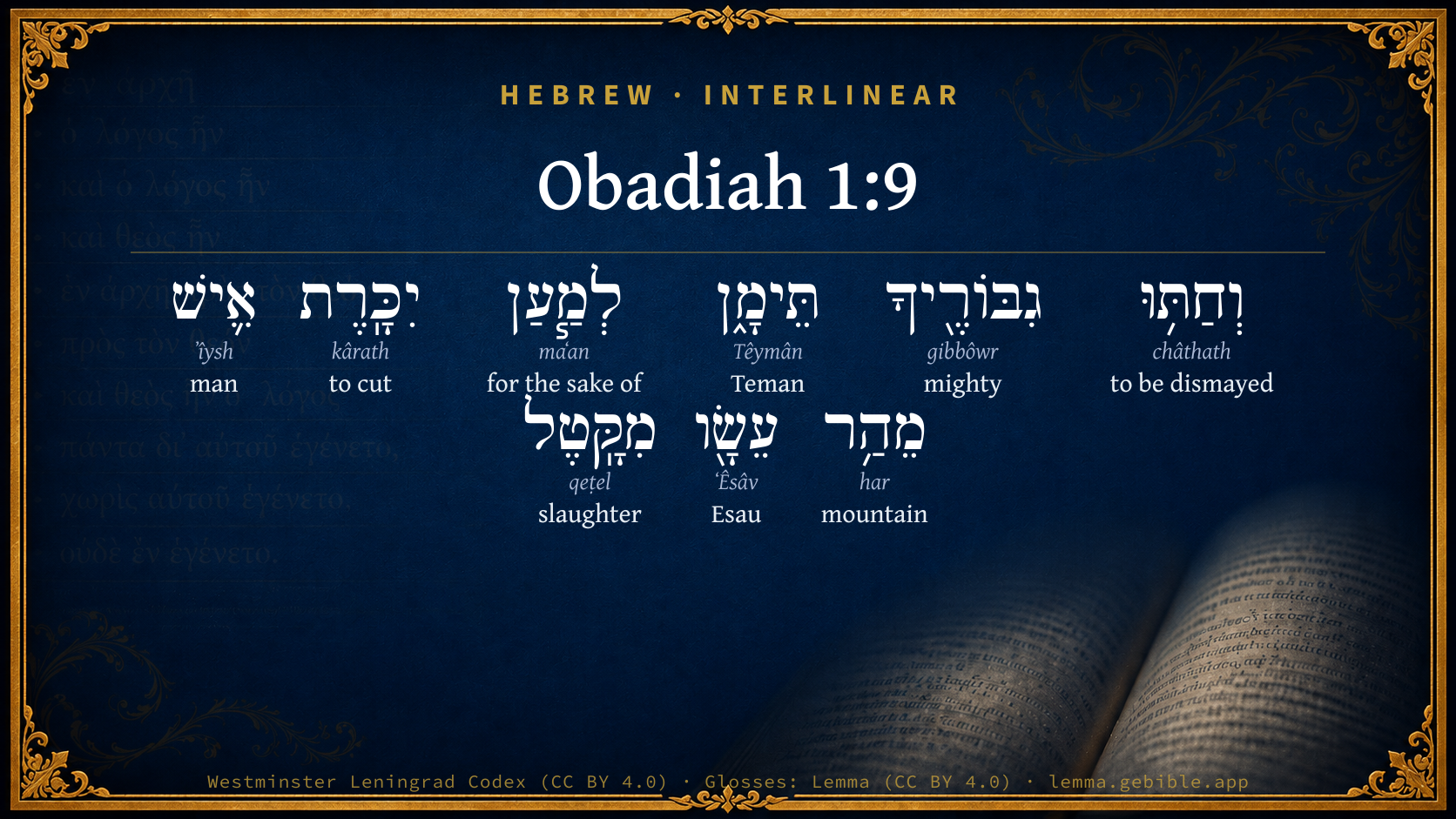
Hebrew (Westminster Leningrad Codex) Obadiah 1:9 appears in the Hebrew Old Testament. The text above is from the Westminster Leningrad Codex. Each word links to its Strong’s number, a concise gloss, and parsing drawn from the Open Scriptures Hebrew Bible morphology. Click any word for its full Brown-Driver-Briggs (BDB) entry.
Download image
Cite this verse

Obadiah 1:9 (World English Bible). Public Domain. Lemma interlinear Bible study tool, https://lemma.gebible.app/v/obadiah/1/9.

Show BibTeX & RIS
BibTeX
RIS
English Translation
Your mighty men, Teman, will be dismayed, to the end that everyone may be cut off from the mountain of Esau by slaughter.
World English Bible · Public Domain
Highlights
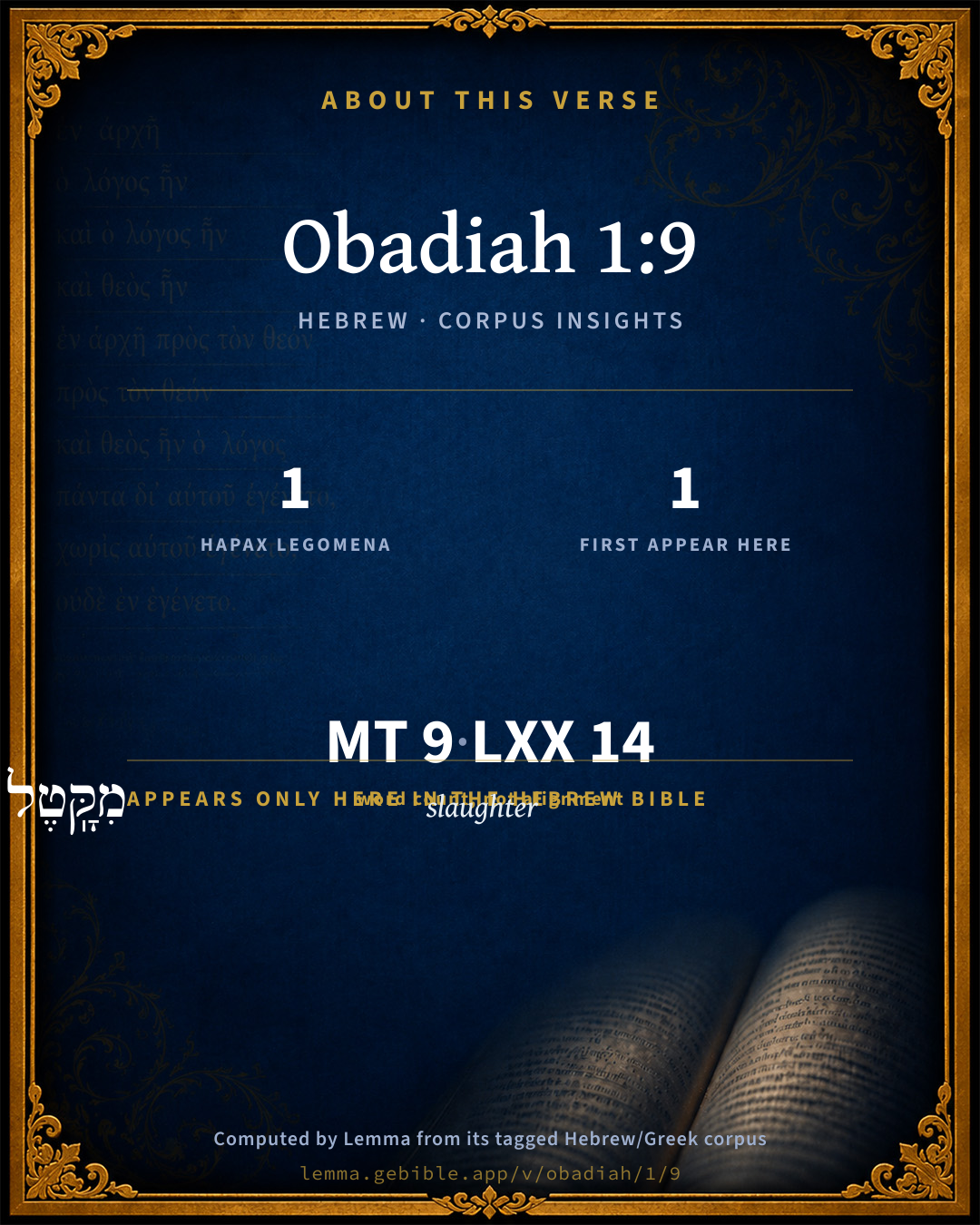
  • 1 hapax legomenon — only here in the Hebrew Bible
  • 1 first appearance in the Hebrew Bible
Full analysis ↓
Download a study sheet

One document with this verse’s original text, its word-by-word gloss line, the meaning frame, cross-references with their text, attributed commentary, and full source and license credits — printable, and it pastes into notes with its structure intact.

This verse Autodidact and up

Study sheet (.html) Plain text (.txt)

A passage Seminary Student

Up to 50 verses in one chapter. A passage sheet keeps up to 6 commentary sources and 12 cross-references per verse, in the order this page ranks them, and says so on the sheet whenever that leaves anything out. Ask for a single verse and you get the Autodidact verse sheet above.

Everything on this page stays free to read, with no account — the sheet is a download of what is already on screen, not access to it.

Want to remove ads? Support Godless Engineer
Compare translations 3

The same verse in 3 English versions, stacked beneath the original-language interlinear above. Click any original word for its lexicon entry.

Each is an independent rendering of the whole verse — the interlinear is not word-aligned to these translations.

Highlighted words mark where these versions differ — a whole-verse word diff, not a word-by-word alignment.

  • World English Bible Public Domain
    Your mighty men, Teman, will be dismayed, to the end that everyone may be cut off from the mountain of Esau by slaughter.
  • King James Version Public Domain
    And thy mighty men, O Teman, shall be dismayed, to the end that every one of the mount of Esau may be cut off by slaughter.
  • unfoldingWord Literal Text CC BY-SA 4.0
    And your mighty men will be dismayed, O Teman, so that a man will be cut off from the mountain of Esau by slaughter.

unfoldingWord Literal Text — © unfoldingWord, licensed CC BY-SA 4.0. Word-aligned USFM3 via Door43 (git.door43.org/unfoldingWord/en_ult).

Versions to compare (up to 4)

3 of 4 selected

Show all 18 translations

Every available English version of this verse, each an independent rendering of the whole verse.

  • World English Bible Public Domain
    Your mighty men, Teman, will be dismayed, to the end that everyone may be cut off from the mountain of Esau by slaughter.
  • Berean Standard Bible Public Domain
    Then your mighty men, O Teman, will be terrified, so that everyone in the mountains of Esau will be cut down in the slaughter.
  • Majority Standard Bible Public Domain
    Then your mighty men, O Teman, will be terrified, so that everyone in the mountains of Esau will be cut down in the slaughter.
  • King James Version Public Domain
    And thy mighty men, O Teman, shall be dismayed, to the end that every one of the mount of Esau may be cut off by slaughter.
  • American Standard Version (1901) Public Domain
    And thy mighty men, O Teman, shall be dismayed, to the end that every one may be cut off from the mount of Esau by slaughter.
  • Revised Version (1885) Public Domain
    And thy mighty men, O Teman, shall be dismayed, to the end that every one may be cut off from the mount of Esau by slaughter.
  • Geneva Bible (1599) Public Domain
    And thy strong men, O Teman, shall bee afraide, because euery one of the mount of Esau shalbe cut off by slaughter.
  • Douay-Rheims (1899) Public Domain
    And thy valiant men of the south shall be afraid, that man may be cut off from the mount of Esau.
  • Young's Literal Translation Public Domain
    And broken down have been thy mighty ones, O Teman, So that every one of the mount of Esau is cut off.
  • Literal Standard Version CC BY-SA 4.0
    And your mighty ones have been broken down, O Teman, || So that everyone of the mountain of Esau is cut off.
  • Unlocked Literal Bible CC BY-SA 4.0
    Your mighty men will be dismayed, Teman, so that every man may be cut off from the mountain of Esau by slaughter.
  • unfoldingWord Literal Text CC BY-SA 4.0
    And your mighty men will be dismayed, O Teman, so that a man will be cut off from the mountain of Esau by slaughter.
  • Darby Bible Public Domain
    And thy mighty men, O Teman, shall be dismayed, to the end that every one may be cut off from the mount of Esau by slaughter.
  • World Messianic Bible Public Domain
    Your mighty men, Teman, will be dismayed, to the end that everyone may be cut off from the mountain of Esau by slaughter.
  • Webster's Bible Public Domain
    And thy mighty men, O Teman, shall be dismayed, to the end that every one of the mount of Esau may be cut off by slaughter.
  • Free Bible Version CC BY-SA 4.0
    Teman, your fighting men will be terrified, so that everyone of the mountains of Esau will be cut down in the massacre.
  • Bible in Basic English Public Domain
    And your men of war, O Teman, will be overcome with fear, so that every one of them may be cut off from the mountain of Esau.
  • JPS Tanakh (1917) Public Domain
    And thy mighty men, O Teman, shall be dismayed, to the end that every one may be cut off from the mount of Esau by slaughter.

Literal Standard Version (2020), Covenant Press — licensed CC BY-SA 4.0. Text via the HelloAO Bible API (eBible.org). Unlocked Literal Bible (unfoldingWord) — licensed CC BY-SA 4.0. Text via the HelloAO Bible API (eBible.org). unfoldingWord Literal Text — © unfoldingWord, licensed CC BY-SA 4.0. Word-aligned USFM3 via Door43 (git.door43.org/unfoldingWord/en_ult). Free Bible Version, Dr. Jonathan Gallagher — licensed CC BY-SA 4.0. Text via the HelloAO Bible API (eBible.org).

Word by word

More ways to search: Search by grammar → Find every occurrence → Compare this word →

Practice this passage: Drill this verse → Learn its vocabulary →

About this verse

These counts appear in no published source. They are computed here, from the morphology-tagged text and Lemma’s own curated glosses. What Lemma adds →

9
words
9
distinct lemmas
Prophets
section

Notable vocabulary

1 hapax legomenon — a word that appears only here in the entire Hebrew Bible:

  • מִקָּֽטֶל slaughter H6993

First appearance in Scripture

This word makes its first canonical appearance in the Hebrew Bible here:

  • מִקָּֽטֶל slaughter H6993

Shared distinctive vocabulary

תֵּימָ֑ן Teman H8487 occurs in 11 verses of the Hebrew Bible. Also found in:

Grammatical profile

  • 2 verbs
  • 5 nouns
  • 1 adjective
  • 1 preposition

Verb forms

  • וְחַתּ֥וּ Qal · Sequential Perfect
  • יִכָּֽרֶת Niphal · Imperfect

Hebrew & Septuagint length

In English translation the verse runs 23 words from the Hebrew and 22 from the Septuagint (LXX English) — closely comparable.

A rough comparison of the two English renderings, which tokenize alike — not a word-level alignment.

Word counts can differ between the Hebrew and the Greek without any difference in meaning — e.g. the Hebrew direct-object marker אֵת has no separate Greek word, and Greek often adds the article ὁ.

In the original languages it is 9 Hebrew tokens and 14 Greek tokens — but the two are counted differently (Hebrew bundles its prefixes and suffixes into one token; the Greek is in lemma form), so that isn’t a like-for-like length.

Cross-references

17

Topical passages linked to Obadiah 1:9 in the Treasury of Scripture Knowledge — connected by theme and wording, ordered by reader-vote popularity; previews shown in the World English Bible.

  • Isaiah 63:1–3 Who is this who comes from Edom, with dyed garments from Bozrah? this who is glorious in his clothing, marching in the greatness of his strength? I who speak in righteousness, mighty to save.
  • Ezekiel 25:13 therefore thus says the Lord Yahweh, I will stretch out my hand on Edom, and will cut off man and animal from it; and I will make it desolate from Teman; even to Dedan shall they fall by the sword.
  • Amos 1:12 But I will send a fire on Teman, And it will devour the palaces of Bozrah."
  • Genesis 36:11 The sons of Eliphaz were Teman, Omar, Zepho, and Gatam, and Kenaz.
  • Isaiah 34:5–8 For my sword has drunk its fill in the sky: behold, it shall come down on Edom, and on the people of my curse, to judgment.
  • Jeremiah 49:22 Behold, he shall come up and fly as the eagle, and spread out his wings against Bozrah: and the heart of the mighty men of Edom at that day shall be as the heart of a woman in her pangs.
  • Job 2:11 Now when Job's three friends heard of all this evil that had come on him, they each came from his own place: Eliphaz the Temanite, Bildad the Shuhite, and Zophar the Naamathite, and they made an appointment together to come to sympathize with him and to comfort him.
  • Jeremiah 49:7 Of Edom. Thus says Yahweh of Hosts: Is wisdom no more in Teman? is counsel perished from the prudent? is their wisdom vanished?
  • 1 Chronicles 1:45 Jobab died, and Husham of the land of the Temanites reigned in his place.
  • Psalms 76:5–6 Valiant men lie plundered, They have slept their last sleep. None of the men of war can lift their hands.
  • Isaiah 19:16–17 In that day shall the Egyptians be like women; and they shall tremble and fear because of the shaking of the hand of Yahweh of Hosts, which he shakes over them.
  • Jeremiah 49:20 Therefore hear the counsel of Yahweh, that he has taken against Edom; and his purposes, that he has purposed against the inhabitants of Teman: Surely they shall drag them away, [even] the little ones of the flock; surely he shall make their habitation desolate over them.
  • Jeremiah 50:36–37 A sword is on the boasters, and they shall become fools; a sword is on her mighty men, and they shall be dismayed.
  • Amos 2:16 And he who is courageous among the mighty will flee away naked in that day," says Yahweh.
  • Obadiah 1:21 Saviors will go up on Mount Zion to judge the mountains of Esau, and the kingdom will be Yahweh's.
  • Deuteronomy 2:5 don't contend with them; for I will not give you of their land, no, not so much as for the sole of the foot to tread on; because I have given Mount Seir to Esau for a possession.
  • Nahum 3:13 Behold, your troops in your midst are women. The gates of your land are set wide open to your enemies. The fire has devoured your bars.

Cross-references courtesy of OpenBible.info (CC BY 4.0).

Hebrew and Greek witnesses Masoretic Hebrew ↔ Greek Septuagint

The same verse in the two great witnesses to the Old Testament, shown verse-for-verse.

These are two independent witnesses, not word-aligned to each other, and the Septuagint is shown in lemma (dictionary) form.

Hebrew Obadiah 1:9 Masoretic · Westminster Leningrad Codex

וְחַתּ֥וּ גִבּוֹרֶ֖יךָ תֵּימָ֑ן לְמַ֧עַן יִכָּֽרֶת אִ֛ישׁ מֵהַ֥ר עֵשָׂ֖ו מִקָּֽטֶל

Your mighty men, Teman, will be dismayed, to the end that everyone may be cut off from the mountain of Esau by slaughter.

World English Bible · Public Domain

Greek LXX Obadiah 1:9 Septuagint · lemma form

καί πτοέω ὁ μαχητής σύ ὁ ἐκ θαιμαν ὅπως ἐκαἴρω ἄνθρωπος ἐκ ὄρος ησαυ

And your warriors from Thaeman shall be dismayed, to the end that man may be cut off from the mount of Esau.

LXX2012 (modern English Septuagint) · Public Domain

On this verse, Jamieson, Fausset & Brown discusses the Septuagint’s reading. Read the note in Commentary ↓

Hebrew: Westminster Leningrad Codex (CC BY 4.0). Greek: Septuagint (public domain); English from LXX2012 (modern English Septuagint) (Public Domain). How the Septuagint differs from the Hebrew →

Targum (Aramaic paraphrase)

1

The Targum is the ancient Jewish Aramaic paraphrase of the Hebrew Scriptures — an interpretive translation, not the Hebrew text itself. Onkelos (literal) and Pseudo-Jonathan (expansive) render the Torah, and Jonathan the Prophets. Coverage is partial: where no permissively-licensed English translation exists for a verse, only the Aramaic is shown. This is verse-level text, not a word-by-word alignment to the Hebrew.

  1. Targum Jonathan Prophets (Joshua–Malachi)
    וְיִתַּבְּרוּן גִבָּרָךְ יַתְבֵי דָרוֹמָא בְּדִיל דְיִשְׁתֵּיצֵי גְבַר דְבֵיהּ צוֹרְבָא מִכְּרַכָּא דְעֵשָׂו מִקְטוֹל:

    (no public-domain English translation for this verse)

    Targum Jonathan — Aramaic: “Mikraot Gedolot” (public domain). English: “Sefaria Community Translation” (CC0 1.0 (public-domain dedication)); “London "Chaldee Paraphrase," 1871” (public domain). Text via Sefaria.

Commentary

Notes on Obadiah 1:9 from classic Christian and Jewish commentators (each source and its license shown beneath its notes). The classic Christian expositions comment on the surrounding passage and are grouped to its opening verse, so a note may address several verses; the Jewish commentaries on the Tanakh (Rashi and others) are per-verse, so they appear only where the commentator wrote on this verse.

Lemma curates 59 commentaries, every one of them public domain or Creative Commons licensed, each selected and text-cleaned for this edition rather than reprinted as found. About our sources →

Trapp's Complete Commentary

John Trapp

Oba 1:9 And thy mighty [men], O Teman, shall be dismayed, to the end that every one of the mount of Esau may be cut off by slaughter.

Ver. 9. And thy mighty men, O Teman] Thy giants, thy champions, that dare to look death in the face upon great adventures in the field; these were now dismayed and dispirited; their courage was quailed, and even broken with fear, as the word signifieth; so that, as Saul, when the devil had preached his funeral, made haste and fell with the fulness of his stature all along on the earth, as being sore afraid, 1Sa 28:20; so shall it be with the mighties of Teman, that is, of Edom, for Teman was nephew to Esau and son to Eliphaz, Gen 36:11, and of him some city or part of the country took its denomination. The Chaldee and the Vulgate Latin take the word Teman appellatively, and render it thus, Thy mighty men shall perish from the South: or those that dwell to the southward of thy country, and so are more remote from the northern Chaldees; yet they shall no sooner hear of thy coming but they shall tremble and forget their prowess.

To the end that every one of the mount of Esau may be cut off by slaughter] Heb. every man, be he never so manly and magnanimous.

Of the mount of Esau] Of Idumea, which was mountainous, and therefore fitly called Seir, that is, rough and rugged.

May be cut off by slaughter] So that they shall live by fame only, and hardly that.

John Trapp, A Commentary or Exposition upon All the Books of the Old and New Testament (1647–1656) — public domain. Text from a community e-Sword module.

Jamieson, Fausset & Brown

Robert Jamieson, A. R. Fausset & David Brown

cut off by slaughter--MAURER translates, "on account of the slaughter," namely, that inflicted on Judea by Edom (compare ). The Septuagint, Syriac, and Vulgate connect these words with , "for the slaughter, for the violence (of which thou art guilty) against thy brother Jacob." English Version, "cut off by slaughter" (that is, an utter cutting off), answers well to "cut off for ever" (). However, the arrangement of the Septuagint gives a better parallelism in . "For the slaughter" (1) being balanced in just retribution by "thou shalt be cut off for ever" (4); as "For thy violence (not so bad as slaughter) against thy brother Jacob" (2) is balanced by "shame (not so bad as being cut off) shall cover thee" (3). Shame and extinction shall repay violence and slaughter (; ). Compare as to Edom's violence, ; ; .

Jamieson, Fausset & Brown — Commentary Critical and Explanatory on the Whole Bible (1871) — public domain (CC PDM 1.0). Text via the HelloAO Bible API.

Adam Clarke's Commentary

Verse 9. Thy mighty men, O Teman] This was one of the strongest places in Idumea; and is put here, as in Am 1:12, and elsewhere, for Idumea itself.

Mount of Esau] Mount Seir.

Adam Clarke's Commentary on the Bible (1810–1826) — public domain. Text from a community e-Sword/MySword module.

John Calvin's Commentaries

The Prophet, after having spoken of one kind of God’s vengeance, adds another, — that he would break whatever there was of strength in Idumea: and thus he shows that the courage and strength of men, no less than their understanding, are in the hand of God. As then God dissipates and destroys, whenever it pleases him, whatever wisdom there may be in men, so also he enervates and breaks down their hearts: in a word, he deprives them of all strength, so that they fail and come to nothing of themselves. Were they who are proud of their strength and counsels rightly to consider this, they would at length learn to submit themselves in true humility to God. But this truth is what the world cannot be made to believe: yet God shows to us here, as in a picture, that however men may flourish for a time, they would immediately vanish, were not he to sustain them, and to support his gifts in them, and keep them entire; and, especially, that empty smoke is everything, that seems to be understanding and strength in men; for the Lord can easily take away both, whensoever it may please him.

We ought therefore carefully to observe what he says here, Broken down shall be thy brave men, O Teman. Some think that a particular country is here pointed out; for Teman is the south, that is, with regard to Judea. But as Teman, we know, was one of the grandsons of Esau, (Genesis 36:15,) and as a part of Arabia was called by this name, it is the more probable, that the Prophet turns here his discourse to Idumea. But as to the word Teman, it is, a part taken for the whole.

For cut off, he says, shall be man: by saying, cut off shall man, he means, that all to a man would be destroyed. How? “by slaughter” . But קתל kothel means a slaughter in which no one remains alive. We hence see what the Prophet means, — that all the Idumeans would be so broken down, that all would fall, for there would be no heart nor strength to resist. It now follows —

John Calvin's Commentaries (1540-1563) — public domain. Text from the Calvin Translation Society English edition (1840s-50s) via the Christian Classics Ethereal Library (ccel.org). Calvin's coverage is partial (roughly two-thirds of the Bible); uncommented books and verses are honest gaps, never fabricated. The 19th-century editor's footnotes and remarks are omitted so the notes are faithfully Calvin's own voice.

The Cambridge Bible for Schools and Colleges

gen. ed. J. J. S. Perowne

9. by slaughter] i.e. by slaughter inflicted on them by their enemies. This is the simplest and most natural meaning. It might be rendered, as the same preposition is at the beginning of the next verse, “for,” i.e. on account of and in retribution of the slaughter which the Edomites had inflicted on the Jews. This clause would then be an introduction to the following verses, in which the cause of their calamity is treated of at length. Ewald’s rendering, “without battle,” though grammatically possible, is contradicted by Eze_35:8.

The Cambridge Bible for Schools and Colleges (gen. ed. J. J. S. Perowne; Cambridge University Press, 1878–1918) — public domain. Text from a community e-Sword module.

John Gill's Exposition

And thy mighty men, O Teman, shall be dismayed,.... Teman was one part of the country of Edom, so called from Teman, a son of Eliphaz, and grandson of Esau, Gen 36:11; and which it seems had been famous for men of might and courage: it abounded with brave officers, and courageous soldiers, who should now be quite dispirited, and have no heart to go out against the enemy; and, instead of defending their country, should throw away their arms, and run away in a fright. The Targum and Vulgate Latin version render it,

"thy mighty men that inhabit the south;''

or are on the south, the southern part of Edom, and so lay farthest off from the Chaldeans, who came from the north; yet these should be at once intimidated upon the rumour of their approach and invasion:

to the end that even one of the mount of Esau may be cut by slaughter; that so there might be none to resist and stop the enemy, or defend their country; but that all might fall by the sword of the enemy, and none be left, even every mighty man, as Jarchi interprets it, through the greatness of the slaughter that should be made.

John Gill's Exposition of the Whole Bible (1746–1763) — public domain (CC PDM 1.0). Text via the HelloAO Bible API.

Albert Barnes' Notes on the Bible

And thy mighty, O Teman, shall be dismayed - The pagan, more religiously than we, ascribed panic to the immediate action of one of their gods, or to Nature deified, Pan, i. e., the Universe: wrong as to the being whom they “ignorantly worshiped;” right, in ascribing it to what they thought a divine agency. Holy Scripture at times discovers the hidden agency, that we may acknowledge God’s Hand in those terrors which we cannot account for. So it relates, on occasion of Jonathan’s slaughter of the Philistine garrison 1Sa 14:15, “there was a trembling in the host and in the field, and among all the people: the garrison and the spoilers, they also trembled, and the earth quaked, so it became a trembling from God,” or (in our common word,) a panic from God. All then failed Edom. Their allies and friends betrayed them; God took away their wisdom. Wisdom was turned into witlessness, and courage into cowardice; “to the end that every one from mount Esau may be cut off by slaughter.” The prophet sums up briefly God’s end in all this. The immediate means were man’s treachery, man’s violence, the failure of wisdom in the wise, and of courage in the brave. The end of all, in God’s will, was their destruction Rom 8:28.

By slaughter - , literally “from slaughter,” may mean either the immediate or the distant cause of their being “cut off,” either the means which God employed , “All things work together for good to those who love God,” and for evil to those who hate Him, that Edom was cut off by one great slaughter by the enemy; or that which moved God to give them over to destruction, their own “slaughter” of their brethren, the Jews, as it follows;

Albert Barnes' Notes on the Bible (1834–1885) — public domain. Text from a community e-Sword/MySword module.

Haydock's Catholic Bible Commentary

South. Hebrew, "Theman," (Calmet) where the Romans kept a garrison, fifteen miles south of Petra. (St. Jerome)

George Leo Haydock (1774–1849), Haydock's Catholic Family Bible and Commentary, 1859 edition — public domain. Excludes Psalms (Douay-Rheims chapter numbering differs from Protestant) and Deuterocanonical books (Catholic canon only).

Matthew Poole's English Annotations

Mighty men; valiant commanders and soldiers, who were never blemished with cowardice, who formerly durst adventure on greatest dangers and encounter most formidable enemies, and were never daunted with a slow-approaching enemy, how much soever over number to them, nor with any sudden surprising accidents; men of invincible courage, and most ready minds.

Teman; a principal city and munition of Idumea. See Eze 25:13; Hab 3:3; Amo 1:12.

Dismayed; astonished and surprised with such fear as disableth from action and counsel, shall neither dare to resist, nor hope to escape, but tamely give up all to the enemy.

To the end that every one may be cut off by slaughter; thus all shall be exposed to slaughter when they dare not fight, who should have saved themselves and defended others. Deplorable is their condition, who, surrounded every way with enemies, have neither strength nor counsel to resist their power or defeat their malice!

Matthew Poole's English Annotations on the Holy Bible (1683–1685) — public domain. Text from a community e-Sword/MySword module.

Whedon's Commentary on the Bible

Daniel D. Whedon

9. Mighty men — Warriors. When they realize at last that they have been entrapped, that wisdom and discernment have taken their flight, the warriors will lose heart, and the result will be the complete undoing of Edom.

O Teman — The change to the direct address adds force and intensity to the threat. On Teman see comment on Amo_1:12.

By slaughter — Ordinarily this is taken to refer to the slaughter to be inflicted upon Edom by her enemies; but according to the above interpretation there is nothing in this section (compare 17ff.) to indicate that the overthrow of Edom will be wrought by her enemies — Jehovah himself will strike the blow. Hence Ewald suggested the translation “without battle,” which is grammatically possible but makes an extremely weak conclusion of the threat. It seems better to carry the word over to Oba_1:10 (so LXX., Peshitto, Vulgate). The preposition is the same as that before “violence” in Oba_1:10, so that “for slaughter” might be read instead of “by slaughter,” the two together “for slaughter, for the violence done… ,” or even “for the slaughter and violence done”; the two words indicating two causes of the judgment to come. Keil objects to this change on the ground that, if adopted, the stronger and more specific term would precede the weaker and more general. In this Nowack agrees with Keil, and he gets out of the difficulty by rejecting “for slaughter” as a marginal gloss to “for violence,” “originating with a reader to whom the latter expression did not appear pointed enough” (so also Marti). However, the objection of Keil is not well founded, and the omissions suggested by the other two commentators mentioned are arbitrary. It is not true that the stronger and more specific term precedes the weaker and more general; the two words refer to two distinct crimes, of which the second, according to Jewish conceptions, was the more serious. Oba_1:10-14 evidently refer to the destruction of Jerusalem in 586 (see p. 288). In this calamity the afflictions of Israel were twofold: on the one hand, they suffered personal losses; on the other, their sanctuary was desecrated and destroyed. The author of Psalms 137 seems to be concerned with the religious afflictions; and the deep feeling manifesting itself in his imprecations was undoubtedly due to the fact that the religious losses were to him of far greater consequence than any temporal privations. Of the two expressions in this passage “slaughter” may well stand for the personal wrongs suffered, “violence” for the wrongs done to the religious life and institutions. Of these the second was felt more keenly than the former; therefore the order of the words is perfectly natural.

Daniel D. Whedon (gen. ed.), Commentary on the Old and New Testaments (1874–1909) — public domain. Text from a community e-Sword module.

The Pulpit Commentary

O Teman; Septuagint, oi ek Yaiman , "those from Thaeman;" Vulgate, a meridic, taking the word as an appellative; so the Chaldee. The southern district of Idumea was so called. (see note on Amo_1:12) One of Job"s friends, and the cleverest of them, was a Temanite. (Job_2:11) To the end that. This judicial blindness is inflicted in order that all may perish. By slaughter. Murder at the hands of the enemy. The LXX, Vulgate, and Syriac connect these words with the following verse. But the Masoretic punctuation, as in the Anglican Version, is doubtless correct (see Keil).

The Pulpit Commentary (1880–1919), ed. H.D.M. Spence-Jones & Joseph S. Exell — public domain. Text from a community e-Sword module.

John Wesley's Explanatory Notes

Teman - A principal city of Idumea.

John Wesley, Explanatory Notes Upon the Whole Bible (1754–1765) — public domain. Text via the GEBible commentary corpus.

Rashi

Rabbi Shlomo Yitzchaki (Rashi)

And your mighty men shall be dismayed—They shall be dismayed and frightened to flee to the land of Israel [Malbim: to the land of Edom]. And Jonathan rendered: And your mighty men shall be dismayed, dwellers of the southland.

in order that every man be cut off—I.e, every mighty man. [from Targum Jonathan]

from the mountain of Esau by slaughter—By the great slaughter that will come upon them.

Rashi on the Tanakh — English translations: “The Judaica Press complete Tanach with Rashi, translated by A. J. Rosenberg” (CC BY 4.0); “Pentateuch with Rashi's commentary by M. Rosenbaum and A.M. Silbermann, 1929-1934” (public domain); “The Metsudah Tanach series, Lakewood, N.J” (CC BY 4.0); and “The Book of Joshua, Metsudah Publications, 1997” (CC BY 4.0). Text via Sefaria.

Lesson kit

Teaching starters — assembled from the data on this page, not authored interpretation. Every prompt links to the verse data it draws on. Edit before teaching.

Obadiah, in the Prophets, opens this verse with 9 words (9 distinct Hebrew lemmas). Its most distinctive word is qeṭel (“slaughter”). A historical commentator’s framing appears above. Read the whole chapter for the surrounding context.

Discussion questions

  1. The word qeṭel carries the sense “slaughter.” How does it shape the verse?
  2. This verse holds 1 word here found nowhere else in the Hebrew Bible. What might the rare word draw attention to?
  3. The word “slaughter” first appears here in Scripture. What is being introduced at this debut?
  4. Genesis 36:11 shares the word «Teman» with this verse. How do the two illuminate each other?
  5. These translations render this verse differently; the difference is in the English rendering, not the original. What questions does that raise?
  6. The verb «וְחַתּ֥וּ» is Qal Sequential Perfect. How does its form color the action?
  7. Reading how Trapp's Complete Commentary and Jamieson, Fausset & Brown read this verse, where do the two commentators agree and where do they part?

Things to notice

Reading settings

Reading text

Shown beneath each verse's original-language words.

Old Testament
Old Testament edition

Read the OT as the Masoretic Hebrew (MT) or the Greek Septuagint (LXX).

English shown for the Greek Septuagint (in the Hebrew ↔ Greek comparison).

Comparing translations? Open the Compare panel on any verse page to stack up to four side by side.