
Jeremiah 49:22

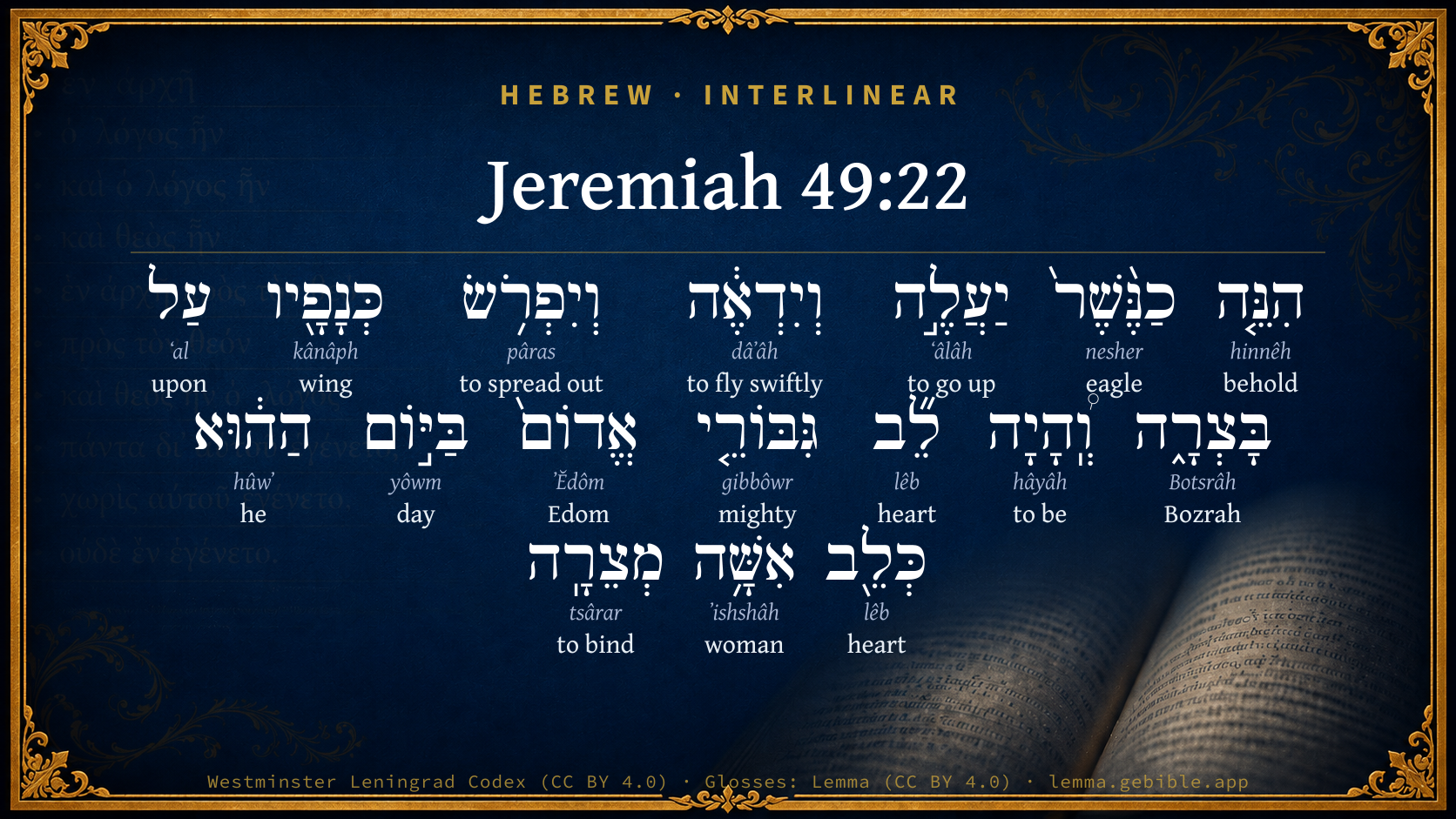
Hebrew (Westminster Leningrad Codex) Jeremiah 49:22 appears in the Hebrew Old Testament. The text above is from the Westminster Leningrad Codex. Each word links to its Strong’s number, a concise gloss, and parsing drawn from the Open Scriptures Hebrew Bible morphology. Click any word for its full Brown-Driver-Briggs (BDB) entry.
Download image
Cite this verse

Jeremiah 49:22 (World English Bible). Public Domain. Lemma interlinear Bible study tool, https://lemma.gebible.app/v/jeremiah/49/22.

Show BibTeX & RIS
BibTeX
RIS
English Translation
Behold, he shall come up and fly as the eagle, and spread out his wings against Bozrah: and the heart of the mighty men of Edom at that day shall be as the heart of a woman in her pangs.
World English Bible · Public Domain
Download a study sheet

One document with this verse’s original text, its word-by-word gloss line, the meaning frame, cross-references with their text, attributed commentary, and full source and license credits — printable, and it pastes into notes with its structure intact.

This verse Autodidact and up

Study sheet (.html) Plain text (.txt)

A passage Seminary Student

Up to 50 verses in one chapter. A passage sheet keeps up to 6 commentary sources and 12 cross-references per verse, in the order this page ranks them, and says so on the sheet whenever that leaves anything out. Ask for a single verse and you get the Autodidact verse sheet above.

Everything on this page stays free to read, with no account — the sheet is a download of what is already on screen, not access to it.

Want to remove ads? Support Godless Engineer
Compare translations 3

The same verse in 3 English versions, stacked beneath the original-language interlinear above. Click any original word for its lexicon entry.

Each is an independent rendering of the whole verse — the interlinear is not word-aligned to these translations.

Highlighted words mark where these versions differ — a whole-verse word diff, not a word-by-word alignment.

  • World English Bible Public Domain
    Behold, he shall come up and fly as the eagle, and spread out his wings against Bozrah: and the heart of the mighty men of Edom at that day shall be as the heart of a woman in her pangs.
  • King James Version Public Domain
    Behold, he shall come up and fly as the eagle, and spread his wings over Bozrah: and at that day shall the heart of the mighty men of Edom be as the heart of a woman in her pangs.
  • unfoldingWord Literal Text CC BY-SA 4.0
    See, someone will attack like an eagle, and swoop down and spread his wings over Bozrah. Then on that day, the hearts of Edom’s soldiers will become like the heart of a woman in birth labor.”

unfoldingWord Literal Text — © unfoldingWord, licensed CC BY-SA 4.0. Word-aligned USFM3 via Door43 (git.door43.org/unfoldingWord/en_ult).

Versions to compare (up to 4)

3 of 4 selected

Show all 18 translations

Every available English version of this verse, each an independent rendering of the whole verse.

  • World English Bible Public Domain
    Behold, he shall come up and fly as the eagle, and spread out his wings against Bozrah: and the heart of the mighty men of Edom at that day shall be as the heart of a woman in her pangs.
  • Berean Standard Bible Public Domain
    Look! An eagle will soar and swoop down, spreading its wings over Bozrah. In that day the hearts of Edom’s mighty men will be like the heart of a woman in labor.
  • Majority Standard Bible Public Domain
    Look! An eagle will soar and swoop down, spreading its wings over Bozrah. In that day the hearts of Edom’s mighty men will be like the heart of a woman in labor.
  • King James Version Public Domain
    Behold, he shall come up and fly as the eagle, and spread his wings over Bozrah: and at that day shall the heart of the mighty men of Edom be as the heart of a woman in her pangs.
  • American Standard Version (1901) Public Domain
    Behold, he shall come up and fly as the eagle, and spread out his wings against Bozrah: and the heart of the mighty men of Edom at that day shall be as the heart of a woman in her pangs.
  • Revised Version (1885) Public Domain
    Behold, he shall come up and fly as the eagle, and spread out his wings against Bozrah: and the heart of the mighty men of Edom at that day shall be as the heart of a woman in her pangs.
  • Geneva Bible (1599) Public Domain
    Behold, he shall come vp, and flie as the Egle, and spreade his wings ouer Bozrah, and at that day shall the heart of the strong men of Edome be as the heart of a woman in trauaile.
  • Douay-Rheims (1899) Public Domain
    Behold he shall come up as an eagle, and fly: and he shall spread his wings over Bosra: and in that day the heart of the valiant ones of Edom shall be as the heart of a woman in labour.
  • Young's Literal Translation Public Domain
    Lo, as an eagle he cometh up, and flieth, And he spreadeth his wings over Bozrah, And the heart of the mighty of Edom hath been in that day, As the heart of a distressed woman!'
  • Literal Standard Version CC BY-SA 4.0
    Behold, He comes up as an eagle, and flies, || And He spreads His wings over Bozrah, || And the heart of the mighty of Edom has been in that day, || As the heart of a travailing woman.”
  • Unlocked Literal Bible CC BY-SA 4.0
    See, someone will attack like an eagle, and swoop down and spread his wings over Bozrah. Then on that day, the hearts of Edom's soldiers will become like the heart of a woman in birth labor.”
  • unfoldingWord Literal Text CC BY-SA 4.0
    See, someone will attack like an eagle, and swoop down and spread his wings over Bozrah. Then on that day, the hearts of Edom’s soldiers will become like the heart of a woman in birth labor.”
  • Darby Bible Public Domain
    Behold, he shall come up, and fly as an eagle, and spread forth his wings against Bozrah; and at that day the heart of the mighty men of Edom shall be as the heart of a woman in her pangs.
  • World Messianic Bible Public Domain
    Behold, he will come up and fly as the eagle, and spread out his wings against Bozrah. The heart of the mighty men of Edom at that day will be as the heart of a woman in her pangs.
  • Webster's Bible Public Domain
    Behold, he shall come up and fly as the eagle, and spread his wings over Bozrah: and at that day shall the heart of the mighty men of Edom be as the heart of a woman in her pangs.
  • Free Bible Version CC BY-SA 4.0
    Watch as an enemy like an eagle flies high, then swoops down, spreading its wings as it attacks Bozrah. At that time Edom's warriors will be as scared as a woman in labor.
  • Bible in Basic English Public Domain
    See, he will come up like an eagle in flight, stretching out his wings against Bozrah: and the hearts of Edom's men of war on that day will be like the heart of a woman in birth-pains.
  • JPS Tanakh (1917) Public Domain
    Behold, he shall come up and swoop down as the vulture, and spread out his wings against Bozrah; and the heart of the mighty men of Edom at that day shall be as the heart of a woman in her pangs.

Literal Standard Version (2020), Covenant Press — licensed CC BY-SA 4.0. Text via the HelloAO Bible API (eBible.org). Unlocked Literal Bible (unfoldingWord) — licensed CC BY-SA 4.0. Text via the HelloAO Bible API (eBible.org). unfoldingWord Literal Text — © unfoldingWord, licensed CC BY-SA 4.0. Word-aligned USFM3 via Door43 (git.door43.org/unfoldingWord/en_ult). Free Bible Version, Dr. Jonathan Gallagher — licensed CC BY-SA 4.0. Text via the HelloAO Bible API (eBible.org).

Word by word

More ways to search: Search by grammar → Find every occurrence → Compare this word →

Practice this passage: Drill this verse → Learn its vocabulary →

וְיִדְאֶ֔ה
dâʼâh
H1675
“and · to fly swiftly”
Conjunction + Verb, Qal, Imperfect, 3rd Person, Masculine, Singular
Part of Speech
Conjunction + Verb
Stem
Qal
Form
Imperfect
Person
3rd Person
Gender
Masculine
Number
Singular
Full BDB Definition

Origin: a primitive root

TWOT: 394

to fly fast, fly swiftly, dart through the air - (Qal) to fly swiftly, dart
  1. הִנֵּ֤ה hinnêh H2009 “behold” Particle, Demonstrative
  2. כַנֶּ֨שֶׁר֙ nesher H5404 “like/as the · eagle” Preposition, Determined + Noun, Common, Masculine, Singular, Absolute
  3. יַעֲלֶ֣ה ʻâlâh H5927 “to go up” Verb, Qal, Imperfect, 3rd Person, Masculine, Singular
  4. וְיִפְרֹ֥שׂ pâras H6566 “and · to spread out” Conjunction + Verb, Qal, Imperfect, 3rd Person, Masculine, Singular
  5. כְּנָפָ֖יו kânâph H3671 “wings · his” Noun, Common, Feminine, Plural, Construct + Suffix, Personal, 3rd Person, Masculine, Singular
  6. עַל ʻal H5921 “upon” Preposition
  7. בָּצְרָ֑ה Botsrâh H1224 “Bozrah” Noun, Proper
  8. וְֽ֠הָיָה hâyâh H1961 “and · to be” Conjunction + Verb, Qal, Sequential Perfect, 3rd Person, Masculine, Singular
  9. לֵ֞ב lêb H3820 “heart of” Noun, Common, Masculine, Singular, Construct
  10. גִּבּוֹרֵ֤י gibbôwr H1368 “mighty of” Adjective, Adjective, Masculine, Plural, Construct
  11. אֱדוֹם֙ ʼĔdôm H123 “Edom” Noun, Proper
  12. בַּיּ֣וֹם yôwm H3117 “in/at the · day” Preposition, Determined + Noun, Common, Masculine, Singular, Absolute
  13. הַה֔וּא hûwʼ H1931 “the · he” Particle, Definite Article + Pronoun, Personal, 3rd Person, Masculine, Singular
  14. כְּלֵ֖ב lêb H3820 “like/as · heart of” Preposition + Noun, Common, Masculine, Singular, Construct
  15. אִשָּׁ֥ה ʼishshâh H802 “woman” Noun, Common, Feminine, Singular, Absolute
  16. מְצֵרָֽה tsârar H6887 “binding” Verb, Hiphil, Participle Active, Feminine, Singular, Absolute

About this verse

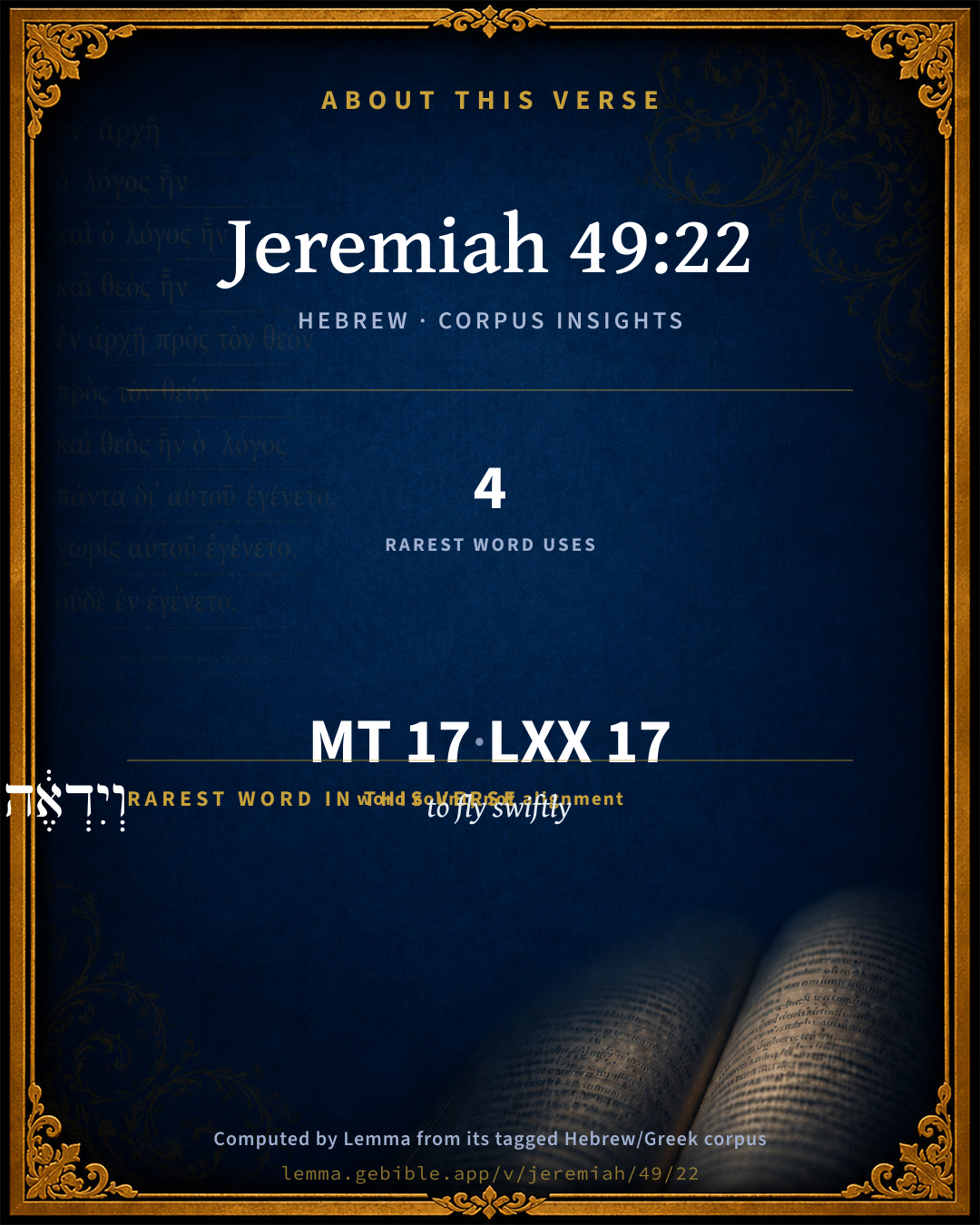
These counts appear in no published source. They are computed here, from the morphology-tagged text and Lemma’s own curated glosses. What Lemma adds →

17
words
16
distinct lemmas
Prophets
section

Notable vocabulary

The rarest word here is וְיִדְאֶ֔ה to fly swiftly H1675 — appearing just 4 times in the whole Hebrew Bible.

Shared distinctive vocabulary

וְיִדְאֶ֔ה to fly swiftly H1675 occurs in 4 verses of the Hebrew Bible. Also found in:

Grammatical profile

  • 5 verbs
  • 8 nouns
  • 1 adjective
  • 1 pronoun
  • 1 preposition
  • 1 particle

Verb forms

  • יַעֲלֶ֣ה Qal · Imperfect
  • וְיִדְאֶ֔ה Qal · Imperfect
  • וְיִפְרֹ֥שׂ Qal · Imperfect
  • וְֽ֠הָיָה Qal · Sequential Perfect
  • מְצֵרָֽה Hiphil · Participle Active

Repetition

A word recurs within this verse — often emphatic in Hebrew:

  • לֵ֞ב heart H3820 ×2

Hebrew & Septuagint length

In the original languages it is 17 Hebrew tokens and 17 Greek tokens — but the two are counted differently (Hebrew bundles its prefixes and suffixes into one token; the Greek is in lemma form), so that isn’t a like-for-like length.

Cross-references

16

Topical passages linked to Jeremiah 49:22 in the Treasury of Scripture Knowledge — connected by theme and wording, ordered by reader-vote popularity; previews shown in the World English Bible.

  • Jeremiah 48:40–41 For thus says Yahweh: Behold, he shall fly as an eagle, and shall spread out his wings against Moab.
  • Isaiah 13:8 and they shall be dismayed; pangs and sorrows shall take hold [of them]; they shall be in pain as a woman in travail: they shall look in amazement one at another; their faces [shall be] faces of flame.
  • Hosea 8:1 "Put the trumpet to your lips! Something like an eagle is over Yahweh's house, Because they have broken my covenant, And rebelled against my law.
  • Deuteronomy 28:49 Yahweh will bring a nation against you from far, from the end of the earth, as the eagle flies; a nation whose language you shall not understand;
  • Jeremiah 4:13 Behold, he shall come up as clouds, and his chariots [shall be] as the whirlwind: his horses are swifter than eagles. Woe to us! for we are ruined.
  • Jeremiah 6:24 We have heard the report of it; our hands wax feeble: anguish has taken hold of us, [and] pangs as of a woman in travail.
  • Jeremiah 30:6 Ask now, and see whether a man does travail with child: why do I see every man with his hands on his loins, as a woman in travail, and all faces are turned into paleness?
  • Jeremiah 49:24 Damascus has grown feeble, she turns herself to flee, and trembling has seized on her: anguish and sorrows have taken hold of her, as of a woman in travail.
  • Psalms 18:5 The cords of Sheol were round about me; The snares of death came on me.
  • Isaiah 21:3 Therefore are my loins filled with anguish; pangs have taken hold on me, as the pangs of a woman in travail: I am pained so that I can't hear; I am dismayed so that I can't see.
  • Isaiah 26:17 Like as a woman with child, who draws near the time of her delivery, is in pain and cries out in her pangs; so we have been before you, Yahweh.
  • Jeremiah 4:31 For I have heard a voice as of a woman in travail, the anguish as of her who brings forth her first child, the voice of the daughter of Zion, who gasps for breath, who spreads her hands, [saying], Woe is me now! for my soul faints before the murderers.
  • Jeremiah 13:21 What will you say, when he shall set over you as head those whom you have yourself taught to be friends to you? shall not sorrows take hold of you, as of a woman in travail?
  • Jeremiah 22:23 Inhabitant of Lebanon, who makes your nest in the cedars, how greatly to be pitied shall you be when pangs come on you, the pain as of a woman in travail!
  • Daniel 7:4 The first was like a lion, and had eagle's wings: I saw until the wings of it were plucked, and it was lifted up from the earth, and made to stand on two feet as a man; and a man's heart was given to it.
  • 1 Thessalonians 5:3 For when they are saying, "Peace and safety," then sudden destruction will come on them, like birth pains on a pregnant woman; and they will in no way escape.

Cross-references courtesy of OpenBible.info (CC BY 4.0).

Hebrew and Greek witnesses Masoretic Hebrew ↔ Greek Septuagint

The same verse in the two great witnesses to the Old Testament, shown verse-for-verse.

These are two independent witnesses, not word-aligned to each other, and the Septuagint is shown in lemma (dictionary) form.

Hebrew Jeremiah 49:22 Masoretic · Westminster Leningrad Codex

הִנֵּ֤ה כַנֶּ֨שֶׁר֙ יַעֲלֶ֣ה וְיִדְאֶ֔ה וְיִפְרֹ֥שׂ כְּנָפָ֖יו עַל בָּצְרָ֑ה וְֽ֠הָיָה לֵ֞ב גִּבּוֹרֵ֤י אֱדוֹם֙ בַּיּ֣וֹם הַה֔וּא כְּלֵ֖ב אִשָּׁ֥ה מְצֵרָֽה

Behold, he shall come up and fly as the eagle, and spread out his wings against Bozrah: and the heart of the mighty men of Edom at that day shall be as the heart of a woman in her pangs.

World English Bible · Public Domain

Greek LXX Structure differs

In the Septuagint, Jeremiah is about an eighth shorter than the Hebrew and arranges its material differently — the Oracles Against the Nations (Hebrew chapters 46–51) appear in the middle of the Greek book, after 25:13. Because the chapter and verse boundaries do not line up, a verse-for-verse comparison with the Hebrew is not shown.

A verse-for-verse comparison isn’t shown here because the chapters and verses don’t line up. Switch to the LXX edition with the MT / LXX toggle above to read the Greek directly.

Hebrew: Westminster Leningrad Codex (CC BY 4.0). Greek: Septuagint (public domain); English from a public-domain English Septuagint. How the Septuagint differs from the Hebrew →

Targum (Aramaic paraphrase)

1

The Targum is the ancient Jewish Aramaic paraphrase of the Hebrew Scriptures — an interpretive translation, not the Hebrew text itself. Onkelos (literal) and Pseudo-Jonathan (expansive) render the Torah, and Jonathan the Prophets. Coverage is partial: where no permissively-licensed English translation exists for a verse, only the Aramaic is shown. This is verse-level text, not a word-by-word alignment to the Hebrew.

  1. Targum Jonathan Prophets (Joshua–Malachi)
    הָא כְּנִשְׁרָא דְסָלֵיק וּמִשְׁתְּדֵי כֵּן יִסַק מְלַךְ בְּמַשִׁרְיָתֵיהּ וְיִשְׁרֵי עַל בָּצְרָה וִיהֵי לֵב גִבָּרֵיהוֹן דֶאֱדוֹמָאֵי בְּיוֹמָא הַהוּא כְּלֵב אִתְּתָא דְעָקָא לָהּ בְּחֶבְלָהָא:

    (no public-domain English translation for this verse)

    Targum Jonathan — Aramaic: “Mikraot Gedolot” (public domain). English: “Sefaria Community Translation” (CC0 1.0 (public-domain dedication)); “London "Chaldee Paraphrase," 1871” (public domain). Text via Sefaria.

Commentary

Notes on Jeremiah 49:22 from classic Christian and Jewish commentators (each source and its license shown beneath its notes). The classic Christian expositions comment on the surrounding passage and are grouped to its opening verse, so a note may address several verses; the Jewish commentaries on the Tanakh (Rashi and others) are per-verse, so they appear only where the commentator wrote on this verse.

Lemma curates 59 commentaries, every one of them public domain or Creative Commons licensed, each selected and text-cleaned for this edition rather than reprinted as found. About our sources →

Trapp's Complete Commentary

John Trapp

Jer 49:22 Behold, he shall come up and fly as the eagle, and spread his wings over Bozrah: and at that day shall the heart of the mighty men of Edom be as the heart of a woman in her pangs.

Ver. 22. Behold, he shall come up and fly.] See Jer 48:40-41.

John Trapp, A Commentary or Exposition upon All the Books of the Old and New Testament (1647–1656) — public domain. Text from a community e-Sword module.

Tyndale Open Study Notes

Tyndale Open Resources

49:22 The eagle, a common bird in the rugged mountains of Edom, is a metaphor for the rapid penetration of the region by the Babylonians.

Tyndale Open Study Notes — © Tyndale Open Resources, licensed CC BY-SA 4.0. Text via the HelloAO Bible API.

Geneva Bible (1599)

Geneva Bible translators

As Jer. 48:40, was said of Moab.

Geneva Bible (1599) marginal notes — public domain. Text via Bolls.life.

Jamieson, Fausset & Brown

Robert Jamieson, A. R. Fausset & David Brown

(Compare Jer 48:40-41).

Bozrah--(See on Jer 48:24).

Jamieson, Fausset & Brown — Commentary Critical and Explanatory on the Whole Bible (1871) — public domain (CC PDM 1.0). Text via the HelloAO Bible API.

Adam Clarke's Commentary

Verse 22. He shall come up and fly as the eagle] Nebuchadnezzar. See Jer 48:40.

Adam Clarke's Commentary on the Bible (1810–1826) — public domain. Text from a community e-Sword/MySword module.

John Calvin's Commentaries

He again speaks of the speedy coming of the Chaldeans, as though he had said, “When the state of that nation shall seem peaceable, when they rest secure in their own nest, then shall the Chaldeans suddenly come, or rather fly.” For he compares them to eagles, in order to show that it would be a very quick and ruinous expedition. At the time this prophecy was declared by the Prophet, no one could have suspected that the Chaldeans would become enemies to the Idumeans, for they were on the best terms with each other; nay, we know that they paid every attention to gain the favor of the Chaldeans. Hence it is said in the Psalms,

“Remember, O Lord, the children of Edom, who said in the day of Jerusalem, Let it be cut down, let it be cut down.” (Psalm 137:7)

By these words is intimated the impious conspiracy of that nation with the Chaldeans. Nor is there a doubt but that they tried by all means to conciliate the Chaldeans for their own interest. Hence the Prophet here points out a sudden change, when he says that the Chaldeans would be like eagles, who would expand their wings over Bozrah We have seen elsewhere that this was the chief city of that nation.

The heart, he says, of the valiant men of Edom shall be like the heart of a sorrowful woman We have seen how great was the pride of the Idumeans. As then they thought themselves superior in valor and counsel, and all other things, the Prophet here shews that the heart of their valiant men would become effeminate; for it cannot be but the hearts of men are in God’s hand. God then is alone he who can sustain and animate us and give us firmness; and he also, when he pleases, can debilitate our spirits; and these things he does every moment: and that day then is not expressed without reason; for God does not only impart to every one of us what valor he pleases, but also takes away, when he pleases, the courage which he had given. Hence it is, that the hearts of the brave become cowardly, and also, that the most timid become sometimes bolder than lions, even when it pleases God either to weaken or to strengthen the hearts of men.

But it ought to be noticed, that no hope is given here to the Idumeans as to any remnant. When the Prophet spoke before of other nations, he gave them some consolation; but here he does not mitigate God’s vengeance: he dooms the Idumeans to final ruin, without giving them any hope; and for this reason, because God had for a long time borne with them, and they had most wickedly abused his forbearance. He had spared them from the time the children of Israel came up from Egypt; and when they denied a passage to them, the children of Israel made a long circuit with great inconvenience, that they might not touch their land. It was a singular favor shown to them. And had they had the least drop of humanity in them, they must have acknowledged such a kindness; on the contrary, they had ever cruelly treated their own brethren, and never ceased to do so, though often warned. It is no wonder then that God should now give them up to ruin, and announce predictions full of despair. This ought to be carefully observed, so that we may learn not to make light of God’s patience when he bears long with us, but in due time to repent, lest when he rises for judgment he should utterly destroy us. It now follows —

John Calvin's Commentaries (1540-1563) — public domain. Text from the Calvin Translation Society English edition (1840s-50s) via the Christian Classics Ethereal Library (ccel.org). Calvin's coverage is partial (roughly two-thirds of the Bible); uncommented books and verses are honest gaps, never fabricated. The 19th-century editor's footnotes and remarks are omitted so the notes are faithfully Calvin's own voice.

Ellicott's Commentary for English Readers

(22) He shall come up and fly as the eagle.—The prophet passes from one symbol of sovereignty to another, and instead of the lion we have (see Note on Jer_48:40) the eagle. What Kerioth was to Moab, Bozrah was to Edom, and its capture is painted in the same terms.

A Bible Commentary for English Readers, edited by Charles John Ellicott (1878–1897) — public domain. Text from a community e-Sword module.

The Cambridge Bible for Schools and Colleges

gen. ed. J. J. S. Perowne

22. Cp. Jer_48:40.

The Cambridge Bible for Schools and Colleges (gen. ed. J. J. S. Perowne; Cambridge University Press, 1878–1918) — public domain. Text from a community e-Sword module.

John Gill's Exposition

Behold, he shall come up, and fly as the eagle,.... The Targum is,

"behold, as an eagle comes up and flies, so shall a king come up with his army;''

the king of Babylon with his army, compared to an eagle for his swiftness and voraciousness, as before to a lion for his strength and fierceness:

and spread his wings over Bozrah; besiege that city, invest it, and seize upon it; very fitly are the wings of an army expressed by the wings of this bird, denoting both their extent and force; the same is said concerning Moab, Jer 48:40;

and at that day shall the heart of the mighty men of Moab be as the heart of a woman in her pangs; when just ready to be delivered; not only weak and timorous, but full of anguish, and: quite dispirited; See Gill on Jer 48:41.

John Gill's Exposition of the Whole Bible (1746–1763) — public domain (CC PDM 1.0). Text via the HelloAO Bible API.

Matthew Poole's English Annotations

See Poole "Jer 48:40", See Poole "Jer 48:41", where the very same thing, and under the same phrases, was spoken against Moab. That which is threatened is the enemies coming swiftly upon the Edomites and preying upon them, and the fear that should surprise them, which should make their hearts faint as the heart of a woman that hath a hard labour.

Matthew Poole's English Annotations on the Holy Bible (1683–1685) — public domain. Text from a community e-Sword/MySword module.

Whedon's Commentary on the Bible

Daniel D. Whedon

22. Come up… as the eagle — Not as the eagle rises in the air, but as an enemy to the attack.

Daniel D. Whedon (gen. ed.), Commentary on the Old and New Testaments (1874–1909) — public domain. Text from a community e-Sword module.

The Pulpit Commentary

Behold, he shall come up... Bozrah. Repeated from Jer_48:40, with the substitution of "Bozrah" for "Moab," and the addition of "and he shall come up" from ver. 19. For "Bozrah," see on ver. 13. And at that day. Repeated from Jer_48:41 (latter half), with the exception that "Edom" stands for "Moab."

The Pulpit Commentary (1880–1919), ed. H.D.M. Spence-Jones & Joseph S. Exell — public domain. Text from a community e-Sword module.

Lesson kit

Teaching starters — assembled from the data on this page, not authored interpretation. Every prompt links to the verse data it draws on. Edit before teaching.

Jeremiah, in the Prophets, opens this verse with 17 words (16 distinct Hebrew lemmas). Its most distinctive word is dâʼâh (“to fly swiftly”). A historical commentator’s framing appears above. Read the whole chapter for the surrounding context.

Discussion questions

  1. What does “to fly swiftly” (dâʼâh) contribute to the verse as a whole?
  2. Deuteronomy 28:49 shares the word «to fly swiftly» with this verse. How do the two illuminate each other?
  3. “heart” occurs 2× in this one verse. What is the effect of the repetition?
  4. These translations render this verse differently. What is at stake in choosing one wording over another?
  5. The verb «יַעֲלֶ֣ה» is Qal Imperfect. How does its form color the action?
  6. Reading how Trapp's Complete Commentary and Tyndale Open Study Notes read this verse, where do the two commentators agree and where do they part?

Things to notice

Reading settings

Reading text

Shown beneath each verse's original-language words.

Old Testament
Old Testament edition

Read the OT as the Masoretic Hebrew (MT) or the Greek Septuagint (LXX).

English shown for the Greek Septuagint (in the Hebrew ↔ Greek comparison).

Comparing translations? Open the Compare panel on any verse page to stack up to four side by side.