
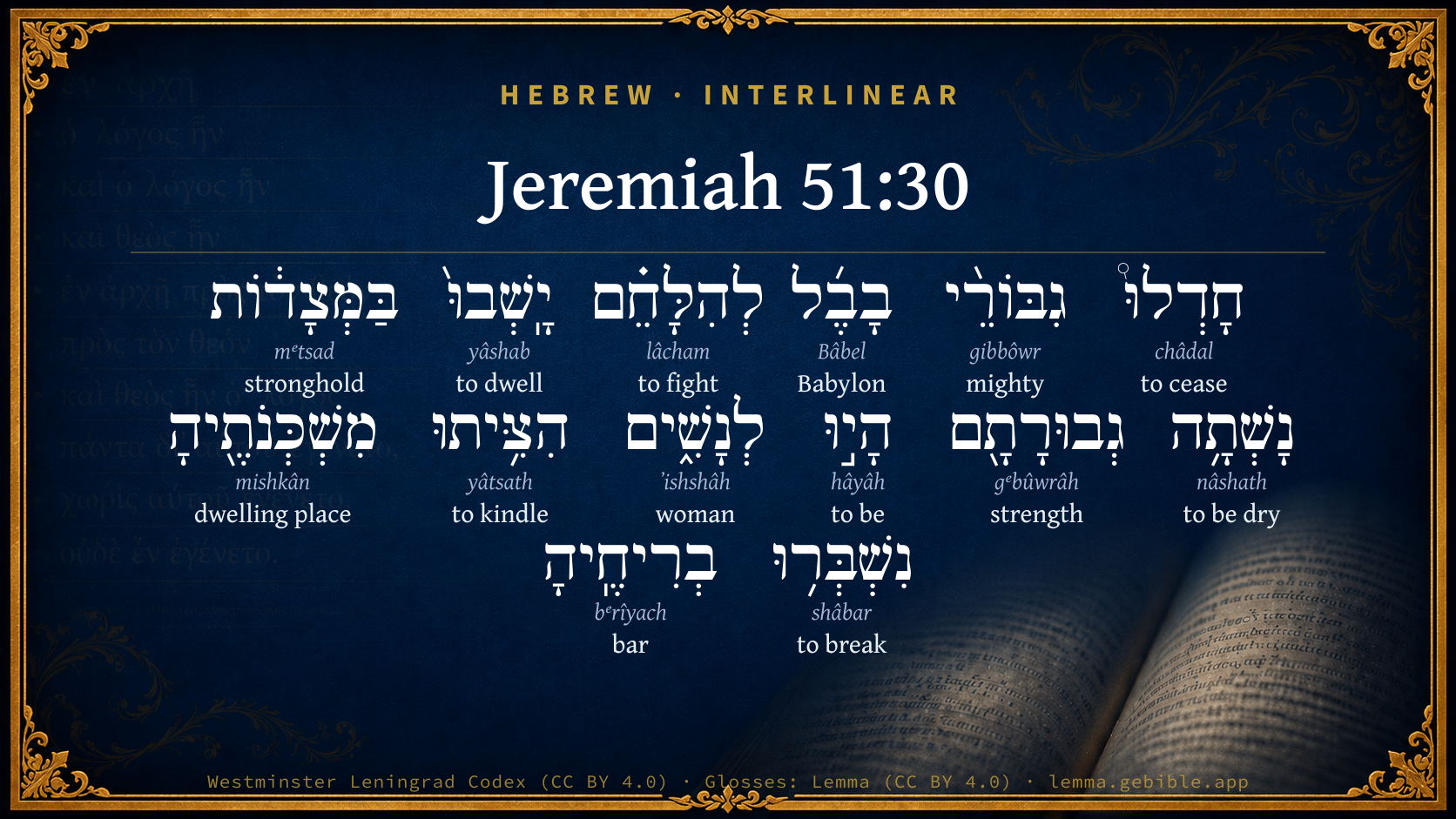
Jeremiah 51:30

Hebrew (Westminster Leningrad Codex) Jeremiah 51:30 appears in the Hebrew Old Testament. The text above is from the Westminster Leningrad Codex. Each word links to its Strong’s number, a concise gloss, and parsing drawn from the Open Scriptures Hebrew Bible morphology. Click any word for its full Brown-Driver-Briggs (BDB) entry.
Download image
Cite this verse

Jeremiah 51:30 (World English Bible). Public Domain. Lemma interlinear Bible study tool, https://lemma.gebible.app/v/jeremiah/51/30.

Show BibTeX & RIS
BibTeX
RIS
English Translation
The mighty men of Babylon have forborne to fight, they remain in their strongholds; their might has failed; they are become as women: her dwelling-places are set on fire; her bars are broken.
World English Bible · Public Domain
Download a study sheet

One document with this verse’s original text, its word-by-word gloss line, the meaning frame, cross-references with their text, attributed commentary, and full source and license credits — printable, and it pastes into notes with its structure intact.

This verse Autodidact and up

Study sheet (.html) Plain text (.txt)

A passage Seminary Student

Up to 50 verses in one chapter. A passage sheet keeps up to 6 commentary sources and 12 cross-references per verse, in the order this page ranks them, and says so on the sheet whenever that leaves anything out. Ask for a single verse and you get the Autodidact verse sheet above.

Everything on this page stays free to read, with no account — the sheet is a download of what is already on screen, not access to it.

Want to remove ads? Support Godless Engineer
Compare translations 3

The same verse in 3 English versions, stacked beneath the original-language interlinear above. Click any original word for its lexicon entry.

Each is an independent rendering of the whole verse — the interlinear is not word-aligned to these translations.

Highlighted words mark where these versions differ — a whole-verse word diff, not a word-by-word alignment.

  • World English Bible Public Domain
    The mighty men of Babylon have forborne to fight, they remain in their strongholds; their might has failed; they are become as women: her dwelling-places are set on fire; her bars are broken.
  • King James Version Public Domain
    The mighty men of Babylon have forborn to fight, they have remained in their holds: their might hath failed; they became as women: they have burned her dwellingplaces; her bars are broken.
  • unfoldingWord Literal Text CC BY-SA 4.0
    The soldiers in Babylon have stopped fighting; they stay in their strongholds. Their strength has failed; they have become women—her homes are on fire, the bars of her gates are broken.

unfoldingWord Literal Text — © unfoldingWord, licensed CC BY-SA 4.0. Word-aligned USFM3 via Door43 (git.door43.org/unfoldingWord/en_ult).

Versions to compare (up to 4)

3 of 4 selected

Show all 18 translations

Every available English version of this verse, each an independent rendering of the whole verse.

  • World English Bible Public Domain
    The mighty men of Babylon have forborne to fight, they remain in their strongholds; their might has failed; they are become as women: her dwelling-places are set on fire; her bars are broken.
  • Berean Standard Bible Public Domain
    The warriors of Babylon have stopped fighting; they sit in their strongholds. Their strength is exhausted; they have become like women. Babylon’s homes have been set ablaze, the bars of her gates are broken.
  • Majority Standard Bible Public Domain
    The warriors of Babylon have stopped fighting; they sit in their strongholds. Their strength is exhausted; they have become like women. Babylon’s homes have been set ablaze, the bars of her gates are broken.
  • King James Version Public Domain
    The mighty men of Babylon have forborn to fight, they have remained in their holds: their might hath failed; they became as women: they have burned her dwellingplaces; her bars are broken.
  • American Standard Version (1901) Public Domain
    The mighty men of Babylon have forborne to fight, they remain in their strongholds; their might hath failed; they are become as women: her dwelling-places are set on fire; her bars are broken.
  • Revised Version (1885) Public Domain
    The mighty men of Babylon have forborne to fight, they remain in their strong holds; their might hath failed; they are become as women: her dwelling places are set on fire; her bars are broken.
  • Geneva Bible (1599) Public Domain
    The strong men of Babel haue ceased to fight: they haue remayned in their holdes: their strength hath fayled, and they were like women: they haue burnt her dwelling places, and her barres are broken.
  • Douay-Rheims (1899) Public Domain
    The valiant men of Babylon have forborne to fight, they have dwelt in holds: their strength hath failed, and they are become as women: her dwelling places are burnt, her bars are broken.
  • Young's Literal Translation Public Domain
    Ceased have the mighty of Babylon to fight, They have remained in strongholds, Failed hath their might, they have become woman, They have burnt her tabernacles, Broken have been her bars.
  • Literal Standard Version CC BY-SA 4.0
    The mighty of Babylon have ceased to fight, || They have remained in strongholds, || Their might has failed, they have become [as] women, || They have burned her dwelling places, || Her bars have been broken.
  • Unlocked Literal Bible CC BY-SA 4.0
    The soldiers in Babylon have stopped fighting; they stay in their strongholds. Their strength has failed; they have become women—her homes are on fire, the bars of her gates are broken.
  • unfoldingWord Literal Text CC BY-SA 4.0
    The soldiers in Babylon have stopped fighting; they stay in their strongholds. Their strength has failed; they have become women—her homes are on fire, the bars of her gates are broken.
  • Darby Bible Public Domain
    The mighty men of Babylon have ceased to fight, they are sitting in the fortresses; their might hath failed, they are become as women: they have set her dwelling places on fire; her bars are broken.
  • World Messianic Bible Public Domain
    The mighty men of Babylon have stopped fighting, they remain in their strongholds. Their might has failed. They have become as women. Her dwelling places are set on fire. Her bars are broken.
  • Webster's Bible Public Domain
    The mighty men of Babylon have forborne to fight, they have remained in their holds: their might hath failed; they became as women: they have burned her dwelling-places; her bars are broken.
  • Free Bible Version CC BY-SA 4.0
    Babylon's defenders have given up fighting—they're just sitting in their fortresses. They're worn out; they've become like frightened women. Babylon's houses are burning; the bars securing her gates have been smashed.
  • Bible in Basic English Public Domain
    Babylon's men of war have kept back from the fight, waiting in their strong places; their strength has given way, they have become like women: her houses have been put on fire, her locks are broken.
  • JPS Tanakh (1917) Public Domain
    The mighty men of Babylon have forborne to fight, they remain in their strongholds; their might hath failed, they are become as women; her dwelling-places are set on fire; her bars are broken.

Literal Standard Version (2020), Covenant Press — licensed CC BY-SA 4.0. Text via the HelloAO Bible API (eBible.org). Unlocked Literal Bible (unfoldingWord) — licensed CC BY-SA 4.0. Text via the HelloAO Bible API (eBible.org). unfoldingWord Literal Text — © unfoldingWord, licensed CC BY-SA 4.0. Word-aligned USFM3 via Door43 (git.door43.org/unfoldingWord/en_ult). Free Bible Version, Dr. Jonathan Gallagher — licensed CC BY-SA 4.0. Text via the HelloAO Bible API (eBible.org).

Word by word

More ways to search: Search by grammar → Find every occurrence → Compare this word →

Practice this passage: Drill this verse → Learn its vocabulary →

נָשְׁתָ֥ה
nâshath
H5405
“to be dry”
Verb, Qal, Perfect, 3rd Person, Feminine, Singular
Part of Speech
Verb
Stem
Qal
Form
Perfect
Person
3rd Person
Gender
Feminine
Number
Singular
Full BDB Definition

Origin: a primitive root

TWOT: 1438

to be dry, be parched - (Qal) to be dry, be parched - (Niphal) to be dried up
  1. חָדְלוּ֩ châdal H2308 “to cease” Verb, Qal, Perfect, 3rd Person, Common, Plural
  2. גִבּוֹרֵ֨י gibbôwr H1368 “mighty of” Adjective, Adjective, Masculine, Plural, Construct
  3. בָבֶ֜ל Bâbel H894 “Babylon” Noun, Proper
  4. לְהִלָּחֵ֗ם lâcham H3898 “to fight” Preposition + Verb, Niphal, Infinitive Construct
  5. יָֽשְׁבוּ֙ yâshab H3427 “to dwell” Verb, Qal, Perfect, 3rd Person, Common, Plural
  6. בַּמְּצָד֔וֹת mᵉtsad H4679 “in/at the · strongholds” Preposition, Determined + Noun, Common, Feminine, Plural, Absolute
  7. גְבוּרָתָ֖ם gᵉbûwrâh H1369 “strength · their” Noun, Common, Feminine, Singular, Construct + Suffix, Personal, 3rd Person, Masculine, Plural
  8. הָי֣וּ hâyâh H1961 “to be” Verb, Qal, Perfect, 3rd Person, Common, Plural
  9. לְנָשִׁ֑ים ʼishshâh H802 “to/for · women” Preposition + Noun, Common, Feminine, Plural, Absolute
  10. הִצִּ֥יתוּ yâtsath H3341 “to kindle” Verb, Hiphil, Perfect, 3rd Person, Common, Plural
  11. מִשְׁכְּנֹתֶ֖יהָ mishkân H4908 “dwelling places · her” Noun, Common, Masculine, Plural, Construct + Suffix, Personal, 3rd Person, Feminine, Singular
  12. נִשְׁבְּר֥וּ shâbar H7665 “to break” Verb, Niphal, Perfect, 3rd Person, Common, Plural
  13. בְרִיחֶֽיהָ bᵉrîyach H1280 “bars · her” Noun, Common, Masculine, Plural, Construct + Suffix, Personal, 3rd Person, Feminine, Singular

About this verse

These counts appear in no published source. They are computed here, from the morphology-tagged text and Lemma’s own curated glosses. What Lemma adds →

14
words
14
distinct lemmas
Prophets
section

Notable vocabulary

The rarest word here is נָשְׁתָ֥ה to be dry H5405 — appearing just 3 times in the whole Hebrew Bible.

Shared distinctive vocabulary

נָשְׁתָ֥ה to be dry H5405 occurs in 3 verses of the Hebrew Bible. Also found in:

Grammatical profile

  • 7 verbs
  • 6 nouns
  • 1 adjective

Verb forms

  • חָדְלוּ֩ Qal · Perfect
  • לְהִלָּחֵ֗ם Niphal · Infinitive Construct
  • יָֽשְׁבוּ֙ Qal · Perfect
  • נָשְׁתָ֥ה Qal · Perfect
  • הָי֣וּ Qal · Perfect
  • הִצִּ֥יתוּ Hiphil · Perfect
  • נִשְׁבְּר֥וּ Niphal · Perfect

Cross-references

14

Topical passages linked to Jeremiah 51:30 in the Treasury of Scripture Knowledge — connected by theme and wording, ordered by reader-vote popularity; previews shown in the World English Bible.

  • Nahum 3:13 Behold, your troops in your midst are women. The gates of your land are set wide open to your enemies. The fire has devoured your bars.
  • Jeremiah 50:36–37 A sword is on the boasters, and they shall become fools; a sword is on her mighty men, and they shall be dismayed.
  • Isaiah 13:7–8 Therefore shall all hands be feeble, and every heart of man shall melt:
  • Isaiah 19:16 In that day shall the Egyptians be like women; and they shall tremble and fear because of the shaking of the hand of Yahweh of Hosts, which he shakes over them.
  • Lamentations 2:9 Her gates are sunk into the ground; he has destroyed and broken her bars: Her king and her princes are among the nations where the law is not; Yes, her prophets find no vision from Yahweh.
  • Psalms 76:5 Valiant men lie plundered, They have slept their last sleep. None of the men of war can lift their hands.
  • Isaiah 45:1–2 Thus says Yahweh to his anointed, to Cyrus, whose right hand I have held, to subdue nations before him, and I will loose the loins of kings; to open the doors before him, and the gates shall not be shut:
  • Jeremiah 48:41 Kerioth is taken, and the strongholds are seized, and the heart of the mighty men of Moab at that day shall be as the heart of a woman in her pangs.
  • Amos 1:5 I will break the bar of Damascus, And cut off the inhabitant from the valley of Aven, And him who holds the scepter from the house of Eden; And the people of Syria shall go into captivity to Kir," says Yahweh.
  • Psalms 107:16 For he has broken the gates of brass, And cut through bars of iron.
  • Psalms 147:13 For he has strengthened the bars of your gates. He has blessed your children within you.
  • Jeremiah 51:32 and the passages are seized, and the reeds they have burned with fire, and the men of war are frightened.
  • Jeremiah 51:57 I will make drunk her princes and her wise men, her governors and her deputies, and her mighty men; and they shall sleep a perpetual sleep, and not wake up, says the King, whose name is Yahweh of Hosts.
  • Revelation 18:10 standing far away for the fear of her torment, saying, 'Woe, woe, the great city, Babylon, the strong city! For your judgment has come in one hour.'

Cross-references courtesy of OpenBible.info (CC BY 4.0).

Hebrew and Greek witnesses Masoretic Hebrew ↔ Greek Septuagint

The same verse in the two great witnesses to the Old Testament, shown verse-for-verse.

These are two independent witnesses, not word-aligned to each other, and the Septuagint is shown in lemma (dictionary) form.

Hebrew Jeremiah 51:30 Masoretic · Westminster Leningrad Codex

חָדְלוּ֩ גִבּוֹרֵ֨י בָבֶ֜ל לְהִלָּחֵ֗ם יָֽשְׁבוּ֙ בַּמְּצָד֔וֹת נָשְׁתָ֥ה גְבוּרָתָ֖ם הָי֣וּ לְנָשִׁ֑ים הִצִּ֥יתוּ מִשְׁכְּנֹתֶ֖יהָ נִשְׁבְּר֥וּ בְרִיחֶֽיהָ

The mighty men of Babylon have forborne to fight, they remain in their strongholds; their might has failed; they are become as women: her dwelling-places are set on fire; her bars are broken.

World English Bible · Public Domain

Greek LXX Structure differs

In the Septuagint, Jeremiah is about an eighth shorter than the Hebrew and arranges its material differently — the Oracles Against the Nations (Hebrew chapters 46–51) appear in the middle of the Greek book, after 25:13. Because the chapter and verse boundaries do not line up, a verse-for-verse comparison with the Hebrew is not shown.

A verse-for-verse comparison isn’t shown here because the chapters and verses don’t line up. Switch to the LXX edition with the MT / LXX toggle above to read the Greek directly.

Hebrew: Westminster Leningrad Codex (CC BY 4.0). Greek: Septuagint (public domain); English from a public-domain English Septuagint. How the Septuagint differs from the Hebrew →

Targum (Aramaic paraphrase)

1

The Targum is the ancient Jewish Aramaic paraphrase of the Hebrew Scriptures — an interpretive translation, not the Hebrew text itself. Onkelos (literal) and Pseudo-Jonathan (expansive) render the Torah, and Jonathan the Prophets. Coverage is partial: where no permissively-licensed English translation exists for a verse, only the Aramaic is shown. This is verse-level text, not a word-by-word alignment to the Hebrew.

  1. Targum Jonathan Prophets (Joshua–Malachi)
    אִתְמְנִיעוּ גִבָּרֵי בָּבֶל מִלְאֲגָחָא קְרָבָא יְתִיבוּ בְמִצָדַיָא אִתְּבָרַת גִבָּרוּתְהוֹן הֲווֹ חֲלִישִׁין כִּנְשַׁיָא אִתְדְלָקָא בִּרְנְיָתָהָא אִתְבָּרוּ עַבְּרָהָא:

    (no public-domain English translation for this verse)

    Targum Jonathan — Aramaic: “Mikraot Gedolot” (public domain). English: “Sefaria Community Translation” (CC0 1.0 (public-domain dedication)); “London "Chaldee Paraphrase," 1871” (public domain). Text via Sefaria.

Commentary

Notes on Jeremiah 51:30 from classic Christian and Jewish commentators (each source and its license shown beneath its notes). The classic Christian expositions comment on the surrounding passage and are grouped to its opening verse, so a note may address several verses; the Jewish commentaries on the Tanakh (Rashi and others) are per-verse, so they appear only where the commentator wrote on this verse.

Lemma curates 59 commentaries, every one of them public domain or Creative Commons licensed, each selected and text-cleaned for this edition rather than reprinted as found. About our sources →

Trapp's Complete Commentary

John Trapp

Jer 51:30 The mighty men of Babylon have forborn to fight, they have remained in [their] holds: their might hath failed; they became as women: they have burned her dwellingplaces; her bars are broken.

Ver. 30. The mighty men of Babylon have forborne to fight.] At Cyrus’s first coming they gave him battle; but being worsted, they from thenceforth remained in their holds till Babylon was taken.

Their might hath failed.] Or, Their courage is shrunk, as Jacob’s sinew did. {Gen 32:32}

They became as women.] See Jer 50:37.

John Trapp, A Commentary or Exposition upon All the Books of the Old and New Testament (1647–1656) — public domain. Text from a community e-Sword module.

Joseph Benson's Commentary

Jer 51:30-32. The mighty men of Babylon have forborne to fight: they have remained, &c. — “The year before the siege of Babylon, Cyrus overthrew Belshazzar in battle, whereupon his army retreated within the walls, where they were shut up by him and besieged. Afterward, when Cyrus entered the city, he ordered public proclamation to be made, that all persons should keep within their houses, and whoever was found abroad should be put to death; and threatened to set their houses on fire, if any offered to hurt the soldiers from the tops of their houses.” They became as women — Timorous, and without courage. They have burned their dwelling-places — The enemy have burned their houses. Her bars are broken — All her fortresses, and what she confided in as her chief defence against the enemy. One post shall run to meet another — Messengers shall run from different parts, and so fall in with one another, all carrying the same intelligence to the same person, that the city was taken on the part every one came from. This is a very natural description of what may be supposed to happen on a city being taken by surprise in the middle of the night; for, as fast as the alarm spread, people would be posting away with the news from all parts to the head-quarters. The translation of the last clause, to show the king of Babylon that his city is taken at one end, is not accurate: the word מקצהdoes not mean at one end, for one is not in the text, but at the extremity. It may not be improper to observe further here, that though it seems unusual to say that one messenger runs to meet another, to acquaint any one with the same news, the usual expression in such a case being, that one messenger follows upon the heels of another; yet, in this matter, this unusual way of speaking was exactly descriptive of the fact; for Babylon being taken by a party of soldiers entering by the channel of the Euphrates at each extremity of the city, the messengers who carried the news to the king at his palace would actually run toward and meet each other at or near the palace, as they came from opposite quarters, to acquaint him that his city was taken at the extremities; for we cannot but suppose that people would run from each end of the city to the palace as soon as Cyrus’s men entered. The passage in the original has great beauty and sublimity, which, however, is almost lost in our translation. Houbigant seems to give it its due force, rendering the verbs in the present tense, and omitting the connecting particles, which greatly augments its energy, thus: “Courier comes to meet courier — messenger meets messenger — to inform the king of Babylon that his city is taken at the extremity, that the passages are stopped, [or surprised, see Jer 51:41,] that fires are burning among the reeds, that the men of war are terrified.” The passages here mentioned “were most probably the entrances into the city from the river side, which were secured by gates that ought, as Herodotus observes, to have been fast barred, which, if it had been done, would have effectually frustrated the attempt of the enemy; but being left open and unguarded, on account of the public festivity, the assailants were in possession of those entrances, and in the heart of the city, before the besieged were aware of it.” The word אגמים, here rendered reeds, properly signifies marshes or lakes; and the phrase here seems to import, that the enemies had burned up all the outworks belonging to the marshy grounds about the river Euphrates. — Lowth.

Joseph Benson's Commentary on the Old and New Testaments (1811–1818) — public domain. Text from a community e-Sword module.

Jamieson, Fausset & Brown

Robert Jamieson, A. R. Fausset & David Brown

forborne to fight--for the city was not taken by force of arms, but by stratagem, according to the counsel given to Cyrus by two eunuchs of Belshazzar who deserted.

remained in . . . holds--not daring to go forth to fight; many, with Nabonidus, withdrew to the fortified city Borsippa.

Jamieson, Fausset & Brown — Commentary Critical and Explanatory on the Whole Bible (1871) — public domain (CC PDM 1.0). Text via the HelloAO Bible API.

Adam Clarke's Commentary

Verse 30. The mighty men - have forborne to fight] They were panic-struck when they found the Medes and Persians within their walls, and at once saw that resistance was useless.

Adam Clarke's Commentary on the Bible (1810–1826) — public domain. Text from a community e-Sword/MySword module.

John Calvin's Commentaries

The Prophet shows here, as by the finger, the manner of the destruction of Babylon, such as it is described by heathen authors. He then says, that the valiant men of Babylon, even those who had been chosen to defend the city, ceased to fight For the city was taken rather by craft than by open force; for after a long siege, Cyrus was laughed to scorn by the Babylonians; then they securely held a feast. In the meantime two eunuchs of Belshazzar passed over to Cyrus; for; as Xenophon relates, the tyrant had slain the son of one, and by way of disgrace castrated the other. Hence, then, it was that they revolted from him; and Cyrus was instructed by them how he could take the city. The fords were dried-up, when Belshazzar suspected no such thing, and in the night he heard that the city was taken. Daniel gives a clearer description; for he says that there was held a stated feast, and that the hand of a writer appeared on the wall, and that the king, being frightened, had heard from Daniel that the end of his kingdom was near at hand, and that the city was taken that very night. (Daniel 5:25-30.) hence the Prophet says now that the valiant men desisted, so that they did not fight. He indeed speaks of what was future, but, we know what was the manner of the prophets, for they related what was to come as though it had already taken place.

He afterwards adds, that they sat down in their fortresses, for the city was not taken by storm — there was no fighting; but the forces passed silently through the fords, and the soldiers entered into the middle of the city; the king was slain together with all his satraps, and then all parts of the city were taken possession of. We now, then, see that the Spirit of God spoke by the mouth of Jeremiah, as of a thing that had already taken place.

He then adds, that their valor had failed or languished, even because terror stupefied them when they heard that the city was taken. So also true became what is added, that they became women, that they were like women as to courage, for no one dared to oppose the conquerors. Fighting might have still been carried on by so large a multitude, yea, they might have engaged with their enemies in hundred or in thousand of the streets of the city, for it would have been easy in the night to distress them: but the Prophet says, that they all became women as to courage. At last, he adds, that that burnt by enemies were the palaces, and that the bars of the gates were broken; for no one dared to summon to arms after it was heard that the city was taken. It follows, —

John Calvin's Commentaries (1540-1563) — public domain. Text from the Calvin Translation Society English edition (1840s-50s) via the Christian Classics Ethereal Library (ccel.org). Calvin's coverage is partial (roughly two-thirds of the Bible); uncommented books and verses are honest gaps, never fabricated. The 19th-century editor's footnotes and remarks are omitted so the notes are faithfully Calvin's own voice.

Ellicott's Commentary for English Readers

(30) The mighty men of Babylon have for born to fight.—The verses that follow paint the capture of the city by the stratagem related in the Note on Jer_50:24. Those who “have burned” are, of course, the invaders. They here begin by setting the houses of the city on fire and breaking open the gates that led from the river into the streets of the city, while the panic-stricken people fled to their citadel in despair.

A Bible Commentary for English Readers, edited by Charles John Ellicott (1878–1897) — public domain. Text from a community e-Sword module.

The Cambridge Bible for Schools and Colleges

gen. ed. J. J. S. Perowne

30. Description of the capture of Babylon.

they are become as women] Cp. Jer_50:37.

The Cambridge Bible for Schools and Colleges (gen. ed. J. J. S. Perowne; Cambridge University Press, 1878–1918) — public domain. Text from a community e-Sword module.

John Gill's Exposition

And that the passages are stopped,.... Or "taken", or "seized" (o); where Cyrus placed soldiers to keep them; these were the passages leading from the river Euphrates to the city, the keys of it; the little gates, that Herodotus (p) speaks of, leading to the river, which were left open that night. Kimchi thinks the towers built by the river side, to keep the enemy out, that should attempt to enter, are meant; these were now in his hands;

and the reeds they have burnt with fire; which grew upon the banks of the river, and in the marshes adjoining to it. Some render it, "the marshes" (q); that is, the reeds and bulrushes in them, which usually grow in such places. And Herodotus (r) makes mention of a marsh Cyrus came to; the reeds in it he burnt, having many torches, with which he might set fire to them; as he proposed with them to burn the houses, doors, and porches (s); either to make way for his army, which might hinder the march of it; or to give light, that they might see their way into the city the better: though some think it was to terrify the inhabitants; which seems not so likely, since he marched up to the royal palace with great secrecy. This circumstance is mentioned, to show the certainty of the enemy's entrance, and the taking of part of the city. R. Jonah, from the Arabic language, in which the word (t) here used signifies "fortresses", so renders it here;

and the men of war are affrighted; and so fled, and left the passes, towers, and fortresses, which fell into the hands of Cyrus, as soon as they perceived his army was come up the channel and was landed, and the reeds were burnt.

(o) "praeoccupata", V. L. "comprehensa", Montanus; "occupati", Tigurine version, Schmidt. (p) L. 1. sive Clio, c. 191. (q) "paludes", V. L. Syr. Grotius; "stagna", Junius & Tremellius, Piscator, Schmidt. (r) L. 1. sive Clio, c. 191. (s) Xenophon, Cyropaedia, l. 7. c. 22. (t) "arundinetum feris et hinc munimentum, castellum", Camus apud Golium, col. 33. "castellum, munimentum viarum, arces", Castel. Lex. col. 29.

John Gill's Exposition of the Whole Bible (1746–1763) — public domain (CC PDM 1.0). Text via the HelloAO Bible API.

Albert Barnes' Notes on the Bible

Have forborn to fight - Or, have ceased to fight: in despair when they saw that the conflict was hopeless.

Holds - The word properly means an acropolis, and so any inaccessible place of refuge.

They have burned - i. e., the enemy have burned.

Bars - i. e., fortifications (compare Amo 1:5).

Albert Barnes' Notes on the Bible (1834–1885) — public domain. Text from a community e-Sword/MySword module.

Haydock's Catholic Bible Commentary

Bars, fastening the gates. (Calmet) --- Those who entered by the channel of the river, would seize the gates to let their companions enter. (Haydock)

George Leo Haydock (1774–1849), Haydock's Catholic Family Bible and Commentary, 1859 edition — public domain. Excludes Psalms (Douay-Rheims chapter numbering differs from Protestant) and Deuterocanonical books (Catholic canon only).

Matthew Poole's English Annotations

When God hath determined an end, he ordereth means proportionable to that end. Babylon had many valiant and mighty men, and it is very probable the Babylonians trusted very much to them; but when it came to, God took off their courage, so as they had no heart to fight, but kept themselves in their strong holds, and if at any time they came out, their courage failed them, and they behaved themselves more like women than men of war; so as their enemies burned their cities, brake down their fortifications, and made what havoc they pleased.

Matthew Poole's English Annotations on the Holy Bible (1683–1685) — public domain. Text from a community e-Sword/MySword module.

Whedon's Commentary on the Bible

Daniel D. Whedon

30. Have forborne — Have ceased; not from cowardice, but from hopelessness. They become as women, and stay in the inaccessible places to await the end.

Daniel D. Whedon (gen. ed.), Commentary on the Old and New Testaments (1874–1909) — public domain. Text from a community e-Sword module.

The Pulpit Commentary

Despair of the Babylonian warriors. Have forborne to fight should rather be have ceased to fight. In their holds. The word is used of hill or mountain fastnesses, (comp. 1Sa_23:14, 19 Jud_1:6:2 1Ch_11:7) and such presumably are referred to here. Their might; rather, their courage. They have burned, etc. The subject is "the enemies." Her bars; viz. those with which the city gates were secured. (Isa_45:2 Amo_1:5)

Effeminacy.

Doubtless in this utterance there is something of the then customary scorn with respect to women. But this must not make us forget that one of the worst things to be said of a man is that he has become as a woman, just as one of the worst things to be said of a woman is that she has become as a man.

I THIS UTTERANCE DOES NOT REPROACH THE WOMAN, BUT THE MAN. Woman has her natural limitations. Her usual place is not in the battlefield or on the walls of the attacked city. An army of women against an army of men would be an unnatural, a revolting spectacle. But this very difference between the proper place of women and the proper place of men intensifies the reproach against a man when it can truly he said of him that he has become as a woman. Those qualities which in a woman are womanly in a man are only effeminate.

II THE CORRESPONDING POSSIBLE REPROACH UPON WOMEN. A woman must not allow it to be said of her that she has become as a man. She must never forget the limitations and duties of her sex. Yet on the other hand, she must not be too ready to accept common opinion in interpreting those limitations and duties.

III THERE ARE TIMES WHEN IT MAY BE THE GREATEST HONOUR TO A MAN TO BECOME AS A WOMAN. There are times when the strength of the man, without being lost, becomes unnoticed because of the presence of a woman-like tenderness. And of course there is the corresponding truth that woman may be honoured in becoming as the man, else where would be the fame of Joan of Arc and the Maid of Saragossa? Both men and women alike must have the courage to face mere external reproaches. Nothing is easier than to taunt a man with being unmanly and a woman with being unwomanly, but if only men and women alike persevere in what they feel to be fight, they will in due time escape from the region of baseless taunts. After all, the humanity common to men and women alike is greater than peculiarities of sex. In Jesus Christ there is neither male nor female. Y.

The Pulpit Commentary (1880–1919), ed. H.D.M. Spence-Jones & Joseph S. Exell — public domain. Text from a community e-Sword module.

unfoldingWord translationNotes

Door43 World Missions Community

General Information:

Yahweh speaks of what will happen as if it had already happened. (See: Predictive Past)

her homes are on fire, the bars of her gates are broken

The city is spoken of as if it were a woman. AT: "the homes in the city are on fire, the bars of the city gates are broken" (See: Metaphor)

his city has been taken

This can be translated in active form. AT: "the enemies have overcome the whole city" (See: Active or Passive)

the fords over the river are seized

This can be translated in active form. AT: "the enemies have taken control of all the fords over the river" (See: Active or Passive)

fords

shallow parts of a river where people can walk across

marshes

places with shallow water and grasses growing in deep mud

confused

unable to think clearly

translationWords

soldier

fire

gate

messenger

preach

king

seize

reed

unfoldingWord translationNotes — © Distant Shores Media and the Door43 World Missions Community, licensed CC BY-SA 4.0. Source: git.door43.org/Door43/en_tn.

Rashi

Rabbi Shlomo Yitzchaki (Rashi)

failed Heb. נשתה, [lit.] jumped. Compare “the hip sinew (הנשה)” (Gen. 33:32), so called because it jumped [was dislocated] from its place.

Rashi on the Tanakh — English translations: “The Judaica Press complete Tanach with Rashi, translated by A. J. Rosenberg” (CC BY 4.0); “Pentateuch with Rashi's commentary by M. Rosenbaum and A.M. Silbermann, 1929-1934” (public domain); “The Metsudah Tanach series, Lakewood, N.J” (CC BY 4.0); and “The Book of Joshua, Metsudah Publications, 1997” (CC BY 4.0). Text via Sefaria.

Lesson kit

Teaching starters — assembled from the data on this page, not authored interpretation. Every prompt links to the verse data it draws on. Edit before teaching.

Jeremiah, in the Prophets, opens this verse with 14 words (14 distinct Hebrew lemmas). Its most distinctive word is nâshath (“to be dry”). A historical commentator’s framing appears above. Read the whole chapter for the surrounding context.

Discussion questions

  1. What does “to be dry” (nâshath) contribute to the verse as a whole?
  2. Isaiah 19:5 shares the word «to be dry» with this verse. How do the two illuminate each other?
  3. The translations on this page render this verse differently — a whole-verse word diff, not a word-by-word alignment. What might account for the different wordings?
  4. The verb «חָדְלוּ֩» is Qal Perfect. How does its form color the action?
  5. Reading how Trapp's Complete Commentary and Joseph Benson's Commentary read this verse, where do the two commentators agree and where do they part?

Things to notice

Reading settings

Reading text

Shown beneath each verse's original-language words.

Old Testament
Old Testament edition

Read the OT as the Masoretic Hebrew (MT) or the Greek Septuagint (LXX).

English shown for the Greek Septuagint (in the Hebrew ↔ Greek comparison).

Comparing translations? Open the Compare panel on any verse page to stack up to four side by side.