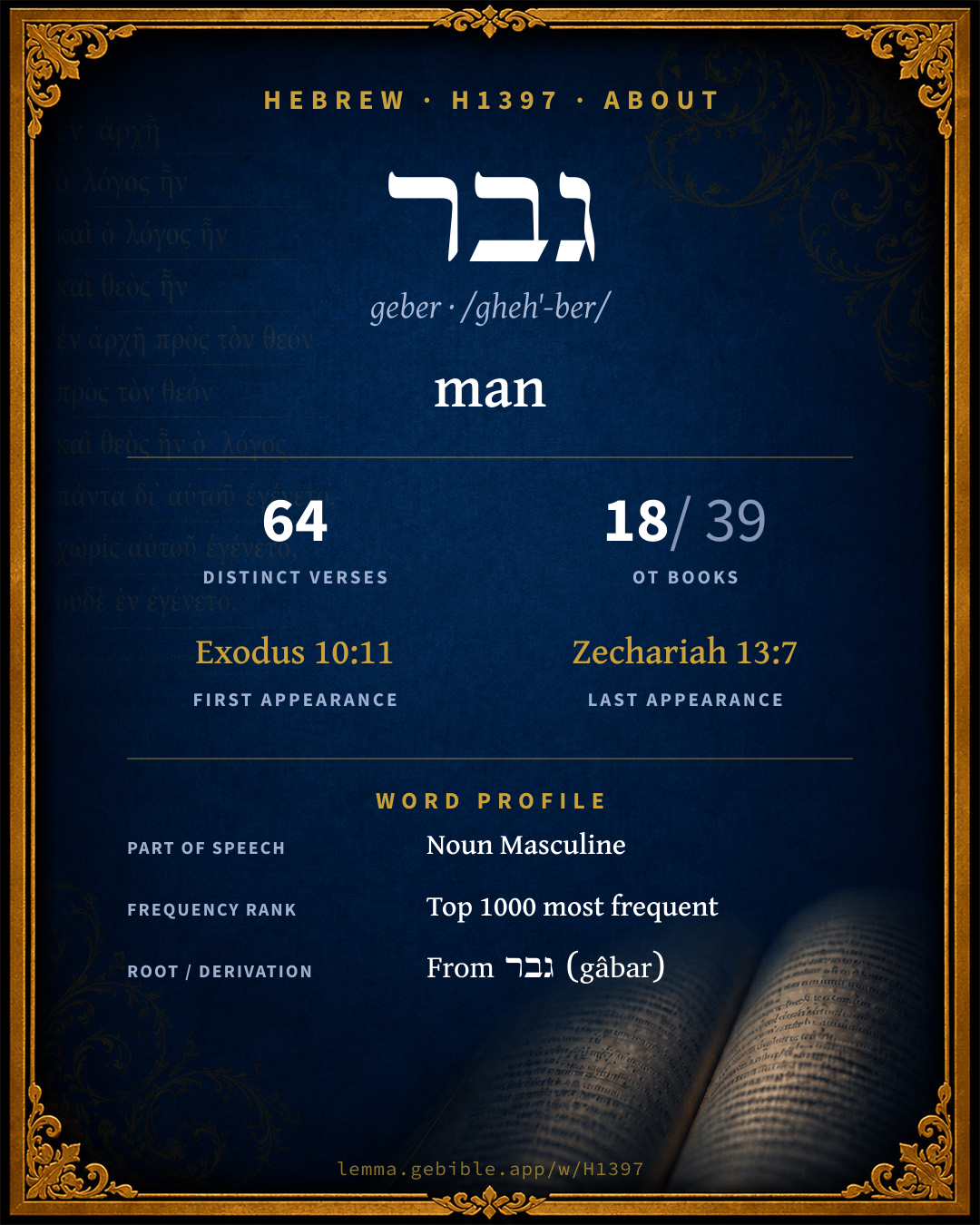
גֶּ֫בֶר
man
Full lexicon entry — Brown-Driver-Briggs (BDB)
From Brown-Driver-Briggs (BDB)
Where this word appears
See every Absolute-state word in the Hebrew Bible →
Grammar key — what these labels mean
Part of speech
- Noun
- A naming word — a person, place, thing, or idea.
Noun type
- Common
- A common noun — a general class of person, place, or thing (“king,” “city,” “water”), not a specific name.
State
- Absolute
- The independent form of a noun, not bound to a following word.
- Construct
- A noun bound to a following noun in a possessive / “of” relationship (the construct chain).
Gender
- Masculine
- Grammatically masculine.
Number
- Singular
- One.
- Plural
- More than one (in Hebrew, generally three or more).
Grammatical forms
- Noun, Common, Masculine, Singular, Absolute 53 times (82%)
- Noun, Common, Masculine, Plural, Absolute 11 times (17%)
- Noun, Common, Masculine, Singular, Construct 1 time (2%)
Parsed forms decoded from the imported morphology (morphhb / Westminster Leningrad Codex — WLC text public domain, morphhb tagging CC BY 4.0), counted across 65 parsed occurrences — not distinct verses.
Every verse where H1397 appears — 64 distinct verses across 18 books. Click any verse to open its interlinear word-by-word view. Verse text shown in the World English Bible for context — . Each verse’s Hebrew form is shown with its reference; the English is not keyword-highlighted, since the data carries no word-level English alignment. Use “Compare translations” on any verse to read it across multiple English versions. This concordance covers the Hebrew Bible; Septuagint (Greek Old Testament) occurrences are not indexed here.
Exodus 2 verses
- Exodus 10:11 הַ/גְּבָרִים֙ ptcl def.art + n c mp Not so! Go now you who are men, and serve Yahweh; for that is what you desire!" They were driven out from Pharaoh's presence.
- Exodus 12:37 הַ/גְּבָרִ֖ים ptcl def.art + n c mp The children of Israel traveled from Rameses to Succoth, about six hundred thousand on foot who were men, besides children.
Numbers 2 verses
Deuteronomy 1 verse
Joshua 3 verses
- Joshua 7:14 לַ/גְּבָרִֽים prep det + n c mp In the morning therefore you shall be brought near by your tribes: and it shall be, that the tribe which Yahweh takes shall come near by families; and the family which Yahweh shall take shall come near by households; and the household which Yahweh shall take shall come near man by man.
- Joshua 7:17 לַ/גְּבָרִ֔ים prep det + n c mp and he brought near the family of Judah; and he took the family of the Zerahites: and he brought near the family of the Zerahites man by man; and Zabdi was taken:
- Joshua 7:18 לַ/גְּבָרִ֑ים prep det + n c mp and he brought near his household man by man; and Achan, the son of Carmi, the son of Zabdi, the son of Zerah, of the tribe of Judah, was taken.
Judges 1 verse
2 Samuel 1 verse
1 Chronicles 3 verses
- 1 Chronicles 23:3 לִ/גְבָרִ֔ים prep + n c mp The Levites were numbered from thirty years old and upward: and their number by their polls, man by man, was thirty-eight thousand.
- 1 Chronicles 24:4 הַ/גְּבָרִ֛ים ptcl def.art + n c mp There were more chief men found of the sons of Eleazar than of the sons of Ithamar; and [thus] were they divided: of the sons of Eleazar there were sixteen, heads of fathers' houses; and of the sons of Ithamar, according to their fathers' houses, eight.
- 1 Chronicles 26:12 הַ/גְּבָרִ֛ים ptcl def.art + n c mp Of these were the divisions of the doorkeepers, even of the chief men, having offices like their brothers, to minister in the house of Yahweh.
Job 15 verses
- Job 3:3 גָֽבֶר n c ms "Let the day perish in which I was born, The night which said, 'There is a man-child conceived.'
- Job 3:23 לְ֭/גֶבֶר prep + n c ms Why is light given to a man whose way is hid, Whom God has hedged in?
- Job 4:17 גָּֽבֶר n c ms 'Shall mortal man be more just than God? Shall a man be more pure than his Maker?
- Job 10:5 גָֽבֶר n c ms Are your days as the days of mortals, Or your years as man's years,
- Job 14:10 וְ/גֶ֣בֶר conj + n c ms But man dies, and is laid low. Yes, man gives up the spirit, and where is he?
- Job 14:14 גֶּ֗בֶר n c ms If a man dies, shall he live again? All the days of my warfare would I wait, Until my release should come.
- Job 16:21 לְ/גֶ֣בֶר prep + n c ms That he would maintain the right of a man with God, Of a son of man with his neighbor!
- Job 22:2 גָּ֑בֶר n c ms "Can a man be profitable to God? Surely he who is wise is profitable to himself.
- Job 33:17 מִ/גֶּ֣בֶר prep + n c ms That he may withdraw man from his purpose, And hide pride from man.
- Job 33:29 גָּֽבֶר n c ms "Behold, God works all these things, Twice, yes three times, with a man,
- Job 34:7 גֶ֥בֶר n c ms What man is like Job, Who drinks scorn like water,
- Job 34:9 גָּ֑בֶר n c ms For he has said, 'It profits a man nothing That he should delight himself with God.'
- Job 34:34 וְ/גֶ֥בֶר conj + n c ms Men of understanding will tell me, Yes, every wise man who hears me:
- Job 38:3 כְ/גֶ֣בֶר prep + n c ms Brace yourself like a man, For I will question you, then you answer me!
- Job 40:7 כְ/גֶ֣בֶר prep + n c ms "Now brace yourself like a man. I will question you, and you will answer me.
Psalms 9 verses
- Psalms 34:8 הַ֝/גֶּ֗בֶר ptcl def.art + n c ms Oh taste and see that Yahweh is good. Blessed is the man who takes refuge in him.
- Psalms 37:23 גֶ֥בֶר n c ms A man's goings are established by Yahweh. He delights in his way.
- Psalms 40:4 הַ/גֶּ֗בֶר ptcl def.art + n c ms Blessed is the man who makes Yahweh his trust, And doesn't respect the proud, nor such as turn aside to lies.
- Psalms 52:7 הַ/גֶּ֗בֶר ptcl def.art + n c ms "Behold, this is the man who didn't make God his strength, But trusted in the abundance of his riches, And strengthened himself in his wickedness."
- Psalms 88:4 כְּ/גֶ֣בֶר prep + n c ms I am counted among those who go down into the pit. I am like a man who has no help,
- Psalms 89:48 גֶ֣בֶר n c ms What man is he who shall live and not see death, Who shall deliver his soul from the power of Sheol? Selah.
- Psalms 94:12 הַ/גֶּ֣בֶר ptcl def.art + n c ms Blessed is the man whom you discipline, Yah, And teach out of your law;
- Psalms 127:5 הַ/גֶּ֗בֶר ptcl def.art + n c ms Happy is the man who has his quiver full of them. They won't be disappointed when they speak with their enemies in the gate.
- Psalms 128:4 גָּ֗בֶר n c ms Behold, thus is the man blessed who fears Yahweh.
Proverbs 8 verses
- Proverbs 6:34 גָּ֑בֶר n c ms For jealousy arouses the fury of the husband. He won't spare in the day of vengeance.
- Proverbs 20:24 גָ֑בֶר n c ms A man's steps are from Yahweh; How then can man understand his way?
- Proverbs 24:5 גֶּֽבֶר n c ms A wise man has great power; And a knowledgeable man increases strength;
- Proverbs 28:3 גֶּ֣בֶר n c ms A needy man who oppresses the poor Is like a driving rain which leaves no crops.
- Proverbs 28:21 גָּֽבֶר n c ms To show partiality is not good; Yet a man will do wrong for a piece of bread.
- Proverbs 29:5 גֶּ֭בֶר n c ms A man who flatters his neighbor, Spreads a net for his feet.
- Proverbs 30:1 הַ֭/גֶּבֶר ptcl def.art + n c ms The words of Agur the son of Jakeh, the oracle: The man says to Ithiel, To Ithiel and Ucal:
- Proverbs 30:19 גֶּ֣בֶר n c ms The way of an eagle in the air; The way of a serpent on a rock; The way of a ship in the midst of the sea; And the way of a man with a maiden.
Isaiah 1 verse
Jeremiah 9 verses
- Jeremiah 17:5 הַ/גֶּ֨בֶר֙ ptcl def.art + n c ms Thus says Yahweh: Cursed is the man who trusts in man, and makes flesh his arm, and whose heart departs from Yahweh.
- Jeremiah 17:7 הַ/גֶּ֔בֶר ptcl def.art + n c ms Blessed is the man who trusts in Yahweh, and whose trust Yahweh is.
- Jeremiah 22:30 גֶּ֖בֶר n c ms Thus says Yahweh, Write you this man childless, a man who shall not prosper in his days; for no more shall a man of his seed prosper, sitting on the throne of David, and ruling in Judah.
- Jeremiah 23:9 וּ/כְ/גֶ֖בֶר conj + prep + n c ms Concerning the prophets. My heart within me is broken, all my bones shake; I am like a drunken man, and like a man whom wine has overcome, because of Yahweh, and because of his holy words.
- Jeremiah 30:6 גֶּ֜בֶר n c ms Ask now, and see whether a man does travail with child: why do I see every man with his hands on his loins, as a woman in travail, and all faces are turned into paleness?
- Jeremiah 31:22 גָּֽבֶר n c ms How long will you go here and there, you backsliding daughter? for Yahweh has created a new thing in the earth: a woman shall encompass a man.
- Jeremiah 41:16 גְּבָרִ֞ים n c mp Then took Johanan the son of Kareah, and all the captains of the forces who were with him, all the remnant of the people whom he had recovered from Ishmael the son of Nethaniah, from Mizpah, after that he had killed Gedaliah the son of Ahikam, [to wit], the men of war, and the women, and the children, and the eunuchs, whom he had brought back from Gibeon:
- Jeremiah 43:6 הַ֠/גְּבָרִים ptcl def.art + n c mp the men, and the women, and the children, and the king's daughters, and every person who Nebuzaradan the captain of the guard had left with Gedaliah the son of Ahikam, the son of Shaphan; and Jeremiah the prophet, and Baruch the son of Neriah;
- Jeremiah 44:20 הַ/גְּבָרִ֤ים ptcl def.art + n c mp Then Jeremiah said to all the people, to the men, and to the women, even to all the people who had given him who answer, saying,
Lamentations 4 verses
- Lamentations 3:1 הַ/גֶּ֨בֶר֙ ptcl def.art + n c ms I am the man that has seen affliction by the rod of his wrath.
- Lamentations 3:27 לַ/גֶּ֔בֶר prep det + n c ms It is good for a man that he bear the yoke in his youth.
- Lamentations 3:35 גָּ֔בֶר n c ms To turn aside the right of a man before the face of the Most High,
- Lamentations 3:39 גֶּ֖בֶר n c ms Why does a living man complain, a man for the punishment of his sins?
Daniel 1 verse
Joel 1 verse
Micah 1 verse
Habakkuk 1 verse
Zechariah 1 verse
About this entry
At a glance — auto-summarized from this page’s data, not written by a person. Every figure links to its source below. This summary describes the numbers; it doesn’t interpret them.
גבר (geber) is a Hebrew noun most often rendered “man.” It first appears in Exodus 10:11. With 64 verses in 18 books, it is a moderately common word in the Hebrew Bible. It clusters with גבר, גבור and גביר under a shared root. The sections below give every sense, occurrence, and version rendering.
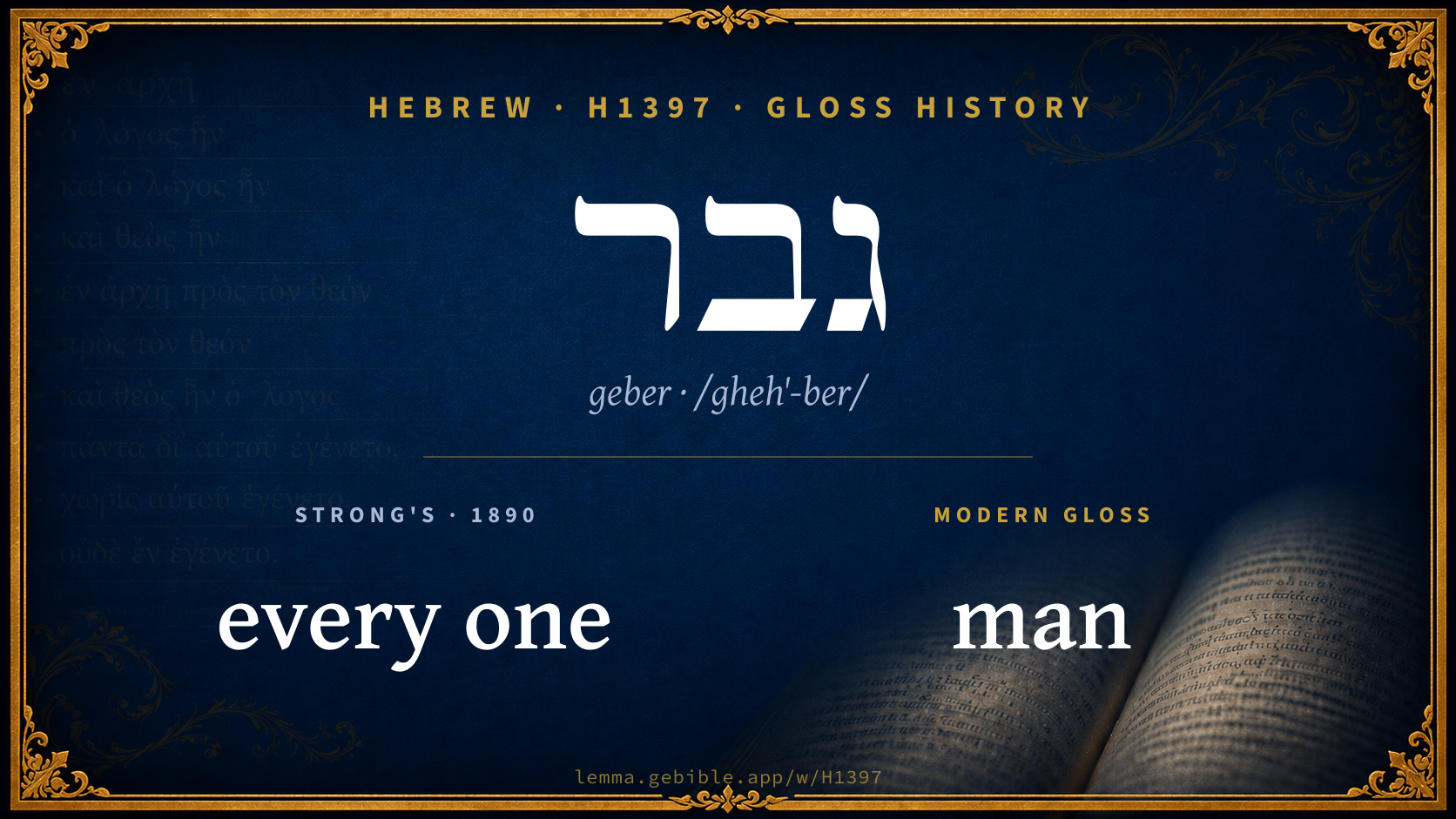
Gloss history
Strong's 1890 vs modern scholarship
About this word
Strong's H1397 catalogs a Hebrew word from the Hebrew Old Testament.
These counts are not copied from any lexicon or concordance. They are computed here, from the morphology-tagged Hebrew Old Testament. What Lemma adds →
- 64
- distinct verses
- The word appears in 64 distinct verses.
- 18 / 39
- OT books
- The word appears in 18 of 39 Old Testament books.
- #597
- by frequency
- Top 1000 most frequent Hebrew words (rank 597 of 8,640 Hebrew words by occurrence).
View all 64 occurrences in the concordance →
By section of the Old Testament
By traditional corpus
Conventional, traditional groupings — biblical authorship is debated, so this is a traditional corpus grouping, not an authorship claim. Each share is this word’s portion of its verses in that division of the Hebrew canon. Each figure is a share of the word’s 64 distinct verses.
- Writings (Ketuvim) 40 verses · 63%
- Prophets (Nevi'im) 19 verses · 30%
- Torah (Pentateuch) 5 verses · 8%
How translations render this word
Counts come from each version’s own published word-to-Strong’s tagging or interlinear alignment — an approximate guide to how each version renders this word, not a word-level alignment the data otherwise carries. Because each total is that version’s own tagged count, the per-version totals vary from one another and need not match the appearance or distinct-verse counts above. These counts may also differ from a printed concordance because Lemma counts each distinctly tagged rendering and does not collapse phrase taggings into a single head-word total. This is a fixed set of word-tagged versions (KJV, ASV, BSB, ULT) and does not change with the reading translation you choose elsewhere. Each version’s license is shown beside its name below (and on Sources).
BDB lists this Strong’s number as 2 distinct words (homographs). Each count above pools all of them and is not split by sense — see the Senses section below. A low-frequency rendering may belong to a different one of those words, not the primary meaning.
- King James Version†: Man 35×, Is the man 4×, Men 4×
- American Standard Version†: Man 36×, Is the man 6×, Men 4×
- Berean Standard Bible†: Man 32×, Men 5×, Like a man 4×
- unfoldingWord Literal Text†: Man 40×, Men 6×, Like a man 4×
King James Version Public Domain
Renders H1397 across 68† tagged occurrences — most commonly:
Plus 17 renderings that appear only once — usually multi-word phrases or single function words the recovered tagging swept in, not distinct renderings.
American Standard Version Public Domain
Renders H1397 across 68† tagged occurrences — most commonly:
Plus 18 renderings that appear only once — usually multi-word phrases or single function words the recovered tagging swept in, not distinct renderings.
Berean Standard Bible Public Domain
Renders H1397 across 62† tagged occurrences — most commonly:
Plus 16 renderings that appear only once — usually multi-word phrases or single function words the recovered tagging swept in, not distinct renderings. Not rendered by a distinct English word in 4 further occurrences.
unfoldingWord Literal Text CC BY-SA 4.0
Renders H1397 across 62† tagged occurrences — most commonly:
Plus 6 renderings that appear only once — usually multi-word phrases or single function words the recovered tagging swept in, not distinct renderings.
Senses in the full BDB
What do BDB’s symbols mean?
BDB uses these scholarly abbreviations:
| Symbol | Meaning |
|---|---|
| 𝔊 | the Septuagint (the ancient Greek translation, LXX) |
| 𝔙 | the Vulgate (the Latin translation) |
| 𝔖 | the Syriac version (the Peshitta) |
| 𝔗 | the Targum (the Aramaic translation) |
| ψ | the Psalms |
| √ | root (the underlying root or stem) |
| ‖ | parallel passage (a synonymous or contrasted parallel) |
| † | the dagger: every passage where the word occurs is cited |
The 0 senses and sub-senses the full Brown-Driver-Briggs lexicon distinguishes for this word, in lexicon order (not ranked by frequency), with BDB’s own verbatim wording and sub-sense lettering. Shown in Hebrew script with BDB’s own scholarly abbreviations. The condensed entry is in the Lexicon Entry tab. See also the Forms in the corpus table below.
גבר I man (NH id., MI16 גברן (pl.), Aramaic גְּבַר, ܓܒܰܪ
גבר II m. an official of Solomon 1 K 4
Senses from the full Brown-Driver-Briggs lexicon (Brown, Driver, Briggs; Oxford 1906 — public domain), digitized via Sefaria, supplemented by the OpenScriptures HebrewLexicon (CC BY 4.0). Full attribution on Sources.
Word origin
I. n.m. man (NH id., MI16 גברן (pl.), Aramaic גְּבַר, ܓܒܰܪ; Assyrian gabru, rival is Akkadian loanword according to SchrJLZ 1874, 200 DlS 120, Sm. Chald. Gen. 286)—Dt 22:5 + 39 times; גָּ֑בֶר Jb 3:3 + 13 times; cstr. גְּבֶּר ψ 18:26 (= 2 S 22:26 גִּבּוֹר but 𝔊 𝔖 read גֶּבֶר); pl. גְּבָרים Je 41:16 + 10 times;—man as strong, disting. from women, children, and non-combatants whom he is to defend, chiefly poetic Ex 10:11 Nu 24:3, 15 (E) Ex 12:37 Jos 7:14, 17, 18 (J) Dt 22:5(×2) Ju 5:30 2 S 23:1 1 Ch 23:3; 24:4; 26:12 Jb 3:3 + 14 times Jb; ψ 18:26 + 8 times ψ; Pr 6:34 + 7 times Pr; Is 22:17 Je 17:5 + 8 times Je; La 3:1, 27, 35, 39 Dn 8:15 Mi 2:2 Hb 2:5 Zc 13:7; also 1 S 10:21 𝔊 We Dr; = each (of locusts) Jo 2:8, cf. אישׁ.
II. n.pr.m. an official of Solomon 1 K 4:19 (cf. בֶּן־גֶּבֶר v 13, p. 122 supr.)
— Brown-Driver-Briggs (Oxford 1906, public domain), digitized via Sefaria, supplemented by the OpenScriptures HebrewLexicon (CC BY 4.0). See Sources.
Derived from גבר (gâbar) (H1396) — to be strong.
Jastrow Dictionary
A second Hebrew/Aramaic lexicon for comparison, covering Aramaic and post-biblical (Talmudic, Targumic, Midrashic) usage that the biblical-Hebrew BDB does not. Matched by lemma rather than by Strong’s number, so a lemma may carry more than one Jastrow headword (shown separately below), and the entries cover usage well beyond the Bible.
גָּבַר
- v. גבב) to be uppermost, prevail; to be strong. Num. R. s. 7 לשון גָּבַר, v. אָנוּשׁ. Sot. IX, 15 גָּבְרוּ בעלי זרוע the violent prevailed. Y. Bets. II, 61ᶜ top; Tosef. Ḥag. II, 11; Bets. 20ᵃ גָּבְרָה יָדָן וכ׳ the Shammaites prevailed over (outnumbered) the Hillelites; a. fr.
- to make strong, strengthen, sustain. Lam. R. to III, 1 גִּבְּרַנִי לעמוד בכולן he made me strong enough to survive all these calamities; ib. 12. Cant. R. to II, 14 מְגַבְּרָן לישראל (ed. Wil. מַגְבִּירָן Hif.) sustains Israel. Ib. III, 7 שהן מְגַבְּרִין את וכ׳ they (the sixty words of the priestly benediction) strengthen Israel. Mekh. B’shall., Amalek, s. 1 וכי … מְגַבְּרוֹת ישראל can Moses’ (uplifted) hands make Israel victorious?; a. fr.—Part. pass. מְגוּבָּר, v. infra.
- 1. same; v. supra.—2)
- to grow strong. Ib. עתידין … לְהַגְבִּיר בד"ת וכ׳ (Moses’ uplifted hands indicated that the Lord remembered that) Israel would in the future be strong in the Law which was to be given through his (Moses’) hands, opp. להמיך; Yalk. Ex. 264.
- , Nithpa. נִתְגַּבֵּר to rise, swell; to grow strong, gather courage; to make one’s self master. Tanḥ. B’resh. 7 המים מִתְגַּבְּרִין the waters of the Nile rose. Num. R. s. 19 ומִתְגַּבֶּרֶת שם and rose there. Ib. מלא מים מְגוּבָּרִין full of high waters. Snh. 96ᵃ לא נ׳ עד וכ׳ had no courage until he came to Dan. R. Hash. III, 8 היו מִתְגַּבְּרִין they were victorious. Ḥag. 16ᵃ, a. e. if one feels שיצרו מתג׳ עליו that his passion threatens to make itself master over him; Kidd. 80ᵇ. Ned. 81ᵃ מפני שהן מתגברין על הצבור because they lord it over the people (Ar. מתגדרין, v. גָּדַר). Num. R. s. 18, v. גָּבַהּ. Yalk. Is. 287 (ref. to Is. XVII, 11) מכה מִתְגַּבֶּרֶת (Lev. R. s. 18 מגרת, corr. acc. or מגברת) an affliction which makes itself the master, v. אָנוּשׁ. Gen. R. s. 76; a. fr. e.g. Isaiah 17:11
גְּבַר I
- Targ. Ps. CIII, 11.—Gitt. 60ᵇ, v. אַלִּים. Pes. 76ᵃ, a. fr. עילאה ג׳ in the case of a contact between warm and cold substances, the upper one prevails (heating or cooling the substance into which it is poured); תתאה ג׳ the lower prevails.
- as preced. Pi. Targ. Am. V, 9. Targ. Zech. X, 6; a. e.—Part. pass. מְגַבַּר growing, swelling. Targ. Is. VIII, 8.
- to make strong, to cause to overpower. Targ. Is. XLI, 25.—Snh. 38ᵃ אַגְבְּרוּ חמרא וכ׳ let the wine get the better of the young men, i.e. give them plenty to drink, that they may become mirthful.
גֶּבֶר
- 1. man, master. Lam. R. to III, 1. Kidd. 80ᵇ (ref. to Lam. III, 39) וכי ג׳ על הטאיו הוא (Rashi) is man master over his sins (sinless)? e.g. Lamentations 3:39
- 2. cock. Yoma I, 8 בקריאת הג׳ at the time of the crowing of the cock; ib. 20ᵇ; Y. Shek. V, 48ᵈ bot.; Y. Succ. V, 55ᶜ disputed meaning: man’s (the cryer’s) crying, or the cock’s crowing, v. כָּרוֹזָא.
- 3. (euphem.) membrum virile. Bekh. VII, 5 (44ᵇ) בעל ג׳ a man with an abnormally large membrum.
גְּבַר II
- ; man. Targ. Gen. II, 24; a. v. fr.—Ber. 63ᵃ באתר דלית ג׳ כ׳ where there is no man, (leader). B. Mets. 97ᵃ (prov.) ג׳ דנשי וכ׳ for a man whom women killed there is no law or judge. Erub. 53ᵇ, v. אוּשְׁפִּיזָא.—Men. 42ᵇ, a. e. חובת ג׳ personal duty, opp. ח׳ טלית the duty resting on the garment (whether or not you wear it).—ההוא גברא a certain man. B. Mets. l. c.; a. v. fr. [Frequ. האי גברא, or ההוא, euphem. for I, or thou; v. ההוא.]—Bekh. 36ᵃ בלא גברא (Rashi גברי) without naming an authority.—Pl. גַּבְרִין, גַּבְרַיָּיא, גַּבְרֵי. Targ. O. Deut. I, 13; a. v. fr.—Lev. R. s. 23 יהוון גַּבְ׳ בכל מילייא (Cant. R. to II, 2 גּוּבְרִין) they shall be strong (trained) in all things. B. Kam. 92ᵇ (prov.) כד הוינן זוטרי לג׳ וכ׳ when we were young, we were esteemed as men, now that we are old &c.; a. v. fr.—Keth. 6ᵃ בלא ג׳, v. supra. Ib. 53ᵇ סימן דגברי ש̇ק̇ ז̇ר̇ף̇ the mnemonical sign for the authorities quoted is &c. (ש̇שת, לק̇יש, אלעז̇ר, ר̇בא, פ̇פא).—Fem. גְּבַרְתָּא, only assumed for argument, v. אַנְתְּרוֹפִי. V. also גּוּבְרָא.
A Dictionary of the Targumim, the Talmud Babli and Yerushalmi, and the Midrashic Literature (Marcus Jastrow; London, Luzac, 1903) — Public Domain. Digitized via Sefaria. Digitized via Sefaria. Full attribution on Sources.
Forms in the corpus
The 43 distinct written forms H1397 takes in the Hebrew Bible, most frequent first — each parse links to that state’s occurrences in the concordance. Hebrew forms include their vowel points and cantillation, so a single lemma takes many written forms.
Same root — word family
Other BDB entries built from the same root as H1397, grouped by Strong’s listed origin. These share a root / origin per the lexicon — not necessarily a shared meaning. Each links to that word’s own entry.
Derives from
Shares the same root
Proper names from this root
People and places named from this root — a name, not an additional meaning of the word.
Compare all same-root words → Showing 4 of 7 — not the complete family. 2 of the same-root words are proper names (people or places). They share a root, not necessarily a meaning.
Septuagint verse parallels
This word appears in 61 verses that also exist in the Greek Old Testament (Septuagint), out of the 64 Hebrew verses it occurs in. You can read those verses in Greek by switching the Old Testament edition to the Septuagint.
Read these verses in the Septuagint
- Exodus 10:11
- Numbers 24:3
- Deuteronomy 22:5
- Joshua 7:14
- Judges 5:30
- 2 Samuel 23:1
- 1 Chronicles 23:3
- Job 3:3
- Psalms 34:8
- Proverbs 6:34
- Isaiah 22:17
- Jeremiah 17:5
This is a verse-level parallel only — the same verses exist in both the Hebrew and Greek Old Testaments. No word-level Hebrew↔Greek correspondence is claimed: the data carries no such alignment, so no Greek word is shown as this Hebrew word’s translation. Coverage is not total — the Septuagint omits the deuterocanon and renumbers the Psalms, so some Hebrew verses have no direct Greek parallel.