
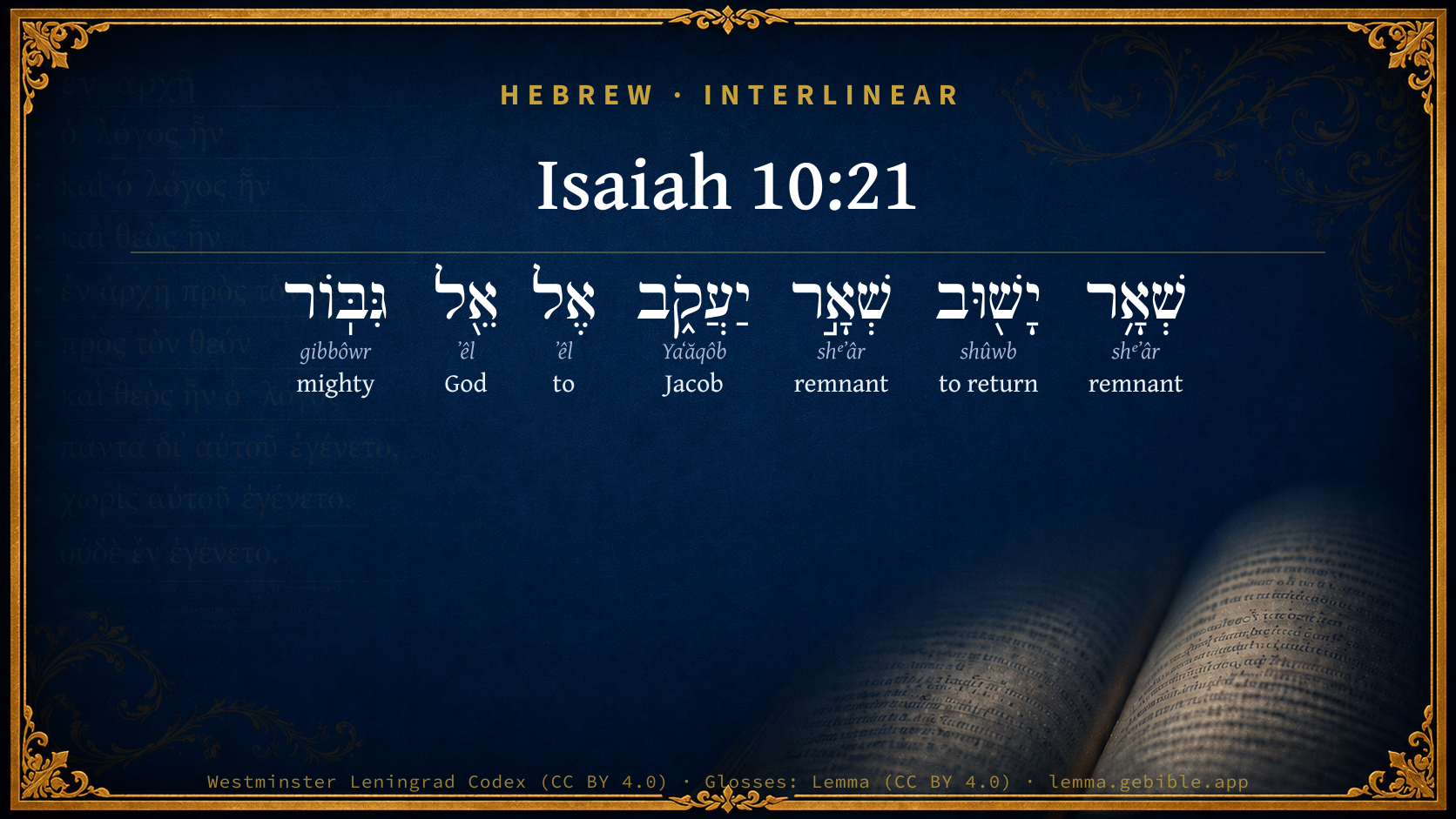
Isaiah 10:21

Hebrew (Westminster Leningrad Codex) Isaiah 10:21 appears in the Hebrew Old Testament. The text above is from the Westminster Leningrad Codex. Each word links to its Strong’s number, a concise gloss, and parsing drawn from the Open Scriptures Hebrew Bible morphology. Click any word for its full Brown-Driver-Briggs (BDB) entry.
Download image
Cite this verse

Isaiah 10:21 (World English Bible). Public Domain. Lemma interlinear Bible study tool, https://lemma.gebible.app/v/isaiah/10/21.

Show BibTeX & RIS
BibTeX
RIS
English Translation
A remnant shall return, [even] the remnant of Jacob, to the mighty God.
World English Bible · Public Domain
Download a study sheet

One document with this verse’s original text, its word-by-word gloss line, the meaning frame, cross-references with their text, attributed commentary, and full source and license credits — printable, and it pastes into notes with its structure intact.

This verse Autodidact and up

Study sheet (.html) Plain text (.txt)

A passage Seminary Student

Up to 50 verses in one chapter. A passage sheet keeps up to 6 commentary sources and 12 cross-references per verse, in the order this page ranks them, and says so on the sheet whenever that leaves anything out. Ask for a single verse and you get the Autodidact verse sheet above.

Everything on this page stays free to read, with no account — the sheet is a download of what is already on screen, not access to it.

Want to remove ads? Support Godless Engineer
Compare translations 3

The same verse in 3 English versions, stacked beneath the original-language interlinear above. Click any original word for its lexicon entry.

Each is an independent rendering of the whole verse — the interlinear is not word-aligned to these translations.

Highlighted words mark where these versions differ — a whole-verse word diff, not a word-by-word alignment.

  • World English Bible Public Domain
    A remnant shall return, [even] the remnant of Jacob, to the mighty God.
  • King James Version Public Domain
    The remnant shall return, even the remnant of Jacob, unto the mighty God.
  • unfoldingWord Literal Text CC BY-SA 4.0
    A remnant will return, a remnant of Jacob, to the Mighty God.

unfoldingWord Literal Text — © unfoldingWord, licensed CC BY-SA 4.0. Word-aligned USFM3 via Door43 (git.door43.org/unfoldingWord/en_ult).

Versions to compare (up to 4)

3 of 4 selected

Show all 18 translations

Every available English version of this verse, each an independent rendering of the whole verse.

  • World English Bible Public Domain
    A remnant shall return, [even] the remnant of Jacob, to the mighty God.
  • Berean Standard Bible Public Domain
    A remnant will return—a remnant of Jacob—to the Mighty God.
  • Majority Standard Bible Public Domain
    A remnant will return—a remnant of Jacob—to the Mighty God.
  • King James Version Public Domain
    The remnant shall return, even the remnant of Jacob, unto the mighty God.
  • American Standard Version (1901) Public Domain
    A remnant shall return, `even' the remnant of Jacob, unto the mighty God.
  • Revised Version (1885) Public Domain
    A remnant shall return, even the remnant of Jacob, unto the mighty God.
  • Geneva Bible (1599) Public Domain
    The remnant shall returne, euen the remnant of Iaakob vnto the mightie God.
  • Douay-Rheims (1899) Public Domain
    The remnant shall be converted, the remnant, I say, of Jacob, to the mighty God.
  • Young's Literal Translation Public Domain
    A remnant returneth -- a remnant of Jacob, Unto the Mighty God.
  • Literal Standard Version CC BY-SA 4.0
    A remnant returns—a remnant of Jacob, || To the Mighty God.
  • Unlocked Literal Bible CC BY-SA 4.0
    A remnant of Jacob will return to the mighty God.
  • unfoldingWord Literal Text CC BY-SA 4.0
    A remnant will return, a remnant of Jacob, to the Mighty God.
  • Darby Bible Public Domain
    The remnant shall return, the remnant of Jacob, unto the mighty ùGod.
  • World Messianic Bible Public Domain
    A remnant will return, even the remnant of Jacob, to the mighty God.
  • Webster's Bible Public Domain
    The remnant shall return, even the remnant of Jacob, to the mighty God.
  • Free Bible Version CC BY-SA 4.0
    A remnant will return, a remnant of Jacob will come back to the Mighty God.
  • Bible in Basic English Public Domain
    The rest, even the rest of Jacob, will come back to the Strong God.
  • JPS Tanakh (1917) Public Domain
    A remnant shall return, even the remnant of Jacob, unto God the Mighty.

Literal Standard Version (2020), Covenant Press — licensed CC BY-SA 4.0. Text via the HelloAO Bible API (eBible.org). Unlocked Literal Bible (unfoldingWord) — licensed CC BY-SA 4.0. Text via the HelloAO Bible API (eBible.org). unfoldingWord Literal Text — © unfoldingWord, licensed CC BY-SA 4.0. Word-aligned USFM3 via Door43 (git.door43.org/unfoldingWord/en_ult). Free Bible Version, Dr. Jonathan Gallagher — licensed CC BY-SA 4.0. Text via the HelloAO Bible API (eBible.org).

Word by word

More ways to search: Search by grammar → Find every occurrence → Compare this word →

Practice this passage: Drill this verse → Learn its vocabulary →

About this verse

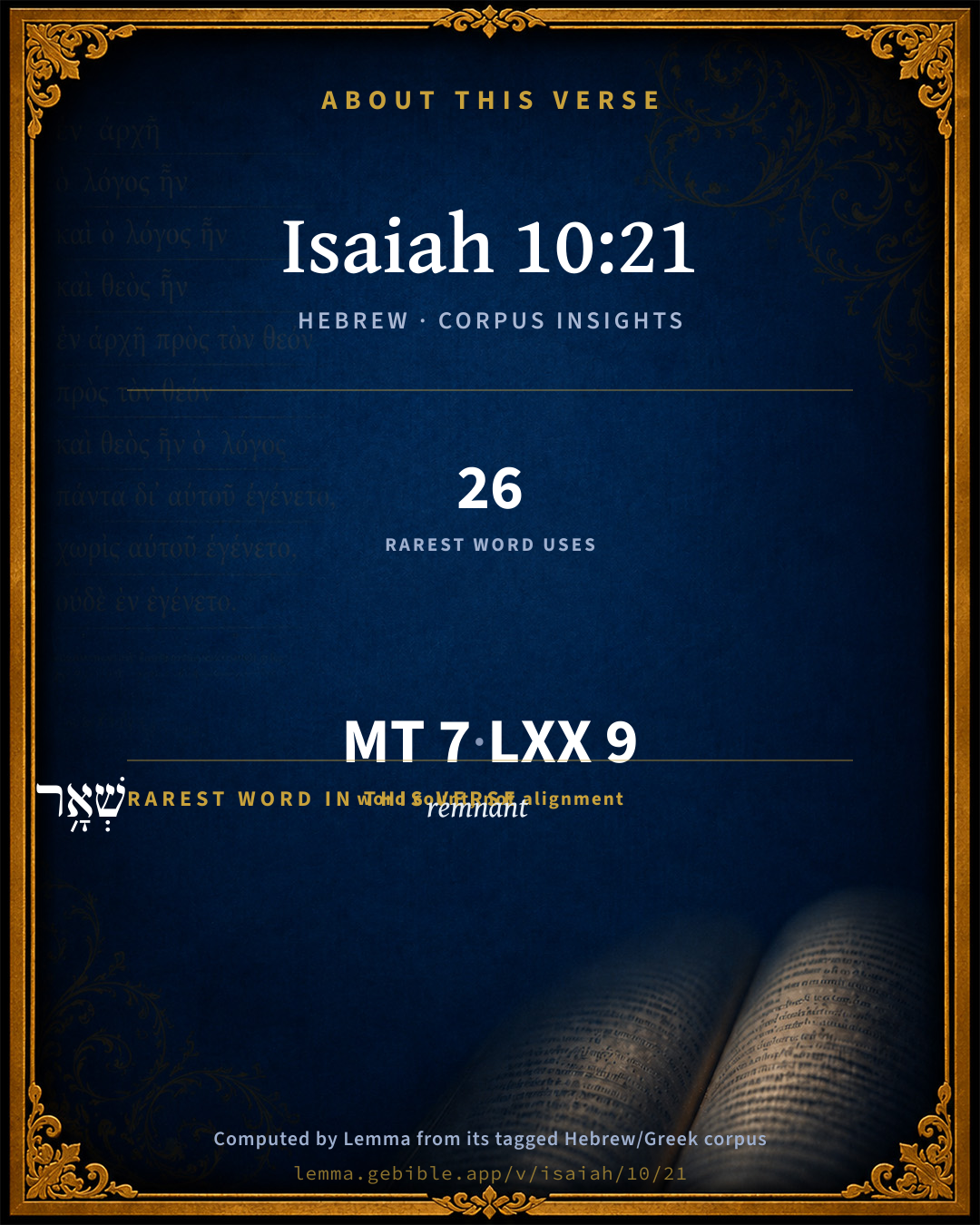
These counts appear in no published source. They are computed here, from the morphology-tagged text and Lemma’s own curated glosses. What Lemma adds →

7
words
6
distinct lemmas
Prophets
section

Shared distinctive vocabulary

שְׁאָ֥ר remnant H7605 occurs in 25 verses of the Hebrew Bible. Also found in:

Grammatical profile

  • 1 verb
  • 4 nouns
  • 1 adjective
  • 1 preposition

Verb forms

  • יָשׁ֖וּב Qal · Imperfect

Repetition

A word recurs within this verse — often emphatic in Hebrew:

  • שְׁאָ֥ר remnant H7605 ×2

Hebrew & Septuagint length

In English translation the verse runs 13 words from the Hebrew and 11 from the Septuagint (LXX English) — closely comparable.

A rough comparison of the two English renderings, which tokenize alike — not a word-level alignment.

Word counts can differ between the Hebrew and the Greek without any difference in meaning — e.g. the Hebrew direct-object marker אֵת has no separate Greek word, and Greek often adds the article ὁ.

In the original languages it is 7 Hebrew tokens and 9 Greek tokens — but the two are counted differently (Hebrew bundles its prefixes and suffixes into one token; the Greek is in lemma form), so that isn’t a like-for-like length.

Cross-references

12

Topical passages linked to Isaiah 10:21 in the Treasury of Scripture Knowledge — connected by theme and wording, ordered by reader-vote popularity; previews shown in the World English Bible.

  • Isaiah 9:6 For to us a child is born, to us a son is given; and the government shall be on his shoulder: and his name shall be called Wonderful, Counselor, Mighty God, Everlasting Father, Prince of Peace.
  • 2 Corinthians 3:14–16 But their minds were hardened, for until this very day at the reading of the old covenant the same veil remains, because in Christ it passes away.
  • Isaiah 7:3 Then Yahweh said to Isaiah, "Go out now to meet Ahaz, you, and Shearjashub your son, at the end of the conduit of the upper pool, on the highway of the fuller's field.
  • Isaiah 9:13 Yet the people have not turned to him who struck them, neither have they sought Yahweh of Hosts.
  • Isaiah 19:22 Yahweh will strike Egypt, smiting and healing; and they shall return to Yahweh, and he will be entreated of them, and will heal them.
  • Isaiah 55:7 let the wicked forsake his way, and the unrighteous man his thoughts; and let him return to Yahweh, and he will have mercy on him; and to our God, for he will abundantly pardon.
  • Isaiah 65:8–9 Thus says Yahweh, As the new wine is found in the cluster, and one says, Don't destroy it, for a blessing is in it: so will I do for my servants' sake, that I may not destroy them all.
  • Hosea 6:1 "Come, and let us return to Yahweh; For he has torn us to pieces, And he will heal us; He has injured us, And he will bind up our wounds.
  • Hosea 7:10 The pride of Israel testifies to his face; Yet they haven't returned to Yahweh their God, Nor sought him, for all this.
  • Hosea 7:16 They return, but not to the Most High. They are like a faulty bow. Their princes will fall by the sword for the rage of their tongue. This will be their derision in the land of Egypt.
  • Hosea 14:1 Israel, return to Yahweh your God; For you have fallen because of your sin.
  • Acts 26:20 but declared first to them of Damascus, at Jerusalem, and throughout all the country of Judea, and also to the Gentiles, that they should repent and turn to God, doing works worthy of repentance.

Cross-references courtesy of OpenBible.info (CC BY 4.0).

Hebrew and Greek witnesses Masoretic Hebrew ↔ Greek Septuagint

The same verse in the two great witnesses to the Old Testament, shown verse-for-verse.

These are two independent witnesses, not word-aligned to each other, and the Septuagint is shown in lemma (dictionary) form.

Hebrew Isaiah 10:21 Masoretic · Westminster Leningrad Codex

שְׁאָ֥ר יָשׁ֖וּב שְׁאָ֣ר יַעֲקֹ֑ב אֶל אֵ֖ל גִּבּֽוֹר

A remnant shall return, [even] the remnant of Jacob, to the mighty God.

World English Bible · Public Domain

Greek LXX Isaiah 10:21 Septuagint · lemma form

καί εἰμί ὁ καταλείπω ὁ ἰακώβ ἐπί θεός ἰσχύω

And the remnant of Jacob shall trust on the mighty God.

LXX2012 (modern English Septuagint) · Public Domain

Hebrew: Westminster Leningrad Codex (CC BY 4.0). Greek: Septuagint (public domain); English from LXX2012 (modern English Septuagint) (Public Domain). How the Septuagint differs from the Hebrew →

Targum (Aramaic paraphrase)

1

The Targum is the ancient Jewish Aramaic paraphrase of the Hebrew Scriptures — an interpretive translation, not the Hebrew text itself. Onkelos (literal) and Pseudo-Jonathan (expansive) render the Torah, and Jonathan the Prophets. Coverage is partial: where no permissively-licensed English translation exists for a verse, only the Aramaic is shown. This is verse-level text, not a word-by-word alignment to the Hebrew.

  1. Targum Jonathan Prophets (Joshua–Malachi)
    שְׁאָר דְלָא חֲטוּ וּדְתָבוּ מֵחֲטָאָה שְׁאָרָא דְבֵית יַעֲקֹב יְתוּבוּן לְמִפְלַח קֳדָם אֱלָהָא גִבָּרָא:

    The remnant which have not sinned, and have turned away from sin, the remnant of the house of Jacob, shall return to worship before the mighty God.

    Targum Jonathan — Aramaic: “Mikraot Gedolot” (public domain). English: “Sefaria Community Translation” (CC0 1.0 (public-domain dedication)); “London "Chaldee Paraphrase," 1871” (public domain). Text via Sefaria.

Commentary

Notes on Isaiah 10:21 from classic Christian and Jewish commentators (each source and its license shown beneath its notes). The classic Christian expositions comment on the surrounding passage and are grouped to its opening verse, so a note may address several verses; the Jewish commentaries on the Tanakh (Rashi and others) are per-verse, so they appear only where the commentator wrote on this verse.

Lemma curates 59 commentaries, every one of them public domain or Creative Commons licensed, each selected and text-cleaned for this edition rather than reprinted as found. About our sources →

Trapp's Complete Commentary

John Trapp

Isa 10:21 The remnant shall return, [even] the remnant of Jacob, unto the mighty God.

Ver. 21. A remnant shall return,] scil., To the Lord by true repentance, from whom they had deeply revolted. But of these there is but as a "remnant" - a poor few - in comparison of the whole piece of cloth.

John Trapp, A Commentary or Exposition upon All the Books of the Old and New Testament (1647–1656) — public domain. Text from a community e-Sword module.

Joseph Benson's Commentary

Isa 10:21-23. The remnant shall return — Hebrew, שׁאר ישׁוב, shear- jashub, the name given to one of the prophet’s sons, (see Isa 7:3,) in confirmation of the truth of God’s promises. It may be rendered, as here, the remnant, or, a remnant, or, but a remnant, shall return; unto the mighty God — Hebrew, אל גבור, the very appellation given to Christ, Isa 9:6. For though thy people Israel — Or, thy people, O Israel; to whom the prophet, by an apostrophe, directs his speech; be as the sand, &c., yet a remnant — Or, a remnant only, as before; shall return — For that this is a threatening in respect of some, as well as a promise in respect of others, is evident from the rest of this, and from the following verse. The consumption decreed shall overflow — God’s judgments are said to overflow when they spread generally, the metaphor being taken from an inundation that sweeps all before it. The destruction of the people of Israel was already decreed by the fixed counsel of God, and therefore must needs be executed, and like a deluge overflow them, with, or in righteousness, as the word is rendered Rom 9:28, that is, with justice, and yet with clemency, inasmuch as he spared a considerable remnant of them, when he might have destroyed them utterly. In the midst of the land — In all the parts of the land, not excepting Jerusalem, which was to be preserved in the Assyrian invasion. Bishop Lowth translates these verses, “Though thy people, O Israel, shall be as the sand of the sea, a remnant of them only shall return. The consummation decided overfloweth with strict justice: For a full and decisive decree shall Jehovah, the Lord of hosts, accomplish in the midst of the land.” The prophet’s affirming, that only a remnant of Judah and Ephraim should be preserved, and return in true repentance to God, might justly cause wonder and offence, both to Jews and Israelites, at the time when he spoke these things: for it implied that far the greater part of the people should perish, which they must have conceived highly improbable, especially as they were at that time very numerous and flourishing. The prophet, therefore, declares repeatedly, and more explicitly, that God had determined, by an absolute and precise decree, thus to exercise his justice and severity upon them. This, it is evident, is the sense of the present passage, though there is some difficulty in the expressions. This prophecy was, in part, fulfilled at the Babylonish captivity, but there can be no doubt that it has also a reference to the times of the Messiah: see note on Rom 9:27. Indeed, as Lowth observes, the remnant, so miraculously preserved in Jerusalem from Sennacherib’s invasion, were a type or figure of that small number of converts under the gospel, styled σωζομενοι, (Act 2:47,) such as should be saved, namely, such as should escape the vengeance which fell upon the main body of the Jewish nation, for their sin in rejecting Christ. And there shall be another remnant of them that shall be saved in the latter days of the Christian Church.

Joseph Benson's Commentary on the Old and New Testaments (1811–1818) — public domain. Text from a community e-Sword module.

Jamieson, Fausset & Brown

Robert Jamieson, A. R. Fausset & David Brown

mighty God-- (Isa 9:6) the God who shall have evinced such might in destroying Israel's enemies. As the Assyrians in Sennacherib's reign did not carry off Judah captive, the returning "remnant" cannot mainly refer to this time.

Jamieson, Fausset & Brown — Commentary Critical and Explanatory on the Whole Bible (1871) — public domain (CC PDM 1.0). Text via the HelloAO Bible API.

Adam Clarke's Commentary

Verse 21. The remnant shalt return - unto the mighty God.] אל גבור El gibbor, the mighty or conquering God; the Messiah, the same person mentioned in Isa 9:6 of the preceding chapter.

Adam Clarke's Commentary on the Bible (1810–1826) — public domain. Text from a community e-Sword/MySword module.

Ellicott's Commentary for English Readers

(21) The remnant shall return . . .—The very form of the words (Shear-jashub) shows that the prophet had the “Immanuel promise in his thoughts, just as “the mighty God” (the same word as in Isa_9:6) must have reminded men of the Child who was to bear that name in the age to come. (Comp. Hezekiah’s proclamation in 2Ch_30:6.)

A Bible Commentary for English Readers, edited by Charles John Ellicott (1878–1897) — public domain. Text from a community e-Sword module.

The Cambridge Bible for Schools and Colleges

gen. ed. J. J. S. Perowne

21. The remnant, &c.] A remnant shall turn. Thus shall be fulfilled the prophecy embodied in the name of Isaiah’s son, Shear-jashub (ch. Isa_7:3).

the mighty God] the Hero-God—in ch. Isa_9:6 a title of the Messiah, but here apparently of Jehovah.

The Cambridge Bible for Schools and Colleges (gen. ed. J. J. S. Perowne; Cambridge University Press, 1878–1918) — public domain. Text from a community e-Sword module.

John Gill's Exposition

For though thy people Israel be as the sand of the sea,.... These words are spoken either by the Lord to the prophet, calling Israel his people; or by the prophet to Hezekiah, as Jarchi and Kimchi think; or they may be rendered thus, "for though thy people, O Israel, be as the sand of the sea" (s); that is, innumerable, as was promised to Abraham, Gen 22:17,

yet a remnant of them shall return; or "be converted in it" (t), to the Messiah; or "be saved", as the apostle interprets it; see Gill on Rom 9:27; a remnant is a few, as Kimchi explains it, out of a great number: it signifies, that the majority of the Jewish nation should reject the Messiah, only a few of them should believe in him; and these should certainly believe in him, and be saved by him; and that for the following reason, because

the consumption decreed shall overflow with righteousness; that is, the precise and absolute decree, concerning the salvation of the remnant, God will cause to overflow, or abundantly execute, in a righteous manner, consistent with his divine perfections; and so it makes for the comfort of the remnant of the Lord's people, agreeably to the intent of the apostle's citation of it; see Gill on Rom 9:28; though some understand it of God's punitive justice, in consuming and destroying the greater part of the Jewish people, the ungodly among them, and saving a remnant, which return and repent; and to this sense are the Targum, and the Jewish commentators.

(s) "Nam etsi fuerit populus tuus, O Israel, sicut arena maris", Piscator. (t) "convertetur in eo", Montanus, Cocceius.

John Gill's Exposition of the Whole Bible (1746–1763) — public domain (CC PDM 1.0). Text via the HelloAO Bible API.

Albert Barnes' Notes on the Bible

The remnant ... - That is, those who shall be left after the invasion of Sennacherib.

Shall return - Shall abandon their idolatrous rites and places of worship, and shall worship the true God.

The mighty God - The God that had evinced his power in overcoming and destroying the armies of Sennacherib.

Albert Barnes' Notes on the Bible (1834–1885) — public domain. Text from a community e-Sword/MySword module.

Matthew Poole's English Annotations

The remnant; or, a remnant; or, but a remnant; or, a remnant only; which particles are oft understood, as hath been formerly and frequently observed, and may be here supplied from the following verses.

Unto the mighty God; unto the Messiah, expressly called the mighty God, Isa 9:6.

Matthew Poole's English Annotations on the Holy Bible (1683–1685) — public domain. Text from a community e-Sword/MySword module.

Whedon's Commentary on the Bible

Daniel D. Whedon

21. The remnant — They shall return to Jehovah, who in the past was the Mighty One (El Gibbor, see note on Isa_9:7) to Israel. They shall return to God in Christ. See Hos_3:5, where Jehovah and David’s Son are placed side by side. Isaiah’s son, Shear-jashub — the fact of whose birth and the significance of whose name (Isa_7:3) no doubt are still familiar — brings up this doctrine of the “remnant,” etc., with vividness.

Daniel D. Whedon (gen. ed.), Commentary on the Old and New Testaments (1874–1909) — public domain. Text from a community e-Sword module.

The Pulpit Commentary

The mighty God. (comp. Isa_9:6) The name is not, however, Messianic in this place.

The Pulpit Commentary (1880–1919), ed. H.D.M. Spence-Jones & Joseph S. Exell — public domain. Text from a community e-Sword module.

Keil & Delitzsch

C. F. Keil & F. Delitzsch

"The remnant will turn, the remnant of Jacob, to God the mighty." El gibbor is God as historically manifested in the heir of David (Isa 9:6). Whilst Hosea (Hos 3:5) places side by side Jehovah and the second David, Isaiah sees them as one. In New Testament phraseology, it would be "to God in Christ."

Keil & Delitzsch — Biblical Commentary on the Old Testament (1861–1891) — public domain (CC PDM 1.0). Text via the HelloAO Bible API. (Old Testament only.)

J. A. Alexander on Isaiah

Joseph Addison Alexander

“A remnant shall return, a remnant of Jacob, to God Almighty.” There is an obvious allusion in these words to the name of the Prophet’s son Shear-jashub, mentioned in Isa 7:3. As the people were probably familiar with this name, its introduction here would be the more significant. The remnant of Jacob means those who should survive God’s judgments threatened in this prophecy, not merely the Assyrian invasion or the Babylonish exile, but the whole series of remarkable events, by which the history of the chosen people would be marked, including the destruction and dispersion of the nation by the Romans. The return here spoken of is one that was to take place at various times and in various circumstances. Under the old dispensation, the prophecy was verified in the conversion of idolatrous Jews to the worship of Jehovah, or of wicked Jews to a godly life, by means of their afflictions; under the new, in the admission of believing Jews to the Christian church, and prospectively in the general conversion of Israel to God, which is yet to be expected.

Joseph Addison Alexander, The Prophecies of Isaiah (1846–1847; New York: Scribner, 1870–1878) — public domain. Text from a community e-Sword module.

Rashi

Rabbi Shlomo Yitzchaki (Rashi)

A remnant shall return The remnant of them shall return to the Holy One, blessed be He.

the mighty God Who demonstrated His might against Sennacherib.

Rashi on the Tanakh — English translations: “The Judaica Press complete Tanach with Rashi, translated by A. J. Rosenberg” (CC BY 4.0); “Pentateuch with Rashi's commentary by M. Rosenbaum and A.M. Silbermann, 1929-1934” (public domain); “The Metsudah Tanach series, Lakewood, N.J” (CC BY 4.0); and “The Book of Joshua, Metsudah Publications, 1997” (CC BY 4.0). Text via Sefaria.

Ibn Ezra

Rabbi Abraham ibn Ezra

שאר יעקב. The remnant shall return. This is the name of the prophet’s son, which is to be explained now. Supply יעקב, after the first שאר. The remnant of Jacob, that is Judah, will return; repeat likewise ישוב before אל: The remnant of Jacob will return to the mighty God (comp. Prov. 21:14). The verse, if written in full, would run thus: שאר יעקב ישוב אל אל גבור שאר יעקב ישוב,. The remnant of Jacob will return, the remnant of Jacob will return to the mighty God.

Mighty, who is able to help them.

Ibn Ezra on the Tanakh — English translations: “Sefaria Community Translation” (CC0 1.0 (public-domain dedication)); “Yalkut, Sifsei Chachomim Chumash, Metsudah Publications, 2009” (CC BY 4.0); and “Commentary of Ibn Ezra on Isaiah - trans. by M. Friedlander, 1873” (public domain). Text via Sefaria.

Lesson kit

Teaching starters — assembled from the data on this page, not authored interpretation. Every prompt links to the verse data it draws on. Edit before teaching.

Isaiah, in the Prophets, opens this verse with 7 words (6 distinct Hebrew lemmas). Its most distinctive word is shᵉʼâr (“remnant”). A historical commentator’s framing appears above. Read the whole chapter for the surrounding context.

Discussion questions

  1. What does “remnant” (shᵉʼâr) contribute to the verse as a whole?
  2. How does 1 Chronicles 11:8, which shares the word «remnant», read alongside this verse?
  3. What does the repetition of “remnant” (2× in this one verse) do in this verse?
  4. These translations render this verse differently; the difference is in the English rendering, not the original. What questions does that raise?
  5. «יָשׁ֖וּב» is a Qal Imperfect verb. How does that grammatical form shape the action described?
  6. Compare how Trapp's Complete Commentary and Joseph Benson's Commentary read this verse. Where do they agree or differ?

Things to notice

Reading settings

Reading text

Shown beneath each verse's original-language words.

Old Testament
Old Testament edition

Read the OT as the Masoretic Hebrew (MT) or the Greek Septuagint (LXX).

English shown for the Greek Septuagint (in the Hebrew ↔ Greek comparison).

Comparing translations? Open the Compare panel on any verse page to stack up to four side by side.