Isaiah 21:17

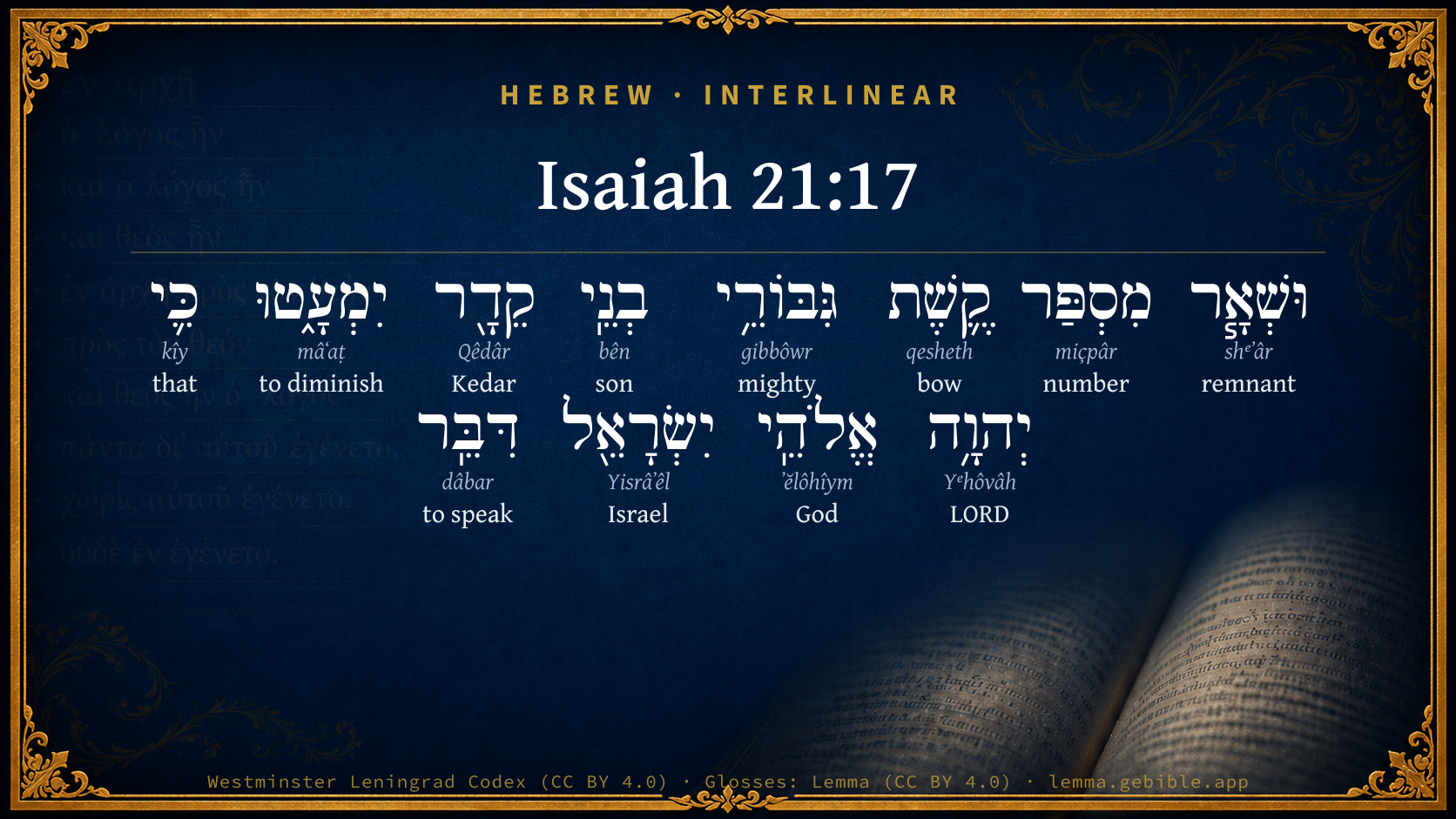
Hebrew (Westminster Leningrad Codex) Isaiah 21:17 appears in the Hebrew Old Testament. The text above is from the Westminster Leningrad Codex. Each word links to its Strong’s number, a concise gloss, and parsing drawn from the Open Scriptures Hebrew Bible morphology. Click any word for its full Brown-Driver-Briggs (BDB) entry.
Download image
Cite this verse

Isaiah 21:17 (World English Bible). Public Domain. Lemma interlinear Bible study tool, https://lemma.gebible.app/v/isaiah/21/17.

Show BibTeX & RIS
BibTeX
RIS
English Translation
and the residue of the number of the archers, the mighty men of the children of Kedar, shall be few; for Yahweh, the God of Israel, has spoken it.
World English Bible · Public Domain
Download a study sheet

One document with this verse’s original text, its word-by-word gloss line, the meaning frame, cross-references with their text, attributed commentary, and full source and license credits — printable, and it pastes into notes with its structure intact.

This verse Autodidact and up

Study sheet (.html) Plain text (.txt)

A passage Seminary Student

Up to 50 verses in one chapter. A passage sheet keeps up to 6 commentary sources and 12 cross-references per verse, in the order this page ranks them, and says so on the sheet whenever that leaves anything out. Ask for a single verse and you get the Autodidact verse sheet above.

Everything on this page stays free to read, with no account — the sheet is a download of what is already on screen, not access to it.

Want to remove ads? Support Godless Engineer
Compare translations 3

The same verse in 3 English versions, stacked beneath the original-language interlinear above. Click any original word for its lexicon entry.

Each is an independent rendering of the whole verse — the interlinear is not word-aligned to these translations.

Highlighted words mark where these versions differ — a whole-verse word diff, not a word-by-word alignment.

  • World English Bible Public Domain
    and the residue of the number of the archers, the mighty men of the children of Kedar, shall be few; for Yahweh, the God of Israel, has spoken it.
  • King James Version Public Domain
    And the residue of the number of archers, the mighty men of the children of Kedar, shall be diminished: for the LORD God of Israel hath spoken it.
  • unfoldingWord Literal Text CC BY-SA 4.0
    And the remnant of the number of the archer, the warriors of the sons of Kedar, will become few, for Yahweh, the God of Israel, has spoken.”

unfoldingWord Literal Text — © unfoldingWord, licensed CC BY-SA 4.0. Word-aligned USFM3 via Door43 (git.door43.org/unfoldingWord/en_ult).

Versions to compare (up to 4)

3 of 4 selected

Show all 18 translations

Every available English version of this verse, each an independent rendering of the whole verse.

  • World English Bible Public Domain
    and the residue of the number of the archers, the mighty men of the children of Kedar, shall be few; for Yahweh, the God of Israel, has spoken it.
  • Berean Standard Bible Public Domain
    The remaining archers, the warriors of Kedar, will be few.” For the LORD, the God of Israel, has spoken.
  • Majority Standard Bible Public Domain
    The remaining archers, the warriors of Kedar, will be few.” For the LORD, the God of Israel, has spoken.
  • King James Version Public Domain
    And the residue of the number of archers, the mighty men of the children of Kedar, shall be diminished: for the LORD God of Israel hath spoken it.
  • American Standard Version (1901) Public Domain
    and the residue of the number of the archers, the mighty men of the children of Kedar, shall be few; for Jehovah, the God of Israel, hath spoken it.
  • Revised Version (1885) Public Domain
    and the residue of the number of the archers, the mighty men of the children of Kedar, shall be few: for the LORD, the God of Israel, hath spoken it.
  • Geneva Bible (1599) Public Domain
    And the residue of the nomber of ye strong archers of the sonnes of Kedar shall be fewe: for the Lord God of Israel hath spoken it.
  • Douay-Rheims (1899) Public Domain
    And the residue of the number of strong archers of the children of Cedar shall be diminished: for the Lord the God of Israel hath spoken it.
  • Young's Literal Translation Public Domain
    And the remnant of the number of bow-men, The mighty of the sons of Kedar are few, For Jehovah, God of Israel, hath spoken!'
  • Literal Standard Version CC BY-SA 4.0
    And the remnant of the number of bow-men, || The mighty of the sons of Kedar, are few, || For YHWH, God of Israel, has spoken!”
  • Unlocked Literal Bible CC BY-SA 4.0
    Only a few of the archers, the warriors of Kedar will remain,” for Yahweh, the God of Israel, has spoken.
  • unfoldingWord Literal Text CC BY-SA 4.0
    And the remnant of the number of the archer, the warriors of the sons of Kedar, will become few, for Yahweh, the God of Israel, has spoken.”
  • Darby Bible Public Domain
    and the residue of the number of the archers, the mighty men of the sons of Kedar, shall be diminished: for Jehovah, the God of Israel, hath spoken.
  • World Messianic Bible Public Domain
    and the residue of the number of the archers, the mighty men of the children of Kedar, will be few; for the LORD, the God of Israel, has spoken it.”
  • Webster's Bible Public Domain
    And the residue of the number of archers, the mighty men of the children of Kedar, shall be diminished: for the LORD God of Israel hath spoken it.
  • Free Bible Version CC BY-SA 4.0
    There will only be a few left of the archers, the warriors of Kedar.” The Lord, the God of Israel, has spoken.
  • Bible in Basic English Public Domain
    And the rest of the bowmen, the men of war of the children of Kedar, will be small in number: for the Lord, the God of Israel, has said it.
  • JPS Tanakh (1917) Public Domain
    and the residue of the number of the archers, the mighty men of the children of Kedar, shall be diminished; for the LORD, the God of Israel, hath spoken it.'

Literal Standard Version (2020), Covenant Press — licensed CC BY-SA 4.0. Text via the HelloAO Bible API (eBible.org). Unlocked Literal Bible (unfoldingWord) — licensed CC BY-SA 4.0. Text via the HelloAO Bible API (eBible.org). unfoldingWord Literal Text — © unfoldingWord, licensed CC BY-SA 4.0. Word-aligned USFM3 via Door43 (git.door43.org/unfoldingWord/en_ult). Free Bible Version, Dr. Jonathan Gallagher — licensed CC BY-SA 4.0. Text via the HelloAO Bible API (eBible.org).

Word by word

More ways to search: Search by grammar → Find every occurrence → Compare this word →

Practice this passage: Drill this verse → Learn its vocabulary →

About this verse

These counts appear in no published source. They are computed here, from the morphology-tagged text and Lemma’s own curated glosses. What Lemma adds →

12
words
12
distinct lemmas
Prophets
section

Notable vocabulary

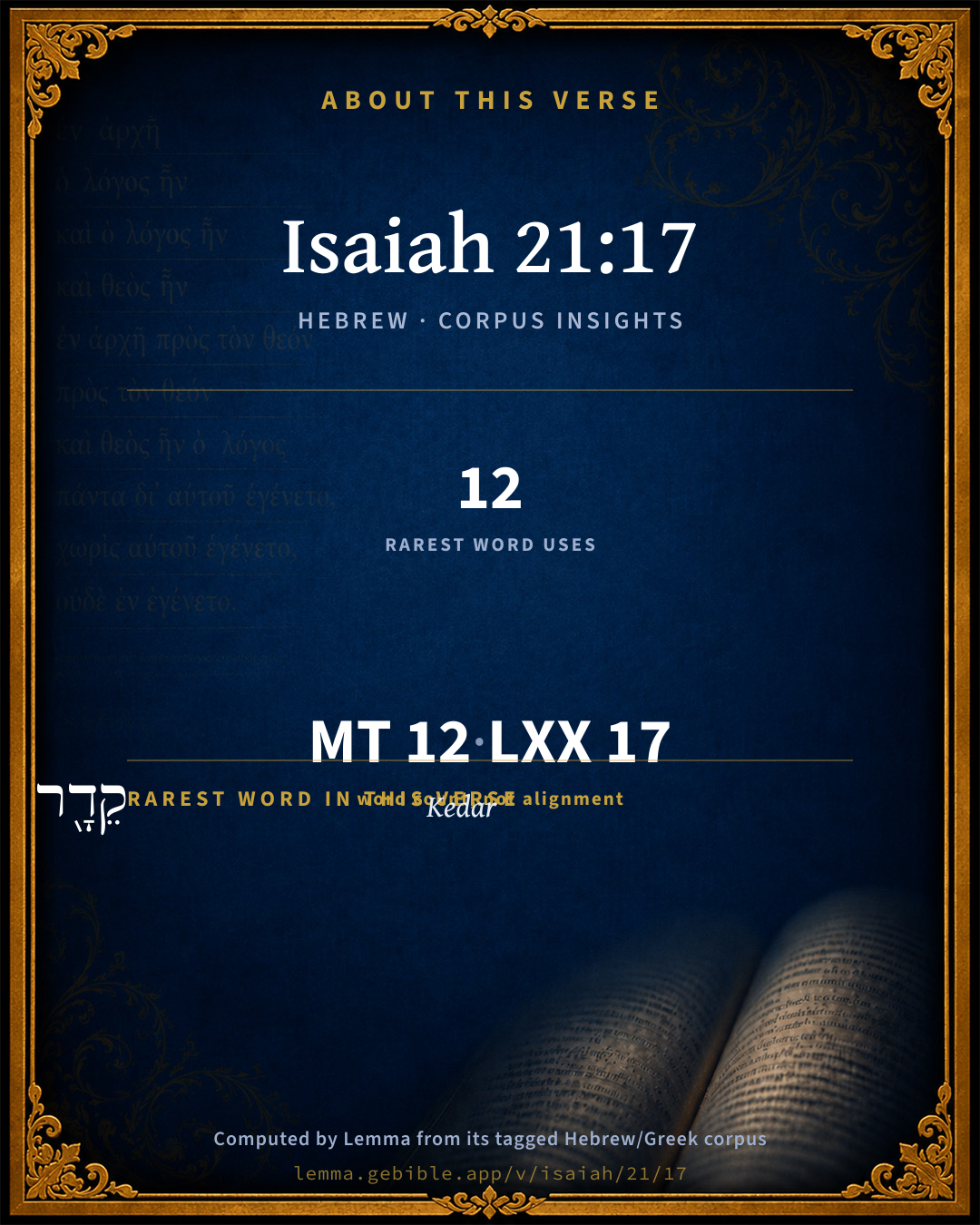
The rarest word here is קֵדָ֖ר Kedar H6938 — appearing just 12 times in the whole Hebrew Bible.

Shared distinctive vocabulary

קֵדָ֖ר Kedar H6938 occurs in 11 verses of the Hebrew Bible. Also found in:

Grammatical profile

  • 2 verbs
  • 8 nouns
  • 1 adjective
  • 1 conjunction

Verb forms

  • יִמְעָ֑טוּ Qal · Imperfect
  • דִּבֵּֽר Piel · Perfect

Hebrew & Septuagint length

In English translation the verse runs 29 words from the Hebrew and 24 from the Septuagint (LXX English) — closely comparable.

A rough comparison of the two English renderings, which tokenize alike — not a word-level alignment.

Word counts can differ between the Hebrew and the Greek without any difference in meaning — e.g. the Hebrew direct-object marker אֵת has no separate Greek word, and Greek often adds the article ὁ.

In the original languages it is 12 Hebrew tokens and 17 Greek tokens — but the two are counted differently (Hebrew bundles its prefixes and suffixes into one token; the Greek is in lemma form), so that isn’t a like-for-like length.

Cross-references

8

Topical passages linked to Isaiah 21:17 in the Treasury of Scripture Knowledge — connected by theme and wording, ordered by reader-vote popularity; previews shown in the World English Bible.

  • Numbers 23:19 God is not a man, that he should lie, Neither the son of man, that he should repent: Has he said, and will he not do it? Or has he spoken, and will he not make it good?
  • Zechariah 1:6 But my words and my decrees, which I commanded my servants the prophets, didn't they overtake your fathers? "Then they repented and said, 'Just as Yahweh of Hosts determined to do to us, according to our ways, and according to our practices, so he has dealt with us.'"
  • Isaiah 1:20 But if you refuse and rebel, you shall be devoured with the sword; For the mouth of Yahweh has spoken it."
  • Matthew 24:35 Heaven and earth will pass away, but my words will not pass away.
  • Psalms 107:39 Again, they are diminished and bowed down Through oppression, trouble, and sorrow.
  • Isaiah 10:18–19 He will consume the glory of his forest, and of his fruitful field, both soul and body: and it shall be as when a standard-bearer faints.
  • Isaiah 17:4–5 It shall happen in that day, that the glory of Jacob shall be made thin, and the fatness of his flesh shall wax lean.
  • Jeremiah 44:29 This shall be the sign to you, says Yahweh, that I will punish you in this place, that you may know that my words shall surely stand against you for evil:

Cross-references courtesy of OpenBible.info (CC BY 4.0).

Hebrew and Greek witnesses Masoretic Hebrew ↔ Greek Septuagint

The same verse in the two great witnesses to the Old Testament, shown verse-for-verse.

These are two independent witnesses, not word-aligned to each other, and the Septuagint is shown in lemma (dictionary) form.

Hebrew Isaiah 21:17 Masoretic · Westminster Leningrad Codex

וּשְׁאָ֧ר מִסְפַּר קֶ֛שֶׁת גִּבּוֹרֵ֥י בְנֵֽי קֵדָ֖ר יִמְעָ֑טוּ כִּ֛י יְהוָ֥ה אֱלֹהֵֽי יִשְׂרָאֵ֖ל דִּבֵּֽר

and the residue of the number of the archers, the mighty men of the children of Kedar, shall be few; for Yahweh, the God of Israel, has spoken it.

World English Bible · Public Domain

Greek LXX Isaiah 21:17 Septuagint · lemma form

καί ὁ κατάλοιπος ὁ τόξευμα ὁ ἰσχυρός υἱός κηδαρ εἰμί ὀλίγος διότι κύριος λαλέω ὁ θεός ἰσραήλ

and the remnant of the strong bows of the sons of Kedar shall be small: for the Lord God of Israel has spoken it.

LXX2012 (modern English Septuagint) · Public Domain

Hebrew: Westminster Leningrad Codex (CC BY 4.0). Greek: Septuagint (public domain); English from LXX2012 (modern English Septuagint) (Public Domain). How the Septuagint differs from the Hebrew →

Targum (Aramaic paraphrase)

1

The Targum is the ancient Jewish Aramaic paraphrase of the Hebrew Scriptures — an interpretive translation, not the Hebrew text itself. Onkelos (literal) and Pseudo-Jonathan (expansive) render the Torah, and Jonathan the Prophets. Coverage is partial: where no permissively-licensed English translation exists for a verse, only the Aramaic is shown. This is verse-level text, not a word-by-word alignment to the Hebrew.

  1. Targum Jonathan Prophets (Joshua–Malachi)
    וּתְקוֹף עָבְדֵי קְרָב גִבָּרֵי בְּנֵי עֲרָבָאֵי יִזְעֲרוּן אֲרֵי בְּמֵימְרָא דַייָ אֱלָהָא דְיִשְׂרָאֵל גְזִיר כֵּן:

    And the strength of the warriors, the mighty, the sons of the Arabians, shall be lessened, because by the WORD of the Lord, the God of Israel, it is thus decreed.

    Targum Jonathan — Aramaic: “Mikraot Gedolot” (public domain). English: “Sefaria Community Translation” (CC0 1.0 (public-domain dedication)); “London "Chaldee Paraphrase," 1871” (public domain). Text via Sefaria.

Commentary

Notes on Isaiah 21:17 from classic Christian and Jewish commentators (each source and its license shown beneath its notes). The classic Christian expositions comment on the surrounding passage and are grouped to its opening verse, so a note may address several verses; the Jewish commentaries on the Tanakh (Rashi and others) are per-verse, so they appear only where the commentator wrote on this verse.

Lemma curates 59 commentaries, every one of them public domain or Creative Commons licensed, each selected and text-cleaned for this edition rather than reprinted as found. About our sources →

Trapp's Complete Commentary

John Trapp

Isa 21:17 And the residue of the number of archers, the mighty men of the children of Kedar, shall be diminished: for the LORD God of Israel hath spoken [it].

Ver. 17. And the residue of the number of archers.] Heb., Of the bow, whereby these Kedarens lived much, as had also their ancestor Ishmael. {Gen 21:20}

For the Lord God of Israel hath spoken it.] Who will surely see it done, and yet he loveth mercifulness, but can, less than Mithridates could, endure those who hate virtue forsaken of fortune, as they call it.

John Trapp, A Commentary or Exposition upon All the Books of the Old and New Testament (1647–1656) — public domain. Text from a community e-Sword module.

Tyndale Open Study Notes

Tyndale Open Resources

21:17 Only a few . . . will survive: Cp. 10:22; 14:30; 16:14; 24:6, 13; 37:32.

Tyndale Open Study Notes — © Tyndale Open Resources, licensed CC BY-SA 4.0. Text via the HelloAO Bible API.

Geneva Bible (1599)

Geneva Bible translators

Which was the name of a people of Arabia: and by the horrible destruction of all these nations, he teacheth the Jews that there is no place for refuge or to escape God’s wrath, but only to remain in his Church, and to live in his fear.

Geneva Bible (1599) marginal notes — public domain. Text via Bolls.life.

Jamieson, Fausset & Brown

Robert Jamieson, A. R. Fausset & David Brown

residue . . . diminished--The remnant of Arab warriors, famous in the bow, left after the invasion, shall be small.

That by Sennacherib, in the fourteenth year of Hezekiah; Isa 22:8-11, the preparations for defense and securing of water exactly answer to those in Ch2 32:4-5, Ch2 32:30. "Shebna," too (Isa 22:15), was scribe at this time (Isa 36:3) [MAURER]. The language of Isa 22:12-14, as to the infidelity and consequent utter ruin of the Jews, seems rather to foreshadow the destruction by Nebuchadnezzar in Zedekiah's reign, and cannot be restricted to Hezekiah's time [LOWTH].

Next: Isaiah Chapter 22

Jamieson, Fausset & Brown — Commentary Critical and Explanatory on the Whole Bible (1871) — public domain (CC PDM 1.0). Text via the HelloAO Bible API.

Adam Clarke's Commentary

Verse 17. The archers, the mighty men of the children of Kedar - "The mighty bowmen of the sons of Kedar"] Sagittariorum fortium, Vulg.; transposing the two words, and reading גבורי קשה gibborey kesheth; which seems to be right. The strong men of the bow, the most excellent archers.

For the Lord - hath spoken it - "For JEHOVAH hath spoken it."] The prophetic Carmina of Marcius, foretelling the battle of Cannae, lib. xxv. 12, conclude with the same kind of solemn form: Nam mihi ita Jupiter fatus est; "Thus hath Jupiter spoken to me." Observe that the word נאם naam, to pronounce, to declare, is the solemn word appropriated to the delivering of prophecies: "Behold, I am against the prophets, saith (נאם naam, pronounceth) JEHOVAH, who use their tongues, וינאמו נאם vaiyinamu neum, and solemnly pronounce, He hath pronounced it;" Jer 23:31. What God says shall most assuredly come to pass; he cannot be deceived.

Adam Clarke's Commentary on the Bible (1810–1826) — public domain. Text from a community e-Sword/MySword module.

Ellicott's Commentary for English Readers

(17) And the residue . . .—The Hebrew word is the same as the characteristic “remnant” of Isaiah’s earlier prophecies. The words point primarily to the subjugation of Arabia by Sargon and Sennacherib, who narrate their victories over the Arabian tribes (Records of the Past, vii. 34). In Jer_49:28-29 we have an echo of the prediction, which, in that case, pointed to their conquest by Nebuchadnezzar.

A Bible Commentary for English Readers, edited by Charles John Ellicott (1878–1897) — public domain. Text from a community e-Sword module.

The Cambridge Bible for Schools and Colleges

gen. ed. J. J. S. Perowne

17. the number of archers] Lit. “of the bows.” The bow was the chief weapon of the Northern Arabs, as of their progenitor Ishmael, Gen_21:20.

The Cambridge Bible for Schools and Colleges (gen. ed. J. J. S. Perowne; Cambridge University Press, 1878–1918) — public domain. Text from a community e-Sword module.

John Gill's Exposition

And the residue of the number of archers,.... Or of "bow" (g), for "bows": that is, of men that use the bow, or are expert at it, as the Kedarenes were, both for taking wild beasts, and fighting with men, in which they followed their original ancestor Ishmael, Gen 21:20 the number of these archers it seems had been great, but would be lessened by the calamity threatened; and those that would escape that, and be preserved from it, should be lessened still, as follows:

the mighty men of the children of Kedar shall be diminished; their military men, the most expert at the use of the bow, and the most valiant and courageous; the few of those that were left, and did not fall by the sword of the Assyrians, should gradually diminish, and be fewer and fewer:

for the Lord God of Israel hath spoken it; who cannot lie, nor will repent, and whose word never fails, what he has said he will do, nor will he alter the thing that is gone out of his lips; and he is spoken of as the God of Israel, because it was to the Israelites that this was said, and for their sakes; either because these Arabians some way or other were injurious to them, or they had put some confidence in them. The Targum is,

"because by the word of the Lord God of Israel it is so decreed.''

(g) "numeri arcus", Montanus, Cocceius.

Next: Isaiah Chapter 22

John Gill's Exposition of the Whole Bible (1746–1763) — public domain (CC PDM 1.0). Text via the HelloAO Bible API.

Albert Barnes' Notes on the Bible

And the residue of the number - That is, those who shall be left in the invasion. Or perhaps it may be read, ‘There shall be a renmant of the number of bowmen; the mighty people of Kedar shall be diminished.’

Of archers - Hebrew, ‘Of the bow;’ that is, of those who use bows in war. The bow was the common instrument in hunting and in war among the ancients.

Shall be diminished - Hebrew, ‘Shall be made small;’ they shall be reduced to a very small number. We cannot indeed determine the precise historical event to which this refers, but the whole connection and circumstances seem to make it probable that it referred to the invasion by the Assyrian when he went up against Judah, or when he was on his way to Egypt.

Albert Barnes' Notes on the Bible (1834–1885) — public domain. Text from a community e-Sword/MySword module.

Matthew Poole's English Annotations

Archers; bows and arrows were their: chief weapons, and they were expert in the use of them, both against beasts and men, as occasion required.

Matthew Poole's English Annotations on the Holy Bible (1683–1685) — public domain. Text from a community e-Sword/MySword module.

J. A. Alexander on Isaiah

Joseph Addison Alexander

“And the remnant of the number of bows (or archers), the mighty men (or heroes) of the children of Kedar, shall be few (or become few), for Jehovah God of Israel hath spoken it.” We read elsewhere of the archery of Ishmael (Gen 21:20) and Kedar (Psa 120:4). The last clause intimates that God, as the God of Israel, has a quarrel with Kedar, and at the same time that His power and omniscience will secure the fulfillment of the threatening. It is not impossible that future discoveries may yet throw light upon these brief and obscure prophecies.

Joseph Addison Alexander, The Prophecies of Isaiah (1846–1847; New York: Scribner, 1870–1878) — public domain. Text from a community e-Sword module.

Rashi

Rabbi Shlomo Yitzchaki (Rashi)

And the rest the remnant.

the bows of the heroes of the children of Kedar Archers, for they are like their forefather, (Ishmael,) about whom it is stated (Gen. 21:2): “And he was an archer.”

Rashi on the Tanakh — English translations: “The Judaica Press complete Tanach with Rashi, translated by A. J. Rosenberg” (CC BY 4.0); “Pentateuch with Rashi's commentary by M. Rosenbaum and A.M. Silbermann, 1929-1934” (public domain); “The Metsudah Tanach series, Lakewood, N.J” (CC BY 4.0); and “The Book of Joshua, Metsudah Publications, 1997” (CC BY 4.0). Text via Sefaria.

Ibn Ezra

Rabbi Abraham ibn Ezra

And the residue, etc. This expression indicates that the greater part will perish.

Ibn Ezra on the Tanakh — English translations: “Sefaria Community Translation” (CC0 1.0 (public-domain dedication)); “Yalkut, Sifsei Chachomim Chumash, Metsudah Publications, 2009” (CC BY 4.0); and “Commentary of Ibn Ezra on Isaiah - trans. by M. Friedlander, 1873” (public domain). Text via Sefaria.

Lesson kit

Teaching starters — assembled from the data on this page, not authored interpretation. Every prompt links to the verse data it draws on. Edit before teaching.

Isaiah, in the Prophets, opens this verse with 12 words (12 distinct Hebrew lemmas). Its most distinctive word is Qêdâr (“Kedar”). A historical commentator’s framing appears above. Read the whole chapter for the surrounding context.

Discussion questions

  1. The word Qêdâr carries the sense “Kedar.” How does it shape the verse?
  2. Genesis 25:13 shares the word «Kedar» with this verse. How do the two illuminate each other?
  3. These translations render this verse differently. What is at stake in choosing one wording over another?
  4. The verb «יִמְעָ֑טוּ» is Qal Imperfect. How does its form color the action?
  5. Reading how Trapp's Complete Commentary and Tyndale Open Study Notes read this verse, where do the two commentators agree and where do they part?

Things to notice

Reading settings

Reading text

Shown beneath each verse's original-language words.

Old Testament
Old Testament edition

Read the OT as the Masoretic Hebrew (MT) or the Greek Septuagint (LXX).

English shown for the Greek Septuagint (in the Hebrew ↔ Greek comparison).

Comparing translations? Open the Compare panel on any verse page to stack up to four side by side.