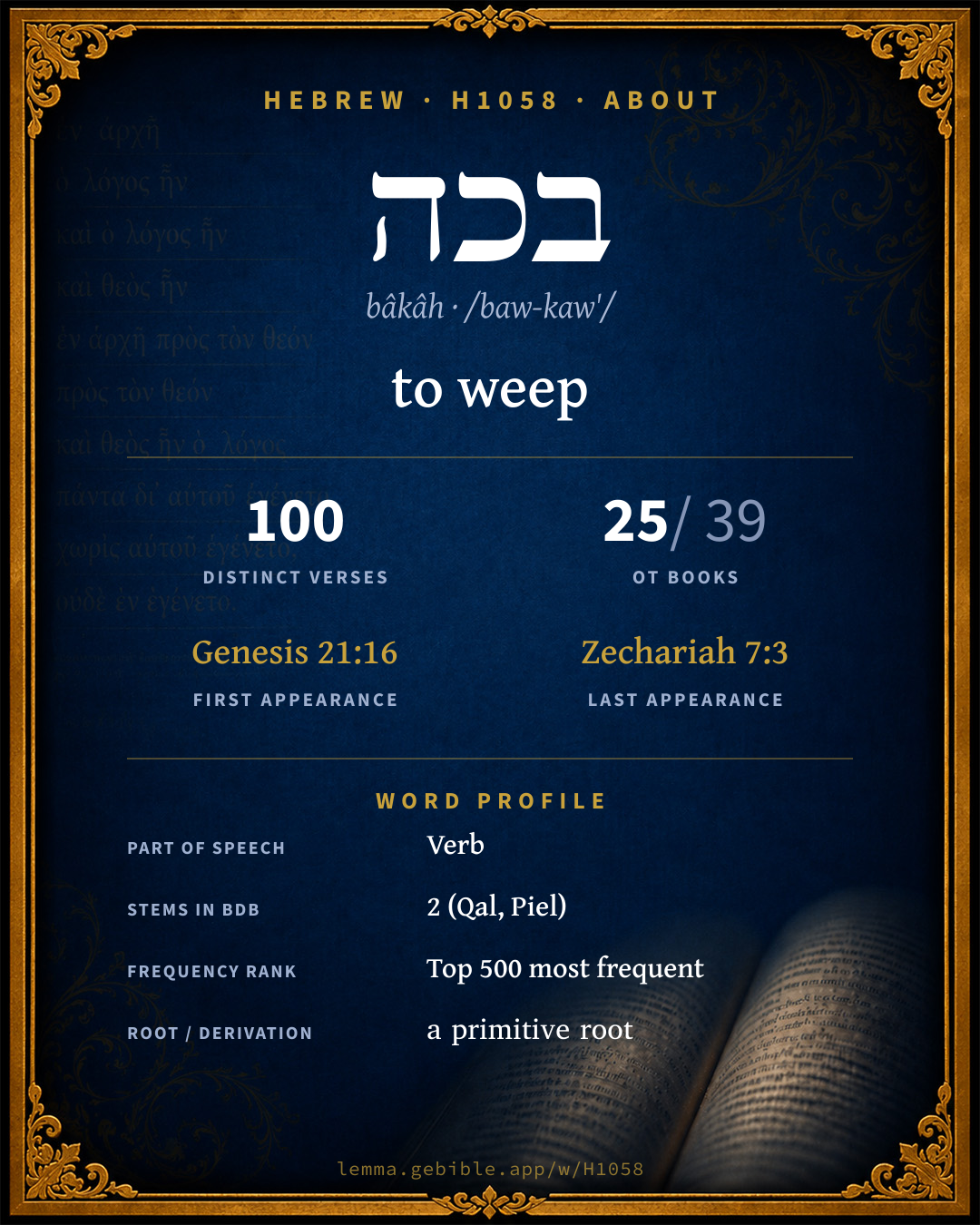
בָּכָה
to weep
also: bewail, cry, shed tears fuller range ↓
Full lexicon entry — Brown-Driver-Briggs (BDB)
From Brown-Driver-Briggs (BDB)
Where this word appears
Grammar key — what these labels mean
Part of speech
- Verb
- An action or state-of-being word.
- Noun
- A naming word — a person, place, thing, or idea.
Noun type
- Common
- A common noun — a general class of person, place, or thing (“king,” “city,” “water”), not a specific name.
Stem
- Qal
- The basic, simple active stem — the plain form of the verb (“he wrote”). Here: ‘weep’
- Piel
- An intensive or resultative active stem.
Form
- Sequential Imperfect
- An imperfect with prefixed waw — the standard past-narrative form (waw-consecutive imperfect).
- Infinitive Absolute
- An unbound verbal noun, often intensifying or standing in for a finite verb.
- Participle Active
- A verbal adjective expressing ongoing or characteristic action (“writing / one who writes”).
- Infinitive Construct
- A bound verbal noun, frequently with prepositions (“to write / in writing”).
- Imperfect
- An incomplete, ongoing, or future action (“he will / would write”).
- Jussive
- A third- or second-person volitional form expressing wish or command (“let him write”).
- Perfect
- A completed action or state — Hebrew marks aspect (completeness) more than strict tense (“he wrote”).
- Cohortative
- A first-person volitional form expressing wish or resolve (“let me / let us write”).
- Sequential Perfect
- A perfect with prefixed waw continuing a preceding imperfect or command (waw-consecutive perfect).
- Imperative
- A direct command (“write!”).
State
- Absolute
- The independent form of a noun, not bound to a following word.
Person
- 3rd Person
- The one spoken about (“he / she / it / they”).
- 1st Person
- The speaker (“I / we”).
- 2nd Person
- The one addressed (“you”).
Gender
- Masculine
- Grammatically masculine.
- Feminine
- Grammatically feminine.
- Common
- Either gender — not distinguished for this form.
Number
- Plural
- More than one (in Hebrew, generally three or more).
- Singular
- One.
Every verse where H1058 appears in the Book of Genesis — 14 distinct verses. Click any verse to open its interlinear word-by-word view. Verse text shown in the World English Bible for context — . Each verse’s Hebrew form is shown with its reference; the English is not keyword-highlighted, since the data carries no word-level English alignment. Use “Compare translations” on any verse to read it across multiple English versions. This concordance covers the Hebrew Bible; Septuagint (Greek Old Testament) occurrences are not indexed here.
Genesis
- Genesis 21:16 וַ/תֵּֽבְךְּ conj + Qal wimpf 3fs She went and sat down opposite him, a good way off, about a bow shot away. For she said, "Don't let me see the death of the child." She sat over against him, and lifted up her voice, and wept.
- Genesis 23:2 וְ/לִ/בְכֹּתָֽ/הּ conj + prep + Qal inf.cs + sfx pers 3fs Sarah died in Kiriath Arba (the same is Hebron), in the land of Canaan. Abraham came to mourn for Sarah, and to weep for her.
- Genesis 27:38 וַ/יֵּֽבְךְּ conj + Qal wimpf 3ms Esau said to his father, "Have you but one blessing, my father? Bless me, even me also, my father." Esau lifted up his voice, and wept.
- Genesis 29:11 וַ/יֵּֽבְךְּ conj + Qal wimpf 3ms Jacob kissed Rachel, and lifted up his voice, and wept.
- Genesis 33:4 וַ/יִּבְכּֽוּ conj + Qal wimpf 3mp Esau ran to meet him, embraced him, fell on his neck, kissed him, and they wept.
- Genesis 37:35 וַ/יֵּ֥בְךְּ conj + Qal wimpf 3ms All his sons and all his daughters rose up to comfort him; but he refused to be comforted. He said, "For I will go down to Sheol to my son mourning." His father wept for him.
- Genesis 42:24 וַ/יֵּ֑בְךְּ conj + Qal wimpf 3ms He turned himself about from them, and wept, and he returned to them, and spoke to them, and took Simeon from among them, and bound him before their eyes.
- Genesis 43:30 לִ/בְכּ֑וֹת וַ/יֵּ֥בְךְּ prep + Qal inf.cs conj + Qal wimpf 3ms Joseph made haste; for his heart yearned over his brother: and he sought a place to weep; and he entered into his room, and wept there.
- Genesis 45:14 וַ/יֵּ֑בְךְּ בָּכָ֖ה conj + Qal wimpf 3ms Qal pf 3ms He fell on his brother Benjamin's neck, and wept, and Benjamin wept on his neck.
- Genesis 45:15 וַ/יֵּ֣בְךְּ conj + Qal wimpf 3ms He kissed all his brothers, and wept on them. After that his brothers talked with him.
- Genesis 46:29 וַ/יֵּ֥בְךְּ conj + Qal wimpf 3ms Joseph made ready his chariot, and went up to meet Israel, his father, in Goshen. He presented himself to him, and fell on his neck, and wept on his neck a good while.
- Genesis 50:1 וַ/יֵּ֥בְךְּ conj + Qal wimpf 3ms Joseph fell on his father's face, wept on him, and kissed him.
- Genesis 50:3 וַ/יִּבְכּ֥וּ conj + Qal wimpf 3mp Forty days were fulfilled for him, for that is how many the days it takes to embalm. The Egyptians wept for him for seventy days.
- Genesis 50:17 וַ/יֵּ֥בְךְּ conj + Qal wimpf 3ms "So you shall tell Joseph, 'Now please forgive the disobedience of your brothers, and their sin, because they did evil to you.' Now, please forgive the disobedience of the servants of the God of your father." Joseph wept when they spoke to him.
About this entry
At a glance — auto-summarized from this page’s data, not written by a person. Every figure links to its source below. This summary describes the numbers; it doesn’t interpret them.
The Hebrew verb בכה centers on the idea of “to weep.” Its earliest occurrence is Genesis 21:16. The Hebrew Bible uses it across 100 verses — moderately common. The verb spans 2 stems, from Qal to Piel. Sharing its root, it stands alongside בכה, בכי and בכית. Dig into 100-verse concordance and the renderings breakdown below.
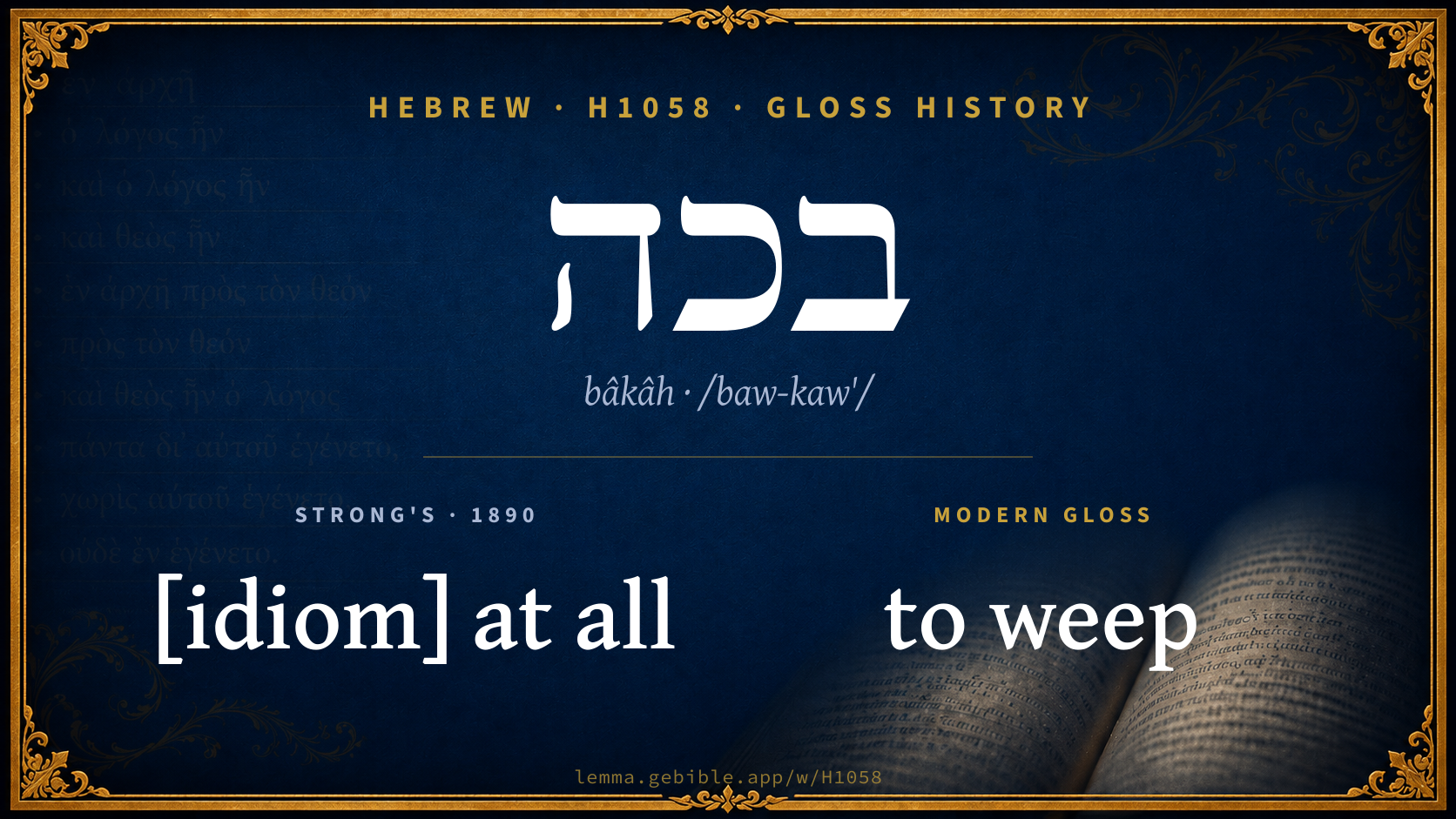
Gloss history
Strong's 1890 vs modern scholarship
About this word
Strong's H1058 catalogs a Hebrew word from the Hebrew Old Testament.
These counts are not copied from any lexicon or concordance. They are computed here, from the morphology-tagged Hebrew Old Testament. What Lemma adds →
- 100
- distinct verses
- The word appears in 100 distinct verses.
- 25 / 39
- OT books
- The word appears in 25 of 39 Old Testament books.
- #377
- by frequency
- Top 500 most frequent Hebrew words (rank 377 of 8,640 Hebrew words by occurrence).
View all 100 occurrences in the concordance →
By section of the Old Testament
By traditional corpus
Conventional, traditional groupings — biblical authorship is debated, so this is a traditional corpus grouping, not an authorship claim. Each share is this word’s portion of its verses in that division of the Hebrew canon. Each figure is a share of the word’s 100 distinct verses.
- Prophets (Nevi'im) 53 verses · 53%
- Torah (Pentateuch) 27 verses · 27%
- Writings (Ketuvim) 20 verses · 20%
How translations render this word
Counts come from each version’s own published word-to-Strong’s tagging or interlinear alignment — an approximate guide to how each version renders this word, not a word-level alignment the data otherwise carries. Because each total is that version’s own tagged count, the per-version totals vary from one another and need not match the appearance or distinct-verse counts above. These counts may also differ from a printed concordance because Lemma counts each distinctly tagged rendering and does not collapse phrase taggings into a single head-word total. This is a fixed set of word-tagged versions (KJV, ASV, BSB, ULT) and does not change with the reading translation you choose elsewhere. Each version’s license is shown beside its name below (and on Sources).
- King James Version: Wept 48×, Weep 16×, Weeping 6×
- American Standard Version: Wept 45×, Weep 12×, Weeping 6×
- Berean Standard Bible: Wept 37×, Weeping 16×, Weep 11×
- unfoldingWord Literal Text: Wept 27×, Weep 20×, Weeping 12×
King James Version Public Domain
Renders H1058 across 113 tagged occurrences — most commonly:
Plus 31 renderings that appear only once — usually multi-word phrases or single function words the recovered tagging swept in, not distinct renderings. Not rendered by a distinct English word in 1 further occurrence.
American Standard Version Public Domain
Renders H1058 across 113 tagged occurrences — most commonly:
Plus 37 renderings that appear only once — usually multi-word phrases or single function words the recovered tagging swept in, not distinct renderings.
Berean Standard Bible Public Domain
Renders H1058 across 110 tagged occurrences — most commonly:
Plus 34 renderings that appear only once — usually multi-word phrases or single function words the recovered tagging swept in, not distinct renderings. Not rendered by a distinct English word in 4 further occurrences.
unfoldingWord Literal Text CC BY-SA 4.0
Renders H1058 across 133 tagged occurrences — most commonly:
Plus other, less common renderings. Plus 28 renderings that appear only once — usually multi-word phrases or single function words the recovered tagging swept in, not distinct renderings.
8 senses and sub-senses in the full BDB
Hebrew verbs can shift meaning by stem (binyan): Qal is the basic action, Niphal is often passive or reflexive, Piel often intensifies or makes it factitive, and Hiphil is typically causative. The senses below are grouped under the stem BDB assigns to each.
What do BDB’s symbols mean?
BDB uses these scholarly abbreviations:
| Symbol | Meaning |
|---|---|
| 𝔊 | the Septuagint (the ancient Greek translation, LXX) |
| 𝔙 | the Vulgate (the Latin translation) |
| 𝔖 | the Syriac version (the Peshitta) |
| 𝔗 | the Targum (the Aramaic translation) |
| ψ | the Psalms |
| √ | root (the underlying root or stem) |
| ‖ | parallel passage (a synonymous or contrasted parallel) |
| † | the dagger: every passage where the word occurs is cited |
The 8 senses and sub-senses the full Brown-Driver-Briggs lexicon distinguishes for this word, in lexicon order (not ranked by frequency), with BDB’s own verbatim wording and sub-sense lettering. Shown in Hebrew script with BDB’s own scholarly abbreviations. The condensed entry is in the Lexicon Entry tab. See also the Forms in the corpus table below.
Qal
- Pf. בּ׳ Gn 43:14; Ho 12:5; וּבָֽכְתָה consec. Dt 21:13; בָּכִ֫יתִי Jb 30:25, etc.; Impf. וַיֵּבְךְ Gn 37:35 + 16 times (וַיֵּבְךְּ Gn 27:38 etc.); 3 fs. תִּבְכֶּה 1 S 1:10 + 2 times; וַתִּבְכֶּה 1 S 1:7, וַתֵּבְךְּ Gn 21:16 (where 𝔊 masc. cf. Di) + 4 times; 2 ms. תִּבְכֶּה Is 30:19; Ez 24:16; וַתִּבְכֶּה 2 K 22:19, וַתֵּבְךְּ 2 S 12:21; 2 Ch 34:27; 2 fs. תִּבְכִּי 1 S 1:8; אֶבְכֶּה Ju 11:37 + 4 times; וָאֶבְכֶּה 2 S 12:22 + 2 times; יִבְכּוּ Lv 10:6 + 3 times; יִבְכָּי֑וּן Jb 31:38; Is 33:7; 3 fpl. תִּבְכֶּינָה Jb 27:15 ψ 78:64; וַתִּב׳ Ru 1:9, 14, etc.; Imv. pl. בְּכוּ Je 22:10; Jo 1:5; בְּכֶינָה 2 S 1:24; Inf. abs. בָּכוֹ Is 30:19 + 3 times + Mi 1:10 (where read בְּעַכּוֹ, v. עכו); בָּכֹה 1 S 1:10 + 3 times; cstr. לִבְכּוֹת Gn 43:30 + 3 times; לִבְכֹּתָהּ Gn 23:2; Pt. בֹּכֶה (בּוֹכֶה) Ex 2:6 + 6 times; fs. בּוֹכִיָּה La 1:16; pl. בֹּכִים (בּו׳) Ezr 3:12 +, etc.;— e.g. Genesis 43:14
- 1. weep (in grief, humiliation, or joy), abs. Gn 42:24; 43:30(×2) Ex 2:6; Nu 11:4, 10; 14:1; 1 S 1:7, 8, 10; 11:5; 30:4(×2) 2 S 1:12; 3:16; 13:36; 15:30(×2); 19:1, 2; 2 K 8:11, 12; Is 30:19(×2); Je 41:6; 50:4; Ez 24:16, 23; La 1:2 Zc 7:3 Jo 1:5; 2:17 ψ 78:64; 126:6 cf. 69:11 (but on text v. Che) Jb 27:15; Ec 3:4 (opp. laugh שׂחק) Ezr 10:1 Ne 8:9 Est 8:3; once c. inanim. subj. Jb 31:38 תְּלָמֶיהָ יִב׳ its furrows weep; on Ne 1:4 יָשַׁבְתִּי וָאֶבְכֶּה cf. Assyrian attašab abakî, Flood1st ed. Dl Gu§ 77 HptBAS i. 145; of loud weeping נָשָׂא הַקּוֹל וַיִּב׳ † Gn 21:16; 27:38; 29:11; Ju 2:4; 21:2; 1 S 11:4; 24:17; 2 S 3:32; 13:36; Jb 2:12; Ru 1:9, 14, cf. בּ׳ בְּאָזְנֵי י׳ Nu 11:18, also Jb 30:31. e.g. Genesis 42:24
- 2. c. acc. cogn. בְּכִי Ju 21:2 2 S 13:36 2 K 20:3 = Is 38:3, cf. בִּבְכִי Is 16:9, מִבְּכִי Je 48:32, & בּ׳ הַרְבֶּה בֶּכֶה Ezr 10:1; sq. קוֹל גָּדוֹל 2 S 15:23, cf. בּ׳ בקול גדול Ezr 3:12; weep bitterly מַר יִב׳ Is 33:7; also c. Inf. abs. weep intensely, grievously 1 S 1:10; Je 22:10; La 1:2, cf.; Is 30:19 & Mi 1:10 (but on text v. supr.) e.g. Judges 21:2
- 3. sq. עַל weep upon, i.e. embrace and weep, עַל־צואריו Gn 45:14; 46:29 cf. 45:15; 50:1; also בּ׳ עַל־פָּנָיו 2 K 13:14; v. further Gn 33:4; 45:14 & וַיִּבְכּוּ אִישׁ אֶת־רֵעֵהוּ 1 S 20:41; also sq. עַל weep over, for Ju 11:37, 38; 2 S 3:34; La 1:16; sq. אֶל־ 2 S 1:24; 3:32; Ez 27:31; sq. לְ Je 22:10; 48:32; Jb 30:25; sq. מִפְּנִי because of Je 13:17 (נפשׁ); sq. temp. clause (of occasion of weeping) Gn 50:17 ψ 137:1; Ne 8:9. e.g. Genesis 45:14
- 4. sq. acc. bewail Gn 23:2; 37:35; 50:3; Lv 10:6; Nu 20:29; Dt 21:13; 34:8; Je 8:23, cf. Is. 16:9. e.g. Genesis 23:2
- 5. sq. עַל in sense of burden.annoy with weeping Nu 11:13; Ju 14:16, 17 cf. לִפְנֵי Nu 11:20. e.g. Numbers 11:13
- 6. בּ׳ לִפְנֵי י׳ of penitent weeping Ju 20:23 (cf. Be; v. also 21:2) Dt 1:45; 2 K 22:19; 2 Ch 34:27, cf. also Nu 25:6; joined with fasting Ju 20:26; 2 S 12:21, 22 cf. Ezr 10:1; so of weeping in anxious entreaty Ho 4:5; on pt. as n.pr. Ju 2:1, 5 v. בֹּכִים infr. e.g. Judges 20:23
Piel
- Pt. fs. מְבַכָּה lament Je 31:15 sq. עַל; bewail, pl. מְבַכּוֹת sq. acc. Ez 8:14. e.g. Jeremiah 31:15
Senses from the full Brown-Driver-Briggs lexicon (Brown, Driver, Briggs; Oxford 1906 — public domain), digitized via Sefaria, supplemented by the OpenScriptures HebrewLexicon (CC BY 4.0). Full attribution on Sources.
Word origin
vb. weep, bewail (Arabic بَكَى, Aramaic בְּכָא, ܒܟܳܐ, Assyrian bakû ZimBP 23, 56, Ethiopic በከየ )—
— Brown-Driver-Briggs (Oxford 1906, public domain), digitized via Sefaria, supplemented by the OpenScriptures HebrewLexicon (CC BY 4.0). See Sources.
Origin: a primitive root
Jastrow Dictionary
A second Hebrew/Aramaic lexicon for comparison, covering Aramaic and post-biblical (Talmudic, Targumic, Midrashic) usage that the biblical-Hebrew BDB does not. Matched by lemma rather than by Strong’s number, so a lemma may carry more than one Jastrow headword (shown separately below), and the entries cover usage well beyond the Bible.
בְּכָא
- , v. בכי
בכי
- √בך to break through, split, v. Ges. H. Dict. s. v.; v. בכר) to weep. Ḥull. 7ᵇ; a. fr. Ohol. XVIII, 4 שדה בּוֹכִין weepers’ field, a place where the funeral cortege disperses; v. M. Kat. 5ᵇ שדה שמפטירין בה מתים (Ms. M. שמפסידין) where the funeral addresses are held.
- 1. to cause to weep, make cry. Lam. R. to I, 2 (ref. to בכה תבכה) בוכה ומְבַכָּה מה"ש עמה she cries and makes the angels cry with her. Ex. R. s. 1 היו מְבַכִּין אותו they made it (the Egyptian child) cry.
- 2. to mourn, lament (Ezek. VIII, 14). Tosef. Kel. B. Bath. II, 8 מְבַכּוֹת מיתיהן lament their dead. e.g. Ezekiel 8:14
כָּא
- (b. h. כֹּה, v. preced.) adverb of place: here, v. הָכָא; of time: now. Targ. Gen. XXII, 5. Targ. Job XXXVIII, 11; a. fr.—Y. Ber. IV, 7ᶜ top וכא אמר הכין and here he says so? Ib. וכה; a. v. fr.—לְכָא hither; מִיכָּא from here. Targ. Josh. VIII, 20. Targ. Ex. XVII, 12; a. fr.—Y. Bets. V, 63ᵃ פצל … לכא ולכא skimmed the water in both directions. Y. B. Mets. VI, 11ᵃ top מיכא ללוד from here to Lydda; a. fr.—v. אִיכָּא, לִיכָּא &c.; כַּאַן, כַּן &c.
כֹּה
- (b. h.) here; thus. Gen. R. s. 56 (ref. to עד־כה, Gen. XXII, 5) נלך … בסופו של כה we shall go and see what will be the outcome of koh (the promise, ‘thus shall be thy seed’, Gen. XV, 5); Tanḥ. Vayera 23. e.g. Genesis 22:5
כָּה
- ch., v. כָּא
A Dictionary of the Targumim, the Talmud Babli and Yerushalmi, and the Midrashic Literature (Marcus Jastrow; London, Luzac, 1903) — Public Domain. Digitized via Sefaria. Digitized via Sefaria. Full attribution on Sources.
Forms in the corpus
The 89 distinct written forms H1058 takes in the Hebrew Bible, most frequent first — each parse links to that stem’s occurrences in the concordance. Hebrew forms include their vowel points and cantillation, so a single lemma takes many written forms.
The 60 most common forms are shown; 29 rarer forms follow in the full concordance.
Same root — word family
Other BDB entries built from the same root as H1058, grouped by Strong’s listed origin. These share a root / origin per the lexicon — not necessarily a shared meaning. Each links to that word’s own entry.
Derived from this word
Proper names from this root
People and places named from this root — a name, not an additional meaning of the word.
Compare all same-root words → Showing 4 of 6 — not the complete family. 2 of the same-root words are proper names (people or places). They share a root, not necessarily a meaning.
Septuagint verse parallels
This word appears in 92 verses that also exist in the Greek Old Testament (Septuagint), out of the 100 Hebrew verses it occurs in. You can read those verses in Greek by switching the Old Testament edition to the Septuagint.
Read these verses in the Septuagint
- Genesis 21:16
- Exodus 2:6
- Leviticus 10:6
- Numbers 11:4
- Deuteronomy 1:45
- Judges 2:4
- Ruth 1:9
- 1 Samuel 1:7
- 2 Samuel 1:12
- 2 Kings 8:11
- 2 Chronicles 34:27
- Ezra 3:12
This is a verse-level parallel only — the same verses exist in both the Hebrew and Greek Old Testaments. No word-level Hebrew↔Greek correspondence is claimed: the data carries no such alignment, so no Greek word is shown as this Hebrew word’s translation. Coverage is not total — the Septuagint omits the deuterocanon and renumbers the Psalms, so some Hebrew verses have no direct Greek parallel.