
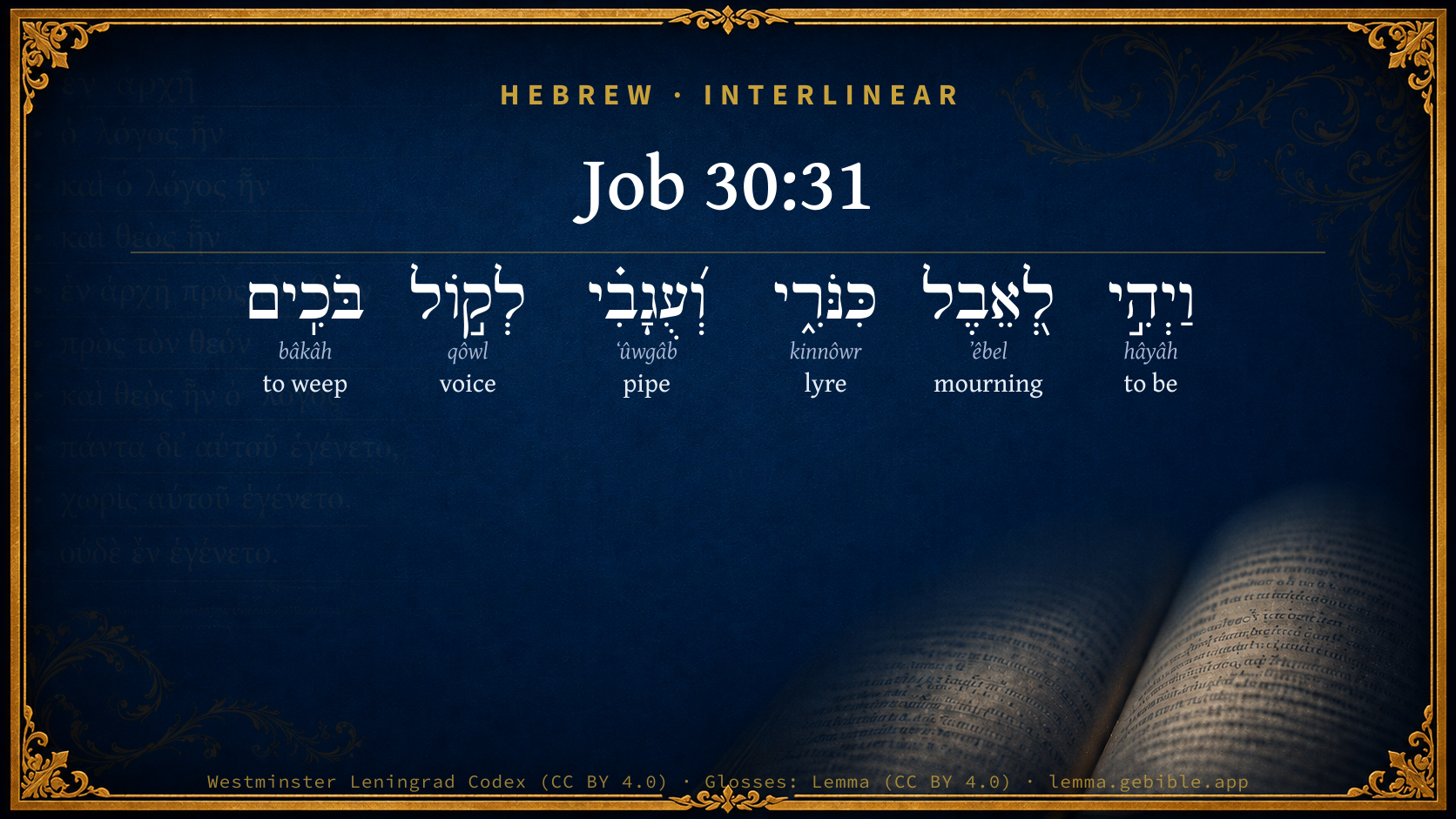
Job 30:31

Hebrew (Westminster Leningrad Codex) Job 30:31 appears in the Hebrew Old Testament. The text above is from the Westminster Leningrad Codex. Each word links to its Strong’s number, a concise gloss, and parsing drawn from the Open Scriptures Hebrew Bible morphology. Click any word for its full Brown-Driver-Briggs (BDB) entry.
Download image
Cite this verse

Job 30:31 (World English Bible). Public Domain. Lemma interlinear Bible study tool, https://lemma.gebible.app/v/job/30/31.

Show BibTeX & RIS
BibTeX
RIS
English Translation
Therefore is my harp turned to mourning, And my pipe into the voice of those who weep.
World English Bible · Public Domain
Download a study sheet

One document with this verse’s original text, its word-by-word gloss line, the meaning frame, cross-references with their text, attributed commentary, and full source and license credits — printable, and it pastes into notes with its structure intact.

This verse Autodidact and up

Study sheet (.html) Plain text (.txt)

A passage Seminary Student

Up to 50 verses in one chapter. A passage sheet keeps up to 6 commentary sources and 12 cross-references per verse, in the order this page ranks them, and says so on the sheet whenever that leaves anything out. Ask for a single verse and you get the Autodidact verse sheet above.

Everything on this page stays free to read, with no account — the sheet is a download of what is already on screen, not access to it.

Want to remove ads? Support Godless Engineer
Compare translations 3

The same verse in 3 English versions, stacked beneath the original-language interlinear above. Click any original word for its lexicon entry.

Each is an independent rendering of the whole verse — the interlinear is not word-aligned to these translations.

Highlighted words mark where these versions differ — a whole-verse word diff, not a word-by-word alignment.

  • World English Bible Public Domain
    Therefore is my harp turned to mourning, And my pipe into the voice of those who weep.
  • King James Version Public Domain
    My harp also is turned to mourning, and my organ into the voice of them that weep.
  • unfoldingWord Literal Text CC BY-SA 4.0
    So my harp is to mourning and my flute to the sound of ones weeping.

unfoldingWord Literal Text — © unfoldingWord, licensed CC BY-SA 4.0. Word-aligned USFM3 via Door43 (git.door43.org/unfoldingWord/en_ult).

Versions to compare (up to 4)

3 of 4 selected

Show all 18 translations

Every available English version of this verse, each an independent rendering of the whole verse.

  • World English Bible Public Domain
    Therefore is my harp turned to mourning, And my pipe into the voice of those who weep.
  • Berean Standard Bible Public Domain
    My harp is tuned to mourning and my flute to the sound of weeping.
  • Majority Standard Bible Public Domain
    My harp is tuned to mourning and my flute to the sound of weeping.
  • King James Version Public Domain
    My harp also is turned to mourning, and my organ into the voice of them that weep.
  • American Standard Version (1901) Public Domain
    Therefore is my harp `turned' to mourning, And my pipe into the voice of them that weep.
  • Revised Version (1885) Public Domain
    Therefore is my harp turned to mourning, and my pipe into the voice of them that weep.
  • Geneva Bible (1599) Public Domain
    Therefore mine harpe is turned to mourning, and mine organs into the voyce of them that weepe.
  • Douay-Rheims (1899) Public Domain
    My harp is turned to mourning, and my organ into the voice of those that weep.
  • Young's Literal Translation Public Domain
    And my harp doth become mourning, And my organ the sound of weeping.
  • Literal Standard Version CC BY-SA 4.0
    And my harp becomes mourning, || And my pipe the sound of weeping.”
  • Unlocked Literal Bible CC BY-SA 4.0
    Therefore my harp is tuned for songs of mourning, my flute for the singing of those who wail.
  • unfoldingWord Literal Text CC BY-SA 4.0
    So my harp is to mourning and my flute to the sound of ones weeping.
  • Darby Bible Public Domain
    My harp also is [turned] to mourning, and my pipe into the voice of weepers.
  • World Messianic Bible Public Domain
    Therefore my harp has turned to mourning, and my pipe into the voice of those who weep.
  • Webster's Bible Public Domain
    My harp also is turned to mourning, and my organ into the voice of them that weep.
  • Free Bible Version CC BY-SA 4.0
    My lyre only plays sad songs, and my pipe is the voice of those who weep.
  • Bible in Basic English Public Domain
    And my music has been turned to sorrow, and the sound of my pipe into the noise of weeping.
  • JPS Tanakh (1917) Public Domain
    Therefore is my harp turned to mourning, and my pipe into the voice of them that weep.

Literal Standard Version (2020), Covenant Press — licensed CC BY-SA 4.0. Text via the HelloAO Bible API (eBible.org). Unlocked Literal Bible (unfoldingWord) — licensed CC BY-SA 4.0. Text via the HelloAO Bible API (eBible.org). unfoldingWord Literal Text — © unfoldingWord, licensed CC BY-SA 4.0. Word-aligned USFM3 via Door43 (git.door43.org/unfoldingWord/en_ult). Free Bible Version, Dr. Jonathan Gallagher — licensed CC BY-SA 4.0. Text via the HelloAO Bible API (eBible.org).

Word by word

More ways to search: Search by grammar → Find every occurrence → Compare this word →

Practice this passage: Drill this verse → Learn its vocabulary →

About this verse

These counts appear in no published source. They are computed here, from the morphology-tagged text and Lemma’s own curated glosses. What Lemma adds →

6
words
6
distinct lemmas
Wisdom
section

Notable vocabulary

The rarest word here is וְ֝עֻגָבִ֗י pipe H5748 — appearing just 4 times in the whole Hebrew Bible.

Shared distinctive vocabulary

וְ֝עֻגָבִ֗י pipe H5748 occurs in 4 verses of the Hebrew Bible. Also found in:

Grammatical profile

  • 2 verbs
  • 4 nouns

Verb forms

  • וַיְהִ֣י Qal · Sequential Imperfect
  • בֹּכִֽים Qal · Participle Active

Hebrew & Septuagint length

In English translation the verse runs 17 words from the Hebrew and 14 from the Septuagint (LXX English) — closely comparable.

A rough comparison of the two English renderings, which tokenize alike — not a word-level alignment.

Word counts can differ between the Hebrew and the Greek without any difference in meaning — e.g. the Hebrew direct-object marker אֵת has no separate Greek word, and Greek often adds the article ὁ.

Cross-references

7

Topical passages linked to Job 30:31 in the Treasury of Scripture Knowledge — connected by theme and wording, ordered by reader-vote popularity; previews shown in the World English Bible.

  • Lamentations 5:15 The joy of our heart is ceased; Our dance is turned into mourning.
  • Isaiah 21:4 My heart flutters, horror has frightened me; the twilight that I desired has been turned into trembling to me.
  • Psalms 137:1–4 By the rivers of Babylon, there we sat down. Yes, we wept, when we remembered Zion.
  • Ecclesiastes 3:4 A time to weep, And a time to laugh; A time to mourn, And a time to dance;
  • Isaiah 22:12 In that day did the Lord, Yahweh of Hosts, call to weeping, and to mourning, and to baldness, and to girding with sackcloth:
  • Isaiah 24:7–9 The new wine mourns, the vine languishes, all the merry-hearted do sigh.
  • Daniel 6:18 Then the king went to his palace, and passed the night fasting; neither were instruments of music brought before him: and his sleep fled from him.

Cross-references courtesy of OpenBible.info (CC BY 4.0).

Hebrew and Greek witnesses Masoretic Hebrew ↔ Greek Septuagint

The same verse in the two great witnesses to the Old Testament, shown verse-for-verse.

These are two independent witnesses, not word-aligned to each other, and the Septuagint is shown in lemma (dictionary) form.

Hebrew Job 30:31 Masoretic · Westminster Leningrad Codex

וַיְהִ֣י לְ֭אֵבֶל כִּנֹּרִ֑י וְ֝עֻגָבִ֗י לְק֣וֹל בֹּכִֽים

Therefore is my harp turned to mourning, And my pipe into the voice of those who weep.

World English Bible · Public Domain

Greek LXX Job 30:31 Septuagint · lemma form

ἀποβαίνω δέ εἰς πάθος ἐγώ ὁ κιθάρα ὁ δέ ψαλμός ἐγώ εἰς κλαυθμός ἐγώ

My harp also has been turned into mourning, and my song into my weeping.

LXX2012 (modern English Septuagint) · Public Domain

Hebrew: Westminster Leningrad Codex (CC BY 4.0). Greek: Septuagint (public domain); English from LXX2012 (modern English Septuagint) (Public Domain). How the Septuagint differs from the Hebrew →

Commentary

Notes on Job 30:31 from classic Christian and Jewish commentators (each source and its license shown beneath its notes). The classic Christian expositions comment on the surrounding passage and are grouped to its opening verse, so a note may address several verses; the Jewish commentaries on the Tanakh (Rashi and others) are per-verse, so they appear only where the commentator wrote on this verse.

Lemma curates 59 commentaries, every one of them public domain or Creative Commons licensed, each selected and text-cleaned for this edition rather than reprinted as found. About our sources →

Trapp's Complete Commentary

John Trapp

Job 30:31 My harp also is [turned] to mourning, and my organ into the voice of them that weep.

Ver. 31. My harp also is turned to mourning] All the days of the afflicted are evil, Pro 15:15, his harps are hanged up, his lute no longer fit but for melancholy airs; his song nothing but lachrymae, doleful ditties; his organs, all those instruments that were wont to divert him, are condemned either to sigh or to be silent. Intempestiva est in luctu Musica /RAPC Sir 22:6, ου ναβλα κωκυτοισιν ου λυρα φιλα (Sophocl.). Gillimer, overcome and besieged by Belisarius, sent to request of him three things: 1. A loaf, to ease his hunger. 2. A harp, to ease his grief. 3. A sponge, to dry up his tears. Such mournful music was Job’s, if any at all.

John Trapp, A Commentary or Exposition upon All the Books of the Old and New Testament (1647–1656) — public domain. Text from a community e-Sword module.

Jamieson, Fausset & Brown

Robert Jamieson, A. R. Fausset & David Brown

organ--rather, "pipe" (Job 21:12). "My joy is turned into the voice of weeping" (Lam 5:15). These instruments are properly appropriated to joy (Isa 30:29, Isa 30:32), which makes their use now in sorrow the sadder by contrast.

Next: Job Chapter 31

Jamieson, Fausset & Brown — Commentary Critical and Explanatory on the Whole Bible (1871) — public domain (CC PDM 1.0). Text via the HelloAO Bible API.

Adam Clarke's Commentary

Verse 31. My harp also is turned to mourning] Instead of the harp, my only music is my own plaintive cries.

And my organ] What the עגב uggab was, we know not; it was most probably some sort of pipe or wind instrument. His harp, כנור kinnor, and his pipe, עגב uggab, were equally mute, or only used for mournful ditties.

THIS chapter is full of the most painful and pathetic sorrow; but nevertheless tempered with a calmness and humiliation of spirit, which did not appear in Job's lamentations previously to the time in which he had that remarkable revelation mentioned in the nineteenth chapter. Job 19:25 After he was assured that his Redeemer was the living God, he submitted to his dispensations, kissed the rod, and mourned not without hope, though in deep distress, occasioned by his unremitting sufferings. If the groaning of Job was great, his stroke was certainly heavy.

Adam Clarke's Commentary on the Bible (1810–1826) — public domain. Text from a community e-Sword/MySword module.

Ellicott's Commentary for English Readers

(31) My harp also is turned to mourning.—Or, Therefore is my harp turned to mourning, and my pipe into the voice of them that weep. The musical instruments here named, like those of Gen_4:21, are respectively the stringed and wind instruments.

A Bible Commentary for English Readers, edited by Charles John Ellicott (1878–1897) — public domain. Text from a community e-Sword module.

The Cambridge Bible for Schools and Colleges

gen. ed. J. J. S. Perowne

31. The joyous music of his former life is turned into wailing. The “organ” is the pipe, ch. Job_21:12; comp. Lam_5:15.

The Cambridge Bible for Schools and Colleges (gen. ed. J. J. S. Perowne; Cambridge University Press, 1878–1918) — public domain. Text from a community e-Sword module.

Albert Barnes' Notes on the Bible

My harp also is turned to mourning - What formerly gave cheerful sounds, now gives only notes of plaintiveness and lamentation. The harp was probably an instrument originally designed to give sounds of joy. For a description of it, see the notes at Isa 5:12.

And my organ - The form of what is here called the organ, is not certainly known. The word עגב ‛ûgâb is doubtless from עגב ‛âgab, “to breathe, to blow”; and most probably the instrument hero intended was the pipe. For a description of it, see the notes at Isa 5:12. This instrument, also, was played, as would appear, on joyous occasions, but Job now says that it was turned to grief. All that had been joyous with him had fled. His honor was taken away; his friends were gone; they who had treated him with reverence now stood at a distance, or treated him with contempt; his health was departed, and his former appearance, indicating a station of affluence, was changed for the dark complexion produced by disease, and the instruments of joyousness now gave forth only notes of sorrow.

Albert Barnes' Notes on the Bible (1834–1885) — public domain. Text from a community e-Sword/MySword module.

Haydock's Catholic Bible Commentary

Weep. I have exchanged my sons of joy for mourning. (Menochius)

George Leo Haydock (1774–1849), Haydock's Catholic Family Bible and Commentary, 1859 edition — public domain. Excludes Psalms (Douay-Rheims chapter numbering differs from Protestant) and Deuterocanonical books (Catholic canon only).

Matthew Poole's English Annotations

Either,

1. I have now nothing but bitter lamentations instead of my former expressions of joy. Or,

2. Those very things which formerly were occasions and instruments of my delight, do now renew and aggravate my sorrows.

Matthew Poole's English Annotations on the Holy Bible (1683–1685) — public domain. Text from a community e-Sword/MySword module.

Whedon's Commentary on the Bible

Daniel D. Whedon

31. Harp… to mourning — See note, Job_21:12. Among the Hindus, when a person is in trouble, his instrument is also considered to be in trouble, (Roberts.)

Thus closes the second part of the soliloquy, (monologue,) Job’s last sorrowful lament. “What a delicate touch of the poet is it that he makes this lament die away so melodiously! One hears the prolonged vibration of its elegiac strains. The festive and joyous music is hushed; the only tones are tones of sadness and lament, mesto flebile.” — Delitzsch.

Daniel D. Whedon (gen. ed.), Commentary on the Old and New Testaments (1874–1909) — public domain. Text from a community e-Sword module.

The Pulpit Commentary

My harp also is turned to mourning. The result of all is that Job"s harp is laid aside, either literally or figuratively. Its music is replaced by the sound of mourning (see vers. 28, 29). And my organ (or rather, my pipe) into the voice of them that weep. The pipe also is no longer sounded in his presence; he hears only the voice of weeping and lamentation. Thus appropriately ends the long dirge in which he has bewailed his miserable fare.

The harp turned to mourning.

This is disappointing and incongruous. The harp is not like the pipes used at Oriental funerals for lamentation. It is an instrument for joyous music. Yet Job"s harp is turned to mourning.

I MAN HAS A NATURAL FACULTY OF JOY. Job had his harp, or that in him of which the harp was symbolical. Some people are of a more melancholy disposition than others, but nobody is so constituted as to be incapable of experiencing gladness. We rightly regard settled melancholy as a form of insanity. Joy is not only our heritage; it is a needful thing. The joy of the Lord is our strength. (Neh_8:10)

II THE SAD WERE ONCE JOYOUS. Job"s harp is tuned to mourning. Then its use had to be perverted before it could be thought of as an instrument of lamentation. It was then put to a new, unwonted employment. This implies that it had been familiarly known as a joyous instrument. In sorrow we do not sufficiently consider how much gladness we have had in life, or, if we look back on the brighter scenes of the past, too often this is simply in order to contrast them with the present, and so to deepen our feeling of distress. But it would be more fair and grateful for us to view our lives in their entirety, and to recognize how much gladness they have contained as a ground for thankfulness to God.

III LIFE IS MARKED BY ALTERNATIVE EXPERIENCES. Few lives are without a gleam of sunshine, and no lives are without some shadow of sorrow. The one form of experience passes over to the other often with a shock of surprise. We are all too easily accustomed to settle down in the present form of experience, as though it were destined to be permanent. But the wisest course is to take the vicissitudes of life, not as unnatural convulsions, as revolutions against the order of nature; but, like the changing seasons, as occurring, the ordered and regular course of events.

IV IT IS POSSIBLE TO HAVE MUSIC IN SADNESS. Job does not describe himself as like those captives of Babylon who hung their harps upon the willows. (Psa_137:2) His harp is sounding still, but the music must agree with the feelings of the time, and gaiety must give place to plaintive notes. Therefore the tune is in a minor key. Still there is melody. The Book of Job, which deals largely with sorrow, is a poem it is composed in musical language. Sorrow is a great inspiration of poetry. How much music would be lost if all the harmonies that have come from sad subjects were struck out! If, then, sorrow can inspire song and music, it is natural to conclude chat suitable song and music should console sorrow. Feeble souls wail in discordant despair, but strong souls harmonize their griefs with their whole nature; and though they may not perceive it at the time, when they reflect in after-days they hear the echo of a solemn music in the memory of their painful experience. When the angel of sorrow takes up the harp and sweeps the strings, strange, awful, thrilling notes sound forth, far richer and deeper than any that leap and dance at the touch of gladness. The Divine mystery of sorrow that gathers about the cross of Christ is not harsh, but musical with the sweetness of eternal love. W.F.A.

The Pulpit Commentary (1880–1919), ed. H.D.M. Spence-Jones & Joseph S. Exell — public domain. Text from a community e-Sword module.

Lesson kit

Teaching starters — assembled from the data on this page, not authored interpretation. Every prompt links to the verse data it draws on. Edit before teaching.

Job, in the Wisdom, opens this verse with 6 words (6 distinct Hebrew lemmas). Its most distinctive word is ʻûwgâb (“pipe”). A historical commentator’s framing appears above. Read the whole chapter for the surrounding context.

Discussion questions

  1. The word ʻûwgâb carries the sense “pipe.” How does it shape the verse?
  2. Genesis 4:21 shares the word «pipe» with this verse. How do the two illuminate each other?
  3. The translations on this page render this verse differently — a whole-verse word diff, not a word-by-word alignment. What might account for the different wordings?
  4. The verb «וַיְהִ֣י» is Qal Sequential Imperfect. How does its form color the action?
  5. Reading how Trapp's Complete Commentary and Jamieson, Fausset & Brown read this verse, where do the two commentators agree and where do they part?

Things to notice

Reading settings

Reading text

Shown beneath each verse's original-language words.

Old Testament
Old Testament edition

Read the OT as the Masoretic Hebrew (MT) or the Greek Septuagint (LXX).

English shown for the Greek Septuagint (in the Hebrew ↔ Greek comparison).

Comparing translations? Open the Compare panel on any verse page to stack up to four side by side.