
Isaiah 16:9

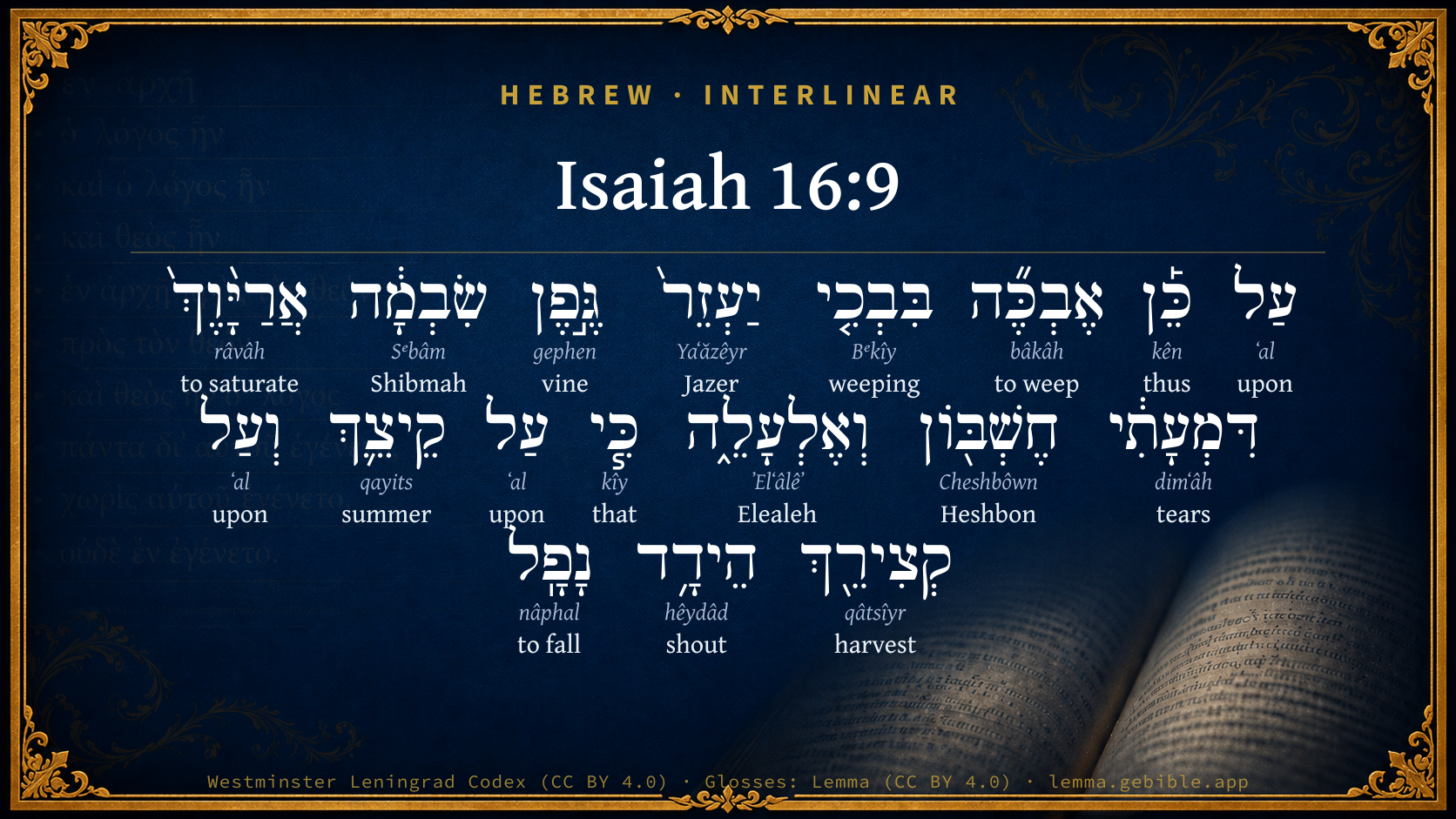
Hebrew (Westminster Leningrad Codex) Isaiah 16:9 appears in the Hebrew Old Testament. The text above is from the Westminster Leningrad Codex. Each word links to its Strong’s number, a concise gloss, and parsing drawn from the Open Scriptures Hebrew Bible morphology. Click any word for its full Brown-Driver-Briggs (BDB) entry.
Download image
Cite this verse

Isaiah 16:9 (World English Bible). Public Domain. Lemma interlinear Bible study tool, https://lemma.gebible.app/v/isaiah/16/9.

Show BibTeX & RIS
BibTeX
RIS
English Translation
Therefore I will weep with the weeping of Jazer for the vine of Sibmah; I will water you with my tears, Heshbon, and Elealeh: for on your summer fruits and on your harvest the [battle] shout is fallen.
World English Bible · Public Domain
Highlights
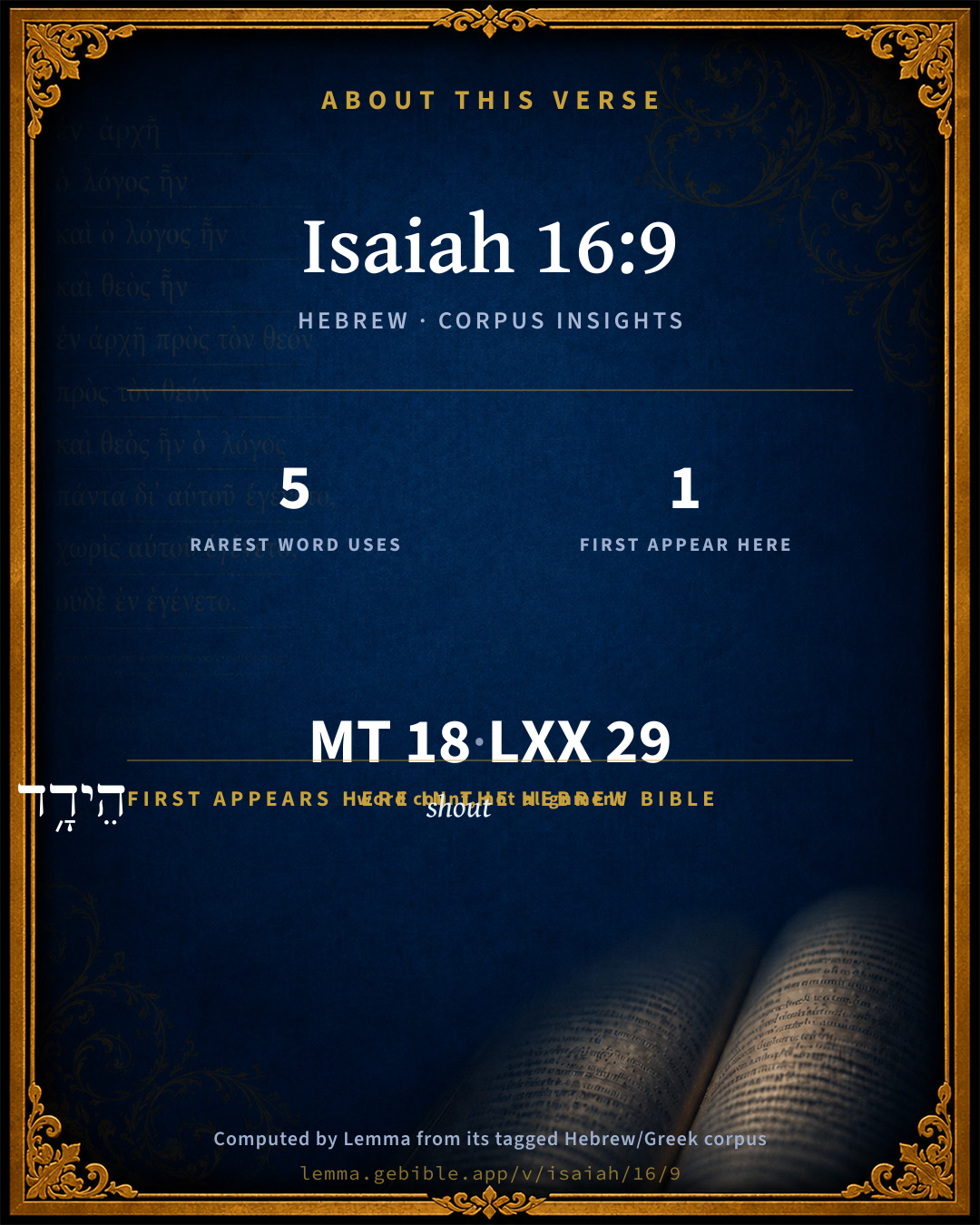
  • 1 first appearance in the Hebrew Bible
Full analysis ↓
Download a study sheet

One document with this verse’s original text, its word-by-word gloss line, the meaning frame, cross-references with their text, attributed commentary, and full source and license credits — printable, and it pastes into notes with its structure intact.

This verse Autodidact and up

Study sheet (.html) Plain text (.txt)

A passage Seminary Student

Up to 50 verses in one chapter. A passage sheet keeps up to 6 commentary sources and 12 cross-references per verse, in the order this page ranks them, and says so on the sheet whenever that leaves anything out. Ask for a single verse and you get the Autodidact verse sheet above.

Everything on this page stays free to read, with no account — the sheet is a download of what is already on screen, not access to it.

Want to remove ads? Support Godless Engineer
Compare translations 3

The same verse in 3 English versions, stacked beneath the original-language interlinear above. Click any original word for its lexicon entry.

Each is an independent rendering of the whole verse — the interlinear is not word-aligned to these translations.

Highlighted words mark where these versions differ — a whole-verse word diff, not a word-by-word alignment.

  • World English Bible Public Domain
    Therefore I will weep with the weeping of Jazer for the vine of Sibmah; I will water you with my tears, Heshbon, and Elealeh: for on your summer fruits and on your harvest the [battle] shout is fallen.
  • King James Version Public Domain
    Therefore I will bewail with the weeping of Jazer the vine of Sibmah: I will water thee with my tears, O Heshbon, and Elealeh: for the shouting for thy summer fruits and for thy harvest is fallen.
  • unfoldingWord Literal Text CC BY-SA 4.0
    Therefore I will weep with the weeping of Jazer the vine of Sibmah. I will drench you my tears, Heshbon and Elealeh. For over your summer fruit and over your harvest, shouting has fallen.

unfoldingWord Literal Text — © unfoldingWord, licensed CC BY-SA 4.0. Word-aligned USFM3 via Door43 (git.door43.org/unfoldingWord/en_ult).

Versions to compare (up to 4)

3 of 4 selected

Show all 18 translations

Every available English version of this verse, each an independent rendering of the whole verse.

  • World English Bible Public Domain
    Therefore I will weep with the weeping of Jazer for the vine of Sibmah; I will water you with my tears, Heshbon, and Elealeh: for on your summer fruits and on your harvest the [battle] shout is fallen.
  • Berean Standard Bible Public Domain
    So I weep with Jazer for the vines of Sibmah; I drench Heshbon and Elealeh with my tears. Triumphant shouts have fallen silent over your summer fruit and your harvest.
  • Majority Standard Bible Public Domain
    So I weep with Jazer for the vines of Sibmah; I drench Heshbon and Elealeh with my tears. Triumphant shouts have fallen silent over your summer fruit and your harvest.
  • King James Version Public Domain
    Therefore I will bewail with the weeping of Jazer the vine of Sibmah: I will water thee with my tears, O Heshbon, and Elealeh: for the shouting for thy summer fruits and for thy harvest is fallen.
  • American Standard Version (1901) Public Domain
    Therefore I will weep with the weeping of Jazer for the vine of Sibmah; I will water thee with my tears, O Heshbon, and Elealeh: for upon thy summer fruits and upon thy harvest the `battle' shout is fallen.
  • Revised Version (1885) Public Domain
    Therefore I will weep with the weeping of Jazer for the vine of Sibmah: I will water thee with my tears, O Heshbon, and Elealeh: for upon thy summer fruits and upon thy harvest the battle shout is fallen.
  • Geneva Bible (1599) Public Domain
    Therefore will I weepe with the weeping of Iaazer, and of the vine of Sibmah, O Heshbon: and Elealeh, I will make thee drunke with my teares, because vpon thy sommer fruits, and vpon thy haruest a showting is fallen.
  • Douay-Rheims (1899) Public Domain
    Therefore I will lament with the weeping of Jazer the vineyard of Sabama: I will water thee with my tears, O Hesebon, and Eleale: for the voice of the treaders hath rushed in upon thy vintage, and upon thy harvest.
  • Young's Literal Translation Public Domain
    Therefore I weep with the weeping of Jazer, The vine of Sibmah, I water thee `with' my tear, O Heshbon and Elealeh, For -- for thy summer fruits, and for thy harvest, The shouting hath fallen.
  • Literal Standard Version CC BY-SA 4.0
    Therefore I weep with the weeping of Jazer, || The vine of Sibmah, || I water you [with] my tear, || O Heshbon and Elealeh, || For—for your summer fruits, and for your harvest, || The shouting has fallen.
  • Unlocked Literal Bible CC BY-SA 4.0
    Indeed I will weep along with Jazer for the vineyard of Sibmah. I will water you with my tears, Heshbon, and Elealeh. For on your fields of summer fruits and harvest I have ended the shouts of joy.
  • unfoldingWord Literal Text CC BY-SA 4.0
    Therefore I will weep with the weeping of Jazer the vine of Sibmah. I will drench you my tears, Heshbon and Elealeh. For over your summer fruit and over your harvest, shouting has fallen.
  • Darby Bible Public Domain
    Therefore I will weep with the weeping of Jaazer for the vine of Sibmah; with my tears will I water thee, Heshbon, and Elealeh, for a cry is fallen upon thy summer fruits and upon thy harvest.
  • World Messianic Bible Public Domain
    Therefore I will weep with the weeping of Jazer for the vine of Sibmah. I will water you with my tears, Heshbon, and Elealeh: for on your summer fruits and on your harvest the battle shout has fallen.
  • Webster's Bible Public Domain
    Therefore I will bewail with the weeping of Jazer the vine of Sibmah: I will water thee with my tears, O Heshbon, and Elealeh: for the shouting for thy summer fruits and for thy harvest is fallen.
  • Free Bible Version CC BY-SA 4.0
    So I cry with Jazer for Sibmah's vines; I soak Heshbon and Elealeh with my tears. Nobody shouts in celebration over your summer fruit and your harvest any more.
  • Bible in Basic English Public Domain
    For this cause my sorrow for the vine of Sibmah will be like the weeping for Jazer: my eyes are dropping water on you, O Heshbon and Elealeh! For they are sounding the war-cry over your summer fruits and the getting in of your grain;
  • JPS Tanakh (1917) Public Domain
    Therefore I will weep with the weeping of Jazer for the vine of Sibmah; I will water thee with my tears, O Heshbon, and Elealeh; for upon thy summer fruits and upon thy harvest the battle shout is fallen.

Literal Standard Version (2020), Covenant Press — licensed CC BY-SA 4.0. Text via the HelloAO Bible API (eBible.org). Unlocked Literal Bible (unfoldingWord) — licensed CC BY-SA 4.0. Text via the HelloAO Bible API (eBible.org). unfoldingWord Literal Text — © unfoldingWord, licensed CC BY-SA 4.0. Word-aligned USFM3 via Door43 (git.door43.org/unfoldingWord/en_ult). Free Bible Version, Dr. Jonathan Gallagher — licensed CC BY-SA 4.0. Text via the HelloAO Bible API (eBible.org).

Word by word

More ways to search: Search by grammar → Find every occurrence → Compare this word →

Practice this passage: Drill this verse → Learn its vocabulary →

וְאֶלְעָלֵ֑ה
ʼElʻâlêʼ
H500
“and · Elealeh”
Conjunction + Noun, Proper
Part of Speech
Conjunction + Noun
Type
Proper
Full BDB Definition

Origin: from H410 and H5927

TWOT: None

Elealeh = "God is ascending" - a Reubenite village near Heshbon (in ruins)
  1. עַל ʻal H5921 “upon” Preposition
  2. כֵּ֡ן kên H3651 “thus” Particle, Demonstrative
  3. אֶבְכֶּ֞ה bâkâh H1058 “to weep” Verb, Qal, Imperfect, 1st Person, Common, Singular
  4. בִּבְכִ֤י Bᵉkîy H1065 “in/at · weeping of” Preposition + Noun, Common, Masculine, Singular, Construct
  5. יַעְזֵר֙ Yaʻăzêyr H3270 “Jazer” Noun, Proper
  6. גֶּ֣פֶן gephen H1612 “vine of” Noun, Common, Both, Singular, Construct
  7. שִׂבְמָ֔ה Sᵉbâm H7643 “Shibmah” Noun, Proper
  8. אֲרַיָּ֨וֶךְ֙ râvâh H7301 “to saturate · you” Verb, Piel, Imperfect, 1st Person, Common, Singular + Suffix, Personal, 2nd Person, Feminine, Singular
  9. דִּמְעָתִ֔י dimʻâh H1832 “tears · my” Noun, Common, Feminine, Singular, Construct + Suffix, Personal, 1st Person, Common, Singular
  10. חֶשְׁבּ֖וֹן Cheshbôwn H2809 “Heshbon” Noun, Proper
  11. כִּ֧י kîy H3588 “that” Conjunction
  12. עַל ʻal H5921 “upon” Preposition
  13. קֵיצֵ֛ךְ qayits H7019 “summer · your” Noun, Common, Masculine, Singular, Construct + Suffix, Personal, 2nd Person, Feminine, Singular
  14. וְעַל ʻal H5921 “and · upon” Conjunction + Preposition
  15. קְצִירֵ֖ךְ qâtsîyr H7105 “harvest · your” Noun, Common, Masculine, Singular, Construct + Suffix, Personal, 2nd Person, Feminine, Singular
  16. הֵידָ֥ד hêydâd H1959 “shout” Noun, Common, Masculine, Singular, Absolute
  17. נָפָֽל nâphal H5307 “to fall” Verb, Qal, Perfect, 3rd Person, Masculine, Singular

About this verse

These counts appear in no published source. They are computed here, from the morphology-tagged text and Lemma’s own curated glosses. What Lemma adds →

18
words
16
distinct lemmas
Prophets
section

Notable vocabulary

The rarest word here is וְאֶלְעָלֵ֑ה Elealeh H500 — appearing just 5 times in the whole Hebrew Bible.

First appearance in Scripture

This word makes its first canonical appearance in the Hebrew Bible here:

  • הֵידָ֥ד shout H1959

Shared distinctive vocabulary

וְאֶלְעָלֵ֑ה Elealeh H500 occurs in 5 verses of the Hebrew Bible. Also found in:

Grammatical profile

  • 3 verbs
  • 10 nouns
  • 3 prepositions
  • 1 conjunction
  • 1 particle

Verb forms

  • אֶבְכֶּ֞ה Qal · Imperfect
  • אֲרַיָּ֨וֶךְ֙ Piel · Imperfect
  • נָפָֽל Qal · Perfect

Repetition

A word recurs within this verse — often emphatic in Hebrew:

Hebrew & Septuagint length

In English translation the verse runs 38 words from the Hebrew and 40 from the Septuagint (LXX English) — closely comparable.

A rough comparison of the two English renderings, which tokenize alike — not a word-level alignment.

Word counts can differ between the Hebrew and the Greek without any difference in meaning — e.g. the Hebrew direct-object marker אֵת has no separate Greek word, and Greek often adds the article ὁ.

In the original languages it is 18 Hebrew tokens and 29 Greek tokens — but the two are counted differently (Hebrew bundles its prefixes and suffixes into one token; the Greek is in lemma form), so that isn’t a like-for-like length.

Cross-references

6

Topical passages linked to Isaiah 16:9 in the Treasury of Scripture Knowledge — connected by theme and wording, ordered by reader-vote popularity; previews shown in the World English Bible.

  • Jeremiah 40:12 then all the Jews returned out of all places where they were driven, and came to the land of Judah, to Gedaliah, to Mizpah, and gathered wine and summer fruits very much.
  • Isaiah 15:4–5 Heshbon cries out, and Elealeh; their voice is heard even to Jahaz: therefore the armed men of Moab cry aloud; his soul trembles within him.
  • Jeremiah 40:10 As for me, behold, I will dwell at Mizpah, to stand before the Chaldeans who shall come to us: but you, gather you wine and summer fruits and oil, and put them in your vessels, and dwell in your cities that you have taken.
  • Judges 9:27 They went out into the field, and gathered their vineyards, and trod [the grapes], and held festival, and went into the house of their god, and did eat and drink, and cursed Abimelech.
  • Isaiah 9:3 You have multiplied the nation, you have increased their joy: they joy before you according to the joy in harvest, as men rejoice when they divide the spoil.
  • Jeremiah 48:32–34 With more than the weeping of Jazer will I weep for you, vine of Sibmah: your branches passed over the sea, they reached even to the sea of Jazer: on your summer fruits and on your vintage the destroyer is fallen.

Cross-references courtesy of OpenBible.info (CC BY 4.0).

Hebrew and Greek witnesses Masoretic Hebrew ↔ Greek Septuagint

The same verse in the two great witnesses to the Old Testament, shown verse-for-verse.

These are two independent witnesses, not word-aligned to each other, and the Septuagint is shown in lemma (dictionary) form.

Hebrew Isaiah 16:9 Masoretic · Westminster Leningrad Codex

עַל כֵּ֡ן אֶבְכֶּ֞ה בִּבְכִ֤י יַעְזֵר֙ גֶּ֣פֶן שִׂבְמָ֔ה אֲרַיָּ֨וֶךְ֙ דִּמְעָתִ֔י חֶשְׁבּ֖וֹן וְאֶלְעָלֵ֑ה כִּ֧י עַל קֵיצֵ֛ךְ וְעַל קְצִירֵ֖ךְ הֵידָ֥ד נָפָֽל

Therefore I will weep with the weeping of Jazer for the vine of Sibmah; I will water you with my tears, Heshbon, and Elealeh: for on your summer fruits and on your harvest the [battle] shout is fallen.

World English Bible · Public Domain

Greek LXX Isaiah 16:9 Septuagint · lemma form

διά οὗτος κλαίω ὡς ὁ κλαυθμός ιαζηρ ἄμπελος σεβαμα ὁ δένδρον σύ καταβάλλω εσεβων καί ελεαλη ὅτι ἐπί ὁ θερισμός καί ἐπί ὁ τρύγητος σύ καταπατέω καί πᾶς πίπτω

Therefore will I weep as with the weeping of Jazer for the vine of Sebama; Esebon and Eleale have cast down your trees; for I will trample on your harvest and on your vintages, and all your plants shall fall.

LXX2012 (modern English Septuagint) · Public Domain

On this verse, Adam Clarke's Commentary discusses the Septuagint’s reading. Read the note in Commentary ↓

Hebrew: Westminster Leningrad Codex (CC BY 4.0). Greek: Septuagint (public domain); English from LXX2012 (modern English Septuagint) (Public Domain). How the Septuagint differs from the Hebrew →

Targum (Aramaic paraphrase)

1

The Targum is the ancient Jewish Aramaic paraphrase of the Hebrew Scriptures — an interpretive translation, not the Hebrew text itself. Onkelos (literal) and Pseudo-Jonathan (expansive) render the Torah, and Jonathan the Prophets. Coverage is partial: where no permissively-licensed English translation exists for a verse, only the Aramaic is shown. This is verse-level text, not a word-by-word alignment to the Hebrew.

  1. Targum Jonathan Prophets (Joshua–Malachi)
    עַל כֵּן כְּמָא דְאַיְתֵיתִי מַשִׁרְיָן עַל יַעְזֵר כֵּן אַיְתֵי קְטוֹלִין עַל שִׂבְמָא אֱרַוִינָךְ דִמְעָתָא חֶשְׁבּוֹן וְאֶלְעָלֵה אֲרֵי עַל חַצְדִיךְ וְעַל קִיטְפִיךְ בְּזוֹזִין נְפָלוּ:

    Therefore, as I have brought armies against Jazer, so will I bring slayers against Sibmah; I will water thee with my tears, O Heshbon and Elealeh! for upon thy harvest, and upon thy vintage the robbers have fallen.

    Targum Jonathan — Aramaic: “Mikraot Gedolot” (public domain). English: “Sefaria Community Translation” (CC0 1.0 (public-domain dedication)); “London "Chaldee Paraphrase," 1871” (public domain). Text via Sefaria.

Commentary

Notes on Isaiah 16:9 from classic Christian and Jewish commentators (each source and its license shown beneath its notes). The classic Christian expositions comment on the surrounding passage and are grouped to its opening verse, so a note may address several verses; the Jewish commentaries on the Tanakh (Rashi and others) are per-verse, so they appear only where the commentator wrote on this verse.

Lemma curates 59 commentaries, every one of them public domain or Creative Commons licensed, each selected and text-cleaned for this edition rather than reprinted as found. About our sources →

Trapp's Complete Commentary

John Trapp

Isa 16:9 Therefore I will bewail with the weeping of Jazer the vine of Sibmah: I will water thee with my tears, O Heshbon, and Elealeh: for the shouting for thy summer fruits and for thy harvest is fallen.

Ver. 9. Therefore I will bewail with the weeping.] Defleo fletum (Paronomasia), that is, the misery of Jazer; or, I will with weeping bewail Jazer, and the vine of Sibmah.

For the shouting for thy summer fruits,] i.e., Thy joy and jollity over thy summer fruits, and over thine harvest, expressed by songs and shouts, do now fail and cease.

John Trapp, A Commentary or Exposition upon All the Books of the Old and New Testament (1647–1656) — public domain. Text from a community e-Sword module.

unfoldingWord translationNotes

Door43 World Missions Community

General Information:

This continues to describe the land of Moab as one large vineyard (See: Isaiah 16:8). God describes events that will happen in the future as if they are happening in the present.

Indeed I will weep

In Isa 16:9-10 the word "I" refers to Yahweh.

I will water you with my tears

God speaks of his deep sorrow for these places as if he would cry much and his many tears would fall on them. AT: "I will cry much for you" (See: Metaphor)

Jazer ... Sibmah

Translate the names of these cities as you did in Isaiah 16:8.

Heshbon ... Elealeh

Translate the names of these cities as you did in Isaiah 15:4.

For on your fields of summer fruits and harvest I have ended the shouts of joy

The "shouts of joy" represent people shouting for joy about the harvest of their fruit trees. AT: "Because of what I will do, you will no longer shout for joy when you harvest your fields of summer fruit" (See: Metonymy)

I have put an end to the shouts of the one who treads

Here "the shouts" refers to the joy of the people who tread the grapes to produce the wine. AT: "therefore the people who tread the grapes do not shout with joy" (See: Metonymy)

translationWords

vineyard

fruit

harvest

joy

wine

unfoldingWord translationNotes — © Distant Shores Media and the Door43 World Missions Community, licensed CC BY-SA 4.0. Source: git.door43.org/Door43/en_tn.

Geneva Bible (1599)

Geneva Bible translators

The enemies are come upon thee, and shout for joy, when they carry thy commodities from thee, as Jer. 48:33.

He showeth that their plague was so great, that it would have moved any man to lament with them, as Ps. 141:5.

Geneva Bible (1599) marginal notes — public domain. Text via Bolls.life.

Jamieson, Fausset & Brown

Robert Jamieson, A. R. Fausset & David Brown

I--will bewail for its desolation, though I belong to another nation (see on Isa 15:5).

with . . . weeping of Jazer--as Jazer weeps.

shouting for . . . fallen--rather, "Upon thy summer fruits and upon thy luxuriant vines the shouting (the battle shout, instead of the joyous shout of the grape-gatherers, usual at the vintage) is fallen" (Isa 16:10; Jer 25:30; Jer 51:14). In the parallel passage (Jer 48:32) the words substantially express the same sense. "The spoiler is fallen upon thy summer fruits."

Jamieson, Fausset & Brown — Commentary Critical and Explanatory on the Whole Bible (1871) — public domain (CC PDM 1.0). Text via the HelloAO Bible API.

Adam Clarke's Commentary

Verse 9. With the weeping - "As with the weeping"] For בבכי bibechi, a MS. reads בכי bechi. In Jer 48:32, it is מבכי mibbechi. The Septuagint read כבכי kibeki, as with weeping, which I follow.

For thy summer fruits and for thy harvest is fallen - "And upon thy vintage the destroyer hath fallen."] ועל קצירך הידד נפל veal ketsirech heidad naphal. In these few words there are two great mistakes, which the text of Jer 48:32 rectifies. For קצירך ketsirech, it has בצירך betsirech; and for הידד heidad, שדד shoded; both which corrections the Chaldee in this place confirms. As to the first,

"Hesebon and Eleale, and

The flowery dale of Sibmah, clad with vines,"

were never celebrated for their harvests; it was the vintage that suffered by the irruption of the enemy; and so read the Septuagint and Syriac. הידד heidad is the noisy acclamation of the treaders of the grapes. And see what sense this makes in the literal rendering of the Vulgate: super messem tuam vox calcantium irruit, "upon thy harvest the voice of the treaders rushes." The reading in Jer 48:32 is certainly right, שדד נפל shoded naphal, "the destroyer hath fallen." The shout of the treaders does not come in till the next verse; in which the text of Isaiah in its turn mends that of Jeremiah, Jer 48:33, where instead of the first הידד heidad, "the shout," we ought undoubtedly to read, as here, הדרך haddorech, "the treader."

Adam Clarke's Commentary on the Bible (1810–1826) — public domain. Text from a community e-Sword/MySword module.

Ellicott's Commentary for English Readers

(9) Therefore I will bewail with the weeping of Jazer . . .—The prophet, in his sympathy with the sufferings of Moab (see Isa_15:5), declares that he will weep with tears as genuine as those of Jazer itself over the desolation of its vineyards.

The shouting for thy summer fruits . . .—Better, as in the margin, on thy summer-fruits, and on thy harvest a shout is fallen, i.e., not the song of the vintage gatherers and the reapers, but the cry of the enemy as they trample on the fields and vineyards. The force of the contrast is emphasised, as in Jer_48:33 (“a cheer which is no cheer,” Cheyne), by the use of the same word (hedad) as that which in the next verse is employed for the song of those that tread the grapes. (Comp. Jer_25:30.) Possibly the word for “harvest” is used generically as including the vintage.

A Bible Commentary for English Readers, edited by Charles John Ellicott (1878–1897) — public domain. Text from a community e-Sword module.

The Cambridge Bible for Schools and Colleges

gen. ed. J. J. S. Perowne

9. (Jer_48:32) with the weeping of Jazer] i.e. in sympathy with the weeping of J. I will water thee] lit. drench thee.

for the shouting … fallen] Render with R.V.: for upon thy summer-fruits (or rather “fruit-gathering”) and upon thy harvest the battle shout is fallen. The word for “shout” (hêdâd) is used both of the joyous shout of the wine-treaders (Jer_25:30) and of the wild war-cry of soldiers in a charge (Jer_51:14). It has the former sense in Isa_16:10, but the latter here. “Harvest” is used for “vintage” (qâçîr for bâçîr) as in ch. Isa_18:5 (see the note).

9–11. The poet gives vent to his sympathy for Moab. These verses are amongst the most beautiful in the poem.

The Cambridge Bible for Schools and Colleges (gen. ed. J. J. S. Perowne; Cambridge University Press, 1878–1918) — public domain. Text from a community e-Sword module.

John Gill's Exposition

Therefore I will bewail with the weeping of Jazer the vine of Sibmah,.... That is, bewail the one, as he had done the other, both places with the fruits about them being destroyed by the enemy; or "therefore with weeping I will bewail" (most vehemently lament, an usual Hebraism) "Jazer", and "the vine of Sibmah": the prophet here represents the Moabites weeping for their vines more especially, they being a people addicted to drunkenness, in which their father was begotten; hence Bacchus is said to be the founder of many of their cities, see Jer 48:32. The Targum is,

"as I have brought armies against Jazer, so will I bring slayers against Sibmah;''

I will water thee with my tears: shed abundance of them, see Psa 6:6,

O Heshbon, and Elealeh; perhaps alluding to the fishponds, in the former, Sol 7:4 of these places; see Gill on Isa 15:4,

for the shouting for thy summer fruits, and for thy harvest, is fallen; is ceased, so as not to be heard; namely, the singing and shouting which used to be made by labourers, while they were gathering the summer fruits, or reaping the harvest, with which they amused and diverted themselves, and their fellow labourers, and so their time and their work went on more pleasantly; or else that great joy and shouting they expressed when all was ended, something of which nature is still among us at this day; but now in Moab it was at an end, because the enemy had destroyed both their summer fruits and harvest; though Jarchi and Kimchi interpret this shouting of the enemy, of the spoilers and plunderers, upon their summer fruits and harvest, when they destroyed them; and so the Targum,

"upon thy harvest, and upon thy vintage, spoilers have fallen;''

so Noldius (g) renders the words, "for upon thy summer fruits, and upon thy harvest, the shouting shall fall"; that is, the shouting of the enemy, spoiling their fruits and their harvest; and this seems to be the true sense, since it agrees with Jer 48:32 and the ceasing of the other kind of shouting is observed in the next verse Isa 16:10.

(g) Ebr Concord. Part p. 253.

John Gill's Exposition of the Whole Bible (1746–1763) — public domain (CC PDM 1.0). Text via the HelloAO Bible API.

Albert Barnes' Notes on the Bible

Therefore, I will bewail - So great is the desolation that I, the prophet, will lament it, though it belongs to another nation than mine own. The expression indicates that the calamity will be great (see the note at Isa 15:5).

With the weeping of Jazer - That is, I will pour out the same lamentation for the vine of Sibmah which I do for Jazer; implying that it would be deep and bitter sorrow (see Jer 48:32).

I will water thee with my tears - Indicating the grievous calamities that were coming upon those places, on account of the pride of the nation. They were to Isaiah foreign nations, but he had a heart that could feel for their calamities.

For the shouting for thy summer fruits - The shouting attending the ingathering of the harvest (note, Isa 9:3). The word used here (הידד hēydâd), denotes, properly, a joyful acclamation, a shout of joy or rejoicing, such as was manifested by the vintager and presser of grapes Jer 25:30; Jer 48:33; or such as was made by the warrior Jer 51:14. Here it means, that in the time when they would expect the usual shout of the harvest, it should not be heard, but instead, thereof, there should be the triumph of the warrior. Literally, ‘upon thy summer fruits, and upon thy harvests has the shouting fallen;’ that is, the shout of the warrior has fallen upon that harvest instead of the rejoicing of the farmer. So Jeremiah evidently understands it Jer 48:32 : ‘The spoiler is fallen upon thy summer fruits, and upon thy vintage.’ Lowth proposes here a correction of the Hebrew text, but without necessity or authority.

Albert Barnes' Notes on the Bible (1834–1885) — public domain. Text from a community e-Sword/MySword module.

Haydock's Catholic Bible Commentary

CHAPTER XVI.

My tears. Chap. xv. 5. (Haydock) --- I announce a different sort of music from that which is customary in times of harvest, and of vintage. The liquor shall be tears, chap. lxiii. 2., and Jeremias xlviii. 32, 33. (Calmet)

George Leo Haydock (1774–1849), Haydock's Catholic Family Bible and Commentary, 1859 edition — public domain. Excludes Psalms (Douay-Rheims chapter numbering differs from Protestant) and Deuterocanonical books (Catholic canon only).

Matthew Poole's English Annotations

I will bewail with the weeping of Jazer the vine of Sibmah: so the sense is, I will bewail Sibmah as I did bewail Jazer, which, they say, was destroyed before Sibmah: or,

the weeping of Jazer might be a proverbial expression; for it is used also Jer 48:32, like that of the mourning of Hadadrimmon, Zec 12:11, though the reason of it be now unknown, as it is in many other proverbs. The words are by others rendered, and that more agreeably to the Hebrew text, I will bewail with weeping (which is a usual Hebraism for I will bitterly bewail)

Jazer, and (which particle is oft understood) the vine of Sibmah. But our translation seems to be justified by the parallel place, Jer 48:32, where it is, O vine of Sibmah, I will weep for thee with the weeping of Jazer. The shouting for thy summer fruits and for thy harvest is fallen; those joyful shouts and acclamations, which were customary in the time of harvest and vintage, Isa 9:3; Jer 25:30, shall cease, because thy land shall be wasted, and thy people destroyed. Or, as it is in the margin, the shout or alarm is fallen upon thy summer fruits and thy harvest, instead of that joyful shout which was then used, to which he here alludes; which seems to be the truer translation, not only because this Hebrew word is elsewhere used concerning the shout of an enemy falling upon a people, as Jer 25:30; 51:14, but especially by considering the parallel place, Jer 48:32, where, for the shout is fallen, it is, the spoiler is fallen upon, &c. If it be objected, that the next verse speaks of the ceasing of their joyful shouts, and that this Hebrew word is there used for vintage shouting, which at first made me incline to the former interpretation, that seems to be fully answered from Jer 48:33, which speaks likewise of the ceasing of their joy and joyful shouts, but withal adds, in the close of the verse, what may end this controversy, their shouting shall be no shouting; they shall indeed have a shouting, but not such a one as they used to have, a joyful shouting of their own people, but an insulting shout of their enemies.

Matthew Poole's English Annotations on the Holy Bible (1683–1685) — public domain. Text from a community e-Sword/MySword module.

Whedon's Commentary on the Bible

Daniel D. Whedon

9, 10. I will water thee with my tears — The prophet turns to mourning again for the woes of Moab, with a sorrow, however, not patriotic. It is because the wrath of Jehovah falls thus on that guilty people. He joins the people of Jazer in their weeping for their loss of rich vintages by means of the enemy. The loss upon Heshbon and upon Elealeh (near to “Heshbon”) is shown by the fact that the shout of the harvesters has ceased. In times of harvest and grape gathering joyous shouts are heard in all Oriental lands. Now all is silent in fields and at wine-presses in the land of Moab, and tears of sympathy gush from even the eyes of a denouncing prophet.

Daniel D. Whedon (gen. ed.), Commentary on the Old and New Testaments (1874–1909) — public domain. Text from a community e-Sword module.

The Pulpit Commentary

Therefore I will bewail. (comp. Isa_15:5, and see theHomiletics on that verse) With the weeping of Jazer. "With tears as genuine as Jazer"s own" (Kay). O Heshbon and Elealeh. (on the close connection of these two cities, see the comment on Isa_15:4) For the shouting, etc.; rather, for on thy summer fruits and on thy harvest a shouting is fallen. The "shouting" intended is that of the invading enemy, which replaces the ordinary joy-song of the vintagers (see ver. 10).

Vers. 9, 10. The sadness of a silent land.

These verses bring before us the picture of a country from which, at the proper seasons, there rises no harvest and no vintage song. "Gladness is taken away, and joy out of the plentiful field; and in its vineyard there shall be no singing, neither shall there be shouting." In every age and every land the gladness of the people has found expression in the joy of harvest, and no picture of woe, want, and desolation could be so effective as this simple one of the harvest-fields from which arise no song. Meditatively treated, we consider

I A LAND WITH NO JOY IN IT. That must be a land on which rests no Divine benedictions; and it must be the picture of

II A LIFE WITH NO JOY IN IT. That must be a life on which rests no Divine smile. We are like the birds, we can only sing in God"s sunshine. Inexpressibly sad is human life without God. "The joy of the Lord is our strength;" but the sadness of agnosticism, atheism, Comtism, secularism, is the all-sufficing proof that these can never take the place of religion for man, who fain would sing for joy. Let such systems prevail, and the song of earth would cease. From the silent, songless land a heart-cry to the great heavens would go, saying R.T. "oh for a vision! Oh for the face!

The Pulpit Commentary (1880–1919), ed. H.D.M. Spence-Jones & Joseph S. Exell — public domain. Text from a community e-Sword module.

John Wesley's Explanatory Notes

Sibmah - I will bewail Sibmah, as I did bewail Jazer, which was destroyed before Sibmah. Fallen - Those joyful shouts which were customary in the time of harvest and vintage, shall cease.

John Wesley, Explanatory Notes Upon the Whole Bible (1754–1765) — public domain. Text via the GEBible commentary corpus.

Keil & Delitzsch

C. F. Keil & F. Delitzsch

The beauties of nature and fruitfulness of the land, which come into the possession of any nation, are gifts from the riches of divine goodness, remnants of the paradisaical commencement of the history of man, and types of its paradisaical close; and for this very reason they are not matters of indifference to the spirit of prophecy. And for the same reason, it is not unworthy of a prophet, who predicts the renovation of nature and the perfecting of it into the beauty of paradise, to weep over such a devastation as that of the Moabitish vineyards which was now passing before his mind (cf., Isa 32:12-13). "Therefore I bemoan the vines of Sibmah with the weeping of Jazer; I flood thee with my tears, O Heshbon and Elealeh, that Hdad hath fallen upon thy fruit-harvest and upon thy vintage." A tetrastich, the Hebrew equivalent, in measure and movement, of a sapphic strophe. The circumstantiality of the vision is here swallowed up again by the sympathy of the prophet; and the prophecy, which is throughout as truly human as it is divine, becomes soft and flowing like an elegy. The prophet mingles his tears with the tears of Jazer. Just as the latter weeps for the devastated vines of Sibmah, so does he also weep. The form אריּוך, transposed from ארוּיך = ארוּך (cf., Ewald, 253, a, where it is explained as being a rare "voluntative" formation), corresponds to the elegiac tone of the whole strophe. Heshbon and Elealeh, those closely connected cities, with their luxuriant fields (shedemoth, Isa 16:8), are now lying in ruins; and the prophet waters them with tears, because hedad has fallen upon the fruit-harvest and vintage of both the sister cities. In other instances the term kâtzı̄r is applied to the wheat-harvest; but here it is used in the same sense as bâtzı̄r, to which it is preferred on account of Isaiah's favourite alliteration, viz., with kaytz (compare, for example, the alliteration of mistor with sēther in Isa 4:6). That it does not refer to the wheat-harvest here, but to the vintage, which was nearly coincident with the fruit-harvest (which is called kaytz, as in Isa 28:4), is evident from the figure suggested in the word hēdâd, which was the shout raised by the pressers of the grapes, to give the time for moving their feet when treading out the wine (Isa 16:10; Jer 25:30). A hēdâd of this kind had fallen upon the rich floors of Heshbon-Elealeh, inasmuch as they had been trodden down by enemies - a Hedad, and yet no Hedad, as Jeremiah gives it in a beautiful oxymoron (Jer 48:33), i.e., no joyous shout of actual grape-treaders.

Keil & Delitzsch — Biblical Commentary on the Old Testament (1861–1891) — public domain (CC PDM 1.0). Text via the HelloAO Bible API. (Old Testament only.)

J. A. Alexander on Isaiah

Joseph Addison Alexander

“Therefore I will weep with the weeping of Jazer (for) the vine of Sibmah. I will wet thee (with) my tears, Heshbon and (thee) Elealeh! For upon thy fruit and upon thy harvest a cry has fallen.” Some suppose these to be the words of a Moabite bewailing the general calamity. There is no objection, however, to the supposition, that the Prophet here expresses his own sympathy with the distress of Moab, as an indirect method of describing its intensity. The emphasis does not lie merely in the Prophet’s feeling for a foreign nation, but in his feeling for a guilty race, on whom he was inspired to denounce the wrath of God.

Joseph Addison Alexander, The Prophecies of Isaiah (1846–1847; New York: Scribner, 1870–1878) — public domain. Text from a community e-Sword module.

Rashi

Rabbi Shlomo Yitzchaki (Rashi)

I will weep with the weeping of Jazer Jonathan paraphrases: As I brought camps upon Jazer, so will I bring killers upon Sibmah, and, according to the wording of the verse, the prophet states: Similar to the lamentations of Jazer, I have to lament over you, the vine of Sibmah.

I will be sated over you with my tears Heb. אַרְיָוֶךְ, I will be sated over you. There are some words that serve as two words. Comp. (Jer. 10:20) “My children went out of me (יְצֵאוּנִי)”; (Jos. 15:19) “A dry land you have given to me (נְתַתָּנִי)”; (Gen. 37:4) “To speak to him (דַּבְּרוֹ) peacefully.”

your figs Heb. (קִיצֵךְ), the figs that are dried out in the summer.

a shout the noise of robbers and spoilers.

Rashi on the Tanakh — English translations: “The Judaica Press complete Tanach with Rashi, translated by A. J. Rosenberg” (CC BY 4.0); “Pentateuch with Rashi's commentary by M. Rosenbaum and A.M. Silbermann, 1929-1934” (public domain); “The Metsudah Tanach series, Lakewood, N.J” (CC BY 4.0); and “The Book of Joshua, Metsudah Publications, 1997” (CC BY 4.0). Text via Sefaria.

Ibn Ezra

Rabbi Abraham ibn Ezra

I will bewail. These are the words which every Moabite will speak.

Sibma. Name of a place; supply על for.

אריוך I will water thee. An irregular form; י is instead of ו, and ו instead of ה; the pronominal suffix of the second person refers to Heshbon, the largest province of Moab.

קיצך Thy summer fruit. Thy fruit of the summer (קַיִץ).

הידד Hedad. A word used by those that stamp and trample about, causing damage to the fruits and the com while they are still fresh.

Ibn Ezra on the Tanakh — English translations: “Sefaria Community Translation” (CC0 1.0 (public-domain dedication)); “Yalkut, Sifsei Chachomim Chumash, Metsudah Publications, 2009” (CC BY 4.0); and “Commentary of Ibn Ezra on Isaiah - trans. by M. Friedlander, 1873” (public domain). Text via Sefaria.

Lesson kit

Teaching starters — assembled from the data on this page, not authored interpretation. Every prompt links to the verse data it draws on. Edit before teaching.

Isaiah, in the Prophets, opens this verse with 18 words (16 distinct Hebrew lemmas). Its most distinctive word is ʼElʻâlêʼ (“Elealeh”). A historical commentator’s framing appears above. Read the whole chapter for the surrounding context.

Discussion questions

  1. How does “Elealeh” (ʼElʻâlêʼ) shape what this verse is saying?
  2. This is the first place “shout” appears in Scripture (first appears here). What does its debut here establish?
  3. How does Numbers 32:3, which shares the word «Elealeh», read alongside this verse?
  4. What does the repetition of “upon” (3× in this one verse) do in this verse?
  5. These translations render this verse differently. What is at stake in choosing one wording over another?
  6. «אֶבְכֶּ֞ה» is a Qal Imperfect verb. How does that grammatical form shape the action described?
  7. Compare how Trapp's Complete Commentary and unfoldingWord translationNotes read this verse. Where do they agree or differ?

Things to notice

Reading settings

Reading text

Shown beneath each verse's original-language words.

Old Testament
Old Testament edition

Read the OT as the Masoretic Hebrew (MT) or the Greek Septuagint (LXX).

English shown for the Greek Septuagint (in the Hebrew ↔ Greek comparison).

Comparing translations? Open the Compare panel on any verse page to stack up to four side by side.