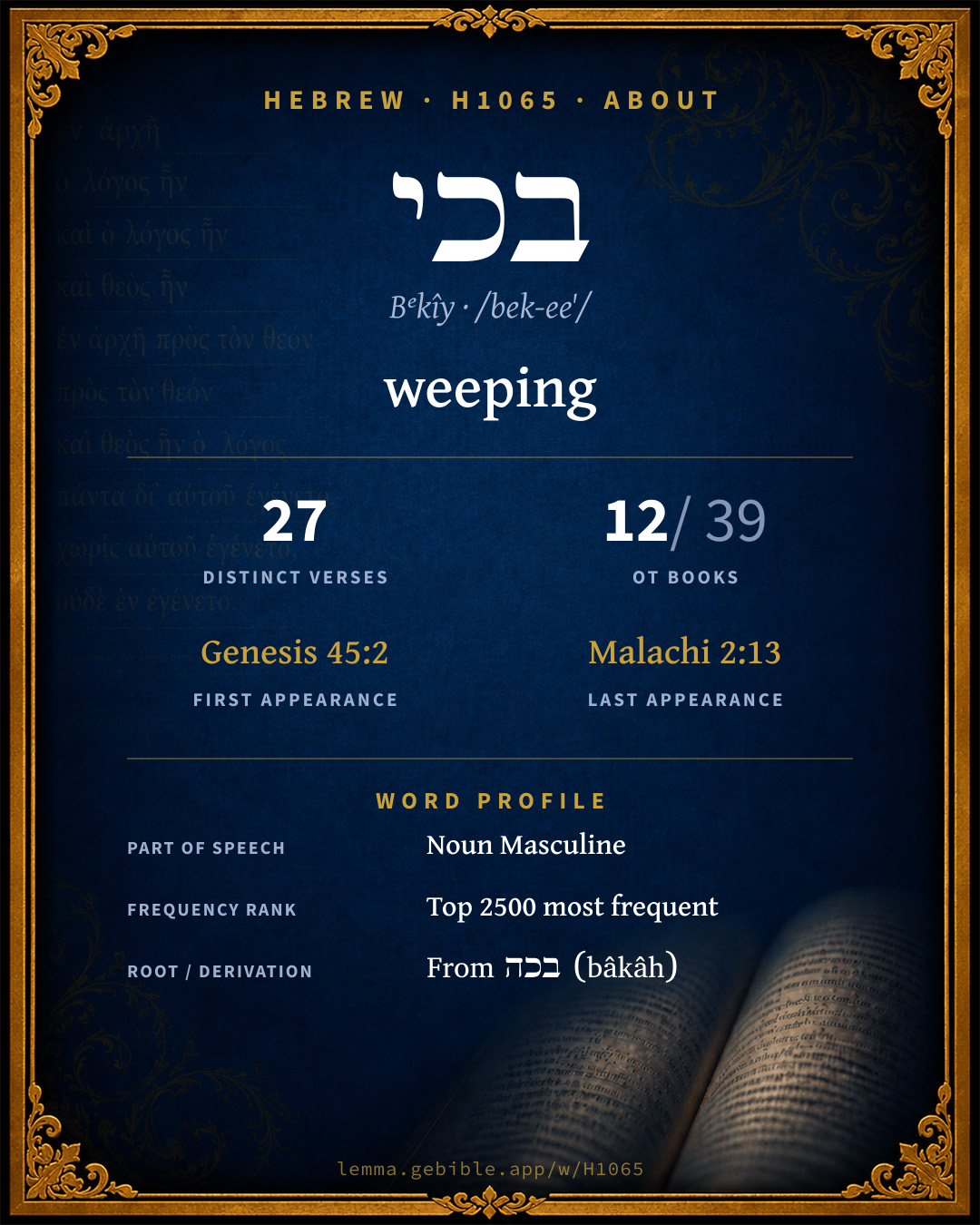
בְּכִי
weeping
Full lexicon entry — Brown-Driver-Briggs (BDB)
From Brown-Driver-Briggs (BDB)
Where this word appears
See every Absolute-state word in the Hebrew Bible →
Grammar key — what these labels mean
Part of speech
- Noun
- A naming word — a person, place, thing, or idea.
Noun type
- Common
- A common noun — a general class of person, place, or thing (“king,” “city,” “water”), not a specific name.
State
- Absolute
- The independent form of a noun, not bound to a following word.
- Construct
- A noun bound to a following noun in a possessive / “of” relationship (the construct chain).
Gender
- Masculine
- Grammatically masculine.
Number
- Singular
- One.
Grammatical forms
- Noun, Common, Masculine, Singular, Absolute 22 times (79%)
- Noun, Common, Masculine, Singular, Construct 6 times (21%)
Parsed forms decoded from the imported morphology (morphhb / Westminster Leningrad Codex — WLC text public domain, morphhb tagging CC BY 4.0), counted across 28 parsed occurrences — not distinct verses.
Every verse where H1065 appears — 27 distinct verses across 12 books. Click any verse to open its interlinear word-by-word view. Verse text shown in the World English Bible for context — . Each verse’s Hebrew form is shown with its reference; the English is not keyword-highlighted, since the data carries no word-level English alignment. Use “Compare translations” on any verse to read it across multiple English versions. This concordance covers the Hebrew Bible; Septuagint (Greek Old Testament) occurrences are not indexed here.
Genesis 1 verse
Deuteronomy 1 verse
Judges 1 verse
2 Samuel 1 verse
Ezra 1 verse
Esther 1 verse
Job 2 verses
Psalms 3 verses
- Psalms 6:8 בִּכְיִֽ/י n c ms cs + sfx pers 1cs Depart from me, all you workers of iniquity, For Yahweh has heard the voice of my weeping.
- Psalms 30:5 בֶּ֗כִי n c ms For his anger is but for a moment; His favor is for a lifetime. Weeping may stay for the night, But joy comes in the morning.
- Psalms 102:9 בִּ/בְכִ֥י prep + n c ms For I have eaten ashes like bread, And mixed my drink with tears,
Isaiah 7 verses
- Isaiah 15:2 לְ/בֶ֑כִי prep + n c ms They are gone up to Bayith, and to Dibon, to the high places, to weep: Moab wails over Nebo, and over Medeba; on all their heads is baldness, every beard is cut off.
- Isaiah 15:3 בַּ/בֶּֽכִי prep det + n c ms In their streets they gird themselves with sackcloth; on their housetops, and in their broad places, everyone wails, weeping abundantly.
- Isaiah 15:5 בִּ/בְכִי֙ prep + n c ms My heart cries out for Moab; her nobles [flee] to Zoar, to Eglath Shelishiyah: for by the ascent of Luhith with weeping they go up; for in the way of Horonaim they raise up a cry of destruction.
- Isaiah 16:9 בִּ/בְכִ֤י prep + n c ms cs Therefore I will weep with the weeping of Jazer for the vine of Sibmah; I will water you with my tears, Heshbon, and Elealeh: for on your summer fruits and on your harvest the [battle] shout is fallen.
- Isaiah 22:4 בַּ/בֶּ֑כִי prep det + n c ms Therefore said I, Look away from me, I will weep bitterly; don't labor to comfort me for the destruction of the daughter of my people.
- Isaiah 22:12 לִ/בְכִי֙ prep + n c ms In that day did the Lord, Yahweh of Hosts, call to weeping, and to mourning, and to baldness, and to girding with sackcloth:
- Isaiah 65:19 בְּכִ֖י n c ms I will rejoice in Jerusalem, and joy in my people; and there shall be heard in her no more the voice of weeping and the voice of crying.
Jeremiah 7 verses
- Jeremiah 3:21 בְּכִ֥י n c ms A voice is heard on the bare heights, the weeping [and] the petitions of the children of Israel; because they have perverted their way, they have forgotten Yahweh their God.
- Jeremiah 9:10 בְכִ֣י n c ms For the mountains will I take up a weeping and wailing, and for the pastures of the wilderness a lamentation, because they are burned up, so that none passes through; neither can men hear the voice of the cattle; both the birds of the sky and the animals are fled, they are gone.
- Jeremiah 31:9 בִּ/בְכִ֣י prep + n c ms They shall come with weeping; and with petitions will I lead them: I will cause them to walk by rivers of waters, in a straight way in which they shall not stumble; for I am a father to Israel, and Ephraim is my firstborn.
- Jeremiah 31:15 בְּכִ֣י n c ms cs Thus says Yahweh: A voice is heard in Ramah, lamentation, and bitter weeping, Rachel weeping for her children; she refuses to be comforted for her children, because they are no more.
- Jeremiah 31:16 מִ/בֶּ֔כִי prep + n c ms Thus says Yahweh: Refrain your voice from weeping, and your eyes from tears; for your work shall be rewarded, says Yahweh; and they shall come again from the land of the enemy.
- Jeremiah 48:5 בִּ/בְכִ֖י בֶּ֑כִי prep + n c ms n c ms For by the ascent of Luhith with continual weeping shall they go up; for at the descent of Horonaim they have heard the distress of the cry of destruction.
- Jeremiah 48:32 מִ/בְּכִ֨י prep + n c ms cs With more than the weeping of Jazer will I weep for you, vine of Sibmah: your branches passed over the sea, they reached even to the sea of Jazer: on your summer fruits and on your vintage the destroyer is fallen.
Joel 1 verse
Malachi 1 verse
About this entry
At a glance — auto-summarized from this page’s data, not written by a person. Every figure links to its source below. This summary describes the numbers; it doesn’t interpret them.
בכי (Bᵉkîy) is a Hebrew noun most often rendered “weeping.” Debuting at Genesis 45:2, it then recurs through the corpus. With 27 verses in 12 books, it is a moderately common word in the Hebrew Bible. It concentrates in Isaiah, which alone accounts for 26% of its uses. From the same root come בכה, בכה and בכית. For the data behind this summary, explore the sense tree and the renderings breakdown below.
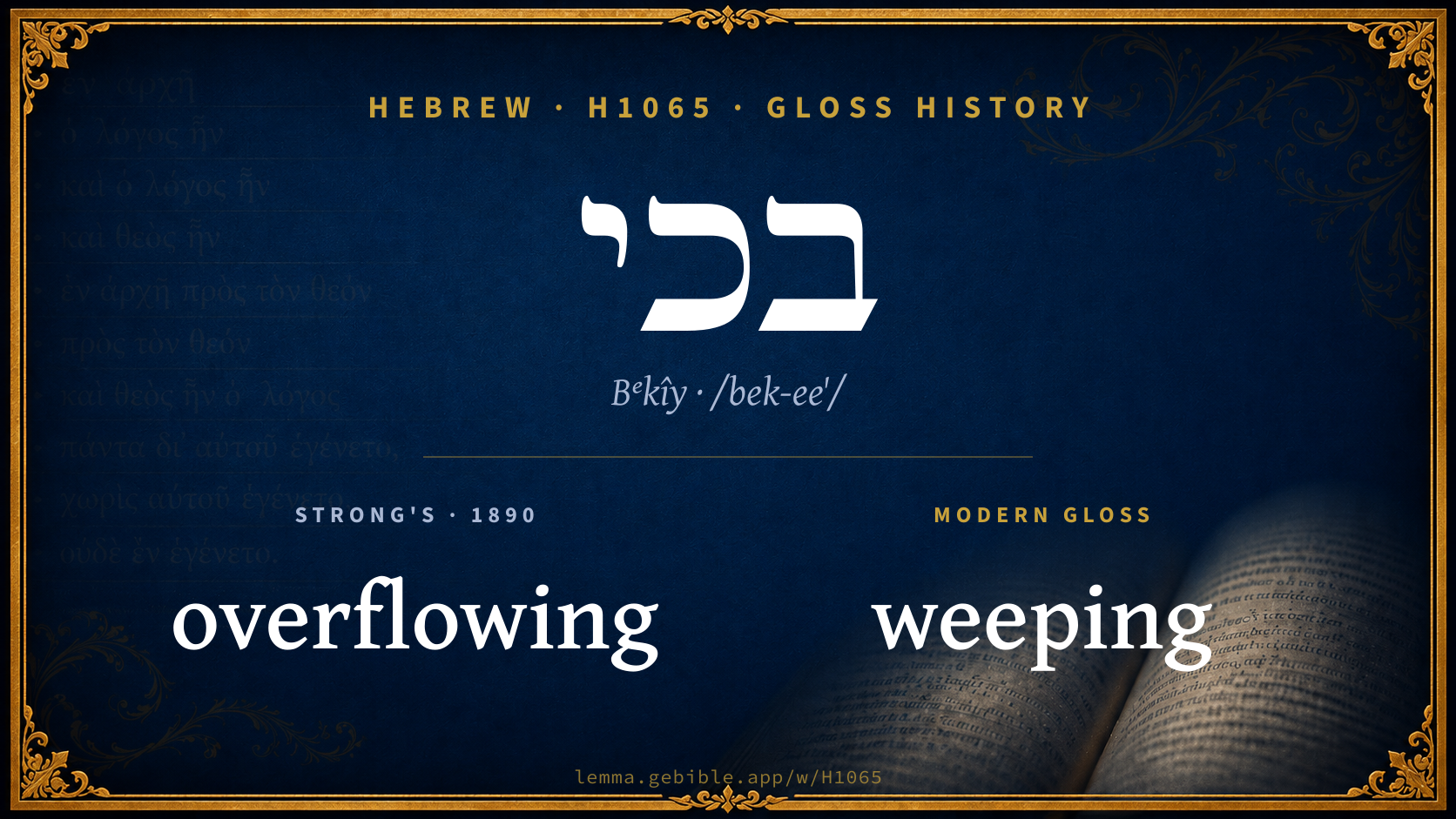
Gloss history
Strong's 1890 vs modern scholarship
About this word
Strong's H1065 catalogs a Hebrew word from the Hebrew Old Testament.
These counts are not copied from any lexicon or concordance. They are computed here, from the morphology-tagged Hebrew Old Testament. What Lemma adds →
- 27
- distinct verses
- The word appears in 27 distinct verses.
- 12 / 39
- OT books
- The word appears in 12 of 39 Old Testament books.
- #1,190
- by frequency
- Top 2500 most frequent Hebrew words (rank 1,190 of 8,640 Hebrew words by occurrence).
View all 27 occurrences in the concordance →
By section of the Old Testament
By traditional corpus
Conventional, traditional groupings — biblical authorship is debated, so this is a traditional corpus grouping, not an authorship claim. Each share is this word’s portion of its verses in that division of the Hebrew canon. Each figure is a share of the word’s 27 distinct verses.
- Prophets (Nevi'im) 18 verses · 67%
- Writings (Ketuvim) 7 verses · 26%
- Torah (Pentateuch) 2 verses · 7%
How translations render this word
Counts come from each version’s own published word-to-Strong’s tagging or interlinear alignment — an approximate guide to how each version renders this word, not a word-level alignment the data otherwise carries. Because each total is that version’s own tagged count, the per-version totals vary from one another and need not match the appearance or distinct-verse counts above. These counts may also differ from a printed concordance because Lemma counts each distinctly tagged rendering and does not collapse phrase taggings into a single head-word total. This is a fixed set of word-tagged versions (KJV, ASV, BSB, ULT) and does not change with the reading translation you choose elsewhere. Each version’s license is shown beside its name below (and on Sources).
- King James Version: Weeping 20×
- American Standard Version: Weeping 19×
- Berean Standard Bible: Weeping 16×
- unfoldingWord Literal Text: Weeping 15×, A 2×, Weeping of 2×
King James Version Public Domain
Renders H1065 across 26 tagged occurrences — most commonly:
Plus 6 renderings that appear only once — usually multi-word phrases or single function words the recovered tagging swept in, not distinct renderings. Not rendered by a distinct English word in 4 further occurrences.
American Standard Version Public Domain
Renders H1065 across 26 tagged occurrences — most commonly:
Plus 7 renderings that appear only once — usually multi-word phrases or single function words the recovered tagging swept in, not distinct renderings.
Berean Standard Bible Public Domain
Renders H1065 across 25 tagged occurrences — most commonly:
Plus 9 renderings that appear only once — usually multi-word phrases or single function words the recovered tagging swept in, not distinct renderings. Not rendered by a distinct English word in 5 further occurrences.
unfoldingWord Literal Text CC BY-SA 4.0
Renders H1065 across 24 tagged occurrences — most commonly:
Plus 5 renderings that appear only once — usually multi-word phrases or single function words the recovered tagging swept in, not distinct renderings.
Senses in BDB
The 1 sense BDB distinguishes for this word, in lexicon order (not ranked by frequency or importance). The full entry — with sub-senses — is in the Lexicon Entry tab.
- a weeping, weeping
Word origin
n.m. Ju 21:2 weeping—בְּכִי Ju 21:2 + 20 times (also cstr. Dt 34:8, etc.); בִּבְכִ֑י Gn 45:2; בֶּ֑כִי Is 15:2 + 6 times; sf. בִּכְי֑י ψ 6:9;—weeping ψ 30:6 Is 15:2, 5; as acc. cogn. (c. בכה) Ju 21:2; 2 S 13:36; 2 K 20:3 = Is 38:3 cf. Is 16:9 (בבכי) Je 48:32 (מבכי); audible קול ב׳ ψ 6:9 Is 65:19; Ezr 3:13 cf. Je 3:21; 31:16; Is 15:3 (ייליל יֹרֵד בבכי v. Je 9:17); so also Gn 45:2 (ויתן את־קלו בב׳) & Je 48:5 (בבכי יעלה בכי i.e. the sound of it shall ascend)—but text here suspicious, cf. Is 15:5; as disfiguring Jb 16:16; ‖ words of mourning Est 4:3 (אֵבֶל, צוֹם, מִסְפֵּד), Je 31:9 (תחנונים cf. 3:21), 9:10; 31:15 (נהי), cf. בכי אבל משׁה Dt 34:8 & Di ad loc.; contrition (humiliation) Jo 2:12 (צום, מִסְפֵּד), Is 22:12 (מספד, קרחה, חגור שׂק), cf. Mal 2:13 (אנקה, דמעה); of bitter weeping Is 22:4 אֲמָרֵר בַּבֶּ֑כִי, cf. Je 31:15 (& Is 33:7); בכי יעזר Is 16:9; Je 48:32 i.e. Yaʿzer in Moab, cf. יעזר n.pr.; ψ 102:10 (שׁקוי בב׳ מסכתי cf. 42:4; 80:6 & Bab. dîmtu maštîtî, tears (were) my drink ZimBP 34, 42). Trop., of trickling streams (נהרות) in mines—hindrance to miners Jb 28:11.
— Brown-Driver-Briggs (Oxford 1906, public domain), digitized via Sefaria, supplemented by the OpenScriptures HebrewLexicon (CC BY 4.0). See Sources.
Derived from בכה (bâkâh) (H1058) — to weep.
Jastrow Dictionary
A second Hebrew/Aramaic lexicon for comparison, covering Aramaic and post-biblical (Talmudic, Targumic, Midrashic) usage that the biblical-Hebrew BDB does not. Matched by lemma rather than by Strong’s number, so a lemma may carry more than one Jastrow headword (shown separately below), and the entries cover usage well beyond the Bible.
בכי
- √בך to break through, split, v. Ges. H. Dict. s. v.; v. בכר) to weep. Ḥull. 7ᵇ; a. fr. Ohol. XVIII, 4 שדה בּוֹכִין weepers’ field, a place where the funeral cortege disperses; v. M. Kat. 5ᵇ שדה שמפטירין בה מתים (Ms. M. שמפסידין) where the funeral addresses are held.
- 1. to cause to weep, make cry. Lam. R. to I, 2 (ref. to בכה תבכה) בוכה ומְבַכָּה מה"ש עמה she cries and makes the angels cry with her. Ex. R. s. 1 היו מְבַכִּין אותו they made it (the Egyptian child) cry.
- 2. to mourn, lament (Ezek. VIII, 14). Tosef. Kel. B. Bath. II, 8 מְבַכּוֹת מיתיהן lament their dead. e.g. Ezekiel 8:14
בכי ²
- , also (act. v.) to lament. Targ. Gen. XXIII, 2; a. fr.—Part. בָּכֵי. Ber. 5ᵇ לההוא שופרא … קא בכינא I cry over that beauty that it should rot in the ground. Ib. אמאי קבכית why criest thou? Ib. דהוה קא בכי (v. Rabb. D. S. a. l.) that he was crying. Lam. R. to I, 17 בָּכְיָה סלקא בָּכְיָה נחתא weeping she (Israel) goes up (to the ruins of Jerusalem), weeping she goes down. Y. Yoma II, 39ᵈ top שרון … בָּכְיִין all the people began to cry.—Y. Ḥag. I, 76ᶜ bot. בכי בעיינוי blear-eyed.—Taan. 5ᵇ וכי בכדי בכו בָּכַיָּיא Ms. M. (ed. ספדו) is it for naught the weepers wept? Gen. R. s. 68, v. next w.; a. fr.
בְּכִי I
- preced.) weeping. Gen. R. s. 68; Lev. R. s. 8, a. e. (playing on בכושרות, Ps. LXVIII, 7) ב׳ ושירות weeping and songs, מאן דבעי אומר וכ׳ he who loves (his wife) sings, he who does not, weeps; Snh. 22ᵃ e.g. Psalms 68:7
בְּכִי I ²
- Targ. II, Sam. XIII, 36; v. בְּכִיתָא
בְּכִי II
- Baalbek (En-Bekhi, later Heliopolis), an ancient city of Syria, renowned for its temples and bazaars (יריד). Ab. Zar. 11ᵇ יריד שבעין ב׳ the bazaar at En B. (with its idolatrous rites). Maasr. V, 8 שום ב׳ ב׳ Baalbek garlic.
בְּכָי
- בָּכָא?) a species of pears, prob. the pyrum Syrium of the Romans (cmp. LXX a. Vulg. I Chr. XIV, 15).. Y. Kil. I, 27ᵃ e.g. 1 Chronicles 14:15
כְּ־
- prefix, h. (v. כֵּן)
- 1. as, like. Targ. Gen. IX, 3. Targ. Hos. IV, 9; a. v. fr.—Ber. I, 2 כאדם וכ׳ like one reading in the Torah. Ib. 3 כדרכו as usual; a. v. fr.—
- *2. whereas. Tosef. Snh. II, 6 כגוזלייא … וכאימרייא וכ׳ ed. Zuck. (Var. דגוזלייא … ואמרייא, as Snh. 11ᵃ, Y. ib. I, 18ᵈ top) whereas the spring pigeons are yet tender &c.—[Ib. 5 בגוזלייא וכ׳.]—[Compound particles כְּדֵי, כְּוָת &c., v. s. vv. or second component.—ך as affix, frequ. indicating place (כ locale) or instrument, as בָּזָךְ, דוּךְ, אוּשְׁפְּזִיכָא &c.]
כי
- the Greek letter Chi (χ). Men. VI, 3 כמין כי, expl. ib. 75ᵃ כמין כי יוני (Ar. יונית) drawing the figure of a Greek Chi; Tosef. ib. VIII, 8; 10; Ker. 5ᵇ; Hor. 12ᵃ, expl. כמין כף יוני ed. (Ms. M. כי). Kel. XX, 7.
כֵּי
- (= כְּאֵי, v. אֵי III) like which?; כֵּי זֶה צַד, כֵּיזֶה צד how?, in what manner? Tosef. B. Kam. III, 4. Tosef. Ter. I, 5; a. fr. ed. Zuck. (ed. usu. כֵּיצַד).
כִּי
- v. כּ־)
- 1. like. Sot. 35ᵇ כי סיד like lime. Y. Yeb. XVI, end, 16ᵃ כי חיה like a lying-in woman; a. fr.
- 2. when. Ex. R. s. 9, beg. (ref. to Ex. VII, 9) … אם ידבר אלא כי וכ׳ it does not read, ‘if Pharaoh …, but when …; he will say so. R. Hash. 3ᵃ, v. אִי II. e.g. Exodus 7:9
- 3. so, thus. Y. Ḥag. III, 77ᵇ וכי היה המעשה and thus it came to pass. Yeb. VIII, 3 לא כי הלכה וכ׳ (some ed. לא כי אלא וכ׳) it is not so; I am reciting a Halakhah. Shek. I, 4 לא כי אלא וכ׳ it is not so, but &c. B. Kam. 25ᵇ; a. fr.
- 4. for. Yoma 87ᵇ (quoting from a prayer) כי עונותינו וכ׳ for our iniquities are &c.
- 5. וְכִי (introducing a question to which a negative answer is expected) is it really so that? R. Hash. 9ᵃ וכי בתשעה … והלא וכ׳ do we fast on the ninth? Is it not the tenth &c.? Sabb. 4ᵃ וכי אומרים וכ׳ dare we say to a man &c.?; Men. 48ᵃ. Yoma 7ᵃ; a. v. fr.
כִּי ²
- 1. as, like. Targ. Is. XIV, 19, v. יְחַט; a. fr., v. כְּ־.—M. Kat. 28ᵇ מותא כי מותא וכ׳ death like death, i.e. death must naturally ensue, v. חֲבוּלְיָא. Sabb. 140ᵇ. v. אוּרְכָּא.—Kidd. 81ᵃ יומא כי האידנא on a day like this.—כי הא ד־ as that which is told of &c. Pes. 117ᵃ; a. fr.—Ḥag. 2ᵃ, a. fr. דלא כי האי תנא which is not in agreement with the opinion of &c.—B. Kam. 46ᵃ לְכִי הא דאיתמר for a case like the one that is told.—Ned. 49ᵃ, a. fr. כי אתריה, v. אֲתַר.—Hor. 13ᵇ נתקין … כי לדידן let us institute something like that which has been done concerning ourselves; a. fr.
- 2. when. Targ. Y. II, Lev. XXVI, 44; a. fr.—Ḥull. 110ᵃ; B. Bath. 87ᵃ כי סליק וכ׳ when R. El. went to Palestine. Snh. 74ᵃ, a. fr. כי אתא וכ׳ when R. … came (from Palestine).—וכי תימא (abbr. וכ"ת), v. אֲמָא II.—Y. Snh. VII, end, 25ᵈ כי יתבון וכ׳ (not כיי) when they sat down to eat; a. v. fr.—כי היכי a) in order that, v. הֵיכִי.—b) as well as, in the same way as. Taan. 9ᵇ כי ה׳ … הכי וכ׳ as the Babylonians are deceitful, so are their rains; a. fr.—[כַּי, v. כַּיי.]
A Dictionary of the Targumim, the Talmud Babli and Yerushalmi, and the Midrashic Literature (Marcus Jastrow; London, Luzac, 1903) — Public Domain. Digitized via Sefaria. Digitized via Sefaria. Full attribution on Sources.
Forms in the corpus
The 24 distinct written forms H1065 takes in the Hebrew Bible, most frequent first — each parse links to that state’s occurrences in the concordance. Hebrew forms include their vowel points and cantillation, so a single lemma takes many written forms.
Same root — word family
Other BDB entries built from the same root as H1065, grouped by Strong’s listed origin. These share a root / origin per the lexicon — not necessarily a shared meaning. Each links to that word’s own entry.
Derives from
Shares the same root
Proper names from this root
People and places named from this root — a name, not an additional meaning of the word.
Compare all same-root words → Showing 4 of 6 — not the complete family. 2 of the same-root words are proper names (people or places). They share a root, not necessarily a meaning.
Septuagint verse parallels
This word appears in 26 verses that also exist in the Greek Old Testament (Septuagint), out of the 27 Hebrew verses it occurs in. You can read those verses in Greek by switching the Old Testament edition to the Septuagint.
Read these verses in the Septuagint
- Genesis 45:2
- Deuteronomy 34:8
- Judges 21:2
- 2 Samuel 13:36
- Ezra 3:13
- Esther 4:3
- Job 16:16
- Psalms 6:8
- Isaiah 15:2
- Jeremiah 3:21
- Joel 2:12
- Malachi 2:13
This is a verse-level parallel only — the same verses exist in both the Hebrew and Greek Old Testaments. No word-level Hebrew↔Greek correspondence is claimed: the data carries no such alignment, so no Greek word is shown as this Hebrew word’s translation. Coverage is not total — the Septuagint omits the deuterocanon and renumbers the Psalms, so some Hebrew verses have no direct Greek parallel.