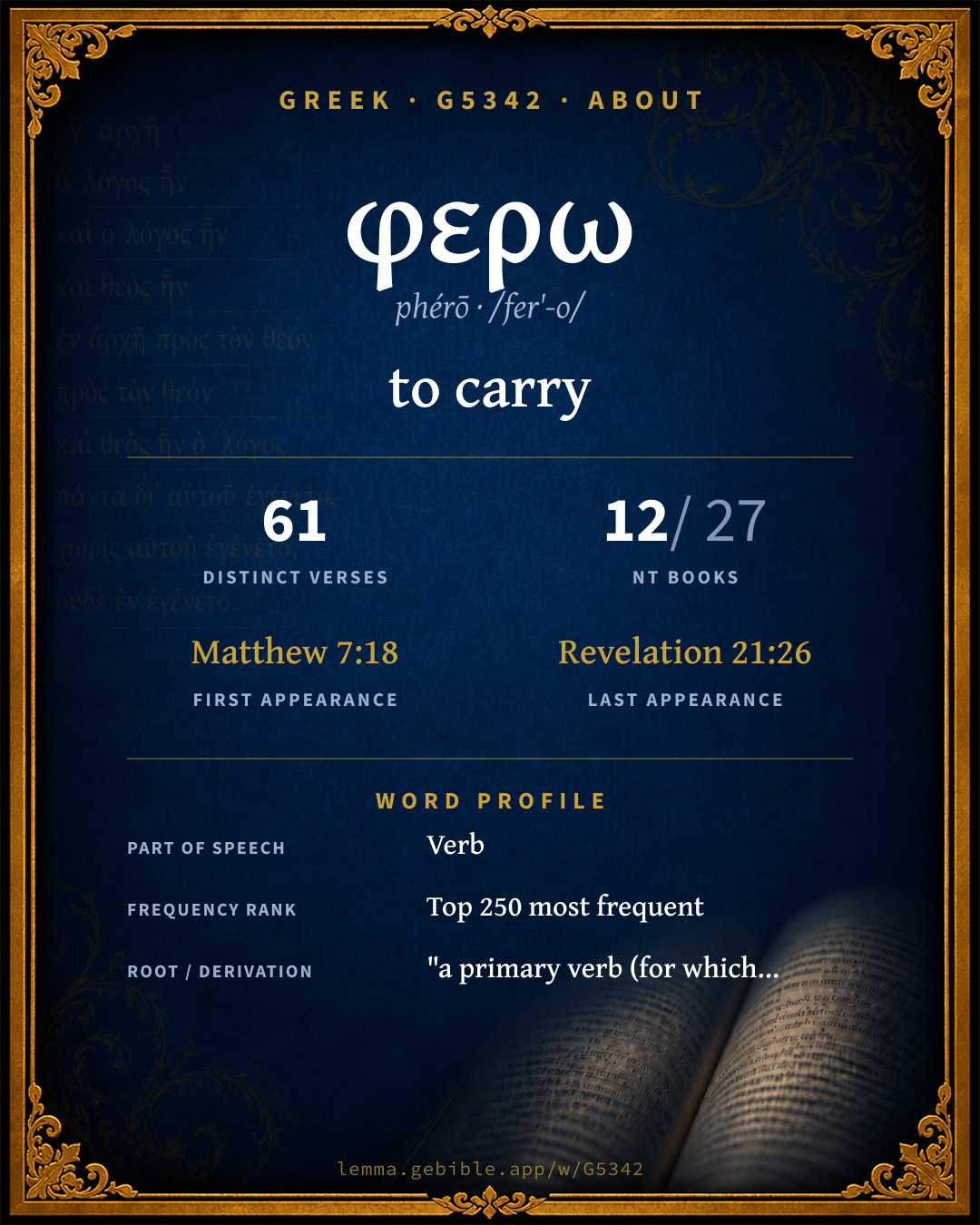
φέρω
to carry
‘to carry’ is one of 5 main senses fuller range ↓
Full lexicon entry — Thayer's Greek Lexicon
From Thayer's Greek Lexicon
Where this word appears
See every Present-tense verb in the Greek New Testament →
Grammar key — what these labels mean
Part of speech
- Verb
- An action or state-of-being word.
Tense
- Present
- Ongoing or general action in present time (imperfective aspect).
- Aorist
- Action viewed as a simple whole, without regard to duration — often past (perfective aspect).
- Imperfect
- Continuous or repeated action in past time (“was writing”).
- Future
- Action expected in future time.
Voice
- Active
- The subject performs the action.
- Passive
- The subject receives the action.
Mood
- Imperative
- Expresses a command or request.
- Indicative
- States a fact or asks a factual question (the mood of reality).
- Participle
- A verbal adjective (“writing,” “having written”).
- Infinitive
- A verbal noun (“to write”), unmarked for person or number.
- Subjunctive
- Expresses probability, purpose, or possibility (the mood of contingency).
Case
- Nominative
- The case of the subject (and the predicate nominative).
- Accusative
- The case of the direct object and of extent.
- Genitive
- The case of source, possession, or “of” — answers “whose / from what.”
Person
- 2nd person
- The one addressed (“you”).
- 3rd person
- The one spoken about (“he / she / it / they”).
- 1st person
- The speaker (“I / we”).
Gender
- Masculine
- Grammatically masculine.
- Neuter
- Grammatically neuter.
- Feminine
- Grammatically feminine.
Number
- Plural
- More than one.
- Singular
- One.
5 verses where G5342 appears in the Aorist tense in the Book of Mark. Filtered view — show all forms. Click any verse to open its interlinear word-by-word view. Verse text shown in the World English Bible for context — . Each verse’s Greek form is shown with its reference; the English is not keyword-highlighted, since the data carries no word-level English alignment. Use “Compare translations” on any verse to read it across multiple English versions. This concordance covers the Greek New Testament; Septuagint (Greek Old Testament) occurrences of this word are not indexed here.
Mark
- Mark 6:27 ἐνέγκαι aor act inf Immediately the king sent out a soldier of his guard, and commanded to bring John's head, and he went and beheaded him in the prison,
- Mark 6:28 ἤνεγκεν aor act ind 3sg and brought his head on a platter, and gave it to the young lady; and the young lady gave it to her mother.
- Mark 9:17 ἤνεγκα aor act ind 1sg One of the multitude answered, "Teacher, I brought to you my son, who has a mute spirit;
- Mark 9:20 ἤνεγκαν aor act ind 3pl They brought him to him, and when he saw him, immediately the spirit convulsed him, and he fell on the ground, wallowing and foaming at the mouth.
- Mark 12:16 ἤνεγκαν aor act ind 3pl They brought it. He said to them, "Whose is this image and inscription?" They said to him, "Caesar's."
About this entry
At a glance — auto-summarized from this page’s data, not written by a person. Every figure links to its source below. This summary describes the numbers; it doesn’t interpret them.
φερω (phérō) is a Greek verb most often rendered “to carry.” Ranging over 5 senses, it is not a single-sense word. It turns up in 61 verses across 12 books, a moderately common footprint. It concentrates in Mark, which alone accounts for 25% of its uses. Scripture first uses it in Matthew 7:18. For the data behind this summary, explore the sense tree and the renderings breakdown below.
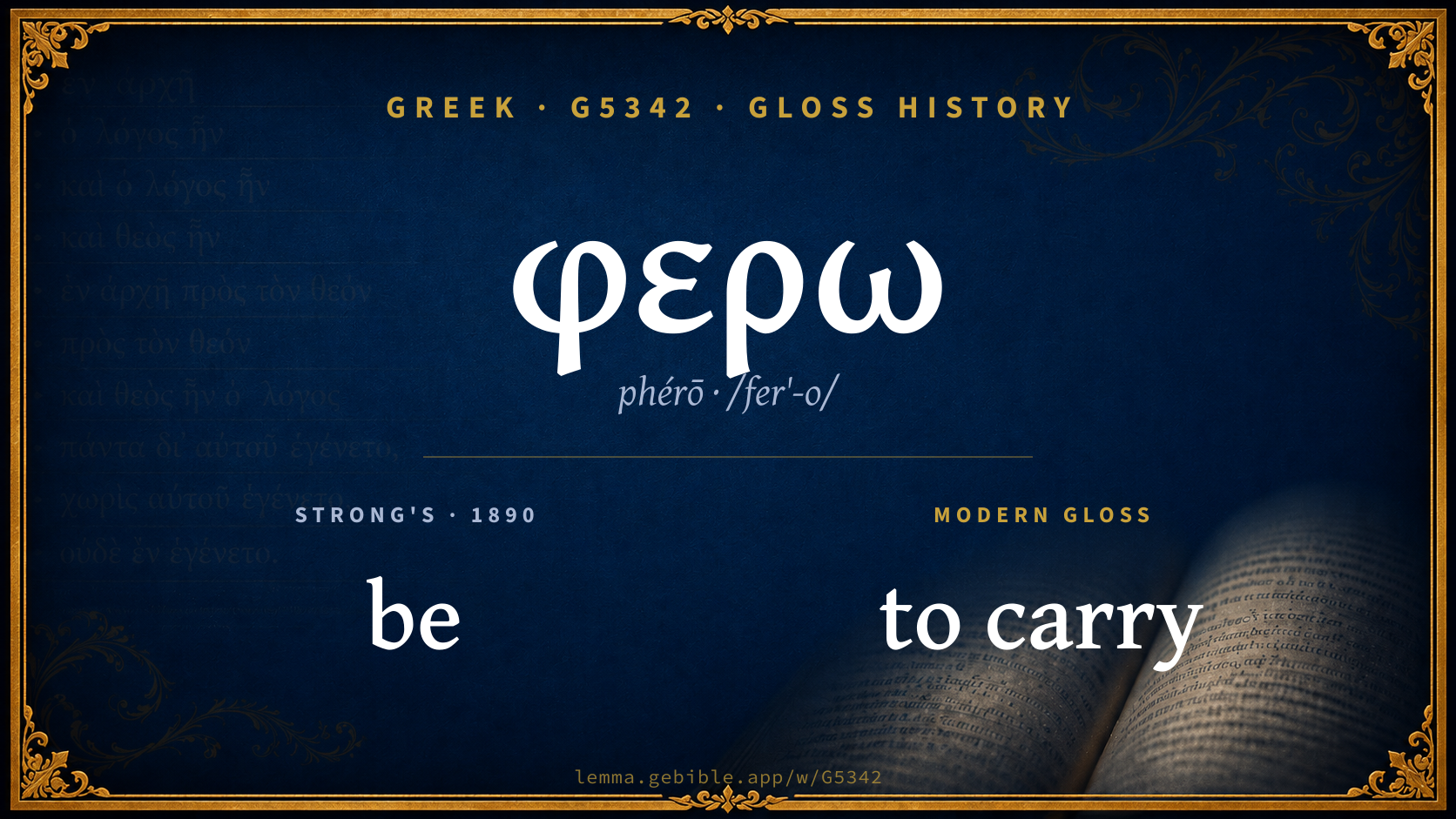
Gloss history
Strong's 1890 vs modern scholarship
About this word
Strong's G5342 catalogs a Greek word from the Greek New Testament.
These counts are not copied from any lexicon or concordance. They are computed here, from the morphology-tagged Greek New Testament. What Lemma adds →
- 61
- distinct verses
- The word appears in 61 distinct verses.
- 12 / 27
- NT books
- The word appears in 12 of 27 New Testament books.
- #243
- by frequency
- Top 250 most frequent Greek words (rank 243 of 5,347 Greek words by occurrence).
View all 61 occurrences in the concordance →
By section of the New Testament
By traditional corpus
Conventional, traditional groupings — biblical authorship is debated, so this is a traditional corpus grouping, not an authorship claim. Some books belong to more than one corpus (Luke is in both the Gospels and the Lukan corpus, and so on), so these shares overlap and need not total 100%. Each figure is a share of the word’s 61 distinct verses.
- Gospels 36 verses · 59%
- Johannine 16 verses · 26%
- Lukan (Luke–Acts) 14 verses · 23%
- General (Catholic) Epistles 6 verses · 10%
- Hebrews 5 verses · 8%
- Pauline corpus 2 verses · 3%
- Revelation 2 verses · 3%
How translations render this word
Counts come from each version’s own published word-to-Strong’s tagging or interlinear alignment — an approximate guide to how each version renders this word, not a word-level alignment the data otherwise carries. Because each total is that version’s own tagged count, the per-version totals vary from one another and need not match the appearance or distinct-verse counts above. These counts may also differ from a printed concordance because Lemma counts each distinctly tagged rendering and does not collapse phrase taggings into a single head-word total. This is a fixed set of word-tagged versions (KJV, ASV, BSB, ULT) and does not change with the reading translation you choose elsewhere. Each version’s license is shown beside its name below (and on Sources).
- King James Version: Bring 8×, Brought 8×, Bringing 3×
- American Standard Version: Bring 11×, Brought 6×, Bear 3×
- Berean Standard Bible: Bring 9×, Brought 8×, They brought 3×
- unfoldingWord Literal Text: Bring 11×, Bringing 6×, Brought 5×
King James Version Public Domain
Renders G5342 across 65 tagged occurrences — most commonly:
Plus 33 renderings that appear only once — usually multi-word phrases or single function words the recovered tagging swept in, not distinct renderings. Not rendered by a distinct English word in 1 further occurrence.
American Standard Version Public Domain
Renders G5342 across 65 tagged occurrences — most commonly:
Plus 33 renderings that appear only once — usually multi-word phrases or single function words the recovered tagging swept in, not distinct renderings.
Berean Standard Bible Public Domain
Renders G5342 across 64 tagged occurrences — most commonly:
Plus 38 renderings that appear only once — usually multi-word phrases or single function words the recovered tagging swept in, not distinct renderings. Not rendered by a distinct English word in 1 further occurrence.
unfoldingWord Literal Text CC BY-SA 4.0
Renders G5342 across 75 tagged occurrences — most commonly:
Plus 37 renderings that appear only once — usually multi-word phrases or single function words the recovered tagging swept in, not distinct renderings.
Senses in Thayer's
The 5 senses Thayer's distinguishes for this word, in lexicon order (not ranked by frequency or importance). The full entry — with sub-senses — is in the Lexicon Entry tab.
- to carry some burden
- to move by bearing; move or, to be conveyed or borne, with the suggestion of force or speed
- to bear up i.e. uphold (keep from falling)
- to bear, i.e. endure, to endure the rigour of a thing, to bear patiently one's conduct, or spare one (abstain from…
- to bring, bring to, bring forward
Word origin
Origin: "a primary verb (for which other and apparently not cognate ones are used in certain tenses only, namely, oio oy'-o; and enegko en-eng'-ko)"
A primary verb (for which other and apparently not cognate ones are used in certain tenses only; namely οἴω oiō̄̄ and ἐνέγκω enegkō̄ to bear or carry (in a very wide application literally and figuratively : - be bear bring (forth) carry come + let her drive be driven endure go on lay lead move reach rushing uphold.
— Strong’s Exhaustive Concordance (1890), public domain.
Forms in the corpus
The 34 distinct written forms G5342 takes in the Greek New Testament, most frequent first — each parse links to that tense’s occurrences in the concordance.
Same root — word family
Other Thayer's entries built from the same root as G5342, grouped by Strong’s listed origin. These share a root / origin per the lexicon — not necessarily a shared meaning. Each links to that word’s own entry.
Derived from this word
- ταλαντον tálanton G5007 talent
- φορος phóros G5411 tribute
- φορτος phórtos G5414 burden
- ωμος ōmos G5606 shoulder
Proper names from this root
People and places named from this root — a name, not an additional meaning of the word.
Compare all same-root words → Showing 4 of 6 — not the complete family. 1 of the same-root words is a proper name (a person or place). They share a root, not necessarily a meaning.
Septuagint usage
The same Greek word φερω appears 234 times in the Greek Old Testament (Septuagint), across 213 verses in 30 books.
- 234
- LXX occurrences
- Tagged occurrences of this Greek word in the Septuagint.
- 213
- verses
- Distinct Septuagint verses containing this word.
- 30 / 39
- OT books
- The word appears in 30 of the 39 Old Testament books.
Sample Septuagint occurrences
- Genesis 4:3 φέρω
- Exodus 28:30 φέρω
- Leviticus 2:2 φέρω
- Numbers 6:10 φέρω
- Deuteronomy 1:9 φέρω
- Joshua 6:13 φέρω
- Judges 3:18 φέρω
- Ruth 3:15 φέρω
- 1 Samuel 9:7 φέρω
- 2 Samuel 1:10 φέρω
- 1 Kings 1:3 φέρω
- 2 Kings 4:42 φέρω
Septuagint occurrences (same lexeme)
Every verse where the same Strong’s number (G5342) appears in the Greek Septuagint — showing the first 50 of 213. Verse text shown in the World English Bible for context; the Greek form is the matched word — the English is not keyword-highlighted.
- Genesis 4:3 φέρω As time passed, it happened that Cain brought an offering to Yahweh from the fruit of the ground.
- Genesis 4:4 φέρω Abel also brought some of the firstborn of his flock and of the fat of it. Yahweh respected Abel and his offering,
- Genesis 27:4 φέρω Make me savory food, such as I love, and bring it to me, that I may eat, and that my soul may bless you before I die."
- Genesis 27:7 φέρω 'Bring me venison, and make me savory food, that I may eat, and bless you before Yahweh before my death.'
- Genesis 27:13 φέρω His mother said to him, "Let your curse be on me, my son. Only obey my voice, and go get them for me."
- Genesis 27:14 φέρω He went, and got them, and brought them to his mother. His mother made savory food, such as his father loved.
- Genesis 30:14 φέρω Reuben went in the days of wheat harvest, and found mandrakes in the field, and brought them to his mother, Leah. Then Rachel said to Leah, "Please give me some of your son's mandrakes."
- Genesis 31:35 φέρω She said to her father, "Don't let my lord be angry that I can't rise up before you; for the manner of women is on me." He searched, but didn't find the teraphim.
- Genesis 32:14 φέρω two hundred female goats and twenty male goats, two hundred ewes and twenty rams,
- Genesis 33:11 φέρω Please take the gift that I brought to you; because God has dealt graciously with me, and because I have enough." He urged him, and he took it.
- Genesis 36:7 φέρω For their substance was too great for them to dwell together, and the land of their travels couldn't bear them because of their cattle.
- Genesis 43:2 φέρω It happened, when they had eaten up the grain which they had brought out of Egypt, their father said to them, "Go again, buy us a little more food."
- Genesis 43:22 φέρω We have brought down other money in our hand to buy food. We don't know who put our money in our sacks."
- Genesis 43:24 φέρω The man brought the men into Joseph's house, and gave them water, and they washed their feet. He gave their donkeys fodder.
- Genesis 47:16 φέρω Joseph said, "Give your cattle; and I will give you food for your cattle, if money fails."
- Genesis 49:3 φέρω "Reuben, you are my firstborn, my might, and the beginning of my strength; The pre-eminence of dignity, and the pre-eminence of power.
- Exodus 28:30 φέρω You shall put in the breastplate of judgment the Urim and the Thummim; and they shall be on Aaron's heart, when he goes in before Yahweh: and Aaron shall bear the judgment of the children of Israel on his heart before Yahweh continually.
- Exodus 32:2 φέρω Aaron said to them, "Take off the golden rings, which are in the ears of your wives, of your sons, and of your daughters, and bring them to me."
- Exodus 32:3 φέρω All the people took off the golden rings which were in their ears, and brought them to Aaron.
- Exodus 35:5 φέρω 'Take from among you an offering to Yahweh. Whoever is of a willing heart, let him bring it, Yahweh's offering: gold, silver, brass,
- Exodus 35:21 φέρω They came, everyone whose heart stirred him up, and everyone whom his spirit made willing, and brought Yahweh's offering, for the work of the tent of meeting, and for all of its service, and for the holy garments.
- Exodus 35:22 φέρω They came, both men and women, as many as were willing-hearted, and brought brooches, ear-rings, signet-rings, and armlets, all jewels of gold; even every man who offered an offering of gold to Yahweh.
- Exodus 35:23 φέρω Everyone, with whom was found blue, purple, scarlet, fine linen, goats' hair, rams' skins dyed red, and sea cow hides, brought them.
- Exodus 35:24 φέρω Everyone who did offer an offering of silver and brass brought Yahweh's offering; and everyone, with whom was found acacia wood for any work of the service, brought it.
- Exodus 35:25 φέρω All the women who were wise-hearted spun with their hands, and brought that which they had spun, the blue, the purple, the scarlet, and the fine linen.
- Exodus 35:27 φέρω The rulers brought the onyx stones, and the stones to be set, for the ephod and for the breastplate;
- Exodus 35:29 φέρω The children of Israel brought a freewill offering to Yahweh; every man and woman, whose heart made them willing to bring for all the work, which Yahweh had commanded to be made by Moses.
- Exodus 36:3 φέρω and they received from Moses all the offering which the children of Israel had brought for the work of the service of the sanctuary, with which to make it. They brought yet to him freewill-offerings every morning.
- Exodus 36:5 φέρω They spoke to Moses, saying, "The people bring much more than enough for the service of the work which Yahweh commanded to make."
- Exodus 39:13 φέρω and the fourth row, a chrysolite, an onyx, and a jasper. They were enclosed in gold settings.
- Leviticus 2:2 φέρω He shall bring it to Aaron's sons the priests; and he shall take his handful of its fine flour, and of its oil, with all its frankincense; and the priest shall burn the memorial of it on the altar, an offering made by fire, of a sweet savor to Yahweh.
- Leviticus 4:28 φέρω if his sin, which he has sinned, is made known to him, then he shall bring for his offering a goat, a female without blemish, for his sin which he has sinned.
- Leviticus 5:6 φέρω and he shall bring his trespass offering to Yahweh for his sin which he has sinned, a female from the flock, a lamb or a goat, for a sin offering; and the priest shall make atonement for him concerning his sin.
- Leviticus 5:7 φέρω "'If he can't afford a lamb, then he shall bring his trespass offering for that in which he has sinned, two turtledoves, or two young pigeons, to Yahweh; one for a sin offering, and the other for a burnt offering.
- Leviticus 5:8 φέρω He shall bring them to the priest, who shall first offer the one which is for the sin offering, and wring off its head from its neck, but shall not sever it completely.
- Leviticus 5:11 φέρω "'But if he can't afford two turtledoves, or two young pigeons, then he shall bring his offering for that in which he has sinned, the tenth part of an ephah of fine flour for a sin offering. He shall put no oil on it, neither shall he put any frankincense on it, for it is a sin offering.
- Leviticus 5:12 φέρω He shall bring it to the priest, and the priest shall take his handful of it as the memorial portion, and burn it on the altar, on the offerings of Yahweh made by fire. It is a sin offering.
- Leviticus 5:15 φέρω "If anyone commits a trespass, and sins unwittingly, in the holy things of Yahweh; then he shall bring his trespass offering to Yahweh, a ram without blemish from the flock, according to your estimation in silver by shekels, after the shekel of the sanctuary, for a trespass offering.
- Leviticus 5:18 φέρω He shall bring a ram without blemish from of the flock, according to your estimation, for a trespass offering, to the priest; and the priest shall make atonement for him concerning the thing in which he sinned and didn't know it, and he will be forgiven.
- Leviticus 5:25 φέρω
- Leviticus 6:14 φέρω "'This is the law of the meal offering: the sons of Aaron shall offer it before Yahweh, before the altar.
- Leviticus 7:29 φέρω "Speak to the children of Israel, saying, 'He who offers the sacrifice of his peace offerings to Yahweh shall bring his offering to Yahweh out of the sacrifice of his peace offerings.
- Leviticus 15:14 φέρω "'On the eighth day he shall take two turtledoves, or two young pigeons, and come before Yahweh to the door of the Tent of Meeting, and give them to the priest:
- Leviticus 15:29 φέρω On the eighth day she shall take two turtledoves, or two young pigeons, and bring them to the priest, to the door of the Tent of Meeting.
- Leviticus 17:4 φέρω and hasn't brought it to the door of the Tent of Meeting, to offer it as an offering to Yahweh before the tabernacle of Yahweh: blood shall be imputed to that man. He has shed blood; and that man shall be cut off from among his people.
- Leviticus 17:5 φέρω This is to the end that the children of Israel may bring their sacrifices, which they sacrifice in the open field, that they may bring them to Yahweh, to the door of the Tent of Meeting, to the priest, and sacrifice them for sacrifices of peace offerings to Yahweh.
- Leviticus 17:9 φέρω and doesn't bring it to the door of the Tent of Meeting, to sacrifice it to Yahweh; that man shall be cut off from his people.
- Leviticus 23:10 φέρω "Speak to the children of Israel, and tell them, 'When you have come into the land which I give to you, and shall reap its the harvest, then you shall bring the sheaf of the first fruits of your harvest to the priest:
- Leviticus 23:12 φέρω On the day when you wave the sheaf, you shall offer a male lamb without blemish a year old for a burnt offering to Yahweh.
- Leviticus 26:36 φέρω "'As for those of you who are left, I will send a faintness into their hearts in the lands of their enemies: and the sound of a driven leaf will put them to flight; and they shall flee, as one flees from the sword; and they will fall when no one pursues.
These are occurrences of the same Greek lexeme (G5342) in the Septuagint — not a translation of any one Hebrew word. The store carries no word-level Hebrew↔Greek alignment, so no Hebrew original is asserted here. Counts come from the recovered LXX Strong's tagging — high-frequency vocabulary is well covered, while rare or late forms may be untagged — so they reflect tagged occurrences and may slightly undercount.