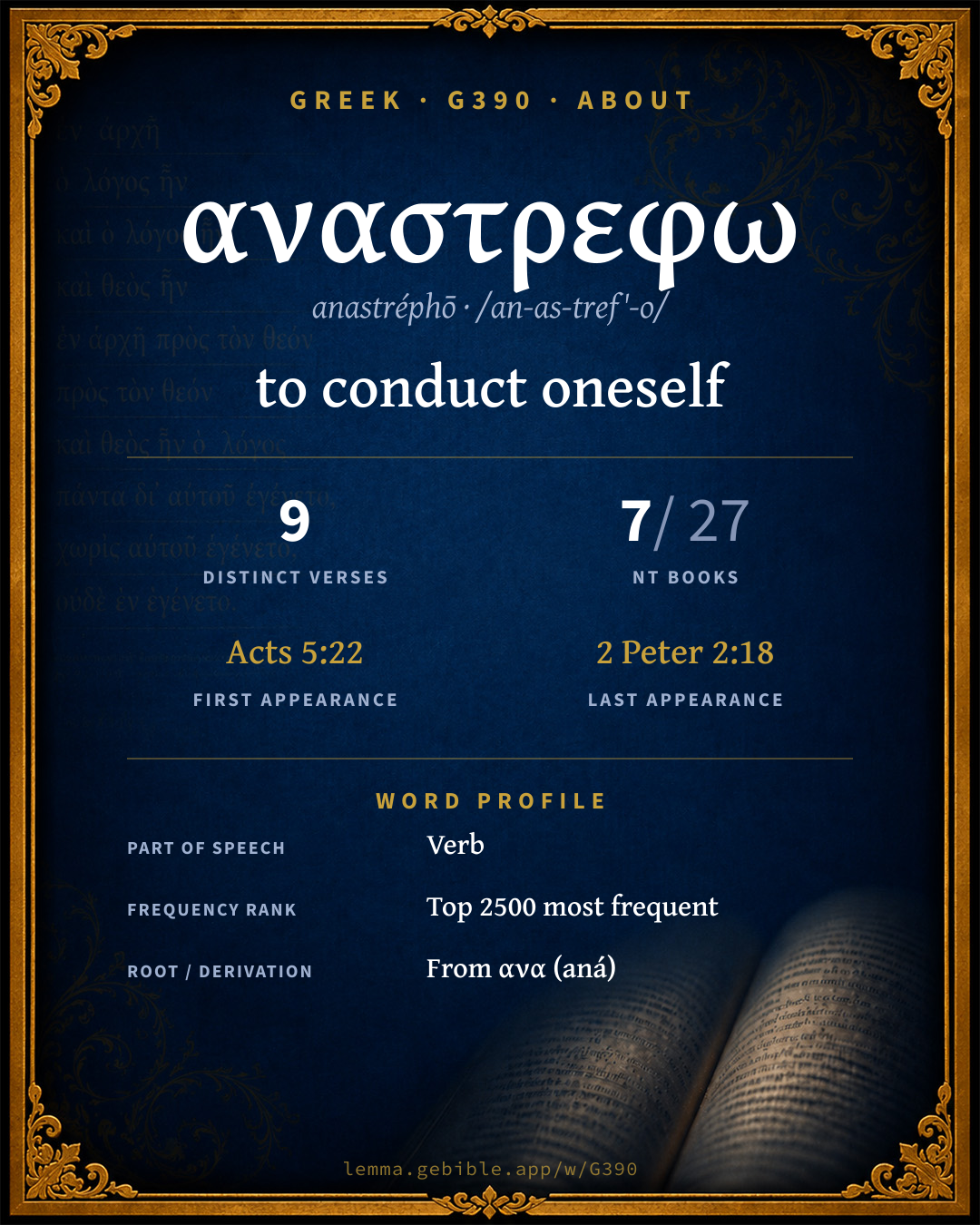
ἀναστρέφω
to conduct oneself
‘to conduct oneself’ is one of 4 main senses fuller range ↓
Full lexicon entry — Thayer's Greek Lexicon
From Thayer's Greek Lexicon
Where this word appears
See every Aorist-tense verb in the Greek New Testament →
Grammar key — what these labels mean
Part of speech
- Verb
- An action or state-of-being word.
Tense
- Aorist
- Action viewed as a simple whole, without regard to duration — often past (perfective aspect).
- Present
- Ongoing or general action in present time (imperfective aspect).
- Future
- Action expected in future time.
Voice
- Passive
- The subject receives the action.
- Active
- The subject performs the action.
Mood
- Indicative
- States a fact or asks a factual question (the mood of reality).
- Infinitive
- A verbal noun (“to write”), unmarked for person or number.
- Imperative
- Expresses a command or request.
- Participle
- A verbal adjective (“writing,” “having written”).
Case
- Nominative
- The case of the subject (and the predicate nominative).
- Accusative
- The case of the direct object and of extent.
- Genitive
- The case of source, possession, or “of” — answers “whose / from what.”
Person
- 1st person
- The speaker (“I / we”).
- 2nd person
- The one addressed (“you”).
Gender
- Masculine
- Grammatically masculine.
Number
- Plural
- More than one.
- Singular
- One.
Grammatical forms
- Verb, Aorist, Passive, Indicative, 1st person, Plural 2 times (22%)
- Verb, Present, Passive, Infinitive 2 times (22%)
- Verb, Aorist, Passive, Imperative, 2nd person, Plural 1 time (11%)
- Verb, Aorist, Active, Participle, Nominative, Plural, Masculine 1 time (11%)
- Verb, Future, Active, Indicative, 1st person, Singular 1 time (11%)
- Verb, Present, Passive, Participle, Accusative, Plural, Masculine 1 time (11%)
- Verb, Present, Passive, Participle, Genitive, Plural, Masculine 1 time (11%)
Parsed forms decoded from the imported morphology (Robinson–Tischendorf, public domain), counted across 9 parsed occurrences — not distinct verses.
Every verse where G390 appears — 9 distinct verses across 7 books. Click any verse to open its interlinear word-by-word view. Verse text shown in the World English Bible for context — . Each verse’s Greek form is shown with its reference; the English is not keyword-highlighted, since the data carries no word-level English alignment. Use “Compare translations” on any verse to read it across multiple English versions. This concordance covers the Greek New Testament; Septuagint (Greek Old Testament) occurrences of this word are not indexed here.
Acts 2 verses
- Acts 5:22 ἀναστρέψαντες aor act ptcp nom pl masc But the officers who came didn't find them in the prison. They returned and reported,
- Acts 15:16 ἀναστρέψω fut act ind 1sg 'After these things I will return. I will again build the tent of David, which has fallen. I will again build its ruins. I will set it up,
2 Corinthians 1 verse
Ephesians 1 verse
1 Timothy 1 verse
Hebrews 2 verses
- Hebrews 10:33 ἀναστρεφομένων pres pass ptcp gen pl masc partly, being exposed to both reproaches and oppressions; and partly, becoming partakers with those who were treated so.
- Hebrews 13:18 ἀναστρέφεσθαι pres pass inf Pray for us, for we are persuaded that we have a good conscience, desiring to live honorably in all things.
1 Peter 1 verse
2 Peter 1 verse
About this entry
At a glance — auto-summarized from this page’s data, not written by a person. Every figure links to its source below. This summary describes the numbers; it doesn’t interpret them.
At its core, αναστρεφω (anastréphō) means “to conduct oneself.” Ranging over 4 senses, it is not a single-sense word. With 9 verses in 7 books, it is an uncommon word in the Greek New Testament. Scripture first uses it in Acts 5:22. Sharing its root, it stands alongside ανα, αναβαινω and αναβαλλομαι. Dig into 9-verse concordance and the renderings breakdown below.
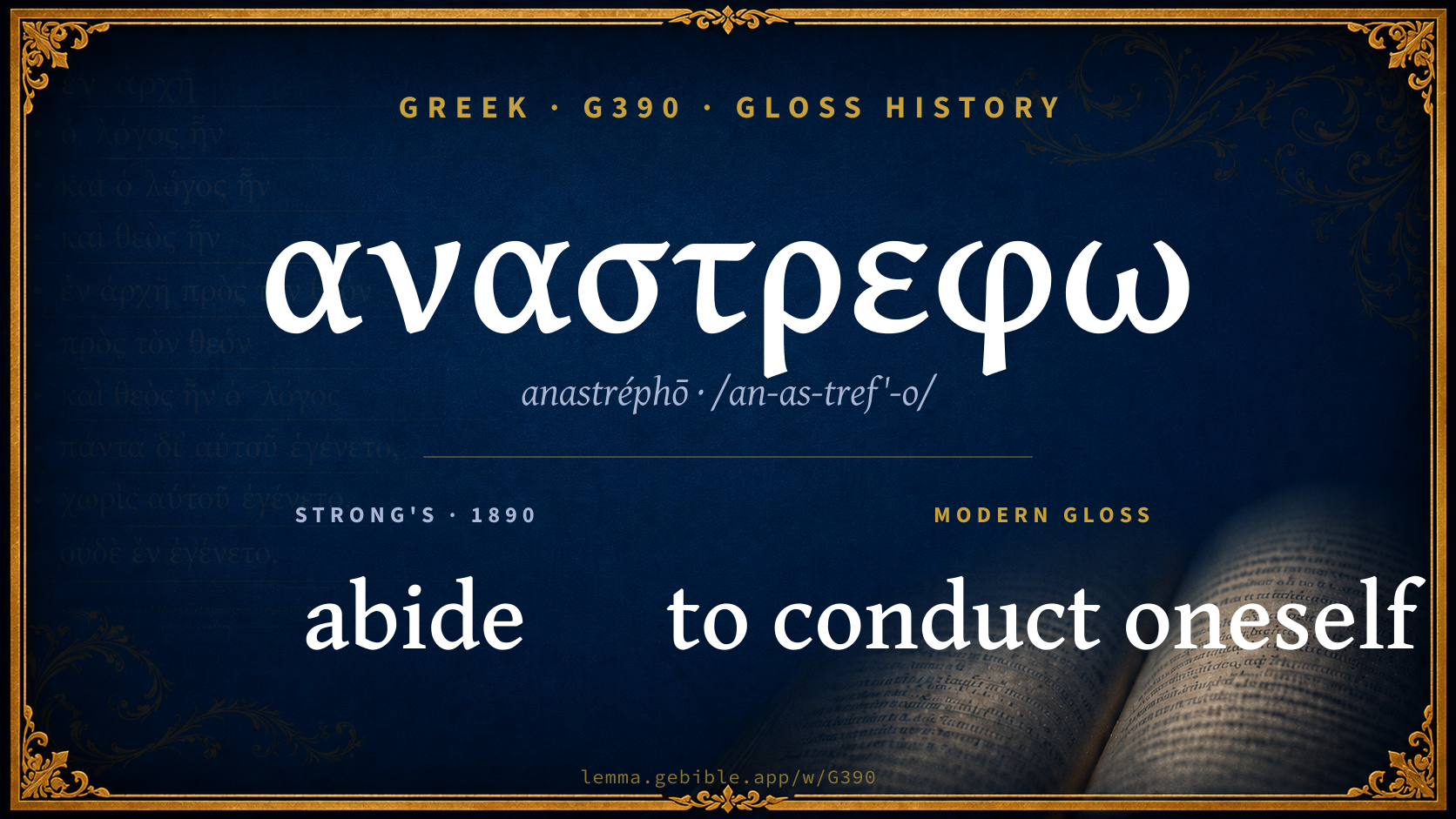
Gloss history
Strong's 1890 vs modern scholarship
About this word
Strong's G390 catalogs a Greek word from the Greek New Testament.
These counts are not copied from any lexicon or concordance. They are computed here, from the morphology-tagged Greek New Testament. What Lemma adds →
- 9
- distinct verses
- The word appears in 9 distinct verses.
- 7 / 27
- NT books
- The word appears in 7 of 27 New Testament books.
- #1,140
- by frequency
- Top 2500 most frequent Greek words (rank 1,140 of 5,347 Greek words by occurrence).
View all 9 occurrences in the concordance →
Most concentrated in
- Acts 2 verses 22%
- Hebrews 2 verses 22%
- 2 Corinthians 1 verse 11%
By section of the New Testament
By traditional corpus
Conventional, traditional groupings — biblical authorship is debated, so this is a traditional corpus grouping, not an authorship claim. Some books belong to more than one corpus (Luke is in both the Gospels and the Lukan corpus, and so on), so these shares overlap and need not total 100%. Each figure is a share of the word’s 9 distinct verses.
- Pauline corpus 3 verses · 33%
- Lukan (Luke–Acts) 2 verses · 22%
- Hebrews 2 verses · 22%
- General (Catholic) Epistles 2 verses · 22%
How translations render this word
Counts come from each version’s own published word-to-Strong’s tagging or interlinear alignment — an approximate guide to how each version renders this word, not a word-level alignment the data otherwise carries. Because each total is that version’s own tagged count, the per-version totals vary from one another and need not match the appearance or distinct-verse counts above. These counts may also differ from a printed concordance because Lemma counts each distinctly tagged rendering and does not collapse phrase taggings into a single head-word total. This is a fixed set of word-tagged versions (KJV, ASV, BSB, ULT) and does not change with the reading translation you choose elsewhere. Each version’s license is shown beside its name below (and on Sources).
- King James Version: Live 2×
- American Standard Version: Live 2×
- Berean Standard Bible: Live 2×
- unfoldingWord Literal Text: Behave 1×, Being treated 1×, Conduct ourselves 1×
King James Version Public Domain
Renders G390 across 12 tagged occurrences — most commonly:
Plus 10 renderings that appear only once — usually multi-word phrases or single function words the recovered tagging swept in, not distinct renderings.
American Standard Version Public Domain
Renders G390 across 13 tagged occurrences — most commonly:
Plus 11 renderings that appear only once — usually multi-word phrases or single function words the recovered tagging swept in, not distinct renderings.
Berean Standard Bible Public Domain
Renders G390 across 9 tagged occurrences — most commonly:
Plus 7 renderings that appear only once — usually multi-word phrases or single function words the recovered tagging swept in, not distinct renderings.
unfoldingWord Literal Text CC BY-SA 4.0
Renders G390 across 9 tagged occurrences — most commonly:
Senses in Thayer's
The 4 senses Thayer's distinguishes for this word, in lexicon order (not ranked by frequency or importance). The full entry — with sub-senses — is in the Lexicon Entry tab.
- to turn upside down, overturn
- to turn back
- to turn hither and thither, to turn one's self about, sojourn dwell in a place
- metaph. to conduct one's self, behave one's self, live
Word origin
Derived from ανα (aná) (G303) — among.
Forms in the corpus
The 8 distinct written forms G390 takes in the Greek New Testament, most frequent first — each parse links to that tense’s occurrences in the concordance.
| Form | Parsing | Example | Uses |
|---|---|---|---|
| ἀναστρέφεσθαι anastréphesthai | Verb, Present, Passive, Infinitive | 1 Timothy 3:15 | 2 |
| ἀναστράφητε anastráphēte | Verb, Aorist, Passive, Imperative, 2nd person, Plural | 1 Peter 1:17 | 1 |
| ἀναστρέψαντες anastrépsantes | Verb, Aorist, Active, Participle, Nominative, Plural, Masculine | Acts 5:22 | 1 |
| ἀναστρέψω anastrépsō | Verb, Future, Active, Indicative, 1st person, Singular | Acts 15:16 | 1 |
| ἀναστρεφομένους anastrephoménous | Verb, Present, Passive, Participle, Accusative, Plural, Masculine | 2 Peter 2:18 | 1 |
| ἀναστρεφομένων anastrephoménōn | Verb, Present, Passive, Participle, Genitive, Plural, Masculine | Hebrews 10:33 | 1 |
| ἀνεστράφημέν anestráphēmén | Verb, Aorist, Passive, Indicative, 1st person, Plural | Ephesians 2:3 | 1 |
| ἀνεστράφημεν anestráphēmen | Verb, Aorist, Passive, Indicative, 1st person, Plural | 2 Corinthians 1:12 | 1 |
Same root — word family
Other Thayer's entries built from the same root as G390, grouped by Strong’s listed origin. These share a root / origin per the lexicon — not necessarily a shared meaning. Each links to that word’s own entry.
Derives from
Shares the same root
- αναβαινω anabaínō G305 to ascend
- αναβαλλομαι anabállomai G306 to delay
- αναβιβαζω anabibázō G307 to draw up
- αναβλεπω anablépō G308 to look up
- αναβοαω anaboáō G310 to cry out
- αναγγελλω anangéllō G312 to announce
- αναγενναω anagennáō G313 to be born again
- αναγινωσκω anaginṓskō G314 to recognize
- αναγκη anánkē G318 necessity
- αναγνωριζομαι anagnōrízomai G319 to recognize
- αναγω anágō G321 to lead up
- αναδεικνυμι anadeíknymi G322 to proclaim
- αναδεχομαι anadéchomai G324 to take up
- αναδιδωμι anadídōmi G325 to give forth
- αναζαω anazáō G326 to live again
- αναζητεω anazētéō G327 to search out
- αναζωννυμι anazṓnnymi G328 to gird up
- αναζωπυρεω anazōpyréō G329 to inflame
- αναθαλλω anathállō G330 to sprout up
- αναθεωρεω anatheōréō G333 to observe
- αναιρεω anairéō G337 to take away
- ανακαθιζω anakathízō G339 to sit up
- ανακαινιζω anakainízō G340 to renew
- ανακαινοω anakainóō G341 to make new
+51 more words share this root (not shown).
Derived from this word
Compare all same-root words → Showing 4 of 78 — not the complete family. They share a root, not necessarily a meaning.
Septuagint usage
The same Greek word αναστρεφω appears 95 times in the Greek Old Testament (Septuagint), across 89 verses in 19 books.
- 95
- LXX occurrences
- Tagged occurrences of this Greek word in the Septuagint.
- 89
- verses
- Distinct Septuagint verses containing this word.
- 19 / 39
- OT books
- The word appears in 19 of the 39 Old Testament books.
Sample Septuagint occurrences
- Genesis 8:11 ἀναστρέφω
- Exodus 14:28 ἀναστρέφω
- Leviticus 22:13 ἀναστρέφω
- Numbers 35:28 ἀναστρέφω
- Deuteronomy 3:20 ἀναστρέφω
- Joshua 5:6 ἀναστρέφω
- Judges 7:13 ἀναστρέφω
- Ruth 1:15 ἀναστρέφω
- 1 Samuel 3:5 ἀναστρέφω
- 2 Samuel 1:1 ἀναστρέφω
- 1 Kings 11:22 ἀναστρέφω
- 2 Kings 2:18 ἀναστρέφω
Septuagint occurrences (same lexeme)
Every verse where the same Strong’s number (G390) appears in the Greek Septuagint — showing the first 50 of 89. Verse text shown in the World English Bible for context; the Greek form is the matched word — the English is not keyword-highlighted.
- Genesis 8:11 ἀναστρέφω The dove came back to him at evening, and, behold, in her mouth was an olive leaf plucked off. So Noah knew that the waters were abated from off the earth.
- Genesis 14:7 ἀναστρέφω They returned, and came to En-mishpat (the same is Kadesh), and struck all the country of the Amalekites, and also the Amorites, that lived in Hazazon Tamar.
- Genesis 14:17 ἀναστρέφω The king of Sodom went out to meet him, after his return from the slaughter of Chedorlaomer and the kings who were with him, at the valley of Shaveh (the same is the King's Valley).
- Genesis 18:10 ἀναστρέφω He said, "I will certainly return to you when the season comes round. Behold, Sarah your wife will have a son." Sarah heard in the tent door, which was behind him.
- Genesis 18:14 ἀναστρέφω Is anything too hard for Yahweh? At the set time I will return to you, when the season comes round, and Sarah will have a son."
- Genesis 22:5 ἀναστρέφω Abraham said to his young men, "Stay here with the donkey. The boy and I will go yonder. We will worship, and come back to you.
- Genesis 30:8 ἀναστρέφω Rachel said, "With mighty wrestlings have I wrestled with my sister, and have prevailed." She named him Naphtali.
- Genesis 32:7 ἀναστρέφω Then Jacob was greatly afraid and was distressed: and he divided the people who were with him, and the flocks, and the herds, and the camels, into two companies;
- Genesis 37:29 ἀναστρέφω Reuben returned to the pit; and saw that Joseph wasn't in the pit; and he tore his clothes.
- Genesis 37:30 ἀναστρέφω He returned to his brothers, and said, "The child is no more; and I, where will I go?"
- Genesis 49:22 ἀναστρέφω "Joseph is a fruitful vine, A fruitful vine by a spring; His branches run over the wall.
- Exodus 14:28 ἀναστρέφω The waters returned, and covered the chariots and the horsemen, even all Pharaoh's army that went in after them into the sea. There remained not so much as one of them.
- Exodus 24:14 ἀναστρέφω He said to the elders, "Wait here for us, until we come again to you. Behold, Aaron and Hur are with you. Whoever is involved in a dispute can go to them."
- Leviticus 22:13 ἀναστρέφω But if a priest's daughter is a widow, or divorced, and has no child, and has returned to her father's house, as in her youth, she may eat of her father's bread: but no stranger shall eat any of it.
- Numbers 35:28 ἀναστρέφω because he should have remained in his city of refuge until the death of the high priest: but after the death of the high priest the manslayer shall return into the land of his possession.
- Deuteronomy 3:20 ἀναστρέφω until Yahweh give rest to your brothers, as to you, and they also possess the land which Yahweh your God gives them beyond the Jordan: then shall you return every man to his possession, which I have given you.
- Deuteronomy 24:4 ἀναστρέφω her former husband, who sent her away, may not take her again to be his wife, after that she is defiled; for that is abomination before Yahweh: and you shall not cause the land to sin, which Yahweh your God gives you for an inheritance.
- Deuteronomy 24:19 ἀναστρέφω When you reap your harvest in your field, and have forgot a sheaf in the field, you shall not go again to get it: it shall be for the foreigner, for the fatherless, and for the widow; that Yahweh your God may bless you in all the work of your hands.
- Deuteronomy 24:20 ἀναστρέφω When you beat your olive tree, you shall not go over the boughs again: it shall be for the foreigner, for the fatherless, and for the widow.
- Joshua 5:6 ἀναστρέφω For the children of Israel walked forty years in the wilderness, until all the nation, even the men of war who came forth out of Egypt, were consumed, because they didn't listen to the voice of Yahweh: to whom Yahweh swore that he wouldn't let them see the land which Yahweh swore to their fathers that he would give us, a land flowing with milk and honey.
- Joshua 7:3 ἀναστρέφω They returned to Joshua, and said to him, Don't let all the people go up; but let about two or three thousand men go up and strike Ai; don't make all the people to toil there; for they are but few.
- Joshua 19:12 ἀναστρέφω and it turned from Sarid eastward toward the sunrise to the border of Chisloth Tabor; and it went out to Daberath, and went up to Japhia;
- Joshua 19:29 ἀναστρέφω and the border turned to Ramah, and to the fortified city of Tyre; and the border turned to Hosah; and the goings out of it were at the sea by the region of Achzib;
- Judges 7:13 ἀναστρέφω When Gideon had come, behold, there was a man telling a dream to his fellow; and he said, Behold, I dreamed a dream; and, behold, a cake of barley bread tumbled into the camp of Midian, and came to the tent, and struck it so that it fell, and turned it upside down, so that the tent lay flat.
- Ruth 1:15 ἀναστρέφω She said, Behold, your sister-in-law is gone back to her people, and to her god: return you after your sister-in-law.
- 1 Samuel 3:5 ἀναστρέφω He ran to Eli, and said, Here am I; for you called me. He said, I didn't call; lie down again. He went and lay down.
- 1 Samuel 3:6 ἀναστρέφω Yahweh called yet again, Samuel. Samuel arose and went to Eli, and said, Here am I; for you called me. He answered, I didn't call, my son; lie down again.
- 1 Samuel 3:9 ἀναστρέφω Therefore Eli said to Samuel, Go, lie down: and it shall be, if he call you, that you shall say, Speak, Yahweh; for your servant hears. So Samuel went and lay down in his place.
- 1 Samuel 6:16 ἀναστρέφω When the five lords of the Philistines had seen it, they returned to Ekron the same day.
- 1 Samuel 9:5 ἀναστρέφω When they had come to the land of Zuph, Saul said to his servant who was with him, Come, and let us return, lest my father leave off caring for the donkeys, and be anxious for us.
- 1 Samuel 15:25 ἀναστρέφω Now therefore, please pardon my sin, and turn again with me, that I may worship Yahweh.
- 1 Samuel 15:26 ἀναστρέφω Samuel said to Saul, I will not return with you; for you have rejected the word of Yahweh, and Yahweh has rejected you from being king over Israel.
- 1 Samuel 15:30 ἀναστρέφω Then he said, I have sinned: yet honor me now, Please, before the elders of my people, and before Israel, and turn again with me, that I may worship Yahweh your God.
- 1 Samuel 15:31 ἀναστρέφω So Samuel turned again after Saul; and Saul worshiped Yahweh.
- 1 Samuel 17:33 ἀναστρέφω Saul said to David, You are not able to go against this Philistine to fight with him; for you are but a youth, and he a man of war from his youth.
- 1 Samuel 23:28 ἀναστρέφω So Saul returned from pursuing after David, and went against the Philistines: therefore they called that place Sela Hammahlekoth.
- 1 Samuel 24:2 ἀναστρέφω Then Saul took three thousand chosen men out of all Israel, and went to seek David and his men on the rocks of the wild goats.
- 1 Samuel 25:12 ἀναστρέφω So David's young men turned on their way, and went back, and came and told him according to all these words.
- 1 Samuel 26:25 ἀναστρέφω Then Saul said to David, Blessed be you, my son David: you shall both do mightily, and shall surely prevail. So David went his way, and Saul returned to his place.
- 1 Samuel 27:9 ἀναστρέφω David struck the land, and saved neither man nor woman alive, and took away the sheep, and the oxen, and the donkeys, and the camels, and the clothing; and he returned, and came to Achish.
- 1 Samuel 29:7 ἀναστρέφω Therefore now return, and go in peace, that you not displease the lords of the Philistines.
- 2 Samuel 1:1 ἀναστρέφω It happened after the death of Saul, when David was returned from the slaughter of the Amalekites, and David had abode two days in Ziklag;
- 2 Samuel 2:26 ἀναστρέφω Then Abner called to Joab, and said, "Shall the sword devour forever? Don't you know that it will be bitterness in the latter end? How long shall it be then, before you bid the people return from following their brothers?"
- 2 Samuel 2:30 ἀναστρέφω Joab returned from following Abner: and when he had gathered all the people together, there lacked of David's servants nineteen men and Asahel.
- 2 Samuel 3:16 ἀναστρέφω Her husband went with her, weeping as he went, and followed her to Bahurim. Then said Abner to him, Go, return: and he returned.
- 2 Samuel 3:26 ἀναστρέφω When Joab was come out from David, he sent messengers after Abner, and they brought him back from the well of Sirah: but David didn't know it.
- 2 Samuel 10:14 ἀναστρέφω When the children of Ammon saw that the Syrians were fled, they likewise fled before Abishai, and entered into the city. Then Joab returned from the children of Ammon, and came to Jerusalem.
- 2 Samuel 12:23 ἀναστρέφω But now he is dead, why should I fast? can I bring him back again? I shall go to him, but he will not return to me.
- 2 Samuel 17:20 ἀναστρέφω Absalom's servants came to the woman to the house; and they said, Where are Ahimaaz and Jonathan? The woman said to them, They have gone over the brook of water. When they had sought and could not find them, they returned to Jerusalem.
- 2 Samuel 22:38 ἀναστρέφω I have pursued my enemies, and destroyed them; Neither did I turn again until they were consumed.
These are occurrences of the same Greek lexeme (G390) in the Septuagint — not a translation of any one Hebrew word. The store carries no word-level Hebrew↔Greek alignment, so no Hebrew original is asserted here. Counts come from the recovered LXX Strong's tagging — high-frequency vocabulary is well covered, while rare or late forms may be untagged — so they reflect tagged occurrences and may slightly undercount.