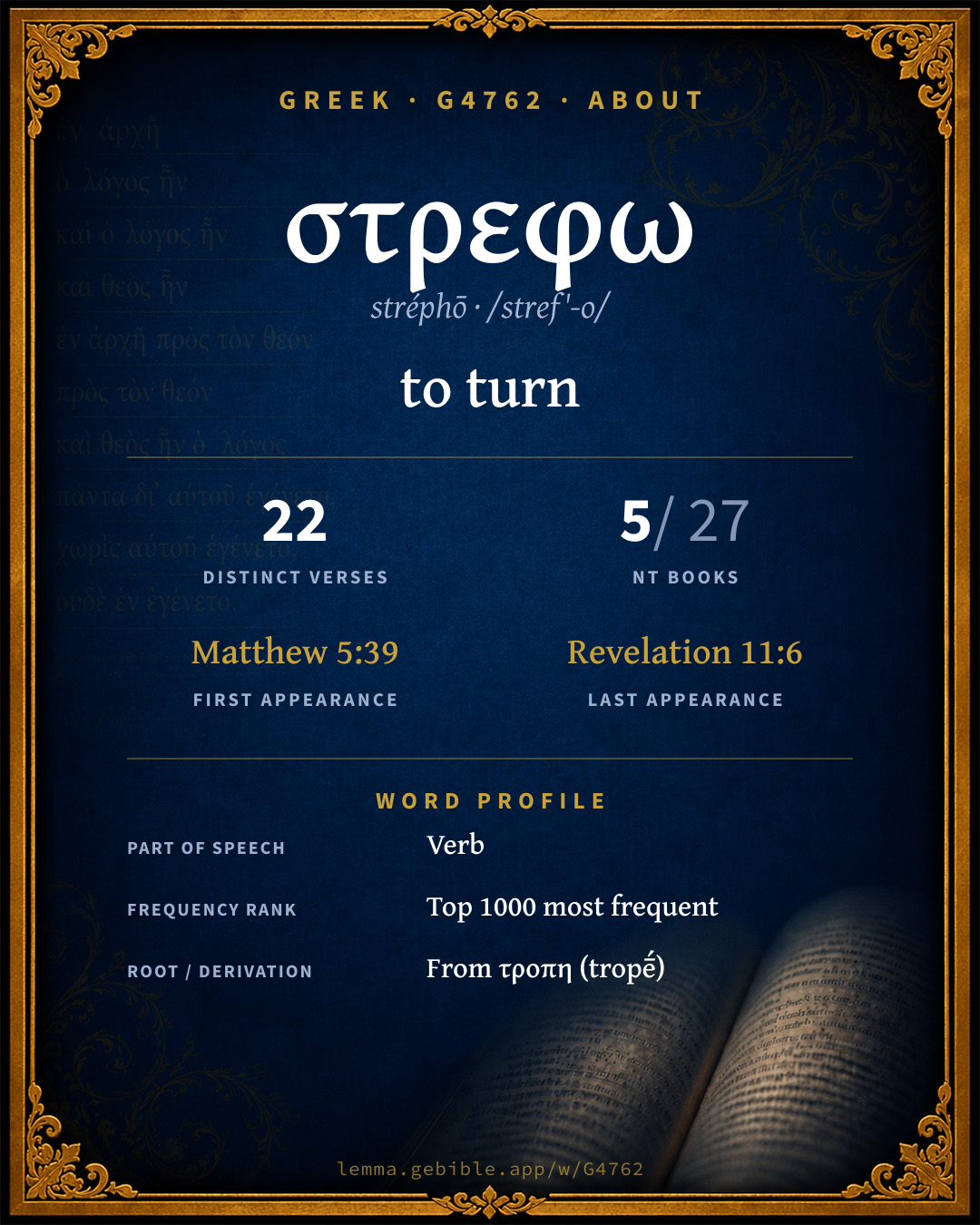
στρέφω
to turn
‘to turn’ is one of 2 main senses fuller range ↓
Full lexicon entry — Thayer's Greek Lexicon
From Thayer's Greek Lexicon
Where this word appears
See every Aorist-tense verb in the Greek New Testament →
Grammar key — what these labels mean
Part of speech
- Verb
- An action or state-of-being word.
Tense
- Aorist
- Action viewed as a simple whole, without regard to duration — often past (perfective aspect).
- Present
- Ongoing or general action in present time (imperfective aspect).
Voice
- Passive
- The subject receives the action.
- Active
- The subject performs the action.
Mood
- Participle
- A verbal adjective (“writing,” “having written”).
- Indicative
- States a fact or asks a factual question (the mood of reality).
- Subjunctive
- Expresses probability, purpose, or possibility (the mood of contingency).
- Imperative
- Expresses a command or request.
- Infinitive
- A verbal noun (“to write”), unmarked for person or number.
Case
- Nominative
- The case of the subject (and the predicate nominative).
Person
- 3rd person
- The one spoken about (“he / she / it / they”).
- 2nd person
- The one addressed (“you”).
- 1st person
- The speaker (“I / we”).
Gender
- Masculine
- Grammatically masculine.
- Feminine
- Grammatically feminine.
Number
- Singular
- One.
- Plural
- More than one.
Grammatical forms 11 distinct
- Verb, Aorist, Passive, Participle, Nominative, Singular, Masculine 11 times (50%)
- Verb, Aorist, Active, Indicative, 3rd person, Singular 2 times (9%)
- Verb, Aorist, Passive, Indicative, 3rd person, Plural 1 time (5%)
- Verb, Aorist, Passive, Indicative, 3rd person, Singular 1 time (5%)
- Verb, Aorist, Passive, Participle, Nominative, Plural, Masculine 1 time (5%)
- Verb, Aorist, Passive, Participle, Nominative, Singular, Feminine 1 time (5%)
- Verb, Aorist, Passive, Subjunctive, 2nd person, Plural 1 time (5%)
- Verb, Aorist, Passive, Subjunctive, 3rd person, Plural 1 time (5%)
+3 more forms (3 occurrences)
Parsed forms decoded from the imported morphology (Robinson–Tischendorf, public domain), counted across 22 parsed occurrences — not distinct verses.
Every verse where G4762 appears — 22 distinct verses across 5 books. Click any verse to open its interlinear word-by-word view. Verse text shown in the World English Bible for context — . Each verse’s Greek form is shown with its reference; the English is not keyword-highlighted, since the data carries no word-level English alignment. Use “Compare translations” on any verse to read it across multiple English versions. This concordance covers the Greek New Testament; Septuagint (Greek Old Testament) occurrences of this word are not indexed here.
Matthew 6 verses
- Matthew 5:39 στρέψον aor act impv 2sg But I tell you, don't resist him who is evil; but whoever strikes you on your right cheek, turn to him the other also.
- Matthew 7:6 στραφέντες aor pass ptcp nom pl masc "Don't give that which is holy to the dogs, neither throw your pearls before the pigs, lest perhaps they trample them under their feet, and turn and tear you to pieces.
- Matthew 9:22 στραφεὶς aor pass ptcp nom sg masc But Jesus, turning around and seeing her, said, "Daughter, cheer up! Your faith has made you well." And the woman was made well from that hour.
- Matthew 16:23 στραφεὶς aor pass ptcp nom sg masc But he turned, and said to Peter, "Get behind me, Satan! You are a stumbling-block to me, for you are not setting your mind on the things of God, but on the things of men."
- Matthew 18:3 στραφῆτε aor pass subj 2pl and said, "Most assuredly I tell you, unless you turn, and become as little children, you will in no way enter into the Kingdom of Heaven.
- Matthew 27:3 ἔστρεψεν aor act ind 3sg Then Judas, who betrayed him, when he saw that Jesus was condemned, felt remorse, and brought back the thirty pieces of silver to the chief priests and elders,
Luke 8 verses
- Luke 7:9 στραφεὶς aor pass ptcp nom sg masc When Jesus heard these things, he marveled at him, and turned and said to the multitude who followed him, "I tell you, I have not found such great faith, no, not in Israel."
- Luke 7:44 στραφεὶς aor pass ptcp nom sg masc Turning to the woman, he said to Simon, "Do you see this woman? I entered into your house, and you gave me no water for my feet, but she has wet my feet with her tears, and wiped them with the hair of her head.
- Luke 9:55 στραφεὶς aor pass ptcp nom sg masc But he turned and rebuked them, "You don't know of what kind of spirit you are.
- Luke 10:22 στραφεὶς aor pass ptcp nom sg masc Turning to the disciples, he said, "All things have been delivered to me by my Father. No one knows who the Son is, except the Father, and who the Father is, except the Son, and he to whomever the Son desires to reveal him."
- Luke 10:23 στραφεὶς aor pass ptcp nom sg masc Turning to the disciples, he said privately, "Blessed are the eyes which see the things that you see,
- Luke 14:25 στραφεὶς aor pass ptcp nom sg masc Now great multitudes were going with him. He turned and said to them,
- Luke 22:61 στραφεὶς aor pass ptcp nom sg masc The Lord turned, and looked at Peter. Then Peter remembered the Lord's word, how he said to him, "Before the rooster crows you will deny me three times."
- Luke 23:28 στραφεὶς aor pass ptcp nom sg masc But Jesus, turning to them, said, "Daughters of Jerusalem, don't weep for me, but weep for yourselves and for your children.
John 4 verses
- John 1:38 στραφεὶς aor pass ptcp nom sg masc Jesus turned, and saw them following, and said to them, "What are you looking for?" They said to him, "Rabbi" (which is to say, being interpreted, Teacher), "where are you staying?"
- John 12:40 στραφῶσιν aor pass subj 3pl "He has blinded their eyes and he hardened their heart, Lest they should see with their eyes, And perceive with their heart, And would turn, And I would heal them."
- John 20:14 ἐστράφη aor pass ind 3sg When she had said this, she turned around and saw Jesus standing, and didn't know that it was Jesus.
- John 20:16 στραφεῖσα aor pass ptcp nom sg fem Jesus said to her, "Mary." She turned and said to him, "Rhabbouni!" which is to say, "Teacher!"
Acts 3 verses
- Acts 7:39 ἐστράφησαν aor pass ind 3pl to whom our fathers wouldn't be obedient, but rejected him, and turned back in their hearts to Egypt,
- Acts 7:42 ἔστρεψεν aor act ind 3sg But God turned, and gave them up to serve the host of the sky, as it is written in the book of the prophets, 'Did you offer to me slain animals and sacrifices Forty years in the wilderness, O house of Israel?
- Acts 13:46 στρεφόμεθα pres pass ind 1pl Paul and Barnabas spoke out boldly, and said, "It was necessary that God's word should be spoken to you first. Since indeed you thrust it from you, and judge yourselves unworthy of eternal life, behold, we turn to the Gentiles.
Revelation 1 verse
About this entry
At a glance — auto-summarized from this page’s data, not written by a person. Every figure links to its source below. This summary describes the numbers; it doesn’t interpret them.
The Greek verb στρεφω centers on the idea of “to turn.” First canonically at Matthew 5:39, it enters the text early. The Greek New Testament uses it across 22 verses — uncommon. Luke dominates its distribution — 8 of 22 verses. Lexicons map it across 2 senses. For the data behind this summary, explore the sense tree and the renderings breakdown below.
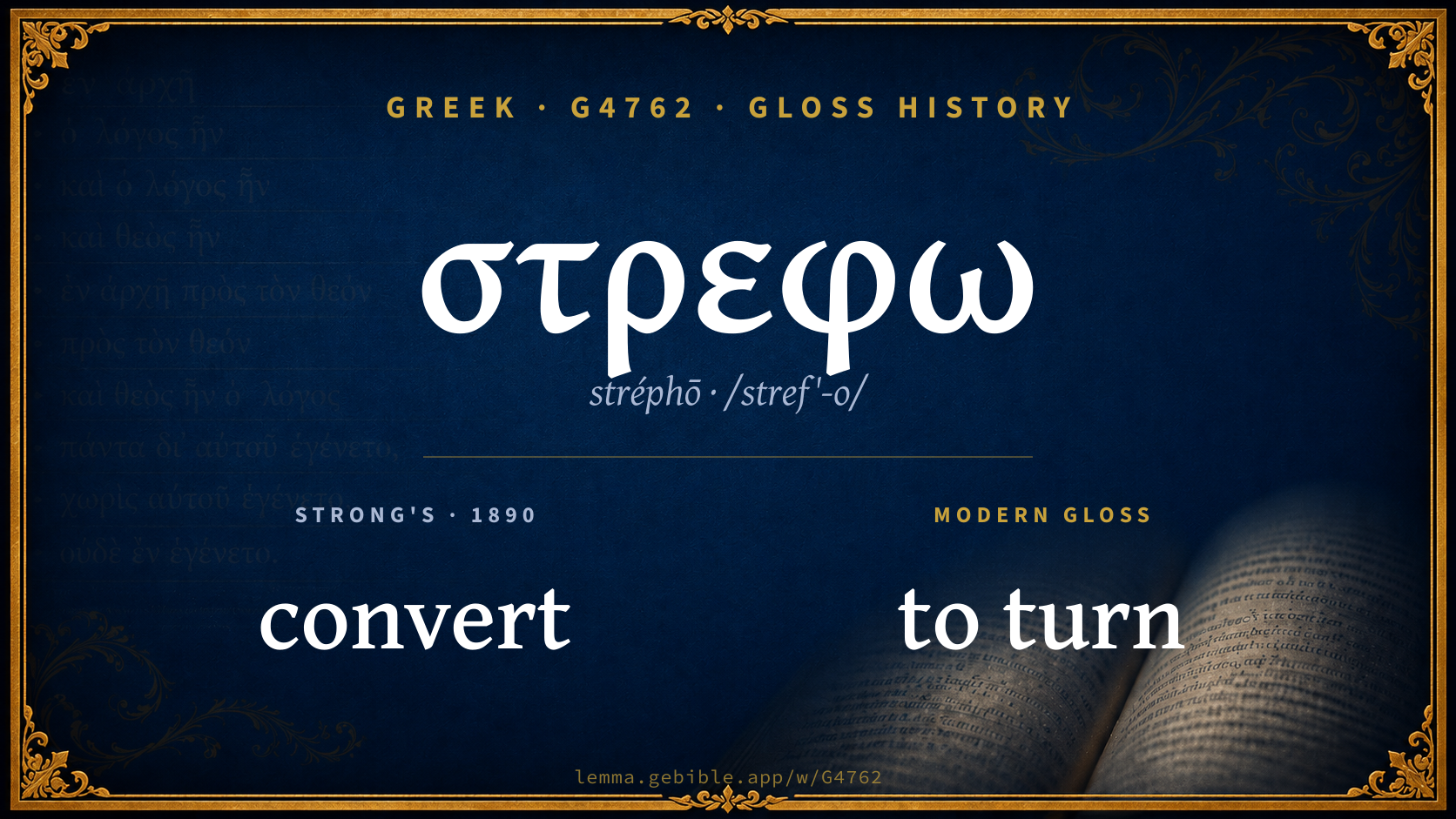
Gloss history
Strong's 1890 vs modern scholarship
About this word
Strong's G4762 catalogs a Greek word from the Greek New Testament.
These counts are not copied from any lexicon or concordance. They are computed here, from the morphology-tagged Greek New Testament. What Lemma adds →
- 22
- distinct verses
- The word appears in 22 distinct verses.
- 5 / 27
- NT books
- The word appears in 5 of 27 New Testament books.
- #586
- by frequency
- Top 1000 most frequent Greek words (rank 586 of 5,347 Greek words by occurrence).
View all 22 occurrences in the concordance →
By section of the New Testament
By traditional corpus
Conventional, traditional groupings — biblical authorship is debated, so this is a traditional corpus grouping, not an authorship claim. Some books belong to more than one corpus (Luke is in both the Gospels and the Lukan corpus, and so on), so these shares overlap and need not total 100%. Each figure is a share of the word’s 22 distinct verses.
- Gospels 18 verses · 82%
- Lukan (Luke–Acts) 11 verses · 50%
- Johannine 5 verses · 23%
- Revelation 1 verse · 5%
How translations render this word
Counts come from each version’s own published word-to-Strong’s tagging or interlinear alignment — an approximate guide to how each version renders this word, not a word-level alignment the data otherwise carries. Because each total is that version’s own tagged count, the per-version totals vary from one another and need not match the appearance or distinct-verse counts above. These counts may also differ from a printed concordance because Lemma counts each distinctly tagged rendering and does not collapse phrase taggings into a single head-word total. This is a fixed set of word-tagged versions (KJV, ASV, BSB, ULT) and does not change with the reading translation you choose elsewhere. Each version’s license is shown beside its name below (and on Sources).
- King James Version: He turned 4×, Turned 4×, Turn 2×
- American Standard Version: He turned 3×, Turn 3×, Turned 3×
- Berean Standard Bible: Turned 8×, Turn 4×, Turning 2×
- unfoldingWord Literal Text: Having turned 6×, Turning 4×, Turn 2×
King James Version Public Domain
Renders G4762 across 18 tagged occurrences — most commonly:
Plus 8 renderings that appear only once — usually multi-word phrases or single function words the recovered tagging swept in, not distinct renderings.
American Standard Version Public Domain
Renders G4762 across 17 tagged occurrences — most commonly:
Plus 5 renderings that appear only once — usually multi-word phrases or single function words the recovered tagging swept in, not distinct renderings.
Berean Standard Bible Public Domain
Renders G4762 across 21 tagged occurrences — most commonly:
Plus 7 renderings that appear only once — usually multi-word phrases or single function words the recovered tagging swept in, not distinct renderings.
unfoldingWord Literal Text CC BY-SA 4.0
Renders G4762 across 21 tagged occurrences — most commonly:
Plus 9 renderings that appear only once — usually multi-word phrases or single function words the recovered tagging swept in, not distinct renderings.
Senses in Thayer's
The 2 senses Thayer's distinguishes for this word, in lexicon order (not ranked by frequency or importance). The full entry — with sub-senses — is in the Lexicon Entry tab.
- to turn, turn around
- to turn one's self (i.e. to turn the back to one
Word origin
Derived from τροπη (tropḗ) (G5157) — turning.
strengthened from the base of G5157 ; to twist that is turn quite around or reverse (literally or figuratively): - convert turn (again back again self self about).
— Strong’s Exhaustive Concordance (1890), public domain.
Forms in the corpus
The 11 distinct written forms G4762 takes in the Greek New Testament, most frequent first — each parse links to that tense’s occurrences in the concordance.
Same root — word family
Other Thayer's entries built from the same root as G4762, grouped by Strong’s listed origin. These share a root / origin per the lexicon — not necessarily a shared meaning. Each links to that word’s own entry.
Derives from
Shares the same root
Derived from this word
Compare all same-root words → They share a root, not necessarily a meaning.
Septuagint usage
The same Greek word στρεφω appears 34 times in the Greek Old Testament (Septuagint), across 34 verses in 14 books.
- 34
- LXX occurrences
- Tagged occurrences of this Greek word in the Septuagint.
- 34
- verses
- Distinct Septuagint verses containing this word.
- 14 / 39
- OT books
- The word appears in 14 of the 39 Old Testament books.
Sample Septuagint occurrences
- Genesis 3:24 στρέφω
- Exodus 4:17 στρέφω
- Judges 7:13 στρέφω
- 1 Samuel 10:6 στρέφω
- 1 Kings 2:15 στρέφω
- Ezra 23:2 στρέφω
- Esther 9:22 στρέφω
- Job 28:5 στρέφω
- Psalms 29:12 στρέφω
- Proverbs 12:7 στρέφω
- Isaiah 34:9 στρέφω
- Jeremiah 2:21 στρέφω
Septuagint occurrences (same lexeme)
Every verse where the same Strong’s number (G4762) appears in the Greek Septuagint. Verse text shown in the World English Bible for context; the Greek form is the matched word — the English is not keyword-highlighted.
- Genesis 3:24 στρέφω So he drove out the man; and he placed Cherubs at the east of the garden of Eden, and the flame of a sword which turned every way, to guard the way to the tree of life.
- Exodus 4:17 στρέφω You shall take this rod in your hand, with which you shall do the signs."
- Exodus 7:15 στρέφω Go to Pharaoh in the morning. Behold, he goes out to the water; and you shall stand by the river's bank to meet him; and the rod which was turned to a serpent you shall take in your hand.
- Judges 7:13 στρέφω When Gideon had come, behold, there was a man telling a dream to his fellow; and he said, Behold, I dreamed a dream; and, behold, a cake of barley bread tumbled into the camp of Midian, and came to the tent, and struck it so that it fell, and turned it upside down, so that the tent lay flat.
- Judges 18:26 στρέφω The children of Dan went their way: and when Micah saw that they were too strong for him, he turned and went back to his house.
- 1 Samuel 10:6 στρέφω and the Spirit of Yahweh will come mightily on you, and you shall prophesy with them, and shall be turned into another man.
- 1 Samuel 14:47 στρέφω Now when Saul had taken the kingdom over Israel, he fought against all his enemies on every side, against Moab, and against the children of Ammon, and against Edom, and against the kings of Zobah, and against the Philistines: and wherever he turned himself, he put [them] to the worse.
- 1 Kings 2:15 στρέφω He said, You know that the kingdom was mine, and that all Israel set their faces on me, that I should reign: however the kingdom is turned about, and is become my brother's; for it was his from Yahweh.
- 1 Kings 6:34 στρέφω and two doors of fir-wood: the two leaves of the one door were folding, and the two leaves of the other door were folding.
- 1 Kings 18:37 στρέφω Hear me, Yahweh, hear me, that this people may know that you, Yahweh, are God, and [that] you have turned their heart back again.
- Ezra 23:2 στρέφω
- Esther 9:22 στρέφω as the days in which the Jews had rest from their enemies, and the month which was turned to them from sorrow to gladness, and from mourning into a good day; that they should make them days of feasting and gladness, and of sending portions one to another, and gifts to the needy.
- Job 28:5 στρέφω As for the earth, out of it comes bread; Underneath it is turned up as it were by fire.
- Job 34:25 στρέφω Therefore he takes knowledge of their works. He overturns them in the night, so that they are destroyed.
- Job 41:17 στρέφω They are joined one to another; They stick together, so that they can't be pulled apart.
- Psalms 29:12 στρέφω
- Psalms 31:4 στρέφω Pluck me out of the net that they have laid secretly for me, For you are my stronghold.
- Psalms 40:4 στρέφω Blessed is the man who makes Yahweh his trust, And doesn't respect the proud, nor such as turn aside to lies.
- Psalms 77:9 στρέφω Has God forgotten to be gracious? Has he, in anger, withheld his compassion?" Selah.
- Psalms 113:3 στρέφω From the rising of the sun to the going down of the same, Yahweh's name is to be praised.
- Psalms 113:8 στρέφω That he may set him with princes, Even with the princes of his people.
- Proverbs 12:7 στρέφω The wicked are overthrown, and are no more, But the house of the righteous shall stand.
- Proverbs 26:14 στρέφω As the door turns on its hinges, So does the sluggard on his bed.
- Isaiah 34:9 στρέφω The streams of [Edom] shall be turned into pitch, and the dust of it into sulfur, and the land of it shall become burning pitch.
- Isaiah 63:10 στρέφω But they rebelled, and grieved his holy Spirit: therefore he was turned to be their enemy, [and] himself fought against them.
- Jeremiah 2:21 στρέφω Yet I had planted you a noble vine, wholly a right seed: how then are you turned into the degenerate branches of a foreign vine to me?
- Jeremiah 2:27 στρέφω who tell a stock, You are my father; and to a stone, You have brought me forth: for they have turned their back to me, and not their face; but in the time of their trouble they will say, Arise, and save us.
- Jeremiah 31:39 στρέφω The measuring line shall go out further straight onward to the hill Gareb, and shall turn about to Goah.
- Jeremiah 37:6 στρέφω Then came the word of Yahweh to the prophet Jeremiah, saying,
- Jeremiah 37:23 στρέφω
- Jeremiah 38:13 στρέφω So they drew up Jeremiah with the cords, and took him up out of the dungeon: and Jeremiah remained in the court of the guard.
- Lamentations 1:20 στρέφω See, Yahweh; for I am in distress; my heart is troubled; My heart is turned within me; for I have grievously rebelled: Abroad the sword bereaves, at home there is as death.
- Lamentations 5:15 στρέφω The joy of our heart is ceased; Our dance is turned into mourning.
- Ezekiel 4:8 στρέφω Behold, I lay bands on you, and you shall not turn you from one side to the other, until you have accomplished the days of your siege.
These are occurrences of the same Greek lexeme (G4762) in the Septuagint — not a translation of any one Hebrew word. The store carries no word-level Hebrew↔Greek alignment, so no Hebrew original is asserted here. Counts come from the recovered LXX Strong's tagging — high-frequency vocabulary is well covered, while rare or late forms may be untagged — so they reflect tagged occurrences and may slightly undercount.