2 Samuel 3:16

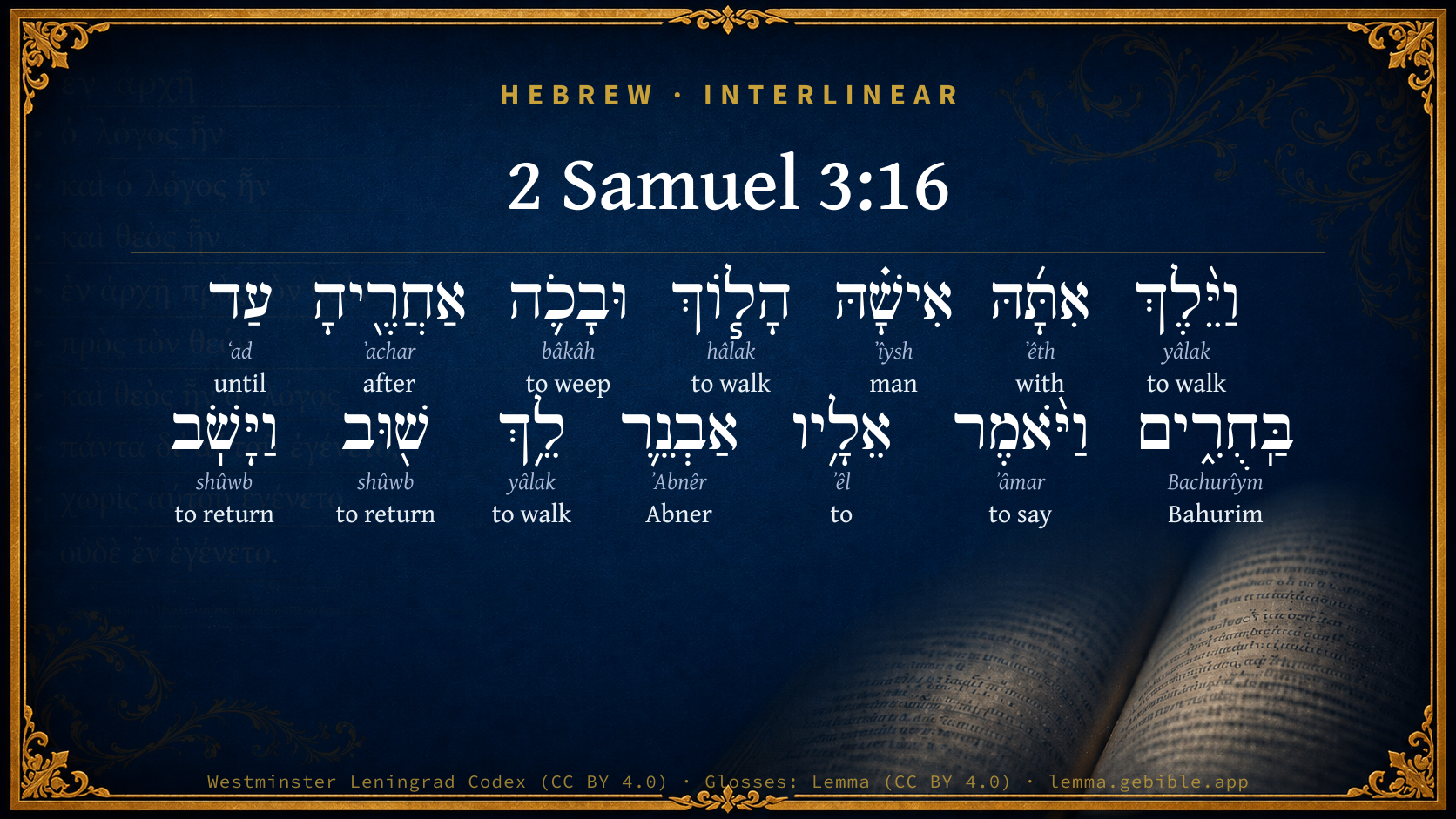
Hebrew (Westminster Leningrad Codex) 2 Samuel 3:16 appears in the Hebrew Old Testament. The text above is from the Westminster Leningrad Codex. Each word links to its Strong’s number, a concise gloss, and parsing drawn from the Open Scriptures Hebrew Bible morphology. Click any word for its full Brown-Driver-Briggs (BDB) entry.
Download image
Cite this verse

2 Samuel 3:16 (World English Bible). Public Domain. Lemma interlinear Bible study tool, https://lemma.gebible.app/v/2-samuel/3/16.

Show BibTeX & RIS
BibTeX
RIS
English Translation
Her husband went with her, weeping as he went, and followed her to Bahurim. Then said Abner to him, Go, return: and he returned.
World English Bible · Public Domain
Highlights
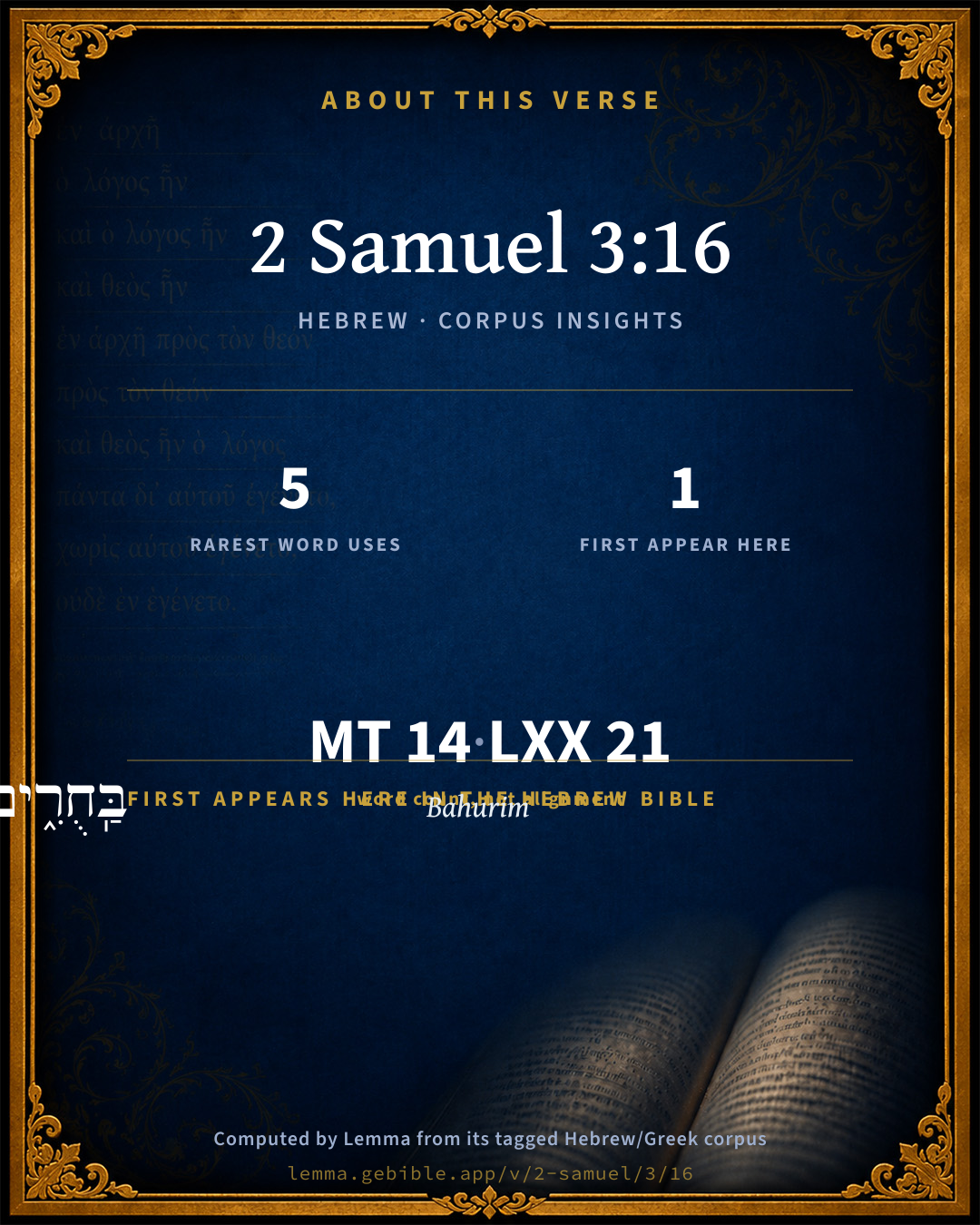
  • 1 first appearance in the Hebrew Bible
Full analysis ↓
Download a study sheet

One document with this verse’s original text, its word-by-word gloss line, the meaning frame, cross-references with their text, attributed commentary, and full source and license credits — printable, and it pastes into notes with its structure intact.

This verse Autodidact and up

Study sheet (.html) Plain text (.txt)

A passage Seminary Student

Up to 50 verses in one chapter. A passage sheet keeps up to 6 commentary sources and 12 cross-references per verse, in the order this page ranks them, and says so on the sheet whenever that leaves anything out. Ask for a single verse and you get the Autodidact verse sheet above.

Everything on this page stays free to read, with no account — the sheet is a download of what is already on screen, not access to it.

Want to remove ads? Support Godless Engineer
Compare translations 3

The same verse in 3 English versions, stacked beneath the original-language interlinear above. Click any original word for its lexicon entry.

Each is an independent rendering of the whole verse — the interlinear is not word-aligned to these translations.

Highlighted words mark where these versions differ — a whole-verse word diff, not a word-by-word alignment.

  • World English Bible Public Domain
    Her husband went with her, weeping as he went, and followed her to Bahurim. Then said Abner to him, Go, return: and he returned.
  • King James Version Public Domain
    And her husband went with her along weeping behind her to Bahurim. Then said Abner unto him, Go, return. And he returned.
  • unfoldingWord Literal Text CC BY-SA 4.0
    And her husband went with her, going and weeping after her, to Bahurim. Then Abner said to him, “Go, return.” So he returned.

unfoldingWord Literal Text — © unfoldingWord, licensed CC BY-SA 4.0. Word-aligned USFM3 via Door43 (git.door43.org/unfoldingWord/en_ult).

Versions to compare (up to 4)

3 of 4 selected

Show all 18 translations

Every available English version of this verse, each an independent rendering of the whole verse.

  • World English Bible Public Domain
    Her husband went with her, weeping as he went, and followed her to Bahurim. Then said Abner to him, Go, return: and he returned.
  • Berean Standard Bible Public Domain
    Her husband followed her, weeping all the way to Bahurim. Then Abner said to him, “Go back.” So he returned home.
  • Majority Standard Bible Public Domain
    Her husband followed her, weeping all the way to Bahurim. Then Abner said to him, “Go back.” So he returned home.
  • King James Version Public Domain
    And her husband went with her along weeping behind her to Bahurim. Then said Abner unto him, Go, return. And he returned.
  • American Standard Version (1901) Public Domain
    And her husband went with her, weeping as he went, and followed her to Bahurim. Then said Abner unto him, Go, return: and he returned.
  • Revised Version (1885) Public Domain
    And her husband went with her, weeping as he went, and followed her to Bahurim. Then said Abner unto him, Go, return: and he returned.
  • Geneva Bible (1599) Public Domain
    And her husband went with her, and came weeping behinde her, vnto Bahurim: then saide Abner vnto him, Go, and returne. So he returned.
  • Douay-Rheims (1899) Public Domain
    And her husband followed her, weeping as far as Bahurim: and Abner said to him: Go and return. And he returned.
  • Young's Literal Translation Public Domain
    and her husband goeth with her, going on and weeping behind her, unto Bahurim, and Abner saith unto him, `Go, turn back;' and he turneth back.
  • Literal Standard Version CC BY-SA 4.0
    and her husband goes with her, going on and weeping behind her, to Bahurim, and Abner says to him, “Go, return”; and he turns back.
  • Unlocked Literal Bible CC BY-SA 4.0
    Her husband went with her, weeping as he went, and followed her to Bahurim. Then Abner said to him, “Return home now.” So he returned.
  • unfoldingWord Literal Text CC BY-SA 4.0
    And her husband went with her, going and weeping after her, to Bahurim. Then Abner said to him, “Go, return.” So he returned.
  • Darby Bible Public Domain
    And her husband went with her along weeping behind her to Bahurim. Then said Abner to him, Go, return. And he returned.
  • World Messianic Bible Public Domain
    Her husband went with her, weeping as he went, and followed her to Bahurim. Then Abner said to him, “Go! Return!” and he returned.
  • Webster's Bible Public Domain
    And her husband went with her, weeping behind her to Bahurim. Then said Abner to him, Go, return. And he returned.
  • Free Bible Version CC BY-SA 4.0
    Her husband followed her to the town of Bahurim, crying as he went. Then Abner ordered him, “Go back home!” So he went home.
  • Bible in Basic English Public Domain
    And her husband went with her as far as Bahurim, weeping while he went. Then Abner said to him, Go back. And he went back.
  • JPS Tanakh (1917) Public Domain
    And her husband went with her, weeping as he went, and followed her to Bahurim. Then said Abner unto him: 'Go, return'; and he returned.

Literal Standard Version (2020), Covenant Press — licensed CC BY-SA 4.0. Text via the HelloAO Bible API (eBible.org). Unlocked Literal Bible (unfoldingWord) — licensed CC BY-SA 4.0. Text via the HelloAO Bible API (eBible.org). unfoldingWord Literal Text — © unfoldingWord, licensed CC BY-SA 4.0. Word-aligned USFM3 via Door43 (git.door43.org/unfoldingWord/en_ult). Free Bible Version, Dr. Jonathan Gallagher — licensed CC BY-SA 4.0. Text via the HelloAO Bible API (eBible.org).

Word by word

More ways to search: Search by grammar → Find every occurrence → Compare this word →

Practice this passage: Drill this verse → Learn its vocabulary →

בַּֽחֻרִ֑ים
Bachurîym
H980
“Bahurim”
Noun, Proper
Part of Speech
Noun
Type
Proper
Full BDB Definition

Origin: masculine plural of H970

TWOT: None

Bahurim = "young men's village" - a town in Benjamin between Jerusalem and Jericho beyond the Mount of Olives on the way to Jericho
  1. וַיֵּ֨לֶךְ yâlak H3212 “and · to walk” Conjunction + Verb, Qal, Sequential Imperfect, 3rd Person, Masculine, Singular
  2. אִתָּ֜הּ ʼêth H854 “with · her” Preposition + Suffix, Personal, 3rd Person, Feminine, Singular
  3. אִישָׁ֗הּ ʼîysh H376 “man · her” Noun, Common, Masculine, Singular, Construct + Suffix, Personal, 3rd Person, Feminine, Singular
  4. הָל֧וֹךְ hâlak H1980 “to walk” Verb, Qal, Infinitive Absolute
  5. וּבָכֹ֛ה bâkâh H1058 “and · to weep” Conjunction + Verb, Qal, Infinitive Absolute
  6. אַחֲרֶ֖יהָ ʼachar H310 “after · her” Preposition + Suffix, Personal, 3rd Person, Feminine, Singular
  7. עַד ʻad H5704 “until” Preposition
  8. וַיֹּ֨אמֶר ʼâmar H559 “and · to say” Conjunction + Verb, Qal, Sequential Imperfect, 3rd Person, Masculine, Singular
  9. אֵלָ֥יו ʼêl H413 “to · him” Preposition + Suffix, Personal, 3rd Person, Masculine, Singular
  10. אַבְנֵ֛ר ʼAbnêr H74 “Abner” Noun, Proper
  11. לֵ֥ךְ yâlak H3212 “walk” Verb, Qal, Imperative, 2nd Person, Masculine, Singular
  12. שׁ֖וּב shûwb H7725 “return” Verb, Qal, Imperative, 2nd Person, Masculine, Singular
  13. וַיָּשֹֽׁב shûwb H7725 “and · to return” Conjunction + Verb, Qal, Sequential Imperfect, 3rd Person, Masculine, Singular

About this verse

These counts appear in no published source. They are computed here, from the morphology-tagged text and Lemma’s own curated glosses. What Lemma adds →

14
words
12
distinct lemmas
Historical
section

Notable vocabulary

The rarest word here is בַּֽחֻרִ֑ים Bahurim H980 — appearing just 5 times in the whole Hebrew Bible.

First appearance in Scripture

This word makes its first canonical appearance in the Hebrew Bible here:

  • בַּֽחֻרִ֑ים Bahurim H980

Shared distinctive vocabulary

בַּֽחֻרִ֑ים Bahurim H980 occurs in 5 verses of the Hebrew Bible. Also found in:

Grammatical profile

  • 7 verbs
  • 3 nouns
  • 4 prepositions

Verb forms

  • וַיֵּ֨לֶךְ Qal · Sequential Imperfect
  • הָל֧וֹךְ Qal · Infinitive Absolute
  • וּבָכֹ֛ה Qal · Infinitive Absolute
  • וַיֹּ֨אמֶר Qal · Sequential Imperfect
  • לֵ֥ךְ Qal · Imperative
  • שׁ֖וּב Qal · Imperative
  • וַיָּשֹֽׁב Qal · Sequential Imperfect

Repetition

Words recur within this verse — often emphatic in Hebrew:

  • וַיֵּ֨לֶךְ to walk H3212 ×2
  • שׁ֖וּב to return H7725 ×2

Hebrew & Septuagint length

In English translation the verse runs 24 words from the Hebrew and 23 from the Septuagint (LXX English) — closely comparable.

A rough comparison of the two English renderings, which tokenize alike — not a word-level alignment.

Word counts can differ between the Hebrew and the Greek without any difference in meaning — e.g. the Hebrew direct-object marker אֵת has no separate Greek word, and Greek often adds the article ὁ.

In the original languages it is 14 Hebrew tokens and 21 Greek tokens — but the two are counted differently (Hebrew bundles its prefixes and suffixes into one token; the Greek is in lemma form), so that isn’t a like-for-like length.

Cross-references

5

Topical passages linked to 2 Samuel 3:16 in the Treasury of Scripture Knowledge — connected by theme and wording, ordered by reader-vote popularity; previews shown in the World English Bible.

  • 2 Samuel 16:5 When king David came to Bahurim, behold, a man of the family of the house of Saul came out, whose name was Shimei, the son of Gera. He came out, and cursed still as he came.
  • 2 Samuel 19:16 Shimei the son of Gera, the Benjamite, who was of Bahurim, hurried and came down with the men of Judah to meet king David.
  • 2 Samuel 17:18 But a boy saw them, and told Absalom: and they went both of them away quickly, and came to the house of a man in Bahurim, who had a well in his court; and they went down there.
  • 1 Kings 2:8 Behold, there is with you Shimei the son of Gera, the Benjamite, of Bahurim, who cursed me with a grievous curse in the day when I went to Mahanaim; but he came down to meet me at the Jordan, and I swore to him by Yahweh, saying, I will not put you to death with the sword.
  • Proverbs 9:17–18 "Stolen water is sweet. Food eaten in secret is pleasant."

Cross-references courtesy of OpenBible.info (CC BY 4.0).

Hebrew and Greek witnesses Masoretic Hebrew ↔ Greek Septuagint

The same verse in the two great witnesses to the Old Testament, shown verse-for-verse.

These are two independent witnesses, not word-aligned to each other, and the Septuagint is shown in lemma (dictionary) form.

Hebrew 2 Samuel 3:16 Masoretic · Westminster Leningrad Codex

וַיֵּ֨לֶךְ אִתָּ֜הּ אִישָׁ֗הּ הָל֧וֹךְ וּבָכֹ֛ה אַחֲרֶ֖יהָ עַד בַּֽחֻרִ֑ים וַיֹּ֨אמֶר אֵלָ֥יו אַבְנֵ֛ר לֵ֥ךְ שׁ֖וּב וַיָּשֹֽׁב

Her husband went with her, weeping as he went, and followed her to Bahurim. Then said Abner to him, Go, return: and he returned.

World English Bible · Public Domain

Greek LXX 2 Samuel 3:16 Septuagint · lemma form

καί πορεύομαι ὁ ἀνήρ αὐτός μετά αὐτός κλαίω ὀπίσω αὐτός ἕως βαρακιμ καί εἶπον πρός αὐτός αβεννηρ πορεύομαι ἀναστρέφω καί ἀναστρέφω

And her husband went with her weeping behind her as far as Barakim. And Abenner said to him, Go, return; and he returned.

LXX2012 (modern English Septuagint) · Public Domain

Hebrew: Westminster Leningrad Codex (CC BY 4.0). Greek: Septuagint (public domain); English from LXX2012 (modern English Septuagint) (Public Domain). How the Septuagint differs from the Hebrew →

Targum (Aramaic paraphrase)

1

The Targum is the ancient Jewish Aramaic paraphrase of the Hebrew Scriptures — an interpretive translation, not the Hebrew text itself. Onkelos (literal) and Pseudo-Jonathan (expansive) render the Torah, and Jonathan the Prophets. Coverage is partial: where no permissively-licensed English translation exists for a verse, only the Aramaic is shown. This is verse-level text, not a word-by-word alignment to the Hebrew.

  1. Targum Jonathan Prophets (Joshua–Malachi)
    וַאֲזַל עִמָה בַּעֲלָהּ אָזֵיל וּבְכִי בַּתְרָאָה עַד עַלְמֻת וַאֲמַר לֵיהּ אַבְנֵר אֱזֵיל תּוּב וְתָב:

    (no public-domain English translation for this verse)

    Targum Jonathan — Aramaic: “Mikraot Gedolot” (public domain). English: “Sefaria Community Translation” (CC0 1.0 (public-domain dedication)); “London "Chaldee Paraphrase," 1871” (public domain). Text via Sefaria.

Commentary

Notes on 2 Samuel 3:16 from classic Christian and Jewish commentators (each source and its license shown beneath its notes). The classic Christian expositions comment on the surrounding passage and are grouped to its opening verse, so a note may address several verses; the Jewish commentaries on the Tanakh (Rashi and others) are per-verse, so they appear only where the commentator wrote on this verse.

Lemma curates 59 commentaries, every one of them public domain or Creative Commons licensed, each selected and text-cleaned for this edition rather than reprinted as found. About our sources →

Trapp's Complete Commentary

John Trapp

2Sa 3:16 And her husband went with her along weeping behind her to Bahurim. Then said Abner unto him, Go, return. And he returned.

Ver. 16. And her husband went with her along weeping.] Heb., Going and weeping, as having still a month’s mind - as we say - to a wife so noble and beautiful. So have many to their sweet sins, which yet, for some inconveniences, they are forced to leave, but cannot be drawn to loath. Phaltiel might have taken up that for his motto - Nocet empta dolore voluptas, and so shall all sinners at length,

“ Habet omnis hoc voluptas,

Stimulis agit fruentes:

Apiumque par volantum

Ubi greta mella fudit,

Fugit et nimis tenaci

Ferit icta corda morsu. ”

- Boet., lib. iii. metr. 7.

John Trapp, A Commentary or Exposition upon All the Books of the Old and New Testament (1647–1656) — public domain. Text from a community e-Sword module.

Tyndale Open Study Notes

Tyndale Open Resources

3:16 In spite of Palti’s anguished weeping, he was powerless to stop what was happening (cp. Judg 18:1-26). • Bahurim was probably a center of support for Saul’s clan just east of Jerusalem (cp. 2 Sam 16:5).

Tyndale Open Study Notes — © Tyndale Open Resources, licensed CC BY-SA 4.0. Text via the HelloAO Bible API.

Adam Clarke's Commentary

Verse 16. Weeping behind her] If genuine affection did not still subsist between David and Michal, it was a pity to have taken her from Phaltiel, who had her to wife from the conjoint authority of her father and her king.

Nevertheless David had a legal right to her, as she had never been divorced, for she was taken from him by the hand of violence.

Adam Clarke's Commentary on the Bible (1810–1826) — public domain. Text from a community e-Sword/MySword module.

Ellicott's Commentary for English Readers

(16) Weeping behind her.—Phaltiel appears to have been sincerely attached to Michal, and it may be supposed that his affection was reciprocated. But it is to be remembered that she was not rightfully his wife, and that David’s claim was prior as well as better. According to 1Sa_25:44, Phaltiel was of Gallim, a place thought, from the connection in which it is mentioned in Isa_10:30, to have been in Benjamin, and not far from Gibeah; but he had probably crossed the Jordan with the adherents of the house of Saul. Bahurim was on the road from the Mount of Olives to the Jordan valley, and hence on the way from Mahanaim to Hebron, and a long distance from the former. It was the residence of Shimei (2Sa_16:5), and the place of concealment of David’s messengers, Jonathan and Ahimaaz (2Sa_17:18).

A Bible Commentary for English Readers, edited by Charles John Ellicott (1878–1897) — public domain. Text from a community e-Sword module.

The Cambridge Bible for Schools and Colleges

gen. ed. J. J. S. Perowne

16. Bahurim] A village mentioned again only in connexion with David’s flight from Jerusalem as the residence of Shimei (ch. 2Sa_16:5), and the place where Jonathan and Ahimaaz hid themselves (ch. 2Sa_17:18). It belonged to the tribe of Benjamin, and was on the road from Jerusalem over the Mount of Olives to the Jordan fords. A Jewish tradition in the Targum identifies it with Almon (Jos_21:18), now Almît, about 4 miles N.E. of Jerusalem, and a mile beyond Anathoth (Anâta). According to this view, which is adopted by Lieut. Conder, it was not on the main road through Bethany, but on a road which leads across the saddle north of the principal summit of the Mount of Olives.

The Cambridge Bible for Schools and Colleges (gen. ed. J. J. S. Perowne; Cambridge University Press, 1878–1918) — public domain. Text from a community e-Sword module.

John Gill's Exposition

And her husband went with her along weeping behind her,.... Because of his great affection to her, unwilling to part with her, but forced to it at the command of the king her brother:

to Bahurim; a city in the tribe of Benjamin, Sa2 19:16; perhaps the same with Almon, Jos 21:18; these two words being of the same signification; and the Targum has it hero Almuth; so Alemeth in Ch1 6:60. It seems to be the same Josephus (c) calls Bachures, and says it was not far from Jerusalem. Bunting (d) says it was something more than a mile towards the northeast, and at this time is a fair castle strongly fortified, standing in a high place, and in the valley near it, at the stone Bohan, Jos 15:6; see Sa2 17:18,

then said Abner to him, go, return, and he returned; by which it appears that Abner came with her to introduce her to David, without whom he was not to see his face; and he did not choose her husband should go with her any further, and was at his orders obliged to go back, who otherwise would have gladly accompanied her further still, through his great affection for her.

(c) Antiqu. l. 7. c. 9. sect. 7. (d) Travels, p. 144.

John Gill's Exposition of the Whole Bible (1746–1763) — public domain (CC PDM 1.0). Text via the HelloAO Bible API.

Albert Barnes' Notes on the Bible

Bahurim - Best known as the residence of Shimei, and as the place where Jonathan and Ahimaaz were concealed in a well on the occasion of David’s flight from Absalom 2Sa 16:5; 2Sa 17:18. It seems to have been situated in the southern border of the tribe of Benjamin, and on the route from Jerusalem to the Jordan fords, since Phaltiel came from Mahanaim 2Sa 2:8.

Albert Barnes' Notes on the Bible (1834–1885) — public domain. Text from a community e-Sword/MySword module.

Haydock's Catholic Bible Commentary

Bahurim, in the tribe of Benjamin. (Adrichomius 28.)

George Leo Haydock (1774–1849), Haydock's Catholic Family Bible and Commentary, 1859 edition — public domain. Excludes Psalms (Douay-Rheims chapter numbering differs from Protestant) and Deuterocanonical books (Catholic canon only).

Matthew Poole's English Annotations

Bahurim; a city of Benjamin, upon the borders of Judah. See 2Sa 19:16; 1Ki 2:8.

Matthew Poole's English Annotations on the Holy Bible (1683–1685) — public domain. Text from a community e-Sword/MySword module.

Whedon's Commentary on the Bible

Daniel D. Whedon

16. Weeping behind her — “There has been much idle talk about the cruelty of taking her away from a man with whom she had lived some years, and who, for all that appears, was a good husband, seeing that he followed her weeping and lamenting, until he was compelled to desist by those who bore her from him. But this was the fruit of his own wrong, which a man always reaps in the long run. He had coveted another man’s wife, and had wrongfully possessed himself of her, knowing well that she belonged to another; and Phaltiel was not the first man, nor the last, who has lamented to be deprived of that which did not belong to him.” — Kitto.

Bahurim — A place a little east or northeast of Jerusalem, beyond the mount of Olives, (compare 2Sa_16:1-5,) but its site has not been determined.

Daniel D. Whedon (gen. ed.), Commentary on the Old and New Testaments (1874–1909) — public domain. Text from a community e-Sword module.

The Pulpit Commentary

Her husband went with her along weeping behind her. "Along weeping" is a very awkward rendering of the Hebrew phrase, "going and weeping." The Revised Version is far better, "weeping as he went and followed her." Phaltiel had been Michal"s husband for eight or nine years, and his sorrow at losing her excites sympathy for them both. They had evidently loved one another, and she was now going to be but one of many wives; and though David may have desired her restoration because he valued her and cherished the remembrance of their youthful affection, yet there was a large admixture of political motive in his conduct. At Gallim she had been Phaltiel"s one jewel, and had been loved for her own sake; at Hebron she would have many rivals. But women of royal rank have often to pay the price of sacrificed affections for the ends of statecraft. Near Bahurim, on the road from Jerusalem to Gilgal, in the valley of the Jordan, the convoy approached the borders of Judah, and Abner will not allow the weeping husband to enter David"s dominions. Painful as was his fate, he had himself done wrong in marrying another man"s wife; and if he was weeping now, we may well believe that David had felt equal anguish when Michal was torn from him and sold to another, for fathers in those days received instead of giving a dowry upon themarriage of their daughters. Saul in this matter was most to blame, and if he had not committed this wrong, David might never have sought an evil solace in multiplying to himself other wives

The Pulpit Commentary (1880–1919), ed. H.D.M. Spence-Jones & Joseph S. Exell — public domain. Text from a community e-Sword module.

Rashi

Rabbi Shlomo Yitzchaki (Rashi)

Following and crying. Over the good deed [about to be] leaving him because all those years he thrust a sword into the bed [separating] between him and her and he did not stumble [into sinful intimacy] with her.

Rashi on the Tanakh — English translations: “The Judaica Press complete Tanach with Rashi, translated by A. J. Rosenberg” (CC BY 4.0); “Pentateuch with Rashi's commentary by M. Rosenbaum and A.M. Silbermann, 1929-1934” (public domain); “The Metsudah Tanach series, Lakewood, N.J” (CC BY 4.0); and “The Book of Joshua, Metsudah Publications, 1997” (CC BY 4.0). Text via Sefaria.

Lesson kit

Teaching starters — assembled from the data on this page, not authored interpretation. Every prompt links to the verse data it draws on. Edit before teaching.

2 Samuel, in the Historical, opens this verse with 14 words (12 distinct Hebrew lemmas). Its most distinctive word is Bachurîym (“Bahurim”). A historical commentator’s framing appears above. Read the whole chapter for the surrounding context.

Discussion questions

  1. What does “Bahurim” (Bachurîym) contribute to the verse as a whole?
  2. This is the first place “Bahurim” appears in Scripture (first appears here). What does its debut here establish?
  3. How does 2 Samuel 16:5, which shares the word «Bahurim», read alongside this verse?
  4. What does the repetition of “to walk” (2× in this one verse) do in this verse?
  5. These translations render this verse differently; the difference is in the English rendering, not the original. What questions does that raise?
  6. «וַיֵּ֨לֶךְ» is a Qal Sequential Imperfect verb. How does that grammatical form shape the action described?
  7. Compare how Trapp's Complete Commentary and Tyndale Open Study Notes read this verse. Where do they agree or differ?

Things to notice

Reading settings

Reading text

Shown beneath each verse's original-language words.

Old Testament
Old Testament edition

Read the OT as the Masoretic Hebrew (MT) or the Greek Septuagint (LXX).

English shown for the Greek Septuagint (in the Hebrew ↔ Greek comparison).

Comparing translations? Open the Compare panel on any verse page to stack up to four side by side.