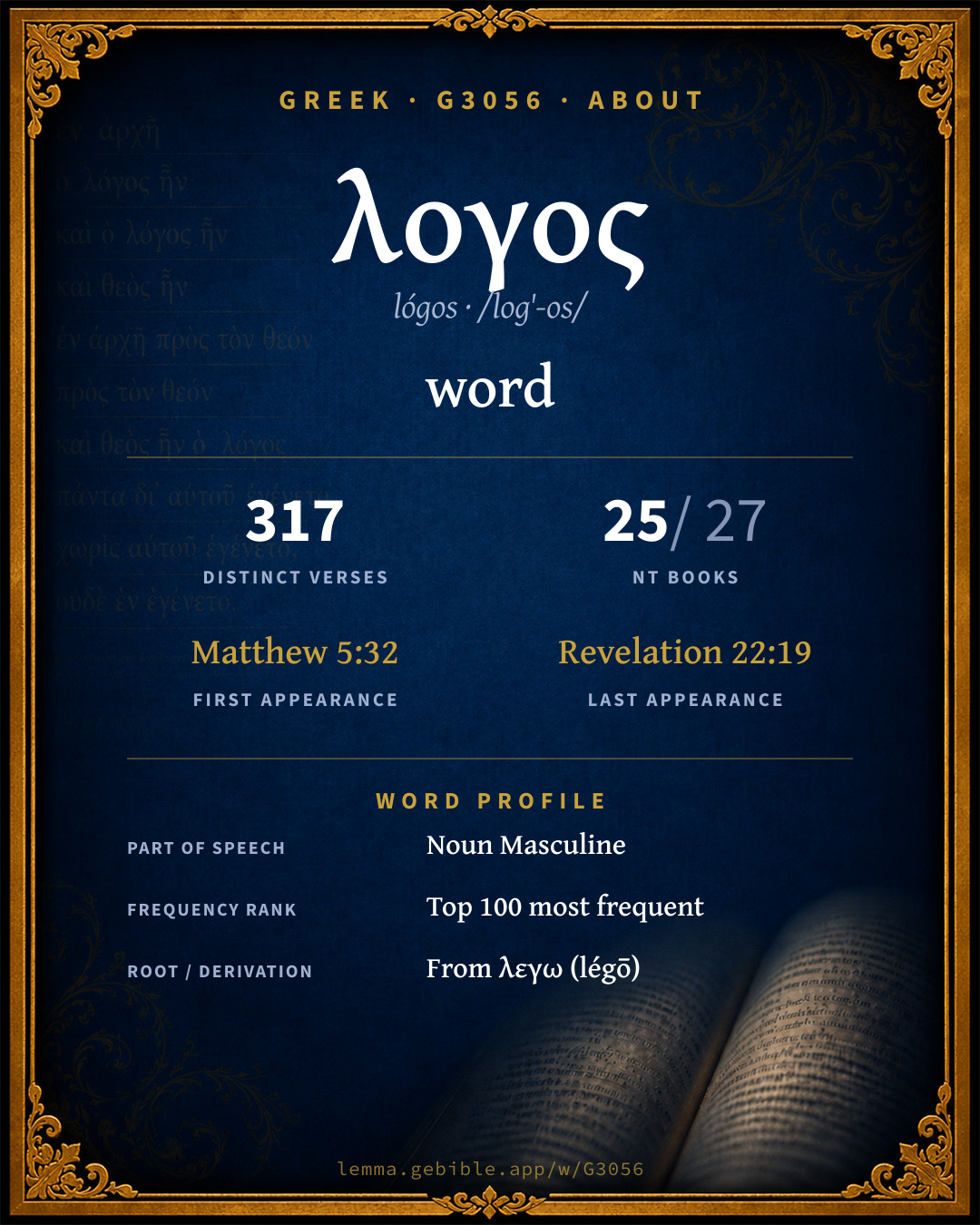
λόγος
word
‘word’ is one of 9 main senses fuller range ↓
Full lexicon entry — Thayer's Greek Lexicon
From Thayer's Greek Lexicon
Where this word appears
See every Nominative-case word in the Greek New Testament →
Grammar key — what these labels mean
Part of speech
- Noun
- A naming word — a person, place, thing, or idea.
Case
- Accusative
- The case of the direct object and of extent.
- Nominative
- The case of the subject (and the predicate nominative).
- Dative
- The case of the indirect object, means, or location — “to / for / with / in.”
- Genitive
- The case of source, possession, or “of” — answers “whose / from what.”
Gender
- Masculine
- Grammatically masculine.
Number
- Singular
- One.
- Plural
- More than one.
6 verses where G3056 appears in the Nominative case in the Book of Hebrews. Filtered view — show all forms. Click any verse to open its interlinear word-by-word view. Verse text shown in the World English Bible for context — . Each verse’s Greek form is shown with its reference; the English is not keyword-highlighted, since the data carries no word-level English alignment. Use “Compare translations” on any verse to read it across multiple English versions. This concordance covers the Greek New Testament; Septuagint (Greek Old Testament) occurrences of this word are not indexed here.
Hebrews
- Hebrews 2:2 λόγος n nom sg masc For if the word spoken through angels proved steadfast, and every transgression and disobedience received a just recompense;
- Hebrews 4:2 λόγος n nom sg masc For indeed we have had good news preached to us, even as they also did, but the word they heard didn't profit them, because it wasn't mixed with faith by those who heard.
- Hebrews 4:12 λόγος n nom sg masc For the word of God is living, and active, and sharper than any two-edged sword, and piercing even to the dividing of soul and spirit, of both joints and marrow, and is able to discern the thoughts and intentions of the heart.
- Hebrews 4:13 λόγος n nom sg masc There is no creature that is hidden from his sight, but all things are naked and laid open before the eyes of him with whom we have to do.
- Hebrews 5:11 λόγος n nom sg masc About him we have many words to say, and hard to interpret, seeing you have become dull of hearing.
- Hebrews 7:28 λόγος n nom sg masc For the law appoints men as high priests who have weakness, but the word of the oath which came after the law appoints a Son forever who has been perfected.
About this entry
At a glance — auto-summarized from this page’s data, not written by a person. Every figure links to its source below. This summary describes the numbers; it doesn’t interpret them.
λογος (lógos) is a Greek noun most often rendered “word.” Ranging over 9 senses, it is not a single-sense word. Spanning 317 verses in 25 books, it ranks among the common words of the Greek New Testament. Scripture first uses it in Matthew 5:32. Sharing its root, it stands alongside λεγω, βαττολογεω and λογια. The sections below give every sense, occurrence, and version rendering.
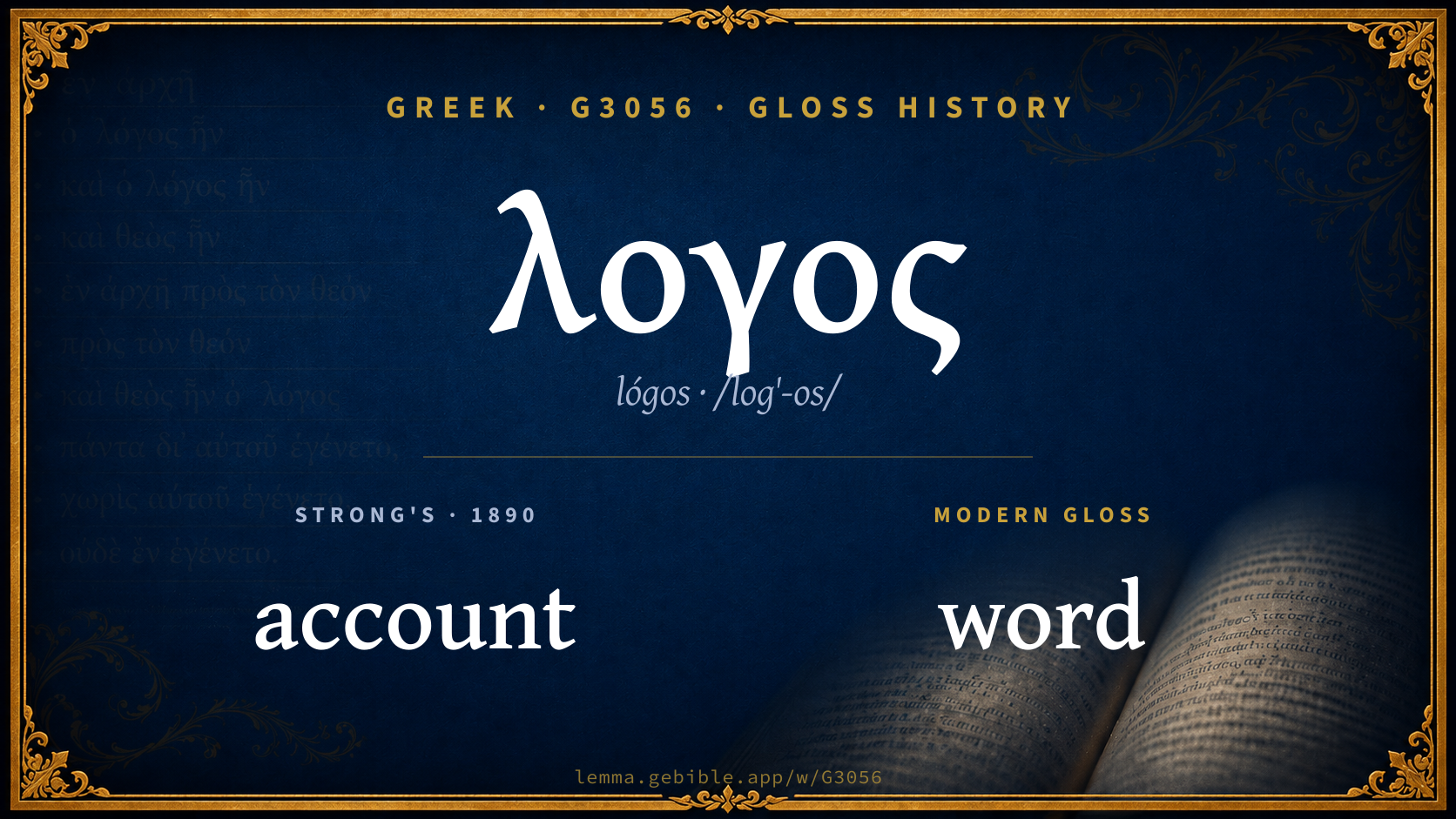
Gloss history
Strong's 1890 vs modern scholarship
About this word
Strong's G3056 catalogs a Greek word from the Greek New Testament.
These counts are not copied from any lexicon or concordance. They are computed here, from the morphology-tagged Greek New Testament. What Lemma adds →
- 317
- distinct verses
- The word appears in 317 distinct verses.
- 25 / 27
- NT books
- The word appears in 25 of 27 New Testament books.
- #56
- by frequency
- Top 100 most frequent Greek words (rank 56 of 5,347 Greek words by occurrence).
View all 317 occurrences in the concordance →
By section of the New Testament
By traditional corpus
Conventional, traditional groupings — biblical authorship is debated, so this is a traditional corpus grouping, not an authorship claim. Some books belong to more than one corpus (Luke is in both the Gospels and the Lukan corpus, and so on), so these shares overlap and need not total 100%. Each figure is a share of the word’s 317 distinct verses.
- Gospels 121 verses · 38%
- Lukan (Luke–Acts) 98 verses · 31%
- Pauline corpus 79 verses · 25%
- Johannine 61 verses · 19%
- General (Catholic) Epistles 22 verses · 7%
- Revelation 18 verses · 6%
- Hebrews 12 verses · 4%
How translations render this word
Counts come from each version’s own published word-to-Strong’s tagging or interlinear alignment — an approximate guide to how each version renders this word, not a word-level alignment the data otherwise carries. Because each total is that version’s own tagged count, the per-version totals vary from one another and need not match the appearance or distinct-verse counts above. These counts may also differ from a printed concordance because Lemma counts each distinctly tagged rendering and does not collapse phrase taggings into a single head-word total. This is a fixed set of word-tagged versions (KJV, ASV, BSB, ULT) and does not change with the reading translation you choose elsewhere. Each version’s license is shown beside its name below (and on Sources).
- King James Version: Word 174×, Words 46×, Saying 33×
- American Standard Version: Word 186×, Words 58×, Saying 19×
- Berean Standard Bible: Word 142×, Words 54×, Message 33×
- unfoldingWord Literal Text: Word 234×, Words 62×, Message 9×
King James Version Public Domain
Renders G3056 across 325 tagged occurrences — most commonly:
Plus 23 renderings that appear only once — usually multi-word phrases or single function words the recovered tagging swept in, not distinct renderings. Not rendered by a distinct English word in 6 further occurrences.
American Standard Version Public Domain
Renders G3056 across 334 tagged occurrences — most commonly:
Plus other, less common renderings. Plus 25 renderings that appear only once — usually multi-word phrases or single function words the recovered tagging swept in, not distinct renderings.
Berean Standard Bible Public Domain
Renders G3056 across 311 tagged occurrences — most commonly:
Plus other, less common renderings. Plus 28 renderings that appear only once — usually multi-word phrases or single function words the recovered tagging swept in, not distinct renderings. Not rendered by a distinct English word in 16 further occurrences.
unfoldingWord Literal Text CC BY-SA 4.0
Renders G3056 across 347 tagged occurrences — most commonly:
Plus 9 renderings that appear only once — usually multi-word phrases or single function words the recovered tagging swept in, not distinct renderings.
9 senses in Thayer's, in lexicon order
The 9 senses Thayer's distinguishes for this word, in lexicon order (not ranked by frequency or importance). The full entry — with sub-senses — is in the Lexicon Entry tab.
- a word, uttered by a living voice, embodies a conception or idea
- what someone has said
- discourse
- doctrine, teaching
- anything reported in speech; a narration, narrative
- matter under discussion, thing spoken of, affair, a matter in dispute, case, suit at law
- the thing spoken of or talked about; event, deed
- its use as respect to the MIND alone
- In John, denotes the essential Word of God, Jesus Christ, the personal wisdom and power in union with God, his minister…
Word origin
Derived from λεγω (légō) (G3004) — to say.
From G3004 ; something said (including the thought ); by implication a topic (subject of discourse) also reasoning (the mental faculty) or motive ; by extension a computation ; specifically (with the article in John) the divine Expression (that is christ ): - account cause communication X concerning doctrine fame X have to do intent matter mouth preaching question reason + reckon remove say (-ing) shew X speaker speech talk thing + none of these things move me tidings treatise utterance word work.
— Strong’s Exhaustive Concordance (1890), public domain.
Forms in the corpus
The 8 distinct written forms G3056 takes in the Greek New Testament, most frequent first — each parse links to that case’s occurrences in the concordance.
| Form | Parsing | Example | Uses |
|---|---|---|---|
| λόγον lógon | Noun, Accusative, Singular, Masculine | Matthew 12:32 | 129 |
| λόγος lógos | Noun, Nominative, Singular, Masculine | Matthew 5:37 | 68 |
| λόγῳ lógō | Noun, Dative, Singular, Masculine | Matthew 8:8 | 45 |
| λόγου lógou | Noun, Genitive, Singular, Masculine | Matthew 5:32 | 28 |
| λόγους lógous | Noun, Accusative, Plural, Masculine | Matthew 7:24 | 22 |
| λόγοις lógois | Noun, Dative, Plural, Masculine | Mark 10:24 | 17 |
| λόγων lógōn | Noun, Genitive, Plural, Masculine | Matthew 12:37 | 11 |
| λόγοι lógoi | Noun, Nominative, Plural, Masculine | Matthew 24:35 | 10 |
Same root — word family
Other Thayer's entries built from the same root as G3056, grouped by Strong’s listed origin. These share a root / origin per the lexicon — not necessarily a shared meaning. Each links to that word’s own entry.
Derives from
Derived from this word
- βαττολογεω battologéō G945 to stammer
- λογια logía G3048 collection
- λογιζομαι logízomai G3049 to reckon
- λογικος logikós G3050 rational
- λογιος lógios G3052 learned
- λογομαχεω logomachéō G3054 to quarrel
Compare all same-root words → Showing 4 of 8 — not the complete family. They share a root, not necessarily a meaning.
Septuagint usage
The same Greek word λογος appears 939 times in the Greek Old Testament (Septuagint), across 845 verses in 35 books.
- 939
- LXX occurrences
- Tagged occurrences of this Greek word in the Septuagint.
- 845
- verses
- Distinct Septuagint verses containing this word.
- 35 / 39
- OT books
- The word appears in 35 of the 39 Old Testament books.
Sample Septuagint occurrences
- Genesis 4:23 λόγος
- Exodus 4:28 λόγος
- Leviticus 8:36 λόγος
- Numbers 11:23 λόγος
- Deuteronomy 1:1 λόγος
- Joshua 2:20 λόγος
- Judges 2:4 λόγος
- Ruth 4:7 λόγος
- 1 Samuel 3:17 λόγος
- 2 Samuel 1:4 λόγος
- 1 Kings 1:7 λόγος
- 2 Kings 1:7 λόγος
Septuagint occurrences (same lexeme)
Every verse where the same Strong’s number (G3056) appears in the Greek Septuagint — showing the first 50 of 845. Verse text shown in the World English Bible for context; the Greek form is the matched word — the English is not keyword-highlighted.
- Genesis 4:23 λόγος Lamech said to his wives, "Adah and Zillah, Hear my voice, You wives of Lamech, listen to my speech, For I have slain a man for wounding me, A young man for bruising me.
- Genesis 29:13 λόγος It happened, when Laban heard the news of Jacob, his sister's son, that he ran to meet Jacob, and embraced him, and kissed him, and brought him to his house. Jacob told Laban all these things.
- Genesis 34:18 λόγος Their words pleased Hamor, and Shechem, Hamor's son.
- Exodus 4:28 λόγος Moses told Aaron all the words of Yahweh with which he had sent him, and all the signs with which he had charged him.
- Exodus 5:9 λόγος Let heavier work be laid on the men, that they may labor therein; and don't let them pay any attention to lying words."
- Exodus 18:19 λόγος Listen now to my voice. I will give you counsel, and God be with you. You represent the people before God, and bring the causes to God.
- Exodus 19:7 λόγος Moses came and called for the elders of the people, and set before them all these words which Yahweh commanded him.
- Exodus 19:8 λόγος All the people answered together, and said, "All that Yahweh has spoken we will do." Moses reported the words of the people to Yahweh.
- Exodus 20:1 λόγος God spoke all these words, saying,
- Exodus 24:3 λόγος Moses came and told the people all the words of Yahweh, and all the ordinances; and all the people answered with one voice, and said, "All the words which Yahweh has spoken will we do."
- Exodus 24:8 λόγος Moses took the blood, and sprinkled it on the people, and said, "Look, this is the blood of the covenant, which Yahweh has made with you concerning all these words."
- Exodus 33:17 λόγος Yahweh said to Moses, "I will do this thing also that you have spoken; for you have found favor in my sight, and I know you by name."
- Exodus 34:27 λόγος Yahweh said to Moses, "Write you these words: for in accordance with these words I have made a covenant with you and with Israel."
- Exodus 34:28 λόγος He was there with Yahweh forty days and forty nights; he neither ate bread, nor drank water. He wrote on the tablets the words of the covenant, the ten commandments.
- Exodus 35:1 λόγος Moses assembled all the congregation of the children of Israel, and said to them, "These are the words which Yahweh has commanded, that you should do them.
- Leviticus 8:36 λόγος Aaron and his sons did all the things which Yahweh commanded by Moses.
- Numbers 11:23 λόγος Yahweh said to Moses, Has Yahweh's hand grown short? now shall you see whether my word shall happen to you or not.
- Numbers 12:6 λόγος He said, Hear now my words: if there be a prophet among you, I Yahweh will make myself known to him in a vision, I will speak with him in a dream.
- Numbers 16:31 λόγος It happened, as he made an end of speaking all these words, that the ground split apart that was under them;
- Numbers 21:21 λόγος Israel sent messengers to Sihon king of the Amorites, saying,
- Deuteronomy 1:1 λόγος These are the words which Moses spoke to all Israel beyond the Jordan in the wilderness, in the Arabah over against Suph, between Paran, and Tophel, and Laban, and Hazeroth, and Dizahab.
- Deuteronomy 1:18 λόγος I commanded you at that time all the things which you should do.
- Deuteronomy 1:32 λόγος Yet in this thing you didn't believe Yahweh your God,
- Deuteronomy 1:34 λόγος Yahweh heard the voice of your words, and was angry, and swore, saying,
- Deuteronomy 2:26 λόγος I sent messengers out of the wilderness of Kedemoth to Sihon king of Heshbon with words of peace, saying,
- Deuteronomy 3:26 λόγος But Yahweh was angry with me for your sakes, and didn't listen to me; and Yahweh said to me, Let it suffice you; speak no more to me of this matter.
- Deuteronomy 4:9 λόγος Only take heed to yourself, and keep your soul diligently, lest you forget the things which your eyes saw, and lest they depart from your heart all the days of your life; but make them known to your children and your children's children;
- Deuteronomy 4:30 λόγος When you are in oppression, and all these things are come on you, in the latter days you shall return to Yahweh your God, and listen to his voice:
- Deuteronomy 5:28 λόγος Yahweh heard the voice of your words, when you spoke to me; and Yahweh said to me, I have heard the voice of the words of this people, which they have spoken to you: they have well said all that they have spoken.
- Deuteronomy 9:10 λόγος Yahweh delivered to me the two tables of stone written with the finger of God; and on them [was written] according to all the words, which Yahweh spoke with you on the mountain out of the midst of the fire in the day of the assembly.
- Deuteronomy 10:4 λόγος He wrote on the tables, according to the first writing, the ten commandments, which Yahweh spoke to you on the mountain out of the midst of the fire in the day of the assembly: and Yahweh gave them to me.
- Deuteronomy 12:28 λόγος Observe and hear all these words which I command you, that it may go well with you, and with your children after you forever, when you do that which is good and right in the eyes of Yahweh your God.
- Deuteronomy 13:4 λόγος You shall walk after Yahweh your God, and fear him, and keep his commandments, and obey his voice, and you shall serve him, and cleave to him.
- Deuteronomy 13:15 λόγος you shall surely strike the inhabitants of that city with the edge of the sword, destroying it utterly, and all that is therein and the cattle of it, with the edge of the sword.
- Deuteronomy 16:19 λόγος You shall not wrest justice: you shall not respect persons; neither shall you take a bribe; for a bribe does blind the eyes of the wise, and pervert the words of the righteous.
- Deuteronomy 22:14 λόγος and lay shameful things to her charge, and bring up an evil name on her, and say, I took this woman, and when I came near to her, I didn't find in her the tokens of virginity;
- Deuteronomy 22:17 λόγος and, behold, he has laid shameful things [to her charge], saying, I didn't find in your daughter the tokens of virginity; and yet these are the tokens of my daughter's virginity. They shall spread the garment before the elders of the city.
- Deuteronomy 22:20 λόγος But if this thing be true, that the tokens of virginity were not found in the young lady;
- Deuteronomy 27:3 λόγος and you shall write on them all the words of this law, when you are passed over; that you may go in to the land which Yahweh your God gives you, a land flowing with milk and honey, as Yahweh, the God of your fathers, has promised you.
- Deuteronomy 27:26 λόγος Cursed be he who doesn't confirm the words of this law to do them. All the people shall say, Amen.
- Deuteronomy 28:14 λόγος and shall not turn aside from any of the words which I command you this day, to the right hand, or to the left, to go after other gods to serve them.
- Deuteronomy 28:69 λόγος
- Deuteronomy 29:8 λόγος and we took their land, and gave it for an inheritance to the Reubenites, and to the Gadites, and to the half-tribe of the Manassites.
- Deuteronomy 31:1 λόγος Moses went and spoke these words to all Israel.
- Deuteronomy 31:12 λόγος Assemble the people, the men and the women and the little ones, and your foreigner who is within your gates, that they may hear, and that they may learn, and fear Yahweh your God, and observe to do all the words of this law;
- Deuteronomy 31:24 λόγος It happened, when Moses had made an end of writing the words of this law in a book, until they were finished,
- Deuteronomy 31:28 λόγος Assemble to me all the elders of your tribes, and your officers, that I may speak these words in their ears, and call heaven and earth to witness against them.
- Deuteronomy 32:44 λόγος Moses came and spoke all the words of this song in the ears of the people, he and Joshua the son of Nun.
- Deuteronomy 32:46 λόγος He said to them, Set your heart to all the words which I testify to you this day, which you shall command your children to observe to do, [even] all the words of this law.
- Deuteronomy 32:47 λόγος For it is no vain thing for you; because it is your life, and through this thing you shall prolong your days in the land, where you go over the Jordan to possess it.
These are occurrences of the same Greek lexeme (G3056) in the Septuagint — not a translation of any one Hebrew word. The store carries no word-level Hebrew↔Greek alignment, so no Hebrew original is asserted here. Counts come from the recovered LXX Strong's tagging — high-frequency vocabulary is well covered, while rare or late forms may be untagged — so they reflect tagged occurrences and may slightly undercount.