
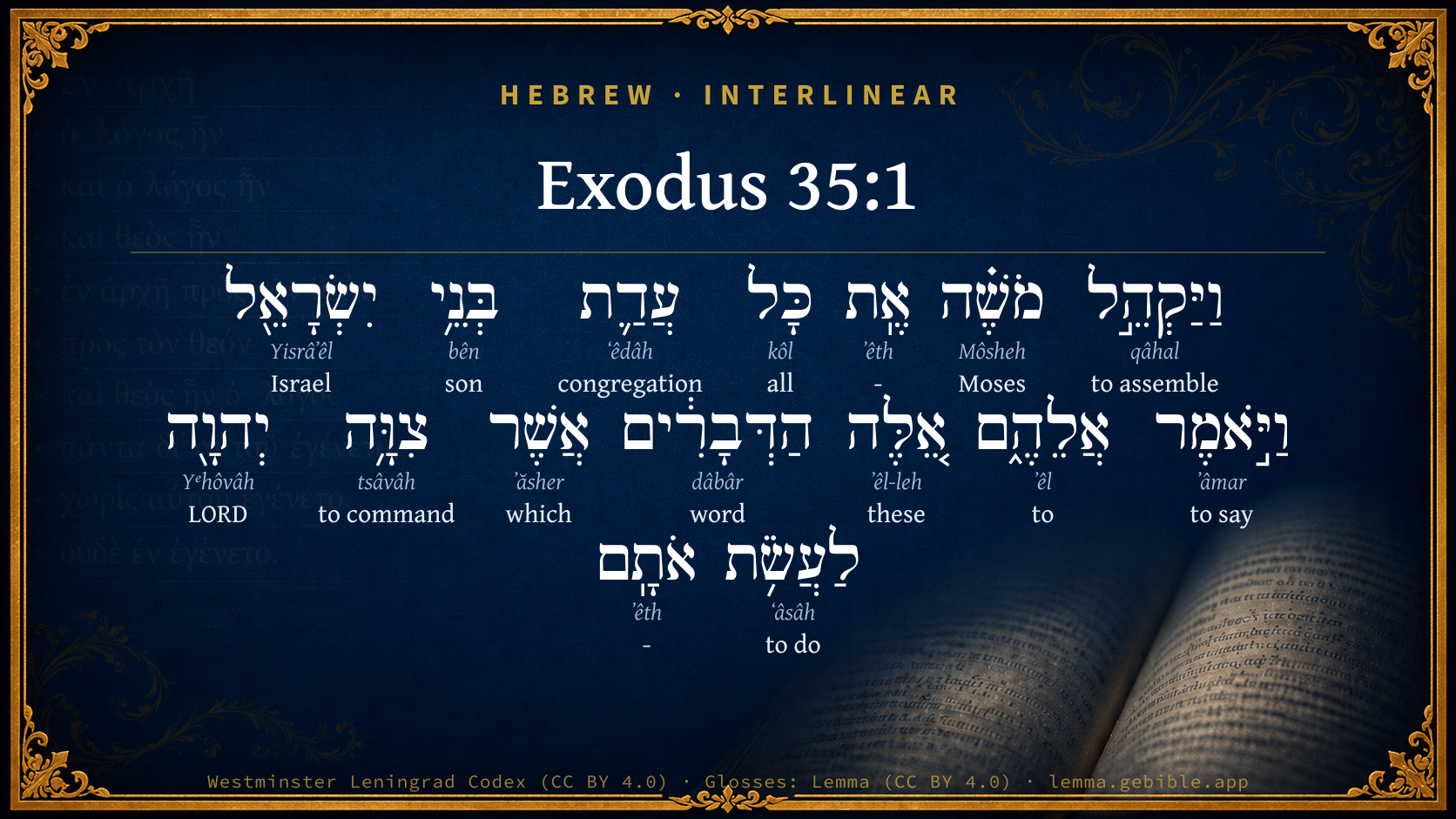
Exodus 35:1

Hebrew (Westminster Leningrad Codex) Exodus 35:1 appears in the Hebrew Old Testament. The text above is from the Westminster Leningrad Codex. Each word links to its Strong’s number, a concise gloss, and parsing drawn from the Open Scriptures Hebrew Bible morphology. Click any word for its full Brown-Driver-Briggs (BDB) entry.
Download image
Cite this verse

Exodus 35:1 (World English Bible). Public Domain. Lemma interlinear Bible study tool, https://lemma.gebible.app/v/exodus/35/1.

Show BibTeX & RIS
BibTeX
RIS
English Translation
Moses assembled all the congregation of the children of Israel, and said to them, "These are the words which Yahweh has commanded, that you should do them.
World English Bible · Public Domain
Download a study sheet

One document with this verse’s original text, its word-by-word gloss line, the meaning frame, cross-references with their text, attributed commentary, and full source and license credits — printable, and it pastes into notes with its structure intact.

This verse Autodidact and up

Study sheet (.html) Plain text (.txt)

A passage Seminary Student

Up to 50 verses in one chapter. A passage sheet keeps up to 6 commentary sources and 12 cross-references per verse, in the order this page ranks them, and says so on the sheet whenever that leaves anything out. Ask for a single verse and you get the Autodidact verse sheet above.

Everything on this page stays free to read, with no account — the sheet is a download of what is already on screen, not access to it.

Want to remove ads? Support Godless Engineer
Compare translations 3

The same verse in 3 English versions, stacked beneath the original-language interlinear above. Click any original word for its lexicon entry.

Each is an independent rendering of the whole verse — the interlinear is not word-aligned to these translations.

Highlighted words mark where these versions differ — a whole-verse word diff, not a word-by-word alignment.

  • World English Bible Public Domain
    Moses assembled all the congregation of the children of Israel, and said to them, "These are the words which Yahweh has commanded, that you should do them.
  • King James Version Public Domain
    And Moses gathered all the congregation of the children of Israel together, and said unto them, These are the words which the LORD hath commanded, that ye should do them.
  • unfoldingWord Literal Text CC BY-SA 4.0
    And Moses assembled all the congregation of the sons of Israel and said to them, “These are the things that Yahweh has commanded you to do.

unfoldingWord Literal Text — © unfoldingWord, licensed CC BY-SA 4.0. Word-aligned USFM3 via Door43 (git.door43.org/unfoldingWord/en_ult).

Versions to compare (up to 4)

3 of 4 selected

Show all 18 translations

Every available English version of this verse, each an independent rendering of the whole verse.

  • World English Bible Public Domain
    Moses assembled all the congregation of the children of Israel, and said to them, "These are the words which Yahweh has commanded, that you should do them.
  • Berean Standard Bible Public Domain
    Then Moses assembled the whole congregation of Israel and said to them, “These are the things that the LORD has commanded you to do:
  • Majority Standard Bible Public Domain
    Then Moses assembled the whole congregation of Israel and said to them, “These are the things that the LORD has commanded you to do:
  • King James Version Public Domain
    And Moses gathered all the congregation of the children of Israel together, and said unto them, These are the words which the LORD hath commanded, that ye should do them.
  • American Standard Version (1901) Public Domain
    And Moses assembled all the congregation of the children of Israel, and said unto them, These are the words which Jehovah hath commanded, that ye should do them.
  • Revised Version (1885) Public Domain
    And Moses assembled all the congregation of the children of Israel, and said unto them, These are the words which the LORD hath commanded, that ye should do them.
  • Geneva Bible (1599) Public Domain
    Then Moses assembled all the Congregation of the children of Israel, and sayd vnto them, These are the wordes which the Lord hath commanded, that ye should do them:
  • Douay-Rheims (1899) Public Domain
    And all the multitude of the children of Israel being gathered together, he said to them: These are the things which the Lord hath commanded to be done.
  • Young's Literal Translation Public Domain
    And Moses assembleth all the company of the sons of Israel, and saith unto them, `These `are' the things which Jehovah hath commanded -- to do them:
  • Literal Standard Version CC BY-SA 4.0
    And Moses assembles all the congregation of the sons of Israel and says to them, “These [are] the things which YHWH has commanded—to do them:
  • Unlocked Literal Bible CC BY-SA 4.0
    Moses assembled all the community of the Israelites and said to them, “These are the things that Yahweh has commanded you to do.
  • unfoldingWord Literal Text CC BY-SA 4.0
    And Moses assembled all the congregation of the sons of Israel and said to them, “These are the things that Yahweh has commanded you to do.
  • Darby Bible Public Domain
    And Moses collected all the assembly of the children of Israel, and said to them, These are the things which Jehovah has commanded, to do them.
  • World Messianic Bible Public Domain
    Moses assembled all the congregation of the children of Israel, and said to them, “These are the words which the LORD has commanded, that you should do them.
  • Webster's Bible Public Domain
    And Moses assembled all the congregation of the children of Israel, and said to them, These are the words which the LORD hath commanded, that ye should do them.
  • Free Bible Version CC BY-SA 4.0
    Moses summoned all the Israelites and told them, “This is what the Lord has ordered you to do:
  • Bible in Basic English Public Domain
    And Moses sent for all the children of Israel to come together, and said to them, This is what the Lord has said and these are his orders.
  • JPS Tanakh (1917) Public Domain
    And Moses assembled all the congregation of the children of Israel, and said unto them: 'These are the words which the LORD hath commanded, that ye should do them.

Literal Standard Version (2020), Covenant Press — licensed CC BY-SA 4.0. Text via the HelloAO Bible API (eBible.org). Unlocked Literal Bible (unfoldingWord) — licensed CC BY-SA 4.0. Text via the HelloAO Bible API (eBible.org). unfoldingWord Literal Text — © unfoldingWord, licensed CC BY-SA 4.0. Word-aligned USFM3 via Door43 (git.door43.org/unfoldingWord/en_ult). Free Bible Version, Dr. Jonathan Gallagher — licensed CC BY-SA 4.0. Text via the HelloAO Bible API (eBible.org).

Word by word

More ways to search: Search by grammar → Find every occurrence → Compare this word →

Practice this passage: Drill this verse → Learn its vocabulary →

וַיַּקְהֵ֣ל
qâhal
H6950
“and · to assemble”
Conjunction + Verb, Hiphil, Sequential Imperfect, 3rd Person, Masculine, Singular
Part of Speech
Conjunction + Verb
Stem
Hiphil
Form
Sequential Imperfect
Person
3rd Person
Gender
Masculine
Number
Singular
Full BDB Definition

Origin: a primitive root

TWOT: 1991

to assemble, gather - (Niphal) to assemble - for religious reasons - for political reasons - (Hiphil) to summon an assembly - for war, judgment - for religious purposes
  1. מֹשֶׁ֗ה Môsheh H4872 “Moses” Noun, Proper
  2. אֶֽת ʼêth H853 “-” Particle, Direct Object
  3. כָּל kôl H3605 “all of” Noun, Common, Masculine, Singular, Construct
  4. עֲדַ֛ת ʻêdâh H5712 “congregation of” Noun, Common, Feminine, Singular, Construct
  5. בְּנֵ֥י bên H1121 “sons of” Noun, Common, Masculine, Plural, Construct
  6. יִשְׂרָאֵ֖ל Yisrâʼêl H3478 “Israel” Noun, Proper
  7. וַיֹּ֣אמֶר ʼâmar H559 “and · to say” Conjunction + Verb, Qal, Sequential Imperfect, 3rd Person, Masculine, Singular
  8. אֲלֵהֶ֑ם ʼêl H413 “to · them” Preposition + Suffix, Personal, 3rd Person, Masculine, Plural
  9. אֵ֚לֶּה ʼêl-leh H428 “these” Pronoun, Demonstrative, Common, Plural
  10. הַדְּבָרִ֔ים dâbâr H1697 “the · words” Particle, Definite Article + Noun, Common, Masculine, Plural, Absolute
  11. אֲשֶׁר ʼăsher H834 “which” Particle, Relative
  12. צִוָּ֥ה tsâvâh H6680 “to command” Verb, Piel, Perfect, 3rd Person, Masculine, Singular
  13. יְהוָ֖ה Yᵉhôvâh H3068 “LORD” Noun, Proper
  14. לַעֲשֹׂ֥ת ʻâsâh H6213 “to do” Preposition + Verb, Qal, Infinitive Construct
  15. אֹתָֽם ʼêth H853 “- · them” Particle, Direct Object + Suffix, Personal, 3rd Person, Masculine, Plural

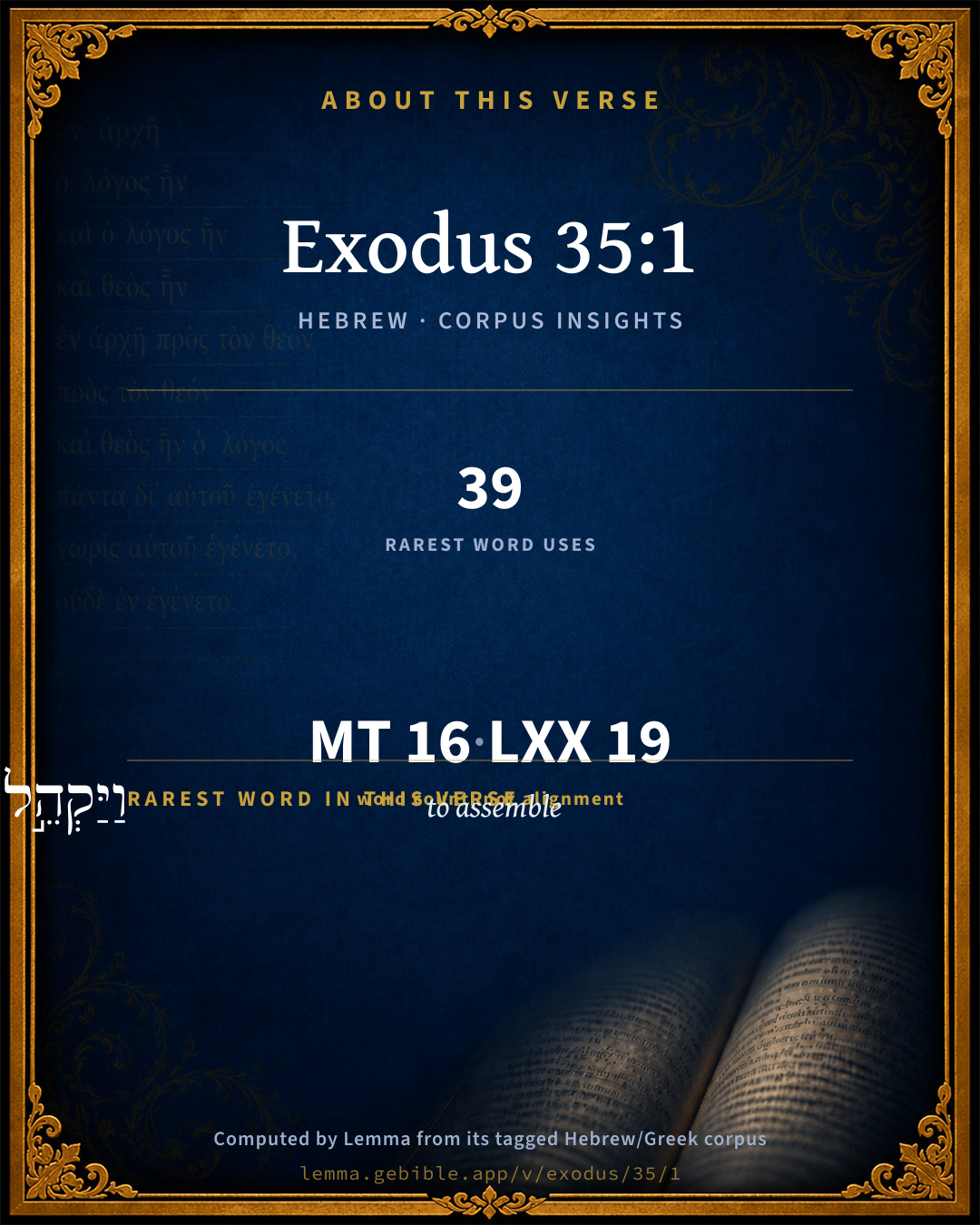
About this verse

These counts appear in no published source. They are computed here, from the morphology-tagged text and Lemma’s own curated glosses. What Lemma adds →

16
words
15
distinct lemmas
Pentateuch
section

Shared distinctive vocabulary

וַיַּקְהֵ֣ל to assemble H6950 occurs in 39 verses of the Hebrew Bible. Also found in:

Grammatical profile

  • 4 verbs
  • 7 nouns
  • 1 pronoun
  • 1 preposition
  • 3 particles

Verb forms

  • וַיַּקְהֵ֣ל Hiphil · Sequential Imperfect
  • וַיֹּ֣אמֶר Qal · Sequential Imperfect
  • צִוָּ֥ה Piel · Perfect
  • לַעֲשֹׂ֥ת Qal · Infinitive Construct

Hebrew & Septuagint length

In English translation the verse runs 27 words from the Hebrew and 28 from the Septuagint (LXX English) — closely comparable.

A rough comparison of the two English renderings, which tokenize alike — not a word-level alignment.

Word counts can differ between the Hebrew and the Greek without any difference in meaning — e.g. the Hebrew direct-object marker אֵת has no separate Greek word, and Greek often adds the article ὁ.

In the original languages it is 16 Hebrew tokens and 19 Greek tokens — but the two are counted differently (Hebrew bundles its prefixes and suffixes into one token; the Greek is in lemma form), so that isn’t a like-for-like length.

Cross-references

6

Topical passages linked to Exodus 35:1 in the Treasury of Scripture Knowledge — connected by theme and wording, ordered by reader-vote popularity; previews shown in the World English Bible.

  • Exodus 34:32 Afterward all the children of Israel came near, and he gave them all of the commandments that Yahweh had spoken with him on Mount Sinai.
  • Exodus 25:1–40 Yahweh spoke to Moses, saying,
  • Exodus 31:1–11 Yahweh spoke to Moses, saying,
  • Matthew 7:21–27 Not everyone who says to me, 'Lord, Lord,' will enter into the Kingdom of Heaven; but he who does the will of my Father who is in heaven.
  • Romans 2:13 For it isn't the hearers of the law who are righteous before God, but the doers of the law will be justified
  • James 1:22 But be doers of the word, and not only hearers, deluding your own selves.

Cross-references courtesy of OpenBible.info (CC BY 4.0).

Hebrew and Greek witnesses Masoretic Hebrew ↔ Greek Septuagint

The same verse in the two great witnesses to the Old Testament, shown verse-for-verse.

These are two independent witnesses, not word-aligned to each other, and the Septuagint is shown in lemma (dictionary) form.

Hebrew Exodus 35:1 Masoretic · Westminster Leningrad Codex

וַיַּקְהֵ֣ל מֹשֶׁ֗ה אֶֽת כָּל עֲדַ֛ת בְּנֵ֥י יִשְׂרָאֵ֖ל וַיֹּ֣אמֶר אֲלֵהֶ֑ם אֵ֚לֶּה הַדְּבָרִ֔ים אֲשֶׁר צִוָּ֥ה יְהוָ֖ה לַעֲשֹׂ֥ת אֹתָֽם

Moses assembled all the congregation of the children of Israel, and said to them, "These are the words which Yahweh has commanded, that you should do them.

World English Bible · Public Domain

Greek LXX Exodus 35:1 Septuagint · lemma form

καί συνἀθροίζω μωυσῆς πᾶς συναγωγή υἱός ἰσραήλ καί εἶπον πρός αὐτός οὗτος ὁ λόγος ὅς εἶπον κύριος ποιέω αὐτός

And Moses gathered all the congregation of the children of Israel together, and said, These are the words which the Lord has spoken for you to do them.

LXX2012 (modern English Septuagint) · Public Domain

Hebrew: Westminster Leningrad Codex (CC BY 4.0). Greek: Septuagint (public domain); English from LXX2012 (modern English Septuagint) (Public Domain). How the Septuagint differs from the Hebrew →

Targum (Aramaic paraphrase)

2

The Targum is the ancient Jewish Aramaic paraphrase of the Hebrew Scriptures — an interpretive translation, not the Hebrew text itself. Onkelos (literal) and Pseudo-Jonathan (expansive) render the Torah, and Jonathan the Prophets. Coverage is partial: where no permissively-licensed English translation exists for a verse, only the Aramaic is shown. This is verse-level text, not a word-by-word alignment to the Hebrew.

  1. Targum Onkelos Torah (Genesis–Deuteronomy)
    וְאַכְנֵשׁ משֶׁה יָת כָּל כְּנִשְׁתָּא דִבְנֵי יִשְרָאֵל וַאֲמַר לְהוֹן אִלֵין פִּתְגָמַיָא דִי פַקֵד יְיָ לְמֶעְבַּד יָתְהוֹן:

    (no public-domain English translation for this verse)

    Targum Onkelos — Aramaic: “Onkelos Genesis” (public domain); “Onkelos Exodus” (public domain); “Onkelos Leviticus” (public domain); “Onkelos Numbers” (public domain); “Onkelos Deuteronomy” (public domain). English: “Sefaria Community Translation” (CC0 1.0 (public-domain dedication)); “J.W. Etheridge. The Targums of Onkelos and Jonathan Ben Uzziel on the Pentateuch. London: Longmans, Green, 1862” (public domain). Text via Sefaria.

  2. Targum Pseudo-Jonathan Torah (Genesis–Deuteronomy)
    ויקהל וּכְנַשׁ משֶׁה יַת כָּל כְּנִישְׁתָּא דִבְנֵי יִשְרָאֵל וַאֲמַר לְהוֹן אִלֵּין פִּתְגָמַיָא דְפַקֵיד יְיָ לְמֶעֱבַּד יַתְהוֹן

    And Mosheh gathered together all the congregation of the sons of Israel, and said to them: These are the things which the Lord hath commanded to be done.

    Targum Pseudo-Jonathan — Aramaic: “Targum Jonathan on Genesis” (public domain); “Targum Jonathan on Exodus” (public domain); “Targum Jonathan on Leviticus” (public domain); “Targum Jonathan on Numbers” (public domain); “Targum Jonathan on Deuteronomy” (public domain). English: “The Targum of Jonathan ben Uzziel, trans. J. W. Etheridge, London, 1862” (public domain). Text via Sefaria.

Commentary

Notes on Exodus 35:1 from classic Christian and Jewish commentators (each source and its license shown beneath its notes). The classic Christian expositions comment on the surrounding passage and are grouped to its opening verse, so a note may address several verses; the Jewish commentaries on the Tanakh (Rashi and others) are per-verse, so they appear only where the commentator wrote on this verse.

Lemma curates 59 commentaries, every one of them public domain or Creative Commons licensed, each selected and text-cleaned for this edition rather than reprinted as found. About our sources →

Matthew Henry's Commentary

It was said in general (Exo 34:32), Moses gave them in commandment all that the Lord has spoken with him. But, the erecting and furnishing of the tabernacle being the work to which they were now immediately to apply themselves, there is particular mention of the orders given concerning it.

I. All the congregation is summoned to attend (Exo 35:1); that is, the heads and rulers of the congregation, the representatives of the several tribes, who must receive instructions from Moses as he had received them from the Lord, and must communicate them to the people. Thus John, being commanded to write to the seven churches what had been revealed to him, writes it to the angels, or ministers, of the churches.

II. Moses gave them in charge all that (and that only) which God had commanded him; thus he approved himself faithful both to God and Israel, between whom he was a messenger or mediator. If he had added, altered, or diminished, he would have been false to both. But, both sides having reposed a trust in him, he was true to the trust; yet he was faithful as a servant only, but Christ as a Son, Heb 3:5, Heb 3:6.

III. He begins with the law of the sabbath, because that was much insisted on in the instructions he had received (Exo 35:2, Exo 35:3): Six days shall work be done, work for the tabernacle, the work of the day that was now to be done in its day; and they had little else to do here in the wilderness, where they had neither husbandry nor merchandise, neither food to get nor clothes to make: but on the seventh day you must not strike a stroke, no, not at the tabernacle-work; the honour of the sabbath was above that of the sanctuary, more ancient and more lasting; that must be to you a holy day, devoted to God, and not be spent in common business. It is a sabbath of rest. It is a sabbath of sabbaths (so some read it), more honourable and excellent than any of the other feasts, and should survive them all. A sabbath of sabbatism, so others read it, being typical of that sabbatism or rest, both spiritual and eternal, which remains for the people of God, Heb 4:9. It is a sabbath of rest, that is, in which a rest from all worldly labour must be very carefully and strictly observed. It is a sabbath and a little sabbath, so some of the Jews would have it read; not only observing the whole day as a sabbath, but an hour before the beginning of it, and an hour after the ending of it, which they throw in over and above out of their own time, and call a little sabbath, to show how glad they are of the approach of the sabbath and how loth to part with it. It is a sabbath of rest, but it is rest to the Lord, to whose honour it must be devoted. A penalty is here annexed to the breach of it: Whosoever doeth work therein shall be put to death. Also a particular prohibition of kindling fires on the sabbath day for any servile work, as smith's work, or plumbers, etc.

IV. He orders preparation to be made for the setting up of the tabernacle. Two things were to be done: -

1. All that were able must contribute: Take you from among you an offering, Exo 35:5. The tabernacle was to be dedicated to the honour of God, and used in his service; and therefore what was brought for the setting up and furnishing of that was an offering to the Lord. Our goodness extends not to God, but what is laid out for the support of his kingdom and interest among men he is pleased to accept as an offering to himself; and he requires such acknowledgements of our receiving our all from him and such instances of our dedicating our all to him. The rule is, Whosoever is of a willing heart let him bring. It was not to be a tax imposed upon them, but a benevolence or voluntary contribution, to intimate to us, (1.) That God has not made our yoke heavy. He is a prince that does not burden his subjects with taxes, nor make them to serve with an offering, but draws with the cords of a man, and leaves it to ourselves to judge what is right; his is a government that there is no cause to complain of, for he does not rule with rigour. (2.) That God loves a cheerful giver, and is best pleased with the free-will offering. Those services are acceptable to him that come from the willing heart of a willing people, Psa 110:3.

2. All that were skilful must work: Every wise-hearted among you shall come, and make, Exo 35:10. See how God dispenses his gifts variously; and, as every man hath received the gift, so he must minister, Pe1 4:10. Those that were rich must bring in materials to work on; those that were ingenious must serve the tabernacle with their ingenuity; as they needed one another, so the tabernacle needed them both, Co1 12:7-21. The work was likely to go on when some helped with their purses, others with their hands, and both with a willing heart. Moses, as he had told them what must be given (Exo 35:5-9), so he gives them the general heads of what must be made (Exo 35:11-19), that, seeing how much work was before them, they might apply themselves to it the more vigorously, and every hand might be busy; and it gave them such an idea of the fabric designed that they could not but long to see it finished.

Matthew Henry's Commentary on the Whole Bible (1708–1710) — public domain (CC PDM 1.0). Text via the HelloAO Bible API.

Trapp's Complete Commentary

John Trapp

Exo 35:1 And Moses gathered all the congregation of the children of Israel together, and said unto them, These [are] the words which the LORD hath commanded, that [ye] should do them.

Ver. 1. And said unto them, These, &c,] He often goes over the same things, as the knife doth the whetstone. Good things must be repeated, sicut in acuendo. It is Moses’s own metaphor. {Deu 6:7}

John Trapp, A Commentary or Exposition upon All the Books of the Old and New Testament (1647–1656) — public domain. Text from a community e-Sword module.

Whedon's Commentary on the Bible

Daniel D. Whedon

THE SABBATH, Exo_35:1-3.

1. These are the words — The plan of the tabernacle which had been given Moses in the mount had not yet been communicated to Israel. Moses now assembles all the congregation, and makes known how Jehovah would have them prepare for him a sanctuary.

Daniel D. Whedon (gen. ed.), Commentary on the Old and New Testaments (1874–1909) — public domain. Text from a community e-Sword module.

The Preacher's Complete Homiletical Commentary

Joseph S. Exell (gen. ed.)

CRITICAL NOTES.—

Exo_35:1. And Moses assembled = vayyakheyl]. This assembling suggests the idea of reuniting and strengthening the bonds of union among “all the congregation,” which, through the sad consequences of the sin of the golden calf, were no doubt very much loosened. And Moses does this by first impressing upon the people that most elevating observance of God’s laws, viz., the keeping holy of the Sabbath day, and then by affording them a common interest in a common work. He only now tells them of what he had been told by God (25–31) concerning the holy service. He invites them to bring free-will gifts for the construction of the tabernacle, its vessels, and the holy garments (Exo_35:4-20). This wrought so effectually on their better nature that Moses found it necessary to restrain the spontaneous outflow of their hearty generosity (Exo_36:5).

MAIN HOMILETICS OF THE PARAGRAPH.—Exo_35:1-3

The covenant having been renewed, Moses now relates to the people what God had revealed concerning the time and place of divine worship.

THE TIME FOR DIVINE WORSHIP

1. Moses was never weary of impressing on the people the importance and divine obligation of the Sabbath day. For this there were several obvious reasons.

(1.) The Sabbath was part of the moral law.

(2.) It was necessitated by the conditions of the body and mind needing rest.

(3.) It was a recognition of God’s right to time.

(4.) An opportunity apart from the distractions and duties of life for drawing near unto God. All these reasons are in special force under the Christian dispensation. Why then should Christian preachers tire of teaching it, or Christian people tire of hearing it? It requires no very wide research to find that selfishness, worldliness, and sin are at the bottom of Sabbath desecration.

2. As this chapter deals mainly with the building of the sanctuary, this command may be regarded as applying to that. They were not to break the law even for so good a purpose. So Christians should not do evil on that day for the supposed benefit that may accrue. The question is not, Would it amuse and instruct to open museums on the Sabbath day; but, Is it right to do so? No! says God’s Word. Notice—

I. That the Sabbath was to be a rest after six days’ work. Hence, honest, diligent toil is of equal obligation. Do not let us lay all the emphasis on “Remember the Sabbath day,” and none on “Six days shalt thou labour.” Again, it would be easy to show that if a man has played away his working week he is unfitted for the sacred enjoyment of the day of rest.

II. That the Sabbath was to be a day of sacred rest. “An holy day, a Sabbath of rest to the Lord.” Not of unsanctified idleness, but a cessation of exhausting labour, so that the mind might be wholly given to the refreshing duties which devolve upon that day. A man may no more waste the Lord’s time than his own. Keeping the Sabbath day holy does not mean simply the putting up of shutters, and the putting by of business; it means also attention to those sacred employments which devolve upon us as the servants of God.

III. That the Sabbath implied the cessation of unnecessary labour. “Ye shall kindle no fire,” &c. In eastern climates this would be quite unnecessary. And, indeed, as the materials of life in those climates are so simple and so easily procurable, very little manual work could be said to be necessary. The obvious exceptions, of course, were works of mercy to man and beast. With us it is different; fires, e.g., are necessary. But the prohibition against needless work is binding still. We have ample time to do our necessary works and to enjoy the luxuries of life. Let us not, nor oblige our servants to, rob God of the right to His own day.

In conclusion—Remember that the Sabbath was made for man and not man for the Sabbath.

i. For man’s use. Not for his abuse. If a man wants recreation let him take it out of his own time. ii. For God’s worship. As the institution, or the confirmation at any rate of the Sabbath contemplated the tabernacle, so the Sabbath is inseparably, all through the ages, connected with the worship of God.

—J. W. Burn.

ILLUSTRATIONS

BY

REV. WILLIAM ADAMSON

Moral Law! Exo_35:1-35.

(1.) The ceremonial law was like a scaffolding around a building which is being slowly and gradually raised. When the building is completed, the scaffolding is taken away. But the moral law is like the rafters, deep sunk in the building itself. These cannot be taken away without the ruin of the whole structure of revelation.

(2.) The ceremonial law is like the bright petals of a blossom, which drop off to make room for the fruit. But the moral law is like the stem, which upholds both blossom and fruit. For God is holy—God is good; and therefore the law of holiness and goodness must, like God, endure for ever.

“Thy God is good, His mercy nigh,

His love sustains thy tottering feet;

Trust Him, for His grace is sure,

Ever doth His Truth endure.”

—Zehn.

Sabbath! Exo_35:2. The Sabbath was originally instituted as a day of rest; and was to be employed in the service of God. Of this latter circumstance the Jews had so far lost sight, that they substituted their own superstitious rites in the place of divine ordinances, and thus exchanged a spiritual for a merely ceremonial observance of the day. Concerning some of the superstitions which prevailed amongst the people, Basnage tells us that in the places where they had liberty, in the time of Maimonides, they sounded the trumpet six times to give notice that the Sabbath was beginning. At the first sound the countryman left his plough; at the second. they shut up their shops; at the third, they covered their pits. They lighted candles, and drew the bread out of the oven; but this last article deserves to be insisted on because of the different cases of conscience about which the masters are divided. When the sound of the sixth trumpet surprised those that had not as yet drawn out their bread from the oven, there the pious must leave it, &c.

“A Sabbath glory for the good

No night shall take away;

When shall Thy servant, Lord, attain

To that eternal day?”

—Geork.

Sabbath-Sanctuary! Exo_35:2. The temple, says Hamilton, was a sacred place. In the Middle Ages it was usual to claim for churches the right of sanctuary; so that whosoever took refuge within the hallowed precincts was safe from the avenger. But it is not to a holy place, but to a holy day, that God has given this protecting privilege. Every seventh day was to be a sacred asylum for man and beast. Humboldt despised all religions and hated Christianity; yet he was forced to own that the “seventh day rest from labour” was an unspeakable blessing. But what Humboldt would not acknowledge, viz., its Divine authority, an eloquent Israelite has. Disraeli, in his “Tancred,” remarks that the life and property of Britain are protected by the law of Sinai. The hard-working people of England, he says, are secured a day of rest in every week by the Sinaitic Decalogue; for

“Sunday is the golden clasp

That binds together

The volume of the week.”

—Longfellow.

Sabbath-Service! Exo_35:3. It is no easy matter to be everybody’s friend. Yet we do not fear to say that the friend we are introducing to our readers deserves that gracious name—we mean the Lord’s day. Our friend is most faithful and punctual; every seven days he comes round. However laborious our vocation, however painful our life, we are sure to see that friend reappear at the end of the week, inviting each of us to break for a few hours the monotony of our work, to give a new current to our thoughts, to put on our Sunday garments, and to enjoy necessary repose.

“Why do we heap huge mounds of years

Before us and behind,

And scour the Sabbath days that pass

Like angels on the wing!

Each turning round a small sweet face

As beautiful as near;

Because it is so small a face,

We will not see it clear.”

The Preacher's Complete Homiletical Commentary (gen. ed. Joseph S. Exell; Funk & Wagnalls, c. 1892) — public domain (pre-1929). A full-Bible homiletical/sermon-outline anthology covering 65 of 66 books (2 John is absent from the source module). Text from a community e-Sword module.

Lange's Commentary on the Holy Scriptures

FOURTH DIVISION

The building of the tabernacle. The house of the redeemer and lawgiver, the residence of the king of Israel; or the erection of the tent of meeting

Exodus 35-40

FIRST SECTION

Summons to Build and to Furnish Voluntarily the Building Materials

Exo_35:1-19

1And Moses gathered all the congregation of the children of Israel together, and said unto them, These are the words which Jehovah hath commanded, that ye should do them. 2Six days shall work be done, but on the seventh day there shall be to you an [a] holy day, a sabbath of rest to Jehovah: whosoever doeth work therein shall be put to death. 3Ye shall kindle no fire throughout your habitations [in any of your dwellings] upon the sabbath day.

4And Moses spake unto all the congregation of the children of Israel, saying, This is the thing which Jehovah commanded, saying, 5Take ye from among you an offering unto [for] Jehovah: whosoever is of a willing heart, let him bring it, an offering of the Lord [Jehovah’s offering]; gold, and silver, and brass, 6And blue, and purple, and scarlet, and fine linen, and goats’ hair, 7And rams’ skins dyed red, and badgers’ [seals’] skins, and shittim [acacia] wood, 8And oil for the light, and spices for [for the] anointing oil, and for the sweet incense, 9And onyx stones, and stones to be set, for the ephod, and for the breast-plate. 10And every wise-hearted [wise-hearted man] among you shall come, and make all that Jehovah hath commanded; 11The tabernacle, his [its] tent, and his [its] covering, his taches [its clasps], and his 12[its] boards, his [its] bars, his [its] pillars, and his [its] sockets, The ark, and the staves thereof, with [thereof,] the mercy-seat, and the veil of the covering [screen], 13The table, and his [its] staves, and all his [its] vessels, and the shew-bread, 14The candlestick also for the light, and his [its] furniture, and his [its] lamps, with 15[and] the oil for the light, And the incense altar, and his [its] staves, and the anointing oil, and the sweet incense, and the hanging [screen] for the door, at the entering in [door] of the tabernacle, 16The altar of burnt-offering, with his [its] brazen grate [grating], his [its] staves, and all his [its] vessels [furniture], the laver, and his foot [its base], 17The hangings of the court, his [its] pillars, and their sockets, and the hanging [screen] for the door of the court, 18The pins of the tabernacle, 19and the pins of the court, and their cords, The cloths [garments] of service, to do service [for ministering] in the holy place, the holy garments for Aaron the priest, and the garments of his sons, to minister in the priest’s office [to serve as priests].

EXEGETICAL AND CRITICAL

In general we refer, as other commentaries do, to the previous directions concerning the tabernacle, 25–31, the execution of which is treated of here. The execution is the practical proof that the covenant-relation has been restored, with the afore-mentioned modifications designed for a religion of the covenant in process of formation

Exo_35:2. The repetition of the precept concerning the Sabbath is interpreted by Knobel and Keil as having for its object to apply the law of the Sabbath to the time of the building of the tabernacle. But though this object may be included, yet a more general object is to be inferred from the circumstance that the Sabbath law concludes the command concerning the building (Exo_31:12 sqq.), as well as here opens the summons to carry out the command. The Sabbath, or the holy time, is the prerequisite of worship, or the coming together in the holy place. The addition, prohibiting the kindling of fire, indicates that the law of the Sabbath is made more rigorous in the matter of abstinence.

Exo_35:5-9. Summons to take the voluntary contributions, vid.Exo_25:2-7.

Exo_35:10-19. Invitation to men of artistic talent to render voluntary assistance on the building; and specification of their duties, vid.Exo_25:8; Exo_31:6-11.

___________________

Second Section

The Voluntary Consecratory Gifts, or the Holy Tributes for the Building

Exo_35:20-29

20And all the congregation of the children of Israel departed from the presence of Moses. 21And they came, every one whose heart stirred him up, and every one whom his spirit made willing, and they brought Jehovah’s offering to [for] the work of the tabernacle of the congregation [tent of meeting], and for all his [its] service, and for the holy garments. 22And they came, both men and women [the men with the women], as many as were willing-hearted, and brought bracelets [hooks], and earrings, and rings [signet-rings], and tablets [necklaces], all jewels of gold [all kinds of golden things]: and every man that offered offered an [that offered an] offering of gold unto Jehovah. 23And every man, with whom was found blue, and purple, and scarlet, and fine linen, and goats’ hair, and red skins of rams [rams’ skins dyed red], and badgers’ [seals’] skins, brought them. 24Every one that did offer an offering of silver and brass [copper] brought Jehovah’s offering: and every man, with whom was found shittim [acacia] wood for any work of the service, brought it. 25And all the women that were wise-hearted did spin with their hands, and brought that which they had spun, both of [spun, the] blue, and of purple, and of scarlet, and of 26[and the purple, the scarlet, and the] fine linen. And all the women whose heart stirred them up in wisdom spun [spun the] goats’ hair. 27And the rulers brought onyx [the onyx] stones, and stones to be set, for the ephod, and for the breast-plate; 28And spice [the spice], and oil [the oil;] for the light, and for the anointing oil, and for the sweet incense. 29The children of Israel brought a willing offering unto Jehovah, every man and woman, whose heart made them willing to bring for all manner of [all the] work, which Jehovah had commanded to be made by the hand of Moses.

EXEGETICAL AND CRITICAL

Exo_35:20 sqq. A charming passage, illumined by the clear light of spontaneity, gladsomeness and joy; an appearance of New Testament features in the Old Testament. At the same time there is involved a fine contrast between Moses’ animated summons, issued at God’s command, together with the glad willingness of the people to build a true sanctifying sanctuary, on the one hand, and the people’s cowardly and false-hearted summons, extorted by the sensuous passions of the multitude, and followed by the tumultuous readiness to make offerings for the establishment of an equivocal, barbarizing system of worship, on the other.

Exo_35:22. The men with the women [Lange: to the women].—Keil, referring to עַל, as used in Gen_32:12 (11), would read: “the men together with the children.” But it is probably meant here that the women anticipated the men, as in such religious movements is often the case. In the passage in Genesis, moreover, there is probably an intimation that the enemy first attacks the children, then the mother, who is defending the children; this was suggested in our Commentary on Genesis, though the rendering “together with” is retained.

Exo_35:23. Every man with whom was found.—At first ornaments for the body are offered; then, possessions and treasures; afterwards, the products of female labor; finally also, princely jewels. “According to the Talmudists and Rabbins, followed by Braun (Vestitus sacerdotum, p. 92), Bähr (Symbolik I., p. 265), and others, the purple and crimson cloths were of wool, the שֵׁשׁ (byssus) of linen. But if so, the costume of the high-priest must have consisted of a diversity of materials, which conflicts with Lev_19:19; Deu_22:11, and also Eze_44:17 sq., where wool is forbidden to be used in sacerdotal garments (vid. Gen_41:42; Gen_46:34). It is therefore safer to suppose that all the four kinds of material were flaxen yarn, the first three colored, the last bleached and white” (Knobel). But it is to be observed in reference to this, that the garments of the high-priest did not consist of a single article, and that the precept in Ezekiel relates to the symbolic aspects of a new, ideal sanctuary.1

___________________

Third Section

Bezaleel and his Assistants Introduced to the People to Receive the Consecrated Materials for the Building

Exo_35:30 to Exo_36:7.

30And Moses said unto the children of Israel, See, Jehovah hath called by name Bezaleel the son of Uri, the son of Hur, of the tribe of Judah; 31And he hath filled him with the spirit of God, in wisdom, in understanding, and in knowledge, and in all manner [kinds] of workmanship; 32And to devise curious works [skilful designs], to work in gold, and in silver, and in brass [copper], 33And in the cutting of stones, to set them [stones for setting], and in carving of wood, to make any manner of cunning work [to work in all kinds of skilful work]. 34And he hath put in his heart that he may teach, both he [to teach, in him], and Aholiab, the son of Ahisamach, of the tribe of Dan. 35Them hath he filled with wisdom of heart, to work all manner [to do all kinds] of work, of the engraver, and of the cunning workman [skilful weaver], and of the embroiderer, in blue, and in purple, in scarlet, and in fine linen, and of the weaver, even of them that do any work, and of those that devise cunning work [skilful designs].

Exo_36:1 Then wrought Bezaleel and Aholiab [And Bezaleel and Aholiab shall work], and every wise-hearted man, in whom Jehovah put [hath put] wisdom and understanding to know how to work all manner of work for [do all the work of] the service of the sanctuary, according to all that Jehovah had [hath] commanded. 2And Moses called Bezaleel and Aholiab, and every wise-hearted man, in whose heart Jehovah had put wisdom, even every one whose heart stirred him up to come unto the work to do it; 3And they received of [from] Moses all the offering, which the children of Israel had brought for the work of the service of the sanctuary, to make it withal. And they brought yet [besides] unto him free [free-will] offerings every morning. 4And all the wise men, that wrought all the work of the sanctuary, came every man from his work which they made [were doing]; 5And they spake unto Moses saying, The people bring much more [are bringing too much—more] than enough for the service of the work, which Jehovah commanded to make [tobe done]. 6And Moses gave commandment, and they caused it to be proclaimed throughout the camp, saying, Let neither man nor woman make any more work for the offering of the sanctuary. So the people were restrained from bringing. 7For the stuff they had was sufficient for all the work to make [do] it, and too much [and there was left over].

EXEGETICAL AND CRITICAL

Exo_35:30 sqq. This is not merely a disclosure respecting the future. The skilled workmen under the master workman Bezaleel are introduced to the people as those who, in Moses’ presence, are to receive the offerings which have already been presented, and to judge of the proportion of them to the need. Two principal classes of workmen are named. The חָרָשׁ [smith] includes at least three different occupations, according as the work is in metal, stone, or wood. The weavers are of three classes: the skilled workman, who inweaves figures (חשֵׁב); the weaver who works together the different colors (רֹקֵם); and the plain weaver (אֹרֵג).

Exo_36:5. And they spake unto Moses.—On all sides there is a superfluity of building material, so that Moses has occasion to cause a proclamation to be made in the camp, asking the contributions to be suspended. A rare instance in the history of collections, though also mediæval and evangelical institutions have often attained an excess of prosperity. Knobel remarks on this point: “The Elohist has a more favorable opinion of Israel in Moses’ time than the later narrator has.” But his archæological knowledge ought surely to have presented him here too with examples of how a nation in great crises is lifted above its ordinary level.

___________________

Fourth Section

The Work of the Building and the Priests’ Ornaments. The Elements of the Typical Sacred Structure

Exo_36:8 to Exo_39:31

A.—the curtains of the tent and the coverings

Exo_36:8-19

8And every wise-hearted man among them that wrought the work of the tabernacle made ten [work made the tabernacle with ten] curtains of [curtains: of] fine-twined linen, and blue, and purple, and scarlet, with cherubims [cherubim] of cunning work [the work of the skilful weaver] made he them. 9The length of one [each] curtain was twenty and eight cubits, and the breadth of one [each] curtain four cubits; the curtains were all of one size [had all one measure]. 10And he coupled the five curtains one unto another: and the other five curtains he coupled one unto another. 11And he made loops of blue on the edge of one [the one] curtain from the selvedge in the coupling [at the border in the first set]: likewise he made in the uttermost side of another curtain, in the coupling of the second [the samemade he at the edge of the outmost curtain in the second set]. 12Fifty loops made he in one [the one] curtain, and fifty loops made he in the edge of the curtain which was in the coupling of the second [which was in the second set]: the loops held one curtain to another [were opposite one to another]. 13And he made fifty taches [clasps] of gold, and coupled the curtains one unto another with the taches [clasps]: so it became one tabernacle [and the tabernacle became one].

14And he made curtains of goats’ hair for the [a] tent over the tabernacle; eleven curtains he made them. 15The length of one [each] curtain was thirty cubits, and four cubits was the breadth of one [each] curtain: the eleven curtains were of one size [had one measure]. 16And he coupled five curtains by themselves, and six curtains by themselves. 17And he made fifty loops upon the uttermost edge of the curtain in the coupling [upon the edge of the outermost curtain in the one set], and fifty loops made he upon the edge of the curtain which coupleth the second [curtain, the second set]. 18And he made fifty taches [clasps] of brass [copper] to couple the tent together, that it might be one. 19And he made a covering for the tent of rams’ skins dyed red, and a covering of badgers’ skins above that [seals’ skins above].

B.—the frame—work of the tent

Exo_36:20-34

20And he made boards [the boards] for the tabernacle of shittim [acacia] wood, standing up. 21The length of a board was ten cubits, and the breadth of a [each] 22board one cubit and a half. One [each] board had two tenons, equally distant one from another: thus did he make for all the boards of the tabernacle. 23And he made boards [the boards] for the tabernacle; twenty boards for the south side southward: 24And forty sockets of silver he made under the twenty boards; two sockets under one board for his [its] two tenons, and two sockets under another board for his [its] two tenons. 25And for the other side of the tabernacle which is toward the north corner [tabernacle, the north side], he made twenty boards, 26And their forty sockets of silver; two sockets under one board, and two sockets under another board. 27And for the sides [rear] of the tabernacle westward he made six boards. 28And two boards made he for the corners of the tabernacle in the two sides [the rear]. 29And they were coupled beneath, and coupled together at the head thereof, to one ring [double beneath, and they were together whole up to the top of it, unto the first ring]: thus he did to both of them in [at] both the corners. 30And there were eight boards; and their sockets were sixteen sockets of silver [sockets of silver, sixteen sockets], under every board two sockets. 31And he made bars of shittim [acacia] wood; five for the boards of the one side of the tabernacle, 32And five bars for the boards of the other side of the tabernacle, and five bars for the boards of the tabernacle for the sides [rear] westward. 33And he made the middle bar to shoot through [pass alongat the middle of] the boards from the one end to the other. 34And he overlaid the boards with gold, and made their rings of gold to be [for] places for the bars, and overlaid the bars with gold.

C.—The veil and the screen

Exo_36:35-38

35And he made a [the] veil of blue, and purple, and scarlet, and fine-twined linen: with cherubims made he it of cunning work [cherubim, the work of a skilful weavermade he it]. 36And he made thereunto [for it] four pillars of shittim [acacia] wood, and overlaid them with gold: their hooks were of gold; and he cast for them four sockets of silex Exo_36:37 And he made an hanging [a screen] for the tabernacle door [door of the tent] of blue, and purple, and scarlet, and fine-twined linen, of needle-work 38[linen, embroidered work]: And the five pillars of it with their hooks: and he overlaid their chapiters [capitals] and their fillets [rods] with gold; but [and] their five sockets were of brass.

Footnotes:

[1][But the ephod was a single thing, and according to Exo_28:6 it was made out of all four of these materials. The same is true of the breast-plate (Exo_35:15).—Tr.].

Lange's Commentary on the Holy Scriptures (Critical, Doctrinal, and Homiletical), ed. John Peter Lange, English translation edited by Philip Schaff (1864–1880) — public domain. Text from a community e-Sword module.

The Annotated Bible

Arno C. Gaebelein

6. The Building of the Tabernacle

CHAPTER 35 The Commandments Concerning the Tabernacle Remembered and the Offerings

1. The Sabbath law emphasized (Exo 35:1-3)

2. The offerings restated (Exo 35:4-10)

3. The tabernacle and its furniture restated (Exo 35:11-19)

4. The offerings given (Exo 35:20-29)

5. The workmen and the teachers (Exo 35:30-35)

It is interesting to review the events and steps which lead to this consummation in Exodus, the setting up of the tabernacle. After Jehovah had redeemed His people and led them through the wilderness to Mount Sinai , dealing with them in grace, the law covenant was made. It was broken by them in their rebellion and idolatry. Intercession and another covenant followed, mingled with grace. And now there is obedience and the tabernacle is put up. And when it was finished the glory filled the place, showing that God was well pleased. Jehovah dwelt there with His people. In New Testament times, the true church is His dwelling place, “an habitation of God through the Spirit.” When the age to come, the millennium is reached, He will again dwell in the midst of Israel and manifest His visible glory in Jerusalem and above the city. Then comes eternity when God is all in all. “And I heard a great voice out of heaven saying, Behold, the tabernacle of God is with men, and He will dwell with them” (Rev 21:3).

The Sabbath rest is once more mentioned. This is not a vain repetition, nor is it the mark of imperfection, or the work of different writers, as the critical school has claimed. Rest precedes the work, not work precedes the rest. This is the blessed spiritual principle. This cannot be under the law, but it is blessedly so under grace. We rest in Him, and He gives us rest so that we can labor and give back to Him.

All the details commanded by Jehovah concerning the tabernacle are repeated and also the material to be furnished by the people in free will offerings. How needful was the repetition! He had made the specifications show what they were to bring, as He has shown in His Word the service and work He expects of His people. And then we behold their willing service. Men and women came and brought their gifts. How it must have refreshed His heart. The women are prominently mentioned. The willing heart and the cheerful giver are also seen in the New Testament. When in the future the day of Christ’s power dawns (His second coming) His earthly people, Israel , will be willing to bring their all to His feet: “Thy people shall be willing in the day of Thy power” (Psa 110:3). Then they will build that great and glorious millennial temple, the house of prayer for all nations.

Once more the two leading workmen are mentioned by name and the fact is made known that the Spirit of God fitted them for the work. But something is added here which we do not find in chapter 31, “And He hath put in his heart that he may teach, both he and Aholiab, the son of Ahisamach, of the tribe of Dan.” Besides having the spirit of wisdom they also had the gift of teaching, to pass on to others what they had learned.

Arno C. Gaebelein, The Annotated Bible (1913–1922) — public domain. Text from a community e-Sword module.

F. W. Grant's Numerical Bible

Section 1. (Exo 35:1-35; Exo 36:1-7.)

The free-will offerings.

The first section reminds us of what we have seen to be a necessity if God is to dwell among men; it must be amid their praises. And that not merely as if God must have His due, but because also these praises are the only effectual proof of hearts brought back to Him, filled and satisfied, exulting in Himself. With such happy hearts God must surround Himself if He is to dwell among men; and in this sense their gifts and hands must build His tabernacle.

1. But before this is entered upon here comes one of those wonderful revealing touches which we have so often in these types -at first sight striking us by its apparent strangeness and incongruity, but in that very way calling our attention the more. Why should a law as to the Sabbath, so often given before, be introduced here again, at the commencement of the appeal for free-will offerings for the tabernacle? One well-known commentator can only suppose that in the construction of a work of this kind the people might have thought that they were freed from the necessity of any suspension of labor!

But if we seek a spiritual reason, we may find it in this, that rest indeed is only possible in God -in that divine sufficiency which is able to bear all demands upon it. And is not this the first requisite for all sufficiency on our part, this rest in God? a Sabbath to Jehovah, because Jehovah is known as the God of all deliverances, acting from Himself and for the glory of His name? It is this that enables us to bring Him our free-will offering and build His tabernacle. And therefore it is not strange, but simple, that it should be found here, insisted on in the peremptory fashion of the law indeed, but even thus not without its corresponding truth as solemn for the soul.

Thus, then, are we taught in a mystery, that if we are to bring to God, we must first receive of Him, if we are to work for Him, we must first rest in Him; and good it is that He should command us thus to rest in Him.

2. And now we have the call for help as to the tabernacle, both in furnishing materials and in the work: all being precisely specified by Him whose word must furnish thoroughly unto every good work. It is not enough that we have will to serve Him; we must learn from Himself also what He can accept. Would that the service of His people were thus always measured and defined! What they had they brought, little or much, and it was accepted; for when was the service of a willing heart refused by God? A widow’s "two mites, which make a farthing" may be here of more value to Him who discerns the heart than the gifts of many that are rich. Upon the detail we can say little, however: each must learn individually with God what he can do.

3. Finally, we have the gifts given by the Spirit for the work: and here we find in the chief man raised up a representative of Judah, quite according to the part that Judah afterward plays with regard to the tabernacle and that into which it passes, -the temple for which David provides and which Solomon builds. With him is associated, however, one of a tribe we should least expect to see in such a place -one of the tribe which afterward led in apostasy in Israel -the tribe of Dan. Thus God’s grace can work, and knowing that all is grace, why should we wonder at it? But with these there is work for all who had wisdom, -in whose heart God had put wisdom, -none is refused.

The fruit of the Spirit, too, in the hearts of the people is beautiful: they bring so much, that they have to be restrained from bringing! How good a thing to see, and how seldom indeed seen -a thing like this in the work of the Lord.

F. W. Grant, The Numerical Bible (4th ed., 1903) — public domain. Text from a community e-Sword module.

Adam Clarke's Commentary

CHAPTER XXXV

Moses assembles the congregation to deliver to them the

commandments of God, 1.

Directions concerning the Sabbath, 2, 3.

Free-will offerings of gold, silver, brass, c., for the

tabernacle, 4-7.

Of oil and spices, 8.

Of precious stones, 9.

Proper artists to be employed, 10.

The tabernacle and its tent, 11.

The ark, 12.

Table of the shew-bread, 13.

Candlestick, 14.

Altar of incense, 15.

Altar of burnt-offering, 16.

Hangings, pins, &c., 17, 18.

Clothes of service, and holy vestments, 19.

The people cheerfully bring their ornaments as offerings to

the Lord, 20-22

together with blue, purple, scarlet, &c., &c., 23, 24.

The women spin, and bring the produce of their skill and

industry, 25, 26.

The rulers bring precious stones, &c., 27, 28.

All the people offer willingly, 29.

Bezaleel and Aholiab appointed to conduct and superintend all

the work of the tabernacle, for which they are qualified by the

spirit of wisdom, 30-35.

NOTES ON CHAP. XXXV

Verse 1. And Moses gathered] The principal subjects in this chapter have been already largely considered in the notes on chapters xxv., xxvi., xxvii., xxviii., xxix., xxx., and xxxi., and to those the reader is particularly desired to refer, together with the parallel texts in the margin.

Adam Clarke's Commentary on the Bible (1810–1826) — public domain. Text from a community e-Sword/MySword module.

Ellicott's Commentary for English Readers

(1) These are the words.—Exo_35:2 is, in the main a repetition of Exo_31:15, but Exo_35:3 is new, or, at any rate, only contained by implication in any previous legislation. Kindling fire was in early times a hard piece of manual work, being effected by the friction of two pieces of dry wood.

XXXV.

ITERATION OF THE LAW CONCERNING THE SABBATH.

(1-3) Moses, being about to require the people to engage in the work, first, of constructing the materials for the Tabernacle, and then of uprearing the Tabernacle itself, prefaced his requirements by a renewed promulgation of the law of the Sabbath, with additional particularity, and with a new sanction. The necessity of such a re-promulgation had been indicated to him in the last injunctions received before his first descent from Sinai (Exo_31:12-17), and in acting as he now did, he must be viewed as carrying out those injunctions. The words here put on record are probably not the whole that he said to the people on the subject, but only some main points of his speech. He can scarcely have omitted to tell them that the Sabbath was to be henceforth “a sign” between God and His people (Exo_31:17).

A Bible Commentary for English Readers, edited by Charles John Ellicott (1878–1897) — public domain. Text from a community e-Sword module.

The Cambridge Bible for Schools and Colleges

gen. ed. J. J. S. Perowne

1. the congregation] see on Exo Exo_12:3.

1–3. Command to observe the sabbath. A repetition of the substance of Exo Exo_31:12-17 (note that v. 2 is in the main identical verbally with Exo_31:15), placed here apparently as a reminder to the Israelites that the sabbath must not be broken even for sacred purposes.

The Cambridge Bible for Schools and Colleges (gen. ed. J. J. S. Perowne; Cambridge University Press, 1878–1918) — public domain. Text from a community e-Sword module.

John Gill's Exposition

And Moses gathered all the congregation of the children of Israel together,.... According to Jarchi, on the morrow after the day of atonement; that is, the next day after his descent from the mount, being desirous of setting about the building of the tabernacle, and making all things appertaining to it as soon as possible; which had been retarded through the sin of the golden calf, and making reconciliation for that:

and said unto them, these are the words which the Lord hath commanded, that ye should do them; namely, the law of the sabbath, as it had a peculiar relation to the making of the tabernacle, and the freewill offerings to be made on that account; for as for the commands, or other ordinances, whether ceremonial or judicial, the people had been made acquainted with them before.

John Gill's Exposition of the Whole Bible (1746–1763) — public domain (CC PDM 1.0). Text via the HelloAO Bible API.

Albert Barnes' Notes on the Bible

The narrative of what relates to the construction of the sanctuary is now resumed from Exo 31:18.

Albert Barnes' Notes on the Bible (1834–1885) — public domain. Text from a community e-Sword/MySword module.

The Pulpit Commentary

Vers. 1-3. ITERATION OF THE LAW CONCERNING THE SABBATH. The work commanded during the time of Moses" first stay upon Sinai (ch. 25-31.), and hindered first by the infraction (ch. 32.), and then by the renewal (chs. 33., 34.) of the covenant, was now about to commence under the direction of Moses, who alone knew what was to be constructed. Before giving his orders upon the matter, he assembled the people (ver. 1) and once more recited to them in a solemn manner the law of the sabbath (ver. 2), adding to the general law a special injunction concerning the kindling of fire (ver. 3), which may have been required by some recent breach of the law in this respect. The iteration of a command, already so often enjoined upon the people (Exo_16:2, 3-30 20:8-11 23:12 31:13-17) is best accounted for by the consideration, that a cautionwas needed, lest the people, in their zeal to hurry on the work of the tabernacle, and regarding that work as a sacred one, and so exceptional, might be tempted to infractions of the law, or even to an entire neglect of it, while the work was in progress.

All the congregation. All the Israelites were to be allowed the privilege of making offerings for the tabernacle, (Exo_25:2-7) and all who were competent might take part in the spinning and the weaving of the materials for the curtains and the holy vestments. (Exo_28:3 Exo_35:10, 25 36:4, etc.) All therefore had to be summoned, to learn what was required. These are the words, etc. i.e. , "These are the injunctions especially "laid" upon you at this time.

Vers. 1, 2. The sabbath rest not to be broken even for sacred work.

Note here a difference. Some work is rendered necessary by the very nature of that public worship which is especially commanded on the sabbath. "On the sabbath days the priests in the temple," says our Lord, "profane the sabbath day and are blameless". (Mat_12:5) Offering sacrifice was a heavy work cleansing the altar and its precincts after sacrifice was perhaps a heavier one reading aloud, teaching, preaching are works, the last-named to many a most exhausting work. Against such kinds of work there is no law. But physical toil, not needed for Divine worship, and so not necessary to be undergone on the sabbath day, stands on a different footing, and was forbidden, at any rate to the Jews. The spinning, weaving, dying, embroidering, carpentering, metallurgy, which occupied hundreds during the rest of the week, were to cease upon the sabbath. Men were not to consider that the fact of the purpose whereto the fabrics were about to be applied so sanctified the making of them as to render that a fit occupation for the "day of holy rest of "rest to the Lord.

Application. Christians will do well to apply the lesson to themselves, and not allow themselves in occupations, on their "day of holy rest," which are really secular, because it may be argued that they have, in some respects, a sacred aspect. To play sacred music, for the excitation of devotional feelings in themselves and others, is a fitting Sunday occupation; but to practise Handel as an exercise, for the acquirement of skill in execution, would be no better than to practise Rossini or Auber. To write articles for the press on Sundays, if otherwise wrong, is not justified by the fact that they are written for a "religious" newspaper. To cast up accounts does not become a right act because they are the accounts of a charity. Whatever our rule of Sunday observance, let us beware of evading it under the excuse that our employment has a connection with religion when it is essentially secular in its character.

HOMILIES BY J. ORR Vers. 1-4. The new start.

Moses" second absence, though, like the first, it lasted-forty days and forty nights, (Exo_34:28) was not followed by the same disastrous effects as the former one. The people had meantime had enough of "gods of gold." They were too frightened at what had happened to think of seeking out any more" inventions". (Ecc_7:29) They were penitent and well disposed. When at length the news came that God had forgiven them, no bounds could be set to their zeal for service. Learn

1. How God brings good out of evil. The Divine physician so treated the distemper of the people that it ended, not simply in restored health, but in increased vitality and energy. The lapse into sin was made the means of imparting to the people the stimulus necessary for the erection of the tabernacle.

2. That revival of religion evinces its reality by the effects which itproduces.

(1) Willingness to hear. "I will hear what God the Lord will speak". (Psa_85:8) Happy would it have been for Israel had it not "turned again to folly.

(2) Willingness to give. Liberality in the Lord"s service.

(3) Willingness to work. The joy of salvation cannot better spend itself than in the doing of the work of the Lord"s kingdom, Willing hearts, ready hands. On the injunction to keep the sabbath, see Homily on Exo_31:12-18. J.O.

The Pulpit Commentary (1880–1919), ed. H.D.M. Spence-Jones & Joseph S. Exell — public domain. Text from a community e-Sword module.

John Wesley's Explanatory Notes

The great affair of setting up God's worship is now upon its former channel again.

I. Moses gives Israel those instructions he had received, which required a present observance, (1.) Concerning the sabbath, ver. 1-3. (2.) Concerning the contribution that was to be made for erecting the tabernacle, ver. 4-9. (3.) Concerning the framing of the tabernacle, and the utensils of it, ver. 10-19.

II. The people bring in their contributions, ver. 20-29.

III. The head workmen are nominated, ver. 30-35.

John Wesley, Explanatory Notes Upon the Whole Bible (1754–1765) — public domain. Text via the GEBible commentary corpus.

Mackintosh's Notes on the Pentateuch

C. H. Mackintosh

Exodus 35 - 40

These chapters contain a recapitulation of the various parts of the tabernacle and its furniture; and inasmuch as, I have already given what I believe to be the import of the more prominent parts, it were needless to add more. There are, however, two things in this section from which we may deduce most profitable instruction, and these are, first, the voluntary devotedness; and, secondly, the implicit obedience of the people with respect to the work of the tabernacle of the congregation. And first, as to their voluntary devotedness, we read, "And all the consecration of the children of Israel departed from the presence of Moses. And they came, every one whose heart stirred him up, and every one whom his spirit made willing, and they brought the Lord’s offering to the work of the tabernacle of the congregation, and for all his service, and for the holy garments. And they came, both men and women, as many as were willing-hearted, and brought bracelets and earrings, and rings, and tablets, all jewels of gold : and every man that offered offered an offering of gold unto the Lord. And every man with whom was found blue, and purple, and scarlet, and fine linen, and goats’ hair, and red skins of rams, and badgers’ skins, brought them. Every one that did offer an offering of silver and brass, brought the Lord’s offering: and every man with whom was found shittim wood? for any work of the service, brought it. And all the women that were wise-hearted did spin with their hands, and brought that which they had spun, both of blue, and of purple, and of scarlet, and of fine linen. And all the women whose heart stirred them up in wisdom spun goats’ hair. And the rulers brought onyx stones, and stones to be set for the ephod, and for the breastplate: and spice and oil for the light, and for the anointing oil, and for the sweet incense. The children of Israel brought a willing offering unto the Lord every man and woman, whose heart made them willing to bring, for all manner of work which the Lord had commanded to be made by the hand of Moses." (Ex. 35: 20-29.) And, again, we read, "And all the wise men that; wrought all the work of the sanctuary, came every man from his work which they made; and they spake unto Moses, saying, The people bring much more than enough for the service of the work, which the Lord commanded to make, . . . . for the stuff they had was sufficient for all the work to make it, and too much." (Ver. 4-7.)

A lovely picture this of devotedness to the work of the sanctuary! It needed no effort to move the hearts of the people to give, no earnest appeals, no impressive arguments. Oh! no; their "hearts stirred them up." This was the true way. The streams of voluntary devotedness flowed from within. "Rulers," "men," "women" - all felt it to he their sweet privilege to give to the Lord, not with a narrow heart or niggard hand, but after such a princely fashion that they had "enough and too much."

Then, as to their implicit obedience, we read, "according to all that the Lord commanded Moses, so the children of Israel made all the work. And Moses did look upon all the work, and, behold, they had done it as the Lord had commanded, even so had they done it: and Moses blessed them." (Ex. 39: 42, 43) The Lord had given the most minute instructions concerning the entire work of the tabernacle. Every pin, every socket, every loop, every tach, was accurately set forth. There was no room left for man’s expediency, his reason, or his common sense. Jehovah did not give a great outline and leave man to fill it up He left no margin whatever in which man might enter his regulations. By no means. "See, saith he, that thou make all things according to the pattern showed to thee in the mount. (Ex. 25: 40; Ex. 26: 30; Heb. 8: 5) This left no room for human device. If man had been allowed to make a single pin, that pin would, most assuredly, have been out of place in the judgement of God. We can see what man’s "graving tool" produces in Ex. 32. Thank God, it had no place in the tabernacle. They did, in this matter, just what they were told - nothing more - nothing less. Salutary lesson this for the professing church! There are many things in the history of Israel which we should earnestly seek to avoid - their impatient murmurings, their legal vows, and their idolatry; but in those two things may we imitate them. May our devotedness be more whole hearted, and our obedience more implicit. We may safely assert, that if all had not been done "according to the pattern showed in the mount," we should not have to read, "then a cloud covered the tent of the congregation, and the glory of the Lord filled the tabernacle. And Moses was not able to enter into the tent of the congregation, because the cloud abode thereon, and the glory of the Lord filled the tabernacle." (Ex. 40: 34, 35) The tabernacle was, in all respects, according to the divine pattern, and, therefore, it could be filled with the divine glory. There is a volume of instruction in this. We are too prone to regard the Word of God as insufficient for the most minute details connected with His worship, and service. This is a great mistake, a mistake which has proved the fruitful source of evils and errors, in the professing Church. The word of God is amply sufficient for everything, whether as regards personal salvation and walk, or the order and rule of the assembly. All scripture is given by inspiration of God, and is profitable for doctrine, for reproof, for correction, for instruction in righteousness, that the man of God may be perfect, thoroughly furnished unto all good works. (2 Tim. 3: 16, 17) This settles the question. If the Word of God furnishes a man thoroughly unto "all good works," it follows, as a, necessary consequence, that whatever I find not in its pages, cannot possibly be a good work. and, further, be it remembered, that the divine glory cannot connect itself with ought that is not according to the divine pattern.

- - - - - - -

Beloved reader, we have now travelled together through this most precious book. We have, I fondly hope, reaped some profit from our study. I trust we have gathered up some refreshing thoughts of Jesus and His sacrifice as we passed along. Feeble, indeed, must be our most vigorous thoughts, and shallow our deepest apprehensions, as to the mind of God in all that this Book contains. It is happy to remember that through grace, we are on our way to that glory where we shall know, even as we are known; and where we shall bask in the sunshine of His countenance who is the beginning and ending of all the ways of God, whether in creation, in providence, or redemption. To Him I do most affectionately commend you, in body, soul, and spirit. May you know the deep blessedness of having your portion in Christ, and be kept in patient waiting for His glorious advent. Amen.

C. H. M.

C. H. Mackintosh, Notes on the Pentateuch — public domain. Text from a community e-Sword module.

Kretzmann's Popular Commentary

Paul E. Kretzmann

The Call for Voluntary Offerings

v. 1. And Moses gathered all the congregation of the children of Israel together, in a solemn assembly, and said unto them, These are the words which the Lord hath commanded that ye should do them. It was the formal, impressive statement of God’s precept.

v. 2. Six days shall work be done. These words contain not only a permission, but a command: the people were to be engaged in the labor of their calling during the week, and none to be found needlessly idle. Cf 2Th 3:12. But on the seventh day there shall be to you an holy day, a Sabbath of rest to the Lord; whosoever doeth work therein, performs the labor of his station or calling, shall be put to death. The government of Israel being theocratic, under the immediate direction of the Lord, the rulers were charged to execute the Sabbath-breaker.

v. 3. Ye shall kindle no fire throughout your habitations upon the Sabbath-day. This ordinance made the Sabbath precept, Exo 20:9-11; Exo 31:13-17, more severe, and prepared for the work connected with the building of the Tabernacle.

v. 4. And Moses spake unto all the congregation of the children of Israel, saying, This is the thing which the Lord commanded, saying,

v. 5. Take ye from among you an offering, a gift presented to the Lord by willingly lifting up the hands containing the sacrifice, unto the Lord; whosoever is of a willing heart, let him bring it, an offering of the Lord; gold, and silver, and brass, copper or some of its standard alloys,

v. 6. and blue, and purple, and scarlet, and fine linen, the expensive materials of hyacinth, purple, and crimson, and of white, shining byssus, to be used in the weaving of the sacred paraments, and goats’ hair, of the long-haired Oriental goats,

v. 7. and rams’ skins dyed red (or tawny), and badgers’ skins, those of the sea-cow of the Indian Ocean and its branches, and shittim (acacia) wood,

v. 8. and oil for the light, and spices for anointing oil, and for the sweet incense, Exo 30:22-38,

v. 9. and onyx stones, and stones to be set for the ephod, and for the breastplate. This list includes all the materials which were used for the Tabernacle and its appointments.

v. 10. And every wise-hearted among you shall come and make all that the Lord hath commanded; all the artistic talent among the children of Israel was pressed into service;

v. 11. the Tabernacle, his tent, and his covering, his taches (loops), and his boards, his bars, his pillars, and his sockets,

v. 12. the ark, and the staves (carrying-poles) thereof, with the mercy-seat, and the veil of the covering, given this designation because it hid the ark with its mercy-seat from the eyes of all but the high priest,

v. 13. the table, and his staves, and all his vessels, and the showbread,

v. 14. the candlestick also for the light, and his furniture, the instruments needed for keeping it in good order, and his lamps, with the oil for the light,

v. 15. and the incense altar, and his staves, and the anointing oil, and the sweet incense, and the hanging for the door at the entering in of the Tabernacle, at the eastern door, which led into the Holy Place,

v. 16. the altar of burnt offering, with his brazen grate, Exo 27:1-4, his staves, and all his vessels, the laver and his foot,

v. 17. the hangings of the court, the curtains which formed its enclosure, his pillars, and their sockets, and the hanging for the door of the court, made of the same materials as the Tabernacle curtains,

v. 18. the pins of the Tabernacle, the pegs for holding the guy-ropes, and the pins of the court, and their cords (ropes),

v. 19. the cloths of service, to do service in the Holy Place, the holy garments for Aaron, the priest, and the garments of his sons, to minister in the priest’s office. All these appointments, these various articles of equipment, had been ordered by the Lord, and were to be made in accordance with His will.

Paul E. Kretzmann, Popular Commentary of the Bible (1921–1924) — public domain. Text from a community e-Sword module.

The Expositor's Bible

CHAPTER XXXV.

THE CONCLUSION.

Exodus 35 - Exodus 40.

The remainder of the narrative sets forth in terms almost identical with the directions already given, the manner in which the Divine injunctions were obeyed. The people, purified in heart by danger, chastisement and shame, brought much more than was required. A quarter of a million would poorly represent the value of the shrine in which, at the last, Moses and Aaron approached their God, while the cloud covered the tent and the glory filled the tabernacle, and Moses failed to overcome his awe and enter.

Thenceforth the cloud was the guide of their halting and their march. Many a time they grieved their God in the wilderness, yet the cloud was on the tabernacle by day, and there was fire therein by night, throughout all their journeyings.

That cloud is seen no longer; but One has said, "Lo, I am with you all the days." If the presence is less material, it is because we ought to be more spiritual.

* * * * *

Looking back upon the story, we can discern more clearly what was asserted when we began--the forming and training of a nation.

They are called from shameful servitude by the devotion of a patriot and a hero, who has learned in failure and exile the difference between self-confidence and faith. The new name of God, and His remembrance of their fathers, inspire them at the same time with awe and hope and nationality. They see the hollowness of earthly force, and of superstitious worships, in the abasement and ruin of Egypt. They are taught by the Paschal sacrifice to confess that the Divine favour is a gift and not a right, that their lives also are justly forfeited. The overthrow of Pharaoh's army and the passage of the Sea brings them into a new and utterly strange life, in an atmosphere and amid scenes well calculated to expand and deepen their emotions, to develop their sense of freedom and self-respect, and yet to oblige them to depend wholly on their God. Privation at Marah chastens them. The attack of Amalek introduces them to war, and forbids their dependence to sink into abject softness. The awful scene of Horeb burns and brands his littleness into man. The covenant shows them that, however little in themselves, they may enter into communion with the Eternal. It also crushes out what is selfish and individualising, by making them feel the superiority of what they all share over anything that is peculiar to one of them. The Decalogue reveals a holiness at once simple and profound, and forms a type of character such as will make any nation great. The sacrificial system tells them at once of the pardon and the heinousness of sin. Religion is both exalted above the world and infused into it, so that all is consecrated. The priesthood and the shrine tell them of sin and pardon, exclusion and hope; but that hope is a common heritage, which none may appropriate without his brother.

The especial sanctity of a sacred calling is balanced by an immediate assertion of the sacredness of toil, and the Divine Spirit is recognised even in the gift of handicraft.

A tragic and shameful failure teaches them, more painfully than any symbolic system of curtains and secret chambers, how little fitted they are for the immediate intercourse of heaven. And yet the ever-present cloud, and the shrine in the heart of their encampment, assure them that God is with them of a truth.

Could any better system be imagined by which to convert a slavish and superstitious multitude into a nation at once humble and pure and gallant--a nation of brothers and of worshippers, chastened by a genuine sense of ill desert and of responsibility, and yet braced and fired by the conviction of an exalted destiny?

To do this, and also to lead mankind to liberty, to rescue them from sensuous worship, and prepare them for a system yet more spiritual, to teach the human race that life is not repose but warfare, pilgrimage and aspiration, and to sow the seeds of beliefs and expectations which only an atoning Mediator and an Incarnate God could satisfy, this was the meaning of the Exodus.

William Robertson Nicoll, ed., The Expositor's Bible (London: Hodder & Stoughton, 1887–1910) — public domain. 65 of 66 books (1 Corinthians is not separately keyed, as that volume carries no machine-parseable verse references); section-level commentary keyed to the opening verse. Introductory and overview sections not keyed to a specific passage are excluded.

unfoldingWord translationNotes

Door43 World Missions Community

the seventh day

"day number seven" or "Saturday" (See: Ordinal Numbers)

Whoever does any work on that day must be put to death

This can be stated in active form. AT: "You must kill anyone who does work on that day" (See: Active or Passive)

translationWords

Moses

Israel

Yahweh

command

works

holy

Sabbath

rest

fire

unfoldingWord translationNotes — © Distant Shores Media and the Door43 World Missions Community, licensed CC BY-SA 4.0. Source: git.door43.org/Door43/en_tn.

Rashi

Rabbi Shlomo Yitzchaki (Rashi)

ויקהל משה AND MOSES ASSEMBLED [ALL THE CONGREGATION OF THE CHILDREN OF ISRAEL] — on the morrow after the Day of Atonement when he came down from the mountain. It (the word ויקהל) is used in the verbal form that expresses the idea of causing a thing to be done, because one does not actually assemble people with one’s hands, but they are assembled by his command. The Targum therefore should be ואכניש (not וכנש as some editions have).

Rashi on the Tanakh — English translations: “The Judaica Press complete Tanach with Rashi, translated by A. J. Rosenberg” (CC BY 4.0); “Pentateuch with Rashi's commentary by M. Rosenbaum and A.M. Silbermann, 1929-1934” (public domain); “The Metsudah Tanach series, Lakewood, N.J” (CC BY 4.0); and “The Book of Joshua, Metsudah Publications, 1997” (CC BY 4.0). Text via Sefaria.

Ramban (Nachmanides)

Rabbi Moshe ben Nachman (Ramban / Nachmanides)

AND MOSES ASSEMBLED ALL THE CONGREGATION OF THE CHILDREN OF ISRAEL. The expression all the congregation of the children of Israel includes the men and women, for all donated to the work of the Tabernacle. Thus Moses, after having commanded Aaron, and the rulers and all the children of Israel — the men — all that the Eternal had spoken with him in Mount Sinai, following the breaking of the Tablets, and after he had put the veil on his face, Verse 33. [as all this is narrated in the preceding section], again commanded that the people be assembled, whereupon the whole congregation gathered to him — men, women, and children.It is possible that this occurred on the day following his descent from the mountain, and he told all of them the subject of the Tabernacle which he had been previously commanded, before the breaking of the Tablets. For since the Holy One, blessed be He, became reconciled with them and gave Moses the second Tablets, and also made a new covenant that G-d would go in their midst, He thereby returned to His previous relationship with them, and to the love of their “wedding,” and it was obvious that His Presence would be in their midst just as He had commanded him at first, even as He said, And let them make Me a Sanctuary, that I may dwell amongst them. Therefore Moses now commanded them all that he had been told at first.

THESE ARE THE THINGS WHICH THE ETERNAL HATH COMMANDED, THAT YE SHOULD DO THEM. 2. SIX DAYS SHALL WORK BE DONE. The expression, these are the things which the Eternal hath commanded refers to the construction of the Tabernacle, refers to the law of the Sabbath, it being mentioned in the plural “words” because the Sabbath is as important as all the other commandments. But according to Ramban, the reference is to the building of the Tabernacle, and the plural is used because the allusion is also to all its vessels, etc. all its vessels and all its various works. He preceded [the explanation of the construction of the Tabernacle] with the law of the Sabbath, meaning to say that the work of these things should be done during the six days, but not on the seventh day which is holy to G-d. It is from here that we learn the principle that the work of the Tabernacle does not set aside the Sabbath, and not from the interpretation of the word ach (but — ‘but’ you shall keep My Sabbaths), as I have explained in the section of Ki Thisa.

Ramban (Nachmanides) on the Tanakh — English translation: “Commentary on the Torah by Ramban (Nachmanides). Translated and annotated by Charles B. Chavel. New York, Shilo Pub. House, 1971-1976” (CC BY 4.0). Text via Sefaria.

Lesson kit

Teaching starters — assembled from the data on this page, not authored interpretation. Every prompt links to the verse data it draws on. Edit before teaching.

Exodus, in the Pentateuch, opens this verse with 16 words (15 distinct Hebrew lemmas). Its most distinctive word is qâhal (“to assemble”). A historical commentator’s framing appears above. Read the whole chapter for the surrounding context.

Discussion questions

  1. How does “to assemble” (qâhal) shape what this verse is saying?
  2. How does Exodus 32:1, which shares the word «to assemble», read alongside this verse?
  3. These translations render this verse differently. What is at stake in choosing one wording over another?
  4. «וַיַּקְהֵ֣ל» is a Hiphil Sequential Imperfect verb. How does that grammatical form shape the action described?
  5. Compare how Matthew Henry's Commentary and Trapp's Complete Commentary read this verse. Where do they agree or differ?

Things to notice

Reading settings

Reading text

Shown beneath each verse's original-language words.

Old Testament
Old Testament edition

Read the OT as the Masoretic Hebrew (MT) or the Greek Septuagint (LXX).

English shown for the Greek Septuagint (in the Hebrew ↔ Greek comparison).

Comparing translations? Open the Compare panel on any verse page to stack up to four side by side.