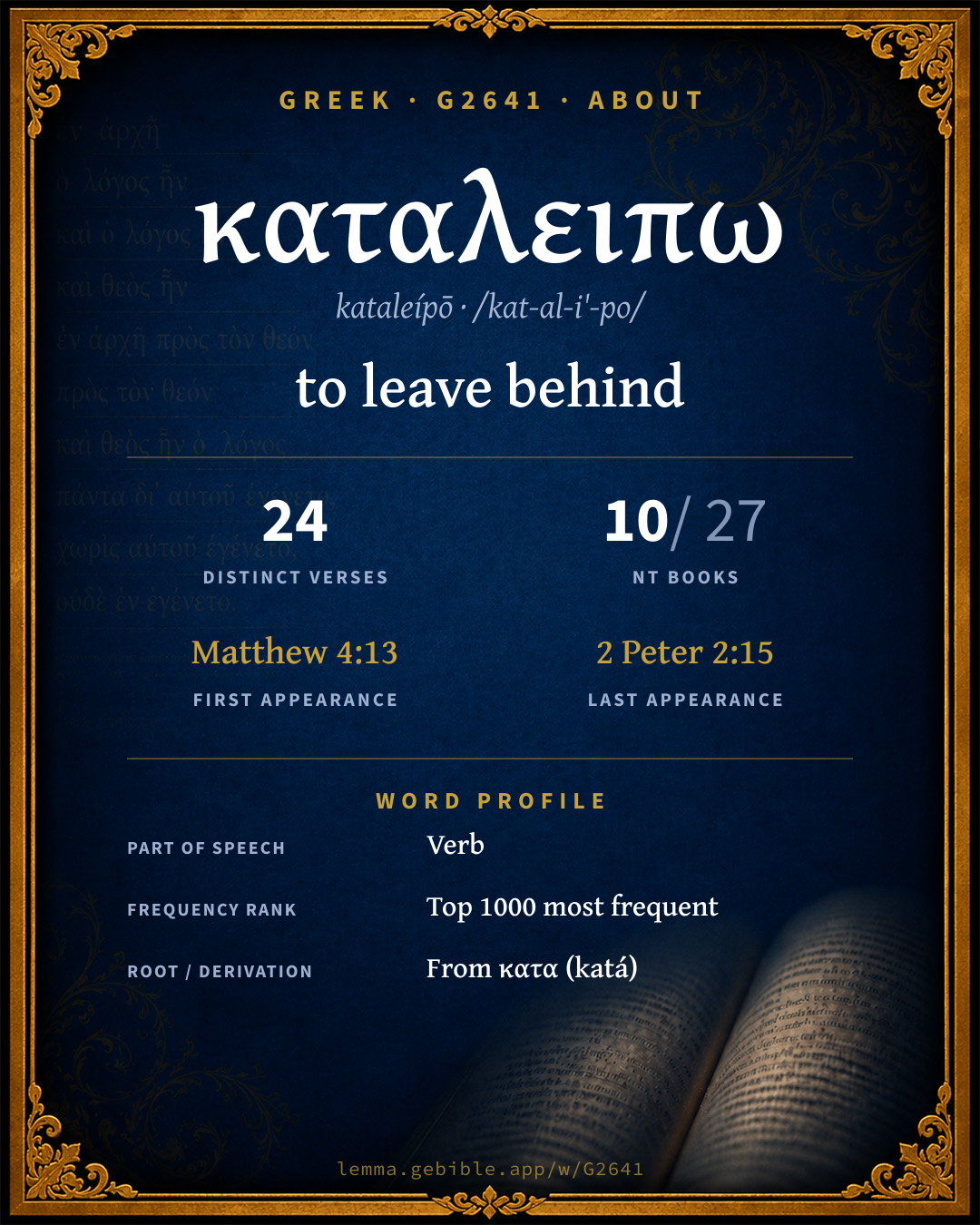
καταλείπω
to leave behind
‘to leave behind’ is one of 6 main senses fuller range ↓
Full lexicon entry — Thayer's Greek Lexicon
From Thayer's Greek Lexicon
Where this word appears
See every Aorist-tense verb in the Greek New Testament →
Grammar key — what these labels mean
Part of speech
- Verb
- An action or state-of-being word.
Tense
- Aorist
- Action viewed as a simple whole, without regard to duration — often past (perfective aspect).
- Future
- Action expected in future time.
- Present
- Ongoing or general action in present time (imperfective aspect).
- Perfect
- A completed past action with continuing present results.
Voice
- Active
- The subject performs the action.
- Passive
- The subject receives the action.
Mood
- Participle
- A verbal adjective (“writing,” “having written”).
- Indicative
- States a fact or asks a factual question (the mood of reality).
- Subjunctive
- Expresses probability, purpose, or possibility (the mood of contingency).
- Infinitive
- A verbal noun (“to write”), unmarked for person or number.
Case
- Nominative
- The case of the subject (and the predicate nominative).
- Accusative
- The case of the direct object and of extent.
- Genitive
- The case of source, possession, or “of” — answers “whose / from what.”
Person
- 3rd person
- The one spoken about (“he / she / it / they”).
- 1st person
- The speaker (“I / we”).
Gender
- Masculine
- Grammatically masculine.
- Feminine
- Grammatically feminine.
Number
- Singular
- One.
- Plural
- More than one.
Grammatical forms 14 distinct
- Verb, Aorist, Active, Participle, Nominative, Singular, Masculine 6 times (25%)
- Verb, Aorist, Active, Indicative, 3rd person, Singular 4 times (17%)
- Verb, Future, Active, Indicative, 3rd person, Singular 3 times (13%)
- Verb, Aorist, Active, Indicative, 1st person, Singular 1 time (4%)
- Verb, Aorist, Active, Indicative, 3rd person, Plural 1 time (4%)
- Verb, Aorist, Active, Participle, Nominative, Plural, Masculine 1 time (4%)
- Verb, Aorist, Active, Subjunctive, 3rd person, Singular 1 time (4%)
- Verb, Aorist, Active, Participle, Accusative, Plural, Masculine 1 time (4%)
+6 more forms (6 occurrences)
Parsed forms decoded from the imported morphology (Robinson–Tischendorf, public domain), counted across 24 parsed occurrences — not distinct verses.
Every verse where G2641 appears — 24 distinct verses across 10 books. Click any verse to open its interlinear word-by-word view. Verse text shown in the World English Bible for context — . Each verse’s Greek form is shown with its reference; the English is not keyword-highlighted, since the data carries no word-level English alignment. Use “Compare translations” on any verse to read it across multiple English versions. This concordance covers the Greek New Testament; Septuagint (Greek Old Testament) occurrences of this word are not indexed here.
Matthew 4 verses
- Matthew 4:13 καταλιπὼν aor act ptcp nom sg masc Leaving Nazareth, he came and lived in Capernaum, which is by the sea, in the region of Zebulun and Naphtali,
- Matthew 16:4 καταλιπὼν aor act ptcp nom sg masc An evil and adulterous generation seeks after a sign, and there will be no sign given to it, except the sign of the prophet Jonah." He left them, and departed.
- Matthew 19:5 καταλείψει fut act ind 3sg and said, 'For this cause a man shall leave his father and mother, and shall join to his wife; and the two shall become one flesh?'
- Matthew 21:17 καταλιπὼν aor act ptcp nom sg masc He left them, and went out of the city to Bethany, and lodged there.
Mark 4 verses
- Mark 10:7 καταλείψει fut act ind 3sg For this cause a man will leave his father and mother, and will join to his wife,
- Mark 12:19 καταλίπῃ aor act subj 3sg "Teacher, Moses wrote to us, 'If a man's brother dies, and leaves a wife behind him, and leaves no children, that his brother should take his wife, and raise up offspring for his brother.'
- Mark 12:21 καταλιπὼν aor act ptcp nom sg masc The second took her, and died, leaving no children behind him. The third likewise;
- Mark 14:52 καταλιπὼν aor act ptcp nom sg masc but he left the linen cloth, and fled from them naked.
Luke 4 verses
- Luke 5:28 καταλιπὼν aor act ptcp nom sg masc He left everything, and rose up and followed him.
- Luke 10:40 κατέλιπεν aor act ind 3sg But Martha was distracted with much serving, and she came up to him, and said, "Lord, don't you care that my sister left me to serve alone? Ask her therefore to help me."
- Luke 15:4 καταλείπει pres act ind 3sg "Which of you men, if you had one hundred sheep, and lost one of them, wouldn't leave the ninety-nine in the wilderness, and go after the one that was lost, until he found it?
- Luke 20:31 κατέλιπον aor act ind 3pl The third took her, and likewise the seven all left no children, and died.
John 1 verse
Acts 5 verses
- Acts 6:2 καταλείψαντας aor act ptcp acc pl masc The twelve summoned the multitude of the disciples and said, "It is not appropriate for us to forsake the word of God and serve tables.
- Acts 18:19 κατέλιπεν aor act ind 3sg He came to Ephesus, and he left them there; but he himself entered into the synagogue, and reasoned with the Jews.
- Acts 21:3 καταλιπόντες aor act ptcp nom pl masc When we had come in sight of Cyprus, leaving it on the left hand, we sailed to Syria, and landed at Tyre, for there the ship was to unload her cargo.
- Acts 24:27 κατέλιπε aor act ind 3sg But when two years were fulfilled, Felix was succeeded by Porcius Festus, and desiring to gain favor with the Jews, Felix left Paul in bonds.
- Acts 25:14 καταλελειμμένος perf pass ptcp nom sg masc As he stayed there many days, Festus laid Paul's case before the king, saying, "There is a certain man left a prisoner by Felix;
Romans 1 verse
Ephesians 1 verse
1 Thessalonians 1 verse
Hebrews 2 verses
- Hebrews 4:1 καταλειπομένης pres pass ptcp gen sg fem Let us fear therefore, lest perhaps a promise being left of entering into his rest, anyone of you should seem to have come short of it.
- Hebrews 11:27 κατέλιπεν aor act ind 3sg By faith, he left Egypt, not fearing the wrath of the king; for he endured, as seeing him who is invisible.
2 Peter 1 verse
About this entry
At a glance — auto-summarized from this page’s data, not written by a person. Every figure links to its source below. This summary describes the numbers; it doesn’t interpret them.
καταλειπω (kataleípō) is a Greek verb most often rendered “to leave behind.” Where the King James Version says “leave,” newer translations reach for “left” (Berean Standard Bible) and “having left” (unfoldingWord Literal Text); the renderings breakdown has the detail. The Greek New Testament uses it across 24 verses — uncommon. Debuting at Matthew 4:13, it then recurs through the corpus. Its lexical range runs to 6 senses. The sections below give every sense, occurrence, and version rendering.
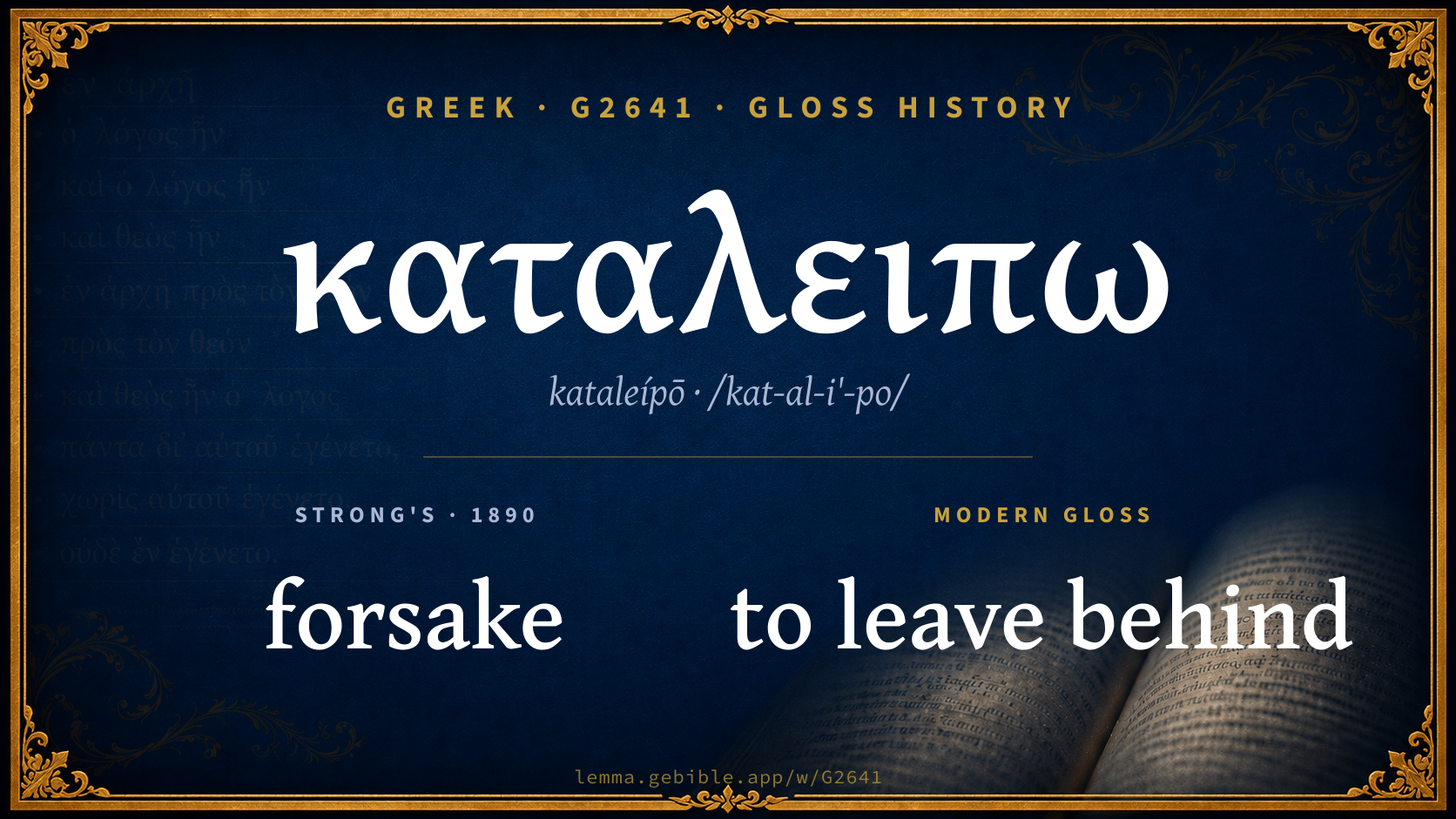
Gloss history
Strong's 1890 vs modern scholarship
About this word
Strong's G2641 catalogs a Greek word from the Greek New Testament.
These counts are not copied from any lexicon or concordance. They are computed here, from the morphology-tagged Greek New Testament. What Lemma adds →
- 24
- distinct verses
- The word appears in 24 distinct verses.
- 10 / 27
- NT books
- The word appears in 10 of 27 New Testament books.
- #548
- by frequency
- Top 1000 most frequent Greek words (rank 548 of 5,347 Greek words by occurrence).
View all 24 occurrences in the concordance →
By section of the New Testament
By traditional corpus
Conventional, traditional groupings — biblical authorship is debated, so this is a traditional corpus grouping, not an authorship claim. Some books belong to more than one corpus (Luke is in both the Gospels and the Lukan corpus, and so on), so these shares overlap and need not total 100%. Each figure is a share of the word’s 24 distinct verses.
- Gospels 13 verses · 54%
- Lukan (Luke–Acts) 9 verses · 38%
- Pauline corpus 3 verses · 13%
- Hebrews 2 verses · 8%
- Johannine 1 verse · 4%
- General (Catholic) Epistles 1 verse · 4%
How translations render this word
Counts come from each version’s own published word-to-Strong’s tagging or interlinear alignment — an approximate guide to how each version renders this word, not a word-level alignment the data otherwise carries. Because each total is that version’s own tagged count, the per-version totals vary from one another and need not match the appearance or distinct-verse counts above. These counts may also differ from a printed concordance because Lemma counts each distinctly tagged rendering and does not collapse phrase taggings into a single head-word total. This is a fixed set of word-tagged versions (KJV, ASV, BSB, ULT) and does not change with the reading translation you choose elsewhere. Each version’s license is shown beside its name below (and on Sources).
- King James Version: Leave 5×, He left 4×, Left 4×
- American Standard Version: Leave 5×, He left 4×, Left 4×
- Berean Standard Bible: Left 6×, Will leave 3×, He left 2×
- unfoldingWord Literal Text: Having left 6×, Behind 3×, Will leave 3×
King James Version Public Domain
Renders G2641 across 29 tagged occurrences — most commonly:
Plus 14 renderings that appear only once — usually multi-word phrases or single function words the recovered tagging swept in, not distinct renderings.
American Standard Version Public Domain
Renders G2641 across 32 tagged occurrences — most commonly:
Plus 12 renderings that appear only once — usually multi-word phrases or single function words the recovered tagging swept in, not distinct renderings.
Berean Standard Bible Public Domain
Renders G2641 across 24 tagged occurrences — most commonly:
Plus 11 renderings that appear only once — usually multi-word phrases or single function words the recovered tagging swept in, not distinct renderings.
unfoldingWord Literal Text CC BY-SA 4.0
Renders G2641 across 28 tagged occurrences — most commonly:
Plus 12 renderings that appear only once — usually multi-word phrases or single function words the recovered tagging swept in, not distinct renderings.
Senses in Thayer's
The 6 senses Thayer's distinguishes for this word, in lexicon order (not ranked by frequency or importance). The full entry — with sub-senses — is in the Lexicon Entry tab.
- to depart from, leave
- to bid (one) to remain
- to forsake, leave to one's self a person or thing by ceasing to care for it, to abandon, leave in the lurch
- to cause to be left over, to reserve, to leave remaining
- like our "leave behind", it is used of one who on being called away cannot take another with him
- like our "leave", leave alone, disregard
Word origin
Derived from κατα (katá) (G2596) — down.
Forms in the corpus
The 14 distinct written forms G2641 takes in the Greek New Testament, most frequent first — each parse links to that tense’s occurrences in the concordance.
Same root — word family
Other Thayer's entries built from the same root as G2641, grouped by Strong’s listed origin. These share a root / origin per the lexicon — not necessarily a shared meaning. Each links to that word’s own entry.
Derives from
Shares the same root
- καθα kathá G2505 according as
- καθαιρεω kathairéō G2507 to tear down
- καθαπτω katháptō G2510 to fasten down
- καθεδρα kathédra G2515 seat
- καθεζομαι kathézomai G2516 to sit down
- καθεξης kathexēs G2517 in order
- καθευδω katheúdō G2518 to fall asleep
- καθηγητης kathēgētḗs G2519 guide
- καθηκω kathḗkō G2520 to come down
- καθημαι káthēmai G2521 to sit down
- καθημερινος kathēmerinós G2522 daily
- καθιημι kathíēmi G2524 to send down
- καθιστημι kathístēmi G2525 to place
- καθο kathó G2526 according to what
- καθολου kathólou G2527 wholly
- καθοπλιζω kathoplízō G2528 to arm
- καθοραω kathoráō G2529 to see clearly
- καθοτι kathóti G2530 according to what
- καθως kathṓs G2531 according as
- καμμυω kammýō G2576 to close eyes
- καταβαινω katabaínō G2597 to descend
- καταβαλλω katabállō G2598 to cast down
- καταβαρεω katabaréō G2599 to weigh down
- καταβιβαζω katabibázō G2601 to bring down
+103 more words share this root (not shown).
Derived from this word
Compare all same-root words → Showing 4 of 130 — not the complete family. They share a root, not necessarily a meaning.
Septuagint usage
The same Greek word καταλειπω appears 371 times in the Greek Old Testament (Septuagint), across 350 verses in 27 books.
- 371
- LXX occurrences
- Tagged occurrences of this Greek word in the Septuagint.
- 350
- verses
- Distinct Septuagint verses containing this word.
- 27 / 39
- OT books
- The word appears in 27 of the 39 Old Testament books.
Sample Septuagint occurrences
- Genesis 2:24 καταλείπω
- Exodus 2:20 καταλείπω
- Leviticus 2:10 καταλείπω
- Numbers 9:12 καταλείπω
- Deuteronomy 2:34 καταλείπω
- Joshua 1:5 καταλείπω
- Judges 2:12 καταλείπω
- Ruth 1:3 καταλείπω
- 1 Samuel 2:11 καταλείπω
- 2 Samuel 13:30 καταλείπω
- 1 Kings 8:57 καταλείπω
- 2 Kings 2:2 καταλείπω
Septuagint occurrences (same lexeme)
Every verse where the same Strong’s number (G2641) appears in the Greek Septuagint — showing the first 50 of 350. Verse text shown in the World English Bible for context; the Greek form is the matched word — the English is not keyword-highlighted.
- Genesis 2:24 καταλείπω Therefore a man will leave his father and his mother, and will join with his wife, and they will be one flesh.
- Genesis 7:23 καταλείπω Every living thing was destroyed that was on the surface of the ground, including man, cattle, creeping things, and birds of the sky. They were destroyed from the earth. Only Noah was left, and those who were with him in the ark.
- Genesis 14:10 καταλείπω Now the valley of Siddim was full of tar pits; and the kings of Sodom and Gomorrah fled, and they fell there, and those who remained fled to the mountain.
- Genesis 24:27 καταλείπω He said, "Blessed be Yahweh, the God of my master Abraham, who has not forsaken his loving kindness and his truth toward my master. As for me, Yahweh has led me in the way to the house of my master's relatives."
- Genesis 28:15 καταλείπω Behold, I am with you, and will keep you, wherever you go, and will bring you again into this land. For I will not leave you, until I have done that which I have spoken of to you."
- Genesis 33:15 καταλείπω Esau said, "Let me now leave with you some of the folk who are with me." He said, "Why? Let me find favor in the sight of my lord."
- Genesis 39:12 καταλείπω She caught him by his garment, saying, "Lie with me!" He left his garment in her hand, and ran outside.
- Genesis 39:13 καταλείπω It happened, when she saw that he had left his garment in her hand, and had run outside,
- Genesis 39:15 καταλείπω It happened, when he heard that I lifted up my voice and cried, that he left his garment by me, and ran outside."
- Genesis 39:18 καταλείπω and it happened, as I lifted up my voice and cried, that he left his garment by me, and ran outside."
- Genesis 42:38 καταλείπω He said, "My son shall not go down with you; for his brother is dead, and he only is left. If harm happens to him by the way in which you go, then you will bring down my gray hairs with sorrow to Sheol."
- Genesis 44:22 καταλείπω We said to my lord, 'The boy can't leave his father: for if he should leave his father, his father would die.'
- Exodus 2:20 καταλείπω He said to his daughters, "Where is he? Why is it that you have left the man? Call him, that he may eat bread."
- Exodus 8:27 καταλείπω We will go three days' journey into the wilderness, and sacrifice to Yahweh our God, as he shall command us."
- Exodus 10:5 καταλείπω and they shall cover the surface of the earth, so that one won't be able to see the earth. They shall eat the residue of that which has escaped, which remains to you from the hail, and shall eat every tree which grows for you out of the field.
- Exodus 12:10 καταλείπω You shall let nothing of it remain until the morning; but that which remains of it until the morning you shall burn with fire.
- Exodus 14:28 καταλείπω The waters returned, and covered the chariots and the horsemen, even all Pharaoh's army that went in after them into the sea. There remained not so much as one of them.
- Exodus 16:19 καταλείπω Moses said to them, "Let no one leave of it until the morning."
- Exodus 16:20 καταλείπω Notwithstanding they didn't listen to Moses, but some of them left of it until the morning, and it bred worms, and became foul: and Moses was angry with them.
- Exodus 16:23 καταλείπω He said to them, "This is that which Yahweh has spoken, 'Tomorrow is a solemn rest, a holy Sabbath to Yahweh. Bake that which you want to bake, and boil that which you want to boil; and all that remains over lay up for yourselves to be kept until the morning."
- Exodus 16:24 καταλείπω They laid it up until the morning, as Moses asked, and it didn't become foul, neither was there any worm in it.
- Exodus 29:34 καταλείπω If anything of the flesh of the consecration, or of the bread, remains to the morning, then you shall burn the remainder with fire: it shall not be eaten, because it is holy.
- Exodus 36:7 καταλείπω For the stuff they had was sufficient for all the work to make it, and too much.
- Exodus 39:12 καταλείπω and the third row, a jacinth, an agate, and an amethyst;
- Leviticus 2:10 καταλείπω That which is left of the meal offering shall be Aaron's and his sons'. It is a thing most holy of the offerings of Yahweh made by fire.
- Leviticus 5:13 καταλείπω The priest shall make atonement for him concerning his sin that he has sinned in any of these things, and he will be forgiven; and the rest shall be the priest's, as the meal offering.'"
- Leviticus 6:9 καταλείπω "Command Aaron and his sons, saying, 'This is the law of the burnt offering: the burnt offering shall be on the hearth on the altar all night until the morning; and the fire of the altar shall be kept burning on it.
- Leviticus 7:15 καταλείπω The flesh of the sacrifice of his peace offerings for thanksgiving shall be eaten on the day of his offering. He shall not leave any of it until the morning.
- Leviticus 7:17 καταλείπω but what remains of the flesh of the sacrifice on the third day shall be burned with fire.
- Leviticus 8:32 καταλείπω What remains of the flesh and of the bread you shall burn with fire.
- Leviticus 10:6 καταλείπω Moses said to Aaron, and to Eleazar and to Ithamar, his sons, "Don't let the hair of your heads go loose, neither tear your clothes; that you don't die, and that he not be angry with all the congregation: but let your brothers, the whole house of Israel, bewail the burning which Yahweh has kindled.
- Leviticus 10:12 καταλείπω Moses spoke to Aaron, and to Eleazar and to Ithamar, his sons who were left, "Take the meal offering that remains of the offerings of Yahweh made by fire, and eat it without yeast beside the altar; for it is most holy;
- Leviticus 10:16 καταλείπω Moses diligently inquired about the goat of the sin offering, and, behold, it was burned: and he was angry with Eleazar and with Ithamar, the sons of Aaron who were left, saying,
- Leviticus 14:17 καταλείπω The priest shall put some of the rest of the oil that is in his hand on the tip of the right ear of him who is to be cleansed, and on the thumb of his right hand, and on the big toe of his right foot, upon the blood of the trespass offering.
- Leviticus 14:18 καταλείπω The rest of the oil that is in the priest's hand he shall put on the head of him who is to be cleansed, and the priest shall make atonement for him before Yahweh.
- Leviticus 14:29 καταλείπω The rest of the oil that is in the priest's hand he shall put on the head of him who is to be cleansed, to make atonement for him before Yahweh.
- Leviticus 19:6 καταλείπω It shall be eaten the same day you offer it, and on the next day: and if anything remains until the third day, it shall be burned with fire.
- Leviticus 19:10 καταλείπω You shall not glean your vineyard, neither shall you gather the fallen grapes of your vineyard; you shall leave them for the poor and for the foreigner. I am Yahweh your God.
- Leviticus 25:52 καταλείπω If there remain but a few years to the year of jubilee, then he shall reckon with him; according to his years of service he shall give back the price of his redemption.
- Leviticus 26:36 καταλείπω "'As for those of you who are left, I will send a faintness into their hearts in the lands of their enemies: and the sound of a driven leaf will put them to flight; and they shall flee, as one flees from the sword; and they will fall when no one pursues.
- Leviticus 26:39 καταλείπω Those of you who are left will pine away in their iniquity in your enemies' lands; and also in the iniquities of their fathers shall they pine away with them.
- Leviticus 26:43 καταλείπω The land also will be left by them, and will enjoy its sabbaths while it lies desolate without them: and they will accept the punishment of their iniquity; because, even because they rejected my ordinances, and their soul abhorred my statutes.
- Numbers 9:12 καταλείπω They shall leave none of it until the morning, nor break a bone of it. According to all the statute of the Passover they shall keep it.
- Numbers 10:31 καταλείπω He said, Don't leave us, please; because you know how we are to encamp in the wilderness, and you shall be to us instead of eyes.
- Numbers 11:26 καταλείπω But there remained two men in the camp, the name of the one was Eldad, and the name of the other Medad: and the Spirit rested on them; and they were of those who were written, but had not gone out to the Tent; and they prophesied in the camp.
- Numbers 21:35 καταλείπω So they struck him, and his sons and all his people, until there was none left him remaining: and they possessed his land.
- Numbers 26:65 καταλείπω For Yahweh had said of them, They shall surely die in the wilderness. There was not left a man of them, save Caleb the son of Jephunneh, and Joshua the son of Nun.
- Numbers 32:15 καταλείπω For if you turn away from after him, he will yet again leave them in the wilderness; and you will destroy all this people.
- Numbers 33:55 καταλείπω But if you will not drive out the inhabitants of the land from before you, then shall those who you let remain of them be as pricks in your eyes, and as thorns in your sides, and they shall vex you in the land in which you dwell.
- Deuteronomy 2:34 καταλείπω We took all his cities at that time, and utterly destroyed every inhabited city, with the women and the little ones; we left none remaining:
These are occurrences of the same Greek lexeme (G2641) in the Septuagint — not a translation of any one Hebrew word. The store carries no word-level Hebrew↔Greek alignment, so no Hebrew original is asserted here. Counts come from the recovered LXX Strong's tagging — high-frequency vocabulary is well covered, while rare or late forms may be untagged — so they reflect tagged occurrences and may slightly undercount.